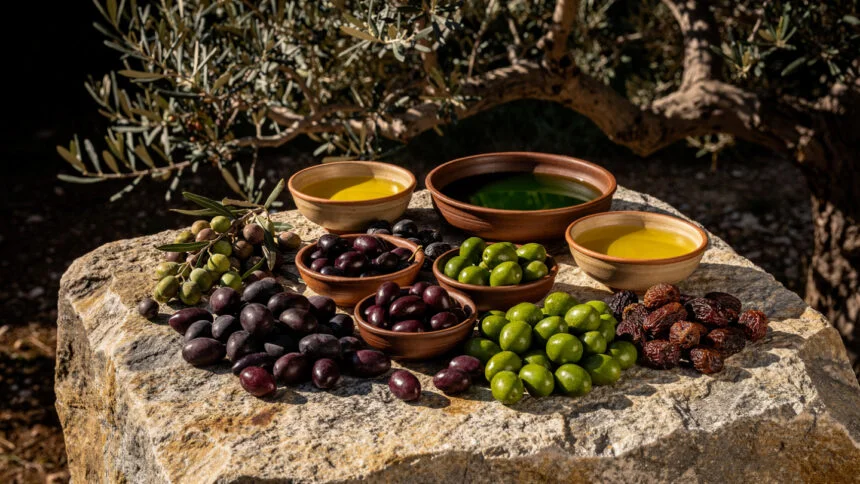



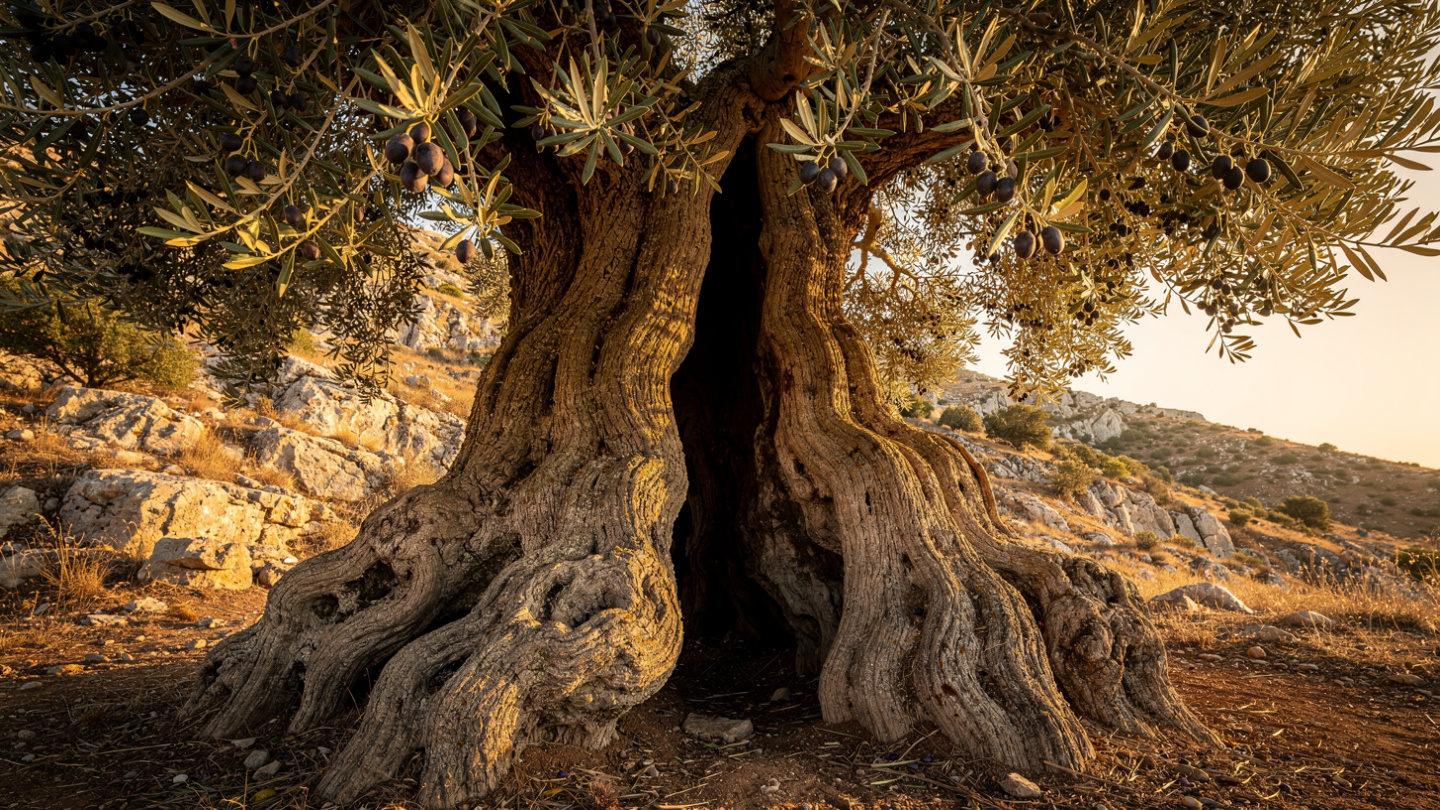
There is a tree in the village of Vouves in the Chania region of Crete that was alive when the Parthenon was being built and is alive now.
Its trunk circumference is 12.5 metres. Its heartwood has long since hollowed, but the living bark and the living cambium layer beneath it continue to produce fruit every autumn from the domesticated Koroneiki branches that were grafted onto the ancient wild rootstock at some point in the centuries between the Bronze Age and the classical period. The oil pressed from those olives carries a direct biochemical lineage to the agricultural tradition that fed Minoan palace administrators and sustained Byzantine monastic communities across the fifteen-hundred-year gap between those two civilisations.
The carbon dating of ancient olive trees is complicated by the biology of the heartwood decay that makes the oldest surviving wood in the tree the outer rings rather than the inner ones, which means the available dating methods give ranges rather than precise ages. The Vouves tree’s estimated age ranges from 2,000 to 4,000 years, whose lower bound places its planting in the Roman period and whose upper bound places it in the Late Bronze Age. The tree itself is not telling which estimate is correct. It is still producing olives.

The quality of the Vouves tree that distinguishes it from the other monumental olive trees of Crete and the mainland is not simply its size or its estimated age but the continuity it represents between the ancient wild olive, the agrielaion, and the domesticated olive, the hemeraios, that the grafting tradition had been developing from the Neolithic period onward: the wild rootstock’s drought resistance and longevity combined with the domesticated variety’s fruit yield and oil quality in the same living organism. The person who grafted the Koroneiki branches onto the Vouves tree’s wild rootstock was performing the agricultural act whose accumulated practice across three thousand years of Aegean olive cultivation gave the Greek world the product that the Linear B tablets recorded as the foundation of the Bronze Age palatial economy.
What the Linear B Tablets Recorded
The earliest written records of olive oil production in the European world are not the classical literary texts that the popular conception of ancient Greece organizes itself around. They are the administrative clay tablets from the Bronze Age palatial centres of Knossos on Crete and Pylos and Mycenae on the mainland, whose content was the content of the palace bureaucracy’s management of the agricultural economy that the palace administration controlled.
The Linear B script, whose decipherment by Michael Ventris in 1952 was the intellectual achievement whose consequence was the discovery that the Mycenaean palatial administration had been conducted in an early form of Greek approximately three centuries before Homer, recorded olive oil as the commodity whose production and distribution and ritual use the tablets tracked most consistently. The ideogram OLE and the syllabic spelling e-ra-wa appear on tablets from multiple palatial sites in the contexts of the harvest record, the storage allocation, and the ritual distribution whose management was the management of the palatial economy’s most valuable product.
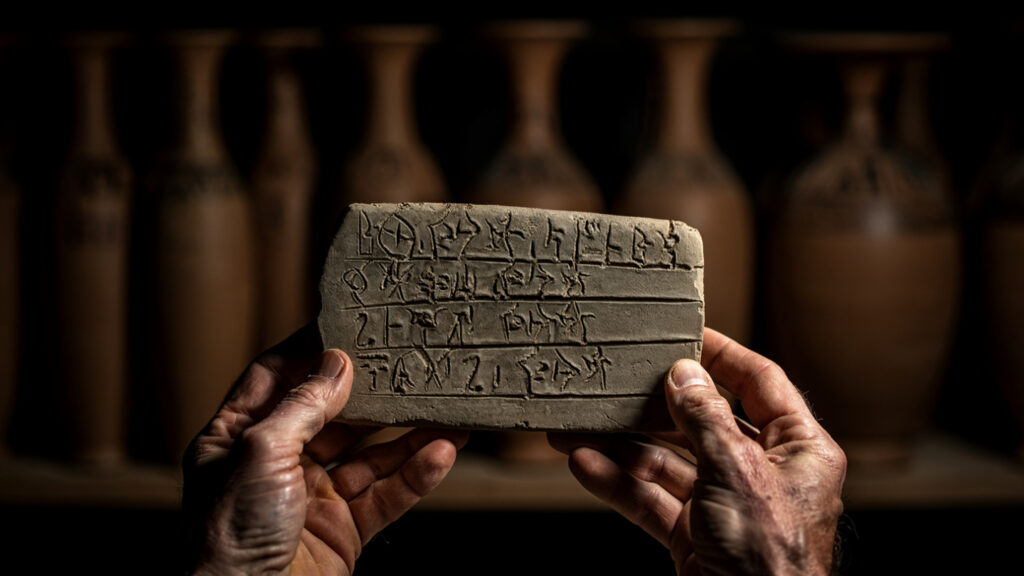
The tablets reveal that the palatial olive oil economy was organized at a level of industrial sophistication that the standard conception of the Bronze Age agricultural world does not fully anticipate: the palaces controlled networks of specialized workshops where raw olive oil was combined with botanical ingredients in proportions to produce the luxury perfumed oils whose formulations the tablets recorded. Coriander, sage, rose roots, and other aromatics were combined with the base olive oil in the proportions that the palace workshops maintained as the production standard for the grades of perfumed oil whose international trade was the commercial activity that funded the construction of the tholos tombs and the cyclopean walls and the other monumental architectural projects that the Mycenaean palatial period produced.
These perfumed oils were sealed in the distinctive stirrup jars whose ceramic form was the container designed for the airtight storage of the valuable liquid: the stirrup jar’s narrow neck and the clay stopper whose application sealed the contents against air and contamination were the packaging technology whose development the palatial perfumed oil trade required. The stirrup jars from Mycenaean Greece have been found in Egypt, in the Levant, in Cyprus, and in the western Mediterranean, whose distribution pattern was the archaeological evidence for the international trade network whose commercial medium was the Mycenaean perfumed olive oil.
The tablets also record the allocation of olive oil for religious offerings, sent to shrines to honor deities. The Lady of the Labyrinth, the Minoan-period deity whose identity and relationship to the later Greek Athena the scholarship continues to develop, receives olive oil allocations in the Knossos tablets whose religious context connected the divine and the agricultural in exactly the form that the later classical tradition would institutionalize through the Athena-olive myth.
The Contest and Its Consequence
The mythological account of Athena’s gift of the first cultivated olive tree to Athens, whose theological content the sacred trees article in this collection develops at length, encoded in mythological form the economic and political reality that the Linear B tablets documented in administrative form: the olive tree was not simply an agricultural product among the other agricultural products of the Aegean world. It was the product whose combination of the food value and the oil value and the timber value and the medicinal value and the international trade value gave it the character of the agricultural foundation whose presence or absence determined the economic capacity of the community that possessed it.

The contest between Poseidon and Athena for the patronage of Athens, in which Poseidon’s saltwater spring offered the maritime power and Athena’s olive tree offered the sustainable agricultural foundation, was the mythological encoding of the historical choice whose consequences the subsequent development of the Athenian civilization expressed: the city that organized its economy around the olive tree’s products rather than around the maritime raiding and tribute extraction whose Poseidon tradition represented was the city that developed the economic stability whose foundation was the long-term investment in the cultivated olive grove.
The olive tree requires twenty years to reach full production from planting and lives for millennia: the agricultural investment whose time horizon was the time horizon of the generation rather than the season was the investment that the civilization organized around the long-term rather than the short-term was most willing to make. The Athenian choice of Athena’s gift over Poseidon’s spring was the mythological encoding of the cultural orientation toward the long-term agricultural investment whose expression in the Attic landscape was the density of the olive groves that ancient sources consistently identified as the characteristic feature of the Athenian agricultural landscape.
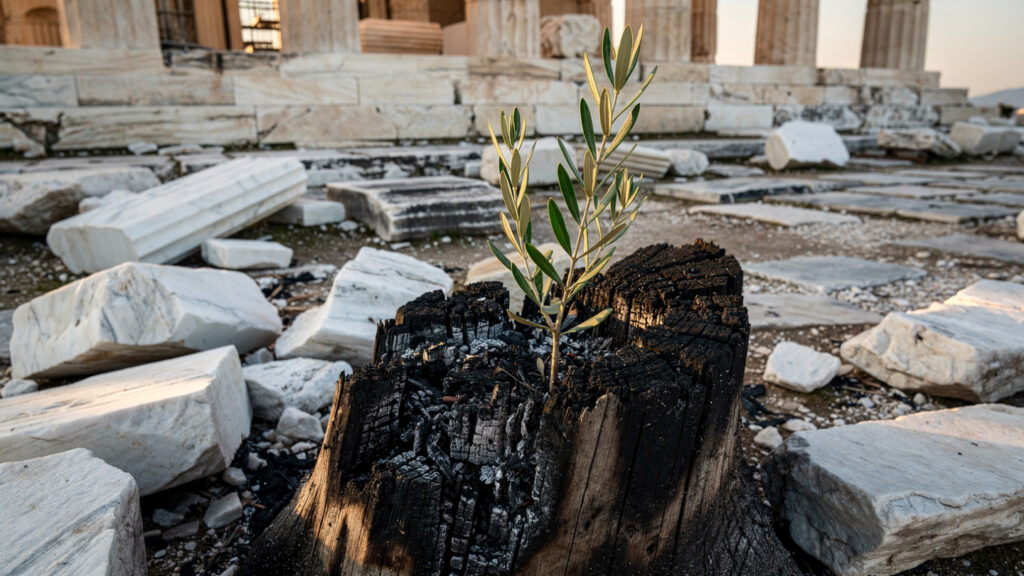
Herodotus recorded that when the Persian army burned the Acropolis in 480 BCE, the sacred olive tree on the Acropolis sprouted a new shoot of approximately two cubits’ length the very next day: the mythological resilience of the divine gift encoded in this report was the biological resilience of the ancient olive tree whose capacity for regeneration from the root system even after the complete destruction of the above-ground structure was the biological fact that the ancient tradition had observed and had encoded in the divine gift narrative.
The Moriai and the Sacred Grove of Athens
The institutional expression of the olive tree’s sacred status in the Athenian civic tradition was the institution of the Moriai: the sacred olive trees of Attica whose legal protection under Athenian law gave them the status of the protected civic institution rather than the private agricultural property.
The Moriai were understood to be the direct descendants of Athena’s original olive tree on the Acropolis: the genealogical connection between the divine gift tree and the trees scattered across the Attic landscape in the groves at the Academy and at other locations gave those trees the sacred status that the divine origin conferred. They were the living extensions of the divine gift into the agricultural landscape, the material connection between the mythological event of the contest and the contemporary reality of the olive groves that the Attic farmers maintained.
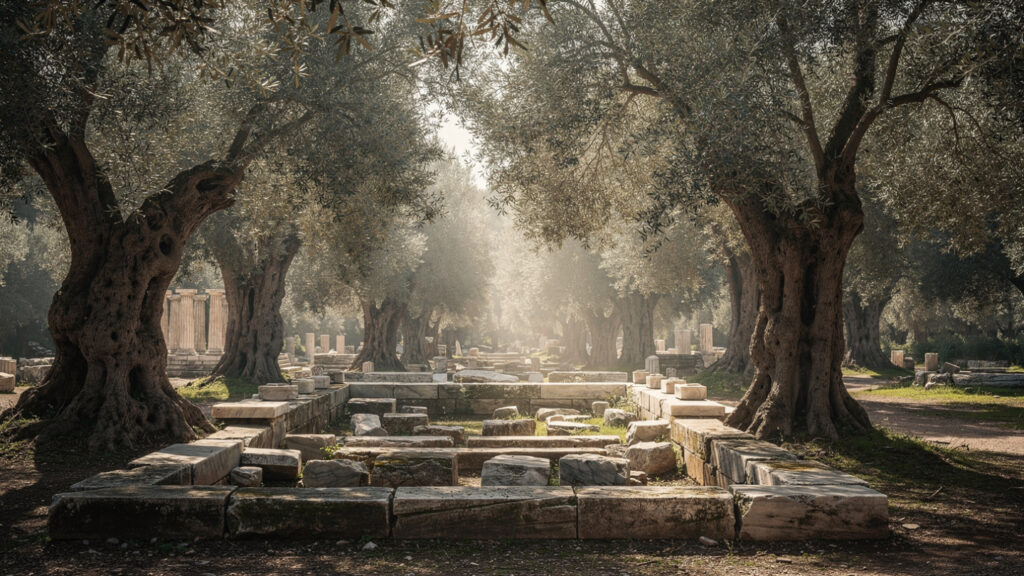
The legal protection was enforced through the mechanism of the monthly inspection by state-appointed officials whose responsibility was the verification that no tree had been damaged or removed: the farmer who damaged a Morion tree was subject to the legal process that ended in exile or death, which was the severity that the tree’s sacred status required. The Athenian state treated the destruction of a sacred olive tree as the same category of offense as the destruction of a temple or the desecration of a sanctuary.
Plato’s Academy was established in the grove of the Akademos whose sacred olive trees were the Moriai: the philosophical school founded in 387 BCE operated in the landscape of the sacred olive grove whose trees’ millennial age gave the philosophical activity conducted beneath them the quality of the thought pursued in the permanent and the ancient rather than the temporary and the contemporary. The silver-leaved trees that shaded the conversations whose content became the foundational texts of Western philosophy were the trees whose destruction was a capital offence under Athenian law, whose age exceeded any individual human life, and whose presence in the landscape was the material expression of the divine gift whose mythological encoding connected the philosophical activity to the civic and theological tradition that the grove preserved.
The Panathenaic Prize Oil
The institutional connection between the sacred olive tradition and the athletic tradition of the ancient Greek world was the connection whose expression was the Panathenaic prize amphorae: the ceramic vessels filled with the highest grade olive oil pressed from the Moriai groves that the Athenian state gave as the prizes in the Panathenaic Games.
The Panathenaic Games were held every four years as part of the Great Panathenaia festival in honor of Athena whose patronage of Athens the olive myth encoded, and whose prize structure was the prize structure whose content was the product of the divine gift: the victorious athlete received not silver or gold but the oil from the sacred trees whose divine origin the prize acknowledged.
The quantities were substantial enough to constitute serious wealth: an equestrian victor might receive one hundred amphorae containing approximately four thousand liters of premium oil whose international market value was the value that made the Panathenaic prize a liquid asset rather than a symbolic token. The athletes who won Panathenaic prizes at the Great Panathenaia were winning a commodity whose sale in the Mediterranean markets could fund the training and travel expenses whose management a successful athletic career required.
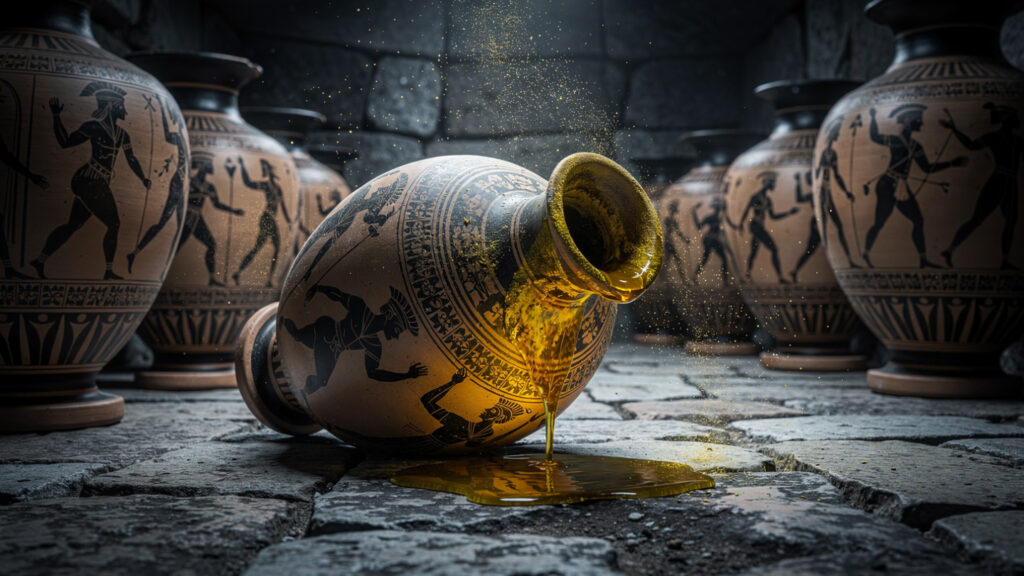
The Panathenaic amphorae were standardized ceramic vessels whose iconographic program was the program that identified their contents and their origin: one side depicted Athena in the martial posture of the warrior goddess whose gift the oil celebrated, and the other side depicted the athletic event whose victory had earned the amphorae. These vessels, produced to a standard for over three centuries of the Panathenaic Games’ operation, survive in museums across the world as the material record of the institutional connection between the olive tree’s divine origin and the athletic tradition’s civic celebration.
The practice of the athletes’ anointing with olive oil before competition was the ritual whose aesthetic and practical dimensions the ancient tradition documented with the technical vocabulary that distinguished the oil’s different functions: the pre-competition anointing that highlighted the musculature and protected the skin from the sun, the application before the wrestling whose coating of dust on the oiled skin gave the grip conditions that the wrestling tradition required, and the post-competition scraping with the strigil that removed the accumulated oil and dust and sweat from the body whose hygiene function was the cleaning method that preceded the washing with water.
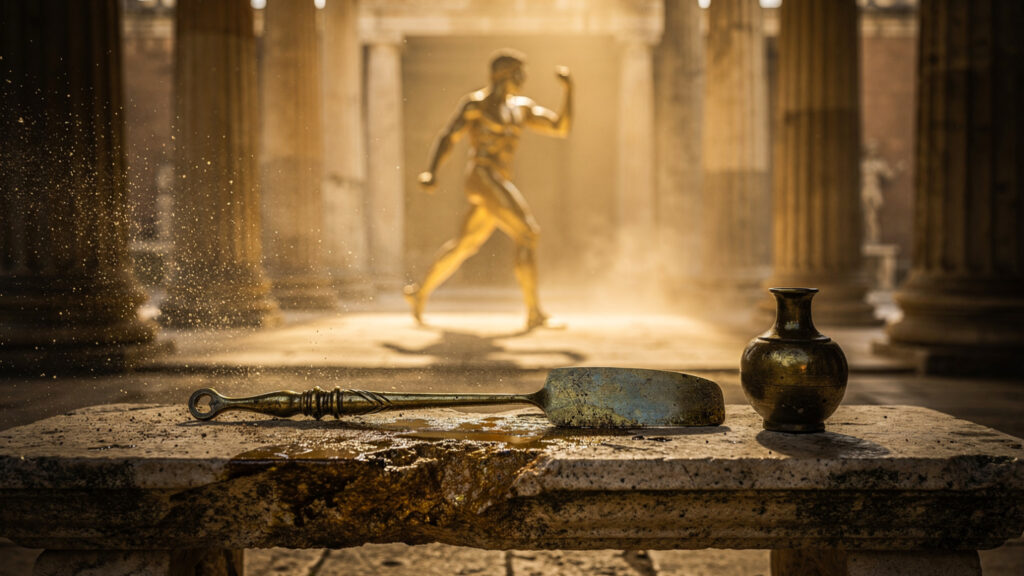
The glistening body of the olive-oiled athlete was the aesthetic expression of the concept of kalokagathia, the beautiful and the good combined in the form of the physically perfect human body whose perfection was the expression of the moral and the intellectual excellence whose cultivation was the purpose of the paideia, the Greek educational tradition. The olive oil that covered the athlete’s body was the olive oil from the sacred trees whose divine origin the contest myth had encoded, and the glistening perfection of the athletic body covered in that oil was the aesthetic expression of the theological claim that the divine gift had made possible.
The Ancient Press and Its Engineering
The transformation of the olive fruit into oil required the technology whose development across the Bronze Age and the classical period expressed the engineering intelligence whose application to the agricultural problem gave the Greek world its most important industrial infrastructure.
The earliest extraction method, documented archaeologically at Minoan sites including the palace at Zakros on eastern Crete, involved crushing the olives in stone troughs using heavy stone rollers or with flat stone pressing surfaces: the crushing technology whose function was the function of breaking the olive cells to release the oil they contained. The crushed pulp was then pressed through the application of the additional mechanical force whose development from the hand-pressing of the basketed pulp to the lever-and-weight press represented the technological evolution that the palatial economy’s demand for the large-scale oil production required.
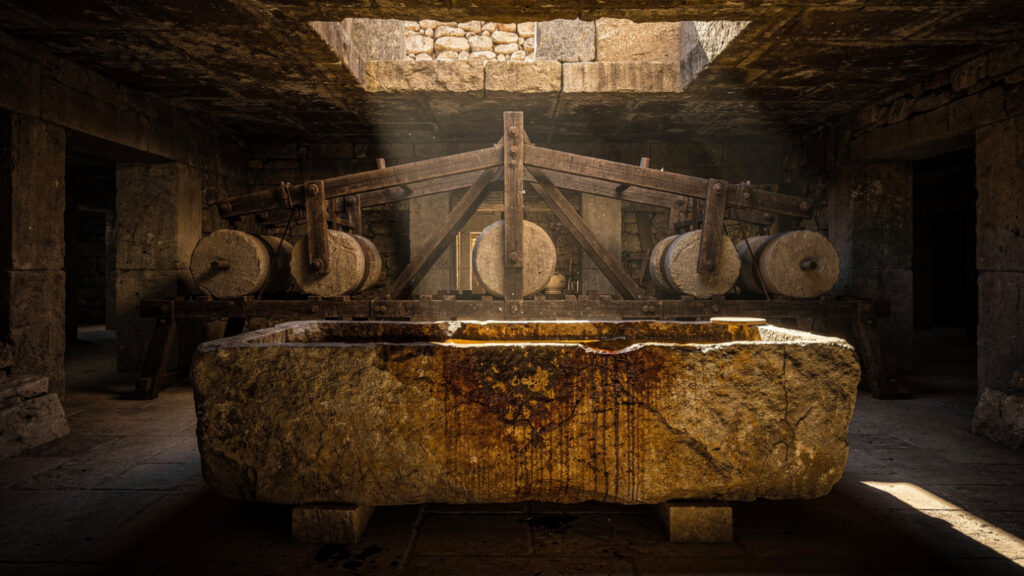
The lever-and-weight press used the mechanical principle of the lever to amplify the pressing force available from the human operation of the press: the massive wooden beam, typically made from a single large timber, was anchored at one end in the stone wall of the press room and was loaded with the stone weights at the other end while the pressing basket containing the crushed olive pulp occupied the fulcrum position. The amplification of the pressing force that the lever provided allowed the extraction of a significantly higher proportion of the available oil from the pressed pulp than the hand-pressing method had achieved.
The pressed liquid draining into the stone settling vats demonstrated the application of the physical principle of density separation: the olive oil, being less dense than the water content of the pressed fruit, rose to the surface of the settling vat while the aqueous phase settled below, allowing the skimming operation to separate the pure oil from the water in a process whose physics was the same physics that the modern centrifugal olive mills apply through the mechanical acceleration of the same density difference.
The ancient press rooms, whose stone remains survive at dozens of sites across the Greek mainland and the islands, were the industrial infrastructure whose operation was the operation of the most economically significant processing technology in the ancient Mediterranean world. The systematic nature of the archaeological evidence, the standardized stone trough dimensions, the positioning of the anchor holes for the lever beams, and the arrangement of the settling vats, reflects the accumulation of the engineering knowledge across the generations of the press operators whose practical refinement of the technology produced the standardization that the archaeological record documents.
The Tree That Survived
The Vouves olive tree produces fruit every autumn. The olives from the branches that were grafted onto the wild rootstock whose age the dendrochronological estimates place in the range of the Bronze Age and the archaic period are harvested by the same method that the Minoan farmers used and that every subsequent generation of the Cretan olive farmers has used: the combination of the hand-picking and the raking whose care for the fruit’s integrity is the care that the production of the highest grade oil requires.
The continuity between the ancient wild olive rootstock and the contemporary domesticated Koroneiki branches in the Vouves tree is the continuity that the entire Greek olive tradition represents in its most concentrated available form: the rootstock that survived the Minoan collapse and the Bronze Age collapse and the Greek Dark Ages and the Persian Wars and the Peloponnesian War and the Macedonian conquest and the Roman period and the Byzantine period and the Ottoman period and the Greek War of Independence is the rootstock that is still connected to the contemporary agricultural and cultural tradition through the graft whose union was performed by hands whose names no record preserves.
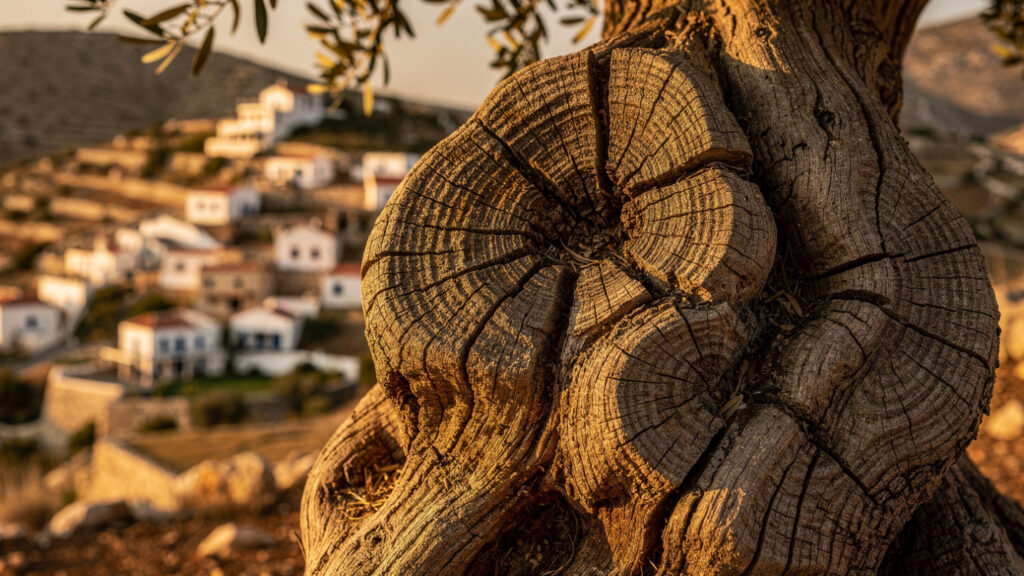
The ancient olive trees of Crete and the Attic plain and the Peloponnese and the Aegean islands are the living archive whose content is the content of the three thousand years of the Greek agricultural tradition whose development from the Minoan palatial economy to the Byzantine monastic economy to the contemporary cooperative production is the development that the trees themselves have witnessed from the location in the landscape where they were planted or where they self-seeded in the moment of the Bronze Age or the Archaic period or the Classical period whose determination the biology of the heartwood decay makes permanently uncertain.
They are not documents. They are the living organisms whose continued existence is the continued existence of the agricultural tradition that the divine gift myth encoded and the Linear B tablets recorded and the Panathenaic prize system institutionalized and the Moriai legal protection maintained and the strigil-scraped athlete’s body displayed and the philosophical conversations beneath the Academy grove’s shaded branches accompanied.
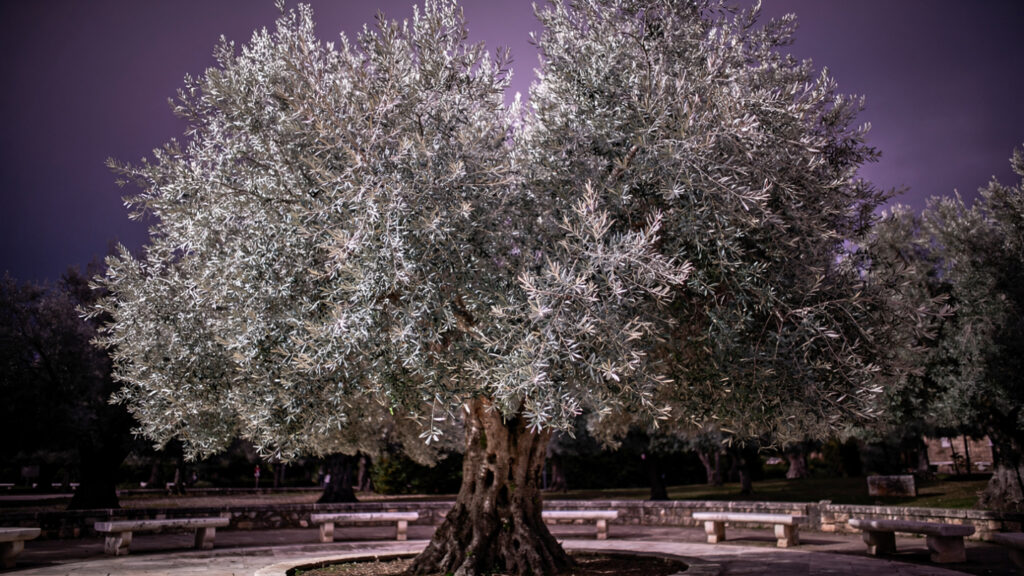
The oldest trees predate the institutions that gave the olive tree its theological and economic and aesthetic significance. The institutions are gone. The trees are still producing olives.
At Olympus Estate, Cultural Chronicles traces the practices and institutions that defined Greek civilization from the inside. The Linear B tablets from the Bronze Age palaces of Knossos and Mycenae recorded olive oil as the foundation of the palatial economy. The Moriai sacred olive trees of Attica were protected by the Athenian law that made their destruction a capital offense. The Panathenaic prize was four thousand liters of oil from the sacred groves. The strigil scraped the sacred oil from the glistening body of the victorious athlete. Plato’s Academy was in the grove of the Moriai. The Vouves tree has a circumference of 12.5 metres and is still producing olives. The institutions are gone. The trees are still here.