





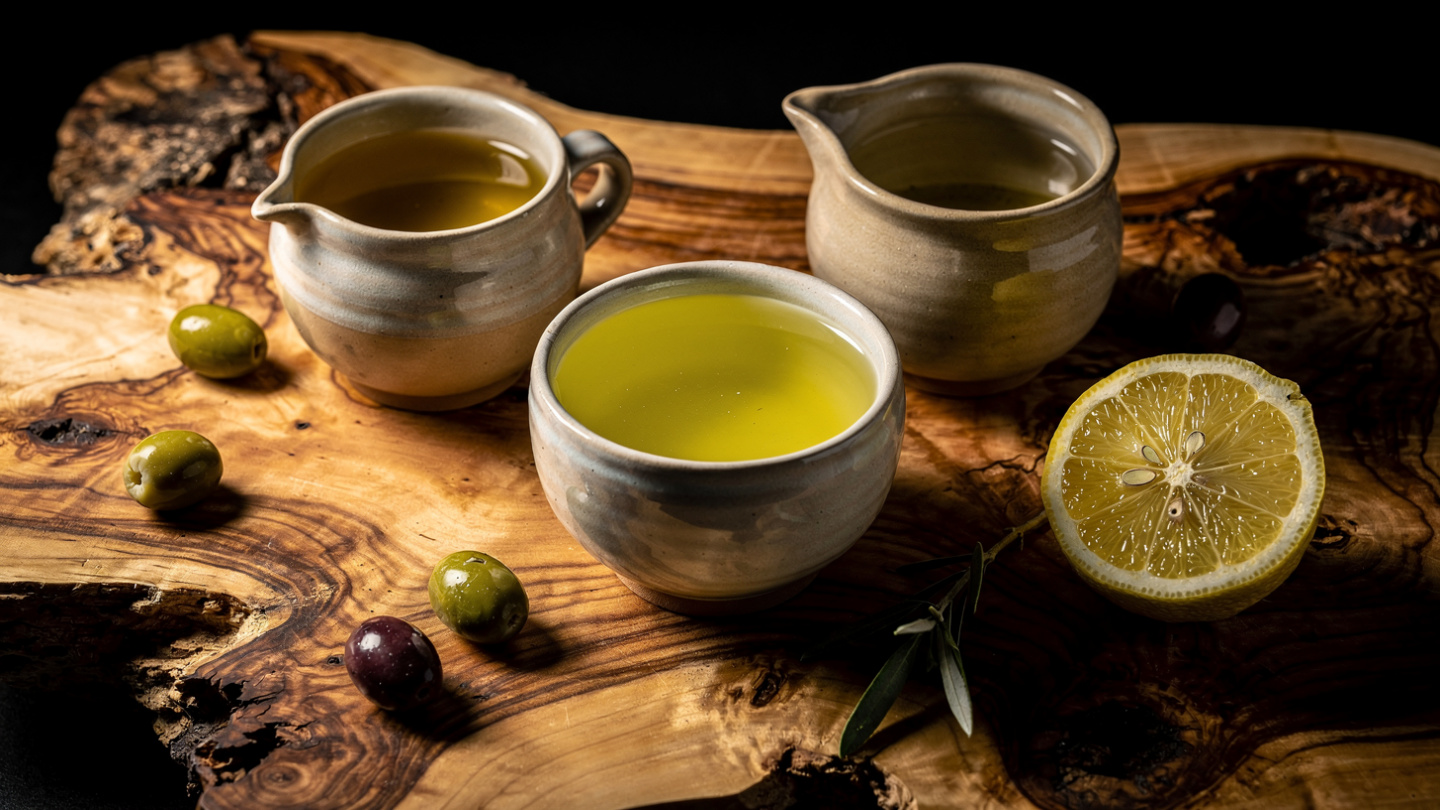
The entire Greek relationship with flavor is in this sauce.
Ladolemono, the Greek emulsion of olive oil and lemon juice whose name combines the two ingredients directly, ladon for oil and lemoni for lemon, is the preparation that appears on the Greek table more consistently than any other single sauce or dressing: on the grilled fish that the Aegean island taverna brings to the table, on the boiled vegetables of the winter kitchen, on the octopus that has been beating against the rocks and then grilled over charcoal, on the green beans of the summer garden, on the simply roasted chicken of the Sunday kitchen. It is the preparation that the Greek cook reaches for when the food in front of them needs one more thing, and that one more thing is almost always the combination of the olive oil’s weight and the lemon’s brightness.
The simplicity of the preparation is deceptive. Two ingredients combined in a ratio determined by the cook’s preference for the balance between richness and acidity: the simplicity conceals the depth of the knowledge required to make it well. The quality of the olive oil determines the character of the sauce as completely as the quality of any single ingredient determines any preparation, and the olive oil that produces the best ladolemono is not the olive oil that produces the best bread dip or the best salad dressing: it is the olive oil that has the combination of bitterness and fruitiness and weight that the lemon’s acidity will both challenge and complement.
Ladolemono is not a recipe. It is a technique that the Greek kitchen applies to a very wide range of preparations, and understanding the technique is understanding one of the fundamental flavoring principles of the Greek culinary tradition.
The Olive Oil and What It Contributes
The olive oil in ladolemono is not background. It is the sauce’s primary flavor dimension, and the choice of olive oil is the choice that most completely determines what the finished ladolemono will taste like and what foods it will serve best.
The Greek olive oil tradition produces a range of flavor profiles that the monovarietal oils document most clearly: the Koroneiki, the dominant variety of the Peloponnese and Crete, produces an oil that is typically peppery and bitter with a grassy early-harvest character and a more mellow fruitiness as the harvest extends later into the season. The Manaki of the Peloponnesian highlands produces a milder, more delicate oil with less bitterness and more sweetness. The Athinolia of the Messinian plain produces an oil with a buttery quality and a distinctive aroma that the other major varieties do not replicate.
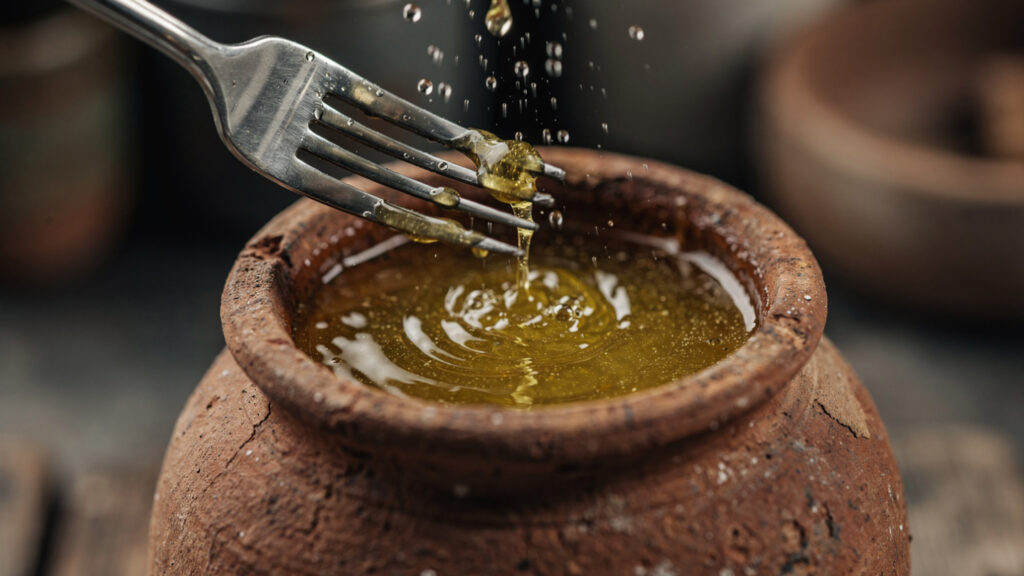
For ladolemono, the early harvest oils, produced from olives that have not yet fully ripened and that carry the maximum concentration of polyphenols and the minimum of the waxes that develop as the olive matures, are typically the most productive choice: the bitterness and the pepper of the early harvest oil are the qualities that the lemon’s acidity intensifies rather than diminishes, and the combination of the oil’s bitterness and the lemon’s sharpness produces the brightness that ladolemono is designed to deliver.
The test is simple: taste the olive oil alone before combining it. If the oil tastes flat or neutral, the ladolemono made from it will taste flat or neutral regardless of the quality of the lemon. If the oil has presence and character, the ladolemono will have presence and character. The olive oil article in this collection develops the Greek variety tradition in full: the Koroneiki, the Athinolia, the Throumba, each with their polyphenol profiles and their flavor contributions. The ladolemono is the preparation that makes those differences most immediately perceptible, because the simplicity of the preparation has nothing to conceal the oil behind.
The Lemon and Its Seasonality
Lemon juice is not uniform across the year, and the Greek culinary tradition’s understanding of this is the understanding of a kitchen organized around seasonal ingredients rather than around year-round commercial supply.
The lemon in the Greek landscape has a primary season from December through April, the winter and early spring months when the fruit has ripened on the tree and carries the combination of acidity and aromatic intensity that the lemon’s optimal condition produces. The two-season lemon trees that are common in the Greek countryside produce a secondary crop in early autumn, and this autumn lemon, picked before the full winter ripening, has a character slightly different from the winter fruit.
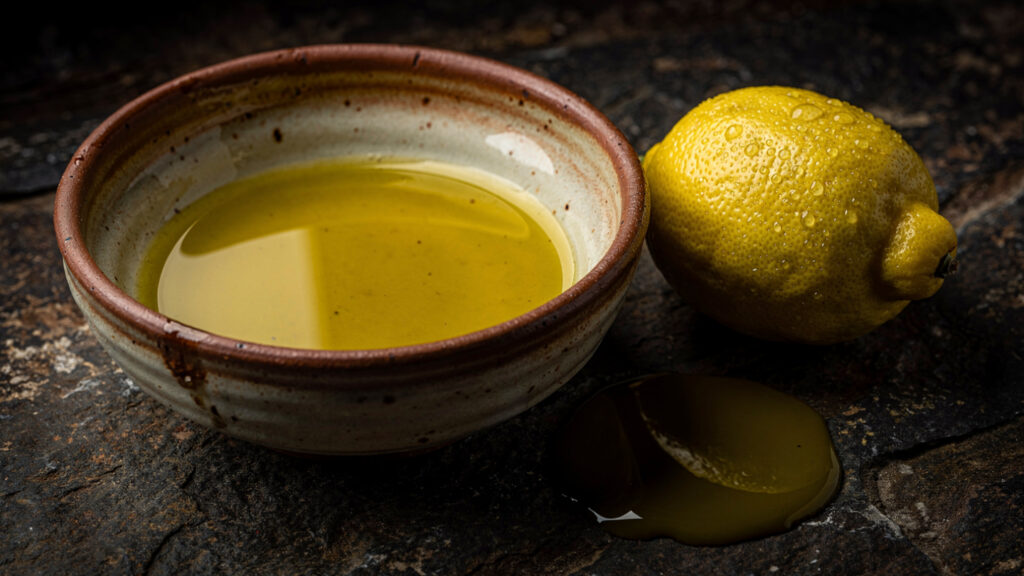
The imported lemon and the commercially stored lemon, which appear in the Greek market through the summer months when the domestic production has ended, carry real risks: the waxing that preserves the skin and the cold storage that extends the shelf life can both introduce a bitterness into the juice that is not the lemon’s natural bitterness but the off-note of the preservation process. The practical discipline required is simple: taste the juice before incorporating it, because a bitter batch will carry the bitterness through into the finished sauce and into the food the sauce is applied to.
The lemon at room temperature releases more juice than the lemon taken directly from the refrigerator: the simple technique of rolling the lemon firmly on the work surface before cutting it, pressing the palm down and rolling back and forth until the fruit softens slightly under the pressure, breaks down the internal membranes that hold the juice in its individual cells and produces measurably more juice from the same fruit. The warm lemon also releases its juice more freely than the cold one: a brief immersion in warm water for thirty seconds achieves the same effect as allowing the refrigerated lemon to return to room temperature naturally.
The Ratio and the Emulsification
The ratio of olive oil to lemon juice in ladolemono is the variable that the cook calibrates to the food the sauce will accompany and to the preference of the people who will eat it.
The standard ratio of 3:1, three parts olive oil to one part lemon juice by volume, produces a sauce that is moderately acidic: bright enough to lift the flavor of the food it accompanies without overwhelming the food’s own character. The more acidic variations, moving toward 2:1 or even 1:1, produce a sauce that is closer to the lemon-forward character that has become more common in contemporary Greek cooking, particularly in the presentation of grilled fish where the acidity’s interaction with the fish’s amino acids produces the brightening effect that ladolemono is most valued for.
The emulsification question is the technique question: whether to make a ladolemono that is simply the two ingredients briefly combined, which produces the looser sauce where the oil and the lemon are distinguishable as separate elements on the palate, or the fully emulsified version where the vigorous whisking or the blender has created a temporary stable emulsion that coats the food more evenly and produces a unified flavor rather than the alternation between the oil’s richness and the lemon’s sharpness.
The loose version is made with a brief fork-mix or the vigorous shake of a sealed jar: thirty seconds of combining is sufficient to distribute the two ingredients through each other without creating a stable emulsion, and the result is a sauce that separates on standing and needs to be remixed before using. This version suits the rough and ready application of the taverna table, where the oil and lemon are combined in the bowl immediately before being poured over the food.
The emulsified version requires vigorous whisking for two to three minutes, or the blender treatment for the most complete emulsification: the blender’s mechanical energy is sufficient to reduce the olive oil to droplets small enough to be maintained in suspension by the lecithins naturally present in the lemon juice, producing a sauce with a lighter, almost creamy texture and a whiter color than the loose version. This version suits the more controlled presentation of the kitchen table, where the sauce is made in advance and requires the stability that the emulsification provides.
What Ladolemono Goes On
The range of applications for ladolemono in the Greek kitchen is the range of preparations that benefit from the combination of fat-carried flavor depth and acid-carried brightness that the sauce provides, which turns out to be a very wide range.
Grilled fish is the application most immediately associated with ladolemono in the Greek culinary imagination: the interaction between the lemon’s acidity and the fish’s amino acids produces the denaturation that brightens the fish’s flavor and lifts its characteristic taste in a way that olive oil alone does not achieve. The ladolemono poured over the freshly grilled fish at the moment it comes off the charcoal, in the heat of the just-cooked surface, emulsifies partially from the food’s own heat and penetrates the fish’s surface while the surface is still open from the cooking.
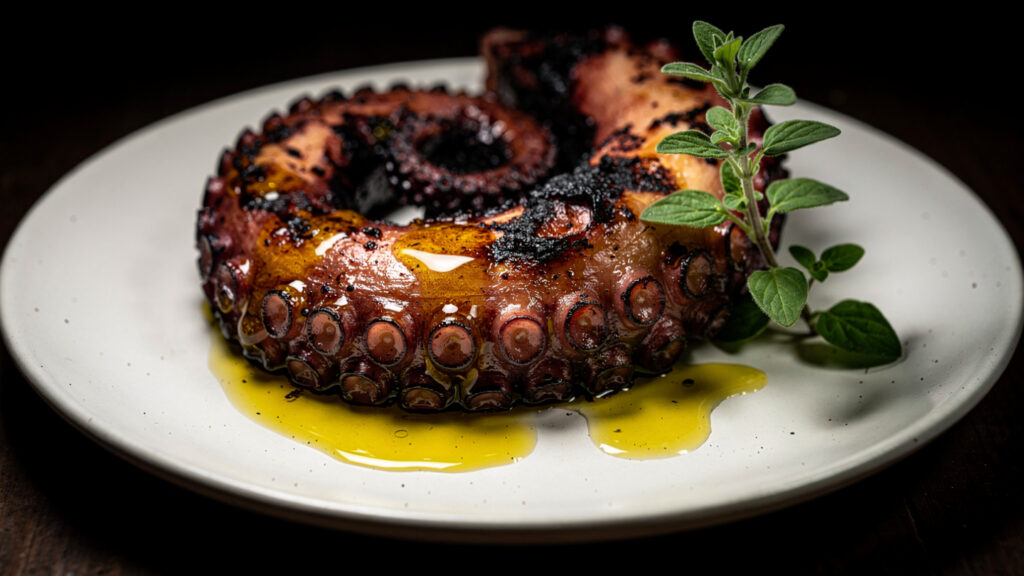
Boiled vegetables receive ladolemono in the tradition that the Greek winter kitchen developed around the horta, the boiled wild greens that are the foundational vegetable preparation of the Greek table from November through April: the dandelion greens and the chicory and the spinach and the nettles that the countryside provides in the cold months are boiled in salted water until just tender and then dressed with olive oil and lemon juice while still warm, the warmth of the vegetable encouraging the oil and the lemon to combine with the vegetable’s own cooking liquid into the loose emulsion that the horta dressing is.
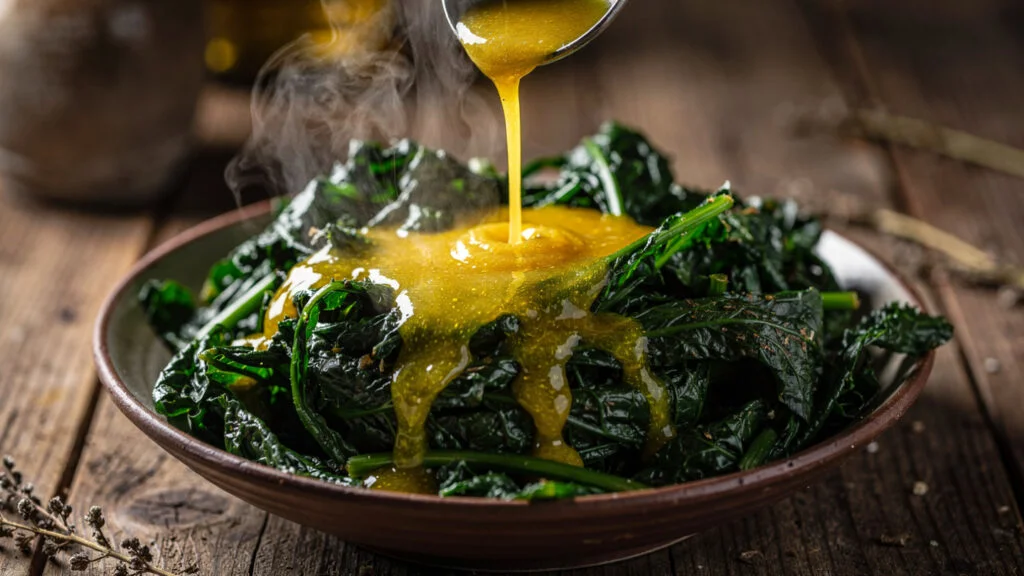
Legumes receive ladolemono in the preparation of the warm bean salad that the Greek kitchen makes from freshly cooked beans rather than from canned beans: the giant beans of the Kastoria region, the black-eyed peas of the summer kitchen, the chickpeas of the winter stew all benefit from the ladolemono treatment at the moment they come out of the cooking water, when the beans are still warm enough to absorb the oil and the lemon into their surface rather than simply being coated with the dressing.
Grilled meats, particularly the souvlaki and the keftedes and the grilled chicken that constitute the core of the Greek charcoal-grilled tradition, receive ladolemono as an alternative to the simpler olive oil dressing: the lemon’s acidity cuts through the fat of the grilled meat in a way that olive oil alone does not, and the combination produces the clean finish that the Greek grill tradition values.
Enrichments and Variations
The enriched versions of ladolemono are best understood not as a simple list of additions but as a series of variations in which the basic two-ingredient structure is developed in directions for applications.
The mustard addition, one to two teaspoons of Dijon or seeded mustard per four-serving portion, serves both an emulsification function and a flavor function: the lecithins in the mustard help stabilize the emulsion that the whisking produces, and the mustard’s own acidity and sharpness adds a dimension to the sauce’s flavor that pairs particularly well with the ladolemono for green salads and for the cold potato salad that the Greek summer kitchen makes from the freshly boiled potatoes of the season.
The garlic addition is the variation that produces the closest approach to the Spanish aioli or the French aïoli within the Greek ladolemono tradition: the single minced clove in the sauce produces a garlic ladolemono that suits the grilled fish particularly well, while the more subtle approach of rubbing the bowl with a cut garlic clove before making the sauce in it produces the ghost of garlic that perfumes the sauce without announcing itself.
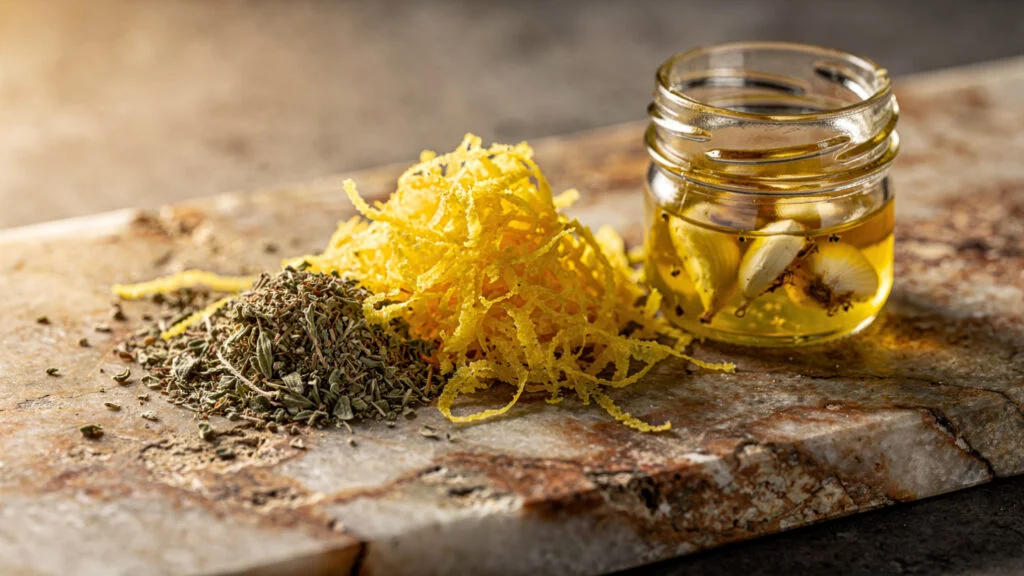
The fresh herb additions, approximately one teaspoon of finely chopped fresh herbs per four-serving portion, are the seasonal variations that the Greek kitchen applies according to what the garden or the countryside is providing at the moment: the fresh dill for the fish preparations, the fresh oregano for the grilled meats, the fresh mint for the summer salads, and the dried oregano crumbled between the palms to release the essential oils for the year-round applications where the dried herb’s concentration is what the preparation requires.
The lemon zest addition, a small amount of the grated outer peel of the unwaxed lemon, is the variation that most intensifies the lemon character of the sauce without increasing its acidity: the essential oils in the peel are the aromatic compounds that the juice’s acidity alone cannot deliver, and the combination of juice and zest produces a ladolemono that is more completely lemon in character than the juice alone achieves.
The ladolemono is not simply a dressing. It is the theological status of the olive expressed in its most elemental form. It is a continuation of the ritual relationship between the Greek kitchen and the sacred tree, a connection that organizes the Greek food calendar and maintains the ancient understanding of the table as a theological document, as detailed in The Sacred Table.
Olympus Estate · Food & Seasonal Life
Ladolemono · Greek Olive Oil and Lemon Sauce
The entire Greek relationship with flavor is in this sauce. Two ingredients. The ratio is yours to decide. The olive oil must have character. The lemon must be tasted first.
Ingredients: The Standard Ratio
- Extra virgin olive oil, early harvest if available90 ml
- Fresh lemon juice, strained, tasted first30 ml
- Sea saltpinch
Method
-
1
Taste the lemon juice
Before combining anything, taste the strained lemon juice. A bitter batch from imported or cold-stored lemons will carry through into the sauce and the food it accompanies. If the juice is bitter, use a different lemon. Roll the lemon firmly on the work surface before cutting to maximize yield.
-
2
Choose your consistency
For the loose version: combine olive oil, lemon juice, and salt in a bowl and mix briefly with a fork, or combine in a sealed jar and shake for 20 seconds. The two ingredients remain distinguishable on the palate. For the emulsified version: whisk vigorously for 2 to 3 minutes, or use a hand blender moving up and down until the sauce lightens in color and gains a slightly creamy texture. The emulsified version coats food more evenly and holds together longer.
-
3
Adjust and serve
Taste before using. If too sharp, add a little more olive oil or a small amount of honey to soften the acidity. If too flat, add more lemon juice or a pinch of salt. Pour over the food immediately for grilled fish and warm vegetables, or dress salads just before serving. The loose version separates on standing and needs a brief re-mix.
Variations
Add 1 small clove, finely minced. Or rub the bowl with a cut clove before making the sauce for a more subtle presence. Best with grilled fish or octopus.
1 to 2 teaspoons of Dijon or seeded mustard. Helps stabilize the emulsion and adds body and tang. Best for green salads and cold potato salads.
1 teaspoon finely chopped dill, oregano, or mint. Add just before serving as fresh herbs oxidize quickly once combined. Dried oregano, crumbled between the palms, works year-round.
A small amount of finely grated unwaxed lemon zest. Adds the aromatic dimension of the peel’s essential oils without increasing acidity. Use organic or in-season lemons only.
At Olympus Estate, Food and Seasonal Life traces Greek cuisine as a living calendar. Ladolemono is on the table at every season and with every category of food that the Greek kitchen produces: the winter horta, the spring grilled fish, the summer vegetable salad, the autumn legume soup. The two ingredients are always the same. What changes is the ratio and the food they are poured over and the olive oil’s character at the moment of the year. This is what it means for a sauce to be fundamental rather than merely popular.