
Herodotus thought Samos remarkable enough to mention three times.
Not as a traveler noting pleasant scenery, but as a historian documenting things he considered genuinely extraordinary in a world he had surveyed at considerable personal effort. The three structures he singled out on Samos as the greatest engineering achievements in the Greek world were not temples or statues but a tunnel, a harbor wall, and a sanctuary precinct: the infrastructure of a civilization that had decided to do things that had not been done before and had the technical capability to accomplish them.
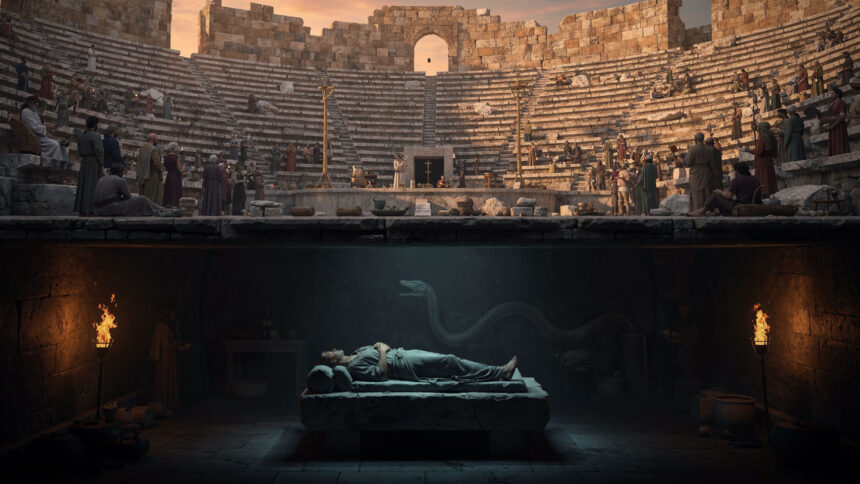
The tunnel was cut through a mountain to carry water to the city. It is approximately one kilometer long, was excavated simultaneously from both ends, and the two excavating teams met in the middle with a lateral deviation of less than a meter over the full length of the work. It was completed in the sixth century BCE under the tyrant Polycrates, who governed Samos at the height of its power and who commissioned from the engineer Eupalinos of Megara a feat of precision that the ancient world recognized as extraordinary and that modern engineering assessments have confirmed was achieved through surveying methods whose logic the surviving tunnel geometry allows us to reconstruct.
This is the island. The cheesecake was invented here, as the cheese molds in the archaeological record document. Pythagoras was born here and developed the mathematical relationships that still carry his name. Epicurus was born here and developed the philosophical framework around which his entire subsequent tradition would organize itself. Hera was worshipped here in a sanctuary whose scale rivaled the Parthenon and whose location at the western end of the island maintained the continuity of a cult that predated the classical period by several centuries.
Samos is not an island that needs superlatives. It needs attention.
The Tunnel and What It Proves
The Eupalinian aqueduct is the starting point for understanding Samos because it is the most direct material evidence for the quality of mind that the island produced and attracted in its period of maximum activity.
Eupalinos of Megara was commissioned to solve a problem: the city of Samos needed a reliable water supply that could not be disrupted by an enemy cutting the surface channels during a siege. The solution he designed was a tunnel through the mountain of Kastro that connected a spring on the north side to the city on the south, running entirely underground and therefore entirely inaccessible to any enemy force operating on the surface.
The engineering problem that this solution posed was how to excavate a tunnel of this length, from both ends simultaneously to save time, through solid limestone, and have the two teams meet in the middle with sufficient precision that the tunnel could function as a continuous channel. The answer required a system of surveying that allowed the direction and gradient of each team’s excavation to be maintained over hundreds of meters of blind work in rock, with no ability to check progress against a visible reference point.
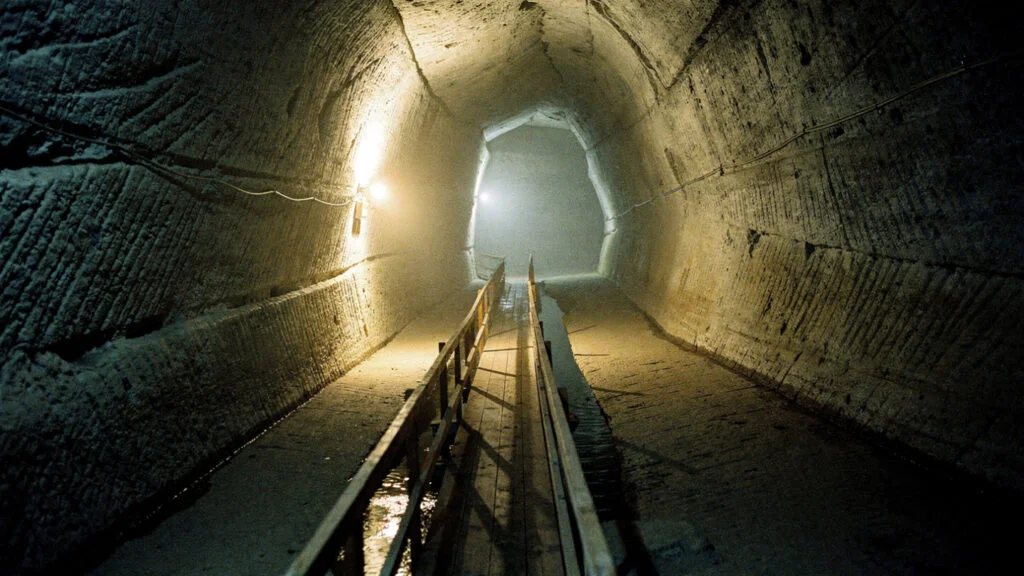
The method that the tunnel’s geometry suggests Eupalinos used involved establishing the horizontal and vertical alignment of each shaft from surface surveys before excavation began, and maintaining those alignments through the use of plumb lines and set squares as the work progressed. When the two teams’ tunnels deviated from alignment, as they did at one point where both teams bent their excavations to find each other, the correction was made and the teams met. The resulting tunnel has carried water and the attention of engineers and archaeologists for two and a half thousand years.
The site is accessible from Pythagorio, the town on the island’s southeastern coast that takes its name from Samos’s most famous native son. The entrance to the tunnel is a short walk from the ancient city’s remains. Visitors can walk approximately two hundred meters into the tunnel with the help of a wooden walkway installed over the ancient channel, far enough to understand what Eupalinos built without requiring the full kilometer of underground passage that the complete tunnel covers.
The sanctuary of Hera at the western end of the island, in the low-lying coastal area near the mouth of the Imbrasos river where the lore placed the goddess’s birth, was among the largest sacred precincts in the ancient Greek world.
The temple that stands, or rather that does not stand in any complete form, at the center of the Heraion was one of the first Greek temples to be built at the scale and with the structural ambition that the classical period would later standardize. The earliest temple on the site predates the archaic period and reflects the continuity of cult at this location that the accounts attributed to a mythological origin: Hera was born here, beside the Imbrasos, and the sacred willow tree under which her birth was said to have occurred was preserved in the sanctuary precinct as living evidence of the event.
The great temple, begun in the sixth century BCE and never completed, would have been the largest temple in the ancient Greek world at its intended scale, surpassing in length the temples at Ephesus and Didyma that the ancient world listed among its Seven Wonders. Its intended dimensions reflected the political ambitions of the Samian state at the height of its power under Polycrates: a temple whose scale would have expressed the same quality of confident technical capability that the tunnel expressed, the willingness to attempt things larger than had been attempted before and the capability to make significant progress toward completing them.
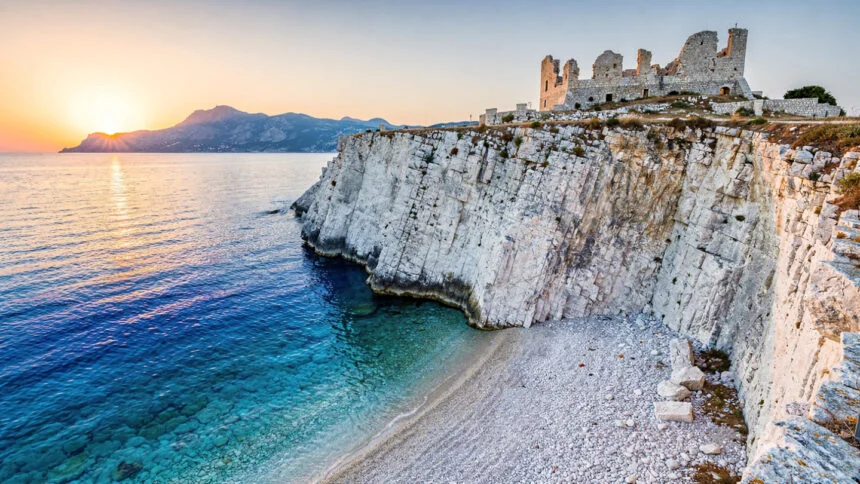
What stands today is a single column, preserved from the original structure, rising from the low flat ground of the sanctuary precinct near the sea. The column is visible from the water as you approach the western end of the island by boat, a vertical marker above the otherwise horizontal landscape. The precinct around it, excavated and managed as a UNESCO World Heritage Site, reveals the plan of the structure and the sequence of building phases that preceded it, going back to the earliest cult structures of the late Bronze Age.
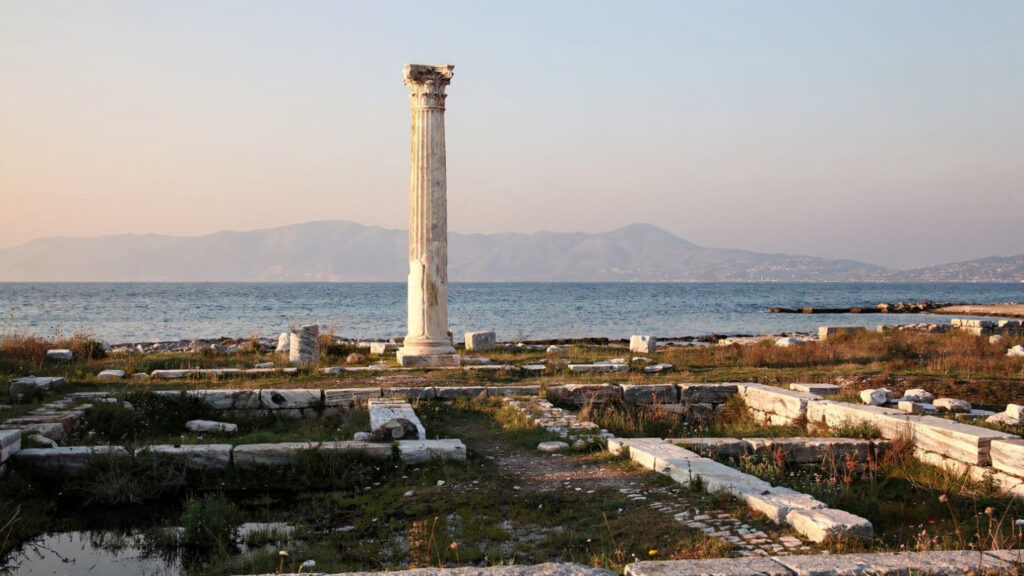
The column is enough. It establishes what the site was and what the people who built on it were attempting, and it does this with the economy that a single surviving element of a great structure produces, concentrating the evidence of the whole into the one piece that survived.
Pythagoras and the Shape of Things
The man whose name the island’s main town now carries was born on Samos in the sixth century BCE and left it, in the ancient sources’ account, because the political conditions under Polycrates’ rule were not compatible with the kind of intellectual life he wanted to conduct. He went to Croton in southern Italy and established the community there that became the Pythagorean school, which treated mathematics as a form of philosophical and religious practice as much as a technical discipline.
The theorem that carries his name was not, as Pythagoras himself would have been the first to acknowledge, discovered by him. The relationship between the squares on the three sides of a right triangle was known in Mesopotamia and in Egypt considerably before his time, and he had traveled to both regions as part of the education that the ancient sources describe for him. What Pythagoras and the Pythagorean tradition contributed was the proof: the demonstration that the relationship was necessarily true rather than empirically observed, the shift from a measured fact about triangles to a logical truth about all right triangles.
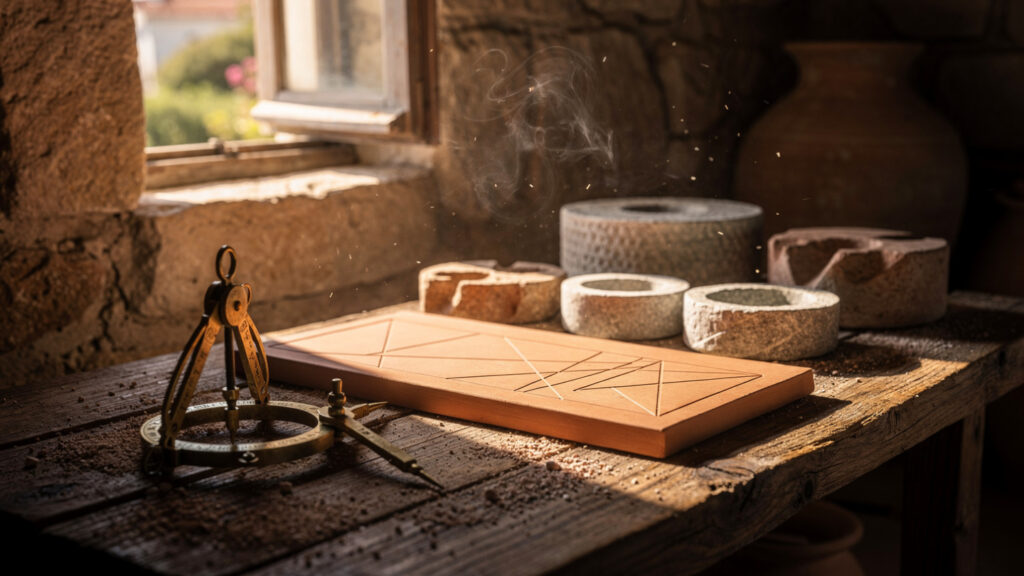
This distinction, between the measured fact and the proved truth, is the distinction that Greek mathematics in general and Pythagoras’s contribution in particular introduced into the intellectual tradition of the ancient world. It is a distinction that still organizes mathematics and has organized it since the sixth century BCE when a man born on Samos worked out that you could know something to be true without measuring it.
The Archaeological Museum of Samos in Vathi holds the material record of this intellectual legacy and the wider culture that produced it. The museum’s most celebrated piece, the kouros figure known as the Samos Apollo or the Kouros of Hera, is among the largest surviving archaic Greek statues, a marble figure approximately five meters tall that was dedicated at the Heraion and that represents the scale of artistic ambition at the site in the same period that Eupalinos was cutting his tunnel and the great temple was being begun.
Pythagorio and the Town Above the Ancient City
The modern town of Pythagorio occupies the site of the ancient city of Samos, and the relationship between the modern settlement and the ancient one is as direct as any in the Aegean: the ancient harbor is still the harbor, the ancient fortification walls are still partially visible in the landscape around the town, and the street pattern of the modern center follows in places the lines of the ancient street pattern beneath it.
The castle of Lykourgos Logothetis on the hill above the harbor was built in the nineteenth century during the Greek War of Independence, using ancient and medieval masonry, and it marks the highest point of the ancient city’s fortification circuit. From its walls, the view across the strait to the Turkish coast establishes the geographic reality of Samos’s position: the island is separated from Asia Minor by a channel approximately two kilometers wide at its narrowest point, close enough that the lights of the Turkish coast are visible from the Samian shore at night and that the relationship between the island and the mainland opposite was, in antiquity, a relationship of proximity rather than separation.
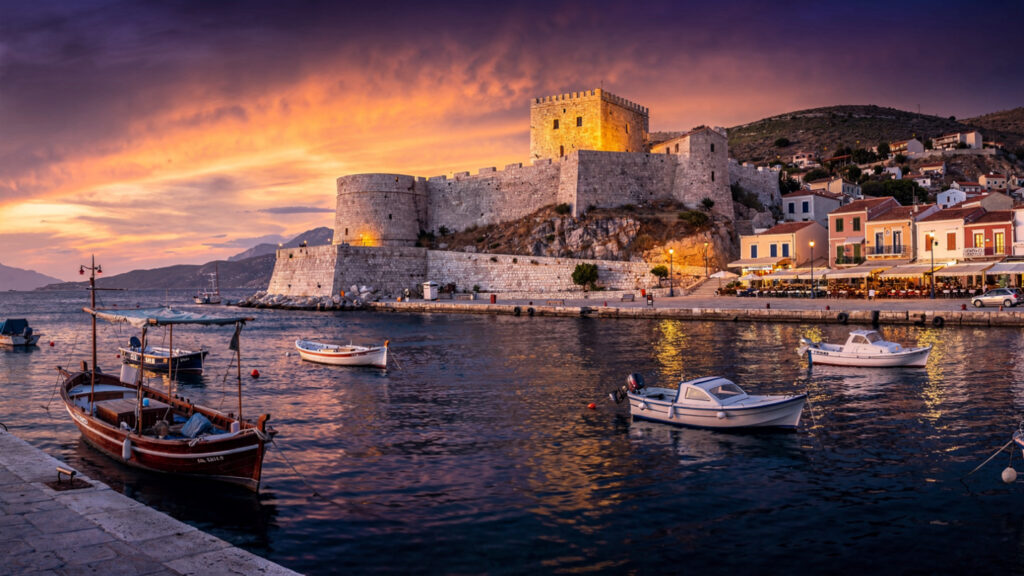
The harbor front of Pythagorio in the evening follows the rhythm of a working Greek port town: fishing boats and pleasure craft moored along the quay, the tavernas opening onto the waterfront, the light changing as the sun moves toward the western end of the island. The quality of light in the eastern Aegean in the evening, when the clarity of the air produces colors in the sky that do not occur at the same latitude in cloudier climates, is one of the things about Samos that the ancient world’s intellectual residents would have known and that modern visitors find consistently extraordinary.
The Mountains and What They Hold
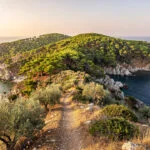
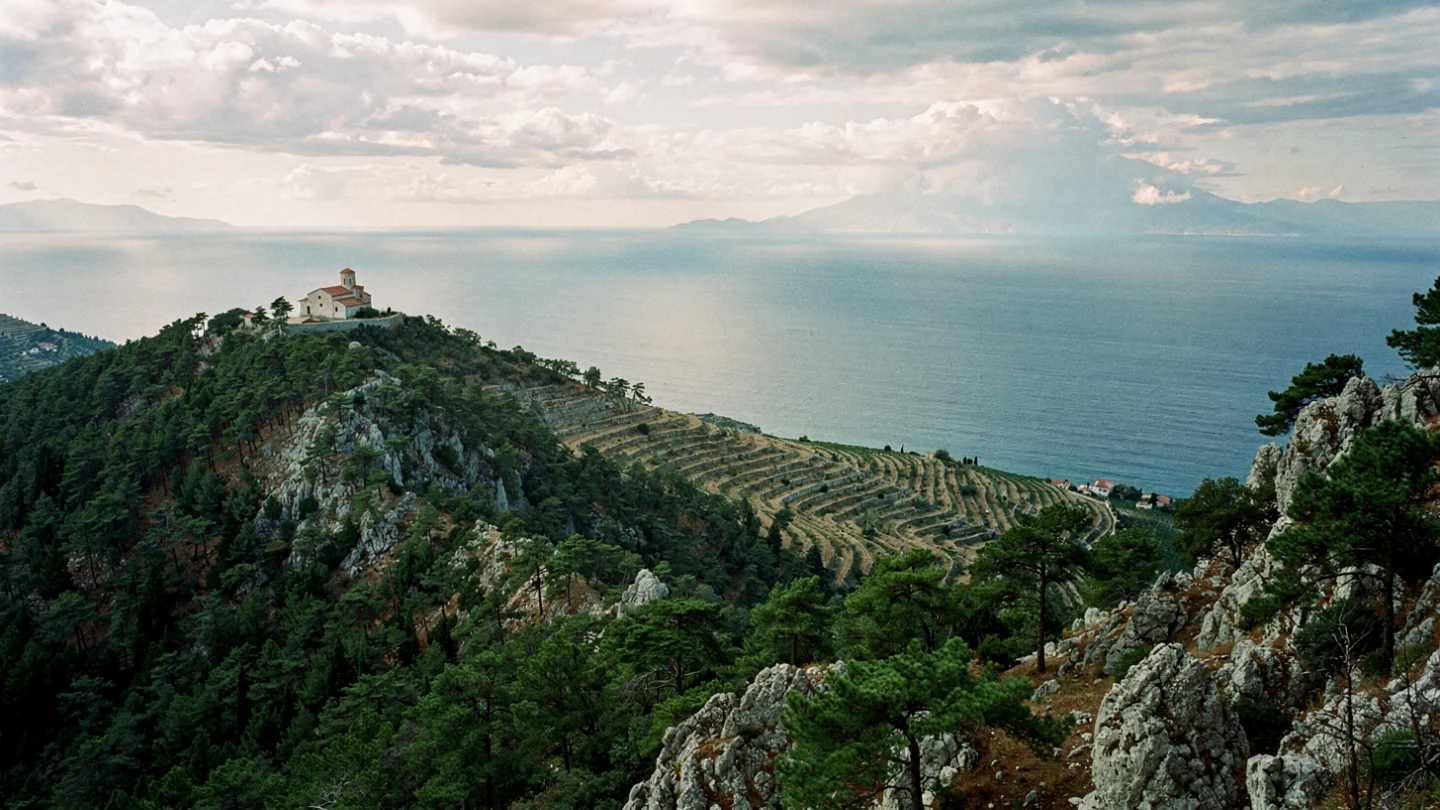
Samos is the greenest of the eastern Aegean islands, a quality produced by the combination of the island’s mountainous terrain and its position close enough to the Turkish coast to receive moisture that the more exposed islands of the central Aegean do not. The two main ranges, Kerkis in the west and Ambelos in the center and east, hold pine and chestnut forest at their upper elevations and cultivated land on their slopes, with the terraced vineyards that produce the Muscat wine for which the island is internationally recognized descending toward the coast on multiple aspects.
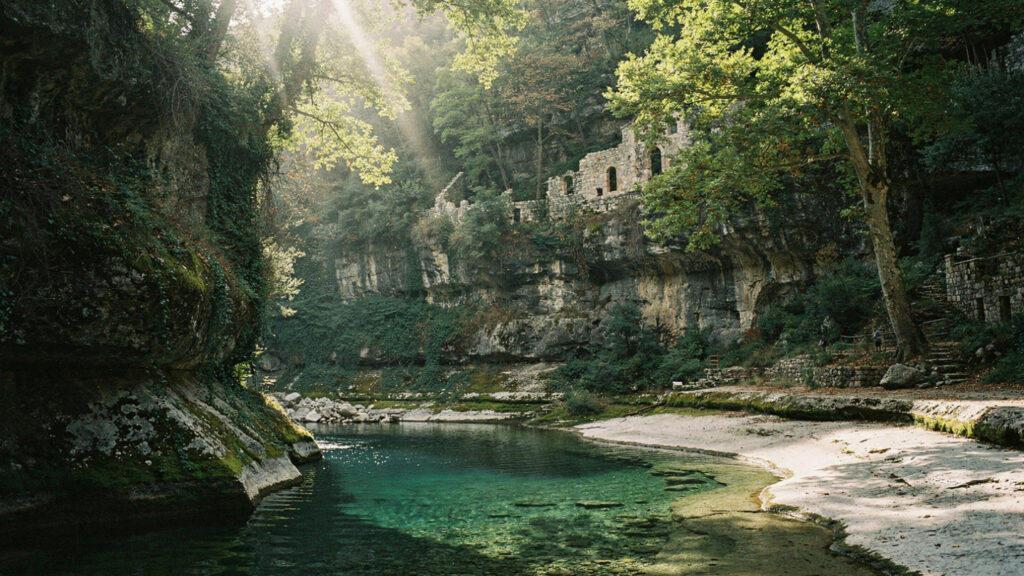
The Potami valley in the northwest of the island, accessible from Karlovasi, is the most rewarding inland route on Samos for anyone willing to walk rather than drive. The path follows the river through a gorge of increasing depth and shade, passing Byzantine ruins embedded in the cliff faces on either side and arriving at the series of waterfalls where the river drops over limestone shelves into pools of sufficient depth for swimming in summer. The walk is approximately forty-five minutes from the nearest road access point to the first waterfall, with subsequent falls requiring more scrambling for access.
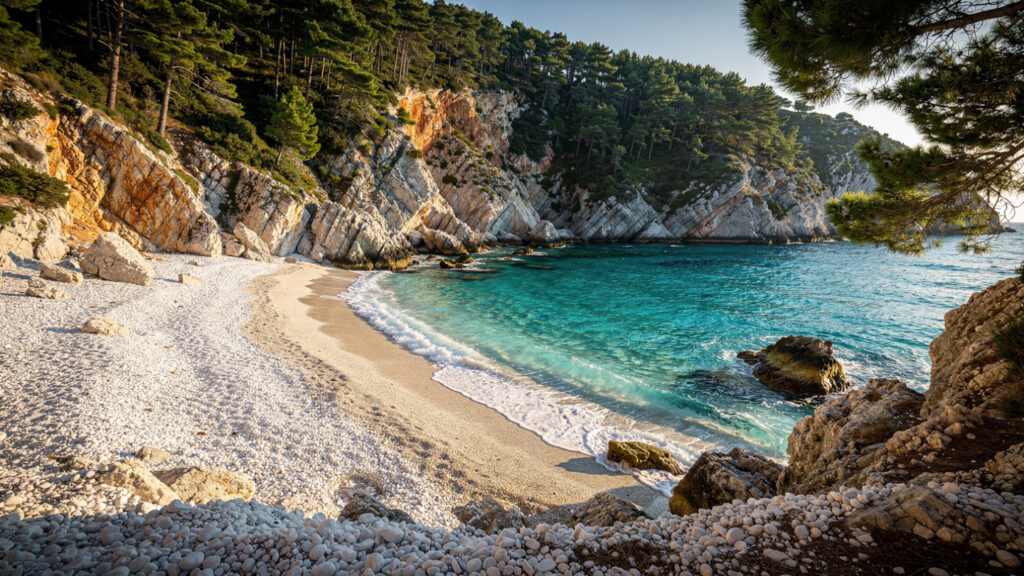
Seitani, accessible by foot along the northern coastal path from Potami or by boat from Karlovasi, is the collection of beaches on Samos’s northwestern coast that remains undeveloped because road access to it is impossible by conventional means. The path along the coast takes approximately ninety minutes from Potami and crosses terrain that requires comfortable footwear and the willingness to move at the pace the path sets rather than the pace a road would allow. The beaches at the end of this effort are of the quality that the absence of infrastructure produces: the water clarity, the beach character, and the surrounding landscape are those of a coastline that has not been organized for visitors.
Mount Kerkis, at 1,433 meters the highest point on the island, offers a full-day ascent from the village of Marathokampos on its southern flank. The summit view extends across the Aegean on clear days to the islands of the Cyclades to the west and to the coast of Asia Minor to the east, the geography of the ancient world spread out at a distance that makes its interconnections visible.
The Muscat and the Monasteries
The Muscat wine of Samos is the island’s most internationally recognized product, a sweet white wine produced from the Muscat Blanc à Petits Grains variety that has been cultivated on the island’s slopes since the Byzantine period. The cooperative that manages most of the island’s wine production operates one of the most significant wine facilities in Greece, and the Muscat that it produces in its various expressions, from the golden vin doux to the darker, more concentrated Nectar Samos, represents a continuous tradition of viticulture whose relationship to the island’s terrain and climate has been refined across centuries.
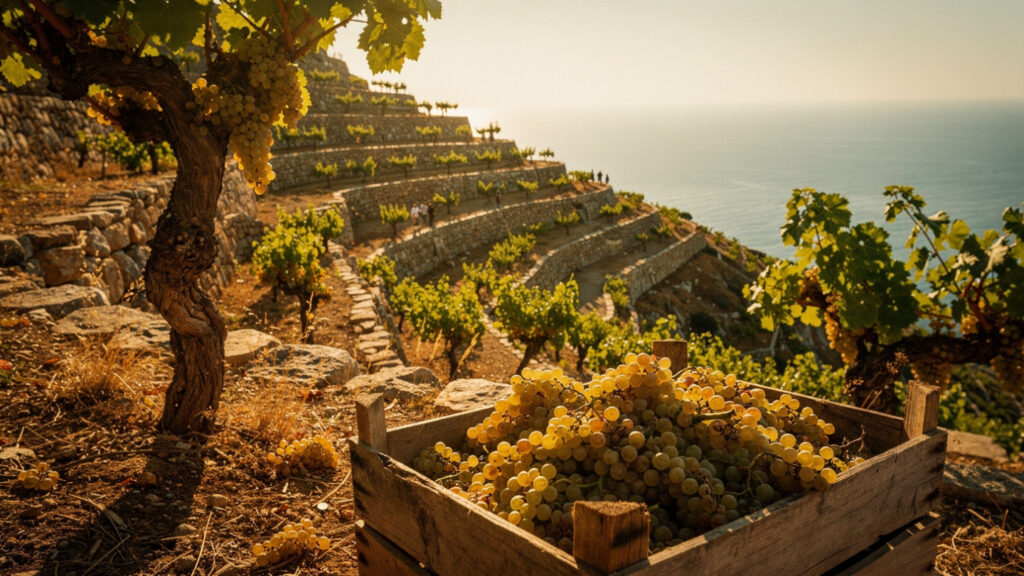
The monasteries that occupy the island’s hillsides belong to a different continuity, that of the Orthodox monastic practice that established itself in the eastern Aegean across the medieval and post-Byzantine periods and that chose its sites with the same attention to landscape and strategic position that had characterized the ancient sanctuary builders.
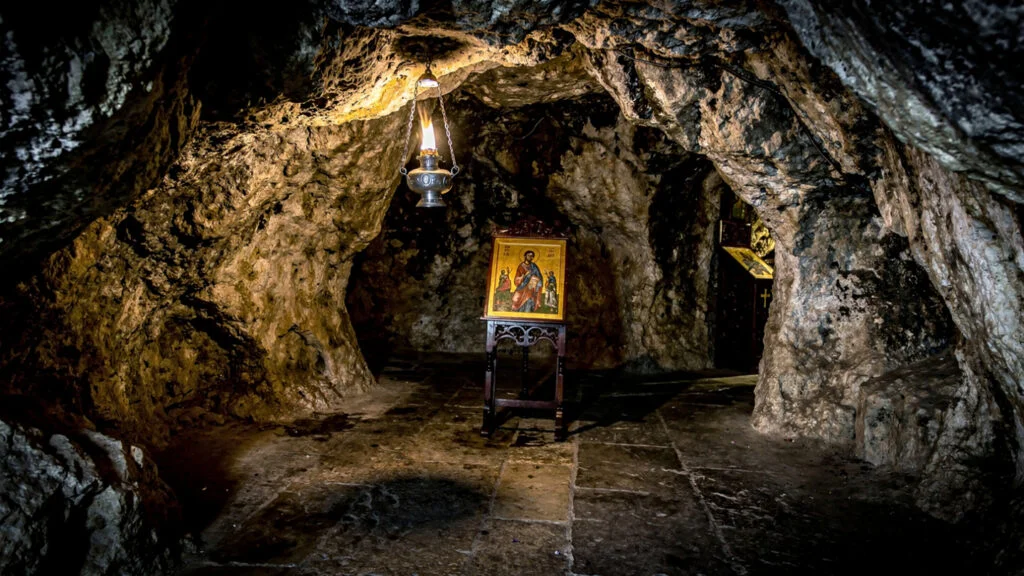
The Monastery of Panagia Spiliani, built into and around a cave above Pythagorio, occupies a site that the cave itself had made sacred before any monastic structure was built there. The cave’s interior holds the chapel and the icon to which the monastery’s name refers. The descent from the monastery to the town below passes through the ancient theater, partially excavated, where the natural hillside provided the seating for performances in the period when Samos was at the height of its classical culture.
The Monastery of Zoodochos Pigi, in the pine forest above Vathi, carries the name that several Aegean monasteries share, the Life-Giving Spring, and occupies the forested hillside above the capital with the quality of silence that the combination of forest and elevation produces.
When to Come and What to Follow
The island’s best conditions for travel depend on what kind of travel is intended.
The archaeological sites, the Heraion and the Eupalinian tunnel and the museum in Vathi, are best visited in April, May, or October, when the temperatures allow extended time outdoors without the intensity of the July and August heat, and when the site attendances are lower. The spring months also produce the quality of landscape that Samos’s greenness in this period generates: the flowers on the hillsides, the waterfalls at their fullest from the winter rains, the light that the clear air of the eastern Aegean spring carries.
The mountain walking is best in the same periods, with October having the advantage of harvest season alongside the walking conditions. The Muscat harvest in late summer and early autumn is accompanied by the activity of the cooperative and by the local festivals that mark the seasonal transition.
The beaches are best in June and September, when the water temperature is fully warm from the summer heat and the visitor density is lower than in the peak weeks of July and August. Seitani requires a comfortable day and good conditions regardless of the month.
The winter months reduce the island to its year-round population and produce the conditions of an eastern Aegean island without its tourist dimension: the kafeneion in the village square, the fishing boats in the harbor, the landscape in the rain. For those who want to understand what the island is rather than what it offers the visitor, this is also a form of access.
At Olympus Estate, Wanderlust Greece guides you across the sacred and storied terrain of the Hellenic world, from the tunnel that Eupalinos cut through a mountain to the single column standing in the Heraion precinct by the sea. The island where Pythagoras was born and cheesecake was documented and Hera was worshipped before the Parthenon was built is still there, still remarkable, still worth the attention that Herodotus gave it.