The loggerhead sea turtle has been nesting on the beaches of Zakynthos for longer than any human settlement on the island has existed.
This fact, simple and easily verified by the paleontological record, establishes the primary relationship that defines the island more precisely than any superlative about turquoise water or golden sand. Zakynthos is a place where a species older than human civilization has continued to do what it does without interruption, in the same bays, on the same beaches, through Venetian occupation and British protectorate and German invasion and a catastrophic earthquake and mass tourism, because the conditions the island provides are the conditions the species requires. The Caretta caretta loggerhead turtle does not choose where it nests arbitrarily. It returns to the beach where it was born, navigating across thousands of kilometers of open ocean, and sea turtles as a lineage have been performing this same behavior for well over a hundred million years, making them contemporaries of the earliest dinosaurs.
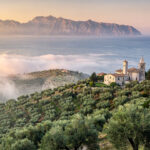
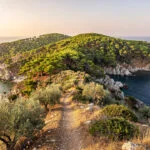
The island that the turtles keep returning to is a crescent of limestone and sandstone rising from the Ionian Sea eighteen kilometers off the western coast of the Peloponnese. It covers approximately 408 square kilometers, with a coastline of 123 kilometers that ranges from the vertical white cliffs of the northwest to the long flat sand beaches of the south where the turtles nest. Its interior is a combination of limestone plateau, fertile valley, olive grove, and the karst formations that produce the artesian springs and sea caves that give the island’s hydrology its character. Mount Vrachionas in the northwest reaches 756 meters and gives the island’s mountainous section its visible profile from the sea.
Zakynthos carries the name that Homer used for it in the Odyssey, where it appears in the catalogue of islands around Ithaca that made up the territory of Odysseus. The Italian name Zante, which the Venetian administration used during the four centuries of its governance from 1484 to 1797, has largely retreated in international usage, though it persists in some contexts. The flower of the Levant, a phrase that the Venetian governors used to describe the island’s agricultural productivity, referred specifically to its currant production in the Venetian period: the small seedless grape known as the Corinthian currant, which Zakynthos exported through Venetian trade networks to northern Europe under the name Zante currant, a connection that persists in the English vocabulary for this dried fruit.
The Earthquake and What It Changed
The earthquake of August 12, 1953, at magnitude 7.2, was the most destructive seismic event in modern Greek history in terms of built heritage. It destroyed approximately 85 percent of the buildings in Zakynthos Town and damaged or destroyed the major villages of the island’s interior. The fires that followed the earthquake burned for several days in the ruins.
What this means for the traveler approaching Zakynthos with historical expectations is that the island’s built heritage is largely post-1953. The Venetian-period architecture that the island was celebrated for, the palaces, the churches, the domestic buildings of the merchant class that the Venetian administration had enriched, is documented in photographs and in the collections of the Byzantine Museum but is not present in the landscape in the form of original structures. The churches that exist in Zakynthos Town were rebuilt after 1953, some in forms that reproduced the pre-earthquake originals as closely as the available documentation permitted and some in simplified versions that the resources and urgency of reconstruction allowed.
This is not a reason to reduce expectations of the island. It is a reason to adjust what is being looked for. The heritage of the island is present in its landscape, its agricultural practices, its music, its cuisine, and the continuity of its religious and cultural customs across the break that the earthquake created. The Venetian inheritance is found in the food, in the musical heritage, and in the forms of the rebuilt churches rather than in the masonry of the buildings themselves.
The reconstruction of Zakynthos Town after 1953 followed the grid plan that the Venetian city had used, and the scale of the streets and squares was maintained from the pre-earthquake layout. Walking through the town, the visitor moves through a spatial organization that the earthquake did not destroy even as it brought down the buildings that had defined it.
Zakynthos Town and Solomos Square
The main square of Zakynthos Town, named for the poet Dionysios Solomos who was born on the island in 1798 and who wrote the poem that became the Greek national anthem, is the spatial and cultural center of the island’s capital.
Solomos is the most significant figure in modern Greek literary history, the poet who wrote in the demotic Greek vernacular at a moment when the dominant literary tradition used the archaic katharevousa form, and whose work established the vernacular as a legitimate literary medium in a way that influenced every subsequent Greek writer. His house, or rather the rebuilt version of his house, is accessible in the town, and the museum that commemorates him in the square that bears his name holds the manuscripts and documents that form the primary archival record of his life and work.
The church of Agios Dionysios, named for the island’s patron saint who was born on Zakynthos in 1547 and whose relics are preserved in the church in a silver reliquary, is the largest church on the island and the religious center of its communal life. The church was rebuilt after 1953 and the bell tower that accompanies it, one of the landmarks of the town’s waterfront, is among the most recognizable images of the island. The saint’s feast day on August 24th brings the island’s religious calendar to its annual high point, with a procession of the reliquary through the town that the island’s population and its summer visitors attend in numbers that the town’s streets can barely accommodate.
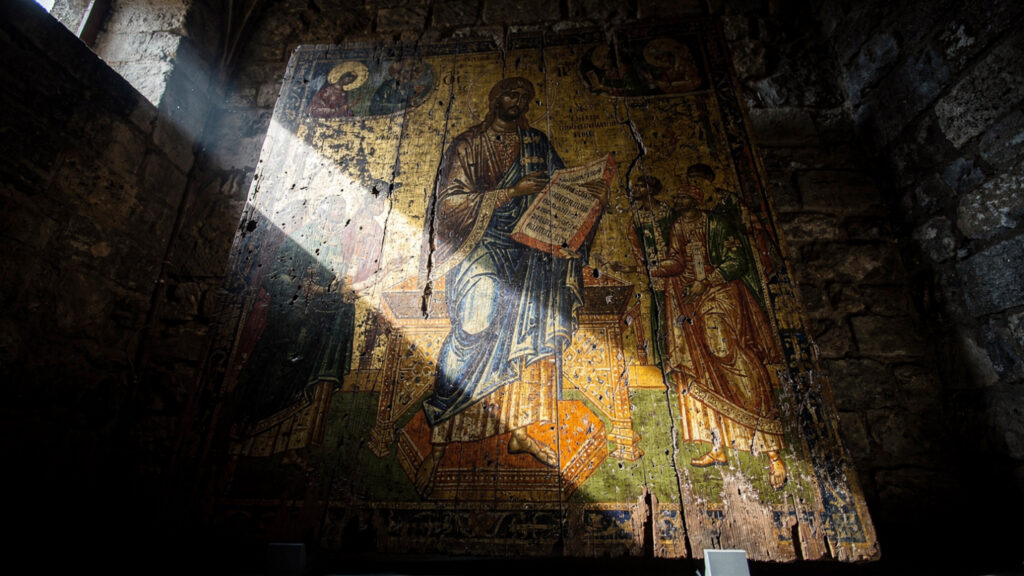
The Byzantine Museum at the north end of Solomos Square holds the collection that the island’s cultural institutions assembled specifically because of the 1953 earthquake: the icons, the woodcarvings, the liturgical objects, and the fragments of decorative painting that were rescued from the ruins of the destroyed churches in the weeks and months after the earthquake, catalogued and preserved as the primary surviving material record of the island’s Venetian-period religious art. The collection is significant beyond its local importance because the Ionian school of painting, which developed on the Ionian Islands during the Venetian period as a synthesis of Byzantine iconographic tradition and Venetian Renaissance technique, produced some of the most accomplished religious painting in the Greek world of the seventeenth and eighteenth centuries, and Zakynthos was one of its major centers.
Navagio and the Landscape of the Northwest
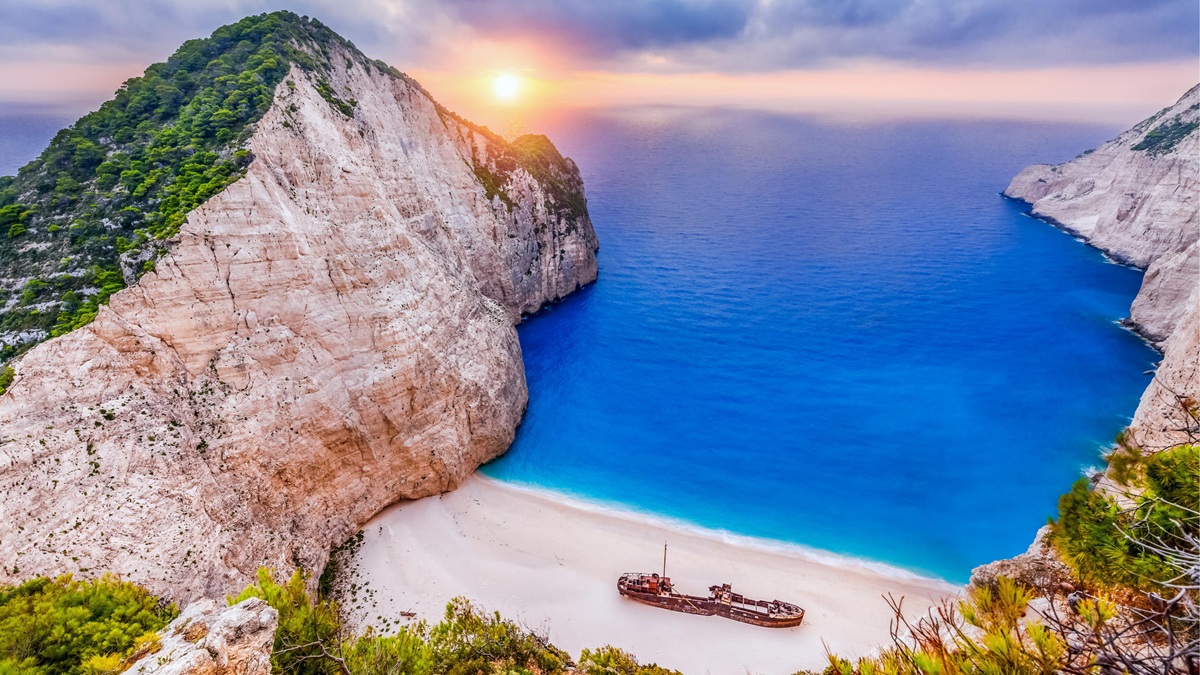
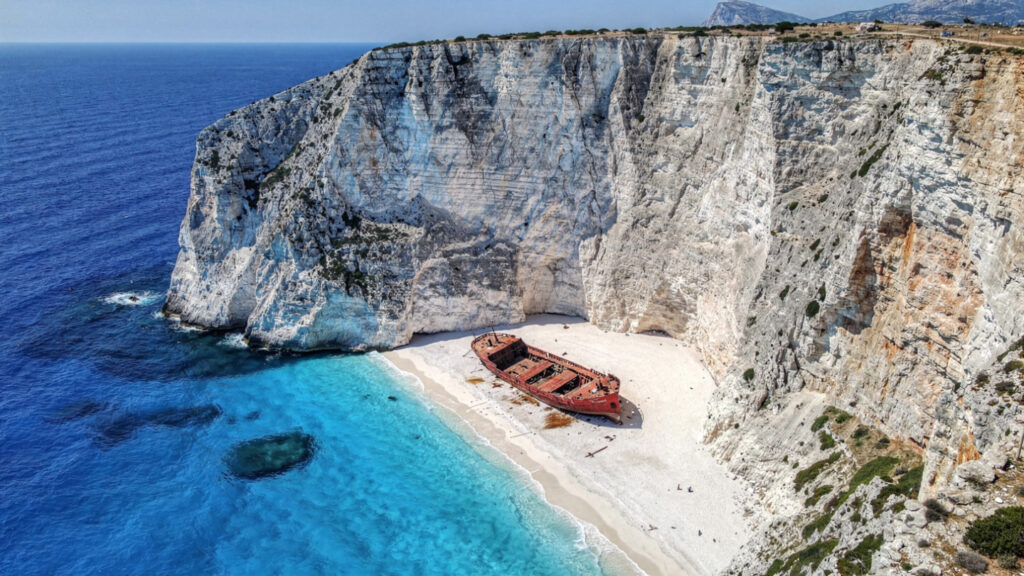
The northwestern corner of Zakynthos, where the limestone plateau ends in vertical cliffs above the Ionian Sea, is the part of the island that the single most reproduced image of Zakynthos is taken from: the clifftop viewpoint above Navagio beach, looking down into the enclosed cove where the rusting hull of the MV Panagiotis lies on the white sand between the chalk-white cliff walls and the turquoise water.
The Panagiotis ran aground in the cove in 1980, having been intercepted by Greek Coast Guard authorities while allegedly carrying contraband cigarettes. The precise circumstances of the grounding are documented in the official record and disputed in the local oral tradition. What is not disputed is the result: the ship has been rusting in the cove for more than forty years, its hull dissolving slowly into the sand that has accumulated around it, and the combination of the wreck, the sand, the cliffs, and the water has produced the image that appears in more travel photographs of Zakynthos than any other single subject.
Navagio is accessible only by boat, which departs from Porto Vromi on the coast below the cliff viewpoint, from Agios Nikolaos in the north, and from Zakynthos Town in the south. The boat ride from Porto Vromi takes approximately fifteen minutes. The cove itself is accessible to swimmers during the boat visit and provides the experience of the beach at the level of the sand rather than from the cliff above, which is a fundamentally different experience of the same place. The cliff viewpoint, reached by road from the village of Anafonitria, provides the wide-angle perspective from which the cove’s full enclosure is visible, the version of the scene that the photographs reproduce, but it is two hundred meters above the sand and separated from the water by the cliff face.
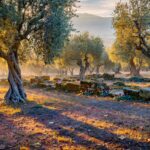
The road from Anafonitria to the cliff viewpoint passes through a landscape that the northwestern interior of the island preserves largely unchanged. It features olive groves, limestone outcrops, and the low stone walls that divide agricultural land in the Ionian Islands tradition. The route also passes the monastery of Anafonitria. Tradition places the final years of Agios Dionysios here. It is said that he sheltered the murderer of his own brother at this location after the man sought asylum and the saint forgave him.
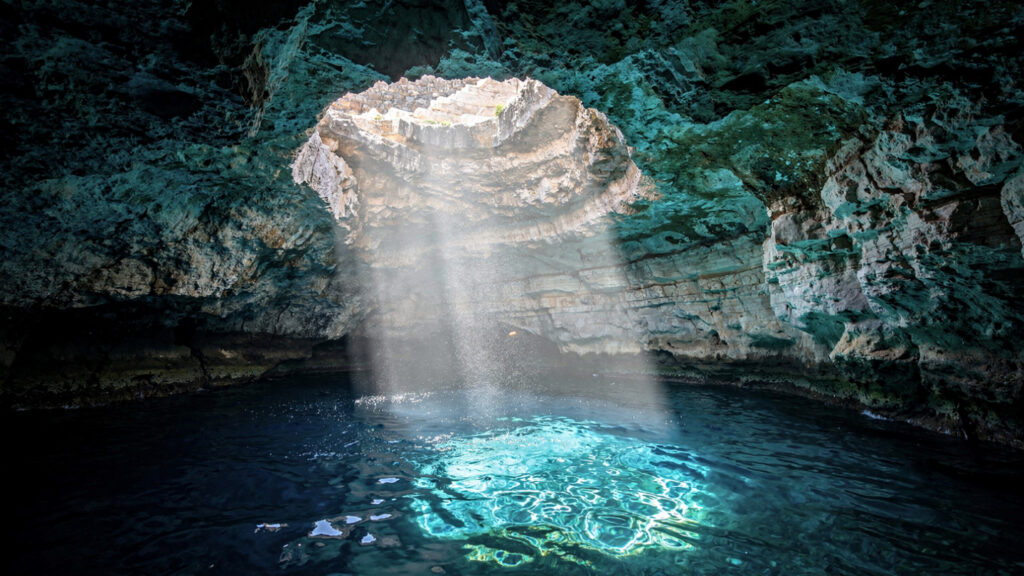
The Blue Caves, accessible by boat from Agios Nikolaos at the island’s northern tip, are sea caves in the cliff base where the refraction of light through the water produces the blue luminescence that gives the caves their name. The effect is most pronounced in the middle of the morning when the sun is at the right angle to illuminate the water inside the cave from below, and the boat tours that visit the caves time their arrivals accordingly.
Laganas Bay and the Turtles
The southern coast of Zakynthos, where the island’s terrain flattens into the sandy beaches the loggerhead turtles return to every year to nest, is managed since 1999 as part of the National Marine Park of Zakynthos, the protected area established specifically to preserve the nesting beaches and the foraging grounds in the bay.
Nesting occurs from June through August. The females emerge from the sea at night to excavate nest chambers in the sand, lay their eggs, cover the nest, and return to the water. The incubation period is approximately fifty days, after which the hatchlings emerge and make their way to the sea, oriented by the natural light horizon that the open sky above the water provides. The presence of artificial light from the beach facilities, which creates a brighter horizon inland than the natural one over the sea, was one of the primary threats to hatchling orientation that the marine park’s regulations were designed to address.
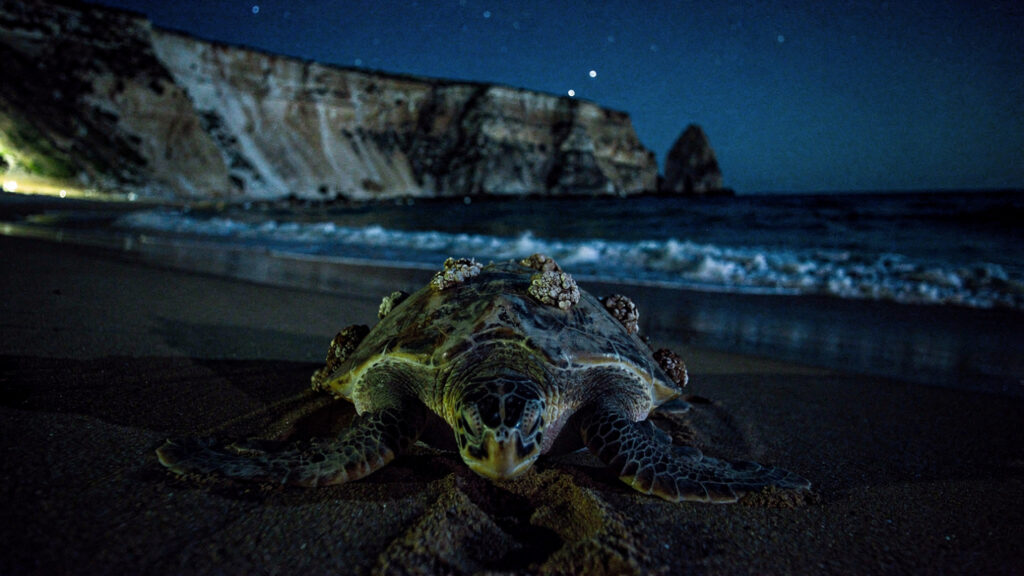
The regulations that govern activity in and around the nesting beaches restrict the use of vehicles on the sand, limit the positioning of beach furniture, prohibit lighting that would disorient hatchlings, and regulate boat access to the bay during nesting season. The turtle watching tours that depart from Laganas and Kalamaki operate within these regulations, with licensed guides who position the boats at distances that allow observation without disturbance.
Gerakas beach, at the southeastern tip of the island on the edge of the marine park, is the nesting beach that the regulations govern most strictly and that provides the most direct evidence of what the marine park has achieved: a beach where loggerhead turtle nests are marked and monitored across the nesting season, where the sand above the waterline shows the tracks of females who have emerged and returned to the sea, and where the visitor is asked to leave before dusk so that the nesting turtles can emerge without human presence.
The Interior and the Agricultural Landscape
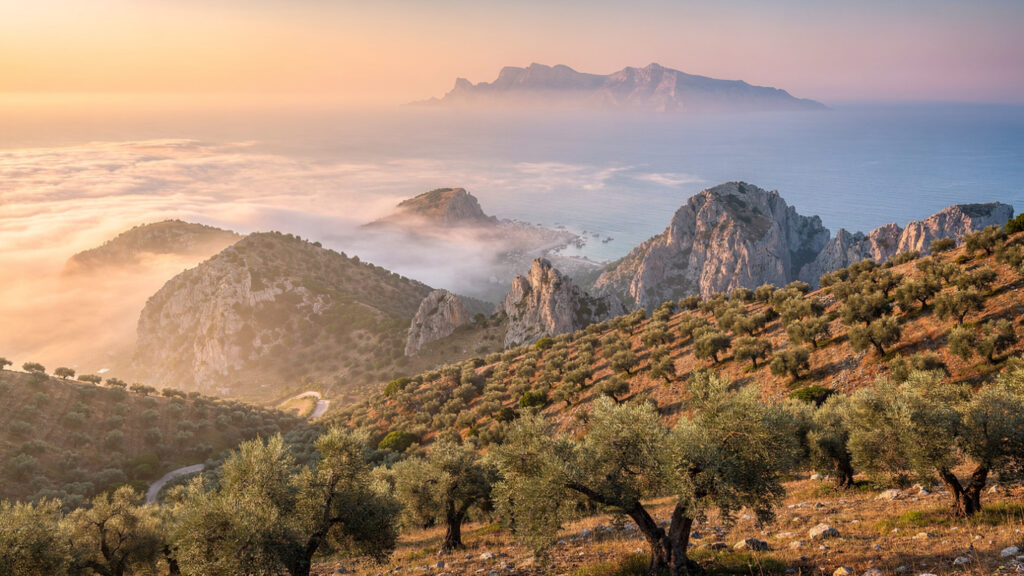
The interior of Zakynthos, between the tourist coast and the mountain in the northwest, holds the agricultural landscape that the island’s economy was built on before tourism became its primary industry.
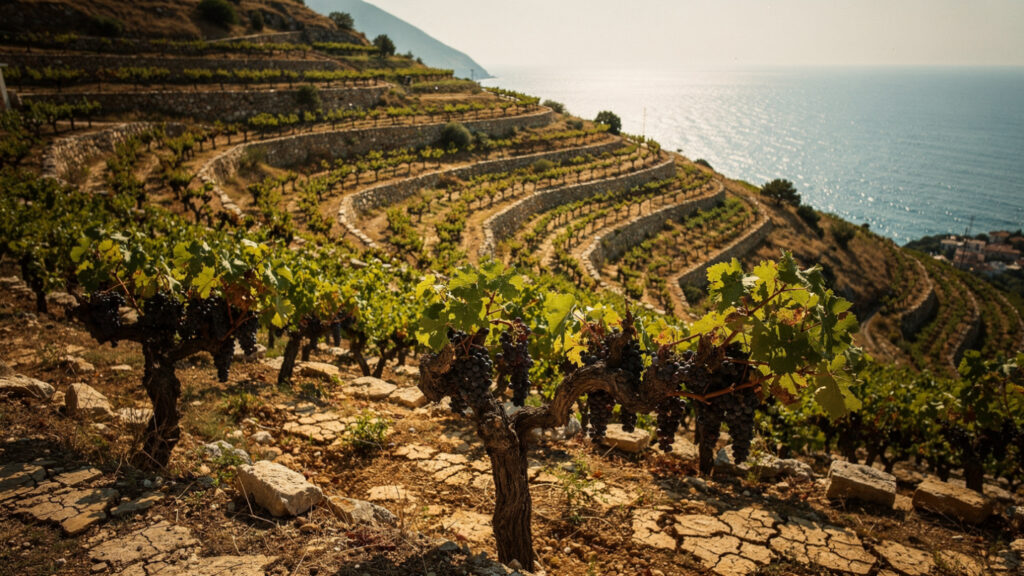
The olive groves, the vineyards, the currant plantations, and the citrus orchards that cover the inland valleys and hillsides reflect the agricultural history that the Venetian administration encouraged and that the island’s soil and climate sustain. The currant grape, the Vitis vinifera variety known internationally as the Zante currant and locally as the korinthi, produces the small seedless fruit on low-trained vines that the island’s winegrowers have been cultivating since the medieval period. The dried currant trade that the Venetians developed through their distribution networks made Zakynthos wealthy enough in the seventeenth and eighteenth centuries to support the artistic production documented in the Byzantine Museum’s collection.
The village of Machairado in the central part of the island holds the church of Agia Mavra, rebuilt after 1953 but preserving the icon of the saint that the pre-earthquake church housed and that was one of the most venerated icons on the island in the Venetian period. The village square, with its bell tower and the plane tree that shades the kafeneion tables, represents the inland social geography of Zakynthos at its most unmodified by tourism.
The Askos Stone Park in the northeastern part of the island is a private nature reserve that maintains the combination of Zakynthian flora and fauna, including native plants and birds and the endangered loggerhead turtle in its terrestrial phase, in a landscape of deliberately managed naturalism. It is the island’s most direct access to the ecological character of the pre-agricultural Zakynthian interior.
Food and the Ionian Table
The food of Zakynthos shares the Venetian inheritance of the Ionian Islands with the cuisines of Corfu and Lefkada, but has local preparations that the island’s agricultural production determines.
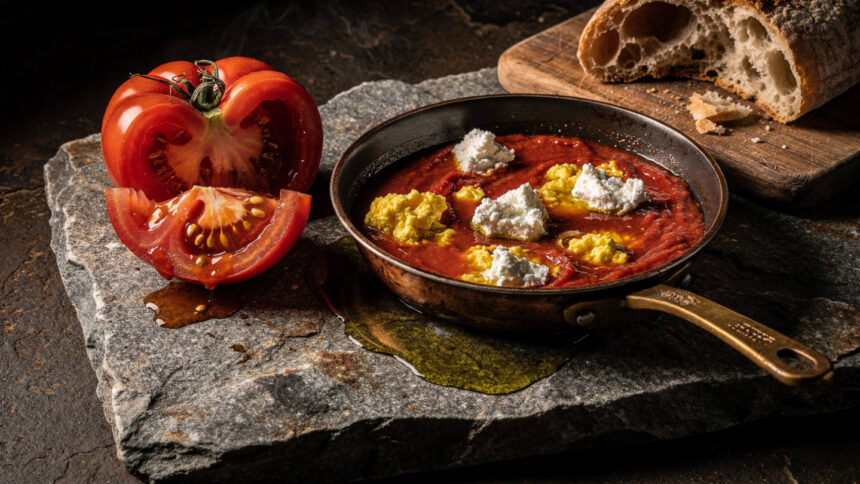
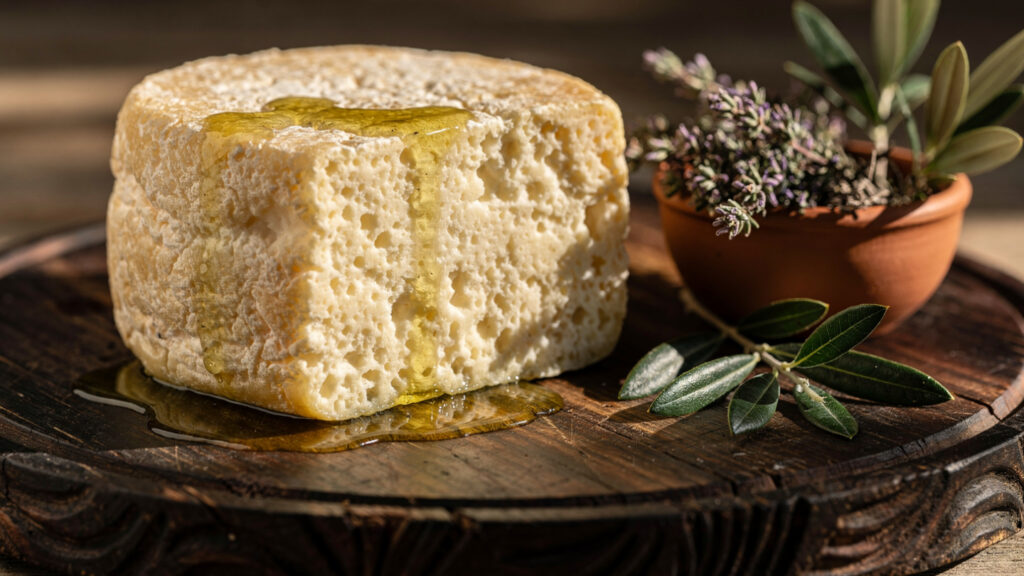
Ladotyri, the olive oil cheese produced on Zakynthos by preserving fresh cheese in olive oil, is the island’s most distinctive dairy product. The name is exact: ladi is oil in Greek, tyri is cheese, and the preparation is the product: a soft, white cheese that has been immersed in local olive oil for a period sufficient to allow the oil’s flavor to penetrate the cheese. The result is a cheese that tastes of the oil that has preserved it, which means it tastes of the olives that produced the oil, which means it tastes of Zakynthos in the way that the best agricultural products taste of their place.
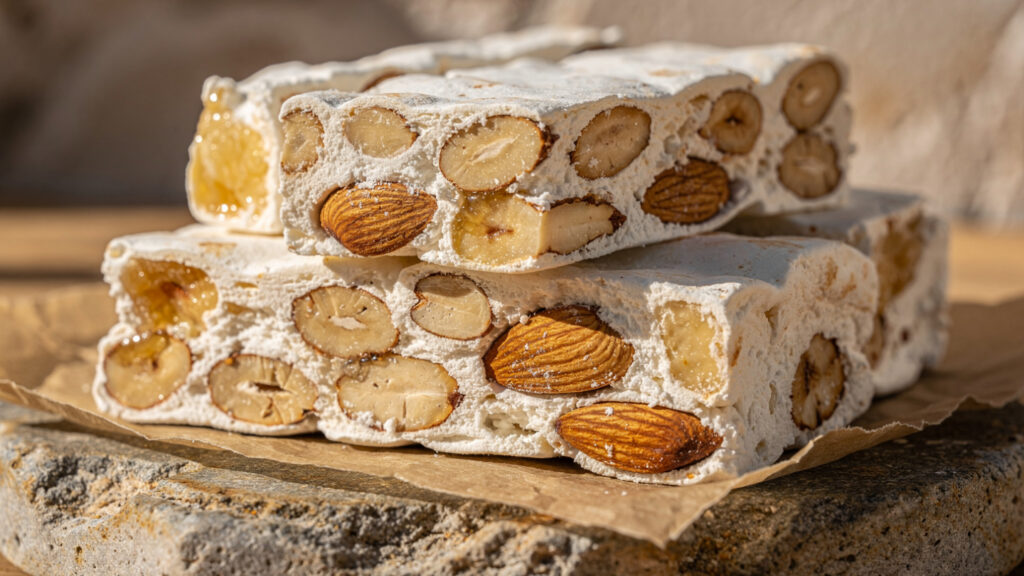
Mandolato, the white nougat made with honey, sugar, egg whites, and almonds, is the island’s most celebrated confection and the one most specifically associated with its festive calendar. The preparation requires honey of quality, traditionally the thyme honey of the island’s dry hillsides, and almonds that are added whole or in pieces rather than ground. It is sold in the confectionery shops of Zakynthos Town in the form that the Venetian-period sugar merchants developed from an older Byzantine sweet, and it is given as a gift at weddings, baptisms, and the major religious feast days.
The wine of Zakynthos, produced from local varieties including the Robola and Verdea grapes, tends toward the orange wine style that the Ionian tradition shares with Corfu, the extended skin contact that produces a wine of more tannin and structure than conventional white wine from the same grape. The Verdea, a grape variety native to Zakynthos, produces a white wine of particular character that the island’s producers have been making in their traditional forms for several centuries.
When to Come
May and June are the months when the island’s full range of qualities is available simultaneously: the turtle nesting has begun, the archaeological and historical sites are accessible without the July-August heat, the agricultural landscape is at the green intensity that the winter rains have produced, and the tourist density is below the peak.
September combines warm sea water, lower visitor numbers than August, and the atmospheric quality that the Ionian autumn produces: clearer air than summer, longer evenings, the harvest underway in the currant vineyards and the olive groves.
The turtle nesting season runs through August, with hatchling emergence continuing through September. Visitors who want to observe turtles in the sea around Laganas Bay should plan their time in the water for the morning, when the turtles are more active at the surface before the beach traffic increases.
The Easter celebrations on Zakynthos have a character that reflects the Ionian customs of the island. The Saturday night service is conducted outdoors in the square. The midnight illumination of candles is carried through the crowd. The fireworks follow the announcement of the Resurrection. On Zakynthos, these are discharged in quantities that the island’s enthusiasm for the occasion justifies and that visitors from quieter Easter practices find memorable.
At Olympus Estate, Wanderlust Greece guides you across the sacred and storied terrain of the Hellenic world, from the nesting beaches where the loggerhead turtles return every summer, contemporaries of the earliest dinosaurs, to the clifftop above Navagio where the Ionian light makes turquoise of the water two hundred meters below. Zakynthos keeps its own time.