




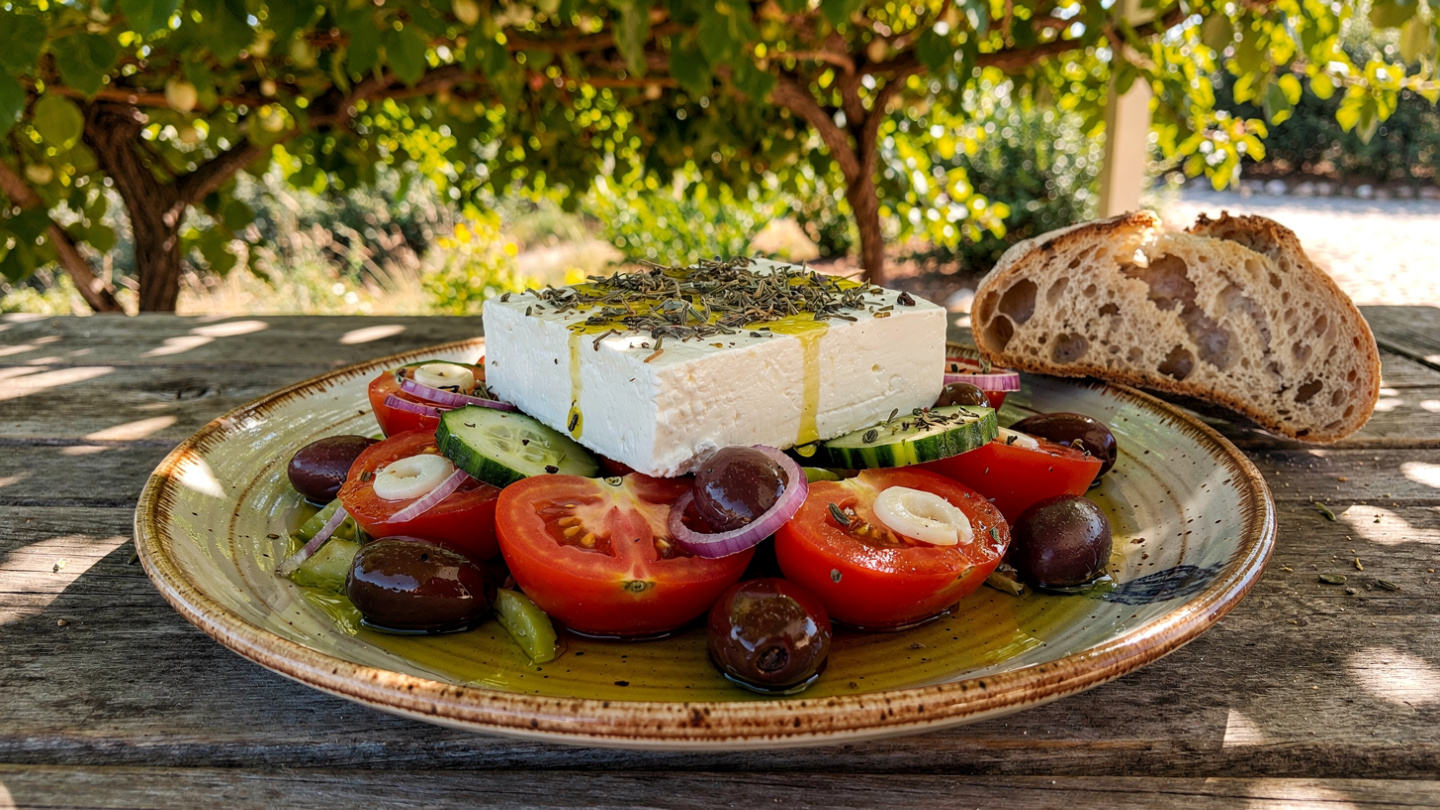
There is no recipe for the horiatiki.
This is the first thing to understand, and it is the thing that most of the world’s reproductions of the dish fail to understand. The horiatiki, the village salad that Greece has been eating in its summer months since at least the classical period, is not a combination of ingredients assembled according to instructions. It is a relationship between ingredients at a moment in the agricultural year, and the relationship produces the dish rather than the recipe producing it.
The tomato must be ripe. Not store-ripe, not vine-ripened in a greenhouse, not red and firm from cold storage. Ripe in the sense that a Greek August tomato is ripe: grown in full sun, in soil that the summer heat has dried and the olive tree roots have not competed for, until the sugar content is as high as it will get and the flesh has lost the water that early harvest preserves and the acids have been balanced by the time on the vine. This tomato, cut into irregular wedges rather than uniform slices because irregular wedges expose more surface to the olive oil and the salt, is the ingredient that everything else in the dish is assembled around.
Without this tomato, the horiatiki is a different dish. A good dish, perhaps, depending on the quality of its other components, but not the horiatiki that the Greek summer table has been serving for three millennia.
What the Village Salad Is
The word horiatiki means village, and the salad it names is the salad that the Greek village table produced in summer from what the garden and the olive grove and the cheese cellar offered simultaneously: tomatoes, cucumbers, onions, olives, feta, olive oil, and the dried oregano that grows wild on the mountain slopes above every Greek village in sufficient quantity to perfume everything it touches.
These are not ingredients chosen for their nutritional profile or their compatibility in some abstract culinary sense. They are the ingredients that were present in the Greek summer landscape at the same time, available to the same household without requiring purchase or trade, and the combination that evolved from this co-availability proved to be one of the most complete and satisfying food preparations that the Mediterranean world produced. The horiatiki is not a designed dish. It is the product of a geography, a season, and several thousand years of people eating what was in front of them.
The structural principle is the same as the Aegean culinary tradition’s most fundamental insight: the best ingredient in its season, dressed with olive oil of sufficient quality to be a flavor in its own right, finished with the dried herb that the landscape provides in abundance, and served with bread. The horiatiki does not add to this. It is this, made with the ingredients that the Greek summer makes available.
The Ingredients and Their Requirements
The tomato carries the dish’s primary flavor and its structural identity. The variety that Greek summer tables use traditionally is large, irregularly shaped, deeply red, and fully ripe: the type sold at Greek markets as tomates horiatikes, village tomatoes, in direct reference to the same horiatiki tradition the salad belongs to. The flavor of a properly ripe Greek summer tomato at room temperature, dressed with olive oil and sea salt, is the flavor the horiatiki is built around. Every other ingredient serves it.
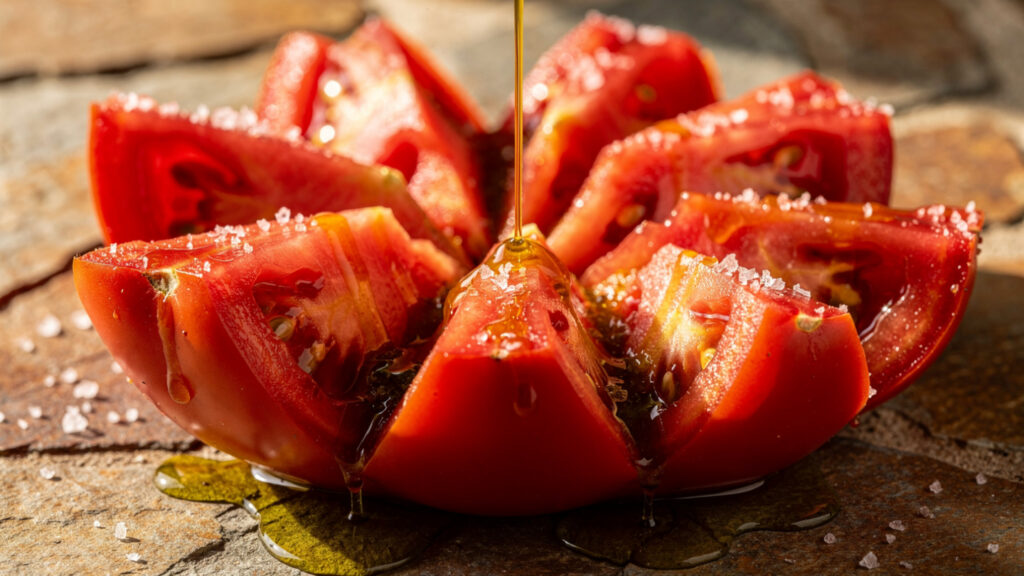
The tomatoes should be cut into large irregular wedges rather than slices. The irregular cut is not rustic carelessness. It exposes more of the tomato’s inner flesh, with its concentrated juice and flavor, to the olive oil and the salt, and produces a piece of tomato that provides more eating in a single forkful than a thin slice allows.
The cucumber should be the thin-skinned variety rather than the thick-skinned greenhouse type. The thin-skinned cucumber, which the Greek summer garden produces naturally without the controlled-humidity conditions that the greenhouse variety requires, has less water, more concentrated flavor, and a skin that does not need to be removed and that adds a slight bitterness that the dish’s overall sweetness requires as a counterpoint. Sliced into rounds or half-rounds, not diced, it provides a clean crunch against the tomato’s softness.
The green pepper appears in the traditional horiatiki in a form that surprises visitors who know the dish only from tourist-oriented versions: a few thin rings of raw green pepper, sweet rather than hot, added for their grassy freshness and their color rather than for any dominant flavor contribution. The pepper is present and then recedes, leaving its freshness in the mouth alongside the tomato and cucumber without asserting itself.
The red onion is sliced thin, not diced. The thin slice softens in the olive oil as the salad sits and loses its raw sharpness while retaining its flavor, providing the pungency that the dish needs without the aggressive bite that thicker cuts would deliver. Some versions salt the onion briefly before adding it to draw out some of its sharpness, a step that produces a milder result for those who find raw onion too assertive.
The Kalamata olive is the only olive that the traditional horiatiki uses, and the substitution of a different variety changes the dish in a way that is immediately perceptible. The Kalamata is an elongated dark olive from the Messenia region of the southern Peloponnese, cured in brine or red wine vinegar, with a combination of brininess, fruity flesh, and the slight vinegar note of the cure that no other olive replicates. Its role in the horiatiki is not simply to provide an olive flavor. It provides the salt and the vinegar and the fat together, in the proportions that the Kalamata’s composition delivers, and it is not replaceable by a generic black olive.
The feta should be in a single block, placed on top of the assembled salad, uncrumbled and uncut. This is not presentation for its own sake. The block of feta allows each person eating the salad to take whatever ratio of cheese to vegetable they prefer at any given moment by cutting from the block with the fork as they eat. Crumbling the cheese distributes it through the salad in a predetermined ratio that removes this choice. The block is also a visual statement about what the ingredient is: a specific, substantial, deliberately chosen thing rather than a seasoning.
The feta’s PDO status, confirmed by the European Court of Justice in 2005, means that the name is legally restricted to cheese made from sheep’s milk, or from sheep’s and goat’s milk in traditional proportions, produced in specific Greek regions according to established methods. This protection exists because the flavor of properly made Greek feta, its saltiness, its acidity, and the fatty‑acid profile of sheep’s milk, is what the horiatiki is calibrated around. A cow’s‑milk feta‑style cheese has a different flavor and a different texture, and its contribution to the dish changes in ways that matter.
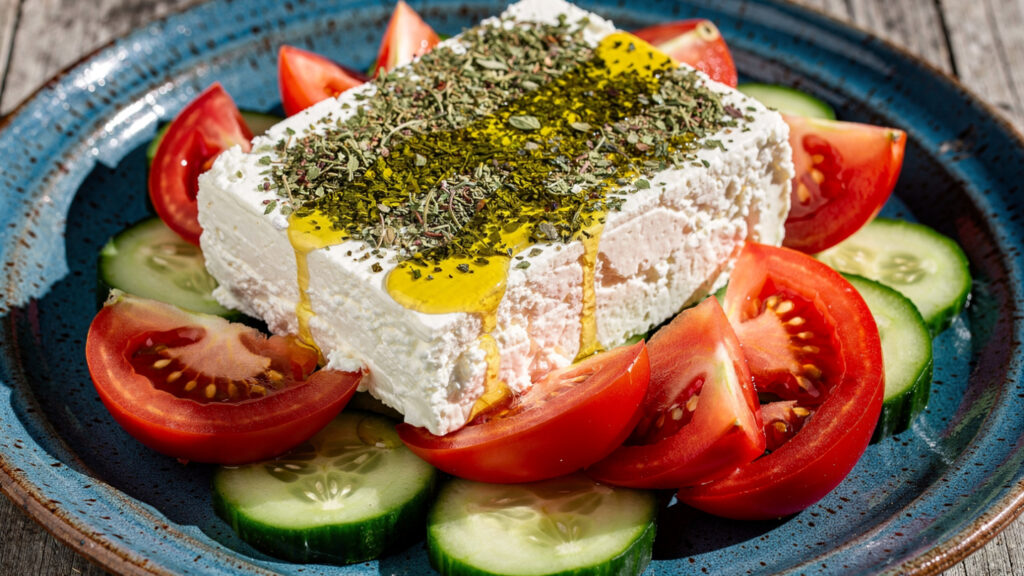
The olive oil is the dish’s dressing, its sauce, and its final ingredient simultaneously. It should be extra virgin, which means it was cold-pressed from olives that were not chemically processed to extract the oil, and it should be Greek, not for nationalist reasons but because the Greek olive oils, particularly the Koroneiki variety of the Peloponnese and the varieties of Crete and Lesbos, have a peppery, grassy, present character that suits the horiatiki in a way that the milder oils of other traditions do not. The olive oil should be poured generously enough that it pools in the base of the bowl as the salad is eaten. That pool is not waste. It is the bread course.
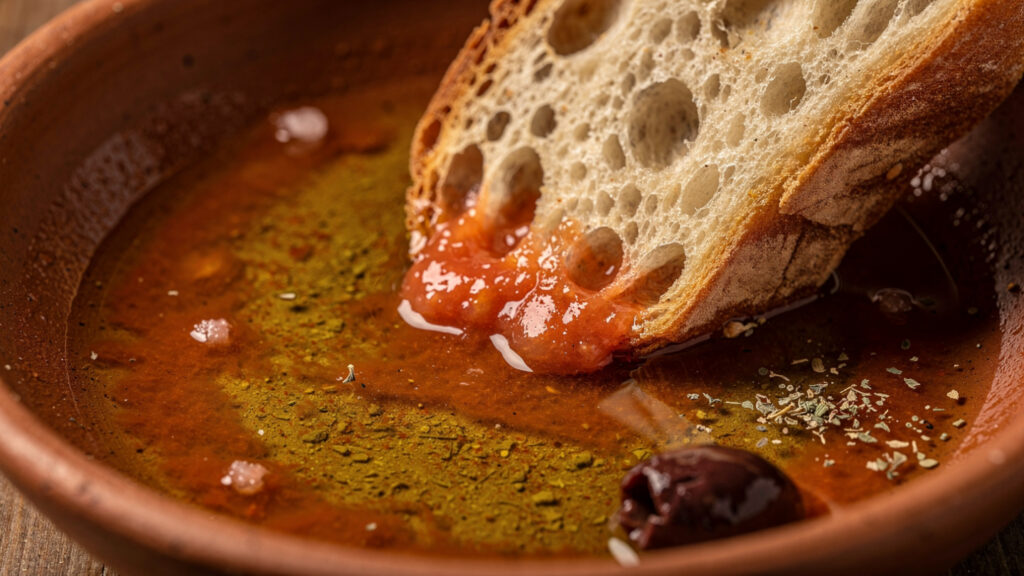
The dried oregano must be Greek mountain oregano rather than the cultivated variety. The wild Origanum vulgare that grows on the limestone slopes above Greek villages in the summer months, dried in the sun and crumbled before use, has an aromatic intensity that the cultivated greenhouse variety does not approach. It is not a different species. It is the same plant grown under conditions of stress, drought, poor soil, and full Mediterranean sun, which concentrate the essential oils that produce the herb’s flavor to a degree that cultivation in good soil and adequate water does not produce. Rubbed between the fingers before it is scattered over the feta and the vegetables, it releases its fragrance immediately and distributes it through the salad as the oil carries it.
The bread is not an accompaniment in the conventional sense of something eaten alongside the main dish. It is the final stage of the horiatiki, the instrument with which the olive oil and tomato juice that have pooled in the base of the bowl are consumed. Eating a horiatiki without bread is leaving the best part of the meal on the plate.
The Assembly
Combine the tomato wedges, cucumber rounds, pepper rings, and onion slices in a wide bowl or on a plate. Scatter the Kalamata olives among the vegetables. Pour the olive oil over the surface. Sprinkle sea salt lightly over everything. Place the block of feta on top. Crumble the dried oregano between your fingers over the feta and the vegetables.
Bring to the table. Eat with bread.
There is no step between the assembly and the table, and there is no step between the table and the eating. The horiatiki does not improve with time. The tomato begins to release more juice and the cucumber softens as it sits, and both of these changes move the dish away from its best state. The best horiatiki is eaten within ten minutes of assembly, in the heat of an August afternoon, at a table that has been set in the shade of an olive tree or a vine-covered pergola, with a carafe of cold water and enough bread to finish the oil.
What the Nutritional Literature Gets Right and Wrong
The health literature that has accumulated around the Mediterranean diet, of which the horiatiki is frequently cited as a representative preparation, is accurate in its broad claims and reductive in its ones.
The broad claim is accurate: a diet built around the combination of olive oil, vegetables, legumes, fish, and modest amounts of dairy that the Mediterranean countries have historically eaten is associated with lower rates of cardiovascular disease, certain cancers, and cognitive decline than diets built around different combinations. The evidence for this association is substantial, consistent across multiple study designs, and has been replicated in populations across the Mediterranean basin and in Mediterranean diaspora communities elsewhere.
The reductive claim is the one that lists the nutritional properties of the horiatiki’s individual components, the lycopene in the tomatoes, the quercetin in the onions, the monounsaturated fatty acids in the olive oil and the olives, and presents the dish as a delivery mechanism for these compounds. This framing is not wrong in its individual facts, but it misrepresents the relationship between the ingredients and the dish’s health significance.
The tomatoes in the horiatiki provide lycopene. They also provide the flavor that makes the dish worth eating, which is the reason it is eaten daily through the Greek summer and therefore the reason its nutritional contribution is sustained rather than occasional. The olive oil provides monounsaturated fatty acids and polyphenols. It also provides the flavor that makes the combination of tomatoes and feta and olives into something that a person would choose to eat over the available alternatives, which is the basis on which any dietary pattern is maintained. The health benefits of the Mediterranean diet are inseparable from the palatability of the Mediterranean diet, and the palatability of the Mediterranean diet is inseparable from the quality of its primary ingredients at their seasonal best.
The horiatiki is healthy because it is good, and it is good because its ingredients, at their seasonal peak, dressed with olive oil of sufficient character, are among the best combinations of flavors and textures that the summer Mediterranean table produces. These are not separate facts. They are the same fact.
The Dish Across the Regions
The horiatiki varies by region in ways that the tourist version, which tends toward a single standardized form, does not capture.
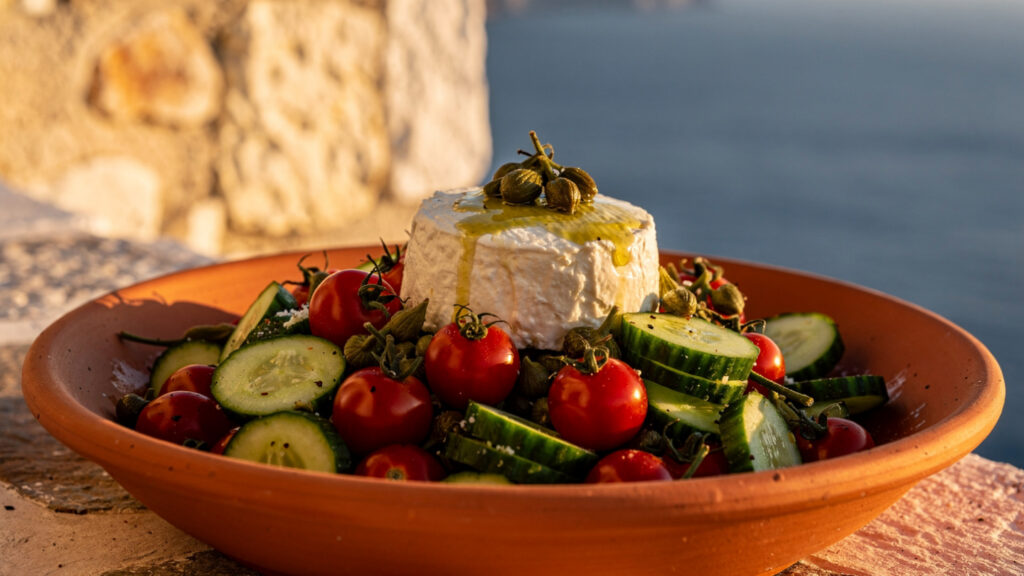
In the Cyclades, the version that the islands produce in summer tends to use the small cherry tomatoes that the volcanic or limestone island soil produces, alongside the capers that grow wild on the island walls and that add a brininess distinct from the olive’s brininess. The Santorini horiatiki with cherry tomatoes, capers, and Santorinian feta is a different dish from the mainland version with its large beefsteak tomatoes, not better or worse but specifically different in the way that the terroir of each place communicates to what it produces.
In Crete, the horiatiki may include dakos, the dried barley rusk that the Cretan kitchen soaks in tomato juice and olive oil as the base for a related preparation, the dakos salad, which occupies the same culinary position as the horiatiki but with the added dimension of the soaked bread as part of the dish rather than alongside it. The Cretan olive oil, from the Koroneiki variety that covers approximately 65 percent of Cretan olive cultivation, has a character, more intensely peppery and aromatic than most mainland varieties, that the Cretan horiatiki is built around.
In Macedonia, where the summers are shorter and the tomato season more compressed, the horiatiki is a more seasonal event than in the southern islands and Peloponnese: more eagerly anticipated, more explicitly tied to the weeks when the conditions are right, and consumed with an intensity that the places where the season lasts longer do not quite produce.
All of these are the horiatiki. The dish is not a fixed formula but a relationship between ingredients and a season, expressed through the particular character of each place’s ingredients in that season.
The Full Recipe for Four
- 4 large ripe tomatoes, cut into large irregular wedges
- 1 medium cucumber, thin-skinned, sliced into rounds
- 1 small green pepper, sliced into thin rings
- 1 small red onion, sliced thin
- 1 cup Kalamata olives, unpitted
- 200g feta, in a single block
- 4 to 5 tablespoons extra virgin Greek olive oil
- 1 teaspoon dried Greek mountain oregano, rubbed between the fingers
- Sea salt, to taste
- Crusty bread, to serve
Arrange the tomatoes in a wide, shallow bowl. Add the cucumber rounds, pepper rings, and onion slices among and over the tomatoes. Scatter the olives across the surface. Pour the olive oil generously over everything. Sprinkle sea salt lightly. Place the block of feta on top. Crumble the dried oregano between your fingers and scatter it over the feta and the vegetables.
Eat within ten minutes of assembly. Eat with bread. Finish the oil in the base of the bowl.
At Olympus Estate, Food and Seasonal Life traces Greek cuisine as a living calendar. The horiatiki is the summer table’s most direct statement: the best ingredient at the right moment, dressed with olive oil that earns its place, eaten with the bread that completes it. No recipe required. Only the August tomato.