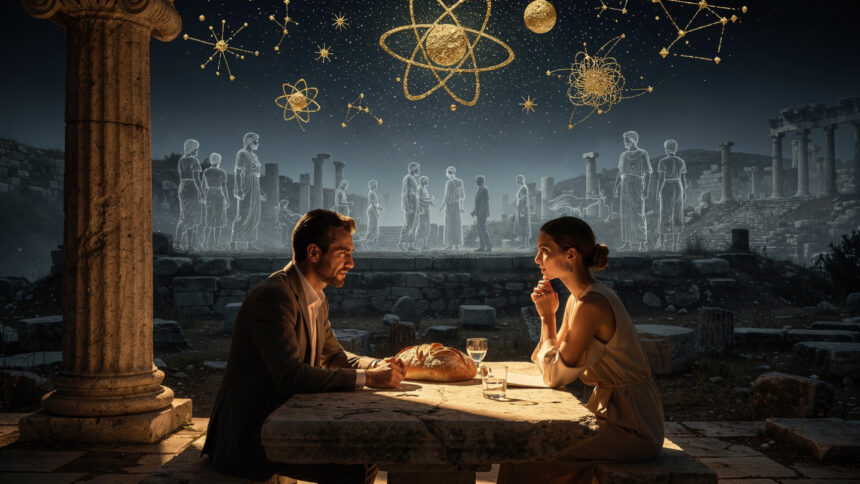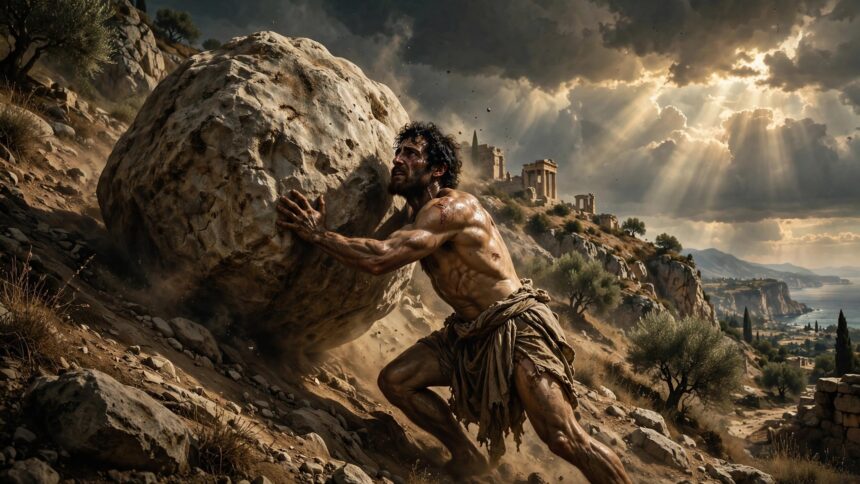

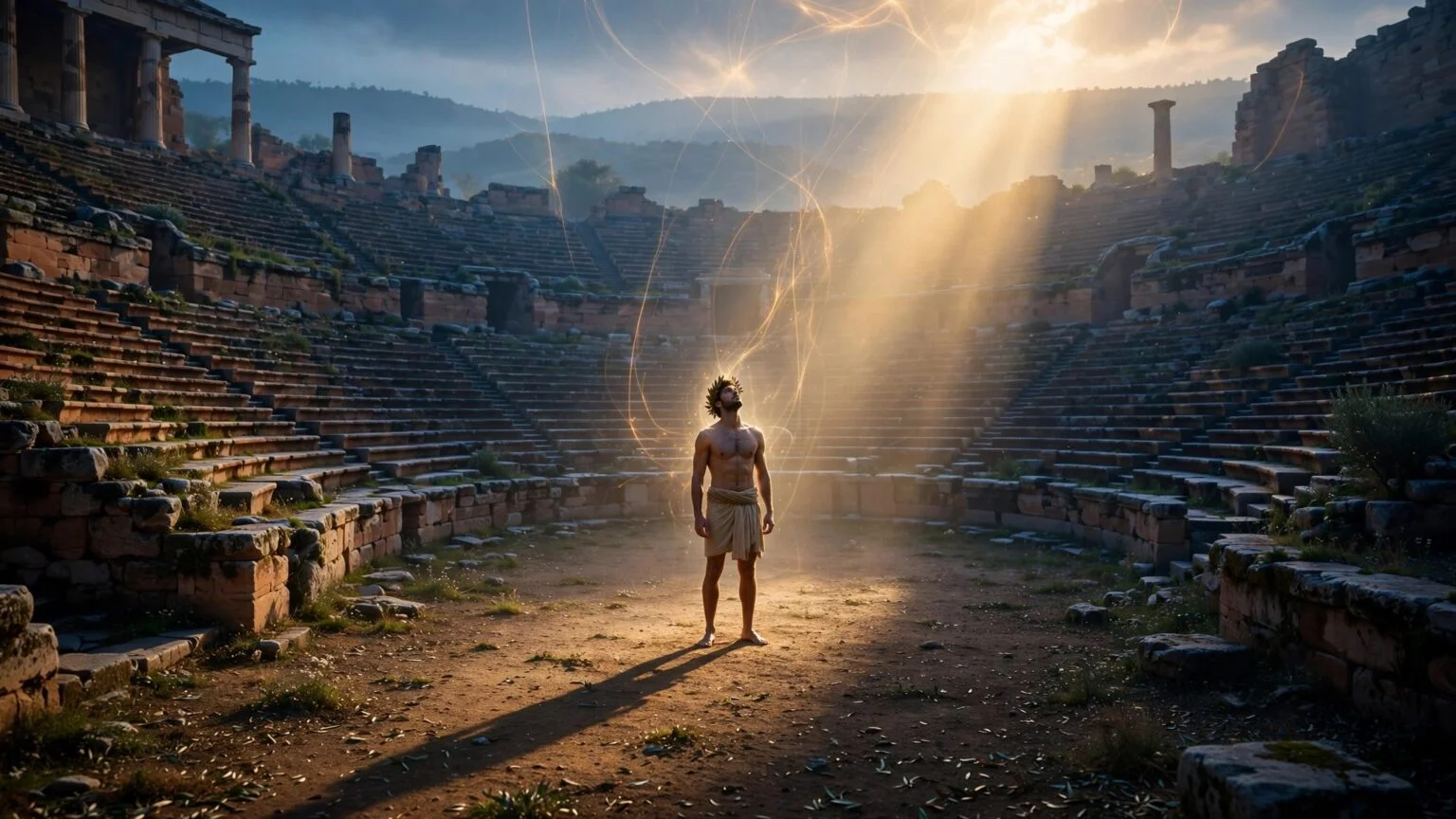
The gods cannot win at Olympia.
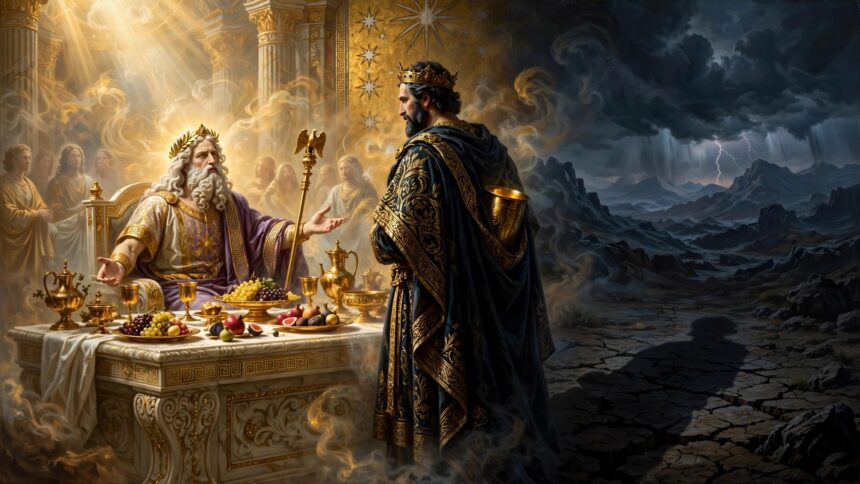
This is the observation that Pindar’s entire poetic project is built around, though he never states it so baldly, because the oblique, compressed, image-saturated language he developed for his victory odes was designed to communicate truths too large for direct statement. The gods cannot win at Olympia because the gods cannot lose. Victory requires the genuine possibility of defeat, and the gods, whose existence is permanent and whose capacities are not subject to the kind of physical and psychological risk that human athletic competition involves, cannot authentically enter the kind of contest that produces authentic victory.
Only mortals can win. Only mortals can fail. And it is precisely this condition of genuine at-risk existence, this mortality that Pindar’s patrons were daily trying to transcend through athletic achievement and the fame that followed it, that makes the moment of victory theologically significant rather than merely athletically impressive. Do not, my soul, strive for the life of the immortals, Pindar writes in the Third Pythian, and the line has been read since antiquity as a warning against hubris, the overreach that the gods punish. It is more precise than that: it is a philosophical statement about where the value actually is. The life of the immortals is, by definition, not the life whose brief brilliant moment of excellence the Pindaric ode exists to preserve. The immortal life is not the one that wins anything worth winning.
Pindar wrote approximately forty-five surviving victory odes, the epinician poems commissioned by the victors of the four great Panhellenic festivals, Olympia, Pythia, Nemea, and Isthmia, composed between approximately 498 and 446 BCE. While the odes are primarily focused on individual victors, they also explore broader themes of innate human excellence and the moral character of the gods. The poet’s intention is to immortalize both the achievements of the victors and the glory of the divine, suggesting that athletic triumphs elevate humanity to a divine level, even if momentarily.
Even if momentarily. That qualification carries the entire weight of Pindar’s philosophical position: not permanently, not continuously, not constitutively. Momentarily. The moment of victory is the moment the human and the divine touch, and then the moment passes, and the human remains human. What the poem preserves is not the divinity but the touching.
Who He Was and Why He Matters for This Collection
Pindar of Thebes was born around 518 BCE and died around 438 BCE, living through the Persian Wars, the golden age of Athenian democracy, and the consolidation of the Panhellenic festival system that his odes both celebrated and helped to sustain. He was born into an aristocratic Boeotian family connected to the priestly traditions of the Theban Apollo sanctuary, and his education in the choral lyric tradition gave him the craft basis for a form of poetry that required not only literary composition but musical composition, choreographic planning, and the management of a relationship between the commissioned poem and the civic life of the city that commissioned it.
He was commissioned by the most powerful men in the Greek world. There was Hieron, tyrant of Syracuse. There was Theron, tyrant of Akragas. There was the royal family of Cyrene, and the aristocratic families of Aegina whose athletic achievements recur across the Nemean and Isthmian odes. Gregory Nagy’s work on Pindaric poetics situates it within the wider oral tradition, where the poet’s role as mediator between mortal achievement and divine memory ensures the victor’s kleos, or renown, endures through repeated performance, the same framework this site has already traced through Achilles’s own choice of glory over a long, forgotten life. Pindar was not just writing poems about athletes. He was the instrument through which the tradition of oral commemoration, which had kept the names of heroes alive across the centuries between the Bronze Age and the archaic period, was extended into the present tense of fifth-century Greek achievement. The athlete who commissioned a Pindaric ode was asking to be placed inside the same commemorative tradition as Achilles and Heracles and the Argonauts.
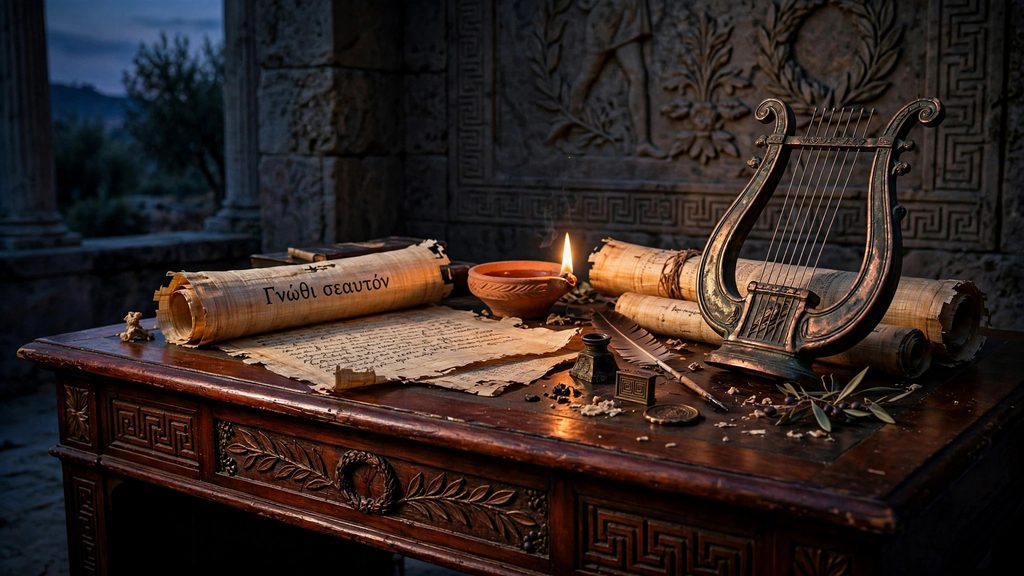
This is why Pindar matters so directly for a site that has spent months building a wide treatment of Greek mythology and culture. He is the primary ancient literary source for several of the mythological treatments this site has already produced: the Argonautica’s account of the Golden Fleece in its most compact and most theologically sophisticated form comes from Pindar’s Fourth Pythian. The account of Pelops’s relationship with Poseidon and the chariot race that founded the Olympic Games comes from the First Olympian. Pindar himself records that Heracles founded the Olympic Games at Olympia after clearing Elis. The account of Asclepius’s birth and death is in the Third Pythian. The genealogy of the Dioscuri is in the Tenth and Eleventh Nemeans. Pindar’s epinician odes integrate mythological narratives as a core structural element, typically comprising up to one-third of the poem’s length, to parallel the victor’s athletic triumph with heroic precedents and divine interventions.
Every time this site has cited Pindar in another article, it has been drawing on a poet whose treatment of Greek myth was not merely recording what others had said before him but was making original, philosophically sophisticated, theologically precise choices about which version of each myth to tell and why. He was not a reporter of mythology. He was a mythological thinker whose choices shaped how the fifth-century Greek world and every subsequent Western tradition understood the heroes and the gods.
The Structure of the Ode and Why It Works That Way
A Pindaric ode is not a poem that proceeds from beginning to end in a linear narrative. It moves the way a mind moves when it is thinking about something enormous: associatively, by sudden juxtaposition, through the collision of myth and present occasion that produces meaning in the gap between them rather than in either term alone.
After a brief introduction on the theme of excellence or human achievement, Pindar quickly mentions the victor, the festival at which he has won his victory, and the event. But the structural account of the ode misses what the ode actually does, which is to create, through the juxtaposition of mythological narrative and contemporary athletic achievement, a kind of temporal collapse: the mythological past and the athletic present are placed in explicit parallel, and the parallel produces the claim that what the athlete has just done belongs to the same order of significance as what the heroes of the tradition accomplished.

This is the Pindaric argument for the importance of athletic victory, and it is considerably more sophisticated than simple flattery. Pindar is not saying that the victor who won the wrestling at Olympia is as great as Heracles. He is saying that the victor who won the wrestling at Olympia has, in that moment of victory, participated in the same category of human excellence that made Heracles what he was: the category of achievement that is meaningful precisely because it was genuinely at risk, because the possibility of failure was real, because the divine capacities that made the achievement possible were channeled through a mortal body that could have failed and didn’t.
Reciprocity between human and divine action is one of Pindar’s great themes. The god’s contribution to the victory is real and is acknowledged in the ode: Hera’s patronage, Apollo’s guidance, Poseidon’s love for Pelops. But the victory is not the god’s victory. It is the mortal’s victory, made possible by divine favor but performed by a body that suffers and tires and can be defeated, in a competition that the divine presence can support but cannot replace. The athlete at Olympia is the instrument through which divine and human excellence cooperate, and the cooperation produces something that neither can produce alone.
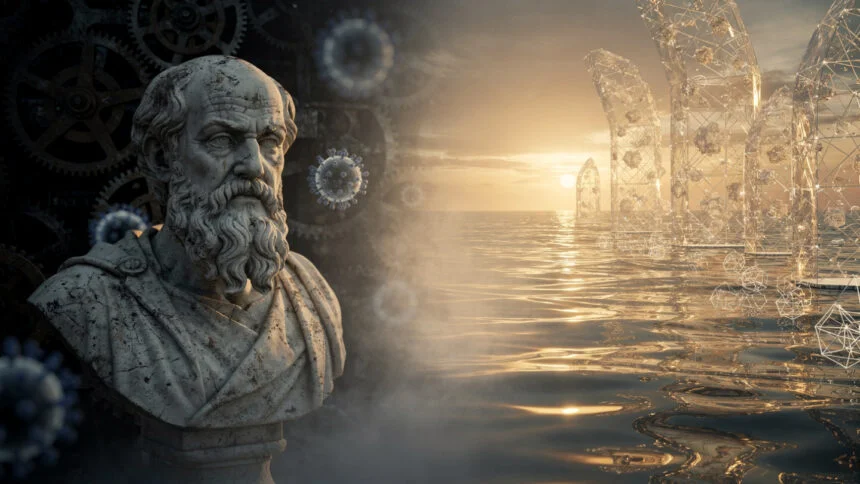
Divine favor contributes to and cooperates with human excellence, and one modern reader has proposed that the two are best understood as two ways of indicating the same underlying reality, in the manner that a wave and a particle describe the same phenomenon in modern physics. The comparison is anachronistic in its vocabulary but faithful to its subject: the myth as the wave function, the athletic achievement as the particle, the same reality appearing differently depending on how you are looking at it.
The Boundary That Fascinates Him
The scholarly tradition that has done the most sustained and most useful work on Pindar in recent decades has consistently identified the same central preoccupation: the boundary between mortal and immortal existence, and the specific figures whose mythological biographies occupy that boundary in ways that illuminate what is at stake on both sides.
Focusing on a set of mythical figures whose identities blur the boundaries between mortality and immortality, Heracles, the Dioscuri, Amphiaraus, and Asclepius, Pindar revalues mortality as a prerequisite for the glory found in victory.
Heracles, who crossed from mortal to divine through the mechanism of suffering beyond what any mortal had previously suffered, appears repeatedly in the odes as the paradigmatic figure for the athlete’s own aspiration: not the god Heracles of Olympus but the mortal Heracles of the labors, the being whose achievement was valuable precisely because it was achieved from the mortal side of the boundary rather than given from the divine one. The site’s own essay on Heracles, which this collection has already produced, draws heavily on the Pindaric understanding of the hero as achiever rather than the hero as given.
The Dioscuri, Castor and Polydeuces, who alternate between the divine and mortal realms on a schedule imposed by the limitations of divided immortality, are Pindar’s most precise single instance of the boundary between divine and mortal existence being inhabited rather than only crossed: they are simultaneously the site of the crossing and its vehicle. Nemean 6 in particular has been read by modern scholars as consistently featuring this same boundary-blurring between the human and divine realms.

Asclepius, the divine physician whose birth from a mortal mother and a divine father placed him at the boundary, and whose death by Zeus’s thunderbolt for crossing the boundary between life and death by resurrecting a mortal who should have stayed dead, is the Third Pythian’s central figure and Pindar’s most sustained meditation on what happens when someone attempts to make permanent what the structure of the world requires to remain temporary. The human who is resurrected should have stayed dead. The boundary that Asclepius’s art crossed was the one that maintained the distinction between divine and mortal existence, and crossing it permanently would have dissolved the value that Pindar’s entire poetic project was built around preserving.
Nemean 6 | The Half-Divine Line
The sixth Nemean Ode opens with what is possibly the most philosophically compressed statement in the entire Pindaric corpus, and the statement is the one this essay has been building toward from its first paragraph:
One is the race of men, one the race of gods, but from one mother do we both draw our breath. Yet wholly divided is the power that separates us, so that the one is nothing, while for the other the brazen heaven endures as a sure abode forever. But we resemble the immortals greatly, whether in greatness of mind or in nature, though we know not what course, by day or in the night hours, fate has written that we should run to the end.
One mother. Both human and divine draw their existence from the same primordial source. But wholly divided is the power. The sharing of origin does not produce a sharing of condition: the gods endure in the brazen heaven forever, while for humans even a single day can change everything. We resemble the immortals greatly in mind or in nature: in the moments of our greatest excellence, in the quality of attention or achievement that the athletic contest or the heroic deed demands, we are genuinely similar to what the gods are always. But we do not know which day or night fate has written as our last.

This is the complete Pindaric argument in a single passage: the resemblance to the divine is real, the difference is real, the resemblance is most complete in the moments of greatest achievement, and those moments are most significant precisely because the mortality that surrounds them means they cannot be predicted to continue. The athlete who wins today might be dead tomorrow. The god who was there today will be there forever. The athlete’s victory means more.
What He Did With the Myths He Used
The mythological choices Pindar made were not merely the selection of relevant stories from an available catalogue. They were original interpretive decisions about which version of a myth to tell, and why, and what theological and ethical argument the chosen version made possible that the alternative versions would not.
The most famous single example is the First Olympian, commissioned for Hieron of Syracuse after his horse Pherenikos won at Olympia in 476 BCE. The ode tells the story of Pelops, the figure whose mythological connection to Olympia this site has documented in the Peloponnese article: the son served by Tantalus to the gods at a feast, restored to life, courted by Poseidon, who eventually won the chariot race against Oenomaus that founded the Olympic dynasty.
But Pindar explicitly rejects the version of the myth in which Pelops was actually eaten by the gods. He refuses to repeat what he calls the monstrous tale, the story of cannibalism at a divine feast, and replaces it with a version in which the gods, recognizing what Tantalus had done, restored Pelops to life untouched, and Poseidon fell in love with him and took him to Olympus. The rejection is not mere squeamishness. It is a theological argument: the gods do not eat human flesh. A story that depicts them doing so misrepresents the divine nature, and a poet whose function is to mediate between human achievement and divine memory has an obligation to represent the divine accurately rather than to repeat whatever earlier poets happened to have said.
Pindar uses mythic narratives as a kind of model past, adjusted to serve an ethical purpose, so that the myth becomes a demonstration of an ethical argument rather than a story merely repeated intact. Pindar’s mythology is curated mythology, and the curation is not distortion but the kind of selection that a thinker with a coherent theological position makes when he decides which version of a story best represents the truth about what gods and humans are and how they relate to each other.

The Fourth Pythian, the longest of the surviving odes at 299 lines, was commissioned by Arcesilas IV of Cyrene after his chariot victory at Pythia in 462 BCE. It tells the Argonaut story in the most compressed and most theologically sophisticated form available in the ancient tradition: not as adventure narrative but as the account of how divine prophecy works through human action, how Medea’s speech of welcome to the Argonauts encodes the future foundation of Cyrene, how the thread connecting Jason’s achievement to the fifth-century Cyrenaean king’s athletic victory runs through the mechanism of divine intention working through mortal capacity across generations.
The Fourth Pythian is, among other things, the Argonautic tradition’s first great literary treatment. Apollonius of Rhodes, who wrote the full Argonautica two centuries later, examined in full elsewhere on this site, knew the Pindaric version and was in explicit dialogue with it, extending and elaborating what Pindar had established as the myth’s interpretive framework.
The Warning and What It Actually Means
Do not, my soul, strive for the life of the immortals.
This line, from the Third Pythian, has been read as evidence that Pindar was a conservative moralist whose fundamental message was submission to divine limits. The reading is not entirely wrong: Pindar does consistently warn against hubris, the overreach that the Greeks consistently associated with divine punishment, and the odes consistently frame the athletic victor’s achievement within a context of gratitude to the gods rather than competition with them.
But the warning’s full meaning requires the context of what follows it in the Third Pythian, which is commissioned for Hieron of Syracuse, who is ill, and which addresses the situation of a powerful man whose wealth and military success have not prevented him from suffering the bodily limitations that all mortals share. Pindar does not tell Hieron that divine power is preferable to human power. He tells him that human power, exercised to its fullest within human limits, is the correct object of aspiration and the correct measure of value. The life of the immortals is not the standard against which Hieron’s life should be measured, because the life of the immortals is not at risk in the way that produces the kind of value the Pindaric ode exists to preserve.
The congratulatory ode is full of elegiac feeling for human sorrow, the outcome of human limitations. Joy is alloyed with, and deepened by, grief. The myth centers around the mortality of Achilles who, great champion though he was, could only do to others what he was ultimately destined to suffer himself.

Joy alloyed with grief. This is the emotional register of the Pindaric ode, and it is the register that distinguishes it from simple celebration of athletic achievement: the victory is genuine and genuinely worth celebrating, and the mortality that makes the victory possible and the sorrow that mortality inevitably produces are not contradictions of the celebration but its deepest content. You cannot fully celebrate what an athlete has achieved without understanding what it cost them to be the kind of being for whom that achievement was possible, and what it will eventually cost them to be the kind of being for whom that achievement was never going to be permanent.
Why He Is Difficult and Why the Difficulty Is the Point
Pindar’s reputation for obscurity is ancient. Horace compared him to a mountain torrent, swollen by rain, that breaks its banks and rushes down with unstoppable force. The ancient commentators who wrote scholia on his odes acknowledged regularly that his meaning was not immediately available without sustained attention and significant background knowledge. The difficulty is real and it is not incidental.

The Pindaric ode was designed for performance at a specific occasion, before an audience that shared an extensive common background in mythology, cult practice, aristocratic family history, and athletic achievement. The compression that makes the odes difficult for modern readers was not obscurantism but efficiency: Pindar could activate an entire mythological narrative with a single epithet, trigger a theological argument with a phrase that a fifth-century Aeginetan aristocrat would recognize immediately, build the full weight of the Argonautic tradition into the Fourth Pythian with references that his Cyrenaean audience would follow without the elaboration that Apollonius’s Alexandrian audience two centuries later would require.
What this means for the reader who approaches Pindar today, including the reader who has been following this site’s treatment of the mythology and philosophy that Pindar drew on, is that the difficulty is actually an invitation: the ode is a compressed form that rewards unpacking, and the unpacking produces a richer engagement with the underlying material than any paraphrase or summary can provide. The site’s essays on Heracles, the Dioscuri, the Argonautica, Zeus, and the Olympic Games all contain material that becomes fuller and more precise when read alongside the relevant Pindaric odes, because Pindar was making interpretive choices about that material that later poets either inherited from him or explicitly argued with.
The Poet as Instrument
Pindar never loses sight of his own function in the relationship between the victor and the commemorative lineage that the ode places the victor inside. In a number of the odes, the patron’s triumph is linked directly to the immortal nature of the poet’s own song.
The athlete’s victory at Olympia lasted a day. The poem that commemorated it was designed to last forever, to be performed again and again, to carry the victor’s name forward through time in the way the kleos tradition had always carried heroic names forward: through the continuing performance of the words that recorded them. The poet was the instrument of that continuation, and Pindar’s self-awareness about this function is one of the odes’ most consistent and most interesting features: he is always aware that the poem is the real work, that the athletic victory is the occasion for the poem rather than the other way around, and that the immortality available to the athlete is the immortality that song provides rather than the immortality of the divine existence that no mortal can inhabit.
The victor’s achievement reflects honor upon the entire community. The ode was not a private document between poet and patron. It was a civic statement, performed at the victor’s homecoming, before the community whose honor the victory had enhanced, whose shared investment in the achievement the performance acknowledged. Pindar was not writing only for the individual who commissioned him. He was writing for the community that would perform and hear the poem across generations, and the poem’s theological and ethical content, its argument about what athletic excellence means and what the relationship between human achievement and divine favor consists in, was addressed to that community rather than only to the patron who paid for it.
The gods cannot win at Olympia. Only mortals can win. The moment of winning is the moment the mortal world touches the divine, briefly, genuinely, at genuine risk of not touching it at all. The poem that preserves that moment does so because no human memory is reliable enough, and no divine attention is patient enough with individual human achievement, to preserve it without the instrument Pindar developed for exactly this purpose.
He wrote forty-five surviving odes. He wrote them in a form so compressed and so specific to its occasion and its tradition that modern readers require extensive preparation to read them. And in doing so he produced one of the most philosophically precise accounts of what human excellence is and why it matters that the fifth century BCE, which also produced Sophocles and Thucydides and Pheidias and Socrates, ever articulated.
In his odes, the sweat of men and the light of the divine meet for a moment, and in that meeting, poetry becomes immortality.
At Olympus Estate, Tales from Olympus moves through the deeper currents of the Greek tradition. Pindar wrote forty-five surviving victory odes between roughly 498 and 446 BCE, commissioned by tyrants, kings, and aristocratic families across the Greek world, and his argument runs through nearly every myth this site has covered: the gods cannot authentically win anything, because victory requires the genuine possibility of defeat, and only mortals can lose. His First Olympian rejected the story of Pelops eaten by the gods as theologically false and gave later poets a more dignified version instead. His Fourth Pythian is the first great literary treatment of the Argonaut myth, two centuries before Apollonius. His Third Pythian, addressed to an ailing Hieron of Syracuse, uses the death of Asclepius to argue that human excellence, exercised at its fullest within mortal limits, is worth more than the permanence the gods already have and cannot risk losing. The gods cannot win at Olympia. Only mortals can. That is why the victory means anything at all.