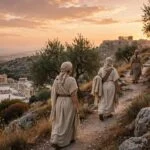
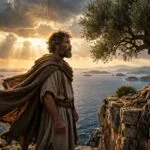

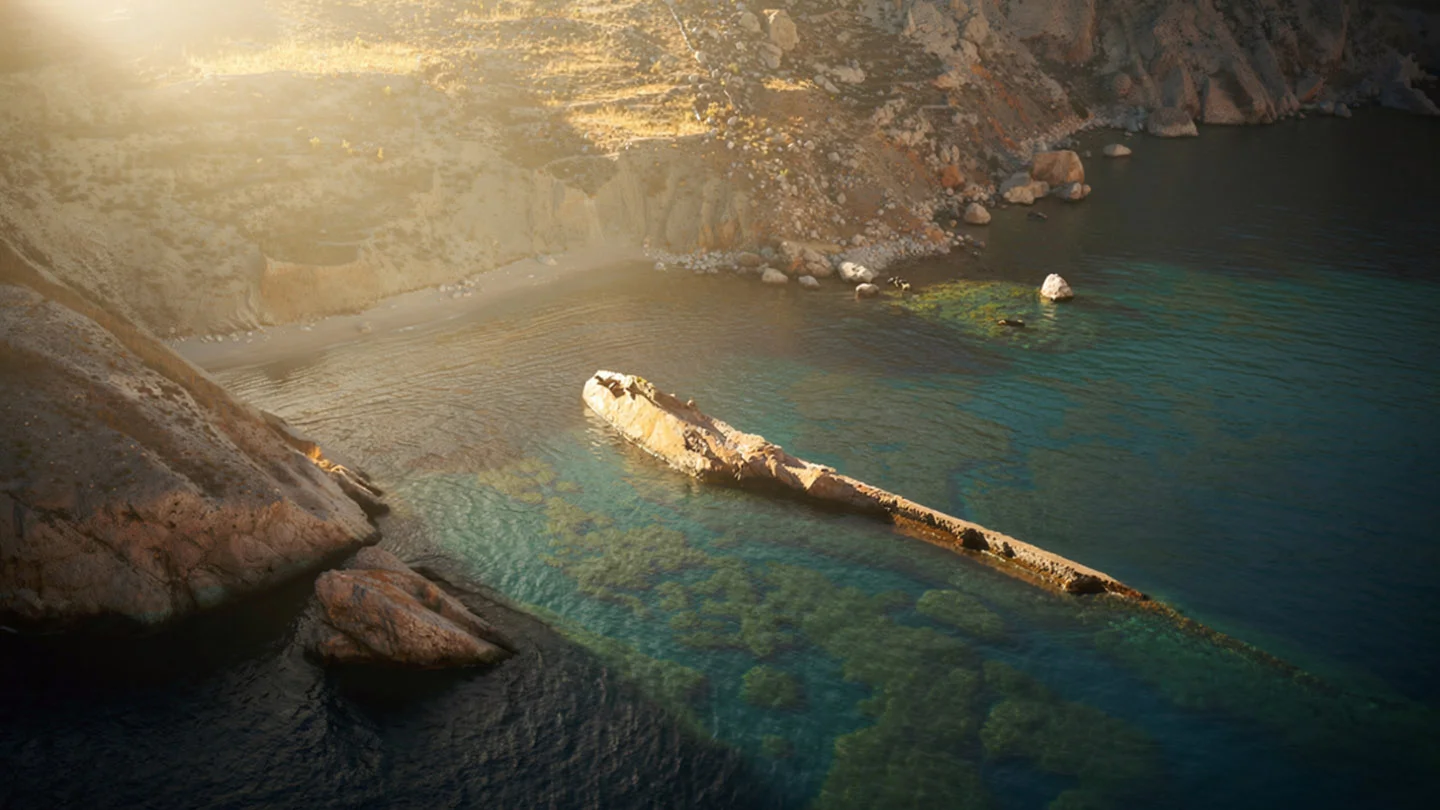
In the fourth century BCE, young men from across Greece made their way by boat to a cave on the northeastern coast of Folegandros.
The cave, Chrysospilia, sits thirty metres above the waterline, accessible from the sea on calm days and inaccessible on most others. Inside, past the first chamber where Roman wells and a floor of accumulated shells record later visitors, the second chamber opens into stalactite formations of considerable beauty. And on the walls and the ceiling of that second chamber, in the darkness that the young men entered having managed the difficult approach, approximately four hundred names are carved. Nicagoras. Themistocles. Cleon. Callimachus. Pythagoras. Lysicrates. Male names, dating from the fourth century BCE, belonging to young adults who had arrived from all parts of Greece.
Scholars who have studied the inscriptions believe the cave was a coming-of-age sanctuary: that the difficult venture of reaching this darkness, by sea, then climbing the rock face to the entrance, then navigating the cave to its second chamber and carving your name in the wall, was the ritual that marked a young Greek man’s passage into adulthood. Four hundred young men from across the Aegean world chose this cave on this limestone island as the correct place for the moment that made them what they would be for the rest of their lives.
Two centuries later, Rome used Folegandros as a destination for exile. The island that the ancient Greek world had chosen voluntarily as a site of ritual transformation became, under a different administration, the address for those the empire wished to forget. The same remoteness that the young men had found worth navigating for its ritual value was what the Romans found useful for their punitive purposes.
Both uses describe the same island. Neither fully contains it.
Iron Land
The ancient world called it Iron Folegandros.
The epithet was geological: a terrain so rocky, so indifferent to agricultural requirements, so committed to its own hardness that iron was the only comparator that communicated the landscape’s quality. The name itself may derive from the Phoenician phelekgundari, meaning rocky land, from the traders who used it as a staging point when crossing the southern Aegean and who found its hardness the most immediately notable thing about it.
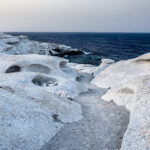
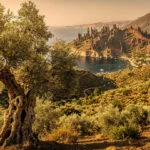
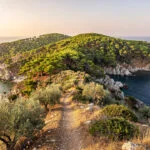
Thirty‑two square kilometres of limestone and terraced hillside and sheer cliff face. Permanent population seven hundred and fifteen. The island has three villages. Chora is the medieval settlement at the cliff’s edge. Ano Meria is the agricultural village at the island’s western end. Karavostasis is the port. A single paved road connects all three.
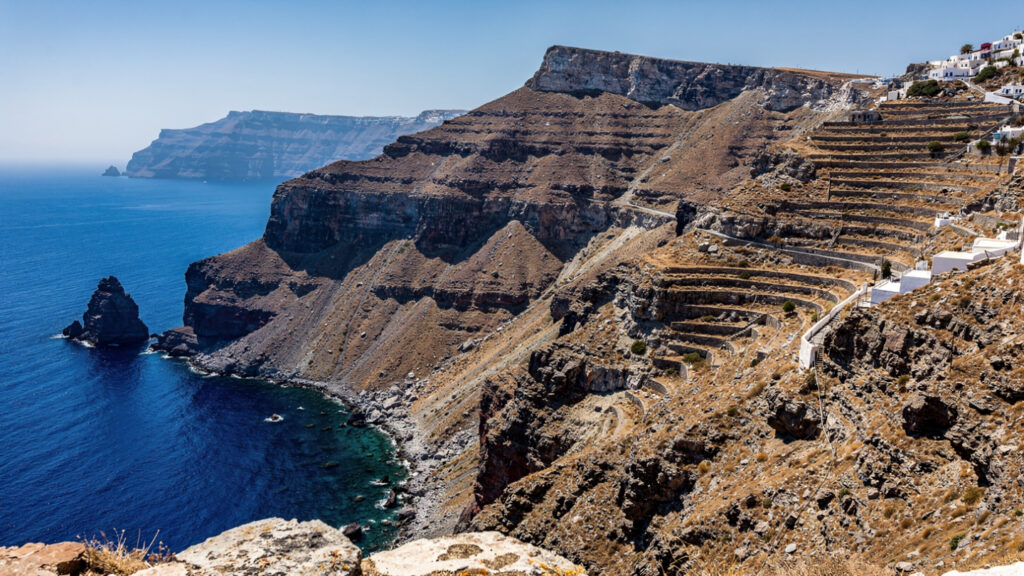
The Romans used Folegandros for political exile. The Metaxas dictatorship used it for political exile in the 1930s. The military junta used it for political exile in the 1960s and 1970s. A place that has served as a destination for exile across three separate political traditions separated by two millennia of Mediterranean history is a place whose fundamental character has remained consistent enough to serve the same function in different centuries. It has not been domesticated.
The iron quality persists. Not as harshness in the experiential sense, because the island is in fact a place of considerable beauty and genuine hospitality. But as a refusal to be made soft by requirements that are not the island’s own. The terrain does not apologise for its gradients. The ferry schedule does not optimise for convenience. The tavernas in the squares do not translate their menus into the largest number of available languages. The island exists on its own terms, which is a description of a quality rather than a marketing claim, and the difference between describing it and claiming it is the difference between the island and its imitators.
The Kastro and What Its Continuity Means
The Venetian Marco Sanudo built the Kastro in 1215. His architectural solution to the problem of Saracen pirates raiding the small island communities of the Cyclades was both elegant and to the landscape it addressed: he took the existing building stock of the cliff-top settlement and reorganised it so that the exterior walls of the outermost houses formed a continuous defensive perimeter, with no windows facing outward and only a single controlled gateway. The houses are the castle. The castle is made of houses, each one a structural element in the collective defence.
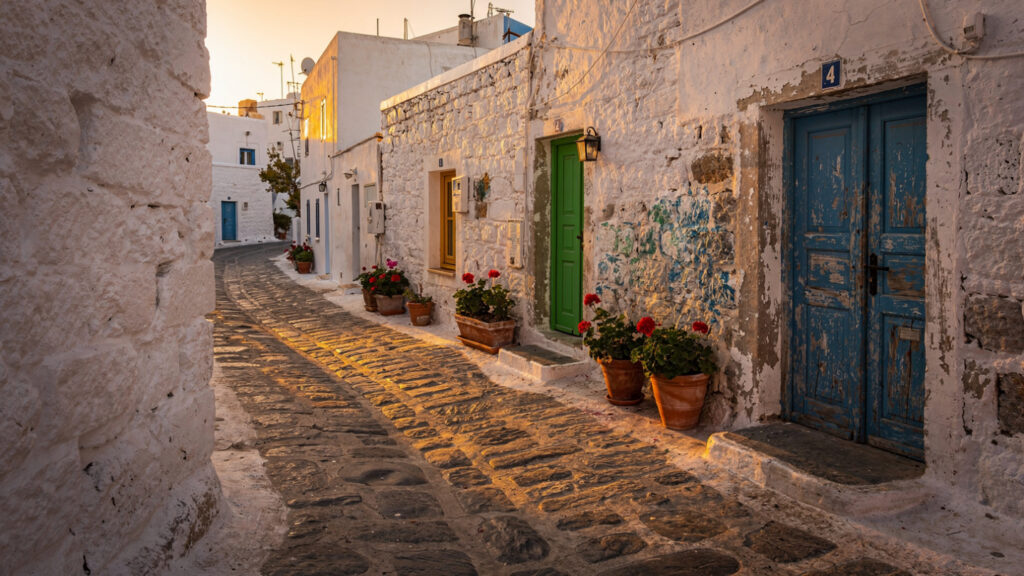
Eight centuries later, those houses are still inhabited.
Not as heritage. Not as a museum installation or a carefully managed historic district. As homes, occupied by people who live on this island, who grew up in these lanes, whose relationship to the medieval architecture around them is the relationship of people who live inside it rather than the relationship of people who visit it. The houses are small and the ceilings are low and the walls are thick and the whitewash is applied with the regularity that Cycladic tradition requires and the colours at the doors and windows are the faded blues and greens of places that maintain their appearances without fussing about them.
Stand in the Kastro lane in the early evening, when the light has turned horizontal and the white walls have taken on the gold that the hour produces, and understand that nothing in your immediate field of vision was arranged for you. It was arranged in 1215 for the purpose of keeping people alive in a landscape that the medieval Aegean made dangerous. That it is also beautiful is a consequence of the seriousness with which the original problem was solved.
The continuity of habitation across eight centuries is the quality that changes what you are looking at. The Kastro is not a building from 1215. It is 1215 continuously inhabited through every subsequent century, the accumulation of eight hundred years of daily life in the same walls, which is a different thing.
The Panagia and the Cliff
Above the Chora, a white zigzagging path climbs from the square called Pounta up the hillside for fifteen minutes to the Church of the Virgin Mary. The path goes through terraced gardens and smells of thyme in the late afternoon heat. The view opens in stages: first the Chora’s rooftops below you, then the wider island, then the sea extending south toward Santorini and Crete without interruption.
Santorini is visible from this path on a clear day as a smudge of white and dark volcanic rock thirty kilometres to the southeast. At this distance it is the correct size: beautiful and dramatic and entirely containing its own consequences at a remove that makes them invisible. The cruise ships are not visible. The sunset queue is not visible. It looks, from the hillside above Folegandros, like what it is: a volcanic island of extraordinary geological drama in the southern Aegean, whose qualities are real and whose overcrowding is a condition that the current view does not require you to engage with.
The church at the top, the Panagia, is a multi-domed white structure of modest dimensions set on the highest point of the cliff above the village, below it the sheer two-hundred-metre drop to the Aegean. Its whiteness catches the light of the afternoon and makes it visible from far out to sea. It has been making itself visible from far out to sea for centuries, which is another of its functions: not only a place of worship but a navigational marker for the boats approaching the island.
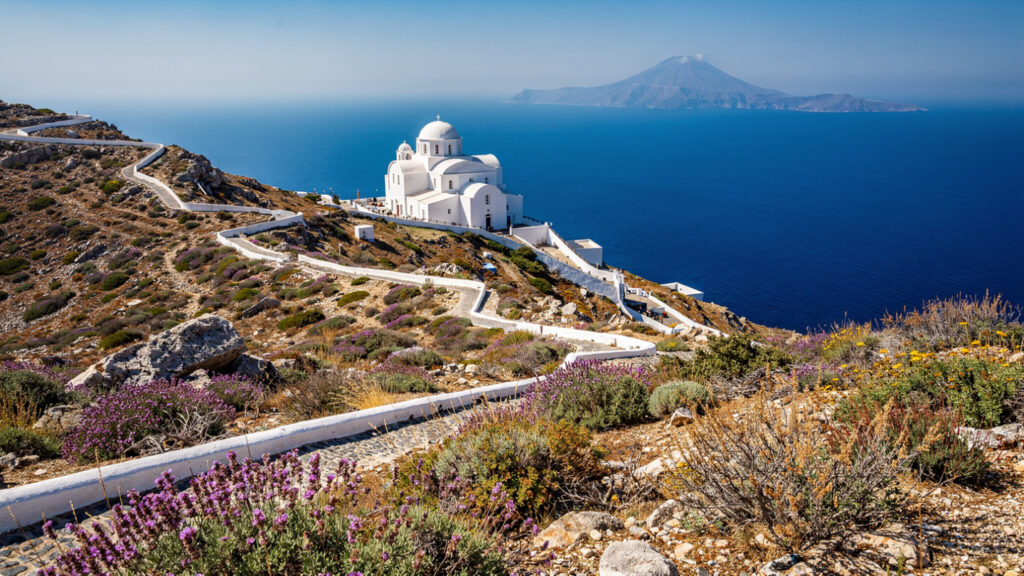
The Easter procession that carries the icon of the Virgin through the streets of the Chora and up this path to the church has been maintained without interruption across centuries of Venetian, Ottoman, and Greek administration. It happens because it has always happened. The visitor who is present for it is present for something the island is doing for itself, which is the highest available category of cultural encounter.
What the Table Knows
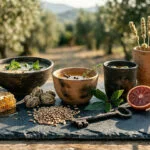
The matsata of Folegandros is a hand-rolled pasta made fresh each morning: thick irregular strands of dough rough enough to hold the sauce that comes with them, served with slow-cooked rabbit or goat or chicken, the meat having been simmering long enough that it falls from the bone into a tomato sauce whose accumulated richness is the argument for the hours it took.
The Venetians brought pasta to the Cyclades during their centuries of governance. The island took the technique and applied it to the Cycladic pantry, which meant rabbit and goat from the animals that the terrain supported and whose farming had been the island’s primary livelihood since before the Venetians arrived. The resulting dish has no Italian equivalent and no equivalent anywhere else. It belongs to Folegandros because the landscape that produced the animals in the sauce is the same landscape that made the island what it is.
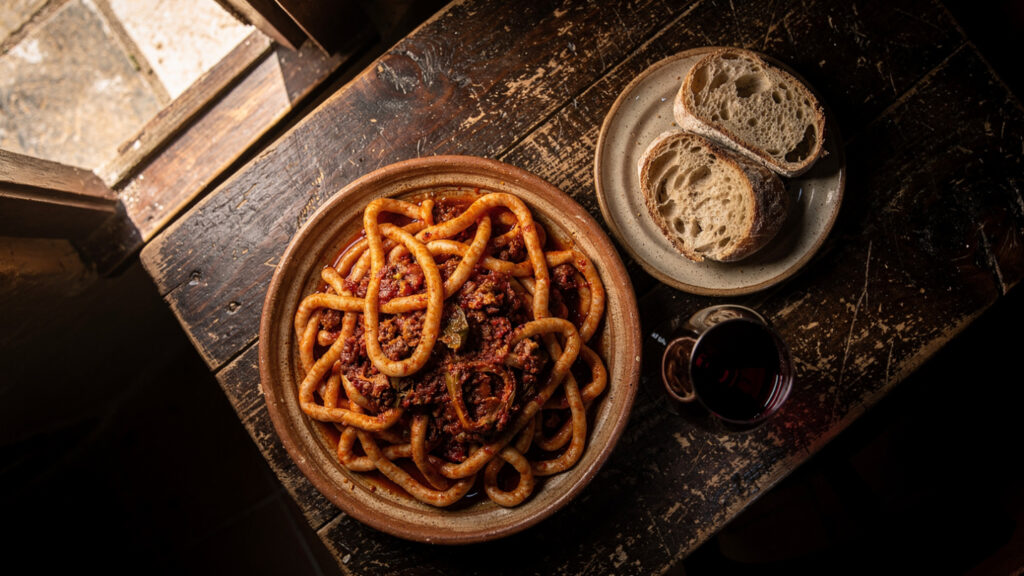
Matsata in Ano Meria, the agricultural village at the island’s western end, is the most authentic version of the dish. The tavernas there serve what they have always served because the people eating in them include the people who grew up eating it.
Revithada is the slow-baked chickpea stew that the island makes in a clay pot in a wood oven for long enough that the beans lose their individual character and become something smoother and more unified, with an earthiness that the limestone landscape produces as naturally as its cliffs. On Sunday mornings in the traditional tavernas it arrives without fanfare and is eaten slowly.
Souroto is the local goat’s cheese, fresh and tangy, made on the island, served crumbled over a salad or alongside the matsata or simply with thyme honey.
Karpouzenia is the detail that surprises visitors who have not been warned about it: a pie made from watermelon pulp, flour, sesame, and honey, summer-specific, cooling, sweet in the register of things a cuisine produces when it has learned to use everything and nothing goes to waste. A cuisine that makes a pie from watermelon is a cuisine that has been thinking seriously about its own ingredients for a long time.
Chrysospilia and the Four Hundred Names
The cave is currently unavailable to visitors due to ongoing archaeological research, which means that the four hundred names carved in the second chamber’s walls are at this moment being studied by the people best equipped to understand them.
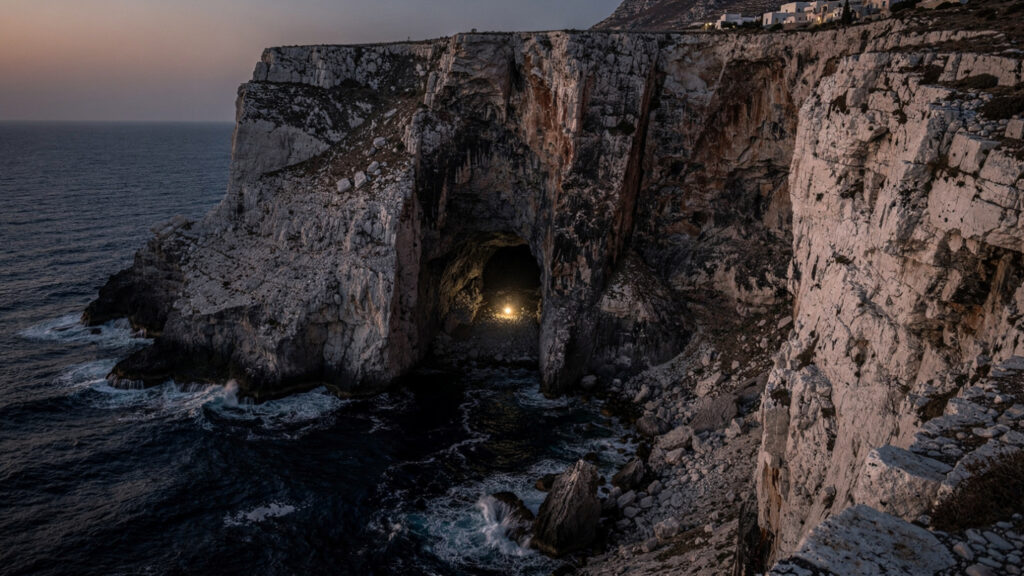
What the names record is this: in the fourth century BCE, young men from across the Greek world made their way to this sea cave on this small island as part of a ritual of passage into adulthood. The cave’s second chamber, accessible only after navigating the approach by sea on a calm day and then the rock face to the entrance and then the first chamber and its narrow connecting corridor, was the space they reached and in which they left the evidence of their arrival. Their names. The names they would carry for the rest of their lives, carved at the moment they crossed the threshold from what they had been into what they would become.
The island that Rome used as a prison because its remoteness made it useful for that purpose was, six centuries earlier, a destination that Greek youth from across the Aegean chose because its remoteness made it the correct location for the most significant ritual of their lives. The same quality served both purposes. The difficulty of the approach was the point in both cases. For the Romans, it prevented escape. For the young Greeks, it constituted the ordeal.
Four hundred names. The names of people who were young in the fourth century BCE and who are known to us only by what they carved in the darkness of a sea cave on a limestone island in the southern Cyclades. Nicagoras. Themistocles. Cleon.
They were here.
The Gundari Signal
In May 2024, the island’s first five-star resort opened on the cliffs.
Gundari is genuinely beautiful in the way of properties made with serious design attention and serious resources. The cliff-facing terraces, the stone and white plaster, the carefully calculated views: all of it represents the current highest standard of Mediterranean hospitality design, and it represents it honestly.
It is also a signal, and the signal is worth reading.
The trajectory from the first luxury property to the transformation of a small island’s character is documented across the Cyclades. It begins with one property that can accommodate the visitor who wants the island’s beauty in a framework that requires nothing of them: no ferry anxiety, no buses that run approximately on time, no tavernas without translated menus. That visitor arrives. Others like them arrive. The island’s infrastructure adjusts in the direction of their requirements. The adjustment is not rapid. But it is directional.
Folegandros in 2026 is at the beginning of this trajectory, not the end. The rest of the island is still entirely itself. The matsata is still being made to the same recipe. The Kastro is still inhabited. The bus still runs approximately. The Chrysospilia cave still contains four hundred names carved by young men who found this island the correct place for the most important ritual of their lives.
The version of Folegandros that exists in 2026, unhurried and confident and fully in possession of its own character, is the version worth encountering. Later versions will be beautiful. They will be different.
Practical Notes
The ferry from Piraeus takes approximately four to six hours depending on the service. From Santorini on a fast catamaran the crossing is under an hour. From Milos a similar range. Ferry frequency increases significantly in peak season and contracts to a few weekly services in winter.
The Chora has no car traffic. Stay in the Chora. The port serves its own practical function, but the evening in the Chora’s connected squares, where the village conducts its social life in the same spaces where you are eating dinner, is the central experience of a visit to Folegandros and it does not work if you are commuting to it from the port each evening.
The beaches that reward the most serious attention, Katergo and the coves beyond Agali, require either a boat from the port or a walk that does not moderate its gradients. The boat is the sensible approach. The walk is the honest one. Both produce the same beach at the end.
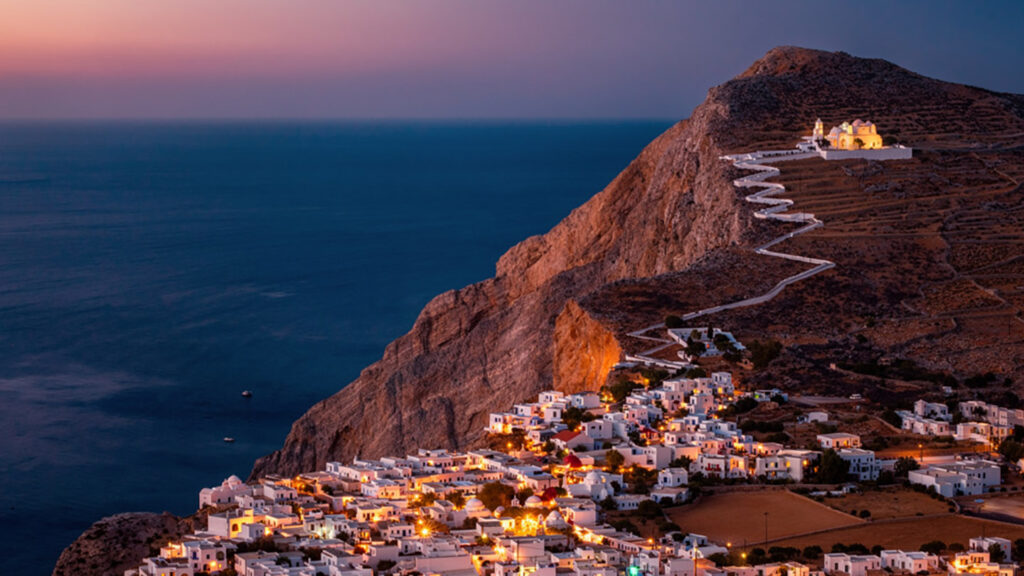
September is the correct month. The light has shifted from summer into its autumn character. The sea retains the summer’s warmth. The island is occupied by people who chose this month deliberately rather than because the school calendar gave them no alternative. The tavernas are full and not overwhelmed. The path to the Panagia is cool enough to walk briskly. The matsata in Ano Meria is being made with the autumn’s rabbit and the last of the summer’s tomatoes.
The ferry takes under an hour from Santorini. The distance is considerably larger than that.
At Olympus Estate, Wanderlust Greece goes beyond the obvious itinerary to find the places where Greece is most completely and most honestly itself. The four hundred names in the Chrysospilia cave were carved by young men from across the ancient Greek world who found this island the correct place for the moment that made them what they would be. The island has been making that argument ever since.