


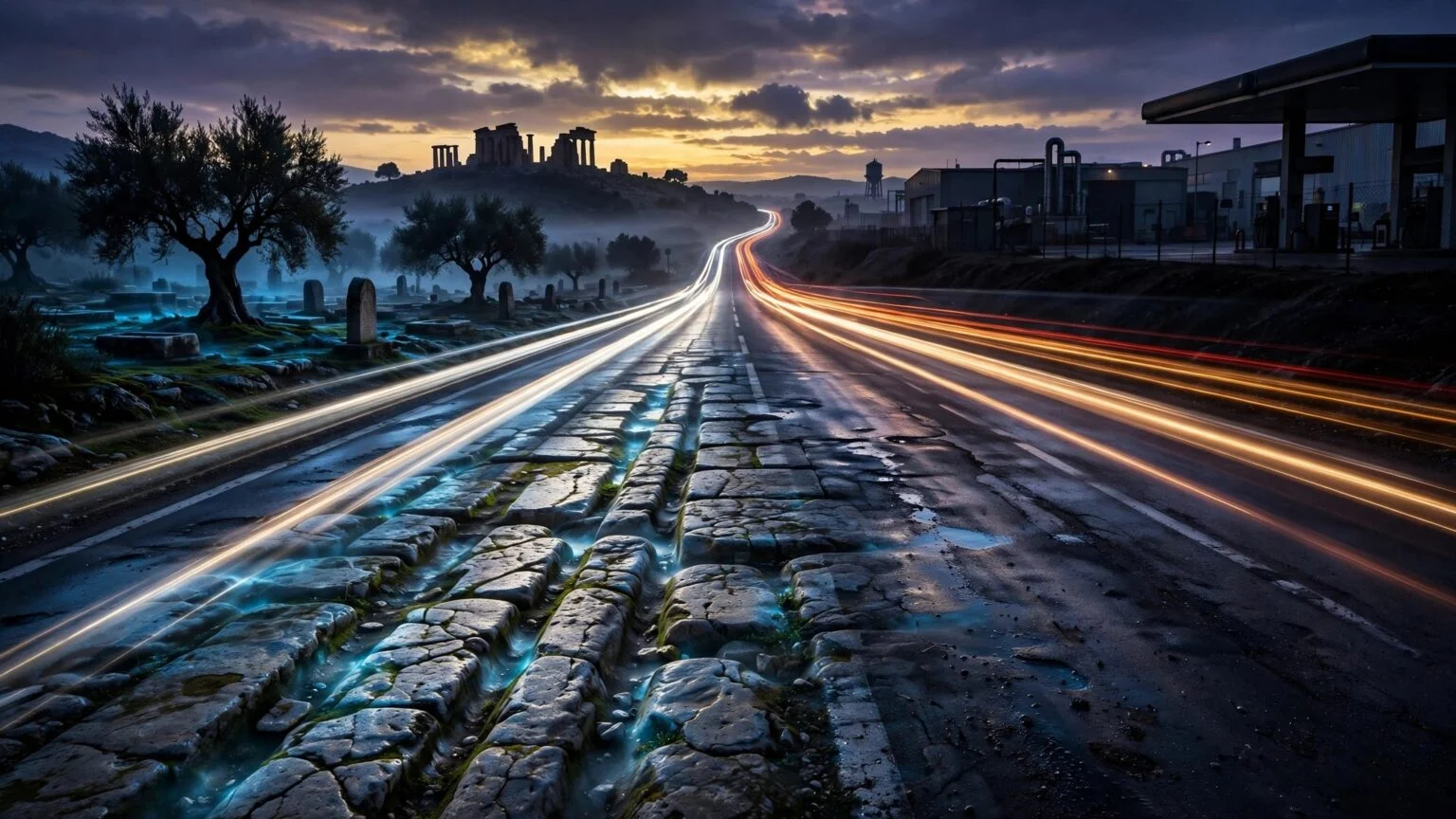
There is a road in western Athens, signposted in ordinary blue and white municipal lettering, that buses use every day, that runs past petrol stations and tyre shops and a stretch of warehouses near Aigaleo, and that has been in continuous use for longer than any other road on earth.
It is called Iera Odos, the Sacred Way. It begins inside the cemetery of Kerameikos, at a gate the Athenians called the Sacred Gate, and it runs twenty-two kilometres west to the town of Elefsina, ancient Eleusis, ending at the ruins of the most important religious sanctuary most people outside Greece have never heard of. For roughly two and a half thousand years, until a national highway finally took over the job in the mid-twentieth century, this single stretch of road was the principal route out of Athens to the rest of mainland Greece. It carried farmers and soldiers and merchants. Once a year, every year, for two millennia, it also carried something else: the largest organised religious procession in the ancient Greek world, walking, on foot, to a sanctuary where initiates would be shown something so secret that revealing it was a capital offence, and that not one of the tens of thousands of people who saw it ever wrote down what it was.
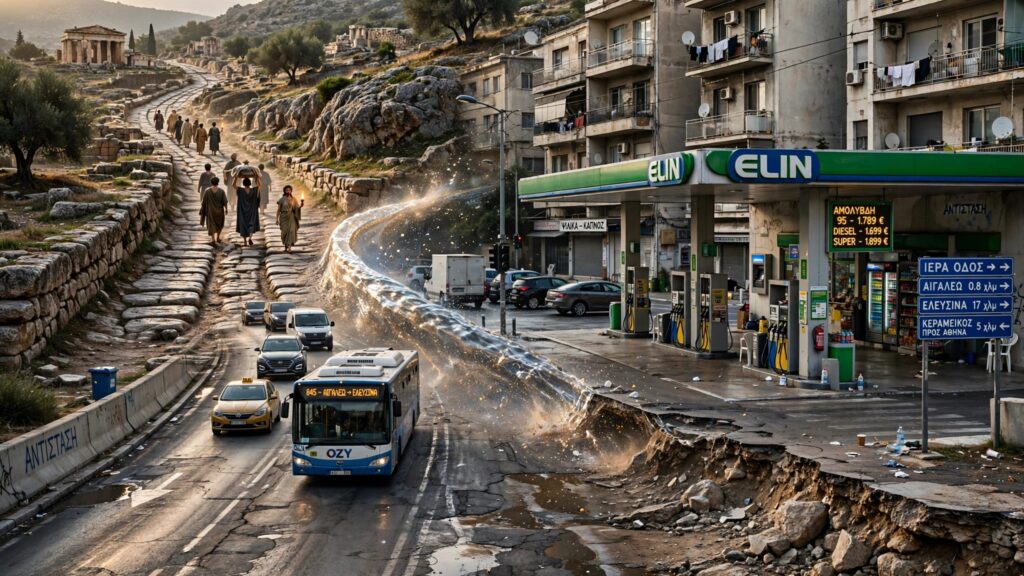
You can walk this road today. Most visitors will drive it instead, because most of it is now an unglamorous arterial road choked with the ordinary traffic of a major European city, and that is precisely the point worth sitting with before describing what survives along it. This is not a preserved monument kept at a careful distance from modern life. It is a working road that modern life simply continued using, because the Greeks built it correctly the first time and nobody since has needed to argue with the route.
What the Mysteries Actually Were
The Eleusinian Mysteries, celebrated at Eleusis in honour of Demeter and her daughter Persephone, were the most significant annual religious event in the ancient Athenian calendar, and very possibly in the wider Greek world. Initiation was offered each year in the month of Boedromion, roughly the modern September, to virtually anyone: Athenian citizens, foreigners, women, even slaves, an openness the more exclusive civic religion of the city did not generally extend elsewhere.
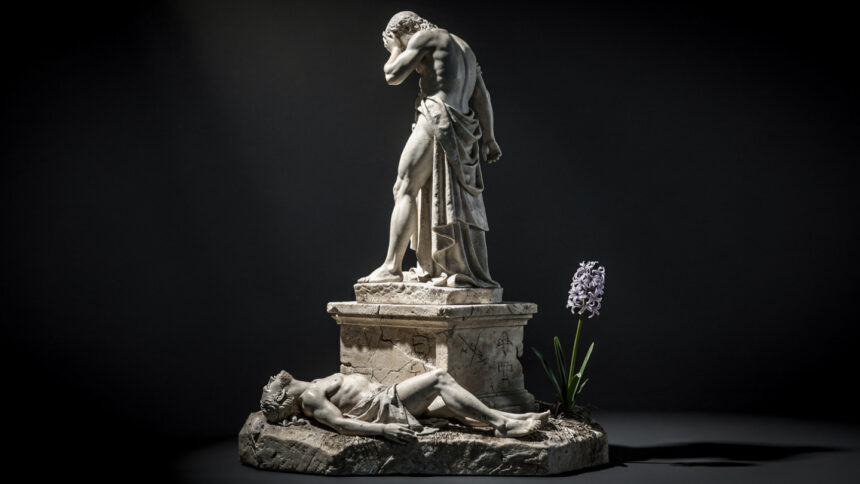
The sanctuary traced its sacred function back, by its own mythological account, to the moment Demeter herself, grieving for her abducted daughter and wandering the earth in disguise, was taken in by the royal family of Eleusis and given the task of nursing their son. Out of gratitude, and grief, and the specific bargain struck afterward with the gods over Persephone’s annual return from the underworld, Demeter taught the people of Eleusis the rites that would let initiates face their own deaths without fear.
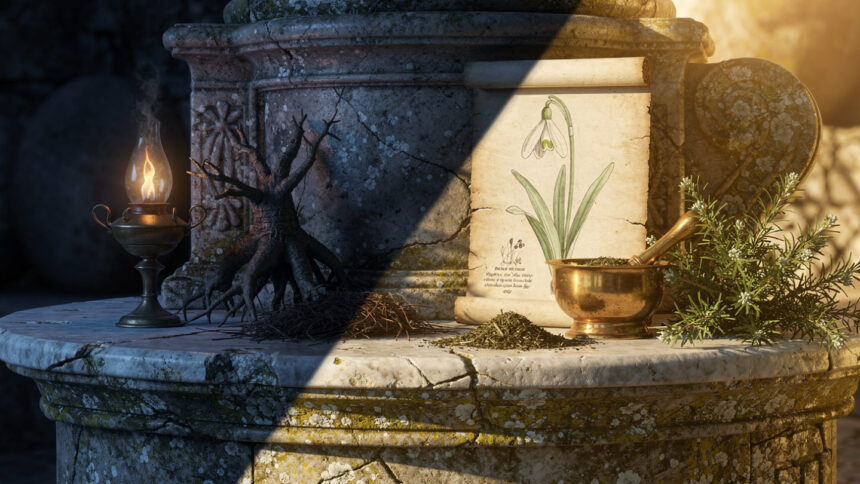
What those rites actually consisted of is one of the best-kept secrets in the ancient world, not because the evidence has been lost but because it was never written down by the tens of thousands of people across centuries who were sworn to silence and, remarkably, kept that oath. We know the broad shape: ritual bathing in the sea, a great procession along this exact road, fasting, the drinking of a barley and herb potion called the kykeon, and finally, inside the great hall of the Telesterion at Eleusis, something shown in the dark that ancient writers who underwent it described only in terms of its effect rather than its content. Initiates spoke afterward of having lost their fear of death. They did not say what they had seen.
The road that got them there is not a mystery at all. It is extensively excavated, repeatedly rediscovered during modern construction projects, and walkable today in fragments that tell you, with unusual physical directness, what twenty-five centuries of footsteps and cart wheels and bus tyres actually do to a single piece of ground.
Beginning at the Sacred Gate
Start where the procession started: inside the Kerameikos, the ancient cemetery of Athens that lies a short walk from Monastiraki and the modern flea market district, now a quiet archaeological park shaded by olive and cypress trees that makes it one of the least visited and most rewarding sites in central Athens.
The Sacred Gate, Iera Pyli, was one of the two principal gates piercing the Themistoclean wall on this side of the city, set beside the Sacred Way’s secular twin, the Dipylon Gate, through which the main road to the Peloponnese and northern Greece also ran. The two gates sat close enough together that the Eridanos, the small river that still runs, mostly culverted, beneath the modern city, flowed between them. From here, on the nineteenth day of Boedromion, the Athenian priestly families responsible for the Mysteries, the Eumolpidae and the Kerykes, led a procession of thousands westward, carrying the sacred objects of the cult and a particular icon of the god Iacchus invoked specifically for the journey, his name shouted repeatedly along the way in a ritual cry that gave the procession itself a kind of soundtrack.
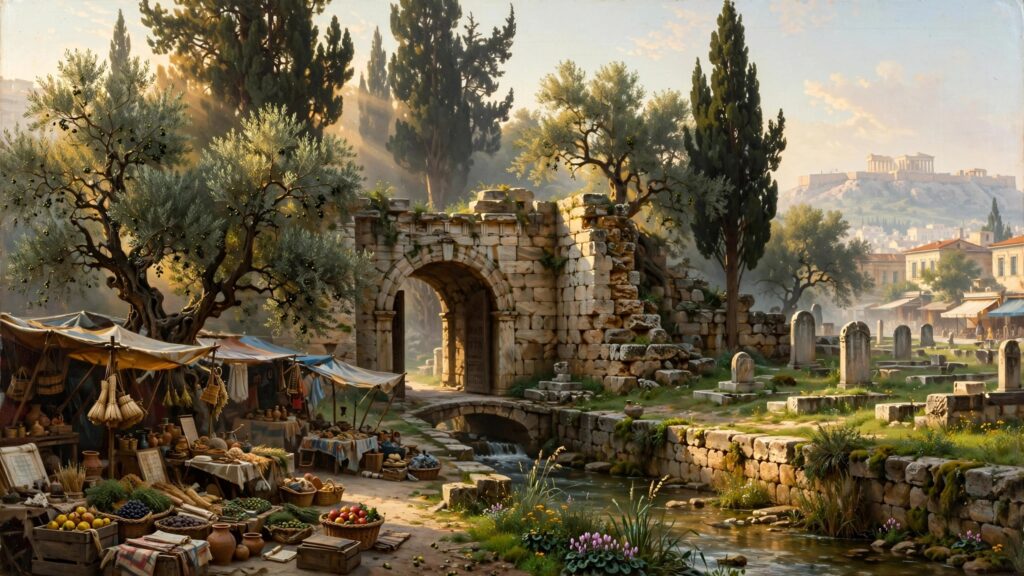
It is worth simply standing at this point before continuing, because almost everything that happens next on the modern road still answers, in its layout, to the decision made here in the archaic period: the road’s width, its orientation across the Thriasian plain, its destination, all fixed by the time Solon and then Peisistratus, in the sixth century BCE, formalised and monumentalised a route that had already been in informal use for centuries before either of them.
What the Metro Diggers Found
For most of the twentieth century, the Sacred Way’s ancient pavement was assumed, sensibly, to lie buried somewhere beneath the modern road of the same name, inaccessible without demolishing a functioning Athenian thoroughfare to look for it. Then the city built a metro system, and in the course of digging tunnels and stations through Aigaleo and the western suburbs, archaeologists found the road repeatedly, in long, well-preserved sections, exactly where two and a half thousand years of written sources had said it would be.
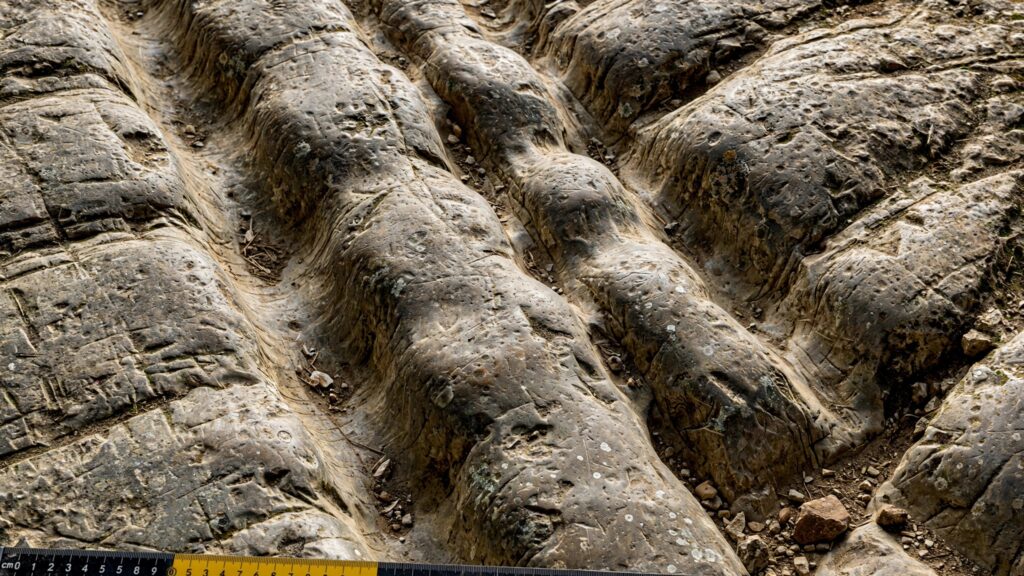
At Estavromenou Square in Aigaleo, near the metro station of the same name, excavators uncovered nearly twenty-eight metres of the ancient street running parallel to the modern road a short distance to its north, bounded by retaining walls of limestone blocks and showing five successive layers of surfacing laid one above the other across centuries of repair and rebuilding, the earliest a trodden surface of dirt and gravel, the latest cut directly into bedrock. In that final, latest layer, the excavators found something that requires no archaeological training to understand on sight: grooves worn by cart and wagon wheels, cut directly into the living rock by the sheer accumulated weight of traffic passing over the same narrow track for centuries, the physical signature of every farmer’s cart and every temple delivery and every procession that ever used this stretch, recorded the only way that kind of repetition can record itself, by wearing a path into stone.
A short distance further along, near what is now called the Well of Prophet Daniel, more sections of the retaining wall came to light, its construction phases spanning from the Geometric period through to the late Roman era, alongside objects connected to the worship of Demeter that suggest this specific point was a stop or storage depository associated with the sanctuary, a place where the procession paused before re-entering the city on its return journey.
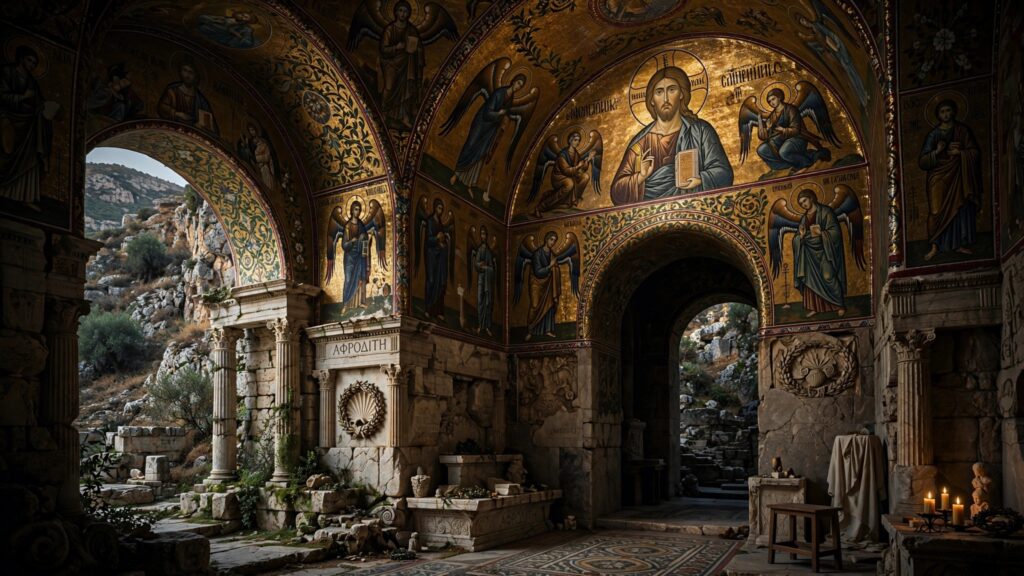
The best-preserved single stretch lies near the Byzantine monastery of Daphni, roughly midway along the route, beside what was once a sanctuary of Aphrodite carved into the rock of Mount Aigaleo. Daphni itself, with its eleventh-century church and its extraordinary, UNESCO-listed gold-ground mosaics, sits directly on the line of the ancient road for a reason that is not coincidental: Christian monasteries were frequently sited deliberately on or near older sacred ground, absorbing the location’s accumulated significance rather than competing with it. The procession of Demeter’s initiates and the daily prayer of Byzantine monks occupy, quite literally, the same few hundred metres of hillside.
The Plain, the River, and Hadrian’s Bridge
West of Daphni, the road descends from the slopes of Aigaleo into the Thriasian Plain, the open agricultural land that separates Athens from Eleusis, and crosses the river ancient sources called the Eleusinian Cephissus, distinct from the larger river of the same name that runs through central Athens.
One kilometre east of Eleusis, at a site known locally as Kalo Pigadi, stands a fifty-metre stone bridge across this river, carried on four arches, its monumental form dated to the reign of the emperor Hadrian around 124 or 125 CE, shortly after his own initiation into the Mysteries, though an earlier bridge on the same site reached back as far as the late fourth century BCE. The architect Ioannis Travlos excavated and documented it in 1950, and it remains one of the best-preserved bridges to survive from antiquity anywhere in Greece. Ancient sources describe the ritual that took place on it directly: as the returning procession crossed back over the river toward Athens, Athenians who had not taken part in the Mysteries gathered on the bridge to hurl mockery and obscene gestures at the initiates as they passed, a sanctioned inversion of ordinary respect that ancient writers treated as a deliberate part of the pilgrims’ return, a final ritual humbling before re-entry into ordinary civic life.
The general crossing of the plain was marked, in antiquity, by additional shrines positioned deliberately along the route, as the Greek practice of marking sacred roads with subsidiary altars and dedications required, keeping the pilgrims’ attention on the journey’s purpose. A sacred road in ancient Greece was rarely simply a road. It was a sequence of devotional punctuation marks, ensuring the traveller’s mind never entirely returned to the ordinary business of getting somewhere.
Arrival | The Processional Way Inside the Sanctuary
The modern Iera Odos finally arrives, after passing through the unglamorous industrial outskirts of contemporary Elefsina, at the archaeological site of ancient Eleusis itself, and here the Sacred Way does not end so much as change its name and its material.
Inside the sanctuary, the route the procession followed becomes the Processional Way proper, climbing from the site’s Roman-era forecourt, the Court of the Romans, paved with large marble slabs, up through what was once the Lesser Propylaea, curving along the rocky slope of the hill to the Telesterion, the great roofed hall where the central rites took place and which, in its final form, could hold several thousand initiates at once beneath a forest of internal columns supporting a roof whose engineering was, by ancient accounts, considered one of the more remarkable achievements of its kind. In the Roman period this final stretch was paved in marble, and pedestals that once carried statues and dedications by wealthy initiates still stand along its edges, some of the statues themselves preserved in the site’s small but excellent museum.
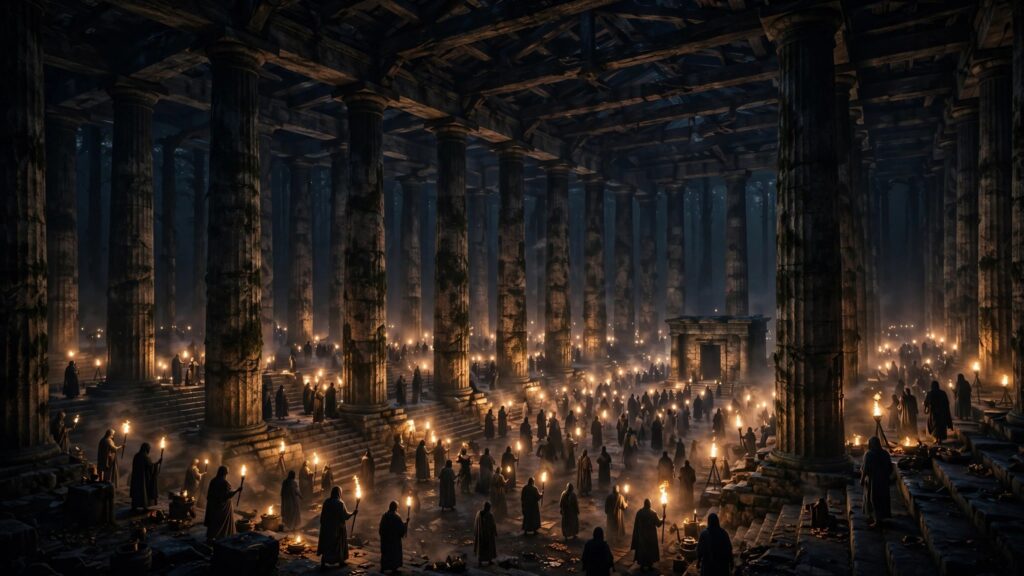
This is where the procession, after a full day’s walk from Athens, arrived in darkness, because the final approach and the rites themselves took place specifically at night, the torches of the initiates providing the only light for a climb that the daylight crossing of the Thriasian plain had been, in effect, an extended preparation for.
The sanctuary operated, with interruptions, for roughly two thousand years, beginning in some form as early as the Mycenaean period and continuing until the Roman emperor Theodosius I’s edict against pagan worship in 392 CE finally banned it, the sanctuary itself destroyed a few years later by Alaric’s Visigoths. With that ending came the end of a procession that had been walking this road for longer than the entire subsequent history of Christian Europe.
Two Other Sacred Roads, and Why They Are Different
Eleusis was not the only sanctuary the Greek world built dedicated processional roads toward, though it is by far the best documented and the most completely walkable today, and it is worth understanding honestly how the other two principal sacred roads of the festival calendar differ from it rather than treating all three as equivalent.
At Delphi, the Sacred Way is shorter and entirely internal to the sanctuary itself rather than a long-distance pilgrimage route across open country: a steeply ascending path of a little over two hundred metres, climbing from the sanctuary’s main entrance past the treasuries the Greek city-states built to house their dedications, up to the Temple of Apollo and the altar where sacrifices were made before consultation with the oracle. This Sacred Way is the architectural spine of the sanctuary rather than the approach to it, and the genuine long-distance pilgrimage to Delphi from Athens or elsewhere followed ordinary regional roads rather than a dedicated sacred route comparable to the Iera Odos.
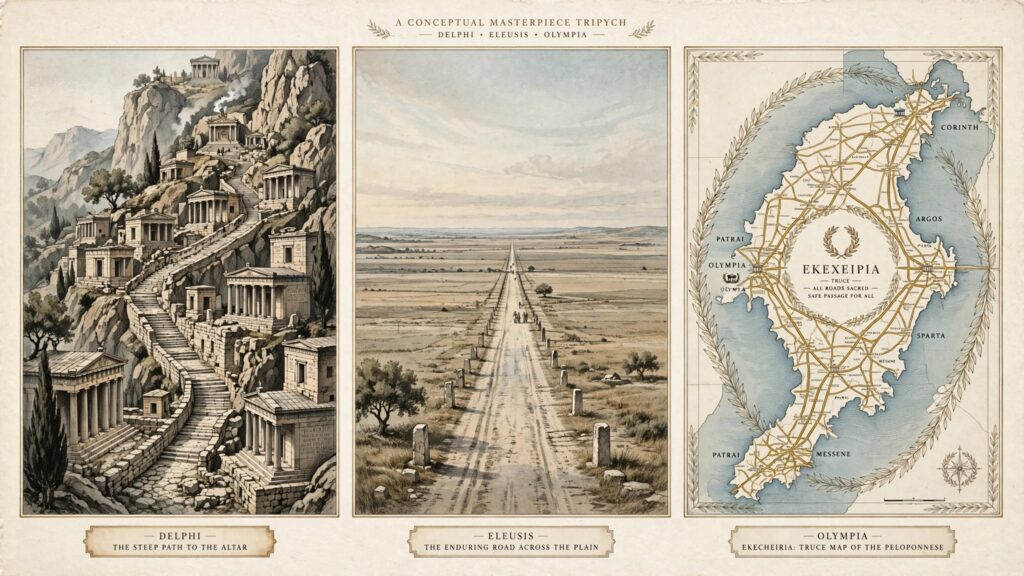
At Olympia, the festival calendar’s most important institution was not a processional road at all but a truce: the ekecheiria, the sacred peace proclaimed across the Greek world before each Olympic festival, under which all hostilities between Greek states were suspended specifically so that athletes, spectators, and the heralds who announced the truce itself could travel safely to the games on whatever roads happened to connect their city to the sanctuary in the Peloponnese. The sanctity at Olympia attached to the safety of travel in general rather than to one specific consecrated road, which is itself a revealing difference: Eleusis sanctified a single path because its rite required a specific, repeated, collective journey on a fixed date, while Olympia sanctified the entire territory of Greece, briefly, because its festival required athletes and spectators to converge from every direction at once.
This distinction matters for the traveller today. The Sacred Way to Eleusis can be walked, or driven, with the ancient route substantially underfoot the entire distance, because it was always one specific road and remains, signposted under its ancient name, one specific road. Delphi’s Sacred Way is a few hundred metres inside a single archaeological site. Olympia’s sacred geography was, by design, the whole of the Peloponnese for a few weeks every four years, and no single surviving road carries its memory the way Iera Odos carries the memory of Eleusis.
Walking It Today
The full twenty-two kilometres from Kerameikos to Elefsina can be walked in a single long day by anyone reasonably fit, though almost nobody does this, because for most of its length the modern road is a busy urban and suburban arterial with narrow or absent pavements, heavy traffic, and none of the romantic isolation that walking an ancient road suggests. This is worth stating plainly rather than glossing over: you are not walking through countryside. You are walking, for long stretches, beside tyre repair shops and small industrial premises, and the discomfort of this is, in its own way, instructive about what a working road actually looks like after twenty-five centuries of remaining a working road.
The more rewarding approach for most visitors is to drive or take public transport along the route, stopping deliberately at the points where the ancient road becomes visible again. Start at the Kerameikos itself, allowing at least ninety minutes. Continue to the excavated section near Estavromenou Square in Aigaleo, reachable by metro to the station of the same name, where the wagon ruts cut into bedrock are visible on site. Stop at the monastery of Daphni, whose Byzantine mosaics alone justify the visit and whose grounds preserve the clearest sense of the ancient road’s relationship to the rock-cut sanctuary of Aphrodite beside it. Pause at the remains of Hadrian’s bridge over the Eleusinian Cephissus at Kalo Pigadi, a short distance east of the site. Finish at the archaeological site and museum at Elefsina itself, which deserves a minimum of two unhurried hours and ideally three.
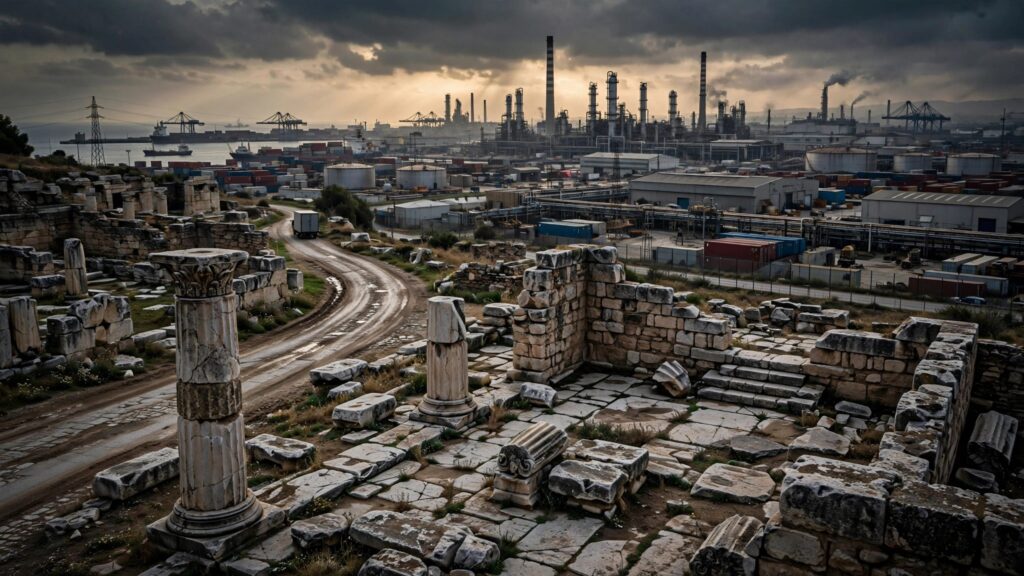
Elefsina today is a working industrial town, and the approach to the sanctuary now runs past refineries and shipping facilities that have nothing romantic about them whatsoever. This, too, is worth experiencing rather than avoiding. The Sacred Way was never a route through preserved wilderness. It was the most important road in Attica, serving the most important religious festival in the Athenian calendar, and important roads accumulate, over millennia, exactly the kind of ordinary, unglamorous human activity that surrounds it today: warehouses, traffic, small businesses, the continuous practical life of a city that has never stopped needing a road to its western neighbour.
What You Are Actually Walking On
The temptation, standing in front of the wagon ruts at Aigaleo or the marble paving inside the sanctuary at Eleusis, is to feel that you have found something preserved, a fragment rescued from time and held at a careful remove from the present. The more accurate description is the opposite. The Sacred Way was never lost. It was never rediscovered in any meaningful sense, because it was never abandoned. The modern Iera Odos that Athenian buses use today follows, with only minor deviations forced by later urban development, the same line that Solon’s road followed, that the track before Solon followed, that the procession of Demeter’s initiates walked every September for two thousand years before a Christian emperor finally ended their right to walk it.
What changed was not the route. It was who was walking it, and why, and what they believed waited for them at the end of it. The wagon ruts in the bedrock at Aigaleo do not know whether the wheels that cut them were carrying grain to an Athenian market or sacred objects toward the Telesterion. They simply record that something heavy passed over this exact spot, repeatedly, for a very long time.
That repetition, sustained without interruption longer than any other road on earth has managed, is the actual monument. Not a single building, not a single procession, but the simple continuous fact of a path that the land between Athens and Eleusis has never once been permitted to forget.
At Olympus Estate, Wanderlust Greece guides you across the sacred and storied terrain of the Hellenic world. The Sacred Way is twenty-two kilometres long, running from the Sacred Gate at Kerameikos to the sanctuary of Demeter at Eleusis, and it has been in continuous use for roughly two and a half thousand years. Metro construction found nearly twenty-eight metres of it intact at Aigaleo, wagon ruts cut into bedrock and all. Hadrian built the fifty-metre bridge over the Eleusinian Cephissus around 125 CE, shortly after his own initiation into the Mysteries. The sanctuary operated for two thousand years until Theodosius banned it in 392 CE. The road never stopped being used. It simply changed who was walking it.