
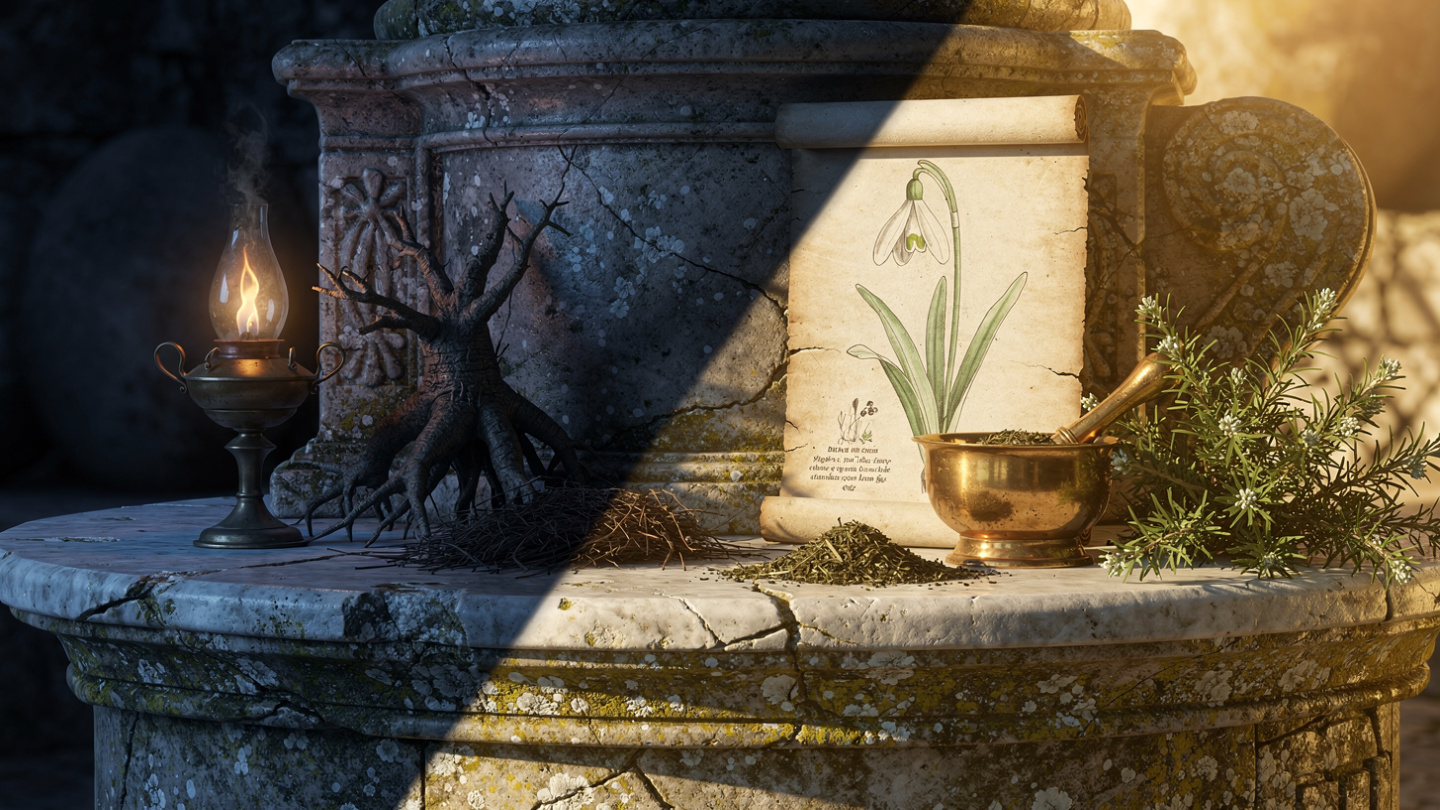
The Greek word pharmakon does not mean medicine.
It means the thing that works on the body, and the ancient Greeks refused to distinguish between the medicine and the poison the way contemporary pharmaceutical science does, because they understood the difference as a property of the dose and the intention, not of the substance itself. The same plant prepared the same way could heal or kill depending on the quantity administered and the condition of the person who received it. The herbalist who understood this was the one who possessed real pharmacological knowledge: what a substance did, at what dose, to what body, under what conditions.
The word pharmakon traveled into the modern world through the Latin pharmacum and produced the English words pharmacy, pharmaceutical, pharmacology: the entire vocabulary of the contemporary science of drug action grew out of a single ancient Greek word that refused to separate medicine from poison in the first place. The contemporary pharmacist who dispenses a prescription capable of killing at the wrong dose is the direct institutional descendant of the ancient Greek herbalist who worked the same threshold between the therapeutic and the toxic.
Hekate governed this knowledge. Circe practiced it.
Hekate and the Liminal Theology
Ancient theology never gave Hekate the character of the witch goddess medieval and later popular imagination built around her, though that later image was not entirely without foundation. She was the goddess of the liminal: the divine being who presided over thresholds between states of existence, between conditions of being, between the organized and the unorganized, between the known and the unknown.
The thresholds Hekate governed were the ones the ancient world considered most dangerous and most consequential: the crossroads where three or more roads met, the threshold of the house, the boundary between the city and the land outside it, the boundary between the living and the dead. These were the locations where the organized human world came most directly into contact with what lay outside it, where civic order gave way to the wild, where the living community gave way to the realm of the dead, where the safety of an enclosed space gave way to the exposed intersection of routes each leading toward a different outcome.
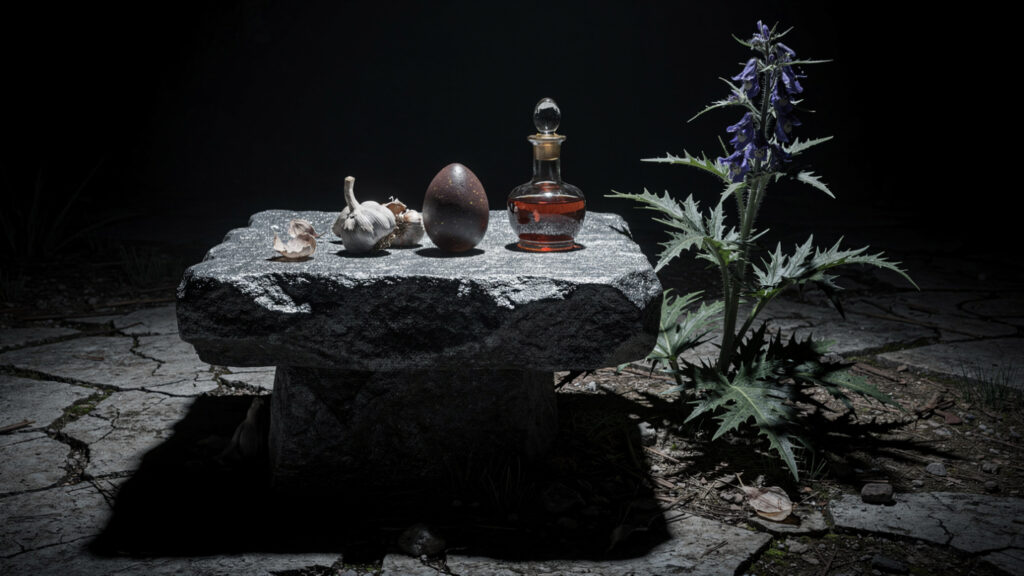
The offerings prescribed for Hekate were offerings of the threshold itself: the Hekate’s suppers, the deipna Hekates, left at the crossroads at the new moon, when the darkness was most complete and the goddess’s presence at these liminal places was felt most strongly. The foods in the offering, eggs, fish, garlic, cheese, and the sweepings of the household floor, sat at exactly the boundary between the organized domestic world and the wild, uncanny world outside it: garlic’s powerful smell was associated with warding off evil spirits, and the sweepings carried the accumulated trace of the household’s own life at its threshold.
Hesiod gave Hekate an honor no other pre-Olympian deity received when Zeus came to power: he preserved her standing from the earlier cosmological order entirely, granting her the privilege of operating across all three realms, sky, earth, and sea, and the prerogative of granting or withholding success in any domain where a human being sought divine help. Hesiod’s Hekate was never a malevolent or marginal figure. As presider over the liminal, she held a prerogative no other Olympian had: the capacity to move between the organized categories of the cosmic structure rather than being confined to just one of them.
The plants associated with Hekate were the plants that grew at exactly the liminal locations where her presence was felt most strongly: the yew that grew in the cemetery, whose toxic properties made it the tree most directly linked to the boundary between the living and the dead, the aconite whose violent toxicity gave it ancient associations with Hekate’s more dangerous aspects, and the hecateion, the plants of the Hekate sanctuary, whose pharmacological properties matched the liminal character of the goddess they belonged to.
Hekate’s priests and priestesses maintained knowledge of the plants that acted at exactly the boundaries she governed, the ones that in large doses crossed from consciousness into unconsciousness, from life into death, from ordinary waking experience into the altered state the ancient world interpreted as an encounter with the divine. The pharmacological and the theological were never separate here. The goddess of the liminal governed the plants that acted at the body’s own biological liminal points, and the herbalist who knew those plants had direct access to the goddess’s own knowledge.
Circe and the Pharmacological Practice
Circe in the Odyssey is the figure in ancient literature who most completely embodies the intellectual character of the pharmacological practitioner: someone whose knowledge of what plants did to bodies, at what doses, gave her exactly the power ancient sources attributed to her.
Homer describes Circe’s preparations with the word pharmakon, the thing that works on the body, a preparation whose action was calibrated to the purpose it served. When Circe transformed Odysseus’s companions into swine, she was not performing a supernatural act in any sense ancient pharmacological knowledge could not explain. She was administering a preparation whose pharmacological properties produced the behavioral and physiological effects the transformation narrative encodes in mythological language.
The plants ancient sources associate with Circe’s practice are exactly the plants whose known pharmacological effects the transformation narrative requires: mandrake, whose tropane alkaloid content produces the hallucinogenic and anesthetic effects ancient writers documented, henbane, whose scopolamine content produces the disorienting, hallucinogenic effects that made it one of the most powerful agents ancient herbalists worked with, and the combination of these and related plants that constituted real, accumulated knowledge of the Solanaceae family’s effects.
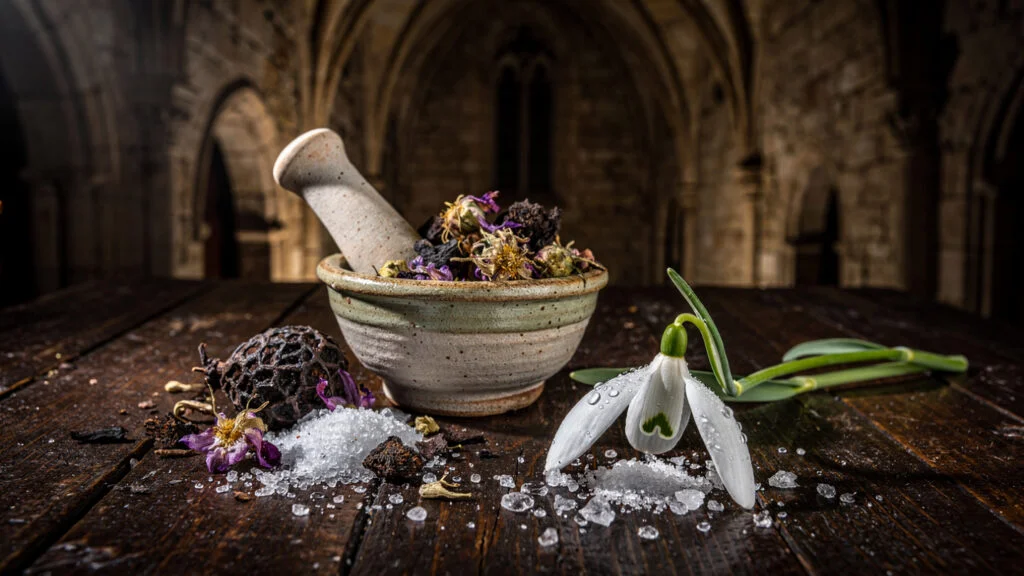
The moly that Hermes gives Odysseus as the antidote to Circe’s preparations, the white-flowered plant with the black root Homer describes, has been identified by modern botanists as the snowdrop, Galanthus nivalis, whose active compound galantamine is a cholinesterase inhibitor now used to treat Alzheimer’s disease. That the snowdrop counteracts the anticholinergic alkaloids found in Solanaceae plants was pharmacological knowledge the ancient world encoded directly into the mythological narrative of Hermes handing Odysseus the plant that would counter Circe’s pharmakon.
If the moly identification holds, the Odyssey passage becomes one of the oldest surviving descriptions of a drug interaction anywhere: the anticholinergic alkaloids of the henbane and mandrake preparation producing their physiological effects, and the cholinesterase inhibitor in the snowdrop counteracting them by a mechanism modern pharmacology has actually identified. Homer’s Circe was not a magical sorceress. She was a pharmacologist.
The Dittany of Crete
Origanum dictamnus, the dittany of Crete, combines an endemic Cretan distribution with an extraordinary ancient reputation for healing, making it one of the most thoroughly researched ancient Greek medicinal plants in the contemporary botanical and pharmacological literature.
The plant grows almost exclusively on the steep limestone cliffs of the Cretan mountain ranges, primarily the White Mountains and the Dikti range, at elevations where the limestone substrate and the exposed cliff-face microclimate together produce exactly the conditions the plant requires. Its wild distribution stays confined to these cliff habitats, and the historical practice of harvesting wild dittany, which demanded a climber’s skill rather than an ordinary herbalist’s, gave the plant both its rarity and its ancient reputation as an herb worth extraordinary effort to obtain.
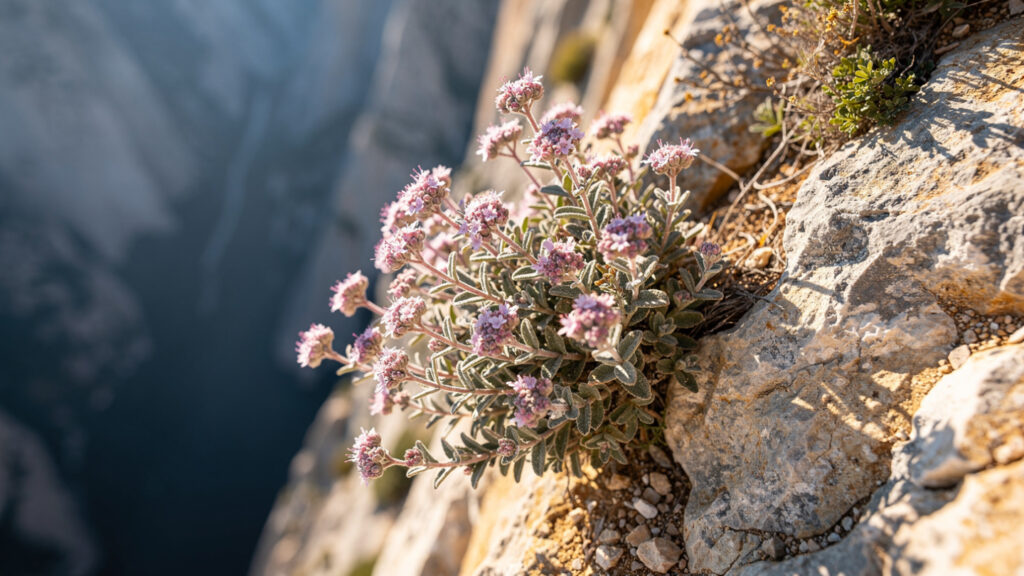
The most celebrated ancient account of dittany’s healing power appears in Virgil’s Aeneid, where Aeneas is wounded by an arrow and the goddess Venus descends to heal him with dittany gathered from the Cretan mountains herself. The healing that follows, the arrow drawn out, the wound closed, the pain relieved, is exactly the effect ancient writers consistently attributed to the plant.
Contemporary research on Origanum dictamnus has identified antimicrobial and antioxidant compounds in the plant’s essential oil whose activity is consistent with the ancient healing claims: carvacrol and thymol, among the most potent naturally occurring antimicrobial agents identified in the botanical record, combined with the anti-inflammatory activity of the plant’s secondary metabolites, give the ancient reputation for wound healing a pharmacological basis modern research has confirmed rather than dismissed.
The contemporary availability of dittany of Crete in Cretan herbal markets reflects the demand the plant’s ancient reputation has sustained across the centuries: dried herb sold in open-air markets, dittany-infused olive oils and honeys from Cretan specialty food producers, and dittany-based herbal preparations are all commercial expressions of botanical knowledge Cretan mountain communities have maintained across centuries of cultivation and wild harvesting.
Theophrastus and the Founding of Botanical Science
What transformed the practical knowledge of the ancient Greek herbalist into the systematic science of botany was Theophrastus’s own work, organized in the late fourth century BCE at the Lyceum in Athens, building on the botanical study he and Aristotle had pursued together on the island of Lesbos in the late 340s BCE.
The Makrinitsa article in this collection develops Aristotle’s own parallel work on Lesbos and the two men’s simultaneous founding of the natural sciences. Theophrastus’s specific contribution gave ancient Greek pharmacological knowledge its most systematic intellectual organization yet. His Historia Plantarum, the Enquiry into Plants, and his De Causis Plantarum, On the Causes of Plants, organized the accumulated knowledge of Greek herbalists into the systematic categories real scientific study required.
The Historia Plantarum’s treatment of pharmacological plants is the work of a systematic naturalist rather than a practicing herbalist. Theophrastus documented the pharmacological identities of mandrake, henbane, aconite, and hemlock with the clinical precision of an observer who had access to the accumulated empirical knowledge of Greek medicine and herbalism, and who was organizing that knowledge into the systematic botanical description real natural science required.
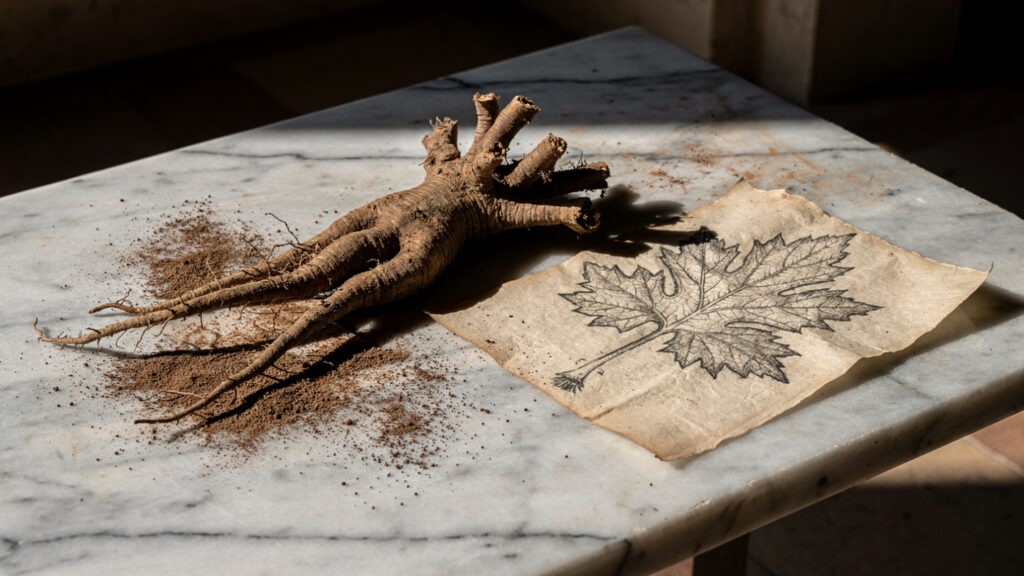
The Historia Plantarum’s account of the mandrake’s pharmacological profile, describing dose-dependent effects running from sedative at low doses through hallucinogenic at moderate doses to toxic at high doses, matches what contemporary pharmacology has confirmed as the accurate clinical profile of the tropane alkaloids in Mandragora officinarum. Theophrastus was describing a genuine dose-response relationship in terms modern pharmacokinetics would recognize, more than two thousand years before that vocabulary existed to describe what he was already observing.
The Living Botanical Heritage
The botanical knowledge ancient Greek herbalists developed, that Theophrastus organized, and that medieval Byzantine monasteries preserved in their herb gardens and medical texts, survives today in its most directly accessible form in the regional herbal practices of the Greek mainland and islands.

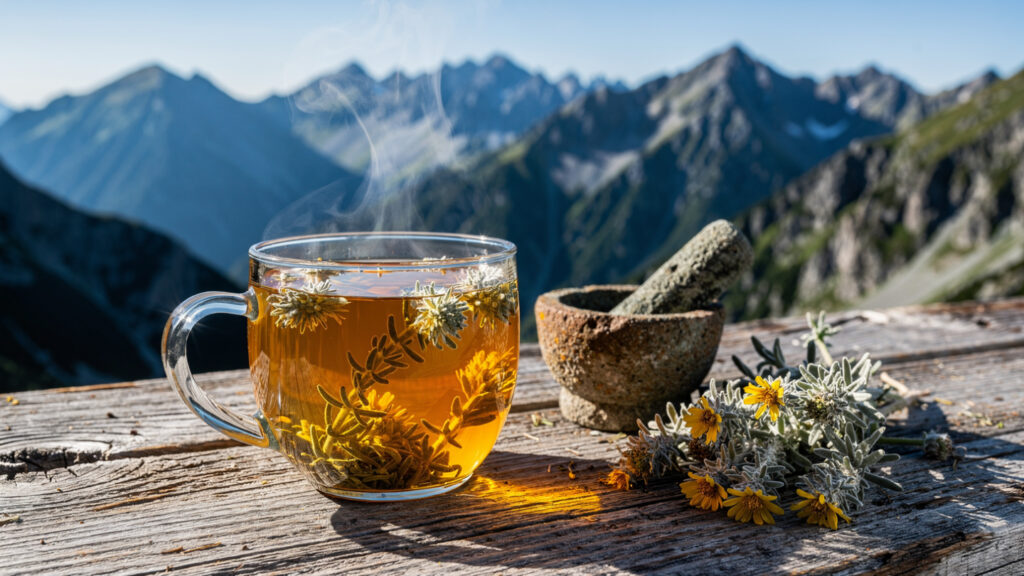
Mountain tea, the daily tisane made from Sideritis species that Greek upland communities have kept brewing for centuries, is the most widely maintained of these living herbal practices, its therapeutic reputation documented by ancient medical writers and now confirmed by contemporary pharmacological research into the plant’s anti-inflammatory and antioxidant effects.
The Sideritis species, the ironworts, are mountain plants whose distribution across Greek upland habitats, the Pindus range and the mountain massifs of the Peloponnese, Crete, and the Aegean islands, reflects the ecological character of Greek mountain vegetation that the Ikaria article in this collection develops as the botanical backdrop to Ikarian longevity. The wild herbs mountain communities gather for the daily tisane are exactly the herbs ancient writers identified as therapeutic, and that contemporary research has now begun characterizing at the molecular level.
The herbal markets of Athens, most directly accessible in the Monastiraki district and in the central market’s dried goods section, are the commercial, urban expression of this same botanical knowledge. The dried herbs, essential oils, herbal preparations, and botanical remedies sold there represent accumulated Greek pharmacological knowledge in its contemporary commercial form, organized around plants whose ancient reputation this living practice has kept alive.
The Cretan mountain communities whose wild herb harvesting the dittany story most completely expresses maintain the most directly continuous relationship with ancient botanical knowledge anywhere: the village herbalists of Anogeia and Spili, and the mountain communities of the White Mountains and the Dikti range, still know which plants grow where, at what season, in what condition, and for what therapeutic purpose they work best, knowledge refined in these same landscapes since the period when Theophrastus was organizing the systematic botanical description of what those landscapes produced.
The Pharmacological Knowledge and Its Honest Limits
An honest account of ancient Greek herbal medicine has to acknowledge that it contained both genuine pharmacological knowledge and a magical, ritual framework whose claims contemporary science cannot confirm.
The genuine pharmacological knowledge was real: what plants did to bodies, at what doses. It was empirically developed, systematically organized by Theophrastus, and transmitted through medieval botanical writing into the modern pharmacological vocabulary that still descends from the single Greek word pharmakon.
The magical and ritual framework was simply how that knowledge was organized and passed down in its own cultural context, one that never drew the line between the pharmacological and the magical the way contemporary science does. The herbalist who knew that mandrake produced physiological effects at specific doses was the same person who interpreted those effects through Hekate’s theological framework of the liminal, and the two forms of knowledge were never in tension. They were complementary: the empirical sitting alongside the theological, each making sense of what the other observed.
The contemporary visitor to a Greek herbal market buying dried dittany of Crete is buying the plant whose wound-healing properties Virgil documented and modern pharmacological research has confirmed. The visitor buying rue as protection from the evil eye is buying a plant whose bitter aromatic compounds are genuinely toxic to insects and genuinely repellent to certain animals, and whose ancient association with warding off malevolent influence may simply encode the practical observation that a strong aromatic plant placed at the threshold kept away creatures associated with disease and misfortune. The pharmaceutical and the protective were never as separate as contemporary categories suggest.
The pharmakon that heals and the pharmakon that harms are the same substance at different doses. Hekate’s knowledge was knowledge of the threshold between them. Circe’s practice was the practice of someone who had mastered that threshold. The contemporary pharmacologist who calculates the therapeutic index, the ratio between a drug’s therapeutic dose and its toxic dose, is performing the same intellectual operation the ancient Greek herbalist performed standing at the boundary between the healing preparation and the poison, choosing the correct side.
At Olympus Estate, Cultural Chronicles traces the practices and institutions that defined Greek civilization from the inside. The Greek word pharmakon means the thing that works on the body, not medicine. The same plant at the same dose could heal or kill. Hekate governed the thresholds between states of being, including the pharmacological threshold between the therapeutic and the toxic. Circe’s preparations in the Odyssey were described with the word pharmakon, and the moly that counteracted them has been identified as the snowdrop whose galantamine compound is now used to treat Alzheimer’s disease. Theophrastus organized the accumulated pharmacological knowledge of the ancient Greek world into the systematic botanical science that produced the vocabulary of the contemporary pharmaceutical industry. The dittany of Crete that Cretan mountain communities still harvest from the cliff faces has the antimicrobial and anti-inflammatory compounds the ancient reputation for wound healing required. The knowledge is still in the plants. The plants are still in the mountains.