




In the interior highlands of the Peloponnese, the region of Arcadia unfolds across a sequence of valleys, forested ridges, and elevated pastures shaped by long winters and springs that arrive without urgency. This is one of the oldest continuously inhabited landscapes in Greece, a terrain that the ancient Greeks themselves regarded as a place apart: wilder than the city-states of the coast, closer to the rhythms of the earth, presided over by Pan and the nymphs of stream and forest rather than the civic gods of Olympus. The mountains of Arcadia, the Mainalon range to the north and Taygetos rising to the south, hold snow well into March, and the valleys between them remain in their own seasonal time, cool and unhurried, while the lowlands are already moving toward summer.
The shift of season in Arcadia is not announced. Snow withdraws slowly from the shaded slopes, and the first signs of renewal appear close to the ground, among stones and damp soil where early light begins to settle. Before the taller growth of late spring takes hold, small and often overlooked plants emerge in the gaps between rocks and along the edges of streams. These early plants were the first to be noticed by the people who moved through this landscape with attention: the shepherds following their flocks along the ancient transhumance routes between winter lowlands and summer pasture, the foragers who knew the hillsides through long acquaintance, and the herb gatherers whose knowledge of plant and season was one of the most essential and least visible forms of expertise in the ancient Greek world.

Among these early spring plants is one remembered in ancient sources as moly, a herb associated in the mythological record with resistance, clarity, and the preservation of the self against forces that seek to alter it. Its presence in the Arcadian landscape is quiet. Its botanical identity in the modern world remains a matter of scholarly debate. Yet its place within the deep memory of Greek tradition has endured for more than two and a half thousand years, carried forward in the text of Homer and in the accumulated weight of commentary and interpretation that has gathered around that text across the centuries.
Moly in the Journey of Odysseus
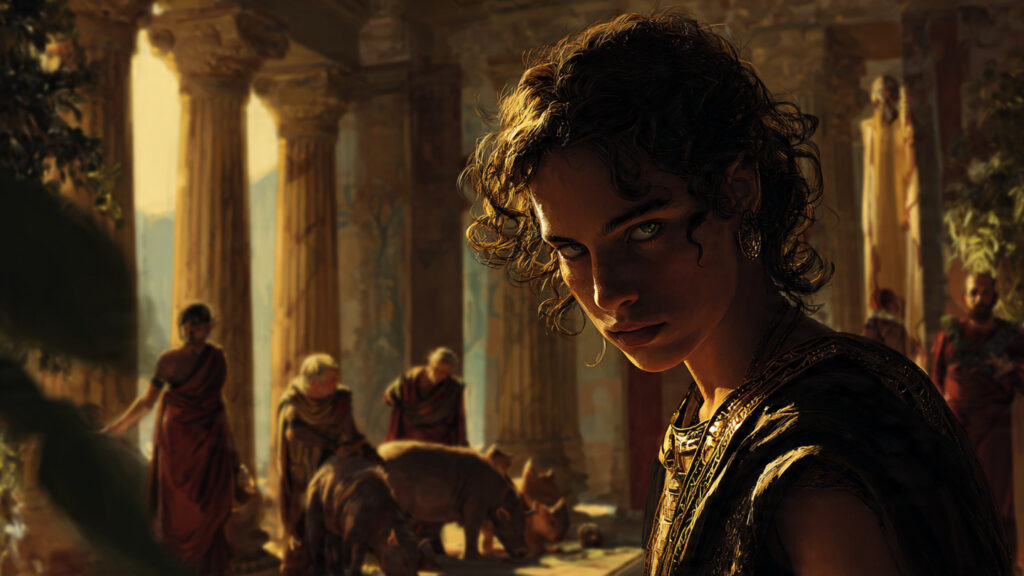
The most fully preserved account of moly appears in the tenth book of the Odyssey, at the moment when Odysseus arrives at the island of Aeaea and encounters the sorceress Circe. His companions, drawn into her hall by her hospitality and the smell of her cooking, are given a drugged mixture that strips them of their memory and their human form, transforming them into swine while leaving their minds intact enough to understand what has happened to them. The horror of the episode lies precisely in this: they are aware, but they are no longer themselves.
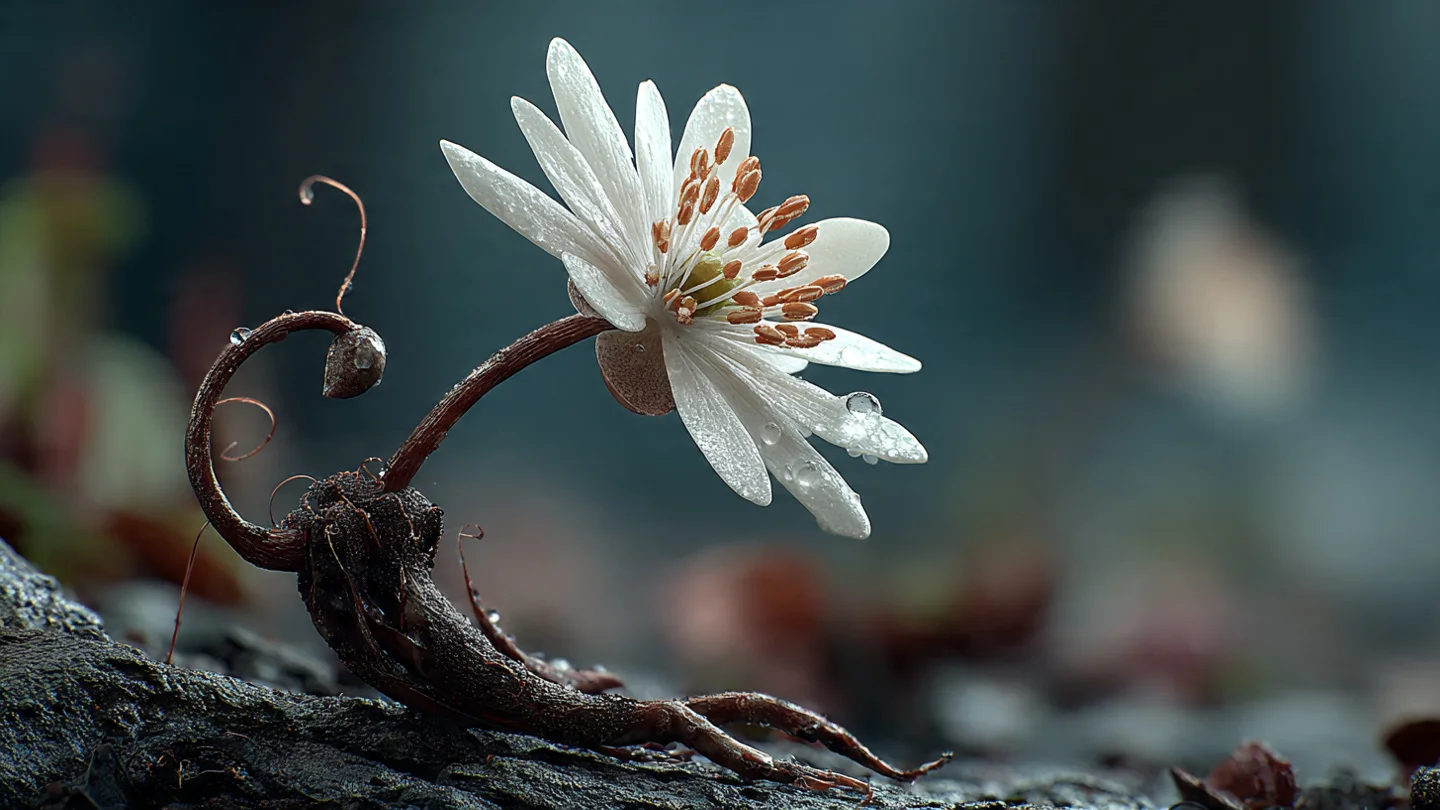
Before Odysseus enters the hall to confront Circe, the god Hermes meets him on the path through the forest. He comes in the form of a young man and carries a warning, but he carries something else as well. A plant pulled from the earth of the island, its dark root held out in his hand, its blossom white as new milk. This plant, Hermes tells him, is called moly. It is difficult for mortal men to find and to pull from the ground. The gods know it and are free to use it. Given this plant, Odysseus will be able to drink Circe’s mixture without being transformed. He will retain his form, his memory, and his will.

Homer’s description is precise in its particulars and deliberately mysterious in its implications. The dark root and the white flower suggest a plant that holds contrary qualities in tension: something that grows in shadow but opens into light, that draws its sustenance from deep in the earth but presents itself in a form of clarity. In the botanical tradition that developed from ancient Greek natural philosophy, this kind of description was not merely poetic. It was a practical guide to identification, of the same order as the descriptions found in the herbal texts attributed to Dioscorides, who catalogued the plants of the Mediterranean world in the first century with the same attention to color, habitat, and growth form that Homer brings to his brief account of moly.
What Homer emphasizes above the physical description, however, is the function of the plant. Moly does not give Odysseus power over Circe. It does not make him stronger or faster or more skilled in combat. It preserves his perception: it prevents the mixture from doing what it does to everyone else, which is to dissolve the boundary between the person and something lesser. In the economy of the episode, this is the essential gift.
Without moly, Odysseus would become what his companions became, aware of his transformation but unable to resist it. With it, he remains himself.
The Botanical Identity of Moly
The question of which plant Homer intended to describe has occupied botanists, classicists, and natural philosophers since antiquity, and it has not been settled. Ancient commentators proposed a range of candidates, including wild garlic, a species of Allium that grows across the Mediterranean and shares something of the dark-rooted, white-flowered profile that Homer describes. The naturalist Theophrastus, writing in Classical Athens in the fourth century BCE, mentioned a plant called moly in his survey of plants, noting that it grew in the highlands of Arcadia and near Pheneos, an ancient city in the northeastern part of the region. His description aligns with the broader family of mountain herbs that characterize the Arcadian flora, plants adapted to thin soils, cold winters, and the particular quality of light at altitude.
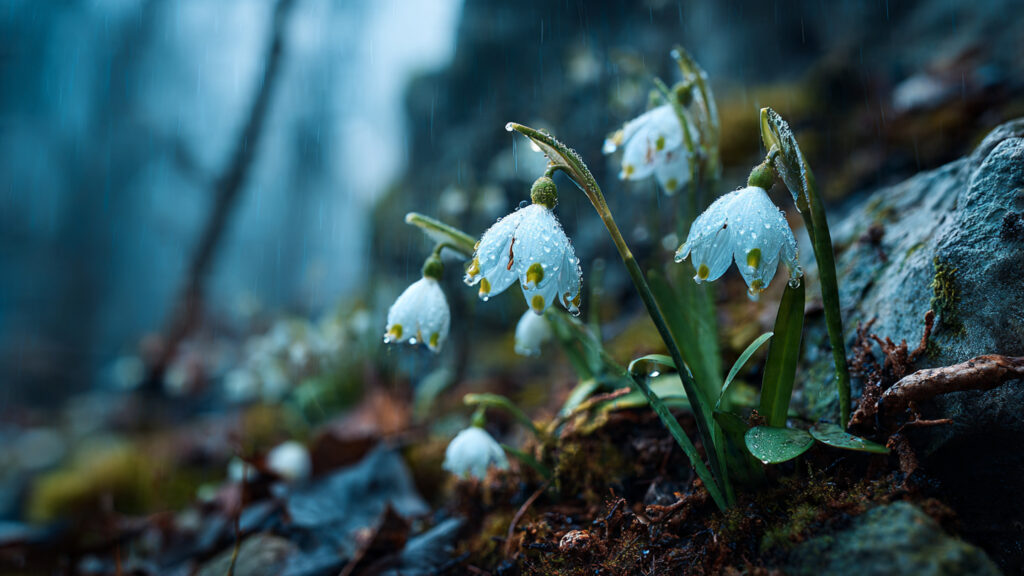
Other candidates proposed across the centuries of commentary include species of Peganum, whose alkaloid content could plausibly be associated with the protective function Homer describes, and various members of the Galanthus family, the snowdrops and their relatives, whose active compounds have been studied in modern pharmacology for their effects on memory and cognition. Galanthamine, derived from certain Galanthus species, is used today in the treatment of memory disorders, a detail that has prompted a number of modern classicists and pharmacologists to propose it as the most pharmacologically plausible candidate for Homer’s moly, lending an unexpected contemporary relevance to the ancient association between the plant and the preservation of the mind against pharmaceutical interference. The identification remains a proposal rather than a settled answer.
None of these identifications is certain, and the uncertainty is itself significant. It reflects the way plant knowledge in the ancient Greek world was transmitted: not through fixed taxonomic categories but through layers of observational description, regional knowledge, and narrative association. A plant known in Arcadia under one name might be known in Crete or Thessaly under another, with the same or overlapping properties attributed to it through different chains of local experience. The identity of moly is genuinely multiple, and its mystery is not a failure of ancient knowledge but an expression of how knowledge of the natural world was organized in a culture that did not separate the practical from the symbolic.
Plant Knowledge and the Herb Gatherers of Ancient Greece
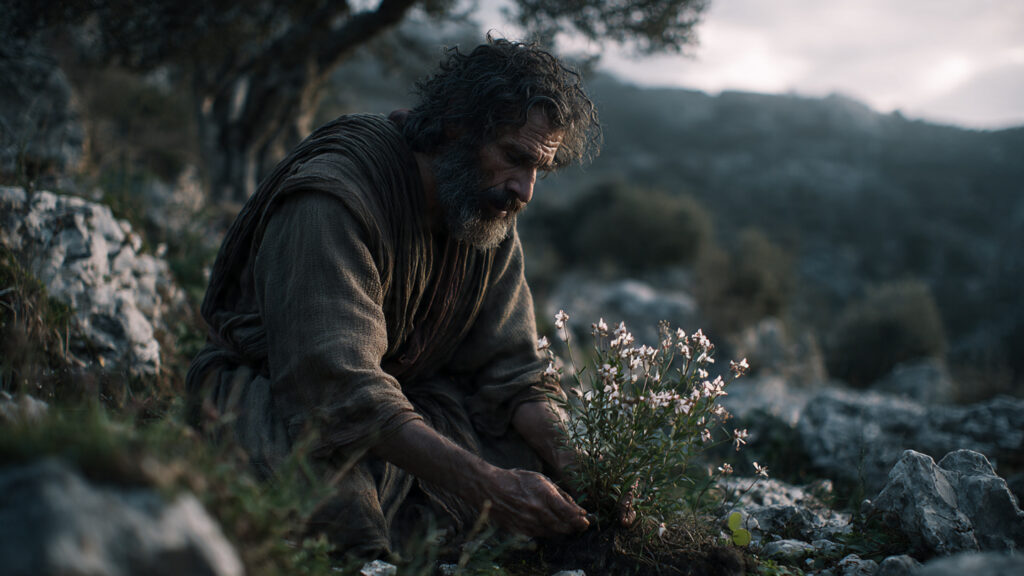
The figure of the herb gatherer, the rhizotomoi or root cutter of ancient Greek sources, occupied a distinct and somewhat ambiguous place in the social world of antiquity. Herb gathering was practical work, essential to the households, healers, and sanctuaries that depended on the properties of plants for medicine, ritual, and food preservation. At the same time, it was work that required a form of knowledge difficult to verify from outside and that operated at the boundary between the natural and the supernatural. The root cutter who knew which plants to gather at which season, in which soil, and prepared in which way, possessed a form of expertise that could not be easily distinguished, from the outside, from the knowledge of a sorceress like Circe herself.
This ambiguity runs through the mythological treatment of plant knowledge in ancient Greece. Circe is a mistress of herbs, and her power operates precisely through the preparation of plant-based mixtures that alter perception and form. Medea, the other great sorceress of Greek mythology, is similarly associated with the gathering and use of powerful plants, in her case drawn from the landscape of Colchis and the traditions of the Black Sea region. What these figures share with the moly episode is a form of attention to the natural world that the Greek tradition recognized as both powerful and dangerous: the knowledge of how to use what the earth produces in ways that affect the interior life of human beings, their memory, their perception, and their sense of who they are. Moly belongs to this tradition. Its gift to Odysseus is the preservation of exactly what the other herb-based preparations of the ancient world threatened to dissolve.
Resistance, Clarity, and the Preservation of the Self
The episode of Circe and moly is unusual in the mythological tradition of Greece because its central concern is not transformation, conquest, or divine punishment, but the preservation of identity under conditions designed to eliminate it. Odysseus does not defeat Circe by force. He enters her hall already protected, drinks her mixture without effect, and draws his sword at the moment she expects him to fall, reversing the dynamic of the encounter entirely. The reversal is possible only because he has retained himself: his memory of who he is, his awareness of where he is, and his will to act in accordance with that awareness.
This kind of inner resistance was a value that ran deep in Greek cultural thought, surfacing in the philosophy of Classical Athens as the concept of sophrosyne, a word usually translated as temperance or self-control but carrying a more precise meaning: the state of being in full possession of one’s own mind, undistorted by passion, fear, intoxication, or the influence of others. Sophrosyne was not passivity. It was the condition of maximum clarity, and it was understood as a prerequisite for action of any quality. The person who had lost sophrosyne had lost, in the most fundamental sense, the ability to be themselves.
Moly gives Odysseus sophrosyne in its most literal form: a plant that prevents a drug from working, that preserves the boundary between the self and what would dissolve it. In a broader cultural reading, the plant becomes a symbol for the discipline of attention, the practice of remaining grounded in one’s own perception when the conditions around one are designed to produce confusion. This is not a static quality. It must be actively maintained, something Hermes must supply because Odysseus cannot simply will himself into the protected state. Even the most resourceful of mortals requires assistance in maintaining clarity against a sufficiently skilled adversary.
The Arcadian Landscape and the Act of Searching
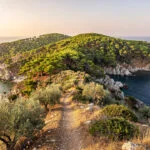
To walk through Arcadia in early spring is to move through a landscape that rewards the kind of attention the myth of moly describes. The terrain does not offer itself easily. The paths between villages in the valleys of the Mainalon follow contours shaped by centuries of use and require a quality of attention to the ground that keeps the eye close to the earth. The vegetation at this season is low and varied, a mosaic of early herbs and grasses and the first leaves of plants that will be much larger by summer, and the identification of any plant requires slowing down to a pace the landscape itself seems to encourage.

In this environment, the ancient practice of herb gathering was not romantic. It was skilled observational work carried out in conditions that were sometimes cold, often muddy, and always demanding of patience. The knowledge required to distinguish useful plants from useless ones, harmful ones from healing ones, plants at their peak of potency from those past it, accumulated through years of contact with the same hillsides across the same succession of seasons. This form of knowledge is not fully recoverable through reading. It can only be approached by returning to the conditions in which it was formed.
Arcadia’s interior villages, places such as Stemnitsa, Dimitsana, and Vytina, sit within this same upland landscape today, and the region as a whole has long maintained a connection to wild herb gathering and small-scale cultivation that is consistent with the agricultural patterns Theophrastus described. The precise survival of any single, unbroken line of botanical knowledge in any specific village is harder to verify than the broader pattern, but the landscape itself, the same hillsides, the same succession of early spring growth, the same blue-shadowed light at altitude that Theophrastus would have walked through, remains genuinely unchanged, and it is this landscape, more than any specific claim of continuous practice, that offers the closest available approach to the conditions in which moly was first described.

Whether moly grows there today in any form Homer would have recognized is impossible to say with certainty. What the landscape offers instead is the condition of attention that the search for such a plant requires, and that is, perhaps, what the myth has always been pointing toward.
Continuity Across Myth and Terrain
The figure of Odysseus, the intervention of Hermes, and the plant that preserved the most resourceful of mortals against the most skilled of sorceresses remain part of a narrative carried across more than two and a half thousand years of continuous reading, commentary, and imaginative engagement. The Odyssey is not a historical document, but its relationship to the landscape, the plants, and the knowledge practices of the ancient Greek world is genuine and specific. The moly episode reflects a real tradition of herb knowledge, a real cultural value attached to the preservation of clarity and selfhood, and a real landscape in which plants of this kind were gathered and used.

In Arcadia, the early spring herbs emerge each year from the same soils, along the same watercourses, at the same point in the seasonal progression that Theophrastus described more than two thousand years ago. Among them, whether named moly or named something else or not named at all, the plants the ancient world associated with clarity, resistance, and the preservation of the self against dissolution continue to grow. The landscape that produced them and the tradition that gave them meaning remain, in their quiet and enduring way, inseparable from each other.
At Olympus Estate, Mythic Essays traces the deeper currents of Greek myth. Moly was the herb Hermes gave Odysseus to resist Circe’s transformative drug, dark-rooted and white-flowered, difficult for mortals to find. Its botanical identity remains genuinely uncertain, debated from wild garlic to Galanthus since antiquity, but its meaning has never been in doubt: the preservation of sophrosyne, the clarity of mind, against forces designed to dissolve it. The herb gatherers of Arcadia knew this landscape long before Homer wrote it down, and the same hillsides, the same early spring growth, remain there still.