




If you want to understand the modern soul of an urban Greek, do not look to the sleek bars of coastal Athens or the synthesised pop echoing from beachfront clubs.
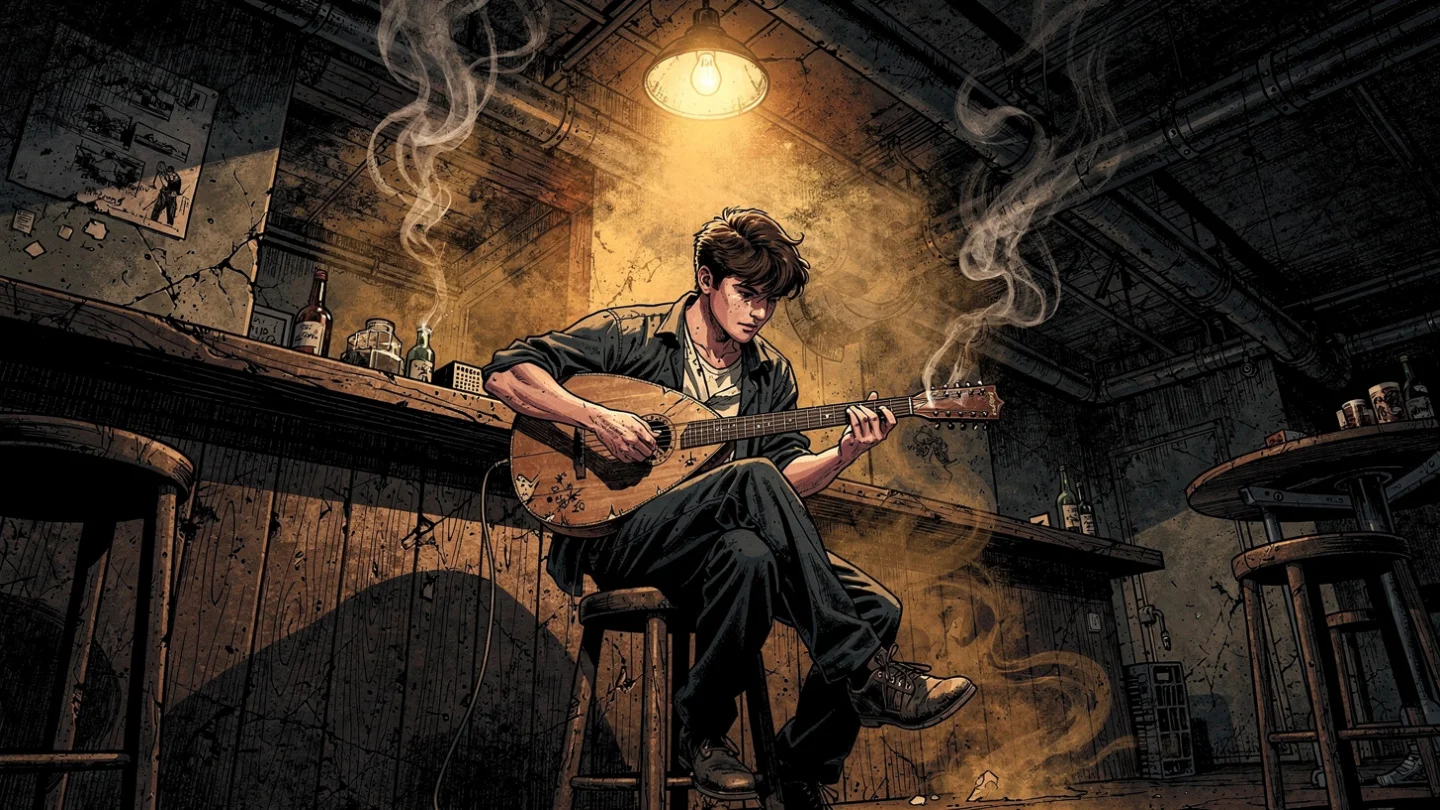
Look instead to a basement tavern in Thessaloniki where the ceiling is low and the light is lower, or to a stone courtyard in Ano Syros on a windless September night, where a musician in their twenties is cradling a wood-backed instrument with the attentiveness of someone handling something that carries more history than they can fully account for.
They are playing Rebetiko.
Often called the Greek Blues, Rebetiko is a musical tradition born in the margins: in the prisons, the refugee camps, and the tekedes, the hidden hashish dens of the 1920s Piraeus waterfront. For decades it carried the scent of exile and underground resistance. Dictators banned it. The bourgeois dismissed it as the soundtrack of the criminal underclass. The mid-century recording industry commodified it into tourist-friendly versions of itself that kept the melody and discarded the soul.
Today, in 2026, Rebetiko is experiencing a grassroots renaissance led entirely by a generation that has no nostalgia for the original era because they did not live in it. They came to this music not because it reminded them of something but because it said something that nothing else was saying: that displacement is survivable, that grief is not weakness, that the human voice and a stringed instrument in an unamplifed room contain more truth than any algorithm can generate or any recording studio can manufacture.
To understand why a century-old genre of displacement has become the most vital counterculture in Greece is to understand a generation that has survived financial collapse, pandemic isolation, and digital saturation, and found its cure in the raw friction of wood, wire, and human breath.
What the Wood Knows
Before the first note is played, the music begins in the forest.
The traditional bouzouki body, the skaftos, the carved bowl that gives the instrument its distinctive tear-drop profile and its resonant depth, is made from mulberry or walnut, and the choice between them is not aesthetic. It is acoustic, historical, and in the hands of the revival’s most serious musicians, almost philosophical.
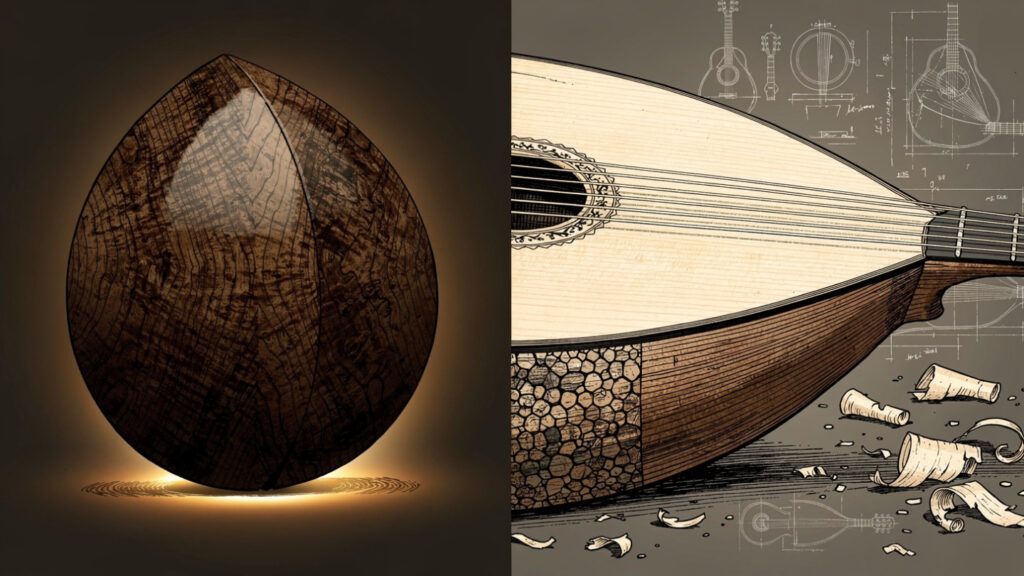
Mulberry, the traditional wood according to sources that trace the instrument’s construction back through the Greek luthier tradition, produces a sound with properties that the revival players prize above everything else: a warm, dark resonance in the lower register, a sustain that does not fade abruptly but settles slowly, like the note is reluctant to leave. The mulberry tree grows slowly. The density of the wood reflects the patience of the growth. A mulberry bowl carries a gravity in the hand that players describe as the instrument already knowing where it wants to go.
Walnut, often dyed black to approximate the mulberry’s darker appearance, produces a brighter and more percussive response: sharper attack, faster decay, the note more present at the moment of striking and less present in the silence after. Walnut has its advocates among the revival players, particularly those working in the Piraeus style where the rhythmic clarity of each stroke matters as much as the sustain between strokes.
The soundboard above the bowl is spruce or cedar: lighter, stiffer, optimised for projection rather than warmth, the wood that carries the sound outward into the room while the bowl wood shapes the colour of what is being carried. The marriage of these two materials, the dark heavy resonance of the bowl and the bright responsive projection of the soundboard, is the acoustic formula that the original rebetes worked with and that the revival players are recovering after decades in which synthetic materials and industrial production had made the formula irrelevant.
The luthiers working in this tradition are obsessive about their wood sources. The revival has produced a generation of instrument makers who seek out aged wood, timber that has been drying for decades, sometimes for longer, because the acoustic properties of a wooden instrument improve significantly as the cellular structure of the wood stabilises over time. A bowl made from fifty-year-old mulberry will sound different from a bowl made from freshly seasoned mulberry, and the difference is audible in the quality of the sustain, in the complexity of the overtones, in what players describe as the voice the instrument was always waiting to find.
The pre-war bouzoukis that the original Markos Vamvakaris and his contemporaries played were made by luthiers working with traditional methods and whatever aged wood the dockside districts of Piraeus could produce. The instruments that survive from this period, handled carefully in the collections of serious musicians, are acoustically extraordinary in ways that modern production instruments do not replicate. The revival’s most committed players seek them out, study them, and use them as the standard against which their own instruments are measured. The wood is the memory. The memory is the sound.
The Language Nobody Was Supposed to Understand
Before the rebetes built a musical vocabulary, they built a linguistic one.
The world of the Piraeus waterfront in the 1920s and 1930s was a world of surveillance. The police raided the tekedes. They smashed instruments, arrested musicians for playing certain songs, prosecuted men for the offence of being a mangas in public. In this environment, the community that produced Rebetiko developed a slang vocabulary that served the same function as any argot developed under pressure: it allowed the initiated to communicate in plain sight of those who wanted to stop them.
The mangas, the term for the archetype of the Rebetiko world, derived from the Turkish manghes, meaning someone with no respect for authority, someone deliberately and philosophically anti-establishment. The mangas had an appearance so distinctive it functioned as a kind of uniform: the wool cap called the kavouraki, the jacket worn with one sleeve empty, the tight belt that concealed a knife, the striped trousers, the pointed shoes. The walk was characteristically uneven, a rolling gait called koutso vadisma, the limping walk, sufficiently distinctive that the group of men who affected it became collectively known as the koutsavakides, the lame-walkers.
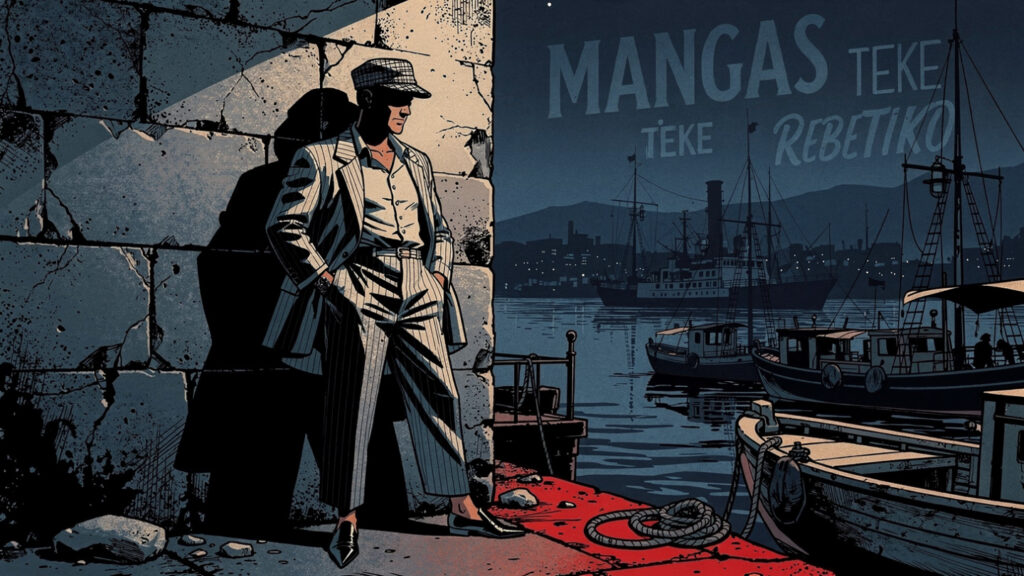
The teke, derived from the Turkish term for a dervish monastery, was the hashish den that provided the social space in which the music was made and heard. In practice the teke was usually a back room attached to a coffee shop, its existence deniable, its entrance controlled. Giorgos Batis, one of the most influential musicians of the Piraeus Rebetiko scene in the 1930s, known as the Mangas of Piraeus, ran a coffee shop in which the front room was entirely ordinary and the inner room contained everything that was not.
The songs themselves developed a coded vocabulary for the substances and the rituals that the police had made officially illegal: the nargile, the water pipe for hashish, the masoura, the smoking pipe, the tsimbouki, the wooden pipe, the act of smoking described through metaphors of aviation, of sailing, of travel to distant places. If you did not know the code, the lyrics described a man taking a journey. If you knew the code, you knew exactly what kind of journey.
The chasiklidika, literally the hashish songs, were the most explicitly coded category in the early Rebetiko repertoire. They did not survive the Metaxas dictatorship’s censorship of 1936, which banned them explicitly and prosecuted their performance. But the vocabulary they had generated, the slang of the Piraeus underworld, survived in the later songs in more oblique forms: in the emotional register of the lyrics, in the references that pointed toward what could no longer be named directly, in the community of understanding that a shared vocabulary creates between those who possess it and maintains between them across time and persecution.
The young musicians of the 2026 revival are learning this vocabulary alongside the music. They study the pre-war recordings not only for the melodic content but for the linguistic content: the words that encode the worldview of the original rebetes, the vocabulary of a community that built its culture under conditions of active suppression and built it so well that it has survived a century of the world’s attempts to make it irrelevant.
The Acoustic Resistance to the Algorithm
Most accounts of the Rebetiko revival describe it as nostalgia. They are missing the actual argument.
The 2026 Rebetiko revival is not a museum piece. It is an act of deliberate refusal.
We live in an era of hyper-produced audio designed for consumption through headphones, optimised for streaming platform metrics, engineered to retain attention across short intervals rather than to sustain presence across long ones. Rebetiko is the exact opposite of this in almost every technical and social dimension.
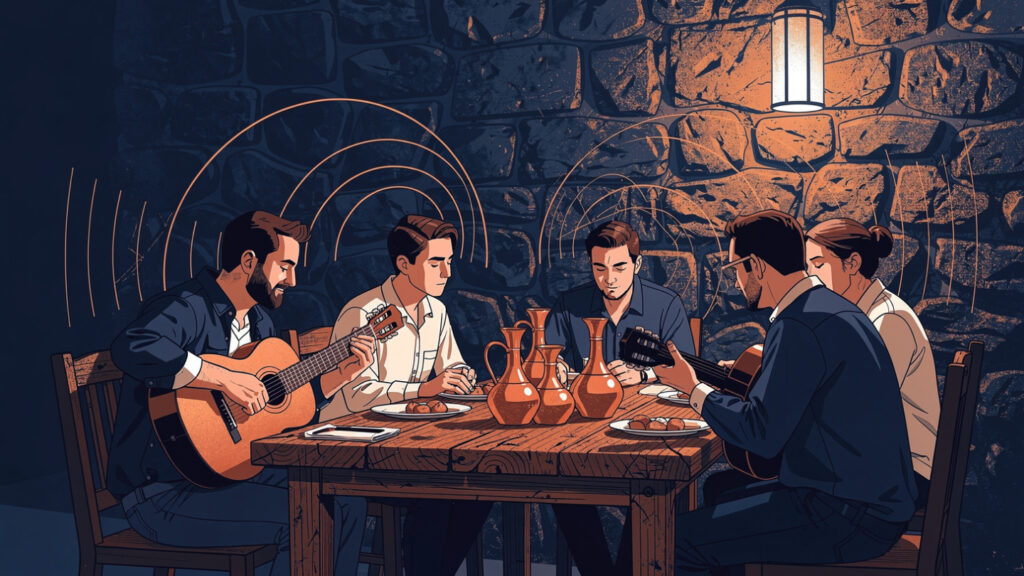
True Rebetiko cannot be experienced through a screen or a streaming playlist because it relies entirely on the acoustic physics of the room and the emotional temperature of the parea, the company. In the koutoukia, the hole-in-the-wall tavern dens where the revival is happening, there are no microphones, no speakers, no stage, no lighting rigs. The musicians sit at the same level as the tables. The space between performer and audience is not managed. It does not exist.
If you drop a fork, you interrupt the song. If you speak over the baglamas during a delicate passage, you break something in the room that takes several minutes to reconstruct. This forced intimacy demands a quality of presence that the digital world has made genuinely unfamiliar to the generation practising it: the experience of being in a space where you cannot be passive, where your physical presence and your attentiveness are active contributions to the event rather than your optional additions to a performance that would occur without you.
For a generation exhausted by the performative nature of online existence, where everything is simultaneously content and performance and metric, the koutouki offers something that has no digital equivalent: a space where the boundary between making and receiving dissolves completely, where the music is produced by the room rather than delivered to it, where your silence is as active a contribution as the musician’s playing.
Born from the Borderlands | The Refugee DNA
The sonic architecture of Rebetiko is a physical map of Greek displacement.
When the 1922 catastrophe and the subsequent population exchange forced over a million Greek refugees from Asia Minor onto the shores of Piraeus, Thessaloniki, and Syros, they arrived with nothing that could be sold but everything that could be sung. The musical traditions they brought, the Smyrnaean style with its violins, its oud, its heavy Eastern vocal ornaments, collided in the dockside slums with the gritty rhythmic Piraeus style already developing among the city’s underclass, anchored by the bouzouki and the tiny, easily concealed baglamas.
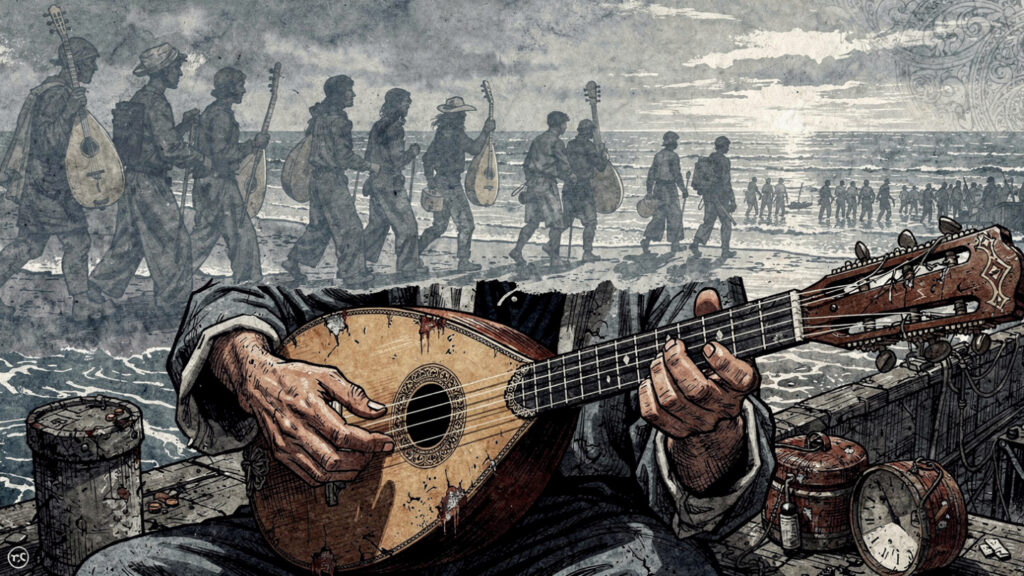
The result was a synthesis that defied every attempt at nationalist tidiness. It was not Greek music in the traditional sense and it was not Turkish music in the Ottoman sense. It was port music: the music produced when two musical traditions meet at the point of their maximum displacement and need each other too urgently to maintain their separation.
The lyrics did not speak of idealised landscapes or national virtue. They spoke of poverty, prison walls, police raids, the ache of kaimos, the Greek term for an existential longing that has no cure and no precise English equivalent. They spoke with the authority of people who had lost everything and discovered, in the process, that what they could not lose was their capacity to describe the loss.
When a young musician plays a song by Markos Vamvakaris today, born on Syros in 1905 and self-taught on instruments he repaired in a Piraeus slaughterhouse, they are tapping into an ancestral resilience: the knowledge that Greek identity was never built on static purity but on the capacity to transform grief into art under conditions that made both the grief and the art genuinely dangerous.
The Architecture of the Dromoi
The haunting quality of Rebetiko, that bittersweet, unstable, melancholic ring that transports you to another register of experience, comes from a musical syntax called the Dromoi: the roads, the pathways.
To the Western ear trained on standard major and minor scales, Rebetiko sounds beautifully unresolved, hovering between intense grief and fierce joy. This is not accidental. It is the product of centuries of sonic convergence: Byzantine ecclesiastical chant meeting Ottoman classical music meeting Greek folk tradition in the ports of the Aegean, producing a system of scales that carries emotional specificity the Western framework cannot accommodate.
A Dromos is not simply a scale. It is an emotional territory with its own psychological weight, its own characteristic ornaments and improvisational conventions, its own relationship to the feeling it was developed to express. The musician entering a Dromos is not choosing a technical framework. They are choosing an emotional address.
Dromos Hijaz, built on an augmented second interval that creates a wide, unresolved gap between the second and third notes of the scale, carries the weight of the Eastern Mediterranean in its sound: heavy, spiritual, explicitly non-Western, a scale that mimics the natural inflection of the grieving voice in a way that the Western minor scale, for all its facility with sadness, does not quite achieve. When a song opens in Hijaz, the room knows before the first phrase completes that this is going to go somewhere difficult.
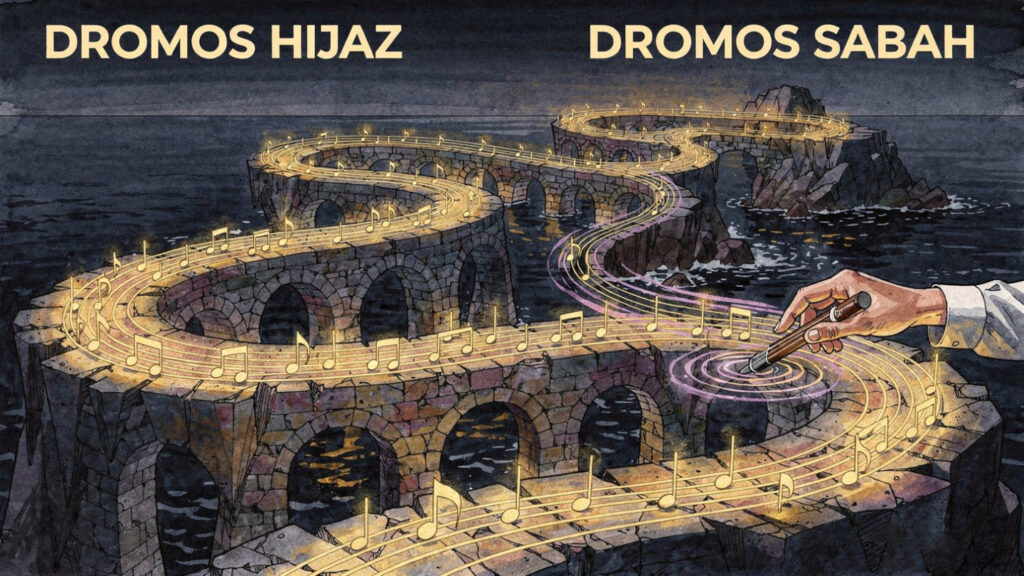
Dromos Sabah is what comes after difficult: a scale of such technical instability that its intervals seem to close in as the melody ascends, trapping the phrase in a narrowing space that produces, in the listener, the physical sensation of being enclosed. Sabah is the scale of kaimos at its most concentrated, used for songs written in prisons and refugee camps, songs in which the landscape of the emotion and the landscape of the physical situation were the same.
Dromos Kiourdi introduces the chameleonic quality that gives Rebetiko its capacity for the sudden pivot from mourning to defiance: a shifting third and seventh that flatten on ascent and sharpen on descent, so that the same melody moving up and then down can pass through minor and major registers in a single phrase. It captures the dual nature of the Greek spirit with technical precision: celebration and grief in the same breath, survival and its cost inseparable from each other.
The Instruments and Their Secrets
The Rebetiko instrument family carries its own history of displacement and adaptation.
The refugees of 1922 arrived with the oud and the saz: fretless instruments capable of playing the infinite microtones, the notes between the notes, of Eastern musical tradition. As the Piraeus style developed, the bouzouki became the dominant voice. The bouzouki is fretted: its metal frets are designed for the fixed intervals of Western tempered tuning. This creates a structural problem for a music whose emotional content depends on precisely the microtonal inflections that fixed frets prevent.
The early rebetes solved this problem through technique rather than redesign. They bent the steel strings with their left hand fingers, forcing the pitch upward between fret positions. They slid into notes from below, approaching the pitch from a microtonal distance and letting the string settle into it rather than striking it cleanly. They developed the taksimi, the unaccompanied improvisational prelude that introduces the Dromos and demonstrates the scale’s emotional range, as a space specifically for this microtonal navigation: a moment of pure melodic statement in which the Eastern musical tradition could be expressed without the rhythmic framework that the frets were best suited for.
The douzenia, the alternative tuning systems that the old masters developed, extended this logic to the instrument’s fundamental configuration. By retuning the open strings away from standard intervals and toward the intervals of the Dromos being played, the rebetes created instruments where the open strings resonated sympathetically with the scale rather than against it, producing a drone effect that filled the small rooms of the tekedes with a thick, heavy resonance. The Carbagnol tuning, the Syrian tuning, the various configurations that the revival players are now recovering from old recordings and the memories of older musicians: each one is an acoustic solution to the problem of how to make a Western-fretted instrument speak with an Eastern accent.
The baglamas, the small cousin of the bouzouki, had a social function beyond its acoustic one: it was small enough to be hidden. A musician entering a teke with a baglamas could conceal it under a coat if the police arrived. This practical consideration shaped the instrument’s role in the music, the small instrument providing rhythmic punctuation and harmonic support while the bouzouki carried the melody, a division of labour that the acoustic constraints of the space made natural and that the social constraints of the era made necessary.
The Zeibekiko | A Secular Exorcism
To see a young Greek step into the centre of a crowded koutouki and begin the Zeibekiko is to witness something that has no equivalent in the dance traditions of any other culture.
The Zeibekiko is not performed to attract a partner or entertain a crowd. It is danced entirely for oneself, and the room understands this and adjusts. The dancer does not perform to the audience. The audience witnesses the dancer, which is a different thing: a posture of attention rather than a posture of reception.
The steps are heavy, uneven, circular. The characteristic 9/8 time signature of the music underlying it produces an asymmetric pulse that the body must negotiate rather than simply follow: three beats plus two beats plus two beats plus two beats, a rhythm that requires active engagement rather than passive surrender. The dancer often looks at the floor, arms extended with the quality of something that has been wounded and is still standing.
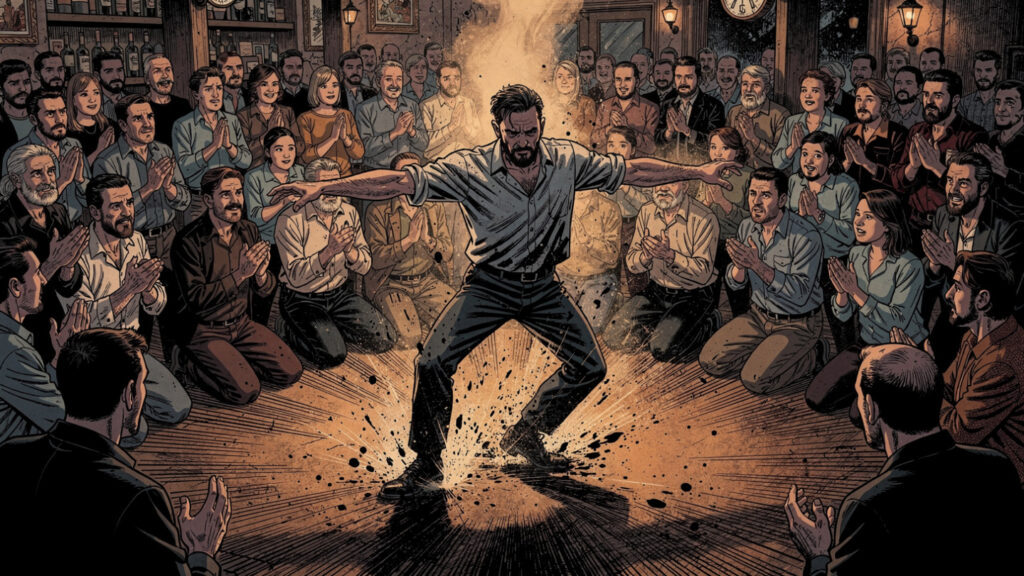
The unwritten rules of the Zeibekiko are observed by the revival generation with a seriousness that suggests they understand what the rules are for. You do not enter the dancer’s space: the circle around the Zeibekiko is sacred in the same way that the oracle’s space was sacred, inviolable, belonging to whoever is inside it for the duration of their presence. To interrupt a dancer is not a social mistake. It is a violation of something that the room has agreed to protect.
The surrounding witnesses kneel or slow-clap on the rhythm, serving as the human frame within which the dancer’s private reckoning occurs. What is being reckoned with varies: the Zeibekiko is the external form that internal pressure takes when the music has created enough space for it. The revival musicians describe watching people dance the Zeibekiko who have clearly never danced it before, whose bodies find the movement without instruction, because the music has organised the space in a way that makes the movement the natural response to being inside it.
This is the same threshold this site’s own account of kefi describes directly: not happiness, but the specific moment when something finally gives way.
The Geography of the Revival
The revival has rewritten the nighttime map of Greece’s major cities.
In Athens, the tourist-heavy alleys of Plaka are bypassed by locals in favour of Exarcheia, Petralona, and Kypseli, where the Rebetadika have shed the mid-century associations of plate-smashing and expensive whiskey tables and returned to the minimalist aesthetic of the 1930s originals. The menu is a copper carafe of house wine or tsipouro, spicy feta dip, wild greens. The musicians sit at the same level as the diners. Nothing separates the sound from the people it is made for.
In Thessaloniki, the movement thrives in the upper old town of Ano Poli, whose Ottoman-era streets provide the acoustic and atmospheric conditions that the music seems to require: enclosed spaces, rough surfaces, the sound bouncing between old stone rather than being absorbed by acoustic panels designed to manage it for an audience.
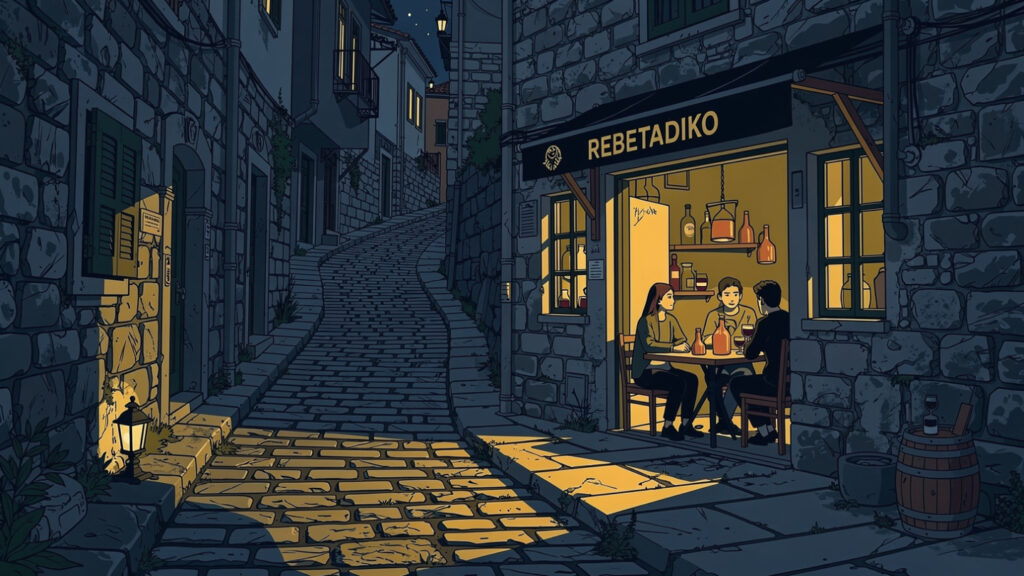
The new generation of venues operates on a deliberately democratic economic model. The koutouki is affordable in a way that the mid-century bouzouki nightclub never was: university students and manual workers and elderly neighbourhood regulars sit together at the same tables because the price of a carafe of wine and a plate of food places the evening within reach of anyone with the desire to be there. This is not accidental. The Rebetiko world always understood that its democracy was part of its resistance, that a music born in the margins stays true to itself when it remains accessible to the people the margins contain.
The Betrayal and the Return | What Happened in Between
The story of Rebetiko is not simply the story of a music that was suppressed and survived. It is the story of a music that was suppressed, survived, was commodified, lost its soul in the commodification, and is now being recovered from the version that the commodification produced.
In the 1950s, Manolis Chiotis added a fourth course of strings to the bouzouki, tuning it to Western intervals and enabling it to play chords in the Western harmonic system. The innovation was technically brilliant and commercially transformative: the tetrachordo bouzouki could accompany the harmonic progressions of popular song in a way the trichordo could not. It entered the living room and the recording studio and the film soundtrack. Vasilis Tsitsanis, the most significant figure in the transition, is credited with bringing the bouzouki out of the hashish den and making it respectable.
Respectability cost something. The douzenia tunings, the taksimi improvisations, the microtonal string-bending that had given the music its Eastern soul, were gradually smoothed away in the process of adaptation to Western harmonic conventions. The chasiklidika, the coded songs of the hashish world, had already been censored out of existence by the Metaxas dictatorship in 1936. What remained was beautiful in ways that the original was not, but it was also less itself.
The military junta of 1967 to 1974 produced a second censorship that paradoxically accelerated the music’s recovery: by suppressing folk music broadly, the junta made it politically significant to recover it. After the dictatorship fell, Giorgos Dalaras recorded his landmark album of fifty years of Rebetiko song in 1975, and the music re-entered public consciousness in a form that acknowledged its full history for the first time in decades.
The 2026 revival is the third movement. It is the first to be conducted entirely by people who came to the music by choice rather than inheritance, who learned the trichordo bouzouki when the tetrachordo was the instrument everyone played, who sought out the pre-war recordings specifically to find what the commodification had removed, and who are rebuilding the complete tradition: the instruments made from the right wood, the douzenia tunings recovered from archival recordings, the linguistic vocabulary of the mangas world studied alongside the musical vocabulary of the Dromoi.
Dromos are Struck on a Mulberry Wood
Rebetiko is the music of the broken who refused to be defeated.
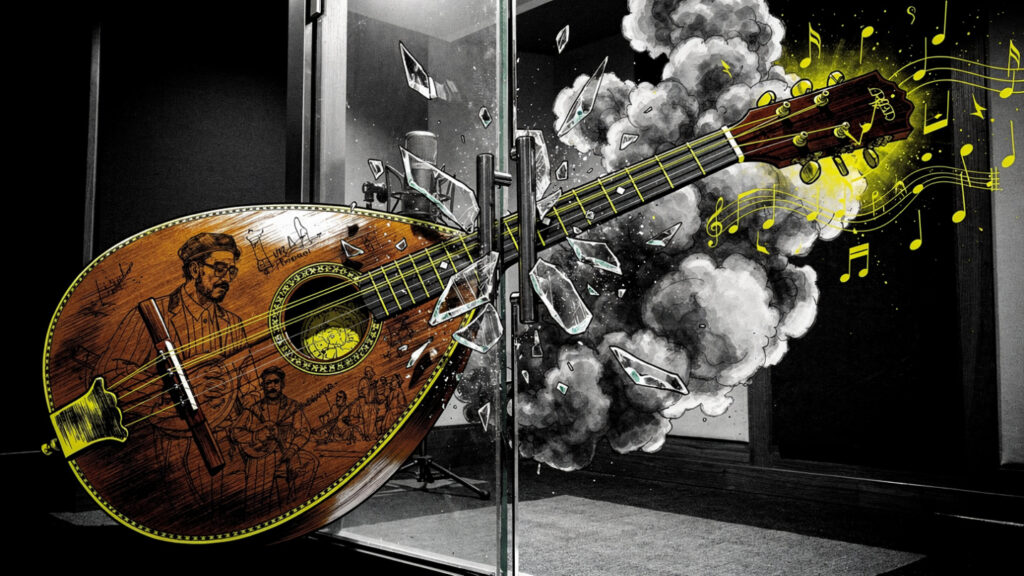
It did not die when the Metaxas dictatorship banned the hashish songs. It did not die when the mid-century recording industry replaced the trichordo with the tetrachordo and the Eastern microtones with Western chord progressions. It did not die when the military junta censored folk music and the tourists turned bouzouki into spectacle. It lived in the pre-war recordings, in the hands of the few musicians who maintained the original techniques, in the linguistic memory of the mangas vocabulary, in the acoustic memory of the mulberry wood instruments that produced a sustain unlike anything the modern production line could replicate.
The young musicians crowding the koutoukia of Greece in 2026 are not engaging in nostalgia. They have recognised that the collective anxiety of their historical moment requires a music that does not lie, that does not optimise for comfort or palatability or streaming metrics, that says exactly what the kaimos requires to be said.
They have found the trichordo bouzoukis. They have learned the douzenia tunings. They have memorised the vocabulary of the hashish dens. They sit at the same tables as their audience, in rooms where the sound has nowhere to go except directly into the people receiving it, and they play the scales that Byzantine chant and Ottoman music and Greek folk tradition produced when they were compressed together in the ports of the Aegean by a catastrophe that left a million people with nothing but their songs.
When you sit in that basement tavern and watch the smoke rise as the first chords of a minor Dromos are struck on a mulberry wood instrument that has been tuned to its own gravity, you understand something that the streaming platforms and the algorithmic playlists and the noise-cancelling headphones cannot tell you.
Some music was made to be in the same room with.
This is that music.
At Olympus Estate, Greek Living looks beneath the surface of culture to find the traditions that keep a people grounded. Rebetiko is not the soundtrack of the past. It is the resilient rhythm of the Greek present, keeping the soul honest one chord at a time, in rooms too small and too honest to pretend otherwise.