



Everyone knows how the story ends. A boy flies too close to the sun, the wax holding his wings together melts, and he falls into the sea that still carries his name.
What almost nobody asks is why Daedalus and his son were trapped on Crete in the first place, needing wings to escape at all. The answer has nothing to do with the Minotaur, examined at length elsewhere on this site, or the labyrinth Daedalus built to contain it. It has to do with a twelve-year-old boy, a fish spine, and an uncle who could not stand being outdone.
The Nephew Who Learned Too Fast
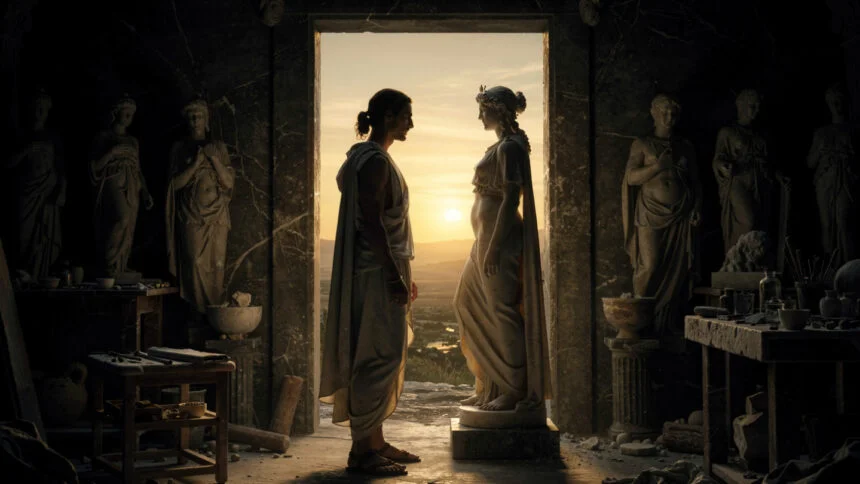
Before Crete, before the labyrinth, before any of it, Daedalus was already the most celebrated craftsman in Athens, a descendant of the royal house of Erechtheus running a workshop that trained the city’s finest sculptors and builders. Into that workshop came his sister’s son, a boy whose name shifts across the ancient tradition, called Talos by Apollodorus and Calos by Pausanias, while Ovid gives the boy the name Perdix. The variations are tangled enough that it is safer to treat them as different strands of a much older story than to force them into a single genealogy. What does not change is why the boy was there. He had been sent to learn the family trade, and he learned it far too well.
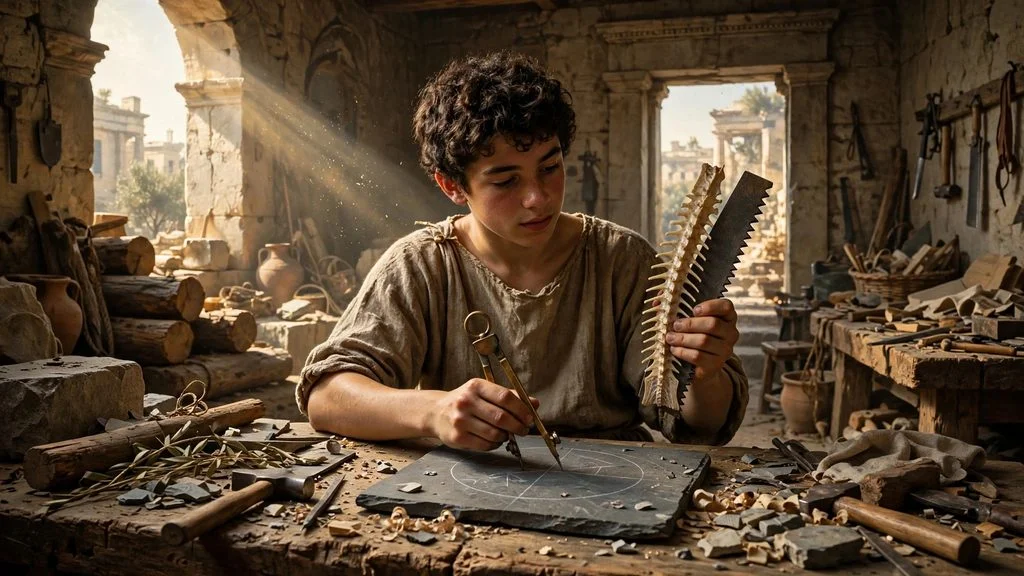
The boy learned faster than anyone expected, including his uncle. Watching the serrated spine of a fish, he worked out the principle of the saw and built the first one. He then paired two iron arms at a joint, one fixed as a pivot and the other free to trace a perfect circle, and invented the compass. The surviving traditions differ over some of the details, but the essential image is remarkably stable. Daedalus’s pupil possessed an inventive intelligence capable of rivaling his teacher. Apollodorus says Daedalus feared the boy would surpass him, while Ovid makes the jealousy even more explicit. Ancient myth does not portray the nephew as merely talented. He is dangerous precisely because his talent threatens the master’s claim to supremacy.
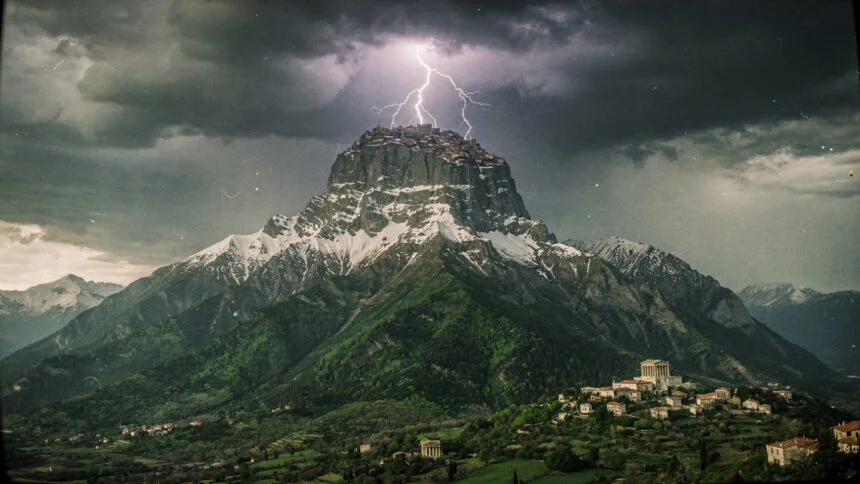
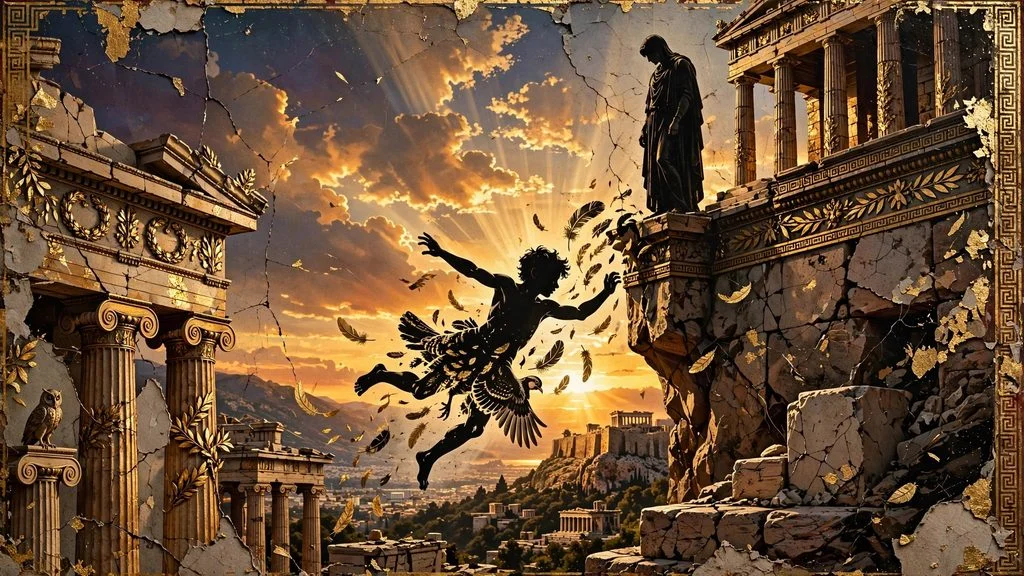
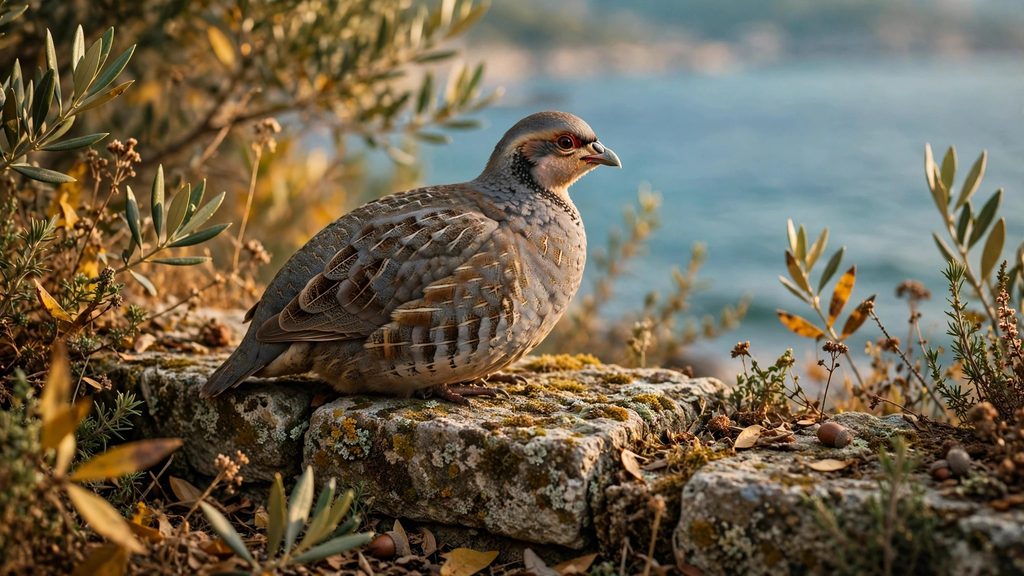
Daedalus could not tolerate it. He lured the boy to the height of the Acropolis, to a temple sacred to Athena, and threw him from it, afterward claiming the fall had been an accident. Ovid’s telling gives the story a small mercy. Athena, examined in her own right elsewhere on this site, favored clever creatures wherever she found them, and caught the boy mid-fall and transformed him into a partridge before he could strike the ground. The bird that carries the name Perdix in Ovid’s telling never seeks high places, a species-wide memory, the ancient audience understood, of the one fall it survived. Other traditions omit the transformation entirely and preserve the murder itself as the essential fact.
The body was found. Athens tried Daedalus for murder before the Areopagus, the city’s ancient court, and condemned him. He fled into exile rather than face the sentence, and the destination he chose was Crete, the court of King Minos, where a craftsman of his skill could always find work and where the crime that had driven him there could not immediately follow him. Apollodorus makes the murder of Talos the direct reason for Daedalus’s flight, while Pausanias independently preserves the tradition that Daedalus murdered his sister’s son Calos and fled to Crete for it. The names vary. The exile does not.
The Prison of His Own Making
On Crete, Daedalus built the labyrinth for Minos, the structure that would contain the Minotaur, and later, when Ariadne needed to help Theseus survive it, it was Daedalus’s own knowledge of the structure that made escape possible. Minos, discovering the betrayal, did not simply banish his architect. In the version preserved by Apollodorus, he shut Daedalus inside the labyrinth itself along with his young son Icarus, whom Apollodorus identifies as the child of Naucrate, a female slave of Minos. Other traditions place Daedalus and Icarus in a tower rather than inside the labyrinth, but the older mythic logic is the same in either case. The builder had made a prison too good for its own architect to escape by walking.
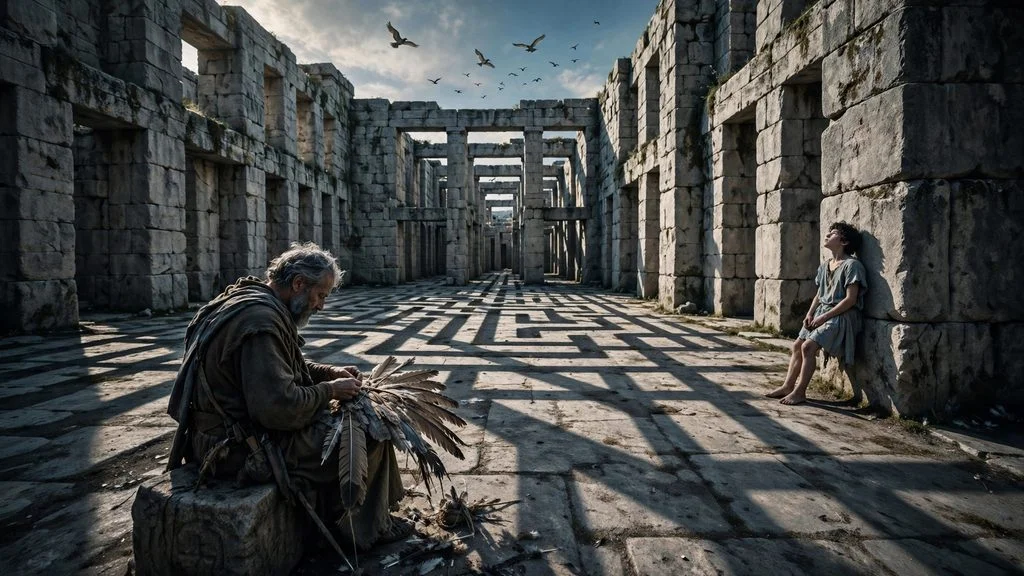
Minos controlled the island and the sea around it completely. What he did not control, Daedalus realized, was the air.
The Wings and the Warning
Daedalus collected feathers, the smallest bound with thread and the larger ones fixed in place with wax, and built two sets of wings curved in imitation of a real bird’s, one for himself and one sized for his son. Before they flew, he gave Icarus the instruction that mattered: not too low, where the sea’s damp could loosen the feathers, and not too high, where the sun’s heat would soften the wax and pull the whole construction apart.

The safe path was the narrow one between. Apollodorus preserves both parts of the warning, while Ovid turns the same instruction into one of the most famous passages in ancient poetry. Popular memory kept only one half of it. Flying too close to the sun became the entire lesson, hubris punished, ambition overreaching its limits. The warning against flying too low disappeared from the idiom almost completely, and its disappearance is its own kind of evidence. A warning against excess makes a satisfying moral. A warning against complacency, against dropping too close to the water out of caution or fatigue, does not flatter the same story nearly as well, so the culture that inherited the myth kept the half that punished ambition and quietly let go of the half that punished timidity.
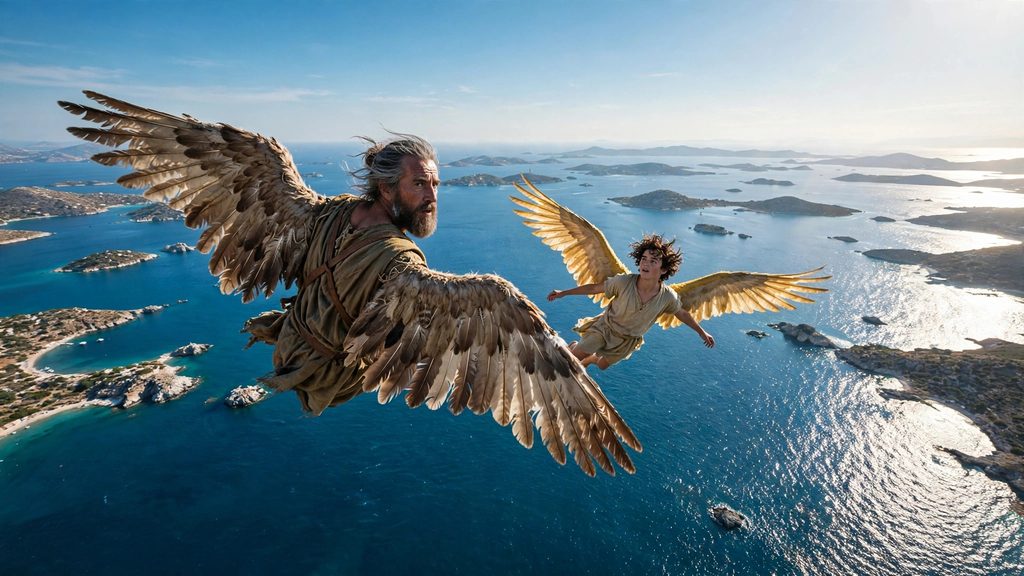
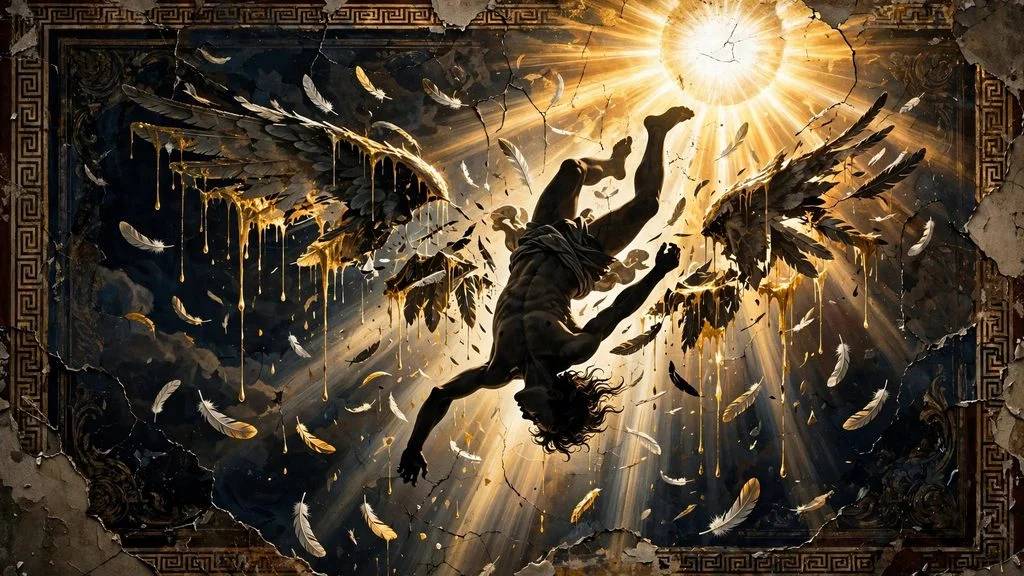
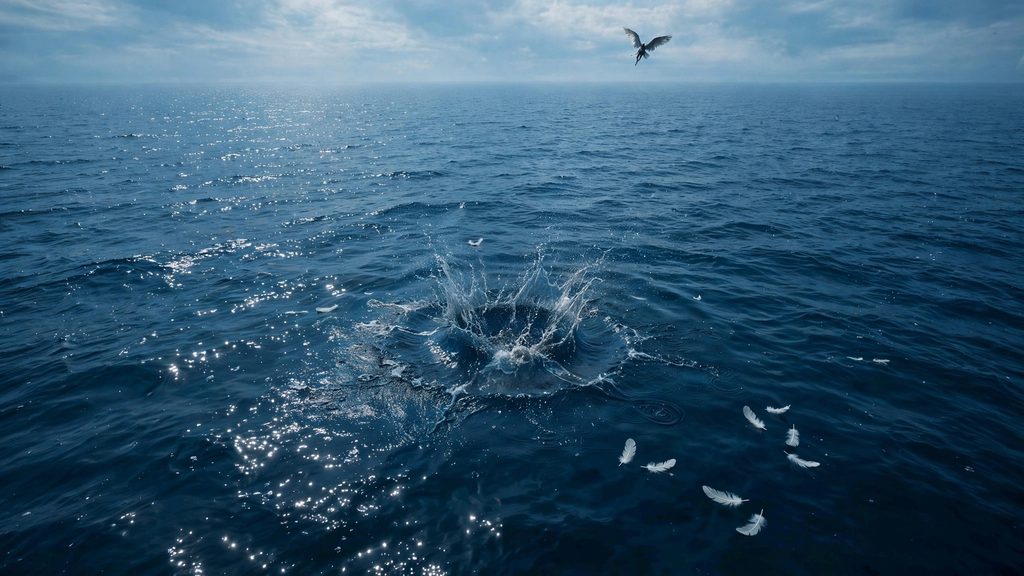
They flew from Crete, passing over the Aegean, Daedalus in front and looking back constantly to check his son was following the line he had set. Icarus did not hold it. Flight, and the specific, dizzying freedom of a boy who had never before been able to rise into the air, undid the instruction his father had given him. He climbed. The wax gave way exactly where Daedalus had warned it would, the feathers came loose, and Icarus fell into the sea that has carried his name ever since, the Icarian Sea. In Apollodorus’s fuller tradition, it is Heracles, passing through the region, who later finds the boy’s body washed ashore on a nearby island, recognizes him, and buries him there, and it is this act that gives the island its name, Icaria, an island still on the map today, southwest of Samos, whose own remarkable modern story is examined elsewhere on this site. Diodorus Siculus tells it more plainly. In his account, the sea and the island simply come to bear the boy’s name in memory of what happened there, with no Heracles, no burial, no second hero drawn into the story at all. Daedalus, in every version, could not close the distance in time to catch him. In Apollodorus’s concise version, the immediate cause is simply Icarus’s disobedience and the melting glue. Ovid gives the catastrophe its full poetic force.
But there is an important detail that almost disappears from the modern version of the story. The ancient tradition did not preserve only the flight by wings. Diodorus Siculus gives a rationalized account in which Daedalus and Icarus escape Crete by ship, with Pasiphae secretly providing the vessel. They reach an island in the open sea, and Icarus dies not by falling from the sky but by disembarking recklessly and falling into the water. Diodorus then gives the winged version separately, describing it as the account certain mythographers tell.
Pausanias preserves another rationalized form in which Daedalus and Icarus sail in separate vessels using sails Daedalus is said to have invented. The famous flight, in other words, was not the only ancient explanation for how Daedalus escaped Crete. The sea escape belongs to the mythology itself, not to a modern attempt to make the story more plausible.
What Almost Never Gets Told
Daedalus landed safely in Sicily, at the court of King Cocalus, who welcomed the famous craftsman and protected him. The Sicilian tradition continued to associate Daedalus with remarkable works of engineering, and ancient writers preserved his presence there as part of the larger story of his escape from Crete.
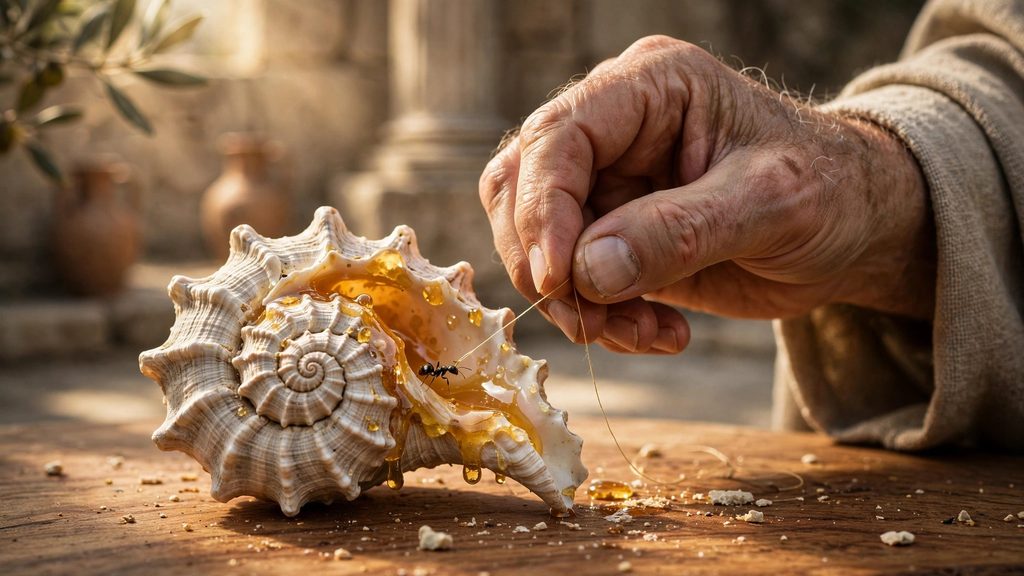
Minos did not let the matter rest. He sailed from court to court carrying a single object, a spiral seashell, and an offer of a substantial reward to anyone who could pass a thread all the way through its inner chambers, a puzzle he was confident only one man alive could actually solve. When he reached Cocalus’s court and presented the challenge, Cocalus, well aware of exactly whose skills would be needed, quietly handed the shell to Daedalus, who bored a small hole at its tip, smeared it with honey, and tied a length of thread to a live ant. The ant, drawn by the honey, wound its own way through every spiral of the shell’s interior, pulling the thread through behind it. When the completed puzzle came back to Minos, he understood immediately, and only one explanation was possible. He demanded Cocalus surrender the fugitive. Apollodorus preserves this episode as the means by which Minos discovered where Daedalus was hiding.
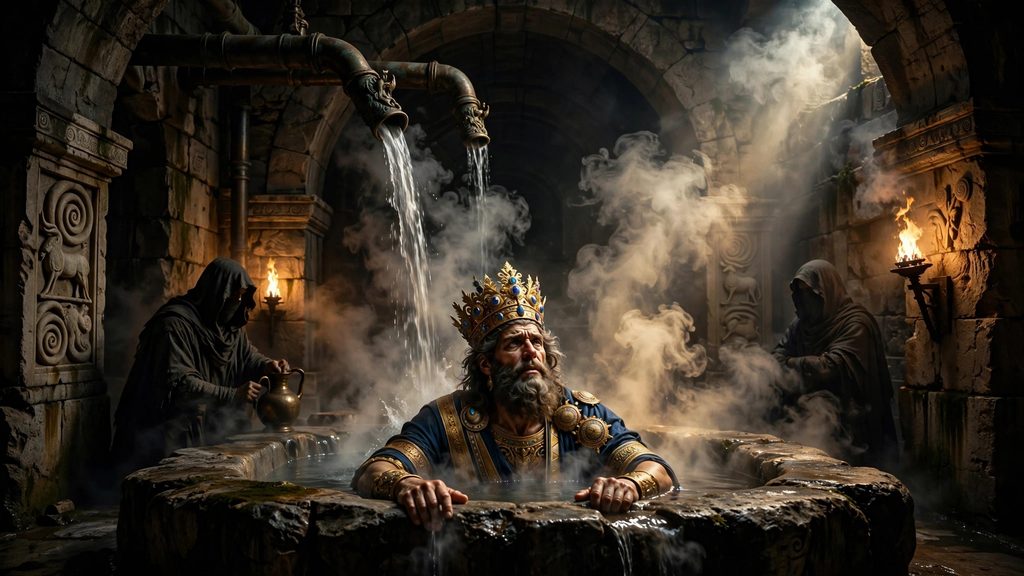
What happened next is where the ancient sources genuinely part ways. Some accounts describe open conflict between Crete and Sicily over the demand. The tradition preserved by Apollodorus has Cocalus receive Minos as a guest and then kill him after a bath, while another version in the same tradition says Minos died when boiling water was poured over him. Other tellings make Cocalus’s daughters responsible, and still others bring Daedalus himself closer to the killing. The details should not be flattened into one supposedly definitive scene. What the surviving tradition agrees on is the outcome. Minos reached Sicily in pursuit of the craftsman who had escaped him, and he did not leave the island alive.
The Same Story, Told Twice
Set the two deaths beside each other and the myth reveals what it was actually about all along. A gifted young relative, more talented than the man responsible for teaching him, dies because that talent cannot be tolerated. Later, Daedalus’s own son dies because the invention his father created cannot be safely mastered by someone who has only just discovered the exhilaration of flight. Once the boy is deliberately thrown from a height. Once the boy rises too high of his own accord. One death is murder. The other is catastrophe. Both stories place Daedalus at the center of a young man’s fall.
Daedalus causes both falls in radically different ways. He deliberately kills the first boy because he fears being surpassed. With Icarus, he does everything the earlier Daedalus failed to do. He teaches. He warns. He builds carefully. He explains the danger. Yet even then his ingenuity cannot guarantee the safety of the person who depends on it. The ancient tradition does not give Daedalus a clean moral reckoning for either death. It allows him to continue being what he has always been, the man who can solve almost any practical problem placed before him.
That is what makes the story darker than the familiar warning about ambition. Daedalus is remembered as the genius who built the labyrinth, invented extraordinary devices, escaped Crete, solved Minos’s impossible puzzle, and reached Sicily alive. The boys around him are remembered differently. One becomes a partridge whose habits preserve the memory of a fall. The other becomes a sea whose name preserves the memory of a death. The craftsman survives. His inventions survive. His victims survive mainly as echoes inside the things the world remembers about him.
The labyrinth was built to contain the Minotaur, but it also became the prison of its maker. The wings were built to save Daedalus and Icarus, but they became the instrument of Icarus’s death. The shell was designed by Minos to expose Daedalus, but the solution led to the king’s final confrontation with the man he had pursued. Again and again, the mythology turns Daedalus’s greatest strength against him.
The flight, then, is not really a story about a boy who wanted to touch the sun. It is the final consequence of a much older crime. Daedalus was on Crete because he had murdered his nephew. He was trapped because the king who employed him eventually turned his ingenuity against him. He built wings because every ordinary route of escape had closed. Icarus died because the invention succeeded brilliantly enough to make him believe he could rise beyond its limits.
That is why the story has endured. The tragedy is not that Daedalus invented something impossible. The tragedy is that he invented exactly what he needed, and even that was not enough to save his son.
At Olympus Estate, Tales from Olympus moves through the deeper currents of the Greek tradition. Daedalus was exiled from Athens for murdering his own nephew, a boy whose name varies across the ancient sources, Talos in Apollodorus, Perdix in Ovid, Calos in Pausanias, and whose ingenuity threatened to surpass his teacher’s. On Crete, Daedalus built the Labyrinth and eventually found himself imprisoned inside it with his son Icarus, according to Apollodorus’s account. He escaped by wings in the best known tradition, but Diodorus Siculus and Pausanias preserve older rationalized versions in which Daedalus and Icarus escaped by sea. Icarus still died, whether by falling from the sky or by falling into the sea while disembarking, and Daedalus continued to Sicily, where his ingenuity once again became both his salvation and the source of danger. The Minotaur and the Labyrinth are examined in full elsewhere on the Estate, but the deeper story belongs to Daedalus himself, the craftsman who could invent an escape from almost anything except the consequences of what he had already done.