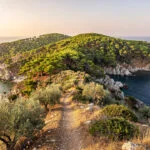






The mountain of Pelion does not announce itself loudly when the calendar turns toward the end of the year. It withdraws into a deep and calculated silence. The Pagasetic Gulf below loses its summer sapphire and turns to the color of cold iron, while the clouds descend to sit heavily among the chestnut and beech trees. There is a smell to this place in December. It is the scent of damp moss, decomposing leaves, and the sharp, persistent ghost of wood smoke that drifts from the chimneys of villages like Makrinitsa and Zagora. In this high, vertical world, the winter was never a season for indulgence or display. It was a season for holding on. This reality is reflected in the kitchen, where the most enduring foods are those that require the least ornamentation.
Pelion has always existed in the narrow space between myth and the lived experience of the soil. According to the old stories, this was the summer residence of the gods and the wild home of the Centaurs, those half human creatures who embodied the tension between the civilized world and the untamed forest. It was also the territory of Artemis, the goddess who moved with the wind and the deer, governing the boundaries where the orchards end and the true wilderness begins. Her presence is still felt in the way the mountain produces its fruit. The apples here are not the polished, uniform spheres found in lowland markets. They are small, dense, and stubbornly tart. They are the Pelion apples, specifically the Firiki variety, which arrive on the branch only after the first frost has bitten the bark. They are the center of a culinary tradition that prizes endurance over aesthetics.

This is the origin of the wild apple tart, a dish that functions less as a confection and more as a piece of edible history. It is a rustic Greek recipe that rejects the buttery flakiness of western pastry in favor of the honest, heavy pull of olive oil and the deep, resinous sweetness of mountain honey. To eat this tart is to consume the mountain itself, along with all the history and mythology that has settled into its soil over the thousands of years since the first apple tree took root in the shadow of the peaks.
The Goddess of the Threshold and the Spirit of the Forest
Artemis is a figure often trapped in the modern imagination as a simple huntress, yet the ancient Greeks knew her as something far more complex. She was the goddess of the transition. She presided over the passage from childhood to adulthood, from the city to the wild, and from the abundance of autumn to the scarcity of winter. Her worship was rooted in the agrios, the wild, uncultivated places where the human ego finds its limits. When we speak of mythology and food, we often forget that the earliest offerings were not elaborate feasts but the simple products of the gathered earth.

On the slopes of Pelion, the wild apple is her signature. These trees grow in the margins, often neglected by formal agriculture, thriving in the thin, rocky soil where larger, sweeter fruits would fail. The fruit they bear is a lesson in restraint. It is high in acid and low in water, which makes it perfect for long storage in the stone cellars of mountain houses. In the ancient world, an apple was a symbol of health and seasonal passage, but it was also a test of character. To appreciate a wild apple is to accept its bitterness and its hardness as part of its value.
The ancient Greek foodways that have survived on this mountain are built on this same principle of acceptance. There is no attempt to force the fruit to be something it is not. In the making of a Greek winter dessert, the goal is to amplify the character of the ingredient through the application of heat and the addition of the few luxuries available in a mountain winter: oil, honey, and perhaps a handful of crushed nuts. This is the discipline of Artemis translated into a baking pan.
The Geography of the Firiki and the Mountain Kitchen

To understand the mountain cuisine of Pelion, one must understand the Firiki. This small, oval apple is believed to have originated in the Black Sea region and reached Pelion around the eighteenth century, but it found its true home in the microclimate of the Centaurs’ mountain. It is a fruit that requires the cold to develop its sugars. Without the biting air of the high altitude, it remains merely sour. But after the winter sets in, the starch transforms into a complex, aromatic sweetness that smells faintly of roses and mountain herbs.
In the villages, the winter kitchen centers around the fournos, the traditional wood-burning oven that provides both heat for the room and a steady, low fire for baking. The rhythm of cooking here is dictated by the wood pile. There is no instant heat. Everything moves with a slow, thermal momentum. The apples are sliced with skins left on, because the skin is where the pectin and the color reside. To peel a Firiki is considered a waste of both time and nutrition.

This sense of practicality defines the Greek living experience in the rural north. Every part of the harvest is used, and every recipe is designed to sustain the body through the labor of the day. A tart made with olive oil provides the kind of long burning energy that butter, which burns off quickly, cannot match. It is a food of the earth, designed for people who still have a physical relationship with the landscape.
The Alchemy of Oil and Flour
In the creation of the olive oil pastry, there is a tactile language that is passed down through the hands. Unlike butter based doughs that must be kept cold and handled with a clinical distance, olive oil dough is warm and forgiving. It feels like the damp sand of the Pagasetic shore. It requires a different kind of touch, a gentle pressing rather than a vigorous kneading. If you work the dough too much, the oil separates and the spirit of the pastry is lost.

The use of extra virgin Greek olive oil in a dessert is a marker of cultural identity. In the Pelion region, the olive groves of the lowlands meet the apple orchards of the heights. The oil brings a peppery, green note to the tart that cuts through the sweetness of the honey. It creates a texture that is closer to a dense shortbread or a rustic bread than a modern pie crust. It is substantial. It is the kind of crust that can be wrapped in a cloth and carried into the forest, remaining intact and satisfying even after hours in the cold air.
The honey, too, is a product of the mountain’s flora. Winter honey in Pelion is often dark and thick, gathered from the blossoms of the chestnut trees or the late blooming heather. It carries a faint bitterness that mirrors the tartness of the apples. When these three elements, the flour, the oil, and the honey, come together, they create a base that is fundamentally different from the sugary, airy desserts of the city. It is a foundation that can support the weight of the wild fruit.
A Narrative of the Baking Ritual
To prepare the tart is to enter a meditative state that ignores the clock. You begin by weighing the flour, ideally a stone ground variety that still holds the scent of the field. The oil is poured in a steady, golden stream, and you rub it into the grain with your fingertips. You are looking for a consistency, a dampness that holds together when squeezed but crumbles easily. This is the work of the senses, not the scale. You add a little honey to soften the edge of the wheat and enough cold water to make the dough sigh as it comes together.
While the dough rests in the cool shadow of the kitchen, you turn your attention to the apples. They are firm and cold from the cellar. As you slice them, the kitchen fills with a scent that is sharp and bright, a reminder of the sun that hit the trees in October. You do not need to be precise with the slices. The rustic Greek recipe thrives on irregularity. You toss the fruit with more honey, a generous dusting of cinnamon, and perhaps a pinch of dried thyme that you gathered from the mountain peaks in July.

The assembly is a matter of pressing the dough into a low, round pan, letting the edges rise slightly to hold the fruit. You arrange the apples in a loose, overlapping pattern, pouring over any juices that have gathered in the bowl. There is no top crust. The apples are left exposed to the heat, where the honey will caramelize their edges and the oil will make their skins shine. When it goes into the oven, the smell changes from the raw scent of the forest to the deep, warm aroma of a mountain home.
The Shared Hearth and the History of the Commons
In the history of Pelion, baking was often a communal act. Until relatively recently, many villages shared large stone ovens that were fired up once or twice a week. Women would bring their pans of bread, their slow cooked meats, and their simple tarts to the oven, exchanging news and advice while the heat did its work. This ancient Greek foodways world reinforced the social fabric of the mountain. A dessert was never just a solitary treat. It was something that passed through the center of the village.

This communal history is why the wild apple tart remains so simple. It was designed to be transported, to be baked in a shared space, and to be sliced and given to neighbors. It is a food of the parea, the group of friends and family that gather around a table when the work is done. Even today, if you visit a home in Pelion during the winter, you will likely be offered a slice of something similar, served without pretense on a small plate with a fork and perhaps a glass of mountain tea.
The lack of refined sugar in these recipes is not just a matter of health, but a reflection of the economic history of the region. Sugar was an expensive import, but honey was everywhere. The bees of Pelion are as much a part of the landscape as the Centaurs. By using honey, the cook is not only sweetening the dish but also adding the complex profile of the mountain’s wild flowers, ensuring that the tart tastes of the place where it was born.
The Sensory Architecture of the Finished Tart
When the tart emerges from the oven, it has a color that is hard to name. It is the color of a late November sunset, all burnt oranges and deep, earthy browns. The edges of the crust are dark and crunchy, while the center has absorbed the juices of the apples, becoming soft and rich. It must not be eaten hot. A Greek winter dessert needs time to settle, to let the honey and the oil re-bind the structures that the heat has loosened.

The first bite is a revelation of textures. There is the initial snap of the crust, followed by the resistance of the apple skin, and finally the soft, yielding heart of the fruit. The sweetness is not immediate. It arrives slowly, carried by the warmth of the cinnamon and the floral notes of the honey. Then comes the salt, just a pinch, which clarifies all the other flavors and makes the palate yearn for another bite.
This is the “soul” of the dessert. It does not provide the quick, hollow high of a sugar heavy pastry. It provides a deep, resonant satisfaction. It feels like a heavy blanket or a well built fire. It is a food that acknowledges the coldness of the world outside the window and offers a sturdy, unwavering defense against it. It is the culinary equivalent of the stone walls that have stood on Pelion for centuries.
Modern Pelion and the Preservation of the Wild
Today, Pelion is a destination for those seeking a different kind of Greek experience. It is a place of boutique guesthouses and sophisticated tavernas that reinvent the traditional recipes for a global audience. Yet, beneath the layer of tourism, the old ways remain remarkably intact. The orchards are still there, the Firiki is still protected as a product of designated origin, and the goddess Artemis still has her territory in the high forests.

The survival of the wild apple tart in modern Greek kitchens is a testament to the power of the archetype. We are drawn to these rustic foods because they satisfy a hunger that is more than physical. They connect us to a rhythm of life that is measured by the seasons rather than the news cycle. In an increasingly digital world, the act of rubbing oil into flour and slicing a hard, wild apple is a radical return to the real.
A Reflective Conclusion on the Persistence of Taste
There is a feeling that comes at the end of a winter meal in a Pelion house, when the plates are cleared and the only sound is the crackle of the wood in the stove. It is a feeling of continuity. You realize that the taste in your mouth is the same taste that a traveler might have experienced two hundred, five hundred, or even a thousand years ago. The world has changed in every way imaginable, but the combination of apple, honey, and oil remains a constant.
The wild apple tart is more than a recipe. It is a vessel for memory. It carries the history of the mountain, the myths of the goddess, and the practical genius of the people who have called Pelion home for generations. It is a reminder that the best things in life are often those that are left unpolished, those that grow in the margins, and those that require the most patience to appreciate.
At Olympus Estate, Food and Seasonal Life traces the culinary traditions of the Greek world from the ancient harvest through the Byzantine kitchen to the contemporary table. The Firiki apple requires the cold to develop its sugars. Without the biting air of the high altitude it remains merely sour. After the winter sets in the starch transforms into a complex aromatic sweetness that smells faintly of roses and mountain herbs. To peel a Firiki is considered a waste of both time and nutrition. The olive oil dough is warm and forgiving, closer to damp sand than cold butter. It requires a gentle pressing rather than a vigorous kneading. The honey is dark and thick, gathered from the blossoms of the chestnut trees or the late blooming heather. It carries a faint bitterness that mirrors the tartness of the apples. The discipline of Artemis translated into a baking pan. The best things are often those left unpolished, those that grow in the margins, those that require the most patience to appreciate.