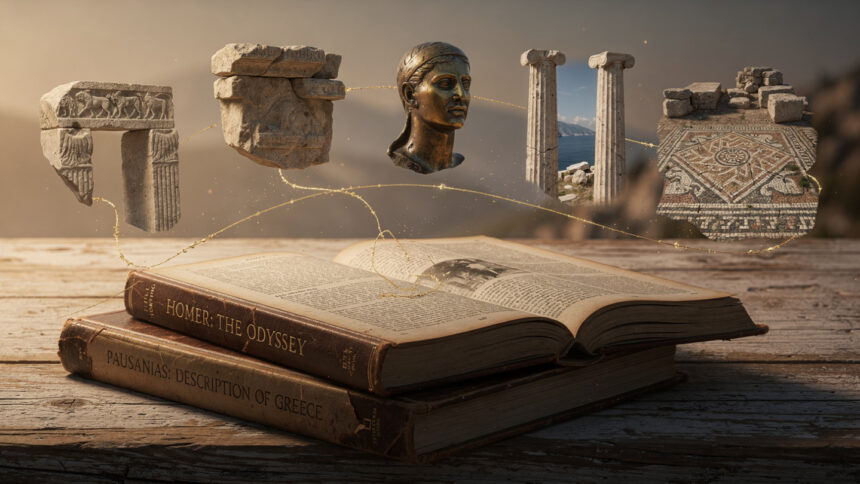
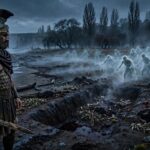
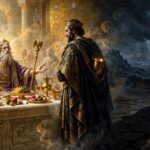
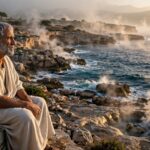
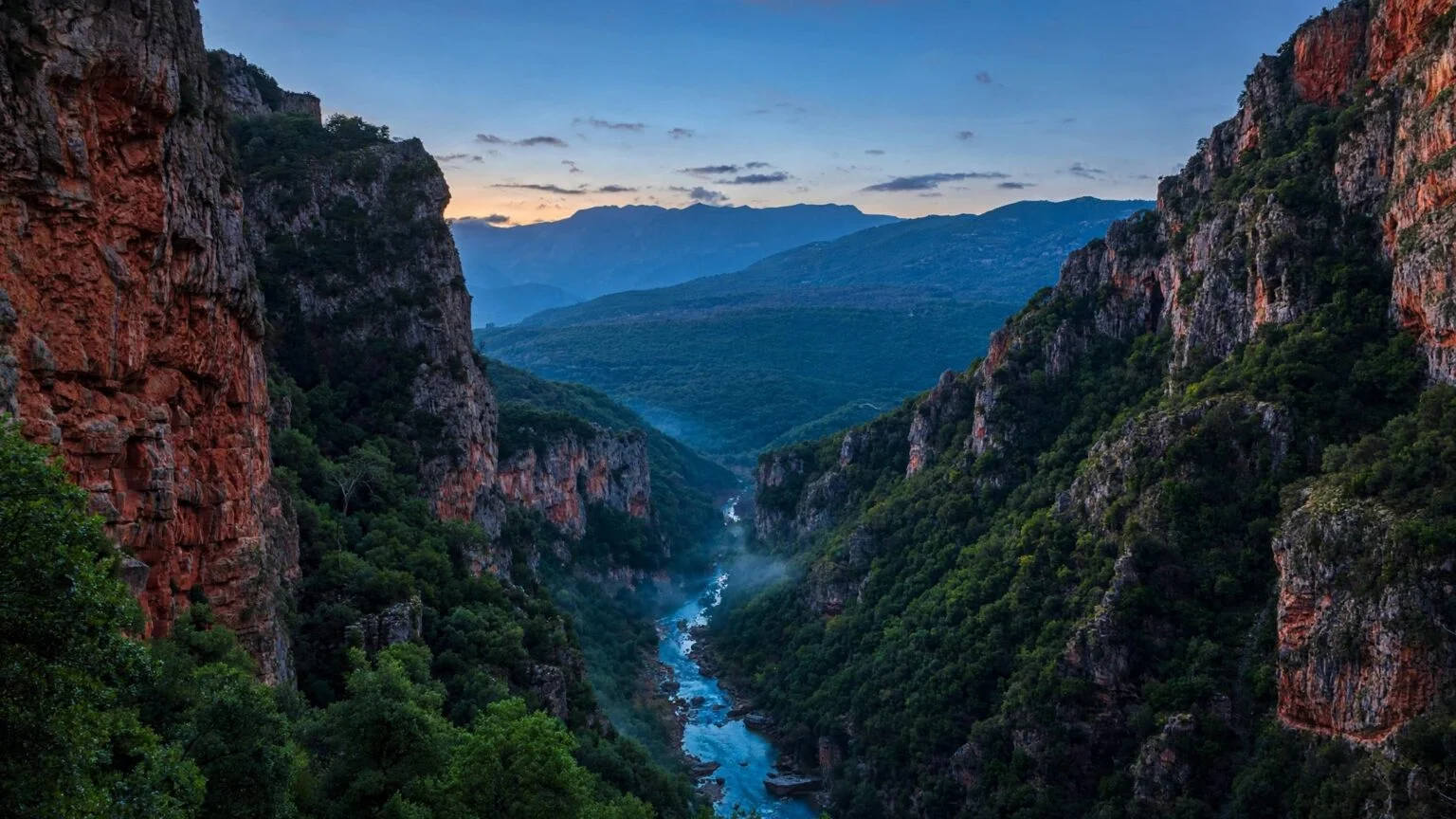
The river that runs through this gorge, according to Pausanias, was the coldest river in the known world.
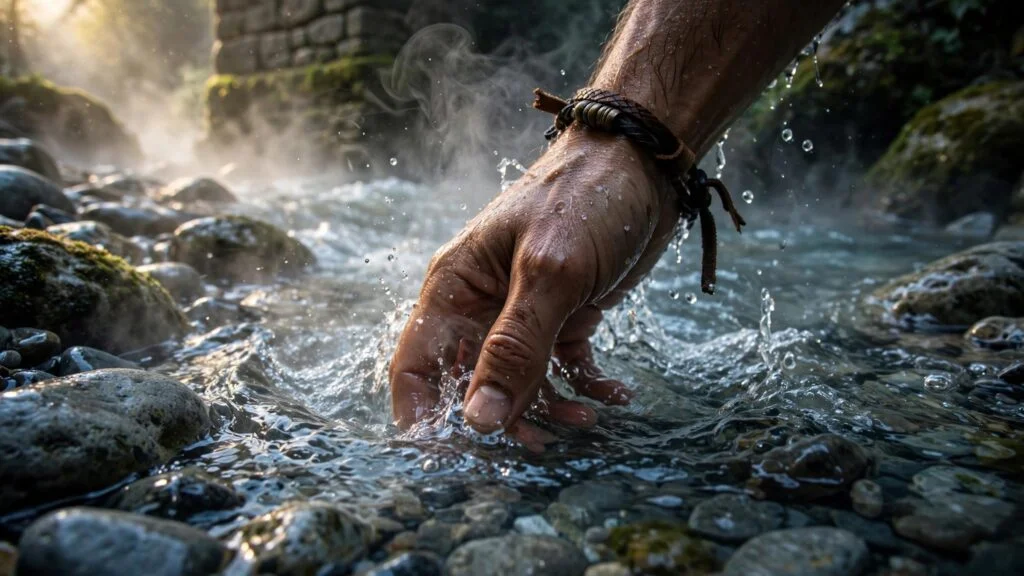
He was not writing as a geographer making a climatological claim. He was writing as a traveler who had placed his hand in the Lousios River and pulled it out again quickly, and who understood that the quality of the cold was connected to what the mythology said the river had been used for: Pausanias described the Lousios as the place where Zeus was bathed as an infant. Lousios in Greek means to wash.
This is the founding claim of the gorge’s mythological character, and it deserves to be read fully before the travel writing begins. Zeus was bathed here when he was a newborn, hidden by his mother Rhea in the mountains of Arcadia while his father Kronos, who had already swallowed his previous children to prevent the prophecy of his overthrow, searched for him. The river that washed the king of the gods when he was the most vulnerable thing in the world, an infant in hiding from a father with murderous intentions, was cold enough that Pausanias, visiting more than a thousand years later, still described it as the coldest river he had encountered anywhere.
This was one of two Arcadian claims on the god’s infancy. The rival tradition places his birth on a mountain summit further south, at an altar whose ash is even older than this river’s own myth.
The gorge has been hiding important things in its cliff faces ever since. The monasteries located within its majestic landscapes were not only places of worship but also served as secret schools during the Ottoman rule, playing a crucial role in preserving the Greek language and culture. The same inaccessibility that protected the infant Zeus from Kronos protected the Greek literary and philosophical tradition from Ottoman suppression. The cliff face that concealed the newborn god later concealed the manuscripts. The river that was cold enough to wash away everything that should not be present has been washing away visibility for three thousand years, and the things it kept invisible were consistently the things most worth keeping.
Lousios Gorge houses several historic Eastern Orthodox monasteries dating to the medieval Byzantine period, giving it the nickname the Mount Athos of the Peloponnese. The comparison to Athos is geographical rather than institutional: not the scale or the prestige of the monastic republic on its Chalkidiki peninsula, but the specific quality of a religious landscape whose monasteries are built into cliff faces above a river that nobody could reach easily, and whose inaccessibility was the condition of their survival.
The Gorge and What It Is
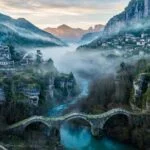
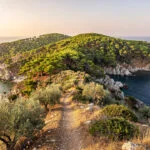
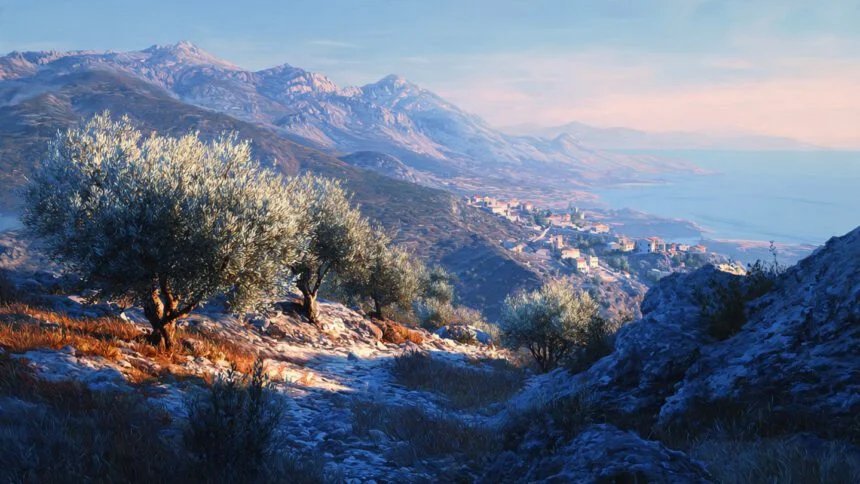
Lousios Gorge is a picturesque canyon in the Arcadia region of Greece carved by the erosion of the Lousios River. Despite the fact that it is fairly small in size, roughly fifteen kilometers in length and two kilometers at its widest, it houses several historic Eastern Orthodox monasteries that date to the medieval Byzantine period.
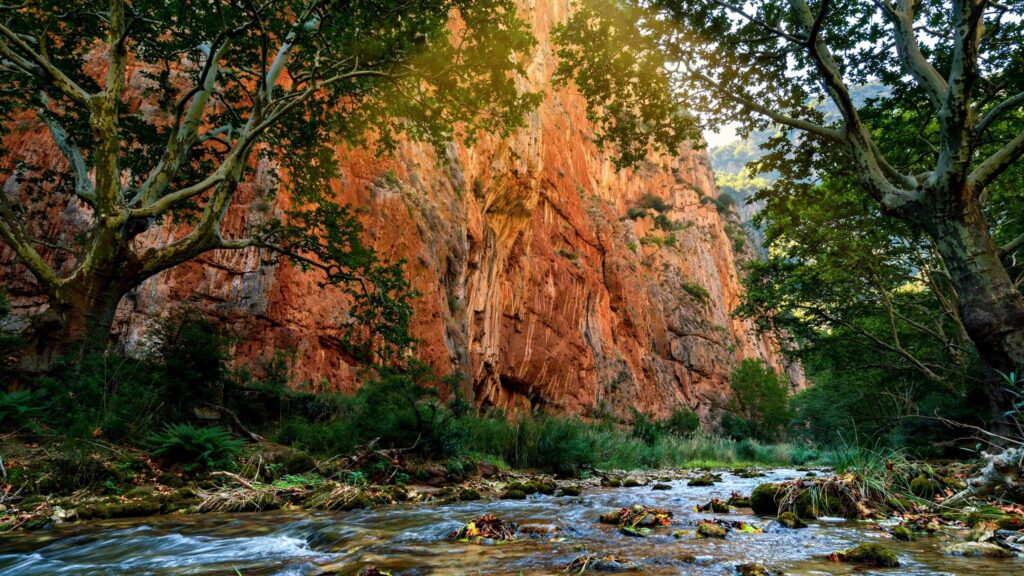
The red limestone cliffs that define the gorge’s visual character rise in places to a hundred meters above the river, their color the specific iron-oxide red that certain limestone formations produce when the mineral content of the rock is right and the erosion has exposed fresh face. The effect, in the afternoon light when the sun is west of the gorge and illuminating the eastern wall directly, is the color of ochre and terracotta simultaneously, a warm red against the dark green of the Platanus orientalis, the oriental plane trees, that line the river’s edges at the gorge floor and that grow here to a size and an age that the inaccessibility of the terrain has permitted.
The Lousios River empties into the Alfios, the ancient Alpheios, which flows west to the Ionian Sea past Olympia. The gorge carries a rich historical legacy that dates back to ancient times: the Bronze Age settlement that preceded the classical city of Gortys places continuous human habitation here across four thousand years, the same limestone cliffs and the same cold river providing the same combination of resources, water, defensible position, and the specific isolation that protects without entirely cutting off, to every population that found a use for them.
The wild herbs that grow along the gorge trail are the detail that experienced walkers mention most consistently alongside the monasteries and the cliff faces: wild mint, oregano, thyme, sage, and the specific mountain tea, tsai tou vounou, that grows at the gorge’s altitude in an abundance the trail crosses repeatedly, the air carrying the herbs’ fragrance at every point where the path brushes against them. The gorge floor is, in spring and early summer, one of the most aromatic walking environments in the Peloponnese, and the combination of the cold river, the red limestone walls, the plane trees, and the herb-laden air produces something that the travel writing vocabulary of dramatic scenery consistently undersells: a genuinely sensory landscape, experienced through smell and touch and the sound of moving water as much as through the visual drama of the cliffs.
Ancient Gortys | The Healing City in the Canyon
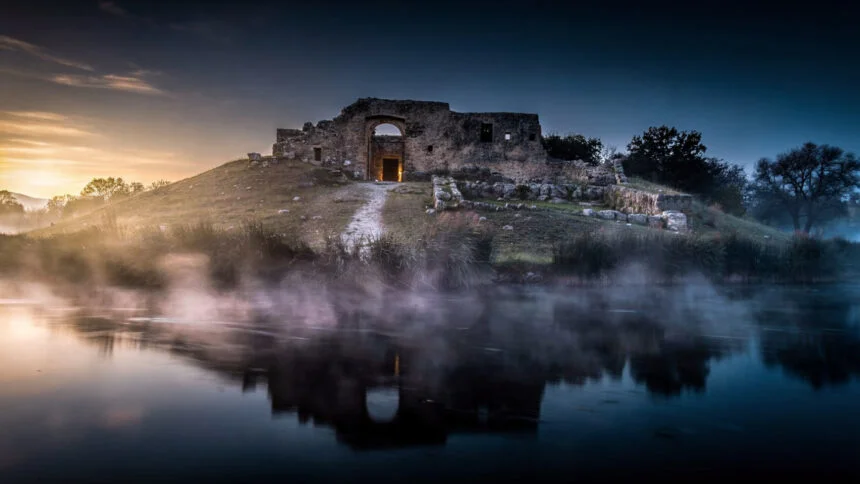
As a traveler keeps hiking, the fourth-century BCE ruins of Gortys appear. It was a healing center with a bathhouse. A circular construction was a dry sauna. The city walls are on the hills above.
The ancient city of Gortys, not to be confused with the more famous Gortyn on Crete, was a significant Arcadian city-state whose specific claim on the gorge was its identity as a therapeutic center: a sanctuary of Asklepios, the god of healing whose most important sanctuary was at Epidaurus, established here in the gorge where the cold water and the microclimate of the canyon provided the conditions that ancient medicine associated with healing and recuperation.
Gortys is an ancient Greek settlement in the Lousios Gorge. The name of the city comes from a mythical hero, Gortys, son of Stymphalus and a legendary king of Arcadia. The first humans settled in the area of the Lousios Gorge during the Bronze Age, and the city went into decline after Megalopolis was founded nearby in the fourth century BCE, drawing much of the surrounding Arcadian population into the new, larger federal capital.
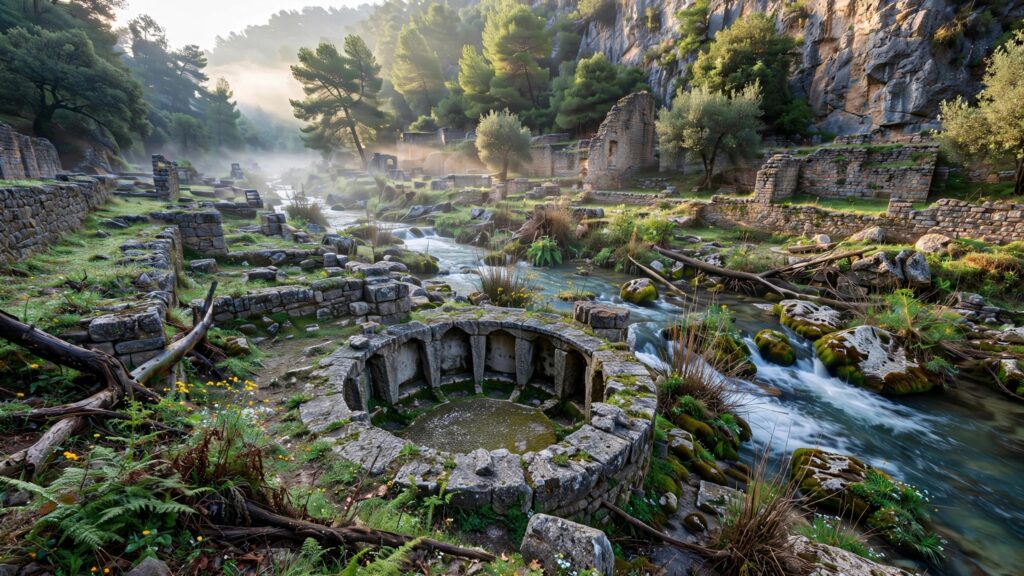
The ruins of the Asklepion, the healing sanctuary, include the remains of a circular tholos structure identified as a dry sauna, the bathhouse whose therapeutic function brought patients to this canyon from across Arcadia and beyond, and the remnants of the city walls that climbed the hills above the gorge floor. The frescoes of the small Byzantine church of Agios Andreas, built upon the ruins of a large Roman building that itself was constructed on top of an ancient Greek building, demonstrate the gorge’s characteristic pattern in miniature: three civilizations using the same small flat piece of land beside the river for three different sacred purposes, each built into or upon the previous, the sequence of uses compressing the entire historical span of the Peloponnese into a single church whose walls contain the evidence.
The gorge’s connection to Demeter runs through the wider Arcadian tradition that places several of the goddess’s most significant sanctuaries in this part of the Peloponnese: the Phigalia sanctuary to the southwest, where Pausanias described a cave sanctuary containing a cult image of Demeter shown with a horse’s head, and the agricultural sanctuaries of the broader Arcadian plain to the east, where grain cultivation had been the dominant economic and religious fact of life since the Mycenaean period. The gorge itself, with its combination of cold water, fertility, and the agricultural valley of the Alfios that the Lousios feeds, belongs to the broader Arcadian agricultural and religious landscape that Demeter’s tradition inhabited. The healing sanctuary at Gortys, with its emphasis on water and on the specific restorative properties of this particular river, belongs to the same theological geography as the Demeter sanctuaries: the belief that particular landscapes carry particular healing properties connected to the divine presences that inhabit them.
The Monasteries Built Into the Rock
The area around the Lousios is rich in monasteries. They remained isolated and unmolested during centuries of war. The first inhabitants were probably hermits, who used the caves as shelter. Over time the hermits formed the modern-day monasteries. They are living communities, not museums, that stretch back to the Middle Ages.
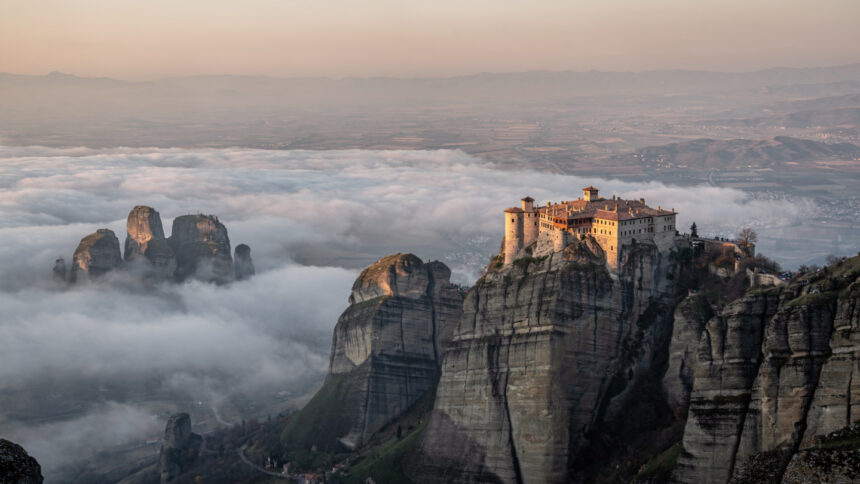
The sequence is important: first the caves, which the limestone cliff face provided in abundance and which the first Christian ascetics who came to this gorge used as natural shelters, then the informal communities of hermits that the caves gradually produced, then the organized monastic communities that eventually built the permanent structures whose walls are now embedded in the rock face itself. The Lousios gorge monasteries are not buildings placed against a cliff. They are buildings that have merged with the cliff, their stone walls and the limestone they rest against sharing the same geological formation, the architecture and the geology in a relationship so complete that the two cannot always be visually distinguished from below. A companion piece on this site, examining the Greek architectural tradition of building into the landscape, treats the technical dimension of this relationship in full. Here the subject is the gorge’s own history.
The Monastery of Prodromos, named for John the Baptist, the Forerunner, and known locally as the Great Cave, stands approximately four kilometers south of Dimitsana, built at the foot of a tall cliff, two hundred meters above the bottom of Lousios Gorge. Monastic tradition dates its founding to the twelfth century, when hermits living in the surrounding caves are said to have first organized into a formal community, though the surviving building itself, in the more cautious assessment of some scholars, more likely took its present form in the sixteenth century. It is the most dramatically positioned of the gorge’s monasteries, its buildings pressed against the cliff face in a way that makes the structure appear to grow outward from the limestone rather than to have been constructed against it. The access trail, crossing the stone bridge over the Lousios at the gorge floor and climbing the cliff path on the opposite bank, requires a serious uphill commitment before the monastery’s wooden gate comes into view.
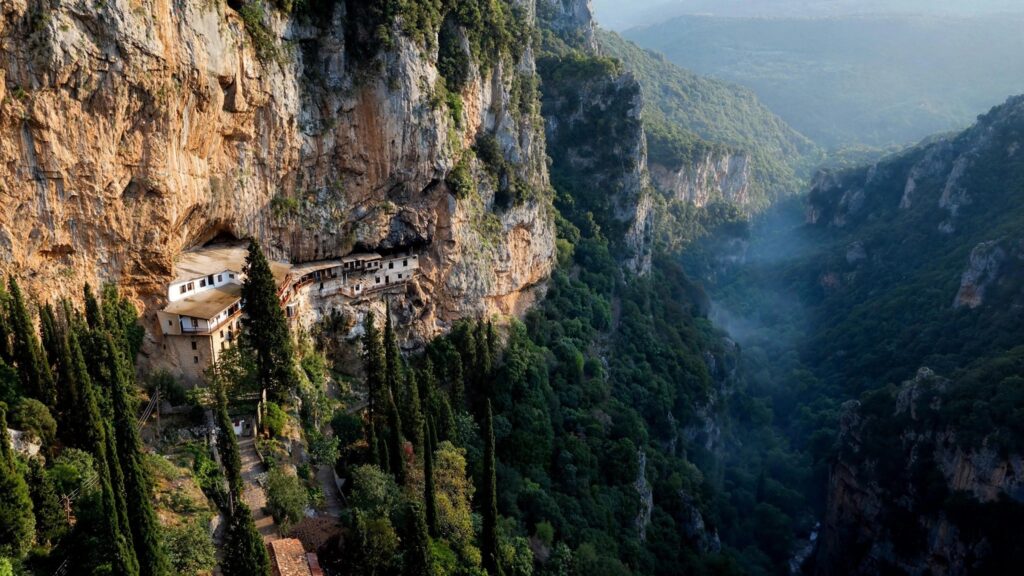
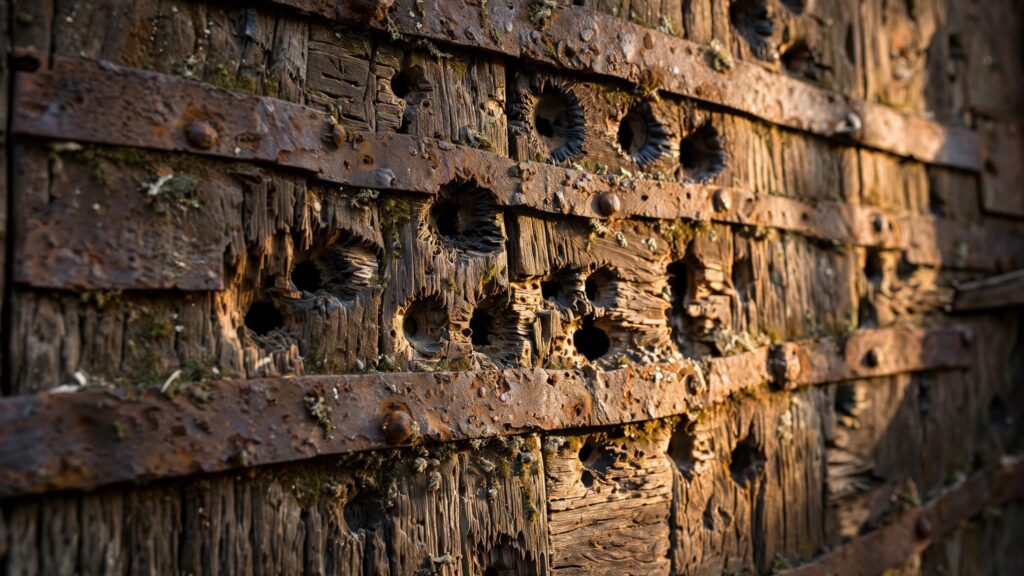
That gate is marked. The old wooden door leading into the monastery is riddled with bullet holes that bear witness to the April 16, 1779 attack by Albanian troops under Ottoman command, part of the wider punitive campaigns the Ottoman administration launched across the Peloponnese in the years following the failed Orlov Revolt of 1770, when Russian-encouraged Greek uprisings had been brutally suppressed and irregular Albanian forces were used to enforce order across the region for years afterward. At the time of the 1779 attack, the monastery was full of women and children taking refuge there, but for some unknown reason the attack failed.
The bullet holes are still there, in the original wood of a door that has been on its hinges since before the American Revolution. Nobody has repaired them. The monastery did not decide that evidence of violence was incompatible with the peace of the place. It decided that the record of what happened and then did not happen, the attack that the monastery full of sheltering civilians somehow survived despite every military logic suggesting it should not have, was worth keeping visible in the fabric of the entrance itself. Every visitor who passes through that door passes through the evidence. Four decades later, during the Greek War of Independence itself, the monastery served the same protective function again, sheltering and treating wounded fighters in a role local tradition remembers as that of a functioning field hospital.
The monastery was tragically dissolved in 1834. Local legends say that all its relics and records were carted off by sixteen mules. The monks rebuilt the monastery’s wealth through hard work, by building mills and keeping livestock. The church is built into the cliffside with sixteenth-century frescoes and balconies.
The frescoes inside the church, their colors preserved by the cliff face’s specific microclimate and by the absence of the kind of direct sunlight exposure that bleaches open-air fresco, are of a quality comparable to what Mystras offers at its best: the same late Byzantine tradition of painting that produces faces of specific, individualized psychological gravity rather than the formal abstraction of earlier Byzantine iconography, the same gold grounds and the same intense coloring, in a space so small and so intimately scaled that the paintings are closer to the viewer’s face than any museum installation would permit.
The Monastery of Philosophou, the Philosopher’s monastery, exists in two versions several hundred meters apart on the gorge wall: the old monastery, the Palaia Philosophou, founded in the tenth century by Ioannis Lampardopoulos, a cultivated official at the court of the Byzantine emperor Nikephoros II Phokas, whose ruins and fragmentary frescoes still stand, and the new monastery, the Nea Philosophou, built in 1691 and currently inhabited by a small monastic community that receives visitors on the prescribed schedule of the Greek Orthodox monastic tradition.
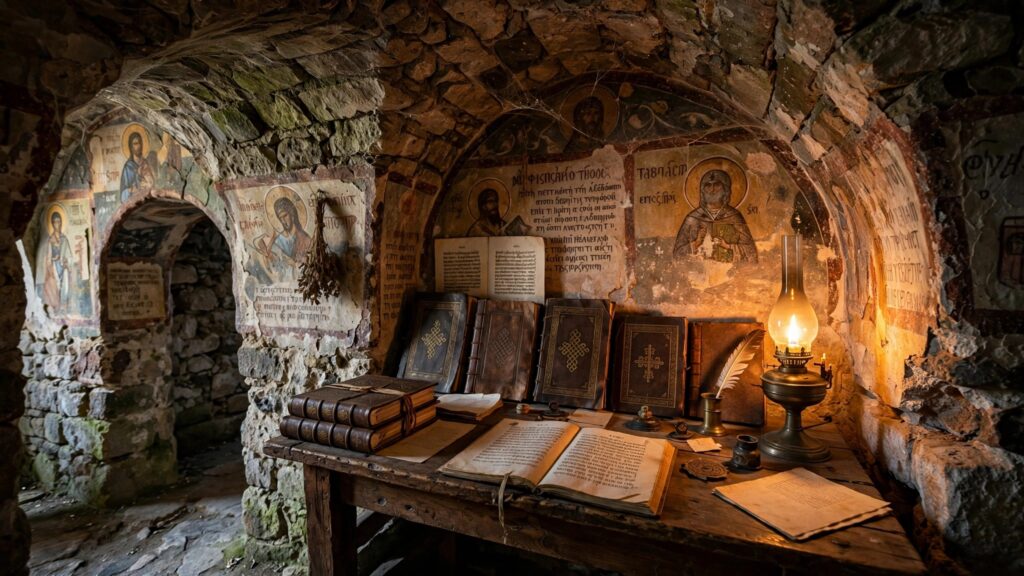
The Philosophou monastery is widely known all over Greece and abroad. During the Ottoman period, it had a famous school from which came eminent men. The school at Philosophou was one of the secret schools, the kryfa scholeia, the hidden schools, that the Orthodox monastic tradition maintained through the Ottoman period as the primary institutional mechanism for transmitting Greek literacy and philosophical knowledge to each generation of children whose parents could not access the official educational systems of the imperial administration. The monks taught in the same space they prayed in, using the texts they preserved in the same way they used the liturgical books, as the living record of a tradition that the cliff face was keeping safe on their behalf.
Dimitsana and Stemnitsa | The Villages Above
The gorge is not visited in isolation. The villages on its rims are the base camps and the context, and both deserve more than passing description.
Dimitsana, perched on a ridge above the northern end of the gorge, was in the Ottoman period one of the most educationally significant communities in the Peloponnese. It has a special place in the history of Greek independence as the birthplace of Metropolitan Germanos III of Old Patras, the churchman whose meeting with the regional chieftains at the monastery of Agia Lavra near Kalavryta is remembered, in the version of the story every Greek schoolchild learns, as the blessing of the revolutionary flag on March 25, 1821, the date the modern Greek state has kept ever since as its independence day. The more careful historical record complicates this slightly without diminishing Germanos’s real role: most historians date the actual meeting at Agia Lavra to March 13, with March 25 chosen afterward to align the national commemoration with the Feast of the Annunciation, and the revolution itself had already broken out days earlier elsewhere in the Peloponnese, in the Mani on March 17 and at Kalamata on March 23. What is not in dispute is Germanos’s genuine, active leadership in mobilizing the region, only the precise date and drama traditionally attached to a single ceremonial moment at Agia Lavra. The town’s Greek Orthodox library, established in the eighteenth century and one of the finest collections of Byzantine manuscripts and rare books in the Peloponnese, reflects the same educational tradition that the Philosophou monastery’s school maintained: a community that understood the preservation of Greek literary culture as inseparable from its political survival.
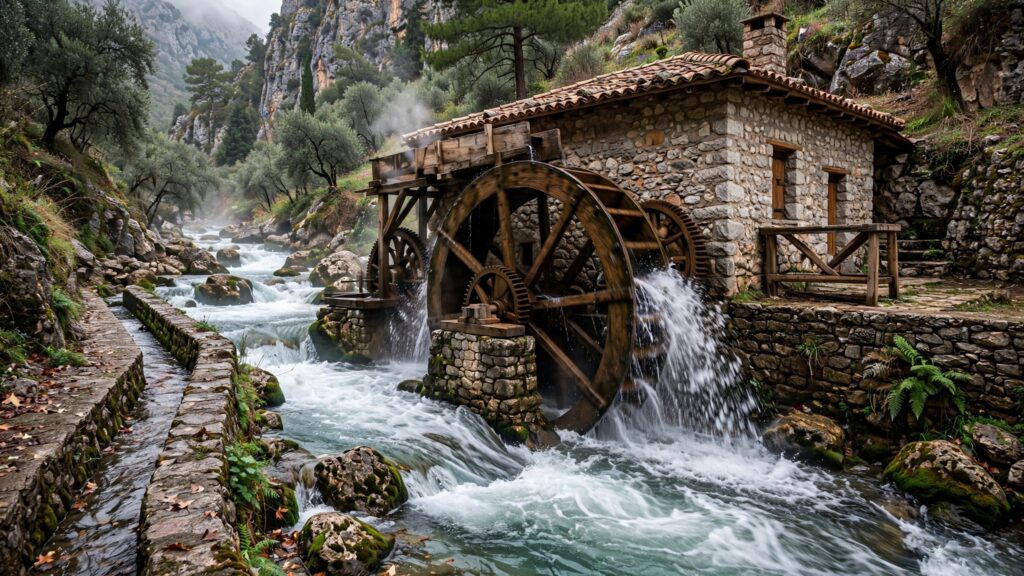
The Open Air Water Power Museum at Dimitsana, installed in a series of renovated watermill buildings along the Lousios below the town, documents the industrial tradition that the gorge’s cold, fast-flowing water sustained: gunpowder mills, tanning mills, flour mills, and the specific paper mill whose production supported the educational institutions of the region by providing the physical material on which Greek texts were copied and distributed. The gorge that once hid the infant Zeus and the monastic schools hid something else as well: the industrial infrastructure of the Greek resistance, the mills that produced the gunpowder that the independence fighters used, powered by the coldest river in the world.
Stemnitsa, fifteen kilometers south of Dimitsana on the opposite rim of the gorge, is the medieval village whose silversmiths and goldsmiths produced the ecclesiastical metalwork that equipped the monasteries of the Peloponnese and whose craft tradition is documented in the Folk Art Museum, whose collection of local metalwork and traditional costume is one of the finest in provincial Greece. The village itself, its stone houses and Byzantine churches arranged on the hillside above the gorge with the compact density of a settlement built for winter rather than for tourism, is a place where the contemporary Greek mountain village and its medieval predecessor are still in genuine dialogue rather than the medieval having been entirely replaced by the contemporary.
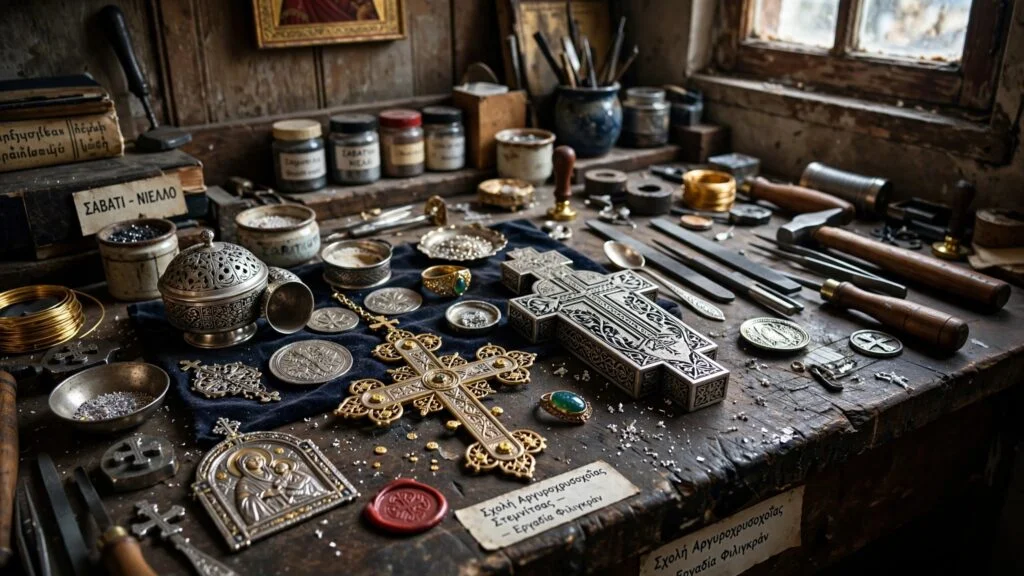
The combination of Dimitsana and Stemnitsa as bases for gorge exploration gives the visitor the two distinct registers of the Arcadian mountain tradition: the educational and the crafts traditions, the book and the silverwork, the intellectual inheritance and the material one, both sustained in the same remote gorge landscape by the same combination of inaccessibility and determination.
The Menalon Trail and How to Walk the Gorge
The Menalon Trail, a long-distance hiking route that connects the villages and landscapes of central Arcadia across a total distance of approximately seventy-five kilometers divided into eight stages, passes through the Lousios Gorge as part of its third and fourth stages, and walking this section of the trail is the most structured way to engage with the gorge properly rather than simply driving to the monasteries and looking up.
The classic gorge walk descends from Dimitsana to the gorge floor, crosses the stone bridge over the Lousios, visits the Prodromos monastery by the cliff path, returns to the gorge floor, and continues south along the river trail to the Philosophou monasteries, the church of Agios Andreas at the Gortys ruins, and eventually climbs back out to Stemnitsa. This full circuit takes between five and seven hours depending on pace and the time spent at the monasteries themselves, covers significant elevation change in both the descent and the ascent, and requires good footwear and water in the summer months when the gorge floor trail is shaded but the climb out of it is not.
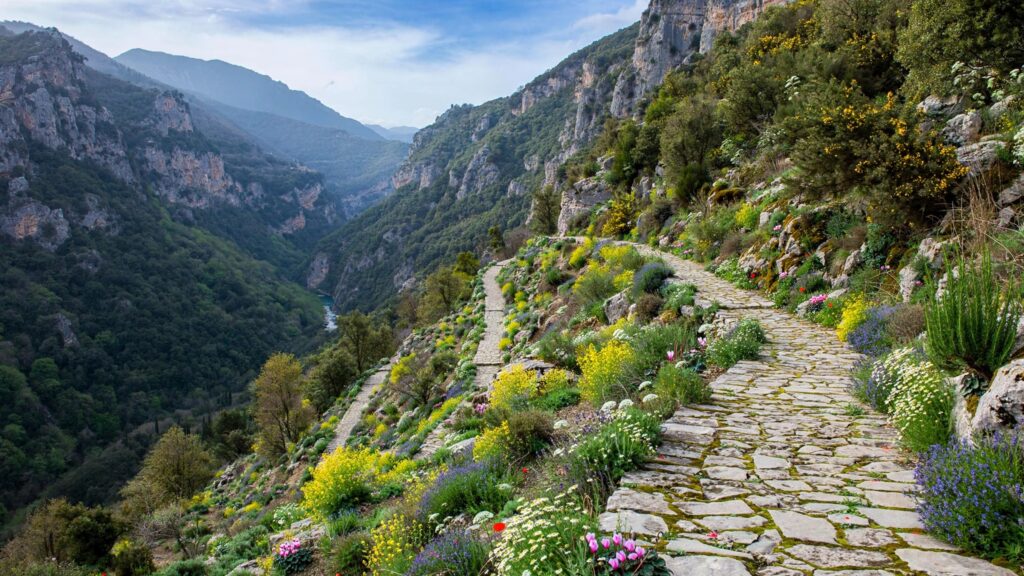
Spring is the best time to appreciate the natural beauty and extraordinary monasteries of the Lousios Gorge, against the backdrop of its great historical, religious, and architectural treasures. The combination of conditions that spring produces, the Lousios running high from the winter rains and the snowmelt above, the wild herbs at the peak of their growth alongside the trail, the plane trees just coming into full leaf to shade the gorge floor, and the flowering of the limestone scrub on the cliff faces, is the landscape at its most complete and most generous. Autumn, September and October, provides a second optimal window: cooler temperatures, the plane trees turning color along the river, and the monasteries receiving visitors in the unhurried rhythm that the end of the summer season produces.
The gorge trail in summer, from late June through August, is walkable but requires early morning starts to avoid the midday heat that the canyon concentrates at its floor. The combination of the cold river and the heat trapped by the limestone walls produces, in the middle hours of a July day, exactly the conditions that persuade experienced walkers to return to the gorge at dawn or late afternoon and wait out the middle hours in Dimitsana with a coffee and the view.
What the Gorge Has Been Hiding
The gorge that hid Zeus from his murderous father has been hiding things of value ever since: the hermits who became monks, the schools that kept Greek alive, the gunpowder mills that supplied the independence fighters, the women and children sheltering in the monastery when the troops arrived at the door in 1779.
The bullet holes in the monastery door bear witness to an attack that should have succeeded and did not. The manuscripts in the Dimitsana library survived the Ottoman period because the cliff face made them expensive to find. The frescoes in the Prodromos church are the color they still are because the limestone above them kept the direct sunlight away for five hundred years.
The coldest river in the world was cold for a reason, Pausanias implied: it had washed the most important infant in the mythological tradition, and something of that contact had remained in the water. The mythology is almost certainly not what keeps the water cold. The geology of the spring-fed Arcadian limestone aquifer is what keeps the water cold. But the mythology is what keeps the observation alive across two and a half thousand years, what gives the walker who places a hand in the Lousios on a July afternoon the specific, pleasurable shock of recognizing that they are in a river that Pausanias described and that Zeus was washed in according to a tradition that predates Pausanias by as long again.
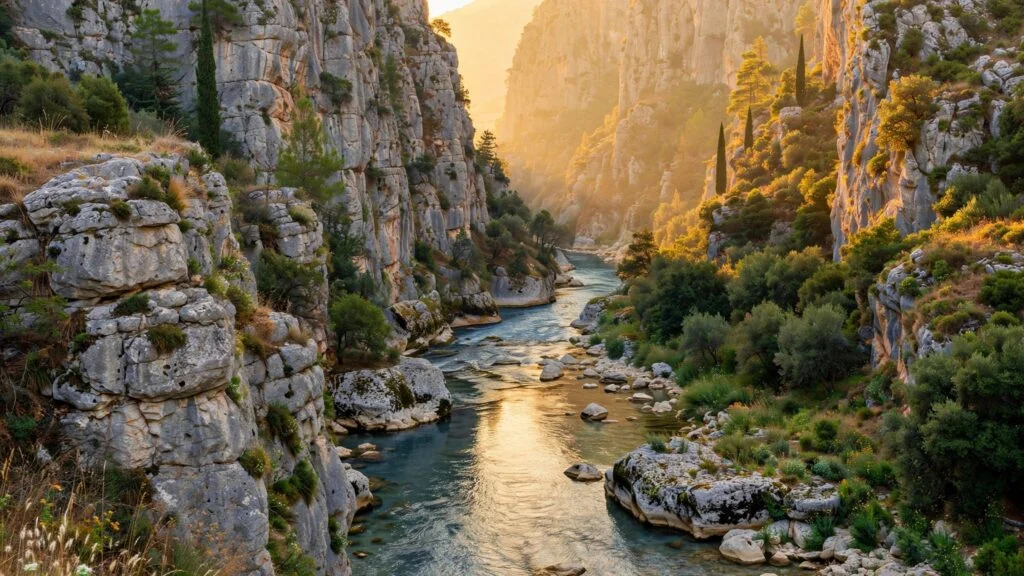
Put your hand in. Feel what Pausanias felt. The gorge has been doing exactly this for longer than any monastery in it has been standing, longer than any secret school held its first lesson, longer than any bullet was fired at any door.
The river was here first. Everything else the gorge has been hiding came later, and found the hiding place already prepared.
At Olympus Estate, Wanderlust Greece looks for the places where Greece is most completely and most honestly itself. Pausanias called the Lousios the coldest river in the known world and traced that cold to the myth that Zeus was bathed here as an infant, hidden by Rhea from his father Kronos. The same inaccessible cliffs that hid the infant god later hid the Byzantine monasteries of Prodromos and Philosophou, whose secret schools preserved Greek literacy through the Ottoman period, and whose watermills, below at Dimitsana, ground the gunpowder that armed the War of Independence. The door at Prodromos still carries the bullet holes from a failed 1779 attack that should have killed the women and children sheltering inside and did not. The ancient healing city of Gortys, an Asklepios sanctuary built around the same cold water, sits further down the gorge floor. The river was here before any of it, and everything the gorge has hidden since found the hiding place already prepared.