




For five hundred years after Siddhartha Gautama achieved enlightenment under the Bodhi tree in the fifth century BCE, no Buddhist artist depicted him in human form.
This was not an oversight. It was a theological position: the Buddha had transcended the cycle of existence that gives human form its significance, and to represent him in the bounded, particular form of a human body would be to misrepresent what he had become. The early Buddhist artistic tradition solved this problem through abstraction: an empty throne, a footprint pressed into stone, a parasol above nothing, a wheel turning without a hand to turn it. These were the images through which the first five centuries of Buddhist devotion expressed itself. The presence was communicated through the absence of the figure.
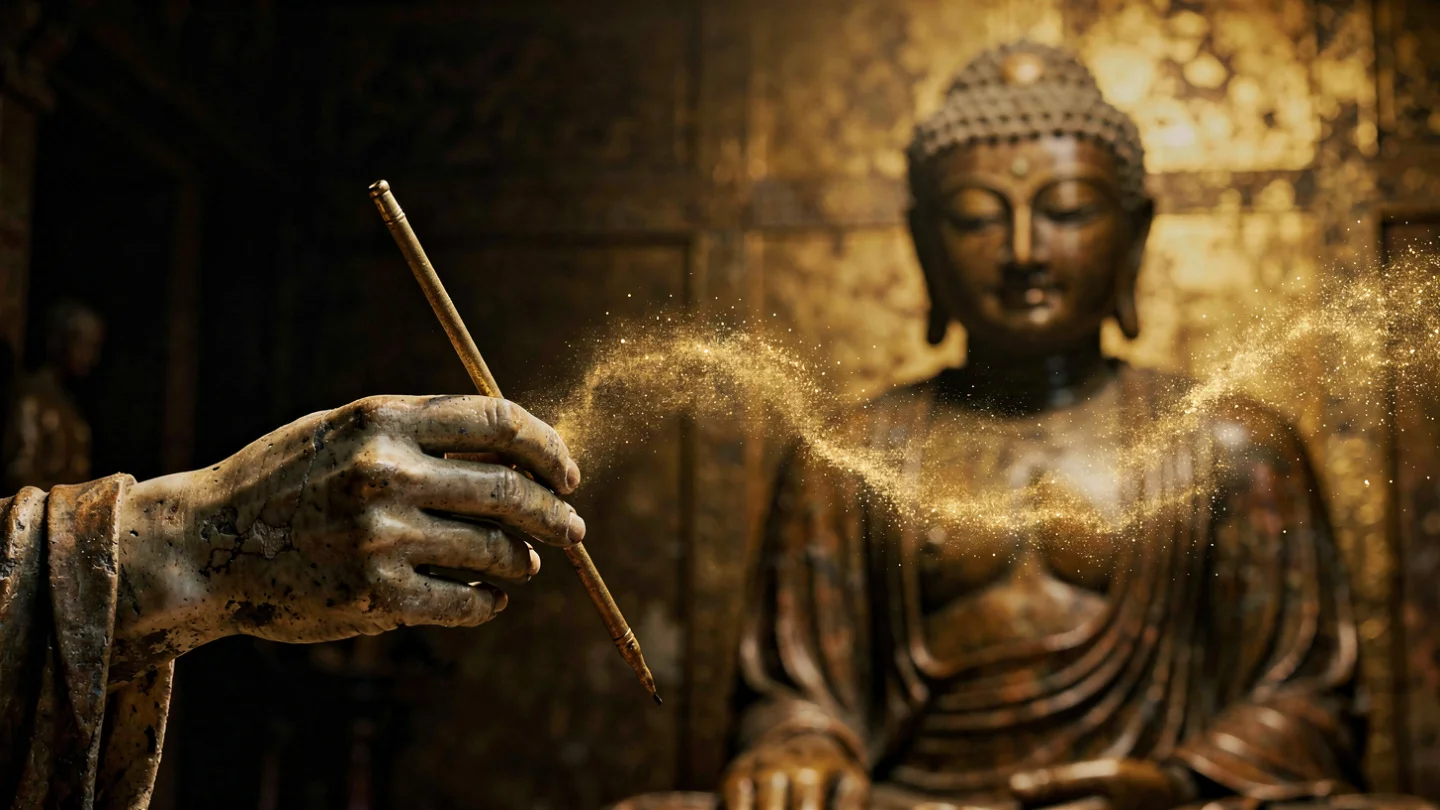
Then, in the workshops of Gandhara, in the territory of what is now northwestern Pakistan and eastern Afghanistan, in the first century of the common era, a sculptor gave the Buddha a face.
The face was Apollo’s.
This was not coincidence, and it was not approximation. The Gandhara school drew upon the anthropomorphic traditions of Greco-Roman religion and represented the Buddha with a youthful Apollo-like face, dressed in garments resembling those seen on Roman imperial statues. The sculptors working in this tradition understood precisely what they were doing: they were applying the Greek discovery that the divine could be represented in the idealised human form, that the perfected body was the appropriate vehicle for transcendent meaning, to a theological subject that their own tradition had previously refused to depict in any human form at all.
The result was one of the most consequential visual decisions in the history of world art. The image they produced traveled east along the Silk Road, passed through Central Asia, entered China through the cave sanctuaries of the northern dynasties, crossed the sea to Korea, and arrived in Japan in the sixth century CE, where it gave the divine world of Japanese Buddhism its defining visual vocabulary. The serene face of the Buddha in a quiet Japanese temple carries, in its forms, the memory of a sculptor in Gandhara who looked at a Greek image of Apollo and understood that the god of light and reason and perfect proportion had given him the means to solve a theological problem that his own tradition had been unable to resolve.
The World That Made Gandhara Possible
The road to Gandhara runs through Alexander’s campaign and through the quality of what he left behind.
Alexander reached the Punjab in 326 BCE, turned back at the Beas River when his army refused to go further, and died in Babylon two years later. What he left in the territories he had crossed was not simply Greek settlers and garrison cities. He left the Greek understanding of the world, embedded in the artistic traditions, the philosophical schools, and the institutional forms of the Hellenistic cities that his successors maintained and developed across the following two centuries.
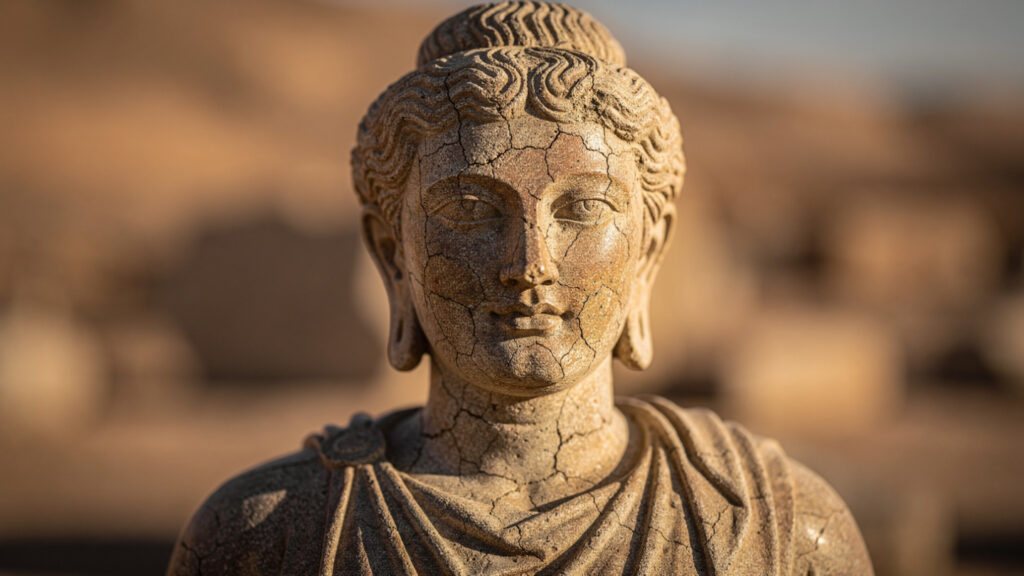
The Indo-Greek kingdoms that ruled parts of Gandhara from the second century BCE produced coins whose iconography tells the entire story in miniature: Greek gods on one side, Buddhist symbols on the other, the two visual vocabularies occupying the same object without apparent contradiction. The Greek kings of this tradition were not simply tolerant of Buddhism. Several were actively supportive. The Milindapanha, a Buddhist philosophical text, records a sustained dialogue between the Greek king Menander, Milinda in the Pali transliteration, and the Buddhist monk Nagasena, a dialogue whose intellectual sophistication suggests genuine engagement between the two traditions rather than the polite coexistence of a colonial administration with its subjects’ religion.
By the time the Kushan Empire unified the region in the first century CE, the conditions for Greco-Buddhist art were fully prepared. The Kushans maintained active trade and diplomatic contacts with Rome: Kushan coins carry portraits in the Roman tradition, Roman luxury goods appear in Kushan contexts, and the artistic workshops of the Gandhara region had access to Roman sculptural models as well as to the earlier Hellenistic sculptural tradition. The sculptors who first gave the Buddha a human face were working within a visual language that had absorbed three centuries of Greco-Roman development and that understood the Greek system of representing the divine in idealised human form from the inside rather than as an external borrowing.
Apollo and the Body of Enlightenment
The debt of the Gandharan Buddha to the Apollo tradition is documented in the forms rather than in any textual account of the sculptors’ intentions, and the forms are precise.
The face follows the Greek canon of idealised masculine beauty that the Apollo tradition had established: the high straight nose continuing the line of the forehead, the clearly defined brow ridge, the full lips, the chin of moderate projection, the overall oval proportion of the head. These are not generic features of handsome men. They are the formal conventions of the Greek tradition of representing the divine in human form, conventions that had been established in the fifth century BCE and that remained the standard for representing transcendent beauty across the subsequent centuries of Hellenistic and Roman development.
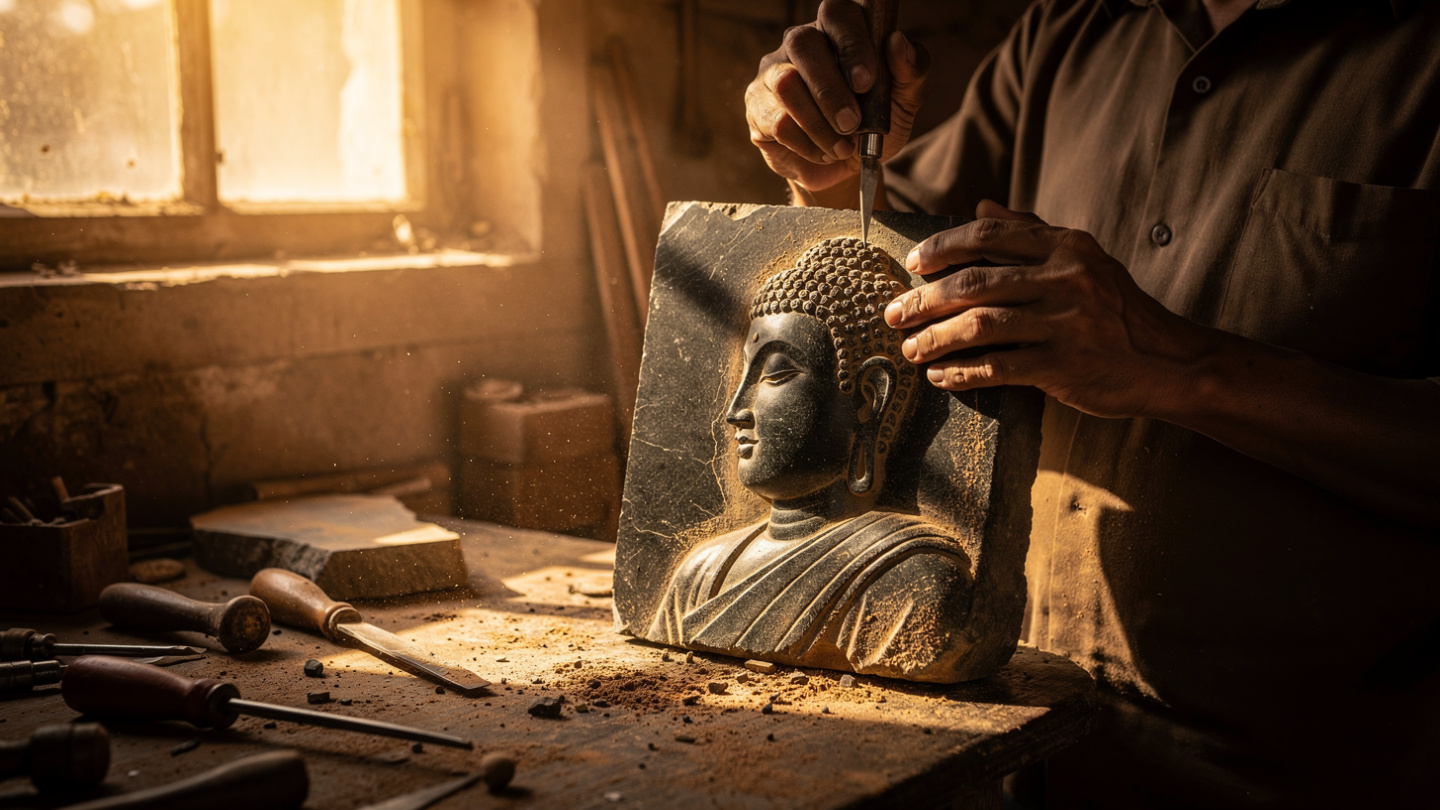
The hair presents a case. The ushnisha, the protrusion at the crown of the skull that Buddhist iconography specifies as one of the physical marks of the Buddha’s enlightened nature, is in early Gandharan sculpture consistently rendered with the wavy, organised locks of the Apollo tradition: not the formalised bun of later Buddhist convention but the treatment of hair as animated form that Greek sculptors had developed as a marker of divine vitality. The stylistic debt of Gandhara’s sculptors to earlier Greco-Roman images can be seen in the classical treatment of the Buddha’s head, ultimately based on that of Apollo, and the naturalistic, toga-like modelling of the folds of the monk’s robe, which follow the contours of the body and create strong rhythmical curves of alternating light and shadow.
The drapery is the other primary evidence. The Greek tradition had developed the rendering of draped fabric over a human body into one of its most technically demanding and most expressive sculptural achievements: the wet drapery technique, in which the fabric appears to cling to the body beneath it while simultaneously flowing in the wind or falling under gravity, achieving the paradox of maximum transparency combined with maximum material presence. Gandharan sculptors applied this technique to the sanghati, the monk’s robe of Buddhist convention. The result is a garment that is simultaneously the simple cotton robe of a wandering teacher and the flowing drapery of an Olympian deity, a piece of cloth that has been made to carry two theological meanings simultaneously through the technical vocabulary that Greek sculptors had developed for the representation of the divine.
Heracles Becomes the Guardian
The transformation of Heracles into Vajrapani is the most completely documented example of the process by which Greek mythological figures were absorbed into Buddhist iconography, and it illustrates the mechanism of Greco-Buddhist synthesis more clearly than any other case.
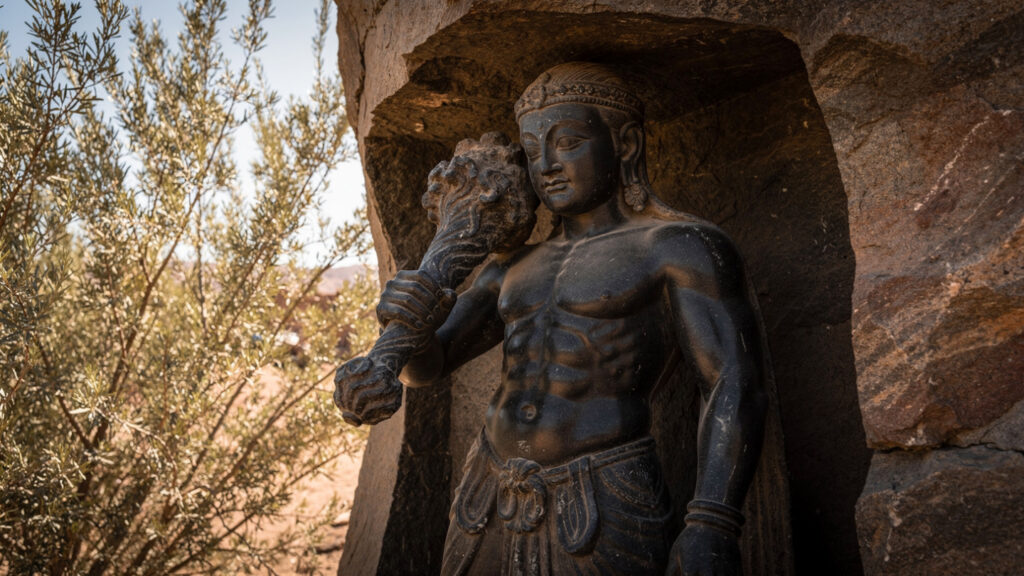
Vajrapani, the thunderbolt holder, is the Buddha’s personal guardian in the early Buddhist tradition: a powerful yaksha who accompanied the Buddha throughout his ministry and whose function was to protect the enlightened one from physical harm. The earliest representations of Vajrapani in Gandharan sculpture depict him as a muscular, nearly naked male figure standing beside the Buddha and holding a club. This figure is recognisably Heracles: the posture, the musculature, and above all the attribute of the gnarled club are the direct formal legacy of the Greek Heracles tradition.
The transformation was not simply a borrowing of convenient visual forms. It was the recognition of a genuine structural parallel between the two figures. Heracles was the hero who stood between ordinary human existence and the divine world, who performed impossible labours as the condition of his eventual apotheosis, whose strength was inseparable from his suffering and whose ultimate destiny was immortality achieved through endurance rather than inheritance. The yaksha who protected the Buddha on his path to enlightenment occupied a structurally similar position: a powerful being whose strength was deployed in the service of transcendence rather than in its own interests, whose function was guardian rather than protagonist.
The Greek visual tradition gave Buddhist artists the means to represent this protective power in a form that the tradition already associated with the combination of extraordinary strength and divine service. Heracles had been doing this work in the Greco-Roman world for centuries. In Gandhara, he continued doing it under a different name, in a different theological context, with the same muscular body and the same gnarled club.
The Silk Road as a Transmission System
The movement of Greco-Buddhist visual forms eastward was not a single event or a single route. It was the cumulative result of centuries of trade, pilgrimage, diplomatic exchange, and the movement of artists and craftsmen along the network of routes that connected the Mediterranean world to China and eventually to Japan.
The first Buddhist images in China, small statues dated to approximately 200 CE found in the context of Chinese burial practices, are in typical Gandharan style: the high ushnisha, the vertical arrangement of the hair, the symmetrically looped robe and parallel incisions for the folds of the arms all carry the formal vocabulary developed in Gandhara. The images accompanying the newly arrived doctrine came from Gandhara, and the Gandharan characteristics are preserved in these early Chinese examples with the precision of objects that were copied from known originals rather than developed independently.
The great cave sanctuaries of northern China, Dunhuang, Yungang, and Longmen, are the monuments where the transmission becomes fully visible. At Yungang, carved in the fifth century CE under Northern Wei patronage, the Buddhas retain the Gandharan tradition in their coiffures and their draped shoulders: the Greek formal vocabulary, now passed through two centuries of Central Asian intermediate development, still legible in the treatment of the figure. At Longmen, the Fengxian Temple’s Vairocana of the early seventh century carries a physique that the Gandharan tradition transmitted through Yungang: the broad shoulders, the defined physical presence, the contrapposto poise that the Greek sculptors of Polykleitos’s generation had developed as the formal expression of physical perfection.
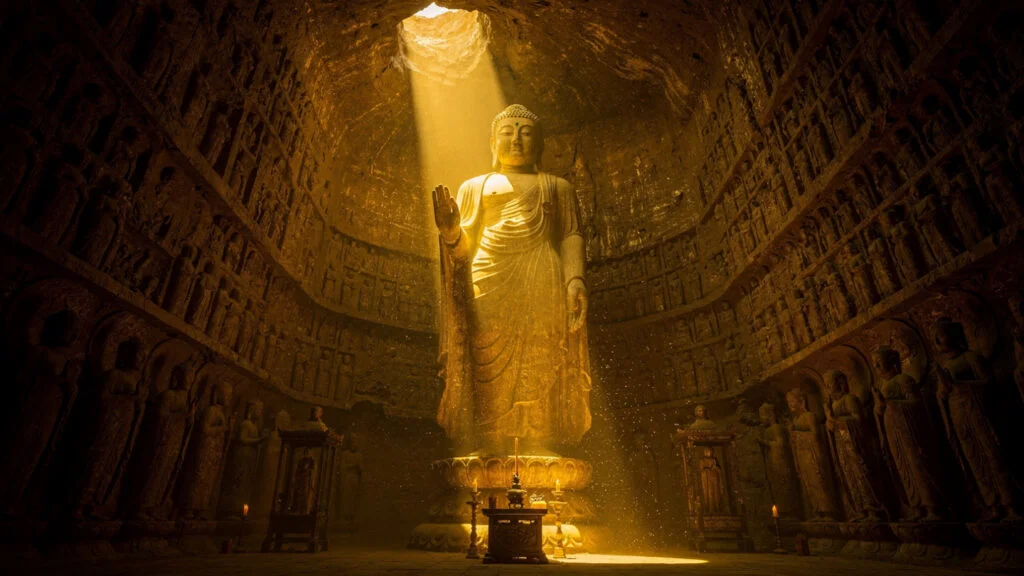
The contrapposto, the subtle weight shift on one leg that makes a standing figure appear to be in motion while remaining still, which Polykleitos perfected in the fifth century BCE as the formal solution to the problem of representing living stillness in stone, traveled from Argos to Gandhara to the cave sanctuaries of northern China to the temple complexes of Japan in a transmission whose final products are separated from their source by a thousand years and five thousand kilometres and yet carry the formal memory of the Greek discovery intact.
Korea and the Final Passage
Korea is the bridge that most histories of Greco-Buddhism pass over too quickly, treating it as a relay station rather than a point of genuine artistic development.
The Buddhist missions that arrived in the Korean kingdoms from China in the fourth century CE brought with them the formal vocabulary that Gandhara had developed and that the Chinese cave sanctuaries had elaborated. Korean artists did not simply transmit what they received. They refined it, applying the quality of attention to surface and material that the Korean metalworking and ceramic traditions had developed over centuries to the formal problems of Buddhist sculpture. The gold crowns of the Silla kingdom, the bronze Buddhas of the Baekje workshops, the stone carvings of the Unified Silla period: all of them process the Greco-Buddhist tradition through the sensibility of a tradition that understood materiality and surface as carriers of spiritual meaning in their own right.
When Buddhist missions from the Korean kingdom of Baekje arrived in Japan in 538 CE, carrying gilt bronze Buddhist statues and sutras and a letter from the Baekje king to the Japanese emperor recommending the new faith, they brought a visual tradition that had traveled from the workshops of Gandhara through Central Asia through China through the Korean peninsula, at each stage absorbing new elements while maintaining the formal core that the Greek tradition of representing the divine in idealised human form had established.
Japan | The Inheritance Fully Received
The Shaka Triad at Horyu-ji temple, completed in 623 CE by the sculptor Tori Busshi and one of the earliest surviving major works of Japanese Buddhist sculpture, shows the Greco-Buddhist tradition at the moment of its arrival in its final destination.
The central Buddha’s robe falls in the heavy rhythmical folds that Gandharan sculptors developed from the Greek drapery tradition, the pattern of alternating ridges and valleys that Greek sculptors had evolved as the formal representation of cloth under gravity. The flanking bodhisattvas stand in postures that carry the memory of contrapposto, the weight slightly displaced, the figure suggesting movement through the quality of the standing pose. The faces carry the oval proportions and the idealised regularity of features that the Apollo tradition had established as the visual vocabulary of divine beauty.
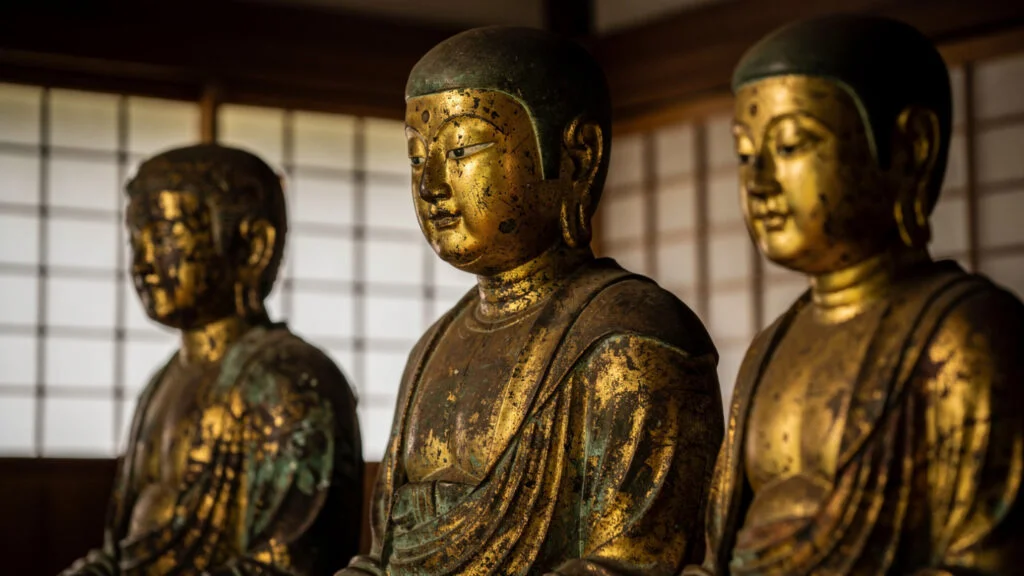
None of this was conscious archaism on Tori Busshi’s part. He was not looking at Greek originals or working from Greek descriptions. He was working from the models available to him, Korean and Chinese Buddhist sculpture that had itself transmitted the Gandharan tradition, which had itself transmitted the Greek tradition. The formal memory was in the objects themselves, passed from hand to hand and eye to eye across a thousand years of transmission.
The Nara Daibutsu, cast in bronze in 749 CE and still the world’s largest bronze Buddha, represents the Greco-Buddhist tradition at the scale of a state monument. The heavy pleats of the robe carry the himation vocabulary that Gandharan sculptors borrowed from the Greek tradition. The face, broad and refined simultaneously, carries the idealised calm of the Apollo type. The overall physical presence of the figure, the sense of a body of substance and proportion inhabiting space in a grounded and intentional way, is the legacy of the Greek discovery that the divine is most fully expressed in the perfected human form.
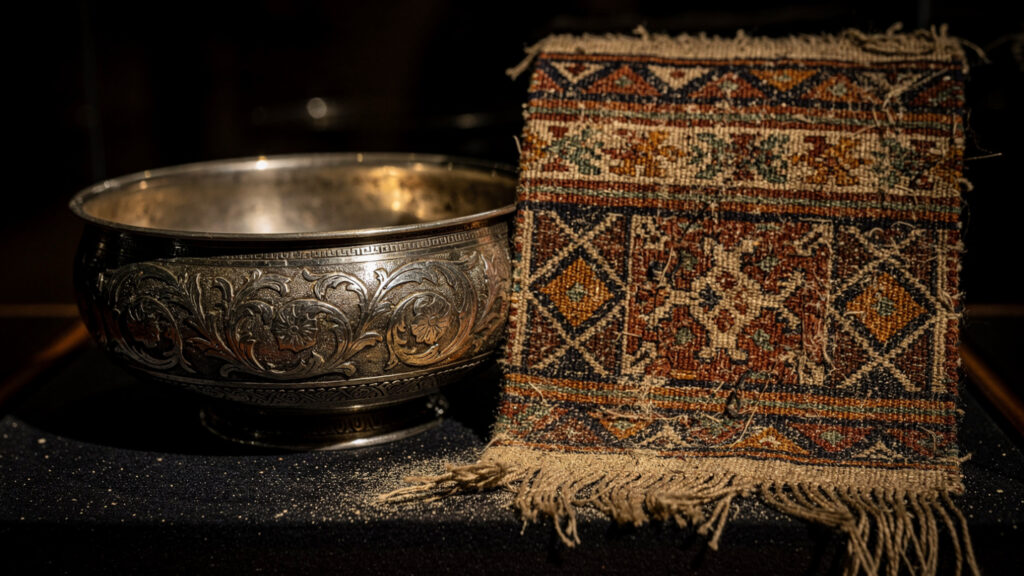
The Shosoin treasury at Todai-ji, sealed after the death of Emperor Shomu in 756 CE and opened only for periodic scholarly inspection, preserves the physical evidence of the Silk Road connections that made all of this possible: Persian silver bowls with Hellenistic vine scroll decoration, Central Asian textiles with motifs that carry the formal vocabulary of the Greek decorative tradition, objects whose presence in an eighth-century Japanese imperial treasury are the material proof of the connections that made the transmission of Greco-Buddhist visual principles from the Mediterranean to Japan not a series of accidents but a sustained cultural engagement across a thousand years and the full width of the Eurasian continent.
The Wind God’s Ancestor
At Todai-ji’s Nandaimon gate, the guardian figures Fujin the wind god and Raijin the thunder god dance in postures of concentrated energy, their bodies twisted in the quality of muscular exertion that the Greek sculptural tradition had developed as the visual representation of force in action.
Fujin’s billowing cloak, his bag of winds held overhead, his body turned in the act of release: these are the formal descendants of the Greek anemoi, the wind gods of the Hellenistic tradition whose own billowing cloaks and dynamic postures had been developed in the second and first centuries BCE as the visual vocabulary of atmospheric force made visible. The transmission runs from the Greek workshops through the Hellenistic cities of the Silk Road through the Gandharan tradition of representing guardian deities with dynamic, forceful bodies through the Chinese tradition of temple guardians through the Korean intermediaries to the gate of Todai-ji.
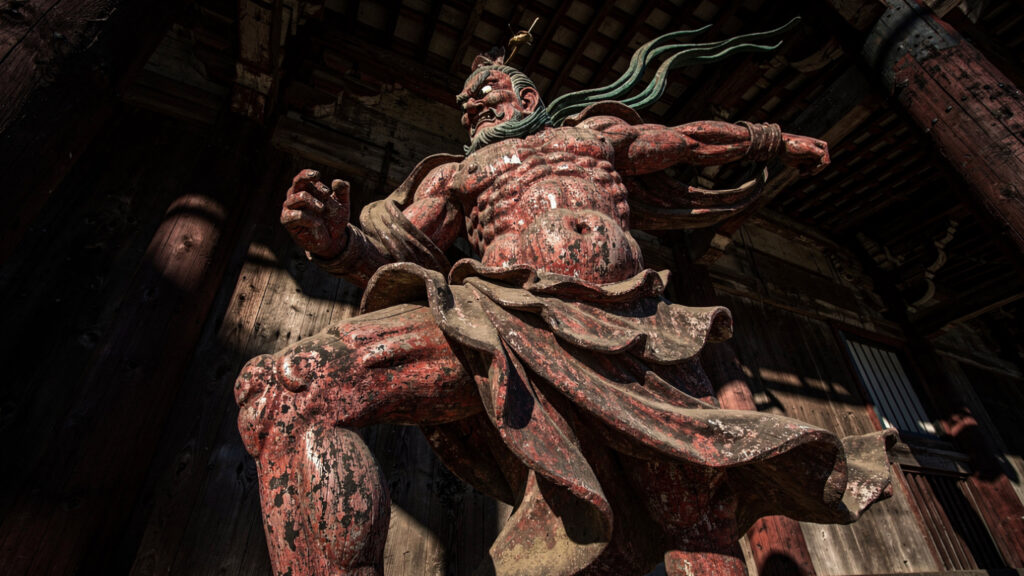
The quality of that dynamism, the sense of a body under tension, of force concentrated and about to be released, which is the formal achievement of the Greek sculptors who developed contrapposto and its more extreme expressions into the vocabulary of heroic action: this quality traveled the entire route intact. It traveled because it was the correct formal solution to the visual problem of representing divine power in a guardian figure, and correct formal solutions, once found, have a persistence that political and religious changes cannot easily displace.
What the Transmission Means
The story of Greco-Buddhism is sometimes told as the story of Greek cultural imperialism, the spread of Hellenistic forms across Asia in the wake of Alexander’s conquests. This reading misses the most important thing about what actually happened.
The Greek formal tradition did not spread eastward because it was imposed. It spread because Buddhist artists recognised in it the solution to a problem that their own tradition had been unable to solve: how to give the divine a human face without reducing the divine to the merely human. The Greek tradition had spent three centuries developing an answer to exactly this problem. The idealised human form, the body of perfect proportion and perfect calm, the face that carries transcendent serenity without losing human legibility: these were the Greek discoveries, and they were made available to Buddhist art at precisely the moment when Buddhist art needed them.
The face that Gandharan sculptors gave the Buddha was Apollo’s face because Apollo’s face was the Greek tradition’s most complete answer to the question of what divine perfection looks like when it takes human form. The quality of serene, illuminated calm that the Apollo tradition had developed as the visual expression of the god of light and reason and perfect proportion was exactly the quality that Buddhist iconography needed to express the state of enlightenment: the condition of a being who has transcended suffering without losing the capacity to be present to the suffering of others.
The Buddha who looks at you from a Japanese temple carries this legacy in his face. The proportion of the features, the treatment of the hair, the fall of the robe, the quality of the calm: all of it is the residue of a conversation that began in the workshops of Gandhara in the first century CE, when a sculptor looked at the Greek tradition of representing Apollo and understood that the god of light had given him the means to represent enlightenment.
The conversation has been going on for two thousand years.
It resurfaced explicitly in the twentieth century, when Japanese scholars encountering Greek mythology for the first time found gods they recognized under different names.
At Olympus Estate, Cultural Chronicles traces the practices and institutions that defined Greek civilization from the inside. For five centuries no Buddhist artist depicted the Buddha in human form because representing him in the bounded particular form of a human body would misrepresent what he had become. Then in the workshops of Gandhara a sculptor gave the Buddha a face. The face was Apollo’s. The ushnisha was rendered with the wavy organised locks of the Apollo tradition. The sanghati was draped with the wet drapery technique the Greek sculptors had developed as the formal expression of cloth under gravity. Heracles became Vajrapani because the structural parallel between the two figures was genuine. Contrapposto traveled from Argos to Gandhara to the cave sanctuaries of northern China to Japan. The formal memory was in the objects themselves. The Buddhist artists did not import Greek cultural imperialism. They recognised a correct formal solution to a theological problem their own tradition had been unable to solve. The conversation has been going on for two thousand years.