

If you measure a culture by its monuments, you see its past. If you measure it by its daily rhythms, you see something closer to its soul.
The first time you experience the Greek siesta, you may mistake it for inconvenience. You have arrived at a shop that was open an hour ago. It is now closed. The shutters are down, the street is quiet, and there is no sign indicating when anything will resume. In the town centre of a Greek village at three in the afternoon in August, the stillness is so complete that it feels less like a commercial decision and more like a weather event: something that happened to the day from the outside rather than something anyone chose.
Then you understand that everyone chose it. Simultaneously, collectively, without argument or negotiation, the entire community withdrew from the public world at the same hour it withdraws every day, for the same reason it has always withdrawn, and the stillness you are standing in is not an absence but a presence: the deliberate creation of time that belongs to the body and the family rather than to the economy.
The siesta is not the only rhythm that shapes the Greek day. The volta, the evening stroll, is the daily social census of every Greek community: the movement through which a town checks on itself and presents itself and reasserts the bonds that the afternoon’s private withdrawal temporarily suspended. The kafeneion, the traditional coffee house, is the third place that holds the rest of the day together: neither home nor work, a space of suspended time where a single cup of coffee, brewed in a copper briki and drunk in stages as the grounds settle, buys hours of genuine social presence at a marble table.
Together, these three rhythms constitute something that the modern world has been trying to name for several decades and has not quite captured: a daily architecture of human life that builds biological health, social depth, and genuine rest into the structure of ordinary time rather than treating them as rewards to be earned after sufficient productivity.
This is the anatomy of the Greek day. It is also, in ways that the research increasingly confirms, one of the most sophisticated approaches to human flourishing that any civilisation has produced.
The Mesimeri | What Silence Actually Is
Since 1996, Greek police regulation has formalised what Greek communities have enforced by social contract for far longer: every year from April through September, the summer quiet hours, Ores Koinís Isychías, run from 15:00 to 17:30. During this period, noise-producing activities in residential areas are prohibited by law. This includes power tools, loud music, raised voices in the street, and the ringing of doorbells with anything less than genuine urgency.
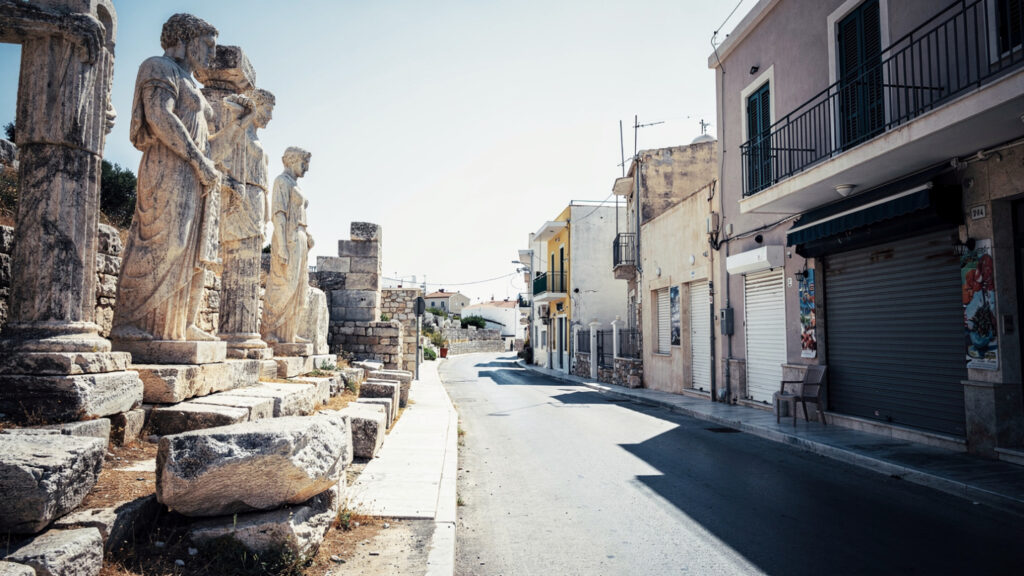
The rule exists because the silence it protects is considered a civic good rather than a personal preference. The Greek understanding of the mesimeri, the midday deep rest, is not that individuals need quiet in order to sleep. It is that the community as a whole requires a period of collective withdrawal from the public world, and that this withdrawal is valuable enough to protect through the same legal mechanisms used to protect property and public order.
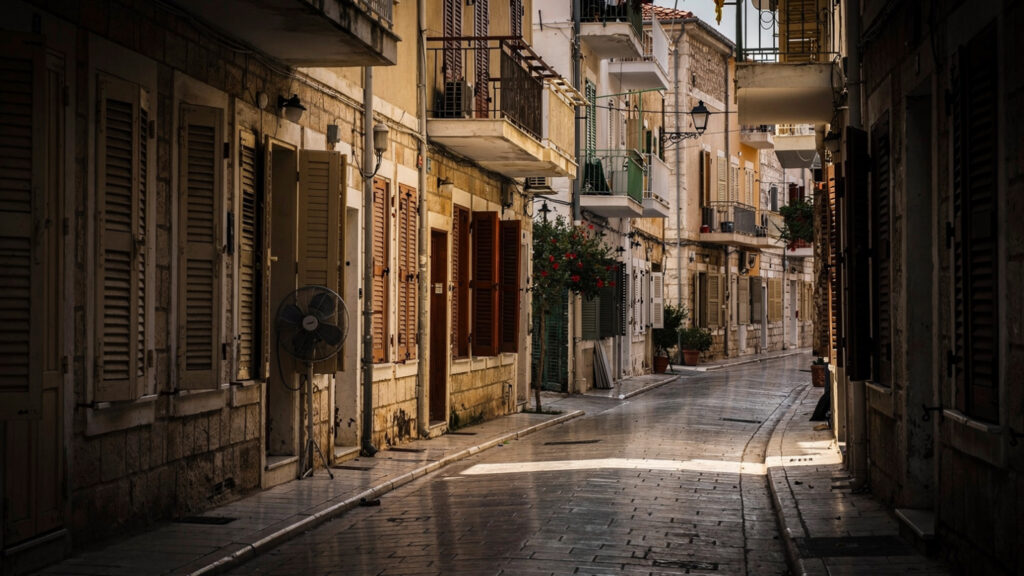
Stand in the centre of a Greek town at 3:30 on an August afternoon and you will understand, in a way that no description fully conveys, what the mesimeri actually is. The heat is the context: the Aegean summer at its peak, the sun doing what it does in the southeastern Mediterranean in August, which is to press down on the landscape with a force that makes all but the most essential movement genuinely effortful. The shutters have come down. The streets are empty. The only sounds are the cicadas, which apparently did not receive the noise ordinance, and occasionally the clack of a fan from somewhere behind a closed shutter.
But the silence is not only biological accommodation to the heat. The research confirms what the Greeks have understood experientially: regular midday rest reduces the risk of cardiovascular death significantly, according to studies consistently conducted across Mediterranean populations, including in the Blue Zone communities of Ikaria where the siesta is as structurally embedded in daily life as mealtimes. The nervous system resets. The cardiovascular load of the midday heat is absorbed and processed rather than accumulated. The afternoon that follows the mesimeri carries a different quality from the afternoon that follows continuous effort: more present, more capable of genuine social engagement, less depleted.
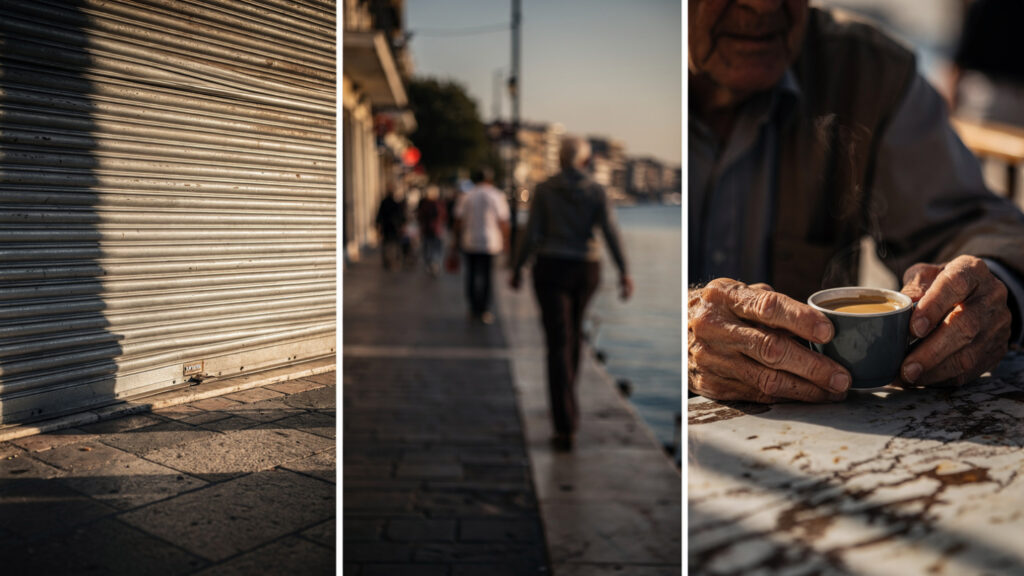
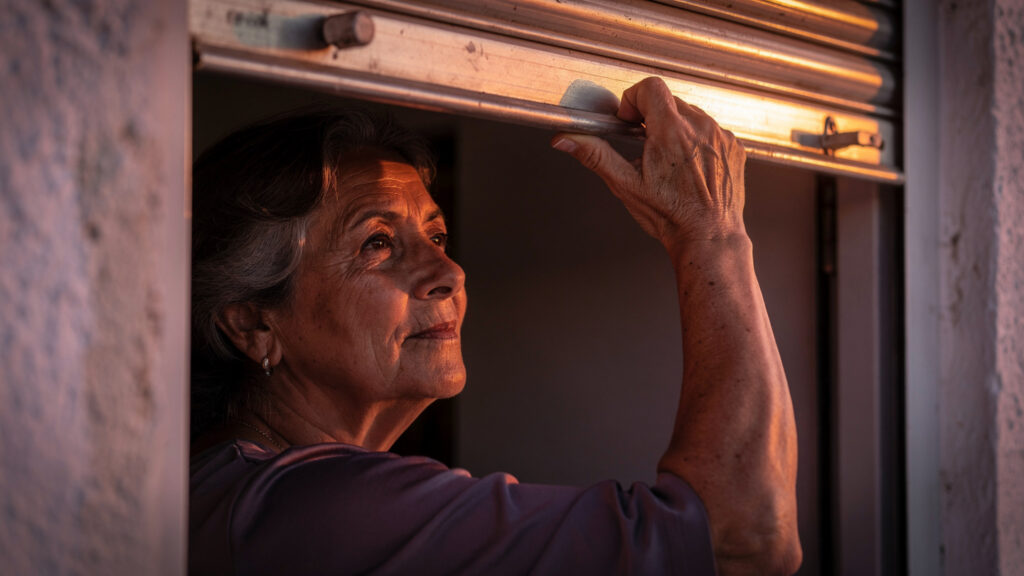
You hear the mesimeri arriving before you see it. The rhythmic clack of rolling shutters, building in waves across a street and then a neighbourhood, is the sound of a community performing a collective act of self-care with the same matter-of-fact efficiency that it brings to any other daily routine. There is nothing precious or deliberate about it. It simply happens, at the same hour it has always happened, because the accumulated intelligence of generations of people living in this climate has established that this is when it should happen.
To knock on a door during the mesimeri without genuine necessity is not simply rude. It is a category of social transgression: the imposition of one person’s disregard for the collective rhythm onto the community that maintains it. Greek social culture takes this seriously in the way it takes all violations of philoxenia seriously: not with explicit anger but with the quality of quiet disapproval that communicates more effectively than anger would.
If you are in a Greek village between three and five in the afternoon, do not knock on doors unless the house is on fire. This is not hyperbole. It is the correct standard.
The Hour the Shutters Rise
At around six in the evening, something happens that has no equivalent in northern European urban life and that visitors to Greece consistently describe as one of the most immediately legible expressions of the country’s social character.
The shutters rise. The city breathes. Not back to work, not into the evening’s private domestic life, but out: into the streets, into the squares, into the public space of the Greek evening hour that belongs to the community rather than to any individual or commercial enterprise.
This is the volta.
The word means simply a turn, a round, a circuit: the movement through a fixed route that a community takes at a fixed hour as a daily social practice. In every Greek town, from the marble-paved central square of Ermoupoli on Syros to the waterfront promenade of Chania on Crete to the harbour of a small island whose permanent population is measured in hundreds, the volta route is known to every resident and walked by a significant portion of them at this hour.
The route is not chosen for scenery, though scenery is invariably present. It is chosen for visibility. The volta is the community’s daily visual census: the circuit through which everyone sees everyone else and is seen, in which the social fabric of the town is reasserted after the afternoon’s private withdrawal, in which the transitions of ordinary life, who is in mourning, who has a new child, who has come back from the mainland, who has aged, who has arrived as a visitor, are registered and acknowledged by the community that needs to know them.
This is something that the phrase “social media” reached toward and did not quite capture: the difference between scrolling through an information feed and walking past another person’s physical body, registering their expression and their posture and the quality of their presence on an evening when you both know you will be on the same path. Physical presence imposes reciprocal acknowledgement. You cannot scroll past a neighbour you have known for thirty years without stopping, and the stopping, the brief exchange that follows, the quality of attention that two people give each other when they meet on the same route they have walked together for decades, is a different thing from a digital interaction in almost every dimension that matters.
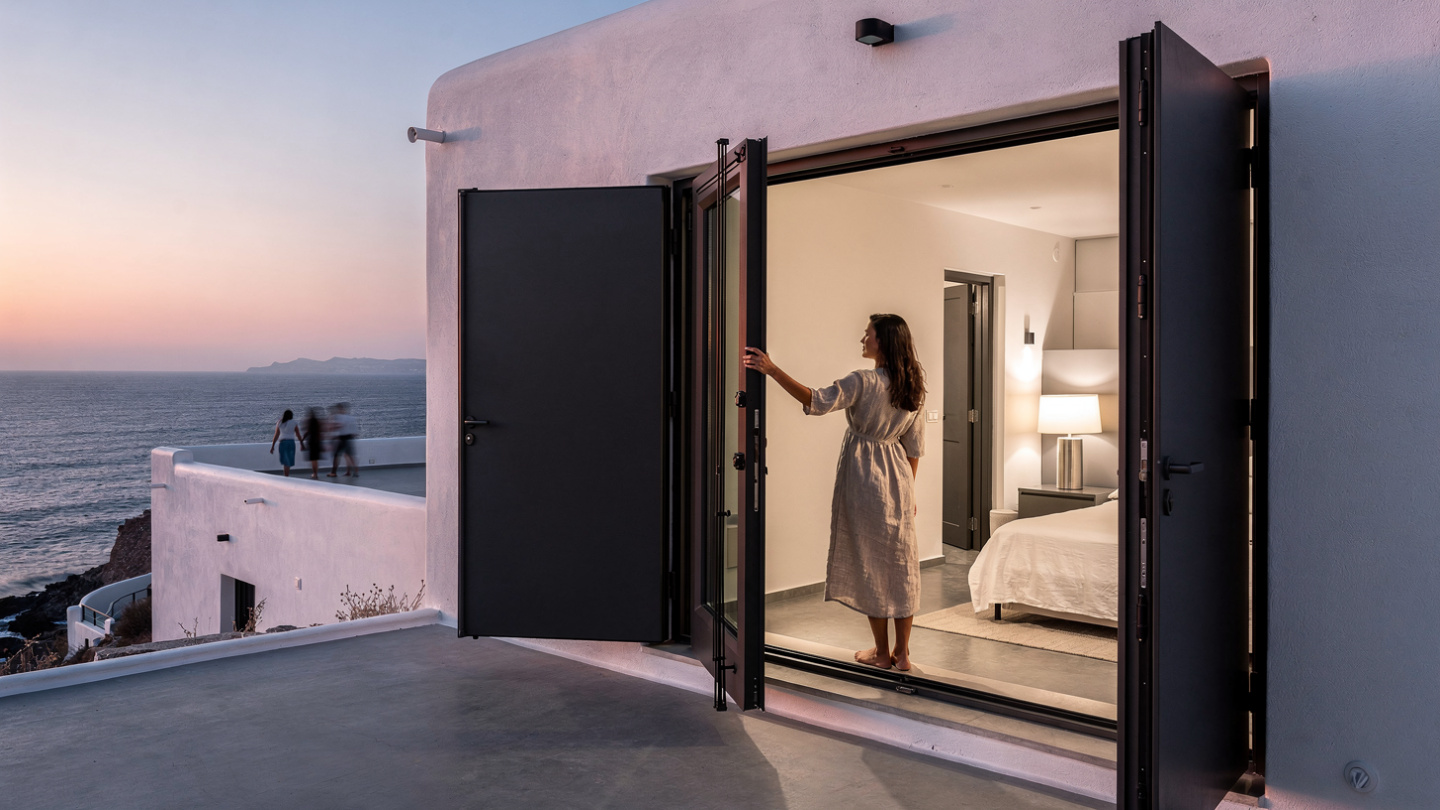
The volta is also, in the specifically practical Greek understanding of it, a digestive act. The heavy midday meal, the mesimeriáno, is metabolised by the evening walk in the way that Greek physiology and the accumulated knowledge of generations who lived this way together have established as correct. The Aegean evening, cooler than the afternoon and carrying the quality of light that the region produces as the sun descends toward the sea, is the ideal context for this movement: warm enough to be outside comfortably, cool enough to make movement pleasurable, the light producing the rose-gold quality on whitewashed walls and harbour water that makes every Greek evening look as though it has been lit by someone who understood that this was the hour.
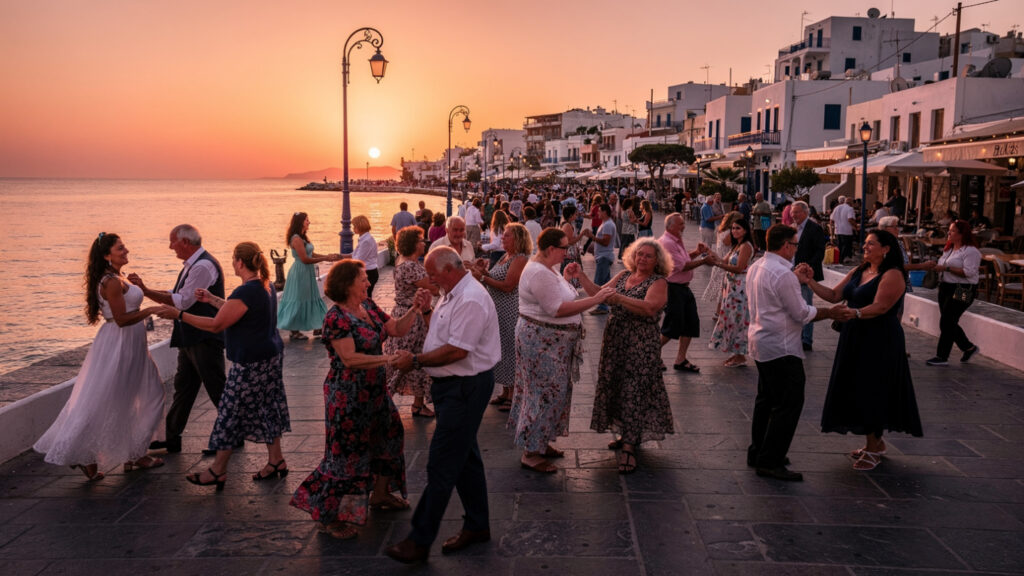
Walk the volta. Identify the local promenade, the paralia or the central square or the harbour front depending on where you are, and walk it at the evening hour when the town walks it. Stop when someone stops you. Understand that the interruptions are the point: the walk that proceeds uninterrupted from one end of the route to the other has not been a volta but a walk, and the distinction matters.
The Kafeneion | Where Time Is Reclaimed
The kafeneion is one of the most misunderstood institutions in Greek life, and the misunderstanding almost always runs in the same direction: it looks, to the uninitiated, like a place where time goes to die.
The old men at the marble tables, the komboloi moving through fingers that have held them for fifty years, the backgammon board whose tiles produce that wooden clacking sound, the cups of coffee that arrived an hour ago and are still not finished, the conversation that has been going since before you sat down at the table across the square and shows no signs of approaching a conclusion: what the visitor sees is time being spent at a rate that the productivity-oriented world finds difficult to accept as legitimate.
What is actually happening is that time is being reclaimed.
The kafeneion is the third place in the sociological sense: neither home nor work, a space that belongs to neither the private sphere of the family nor the economic sphere of the workplace, and that is therefore free from the obligations and the performance requirements of both. At home you are someone’s spouse or parent or child. At work you are someone’s employee or employer. At the kafeneion you are simply a member of the community, present in the shared space of the community, without an agenda that can be scheduled or an outcome that can be measured.
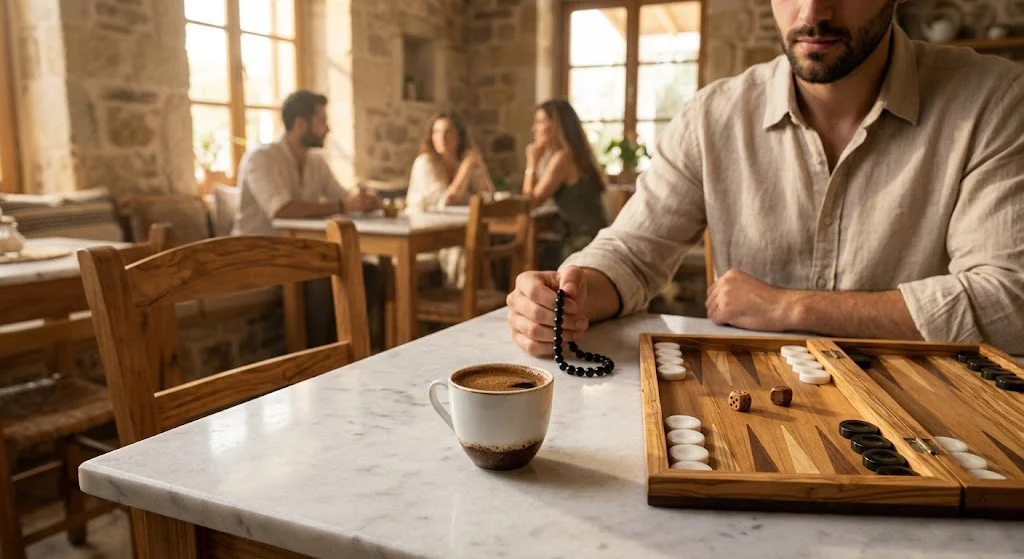
The Greek coffee that anchors the kafeneion experience is served in a small cup, brewed in a copper briki over direct heat until it rises and is poured grounds and all into the cup it will be drunk from. It is not stirred after serving. You wait for the grounds to settle. This waiting is not simply practical, though it is also practical: it is a physical enactment of the posture that the kafeneion as a whole requires. You cannot rush the grounds into settling. They settle at their own pace. The patience with which you wait for them is the patience with which the kafeneion conducts its social life.
A single cup of Greek coffee can reasonably occupy a person at a kafeneion table for two hours without any social awkwardness. This is not because the coffee is consumed slowly, though it is, but because the cup establishes a person’s right to the table and to the social space of the institution for as long as they wish to occupy it. The kafeneion does not operate on a turnover model. It operates on a presence model: the value of the institution is produced by the people who are in it, and those people’s continued presence is therefore not a burden on the institution but the source of its value.
The kerasma, the treating, is the economic expression of this social philosophy. In a kafeneion, you do not split the bill. The bill is paid by someone who wishes to demonstrate their connection to the people they are sitting with, and the competition to pay it is not a performance of wealth but an expression of the belief that what you give to the people you value is not a loss but an investment in the social fabric that sustains you. The phrase that the Greek tradition uses for this is precise: what I give, I have. Generosity in the company of people you care about does not diminish you. It defines you.

The komboloi, the string of beads that the older men of the kafeneion move through their fingers in rhythmic loops and flips, is not decorative and is not a prayer instrument in the conventional sense. It is a tactile anchor: an object that occupies the hands without requiring the mind’s attention, leaving the mind free to engage with the conversation or the backgammon or the quality of the afternoon light on the square without the fidgeting and the phone-checking that the unanchored hand produces in the absence of such an object. The neurological function of the komboloi is identical to what contemporary mindfulness research describes as the benefit of repetitive manual activity for sustained present-moment attention. The kafeneion solved this problem centuries before the research named it.
Why These Rhythms Are Under Pressure and Why They Persist
In 2026, the rhythms that define the Greek day are under genuine pressure from the 24/7 economy, from the smartphone that makes the uninterrupted afternoon available for work regardless of what the shutters are doing, from the tourist economy that expects shops to be open when visitors want to shop rather than when the community wants to be open, and from the pressure that younger generations feel from the comparison between the Greek pace of life and the international economic standards against which Greece has been measured and found wanting for the past fifteen years.
The pressure is real. In the major tourist centres, the siesta has contracted or disappeared. In the most commercially active parts of Athens and Thessaloniki, the volta is more vestigial than structurally significant. The kafeneion, in the urban centres, is being supplemented and in some areas supplanted by specialty coffee shops whose speed of service and design aesthetic serve a different understanding of what coffee is for.
And yet.
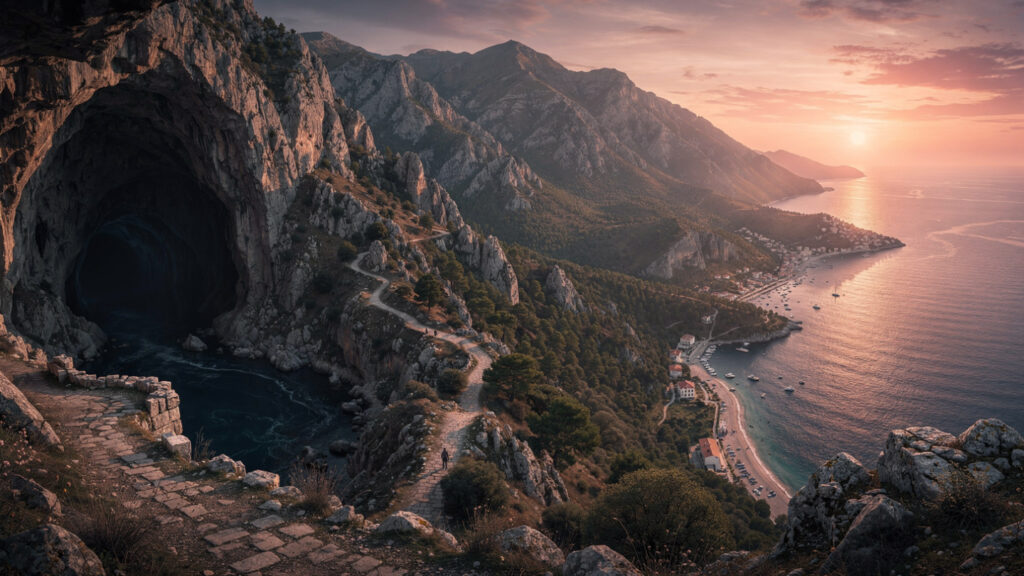
Walk through any Greek village of meaningful size at 3:30 on a summer afternoon. Walk the harbour of any island town that is not primarily a cruise ship destination at 6:30 on a summer evening. Find the kafeneion in any town that has one and sit down and order a coffee and wait for the grounds to settle. What you will find is that the rhythms have not disappeared. They have retreated from the areas where the economic pressure was strongest and persisted in the areas where the community’s commitment to them remained stronger than the pressure against them.
The new generation of Greeks who are deliberately reclaiming these rhythms, operating specialty coffee shops with long-stay policies and no laptop culture pressure, building the working schedules of small businesses around the siesta rather than against it, establishing the evening walkability of their neighbourhoods as a design priority, are not being nostalgic. They are making an argument about what kind of life is worth living that the economic framework of pure productivity measurement cannot accommodate but that the biological and social evidence consistently supports.
The siesta reduces cardiovascular mortality. The physical social contact of the volta produces measurably different neurological outcomes from digital social contact. The third-place institution of the kafeneion provides the benefits of sustained non-transactional social presence that neither home nor work can supply.
The Greeks did not design these rhythms to be healthy. They designed them to be liveable. The health followed from the liveability, as it tends to.
Practical Notes for the Visitor and the Resident
Understanding the rhythms is the first step. Participating in them is where the understanding becomes real.
The siesta rule is simple: between three and five-thirty in the afternoon in a residential Greek neighbourhood, you conduct yourself as though the quiet hours are a genuine obligation rather than a suggestion. This means no phone calls made loudly in the street, no construction or power tool use, no knocking on residential doors without genuine necessity. The rule is enforced socially before it is enforced legally, and the social enforcement is the more effective of the two.
The coffee rule is equally simple: coffee in Greece is a seated activity. Ordering it to go and drinking it while walking is not illegal, but it signals a relationship to time that the kafeneion was specifically designed to counteract. If you are going to drink Greek coffee, sit down. Wait for the grounds to settle. Do not look at your phone until the cup is finished. This is a small practice with surprisingly significant effects on the quality of the subsequent hour.
The volta requires only the willingness to identify the route and walk it at the correct hour. In most Greek towns this requires no research: the hour when the evening stroll begins is self-evident from the movement of people in the streets, and the route is the one that everyone is already walking. Join it. Walk at the pace of the people around you, which is the pace of conversation rather than exercise. Stop when someone you know appears, or when someone you do not know greets you, because in the context of the volta this will happen and is meant to.

The kafeneion requires, above all, the willingness to occupy time without a predetermined outcome. Order the coffee. Wait for the grounds. If someone is playing backgammon at the table next to you and needs a partner, consider becoming the partner. If the conversation at the table extends beyond the duration you had allocated for it, consider extending the allocation.
The rhythm will accommodate you. The question is whether you are willing to accommodate the rhythm.
Accumulated Intelligence of Many Centuries
The daily rhythms of Greece, the silence of the afternoon, the movement of the evening, the stillness of the kafeneion table, are not customs preserved for the benefit of tourists or ethnographers. They are active, functioning, daily practices of a culture that has concluded, through the accumulated intelligence of many centuries of living in a climate in a social formation, that these rhythms produce a human life of higher quality than the alternatives.
This conclusion has been reached without the benefit of cardiovascular research or neurological studies. It has been reached by the method of living this way and noticing that the people who live this way tend to age more slowly, know their neighbours more deeply, experience less of the kind of depletion that the modern world calls burnout, and arrive at the end of their days in possession of the quality of life that was available to them throughout it rather than deferred until a retirement that came too late.
The clock is a servant in this understanding, not a master. The sun will rise. The shutters will close at the hour they always close. The volta will begin as the light changes. The briki will be placed on the heat, and the coffee will rise, and someone will pour it into the small cup, and the grounds will settle at their own pace.
Everything else can wait.
The grounds are not finished settling.
At Olympus Estate, Greek Living explores the soul of Hellenic culture through the rituals that have shaped daily life across generations. The siesta, the volta, and the kafeneion are not a schedule. They are a promise: that today, as on every day, there will be time for the soul to breathe.