
Mussolini is said to have called Leros the Corregidor of the Mediterranean.
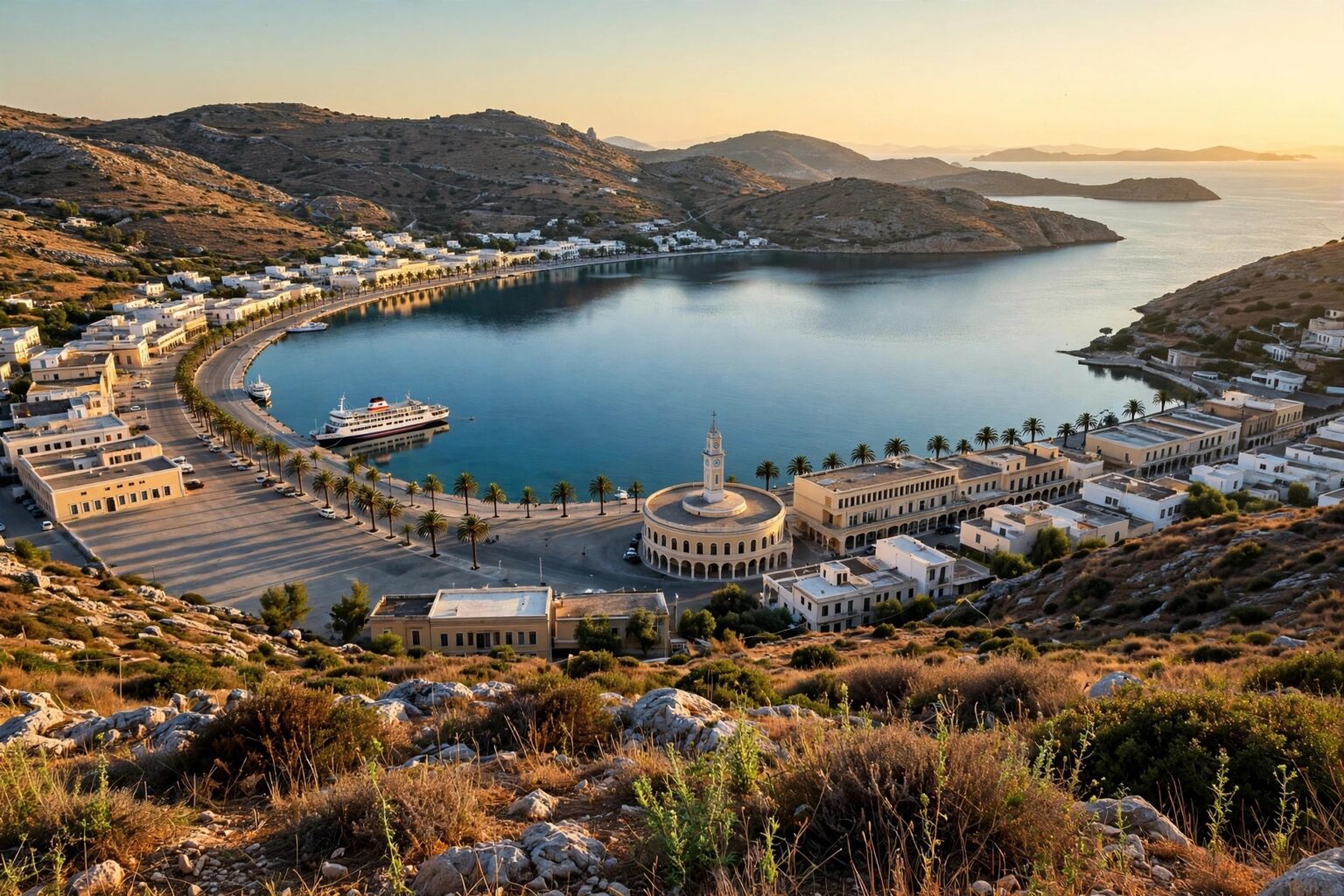
Corregidor was the American fortress island at the mouth of Manila Bay, a rock packed with guns and tunnels, and the comparison said exactly what Italy wanted Leros to be. The small Dodecanese island had one of the finest natural harbours in the Aegean, a deep bay almost closed by its hills, and in the 1920s and 1930s the Italians turned it into their main naval base in the eastern Mediterranean. Then, on the marshy shore of that bay, they built a town from nothing.
They called it Portolago. It was a model town in the Italian Rationalist style, with a market, a cinema, a school, a party headquarters, a church and boulevards wide enough for military parades. Today it is Lakki, a Greek town of about two thousand people, and its streets are still far too wide for the island. Walking through it is one of the strangest experiences in Greece. The town was designed as a stage for an empire, and it became, over eighty years and some very dark chapters, an ordinary Greek town.
The Bay That Looked Like a Lake
Italy took the Dodecanese from the Ottoman Empire in 1912, during its war over Libya, and the Italian flag went up on Leros in May of that year. What began as a temporary occupation became a colony. The Treaty of Lausanne in 1923 confirmed Italian sovereignty over the islands, and the same year the Royal Italian Navy began developing Leros as its main base in the Dodecanese, because the harbour of Rhodes, the colonial capital, was too small.
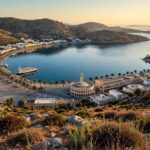
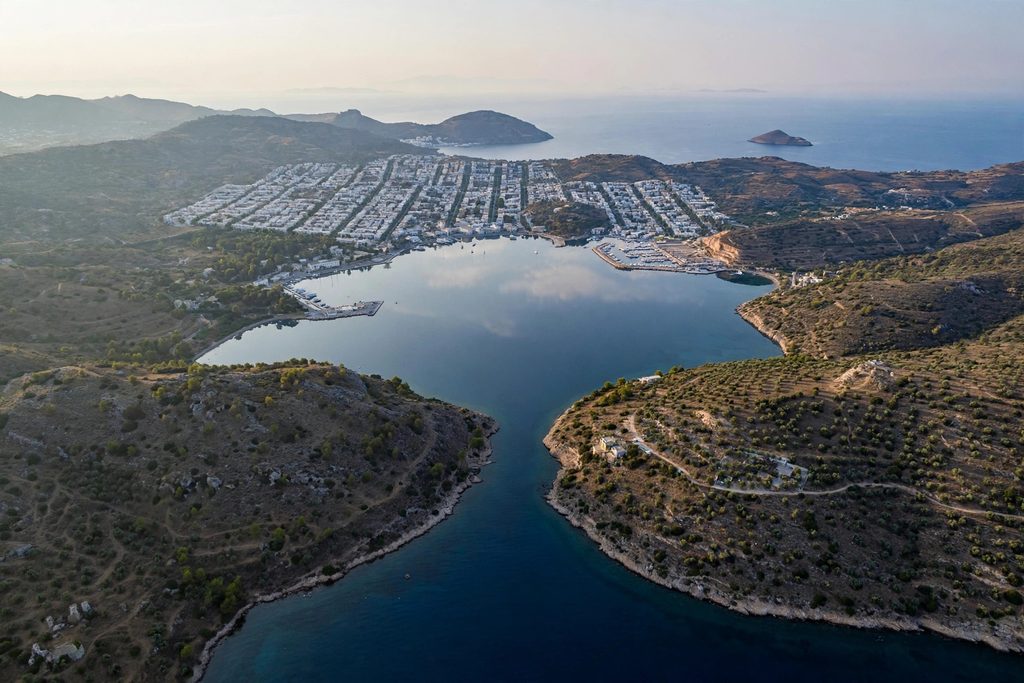
The geography made the choice obvious. Lakki Bay cuts deep into the west side of Leros, with a narrow mouth that can be closed and hills on every side that hide the water from the sea. A seaplane base went up at Lepida on one shore of the bay, gun batteries were dug into the hills, and the entrance was protected by a double boom. By 1930 Leros had dozens of permanent batteries and more than a hundred guns. Destroyers, torpedo boats and submarines made the bay their home port.
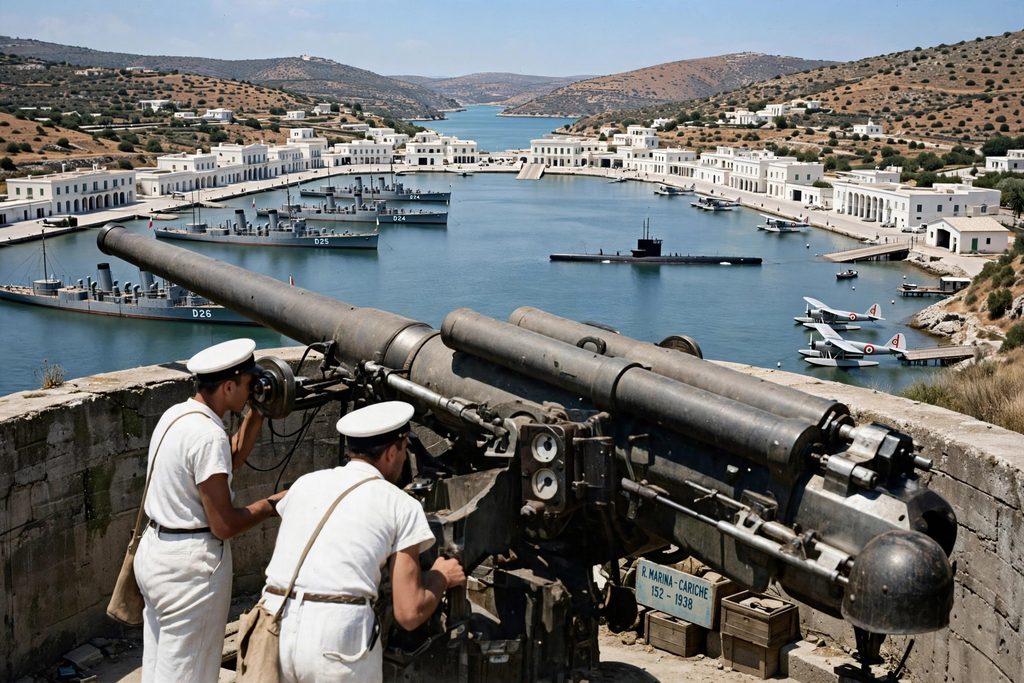
The Italians named the place Portolago. Lago is Italian for lake, and the enclosed bay does look like one. The name also honoured Mario Lago, governor of the Italian Aegean Islands from 1922 to 1936, and the flattery was surely intended. Few colonial place names managed to describe a landscape and compliment a governor at the same time.
A Model Town on a Marsh
A naval base needs barracks, workshops and storehouses. The Italians wanted more than that. They wanted a town where officers, sailors, workers and their families could live a complete Italian life, and where the architecture itself would show what the new Italy stood for.
The site was an empty marsh at the head of the bay. The architect Florestano Di Fausto, who shaped much of Italian Rhodes, was first invited to plan the town. The commission went in the end to two architects working for the colonial administration, Rodolfo Petracco and Armando Bernabiti. Construction began in the late 1920s and ran through the 1930s, with cement and many materials shipped from Italy. The plan was never completed, because the war arrived first. At its peak in the late 1930s, Portolago had some seven to eight thousand inhabitants, making it one of the largest settlements in the Dodecanese.
The town was laid out as a single composition. A broad seafront avenue runs along the bay, and wide streets lead inland to the public buildings, set in squares and gardens with eucalyptus and palms. Officers’ villas and workers’ housing filled the blocks between. Everything was designed at once, by a handful of people, for a population that arrived by ship.
What Rationalism Was
Italian Rationalism, razionalismo, was the Italian answer to the modern movement in architecture of the 1920s and 1930s. Like the Bauhaus in Germany, it rejected ornament in favour of clean geometry, flat roofs, smooth rendered walls, long horizontal windows and buildings shaped by their function. Unlike the Bauhaus, it found a powerful patron in a dictatorship. Mussolini’s regime wanted to be modern and Roman at the same time, and Rationalist architects gave it buildings that were stripped and new but also ordered, symmetrical and monumental, with arcades, towers and colonnades that recalled the Roman past. The most famous example is the Casa del Fascio in Como, designed by Giuseppe Terragni and finished in 1936.
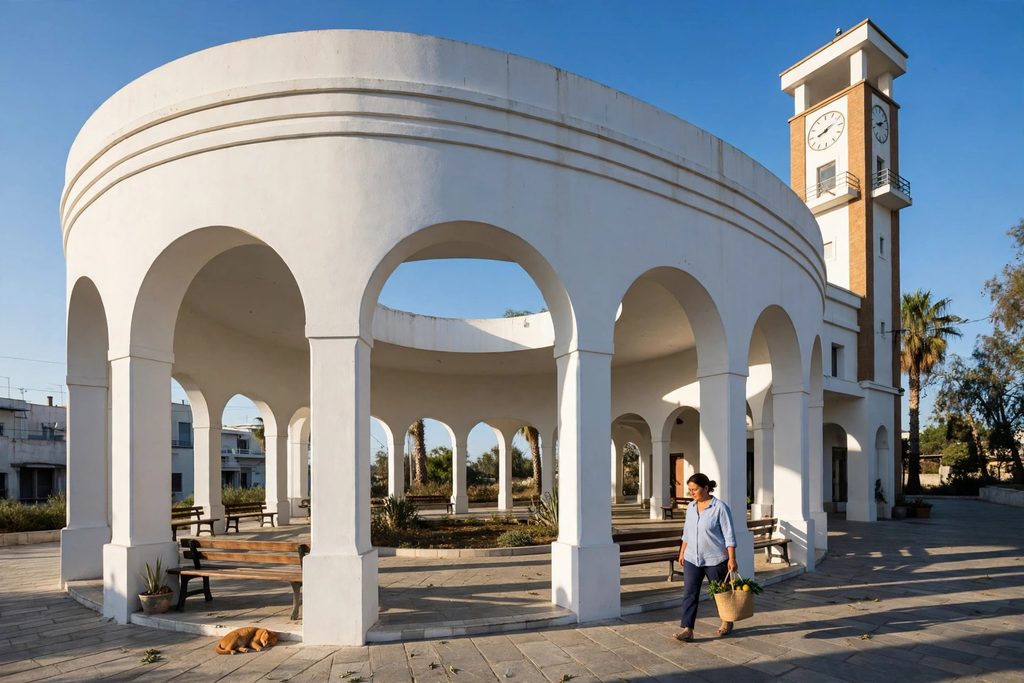
What Petracco and Bernabiti built on Leros is gentler than the grand projects in Rome or the colonies in Africa. The scale is smaller and the buildings answer to the Aegean climate. There are deep arcades for shade, curved corners, flat terraces, white and pale ochre walls, and porthole windows that tie the town to the navy it served. The round market with its clock tower and the curved front of the cinema have the soft lines of Art Deco, and many visitors say the town looks more like Miami Beach than a Greek island.
That gentleness should not hide the purpose. Portolago was built to make Italian rule over a Greek island look permanent and natural. The Greek population of Leros lived around it rather than in it, in the older villages of Platanos and Agia Marina, under a colonial regime that pressed Italian language and schooling on the islands through the 1930s. The town is beautiful, and it was also a statement of ownership. Both things are true, and Lakki makes sense only when they are held together. It belongs in any conversation about how modern architecture arrived in Greece, even though it arrived as an import from an occupying power.
Fifty-Two Days | The Battle of Leros
Mussolini’s fortress was tested in 1943, and not in the way he had imagined. Italy’s armistice with the Allies was announced on 8 September. In the Dodecanese the Italian garrisons suddenly had to choose a side, and on Leros, under the naval commander Luigi Mascherpa, they chose the Allies. British troops began arriving within days. The British hoped to seize the Dodecanese while the Germans were off balance and open a new front in the Aegean.
The Germans moved faster. They held Rhodes, and early in October they took Kos and its airfield, which left the British with no air cover over Leros. From 26 September the Luftwaffe bombed the island almost daily. On that first day, German bombers sank the Greek destroyer Vasilissa Olga, the Queen Olga, and the British destroyer HMS Intrepid in Lakki harbour. The fortified bay that had been built to protect a fleet became a trap for it.
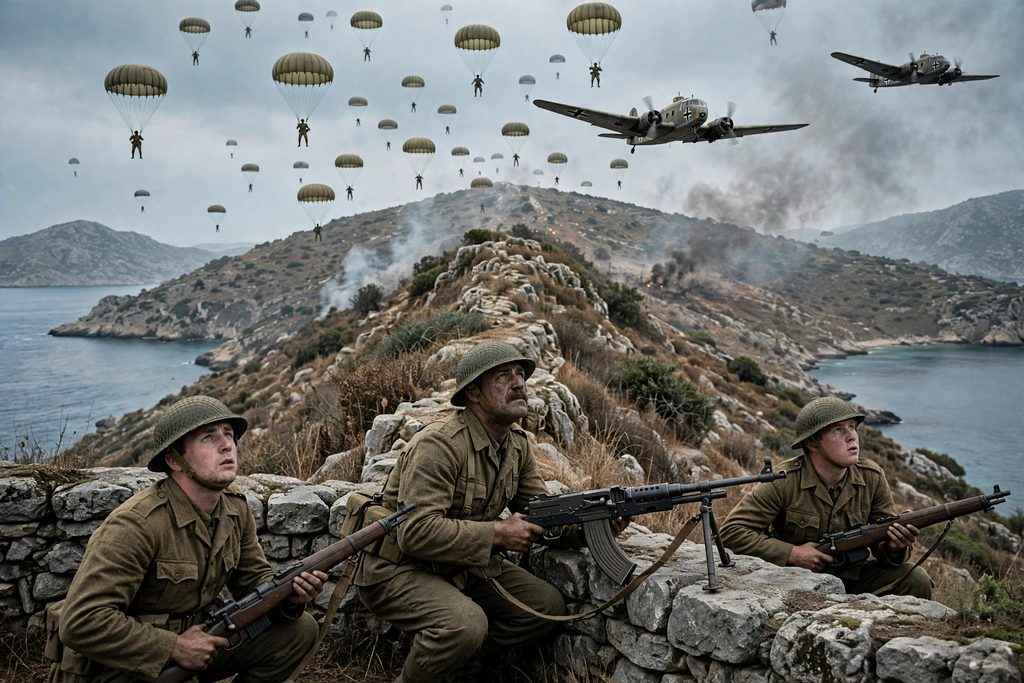
On 12 November German troops landed by sea on the north and east coasts and dropped by parachute onto the narrow neck of the island between Gourna and Alinda, cutting the defence in two. After four days of fighting across the hills, the British commander, Brigadier Robert Tilney, surrendered on the afternoon of 16 November, and Mascherpa that night. The Germans took about 3,200 British and 5,350 Italian prisoners. The Allied Dodecanese campaign was over, and the islands stayed in German hands until 1945.
Mascherpa’s fate was bitter. Handed over to Mussolini’s new puppet republic in northern Italy, he was tried for treason for having fought the Germans, and in May 1944 he was shot at Parma together with Admiral Inigo Campioni, the last Italian governor of the Dodecanese. The men who had defended Leros for the Allies were executed by the regime that had built it.
The Island Behind Navarone
In 1957 the Scottish novelist Alistair MacLean published The Guns of Navarone, and in 1961 it became one of the most successful war films ever made. In the novel, twelve hundred British soldiers are trapped on the Aegean island of Kheros, and the navy cannot rescue them because two huge radar-controlled guns on the neighbouring island of Navarone command the only channel. A small team of commandos is sent to destroy the guns.
Navarone and Kheros are fictional, but the setting is the Dodecanese campaign of 1943, and Kheros, the stranded British garrison waiting for a rescue that might never come, is widely read as a version of Leros. MacLean gave his story the ending the real campaign did not have. On Leros there were no commandos to silence the guns in time, and the garrison was not taken off. It surrendered.
What Greece Did With the Buildings
After the German surrender in 1945, the Dodecanese passed to British military administration. On 31 December 1947 the Greek flag was raised over Leros, and the union of the islands with Greece was formally celebrated in March 1948. The Italian population left. Portolago was renamed Lakki, an old local name for the bay that comes from the ancient Greek lakkos, a pond or basin. The officers’ houses passed to local families.
The big barracks and military buildings were a harder inheritance, and the Greek state used them in ways that have marked the island ever since. In 1949, at the end of the civil war, the Royal Schools opened in part of the abandoned Italian barracks, taking in children and teenagers who had lost their families or been displaced by the war and training them in trades under a strongly anticommunist education. About sixteen thousand young people passed through them before the last graduated in 1964.
In 1957 a royal decree founded a psychiatric colony in the barracks at Lakki, which in 1965 became the Leros Psychiatric Hospital, with more than two and a half thousand beds. Patients were sent there from all over Greece, far from their families. When the dictatorship of the colonels seized power in 1967, Leros became an island of exile as well. From 1967 to 1974 the junta held political prisoners in camps on the island, at Partheni and Agios Georgios, and at times about a third of all the regime’s political detainees were here.
In the late 1980s, reports in the European press exposed the conditions inside the psychiatric hospital, and a long programme of reform followed, moving patients into smaller units and community care. The episode left Leros with a reputation it has worked hard to change. It is a hard chapter, and it is part of the story. A town designed as a utopia for one community became, for a generation, the place where another state sent the people it wanted out of sight.
Lakki Today
Lakki now has a little over two thousand residents and the quiet of a town built for four times as many. The seafront avenue is lined with palms and benches, and the ferries from Piraeus still dock here. The scale is the first thing every visitor notices. Greek island towns grew lane by lane over centuries, folding themselves into the hills like the harbour houses of Symi. Lakki was drawn on a single sheet of paper, and its boulevards, built for parades, are mostly empty.
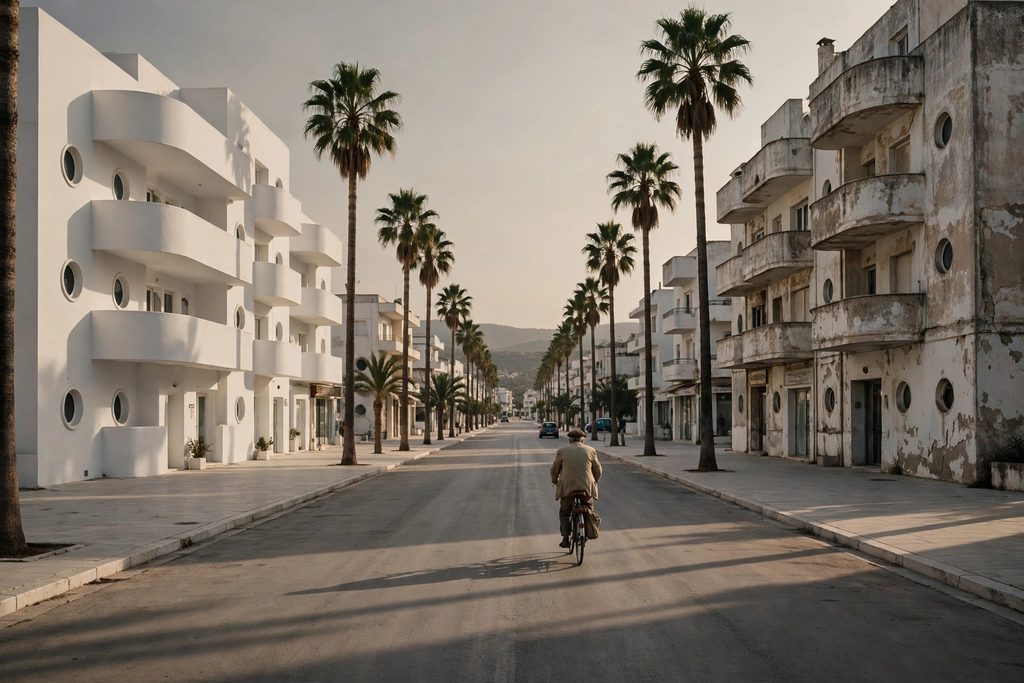
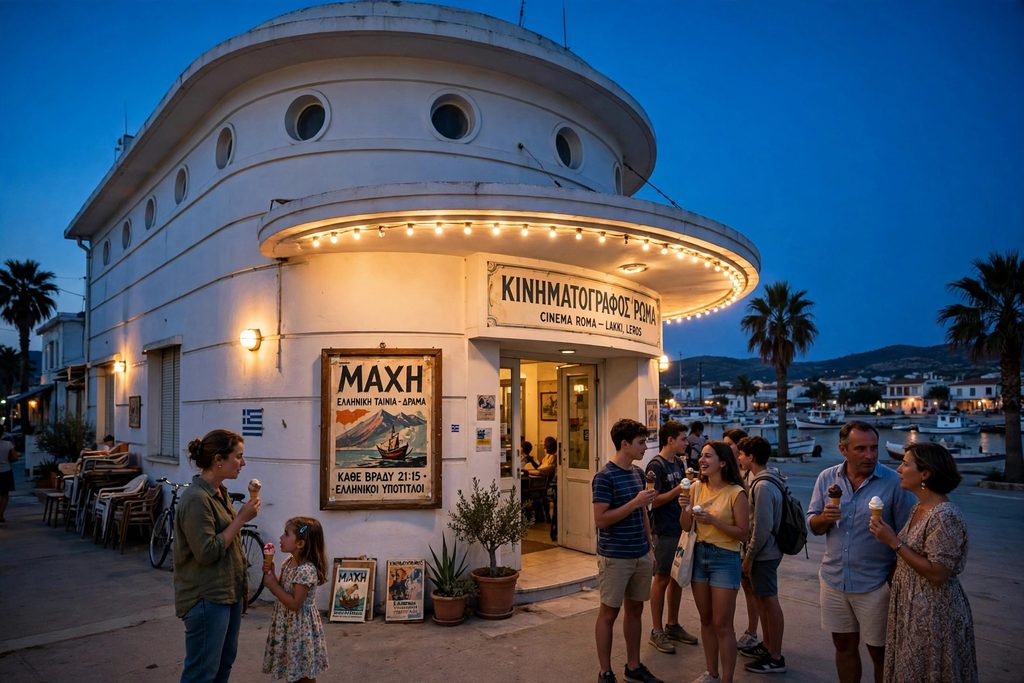
The buildings are slowly being cared for. The Cinema Roma has been restored and works again as a cinema and theatre, and the neighbouring Albergo Roma, which ran as the Hotel Leros from 1948 until the mid-1980s, is being rebuilt as a cultural space. The round market with its clock tower still stands at the centre of town. The former Italian church of San Francesco serves the Orthodox parish of Saint Nicholas. The seaward wing of the old town hall and Casa del Fascio, damaged in the war, now holds cafés and shops. Greece’s Ministry of Culture has declared several of the Italian buildings historical monuments, among them the naval barracks known today as the Poseidonion, the Grande Magazzino warehouse and the Aerophone building at Patella, and universities and the ministry have drawn up a plan to protect and promote the island’s modern heritage.
Many other buildings stand empty, their render peeling and their windows open to the wind. Abandonment in Lakki is part of the landscape, and it gives the town an atmosphere close to the emptied harbours and ruins waiting for restoration elsewhere in Greece. Lakki was not worn down by time. It was emptied, left standing after the purpose it was built for had gone.
The war is never far away. On the waterfront a monument remembers the Queen Olga and the men who died with her. At Merikia, just outside the town, the Leros War Museum fills an Italian military tunnel with weapons, uniforms, photographs and wreckage from 1943. In the clear water of the bays, divers can visit the wrecks of the ships and aircraft lost in the battle.
The Rest of Leros
Beyond Lakki, Leros is a quiet Dodecanese island of deep bays, low green hills and small villages, without the crowds of its neighbours. Agia Marina, on the east coast, is the island’s lively harbour for catamarans and fishing boats, its waterfront lined with tavernas. Above it, Platanos, the island’s capital, climbs the ridge toward the Castle of Panagia, a Byzantine fortress later held by the Knights of Saint John, which looks across the whole island and down to both coasts. A row of restored windmills runs along the ridge below it.
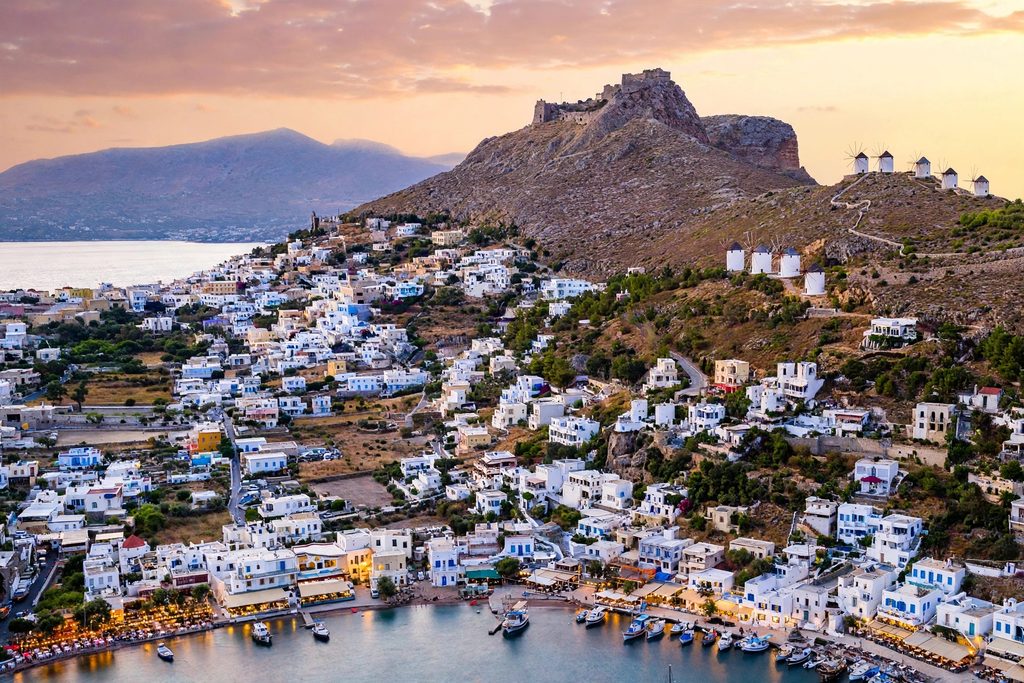
The castle connects Leros to the older history of the Dodecanese, the Byzantine and crusader layers that also shaped Rhodes and the monastery island of Patmos, the next island north. Its church holds an icon of the Virgin that islanders have venerated for centuries, and the climb from Platanos at sunset is one of the best walks on the island.
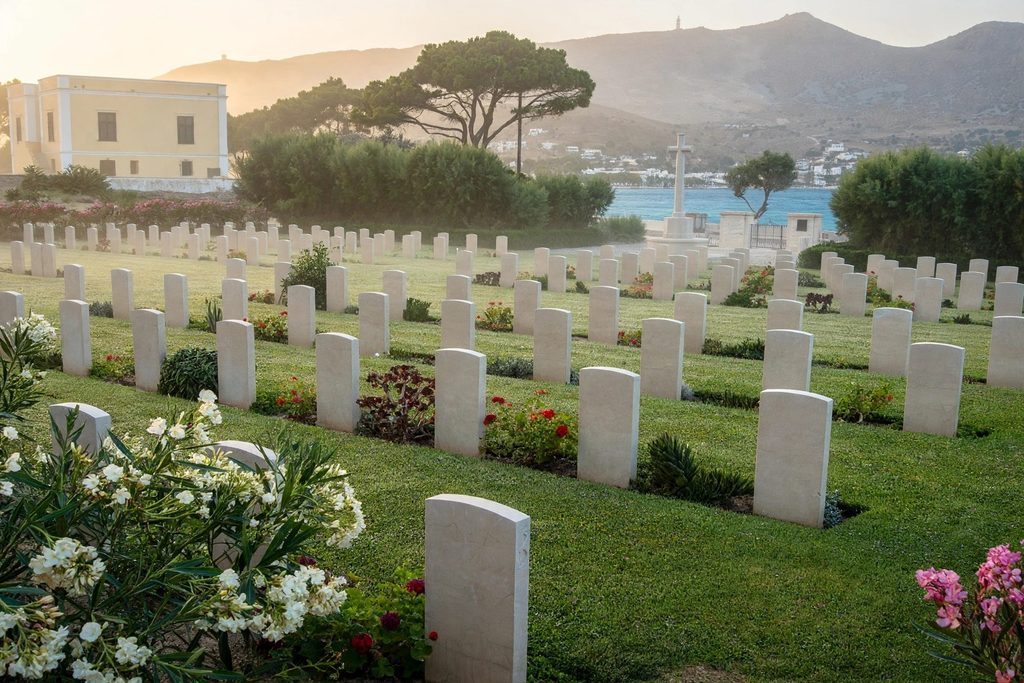
To the north, the bay of Alinda has the island’s longest beach, and beside it the Leros War Cemetery, maintained by the Commonwealth War Graves Commission, holds the graves of the British and Commonwealth soldiers killed in 1943. It is small, immaculate and very quiet, with the sea visible over the wall. Further north still, the bay of Partheni, where the junta held its prisoners, has the island’s small airport and the chapel of Agia Kioura, whose walls were painted by political prisoners during the dictatorship.
Visiting Leros
Leros lies in the northern Dodecanese between Patmos and Kalymnos. The large ferries from Piraeus run overnight and dock at Lakki, while the faster catamarans of the Dodecanese line call at Agia Marina and link Leros with Patmos, Kalymnos, Kos and Rhodes. Small planes fly from Athens to the airport at Partheni. Check current schedules before planning, since routes and frequencies change by season.
- Getting around. The island is small, but a car or scooter makes it easy to reach the castle, the northern bays and the Italian military ruins in the hills.
- Lakki on foot. Give the town at least two unhurried hours. Walk the seafront, the market, the cinema and the church, then the back streets of officers’ villas.
- The war sites. Combine the War Museum at Merikia, the Queen Olga monument and the cemetery at Alinda into one day.
- How long to stay. At least two or three nights. Leros rewards time, and its quiet is part of the point.
Two Names for the Same Bay
The best summary of Lakki is its two names. The Italians called the bay Portolago, the harbour like a lake, and slipped a governor’s name into it. The Greeks call it Lakki, from an ancient word for a pond. Both names describe the same still water enclosed by hills. One of them also claimed it for an empire.
The empire lasted barely thirty years. The buildings have lasted much longer, through a battle, a change of flag, two decades as an island of institutions and a slow return to ordinary life. Greek children have grown up in the old Italian apartments, Greek families buy their bread under the clock tower of the market, and Greek films play in the cinema built for the Italian navy. The streets are still wide enough for military parades. Nobody parades on them.
At Olympus Estate, Greek Islands explores the islands through the layers of history their towns and harbours still carry. Leros, in the northern Dodecanese, was occupied by Italy in 1912, and from 1923 its deep, enclosed bay became the main Italian naval base in the Aegean, a fortress Mussolini is said to have called the Corregidor of the Mediterranean. On the marsh at the head of the bay, Rodolfo Petracco and Armando Bernabiti built Portolago from the late 1920s through the 1930s, a model town in the Italian Rationalist style with the Casa del Balilla, a round market with a clock tower, a school, the town hall and Casa del Fascio, the Cinema Roma and the church of San Francesco, home to seven or eight thousand people at its peak. In the Battle of Leros, from 26 September to 16 November 1943, German bombers sank the Queen Olga and HMS Intrepid in the harbour, German troops landed on 12 November and some 3,200 British and 5,350 Italian soldiers were captured, while the Italian commander Luigi Mascherpa was later executed in Parma. The campaign lies behind the island of Kheros in The Guns of Navarone. After union with Greece in 1947 and 1948 the town became Lakki, and the Italian barracks housed the Royal Schools, a psychiatric colony founded in 1957 and, under the junta, camps for political prisoners. Today the restored cinema, protected monuments, the War Museum, the castle above Platanos and the Commonwealth cemetery at Alinda make Leros one of the most layered islands in Greece.