


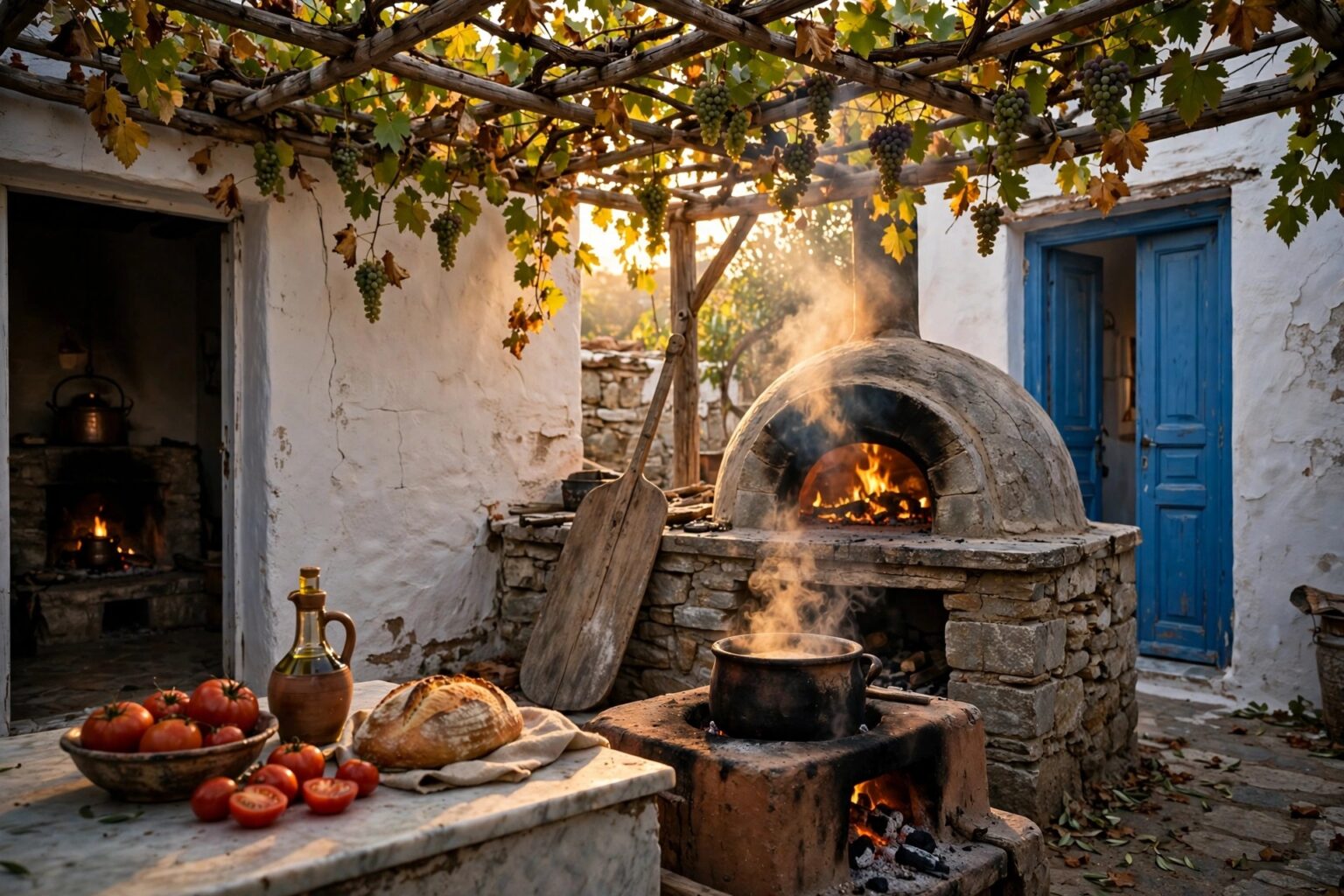
For most of its history, the traditional Greek kitchen was not a room. It was wherever the fire could be lit.
The modern picture of a kitchen is a closed room with a stove, an oven and a cold box, the same in Athens as in Oslo. That kitchen is a few generations old in Greece. Before it, Greek cooking followed the fire, and the fire followed the air, the season and the neighbours. In summer it burned in the courtyard, on a brazier moved from shade to shade. In winter it came inside to the hearth. On baking days it roared in a stone oven at the edge of the village, shared by everyone. The cooking that made Greek food what it is happened at the threshold, half indoors and half out, in a climate that turned sun and wind into tools.
To understand where the Greek kitchen actually lives, follow the fire, from a Bronze Age town under volcanic ash to the gas ring of an Athenian apartment.
Akrotiri | The Kitchen Under the Ash
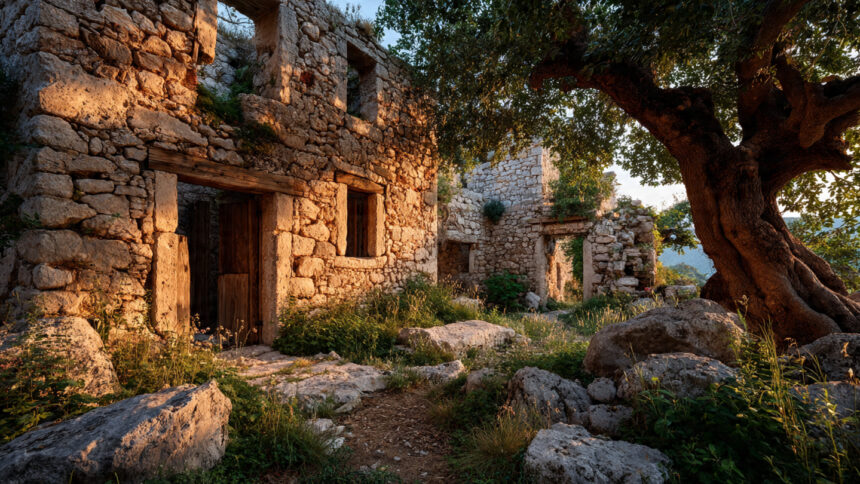
Around 3,600 years ago the volcano of Thera erupted and buried the town of Akrotiri, on what is now Santorini, under metres of pumice and ash. The inhabitants had left in time, but their houses stayed standing, some to two and three storeys, with their pots still in place.
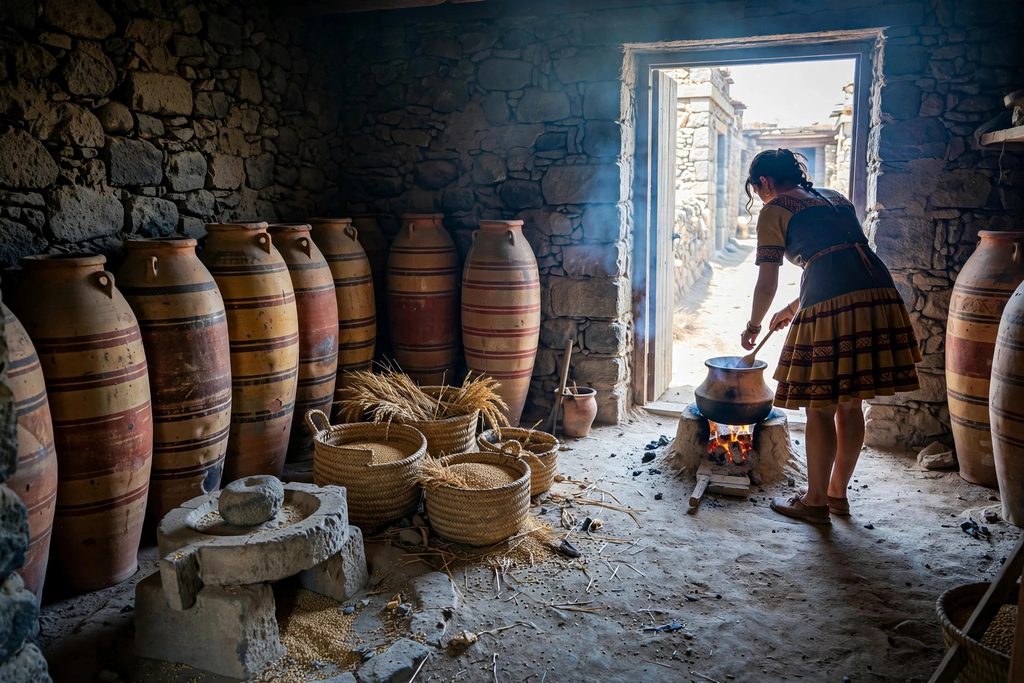
What the excavators found does not look like a modern kitchen. Ground floors held storerooms lined with large clay jars, the pithoi, and residues and remains show they held olive oil, wine, barley and pulses. There were stone mills and grinding installations, cooking pots on three legs that could stand straight in the embers, and clay hearths small enough to be carried. Cooking was done with equipment that moved, set down where the light and the air were right, rather than in one fixed room built around a stove.
Two principles are already visible, and they last for three and a half thousand years. Food was stored in the coolest, darkest part of the house, in thick-walled rooms where the stone kept an even temperature through the year, the same thermal logic that later shaped the Cycladic house. And the fire was kept where the smoke could escape, which in a world without chimneys usually meant near a door, under an opening or out in the open air.
Palaces were different. At Pylos, in the Mycenaean world of the same age, the great hall had a huge fixed hearth at its centre, a painted circle of clay several metres across, with clay chimney pipes above to carry the smoke through the roof. That hearth was not for everyday cooking. It was the symbolic centre of a kingdom, the place where the king feasted his guests and the gods received their share, and it points to the other life of the Greek fire.
The Hearth That Was a Goddess
The Greek word for hearth is hestia, and it is also the name of a goddess. Hestia has almost no myths, because she does not need them. She is the fire itself, the fixed point that makes a house a home, and a Homeric hymn says she receives the first and the last offering at every feast.
The household rituals of ancient Greece gathered around her. A few days after a birth, at the ceremony called the Amphidromia, the newborn was carried around the hearth and so received into the family. A bride was led to the hearth of her new home and showered with nuts and dried figs. A stranger who came as a suppliant sat down by the hearth in the ashes, as Odysseus does in the palace of the Phaeacians, and from that place he could not be refused. Modern Greek still uses the word estia for the home and the family centre.
So the Greek fire had two lives from the start. One was sacred and fixed, the hearth at the centre of the house. The other was practical and mobile, the cooking fire that went wherever the work was. The history of the Greek kitchen is the story of how those two fires moved through the house.
The Classical House Had No Kitchen
The best evidence for the classical Greek house comes from Olynthus in northern Greece, a city destroyed by Philip II of Macedon in 348 BC and never rebuilt. Its excavated neighbourhoods show blocks of houses built around an open courtyard, with the rooms opening off it. The first excavators labelled one room in many houses as the kitchen, because it had a flue or a light construction for letting out smoke.
Later study of where the cooking pots and fire equipment were actually found told a different story. Many houses had no single room for cooking at all. The finds were scattered through the courtyard and several rooms, and much of the equipment was portable. Greek households cooked over clay braziers called escharai, on cooking stands that held a pot over a small fire, in round-bellied pots called chytrai for boiling and in shallow lidded casseroles called lopades for fish and stews. Bread could be baked under a clay cover heaped with embers. A household could carry its whole kitchen out to the courtyard in summer and back under a roof in the rain.
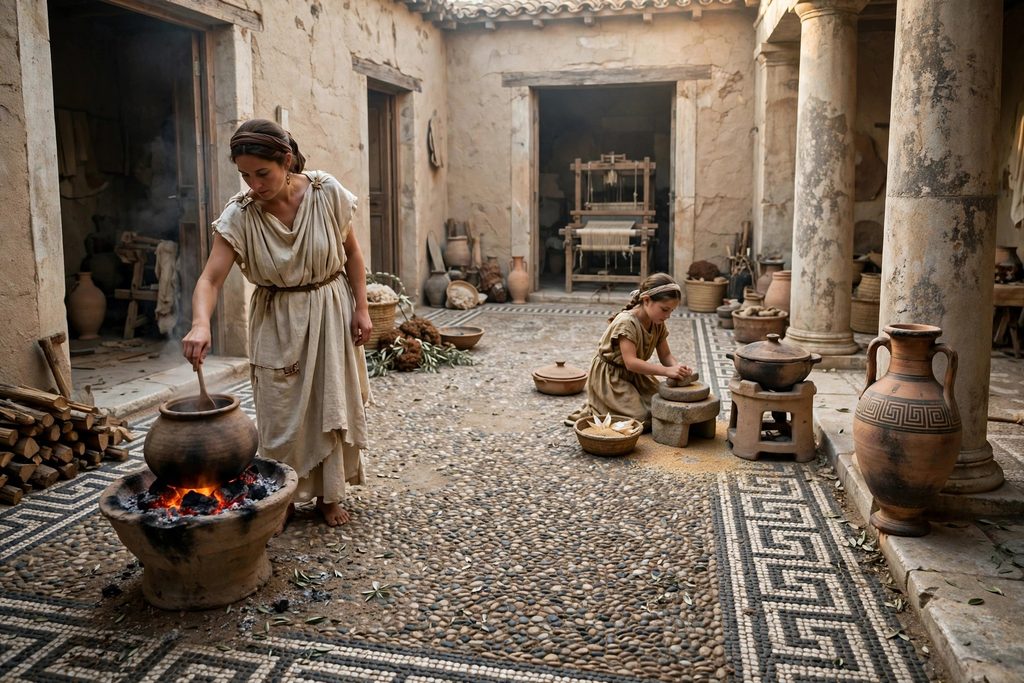
The courtyard was the centre of this life. Light came into the house through it, water was drawn there from cisterns or wells, and much of the daily work of a Greek household, from grinding grain to weaving to cooking, happened in its sun and shade. The kitchen was not a place. It was a set of portable tools and a habit of following the weather.
The Courtyard | An Outdoor Room
The same pattern runs through the village houses of the nineteenth and early twentieth centuries. The avli, the walled courtyard, was not mainly a garden. It was a working room without a roof. Its walls gave shade that moved with the sun, so a cook could knead dough in the morning shade by the east wall, spread tomatoes, figs and grapes to dry in full midday sun, and finish the cooking in the afternoon shadow of the west wall. Flat roofs and terraces became drying floors for trahanas, the soured grain that carried Greek households through winter, and for pulses and herbs.
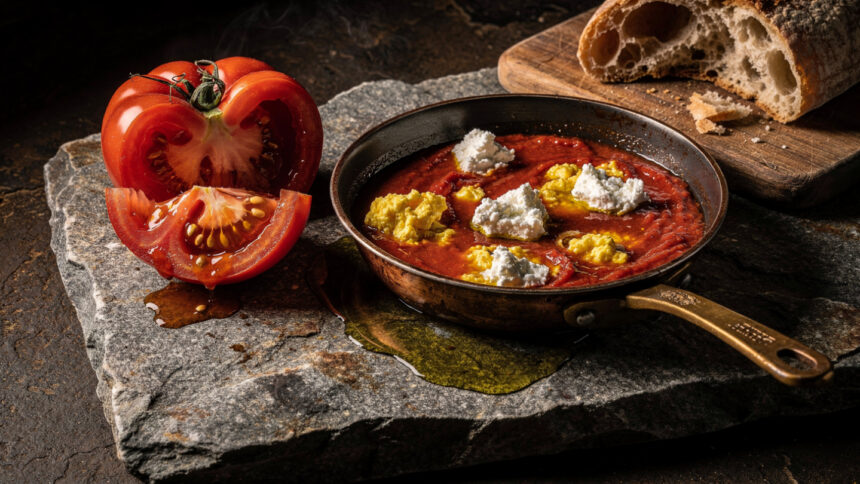
The fire in the courtyard was small and portable. Many households cooked on a mangali, a metal brazier filled with charcoal, which could be carried to wherever the shade was and also warmed the house in winter. On the islands, especially, cooks used the foufou, a portable clay charcoal stove with a pot rest on top and an opening below to feed the fire and draw the air. Both gave a low, steady heat that suited the dishes Greek cooking is built on. The ladera, vegetables and pulses cooked slowly in olive oil and tomato until the oil turns glossy and separates, were dishes for a fire that could be left alone for hours while the cook did other work.
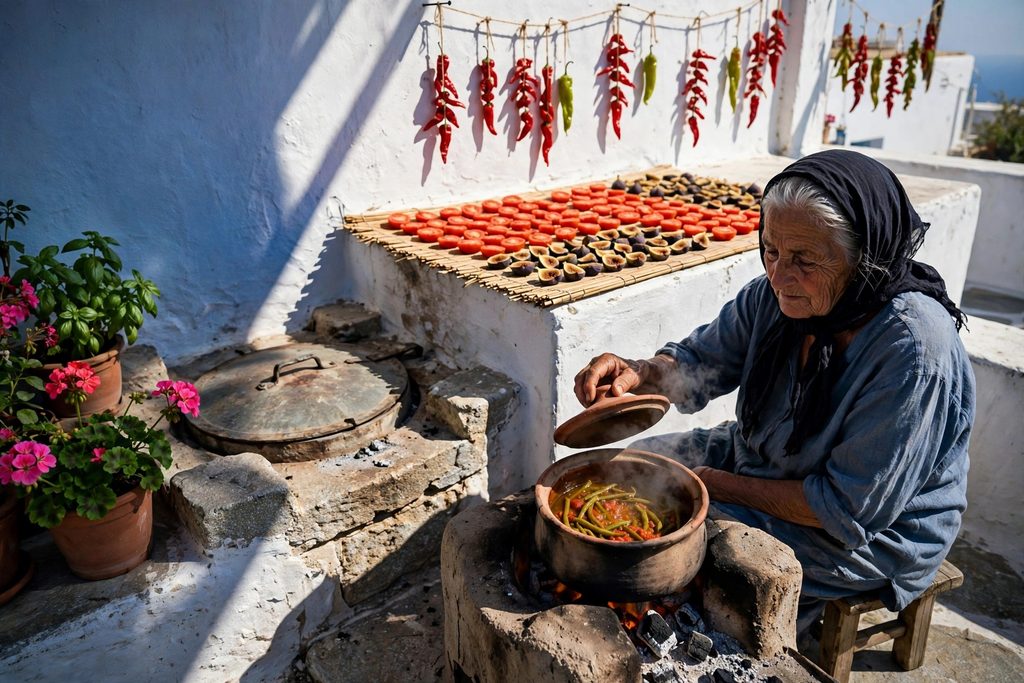
Water was the other half of the courtyard. In the dry islands the house’s roof and courtyard drained into a cistern, and the cook worked within a few steps of it. Storage stayed indoors, in the cool ground-floor rooms where jars of oil, olives, cheese in brine and barrels of wine sat in the dark, exactly as at Akrotiri.
The Fournos | The Oven at the Edge of the Village
A brazier cannot bake bread. For that, Greek villages relied on the fournos, the domed oven of stone or brick, built in the yard of a house or shared by a neighbourhood or a whole village. Firing one was a day’s work. The oven was packed with brushwood, vine prunings or olive wood and burned until the inside of the dome turned from black to white, which meant it was hot enough. Then the embers were raked out, the floor was swept with a wet mop of rags or branches, and the bread went in on a long wooden peel.
Because firing took so much fuel and labour, the heat was used in stages. Bread went in first, at the highest temperature. Then came the pans of meat and potatoes, the pies and the clay pots of beans that needed a long, falling heat. Last of all, as the oven cooled, slices of bread went in to dry into the hard rusks called paximadia, which kept for months, and figs or fruit were dried in the warmth that remained. Nothing was wasted. Greek baking has a long memory in these ovens, back to the dozens of breads the ancient Greeks named.
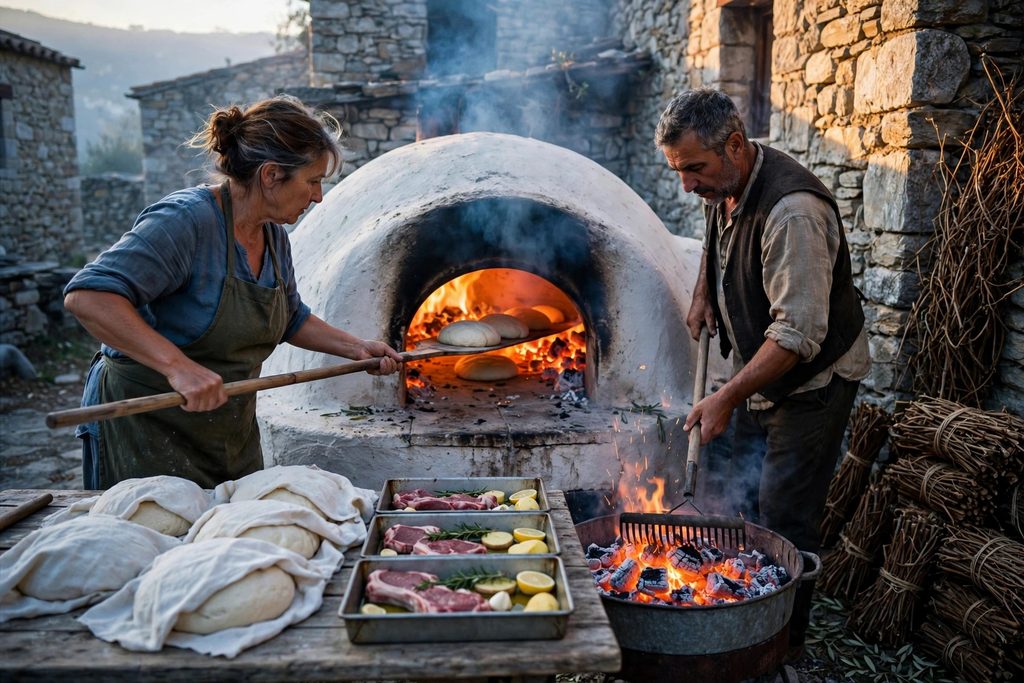
In towns the oven was the baker’s. Within living memory, families in Greek towns and neighbourhoods carried their own pans of lamb and potatoes, stuffed vegetables or pastitsio to the local bakery on Sundays and feast days, and the baker cooked them in the bread oven after the morning’s loaves. Each family scratched a mark on its pan, and at lunchtime the street filled with people carrying them home under cloths. On Sifnos, chickpeas for the Sunday revithada are still sealed in clay pots and left overnight in a cooling wood oven.
Some ovens worked for the economy rather than the table. On Skopelos, stone drying ovens in the yards of country houses turned the island’s plums into prunes for export, and their ruins still stand among the orchards. In Olympos on Karpathos, families have long shared the village’s wood-fired ovens, and some are still in use.
The last of those fires belongs to legend. Kleftiko, lamb cooked slowly in a sealed package or pot, takes its name from the klephts, the mountain outlaws and rebels of the Ottoman centuries. The usual story says they cooked their meat in pits sealed with earth so that no smoke would give away their hiding place. Whether or not it is true, it is a story about a Greek kitchen that had to live entirely outdoors.
Winter | The Fire Comes Inside
When the autumn rains came, the cooking moved indoors to the tzaki, the fireplace in the main room of the house. In the stone houses of the mountains, the room with the fire was where the family cooked, ate, worked and often slept through the winter. The stone walls, once warmed, held the heat long after the fire burned down, as the architecture of the Greek countryside was built to do.
Cooking at the hearth was its own craft. A copper cauldron hung from a hook and chain over the flames, and the cook adjusted the heat by raising or lowering it, or by raking the embers closer or further away. Pots of beans sat at the edge of the fire for hours. Potatoes and onions were buried in the hot ash, chestnuts were roasted in a pierced pan, and bread was toasted on the embers and rubbed with oil. In the mountain villages of the mainland, the gastra turned the hearth into an oven. A tray of meat or pie was set on the swept hearth floor, covered with a clay or iron dome and buried in embers, and left to bake.
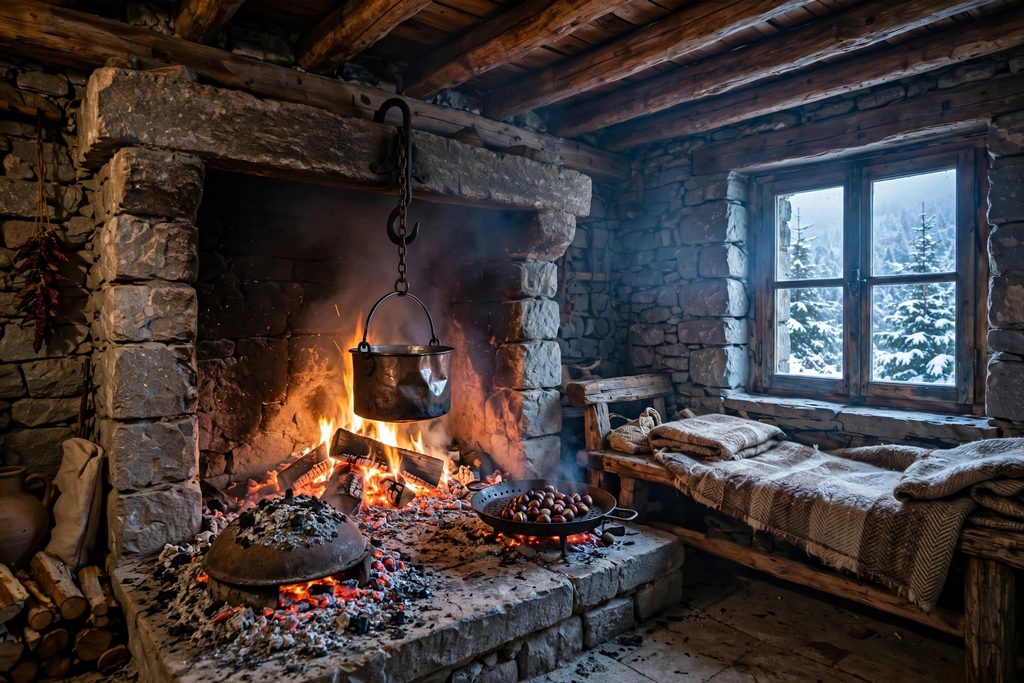
Hearth cooking tastes different, and not only because of memory. The heat is uneven and slow, the pot sits close to woodsmoke for hours, and the cook works by eye, smell and the sound of the pot rather than by a dial. The winter dishes of Greece, the bean soups, the trahanas, the greens braised with rice, the slow stews of meat and onion like stifado, grew up around that kind of fire.
The Table Under the Vine
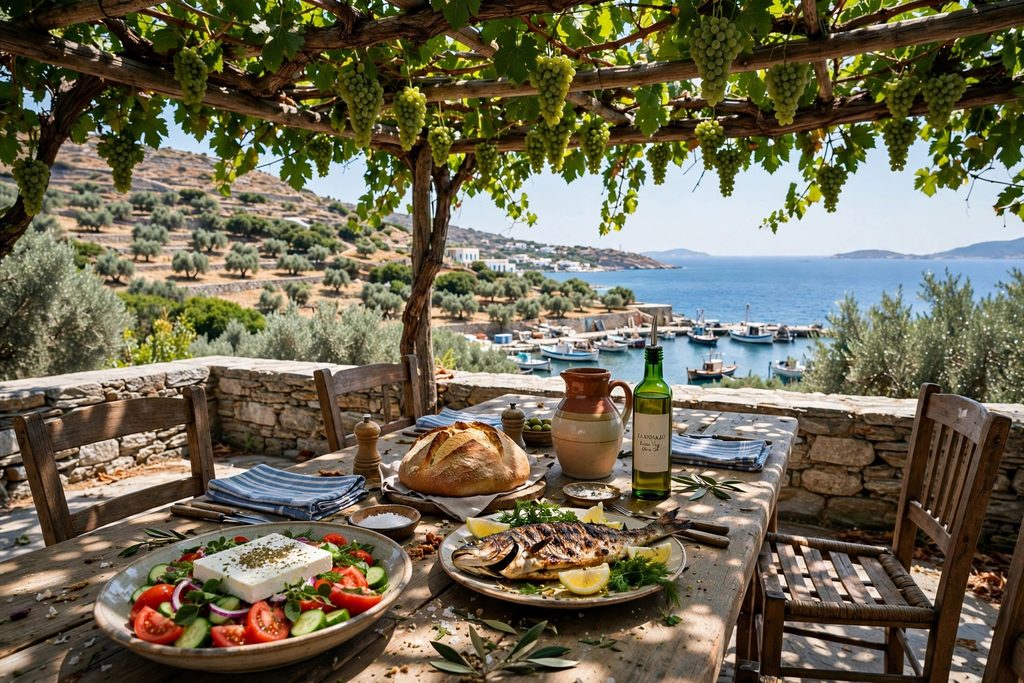
In summer the meal went back outside. Across Greece the summer table was set in the courtyard or on the terrace, very often under a vine trained over a wooden or iron frame, the klimataria. The vine is a piece of climate engineering. In summer its leaves give dense shade and its grapes hang over the table. In winter the leaves fall and let the low sun through to warm the walls of the house.
The food on that table came from within sight of it. Tomatoes from the garden by the wall, fish landed that morning at the harbour below, bread from the last firing of the oven, olive oil pressed from the family’s own trees in the winter. The Greek salad is the plainest example, a dish that is little more than the summer garden, the cheese from the cool storeroom and the oil from the jar, assembled in the open air. It makes sense only where the kitchen and the landscape are the same place.
How the Fire Moved Indoors
For three and a half thousand years the basic pattern held. Then, within roughly two generations, it changed completely.
The first change was the smokeless flame. In the early twentieth century the pressurised kerosene stove reached Greek towns and villages, a small portable burner that cooked fast and needed no chimney. A fire that makes no smoke does not have to sit by a door or under an opening, and for the first time the cooking could move freely inside.
Electricity finished the job. The national power company was founded in 1950, and over the following decades it carried electricity into the villages. The refrigerator replaced the cool storeroom, the electric cooker replaced the hearth, and the bakery replaced the household oven. In the same years Greeks moved from the countryside to the cities in huge numbers, into the apartment blocks, the polykatoikies, that now cover Athens and Thessaloniki. Their kitchens were closed rooms on the model of the rest of Europe, often with a narrow balcony where the courtyard used to be.
Something was gained. Cooking became faster, cleaner and far less dependent on fuel and labour, and the hours that women had spent tending fires were freed. Something was lost as well. The apartment kitchen can make every Greek dish, but it makes them without the wood oven’s falling heat, without the long afternoon at the brazier, and without the courtyard where the work and the weather were part of the same day.
Where the Traditional Greek Kitchen Survives
The old kitchen has not gone. It has retreated to the places and the days that matter most.
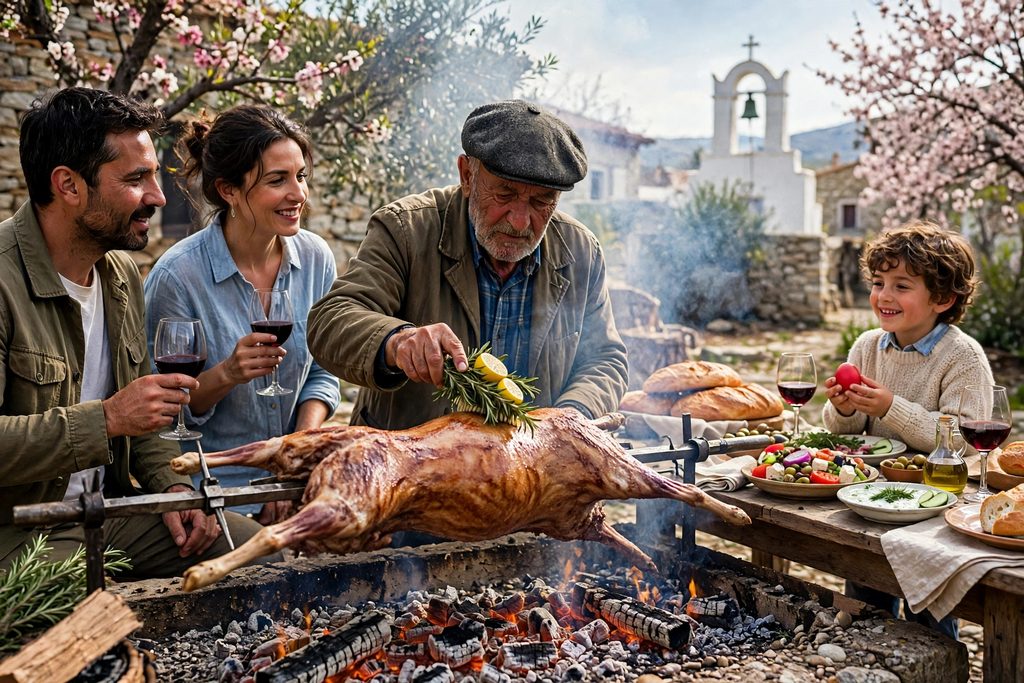
It survives once a year in almost every Greek family, on Easter Sunday, when the lamb turns on a spit over a bed of coals in the yard, the garden or the apartment car park, and the whole family gathers around an outdoor fire from morning until afternoon. It survives in the villages where the communal oven is still fired for festivals and saints’ days, and in the summer kitchens that many village houses keep beside the courtyard, with a wood oven, a sink and a table under the vine. It survives in tavernas whose kitchens open straight onto the terrace, where the smell of the wood oven reaches the table before the food does.
It also survives as a set of lessons for anyone building or restoring a house in Greece. Put the cooking where the air moves. Keep the stores in the coolest, thickest-walled room. Plant a vine over the table for summer shade and winter sun. Build a wood oven in the yard, and fire it for more than one thing at a time. The traditional Greek kitchen was never a matter of nostalgia. It was a practical answer to a hot, dry, windy climate, worked out over thousands of years, and the answer still works.
Between the Hearth and the Open Air
The Greek kitchen lived in two places at once. One was the hearth, sacred, fixed and named for a goddess, where the family gathered in winter and every guest was received. The other was the open air, where a portable fire followed the shade across a courtyard and a stone oven at the edge of the village baked bread for everyone. Greek food was made in the passage between them.
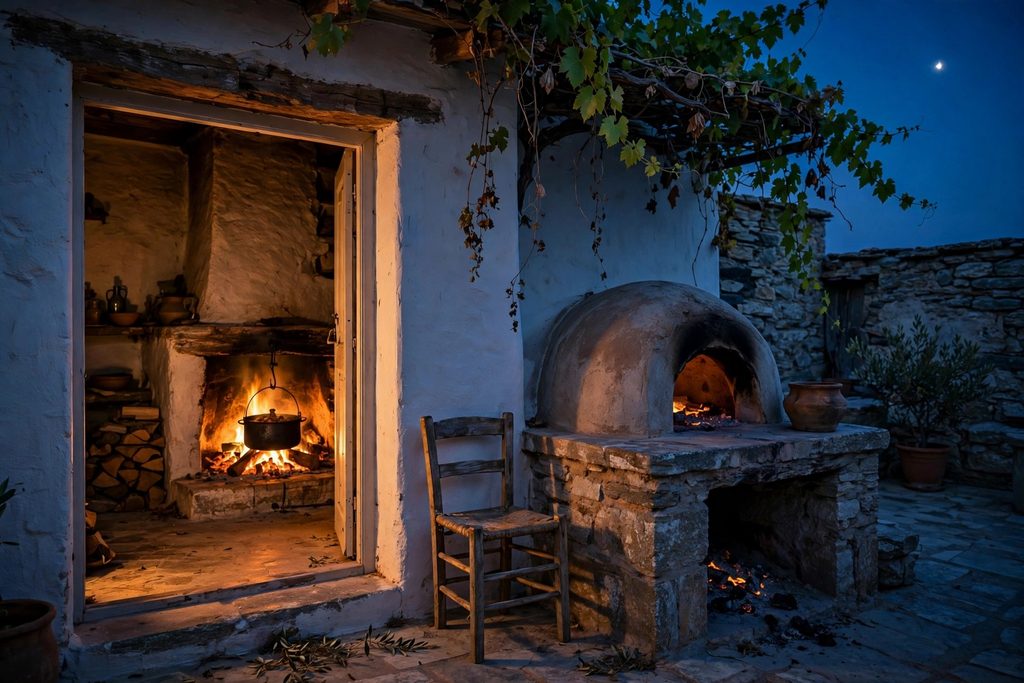
That is why so much of it still tastes best outdoors. A slow pot of beans, a loaf from a wood oven or a plate of tomatoes under a vine carries the conditions it was made in. The architecture of the Greek house was never just the setting for the cooking. It was one of the ingredients.
At Olympus Estate, Architecture and Restoration explores how Greeks built with their climate and how those lessons serve anyone living in a Greek house today. The traditional Greek kitchen was rarely a single room. At Akrotiri on Santorini, buried by the Thera eruption about 3,600 years ago, cooks used tripod pots and portable clay hearths and stored oil, wine, barley and pulses in pithoi in cool ground-floor rooms, while the Mycenaean palace at Pylos kept a great fixed hearth with clay chimney pipes. The hearth, hestia, was also a goddess, honoured at the Amphidromia, at weddings and by suppliants. At Olynthus, destroyed in 348 BC, many courtyard houses had no fixed kitchen, and families cooked on portable braziers and stands with chytrai and lopades. Village houses kept the same logic, with the courtyard as an outdoor room, the mangali and the clay foufou following the shade, and the domed fournos fired for bread, then pies and roasts, then paximadia, while town families sent their pans to the baker and Sifnos still bakes revithada overnight in clay. Winter brought the cooking to the tzaki and the gastra, summer took the table out under the vine, and the kerosene stove, rural electrification after 1950 and the apartment block finally moved the fire indoors. The old kitchen survives at the Easter spit, in village ovens and in houses built with the same practical sense.