


Every civilisation answers the same question when it builds: are you building on the land or with it?
The answer is visible in the result. Architecture that treats the land as a surface to be covered produces one kind of place. Architecture that treats the land as a collaborator produces something entirely different: buildings that carry the colour and the texture and the thermal logic of the geology they stand on, villages whose streets follow the logic of the hillside rather than imposing a grid on it, farms whose terraced fields are the landscape reading its own topography and offering it back in a form that produces grain and olives and wine.
Greek rural architecture is the most sustained answer to this question available in the European built environment. It spans a thousand years of continuous development across a geography so varied, from the high limestone mountains of Epirus to the volcanic islands of the Aegean to the semi-arid plains of the Peloponnese, that each region developed its own architectural vocabulary. What unites them is not a shared aesthetic or a shared building code. It is a shared approach: the understanding that the land is not raw material to be processed but a living system to be entered, read, and built within.
This article moves through the primary regional traditions of Greek rural architecture: what each one built, why it built that way, and what the building tells us about the relationship between the people and the landscape that produced it.
The Logic Behind the Regional Variety
Before the regional traditions, the principle deserves its full description, because it is what makes the variety coherent rather than simply diverse.
Greek vernacular architecture, in every region where it developed without significant external stylistic influence, is built from the material immediately available at the site. This is not simply a practical observation about the economics of pre-industrial building. It is a statement about the relationship between the built object and its ground: a house made from the limestone of the hillside it sits on does not stand apart from the landscape. It is a continuation of the landscape, shaped by human hands into habitable form, but constituted by the same substance as the ground it rests on.
The thermal properties of the building material, which in the Greek rural tradition is almost always stone of some variety, are inseparable from this geological continuity. Stone walls accumulate heat slowly and release it slowly: in the hot Mediterranean summer, the thermal mass of a stone wall absorbs the day’s heat and prevents it from penetrating the interior until the evening, when the occupants open the shutters and the cooler night air enters. In the cold mountain winters of Epirus and Macedonia, the same thermal mass, once warmed by the hearth, radiates heat back into the living space for hours after the fire has gone out.
The Greeks did not design this system. They discovered it, by living in stone buildings in a climate for centuries, and they perpetuated it through the transmission of building knowledge from master builders to apprentices across generations.
The boulouki, the travelling guilds of Epirus master masons whose work we examined in the Zagori article, carried this accumulated knowledge across the Greek-speaking world. They built in Macedonia and in Constantinople and in Bucharest, but what they built in each location reflected the geology and the climate of that location rather than a portable style applied regardless of context.
This is the principle that unifies the regional variety: each tradition is a solution to the problem of building in a place, and the solution always begins with listening to what the place provides.
Zagori and Epirus | When Stone Became Architecture
The vernacular architecture of the Zagori villages in Epirus, which we have written about at length in this site’s property and travel coverage, represents the most complete surviving expression of the boulouki tradition: the stone building system taken to its highest level of refinement.
The defining characteristic of Zagori construction is the complete coherence between material, structure, and climate. The local grey limestone produces walls of dry‑set masonry that in the best examples are laid with a precision that requires no mortar. The stones are shaped to fit each other so accurately that the stability of the wall derives from the geometry of their relationship rather than from any adhesive. This precision is not decorative. It is structural. A dry‑set wall that is correctly laid is more durable than a mortared wall because it can absorb the seasonal movement of the ground below it without cracking.
The slate roofs of the Zagori mansions are the most immediately recognizable element of the architectural heritage: overlapping courses of the local schist, each tile fixed in place by its own weight and the friction of the course below it, producing a surface of extraordinary durability that sheds the heavy winter snowfall of the Pindus mountains while absorbing and releasing the summer heat in the manner the thermal mass argument describes.
The interior of a Zagori mansion carries the full social program of a mountain community’s domestic life. The ground floor was traditionally dedicated to animals and storage, the thermal contribution of the livestock providing additional warmth to the floors above in winter. The main living spaces occupied the upper floors, their ceilings carried on carved wooden beams and their walls lined with built-in storage of the kind that reflects a way of life in which the house contained everything the family needed through a winter that could close the mountain passes for months.
The odiakia, the reception room of a Zagori mansion, is the most socially significant space in the building: the room where guests were received, where the family’s status was communicated through the quality of the carpets, the carved wooden ceiling, and the built-in seating that lined the walls in the Ottoman heritage. The room where hospitality was performed. In the Zagori, the architectural quality of the odiakia was the measure of the family’s achievement, which is why the mansions of returning emigrants from Vienna and Odessa produced odiakia whose craftsmanship rivals anything being produced in the capitals of the Enlightenment world at the same period.
The Cyclades | When White Was a Climate Strategy
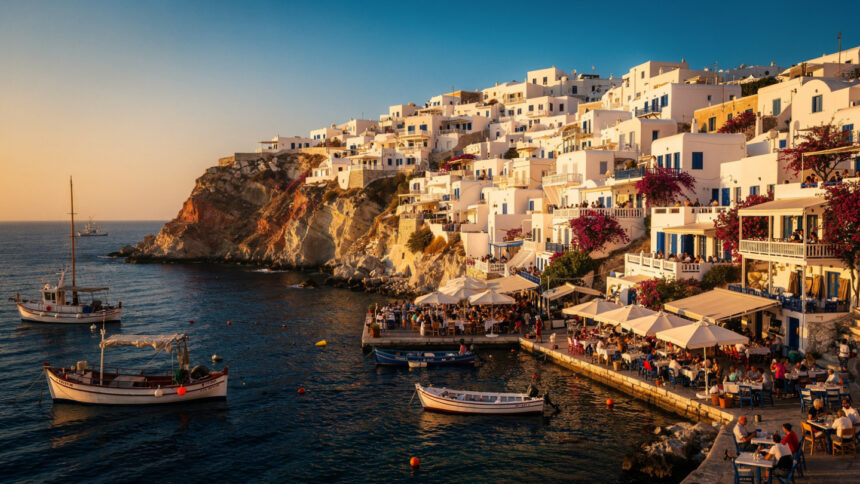
The white architecture of the Cycladic islands is so thoroughly reproduced as a visual symbol of Greece that it has become impossible to see it freshly. Every travel platform, every airline advertisement, every social media account devoted to Greek travel returns to the same image: white cubic forms, blue domes, the Aegean shining below.
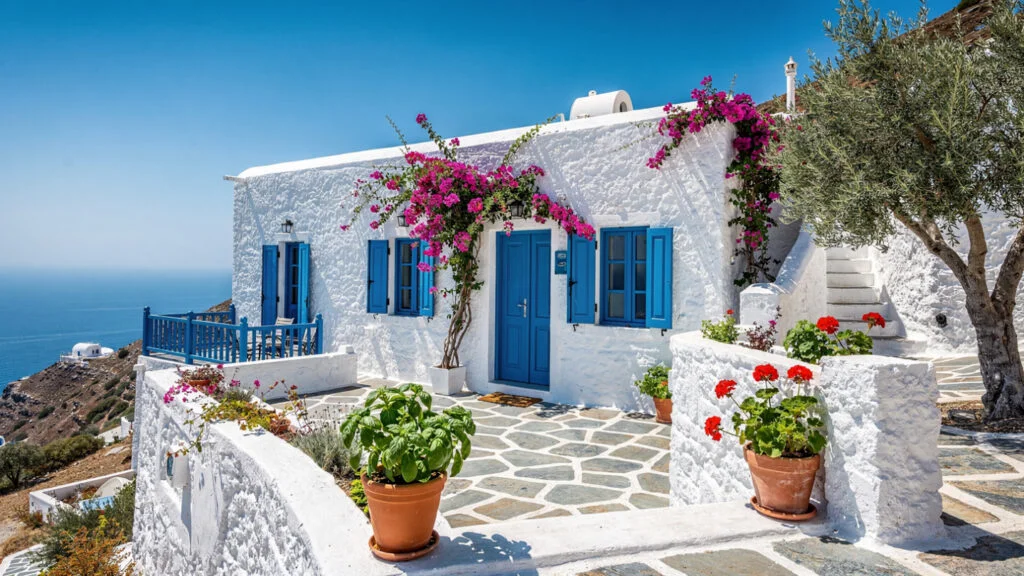
The image is real. What is missing from it is the explanation of why the architecture is this way, which is considerably more interesting than the aesthetics alone.
The volcanic geology of the Cyclades, most dramatically expressed in Santorini but present across the island group in various forms, produces building material of thermal properties. The pumice and volcanic stone of the Cyclades are lighter and more porous than the limestone of the mainland mountain traditions, and the architecture that uses them reflects this: thicker walls for the same structural load, which means greater thermal mass, combined with the lime whitewash that covers the exterior surfaces.
The lime whitewash is not decorative. It is functional in multiple simultaneous ways. It reflects the direct solar radiation of the Aegean summer, reducing the heat load on the wall surface. It is antifungal and antibacterial, which in a maritime climate subject to the moisture of sea air and the condensation of night temperatures is a significant practical benefit. It is also self-renewing: traditional lime whitewash is applied fresh each spring, and the annual reapplication maintains both the optical and the protective functions simultaneously.
The blue of the shutters and the domes, which is less universal in the actual islands than in the photographs of them, has a practical dimension as well: copper sulphate, which produced the blue pigment used in traditional Cycladic paints, is a fungicide and an insect repellent. The colour was chosen for its optical qualities and it worked for reasons that the people who chose it may not have consciously understood but that centuries of use confirmed.
The interior of a traditional Cycladic house is the inversion of its exterior: where the outside is white and bright and highly reflective, the inside is dim, cool, and thick-walled. The small windows that the island architecture uses, scaled for ventilation rather than view, prevent the direct sunlight of the summer Aegean from penetrating the interior while allowing the cooler night air to flush through. The house operates as a passive cooling system whose principles are identical to those that modern sustainable architecture has rediscovered and is now implementing with considerably more technological complexity.
The interiors tell their own stories. Wooden beams hand-carved by artisans, stone hearths passed down through families, and built-in beds (krevatos) all reflect a style of living intimately connected to the land. Each home, with its modest footprint and thoughtful design, mirrors the Greek ethos: simplicity, functionality, and beauty in balance.
Mani | The Tower as a Moral Argument
We have written about the Mani peninsula and its tower house tradition in the travel article dedicated to this extraordinary landscape, but the architecture deserves a more systematic analysis in the context of a broader account of Greek rural building.
The Mani tower is the most uncompromising building type in the Greek vernacular tradition: a structure whose form is entirely determined by its defensive function, in which the aesthetic qualities, and there are genuine aesthetic qualities, are the byproduct of military logic rather than its modification.
The towers were built tall because height is a tactical advantage in the conflict for which they were designed: the intrafamilial blood feud that structured Mani social life for two centuries. A family in a taller tower could fire down into the courtyard of a shorter one. The accumulation of towers in a Mani village, each family extending upward as its rivals extended upward, produced the jagged skyline that defines the landscape of the Deep Mani and that reads, from a distance, as an urban profile rather than a village one.

The construction of the towers is massive limestone masonry, the walls at their base often exceeding a metre in thickness, producing a thermal mass so substantial that the interiors are cool in summer and relatively easy to heat in winter. The narrow window slits positioned for firing rather than light and ventilation make the lower floors of a Mani tower genuinely dark: buildings designed for siege conditions rather than comfortable habitation.
What the tower houses teach about the relationship between social organisation and architectural form is precise and not reducible to the observation that conflict produces defensive buildings. The form of the Mani tower reflects the form of the Mani conflict: vertical, prolonged, conducted between fixed positions in close proximity. A different kind of conflict would have produced a different building. The Mani tower is the social logic of the feud made permanent in stone, and the fact that it is also, in the right light, beautiful, is the architecture telling you something about the relationship between intensity of purpose and aesthetic force that holds across building traditions much wider than this one.
Farms often include courtyards enclosed by low walls, not only for practical uses—such as separating livestock—but also as communal spaces for harvest festivals or family gatherings. Here, one can imagine echoes of rural Dionysian rites, where villagers danced under moonlit skies to honor the cycle of seasons.
Crete | The Mitata and the Vertical Farm
The architecture of rural Crete spans the full range from the grand stone mansions of the Venetian-Ottoman hybrid tradition in Chania and Rethymno, which we have covered in the Crete article, to the most ancient surviving building type in the Greek landscape: the mitata.
The mitata are circular dry-stone shepherd huts found in the high mountain pastures of the White Mountains and the Psiloritis range: corbelled structures whose domed interiors are achieved by the same technique described in the Karpathos article’s account of the Saracen domes on Saria, each course of stone leaning progressively inward until the opening narrows to a capstone. The mitata require no mortar, no tools beyond what could be carried on foot, and no skills that cannot be transmitted by direct demonstration and practice.
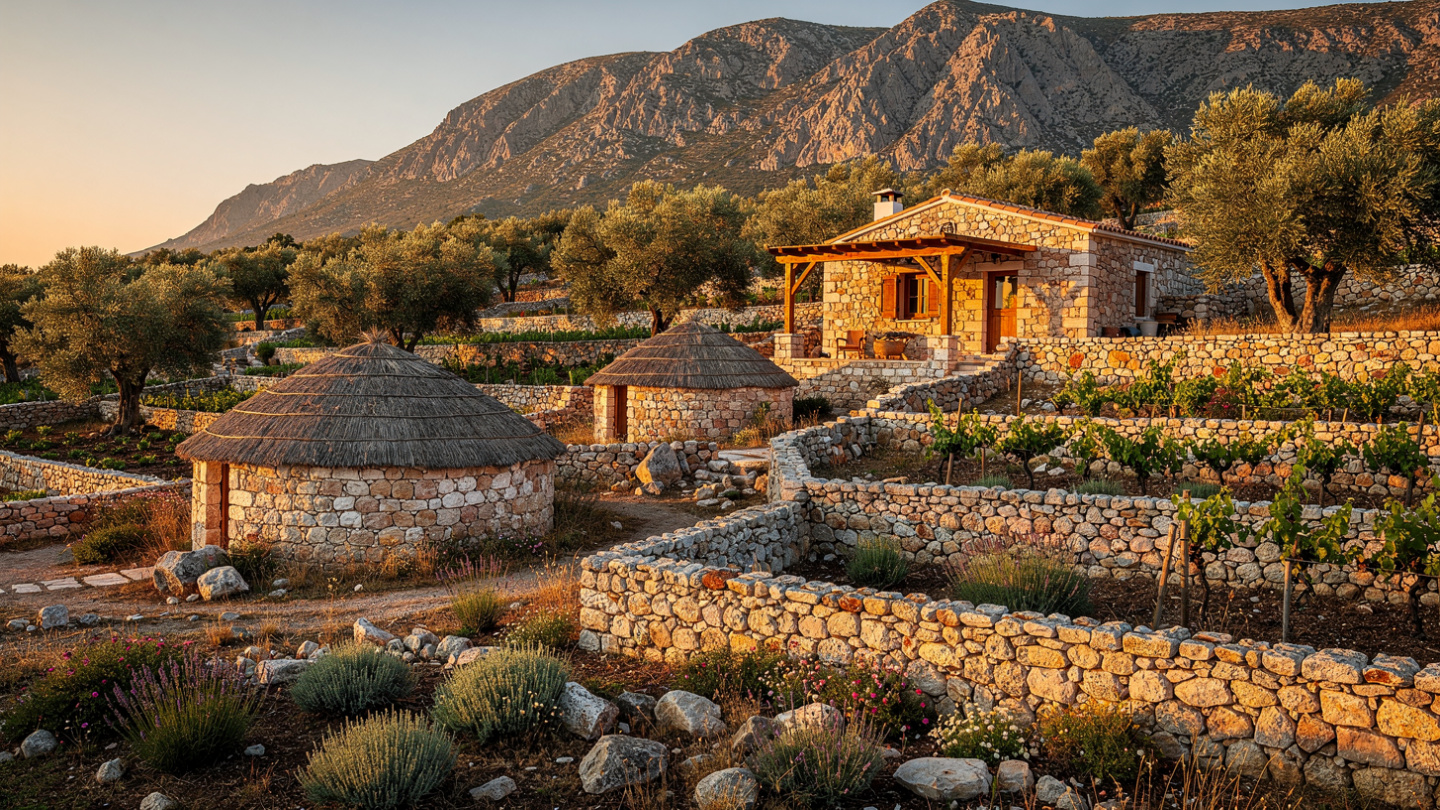
They are among the oldest continuously used building types in Europe. The technique of corbelled dry-stone construction documented in Minoan-era structures on Crete is the same technique used in mitata built by shepherds within living memory. The continuity is not archaism or conscious preservation: it is the persistence of a solution that is correct for its problem, which is how to build a shelter at altitude from the material available on a limestone mountain with no access to timber and no means of transporting heavy materials.
The Cretan farmhouse heritage proper, in the agricultural lowlands and the foothills, is characterized by the courtyard organization that reflects both the Venetian estate heritage and the older Minoan preference for the central court as the organizing principle of domestic space. The courtyard is simultaneously a practical space for the processing of agricultural produce, a secure enclosure for animals, a social space for the family and community activities that do not belong inside the house, and a thermal regulator: the orientation of the courtyard walls and the shade of the pergola that typically covers part of it provide the combination of sunlight and shadow that the Mediterranean summer requires.
Pelion | Where the Forest Made the Difference
The Pelion Peninsula on the eastern coast of Thessaly is the one major region of mainland Greece where the vernacular architectural heritage is significantly shaped by the availability of timber rather than being exclusively stone-based, and the result is architecturally distinct from every other heritage in the country.
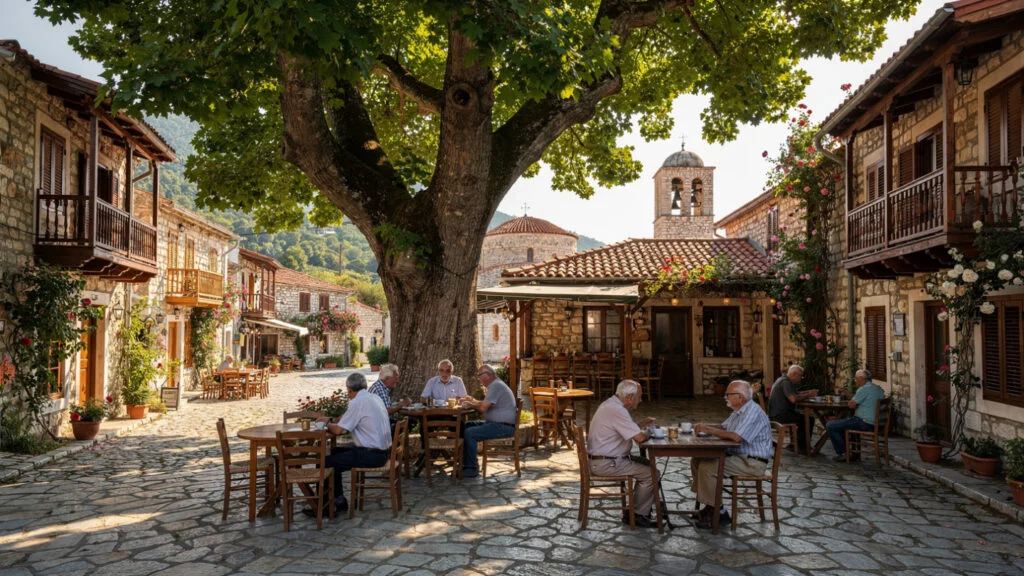
The forests of Pelion, the densely wooded mountain that rises above the Pagasetic Gulf and the Aegean coast, provided the timber for a building heritage that combined stone foundations and lower walls with timber-framed upper floors and the characteristic wooden balconies that project over the narrow lanes of the Pelion villages. The balconies are not decorative appendages. They are the primary summer living space of the house: sheltered from direct sun by their overhanging eaves, open to the mountain breeze, and used for the drying of produce and the processing of the harvest as much as for the sitting-out of evenings.
The intricately carved woodwork on the balcony supports, the window frames, and the door surrounds of the Pelion mansions is the regional equivalent of the carved stone detailing of the Zagori heritage: the application of craft skill to the material that the landscape provides, producing an aesthetic that is unique to this place and could not be replicated in a landscape without the forests that produced it.
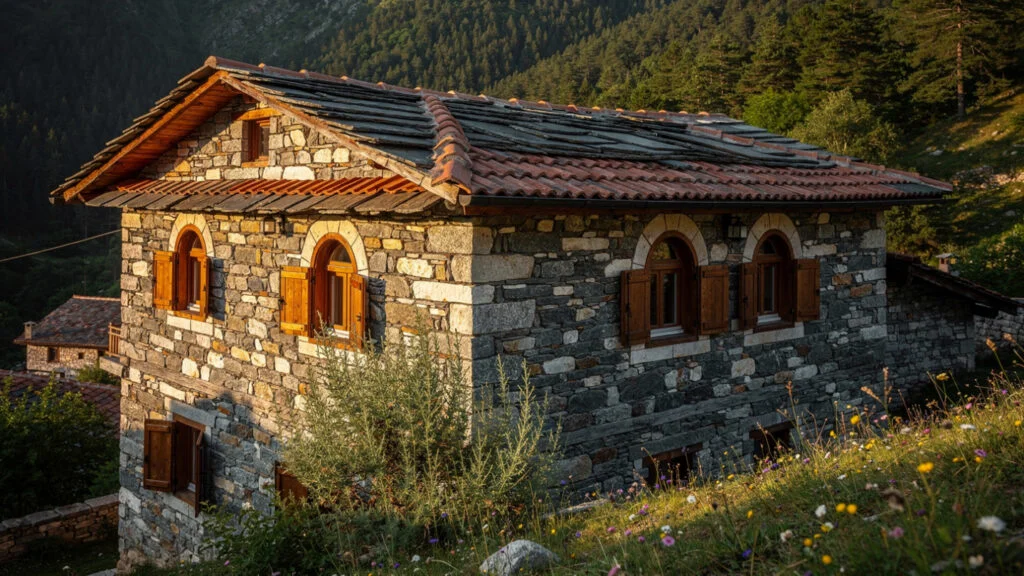
The villages of Makrinitsa, Vizitsa, and Vyzitsa, clinging to the upper slopes of the mountain above Volos, are the most complete surviving expressions of this tradition: cobbled paths connecting stone-paved squares where plane trees four centuries old provide the shade, and the mansions above the squares display the full vocabulary of the Pelion timber-and-stone combination at the scale of a complete village rather than an individual building.
The Farm as a Complete System
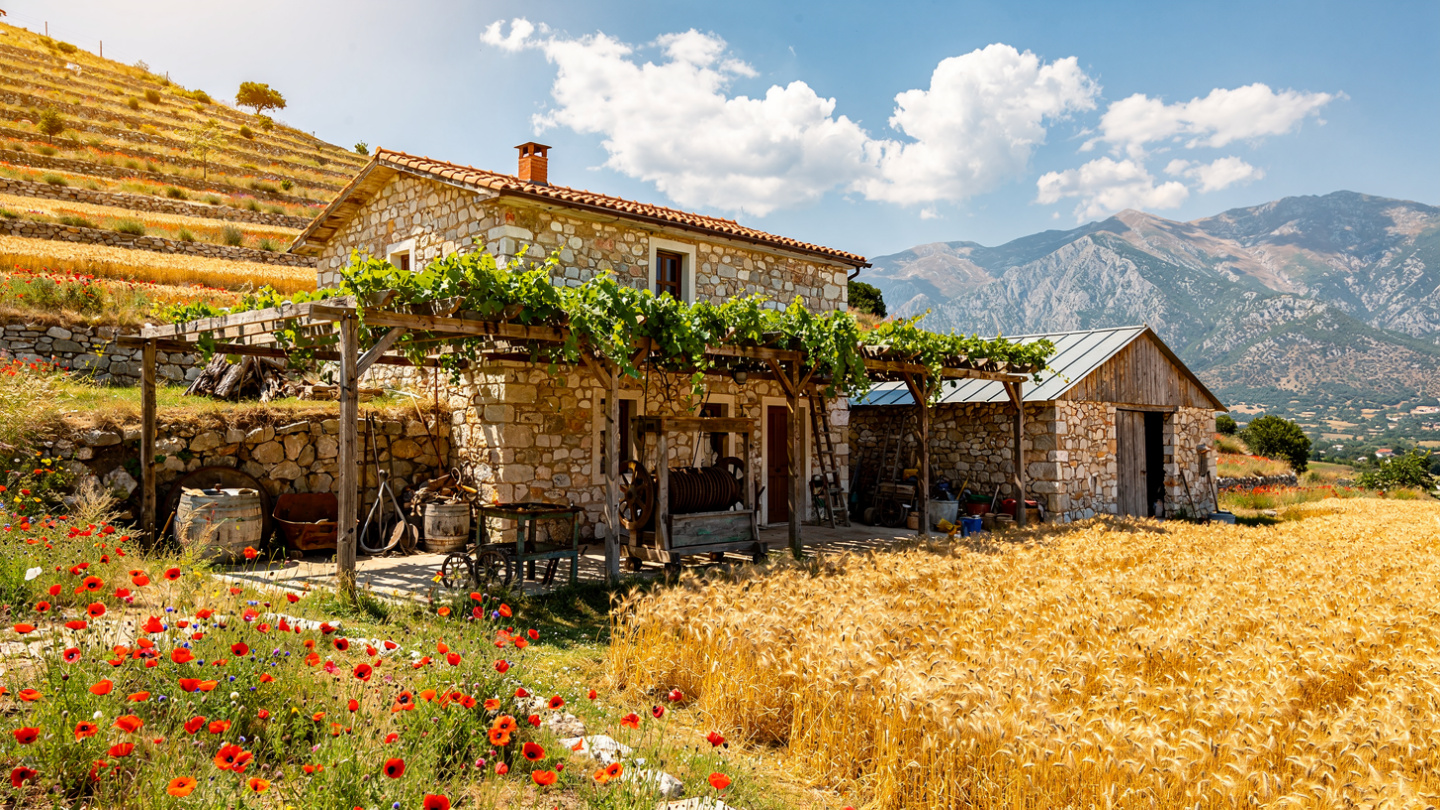
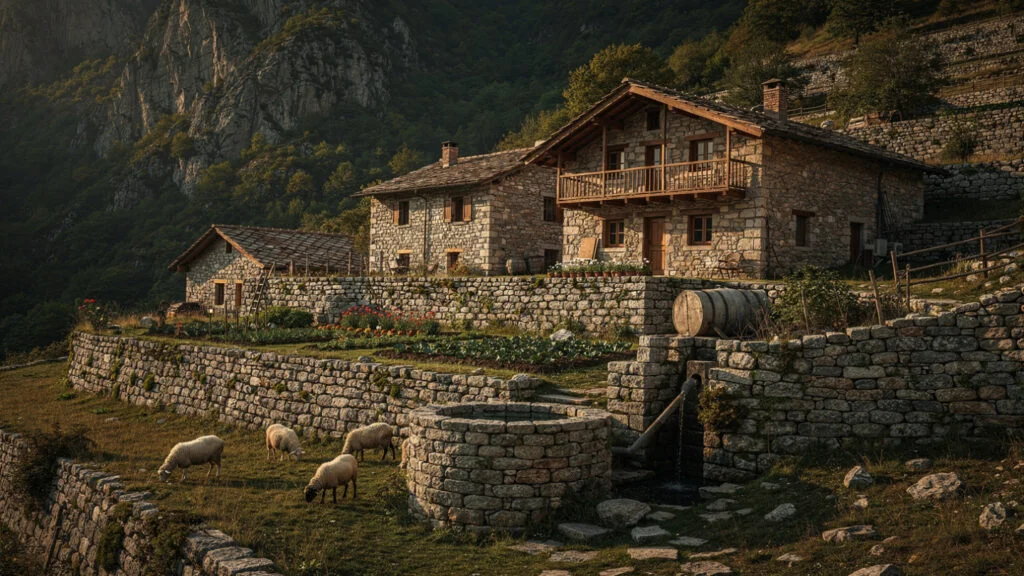
The Greek rural farm, wherever it occurs in the country’s varied geography, operates as a complete system: the farmhouse, the outbuildings, the terraced fields, the water management, and the garden constitute a single integrated design whose parts are inseparable from each other.
The terracing that characterises the agricultural landscape of the Greek islands and the mainland hillsides is the most immediately visible expression of this integrated approach. A terraced hillside is not a farm with walls added. It is a geological intervention: the creation of level ground from sloped ground, using the stone that the creation of level ground produces, in a single act of labour that simultaneously addresses soil erosion, water retention, and the creation of cultivable area. The walls hold the soil. The soil holds the water. The water grows the crops. The crops feed the family. The family maintains the walls.
This self-reinforcing system is the material expression of the Greek understanding of the relationship between human settlement and land management that the mythology encodes in the figure of Demeter: the goddess does not simply provide the harvest. She teaches the humans who work with her how to cultivate the conditions that the harvest requires. The terraced hillside is not nature improved by human intervention. It is human intelligence applied to the problem that nature presents in a limestone landscape with significant rainfall.
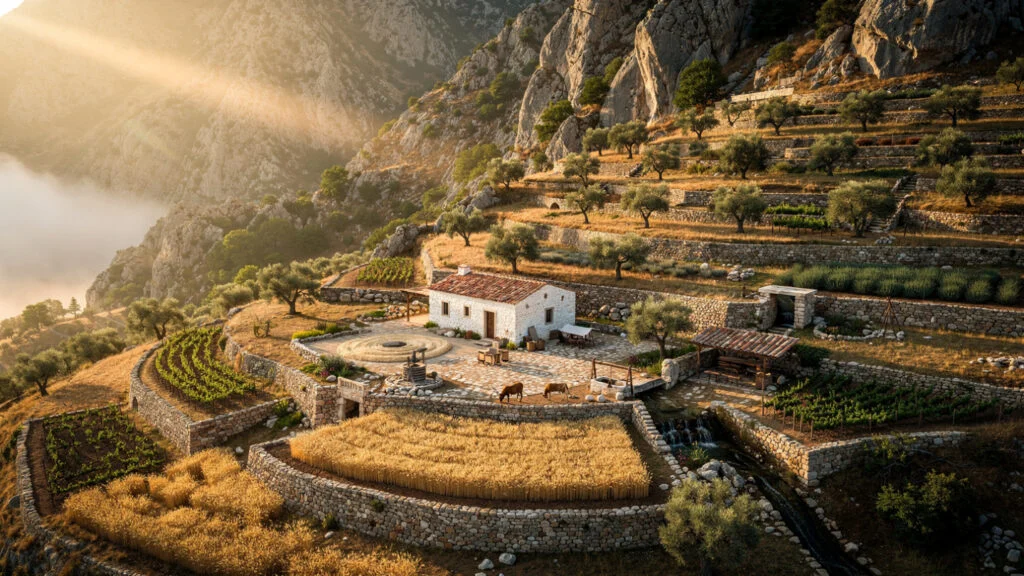
The water management systems of traditional Greek farms, the cisterns, the diversion channels, the mill streams, the irrigation sequences, are invisible in the landscape to a visitor who does not know to look for them, but they are as architecturally significant as the buildings they support. A farm without its water management is an incomplete design. The complete design includes everything between the spring at the top of the hillside and the olive press at its foot.
What the Buildings Are Saying
The argument that runs through all of these regional traditions is the same argument expressed in different vocabularies: that the appropriate human relationship to the land is one of attentiveness and collaboration rather than domination and extraction.
The Zagori mason who spent decades learning to read the limestone of the Pindus and to lay it in walls whose stability required no mortar was developing a knowledge of the material so intimate that the distinction between understanding the stone and using the stone collapsed. The Cycladic builder who chose the wall thickness and the window size in accordance with the thermal logic of a volcanic island in an Aegean microclimate was practising a form of climate intelligence so precise that the buildings it produced require almost no mechanical assistance to remain comfortable across a range of seasonal conditions that includes extremes of heat and cold.
The Cretan shepherd who built a mitata in the mountains using the same technique that Minoan-era builders used four thousand years earlier was not being conservative. He was being correct: the technique is correct for the problem, and the problem has not changed, and the correct solution to an unchanged problem is the same solution that was correct before.
This continuity between ancient practice and contemporary use, this persistence of building wisdom through the transmission of tacit knowledge from builder to apprentice across generations, is the most significant cultural achievement of Greek rural architecture. It is also, in the context of a twenty-first century that is urgently rediscovering the value of passive climate management and local material sourcing and the integration of built form with ecological systems, the most immediately relevant.
The Greek countryside has been building sustainably for three thousand years. Not because it was trying to be sustainable. Because it was paying attention.
They Deserve More Than to Be Admired
The stone that forms the wall of a Zagori mansion is the same stone as the mountain behind it. The white of a Cycladic house is the reflection of the same sunlight that ripens the grapes in the terrace below it. The corbelled dome of a Cretan mitata is shaped by the same geometry that the mountain’s own geology uses to form its cave systems.
Greek rural architecture does not stand apart from its landscape and comment on it. It is part of the landscape, shaped by human intelligence and human need from the materials and in response to the conditions that the landscape provides. To walk through a Zagori village, or to look up at the tower houses of the Mani from the road below, or to stand in the courtyard of a Pelion mansion with the mountain above you and the sea below, is to be inside a design that the landscape and the human settlement worked out together over centuries.
The buildings are the most complete surviving record of that collaboration.
They deserve more than to be admired from a distance as picturesque.
They deserve to be understood.
At Olympus Estate, Property Pantheon examines the built environment of Greece through the lens of heritage, material intelligence, and the long relationship between Greek builders and the landscapes they worked within. This article traces the governing logic of rural Greek architecture — stone from local quarries, orientation toward prevailing winds, thermal mass against the Mediterranean summer — as a continuous tradition running from the Bronze Age farmstead to the surviving vernacular villages of the Peloponnese and the Aegean islands.