




The Greeks did not cut their clothes.
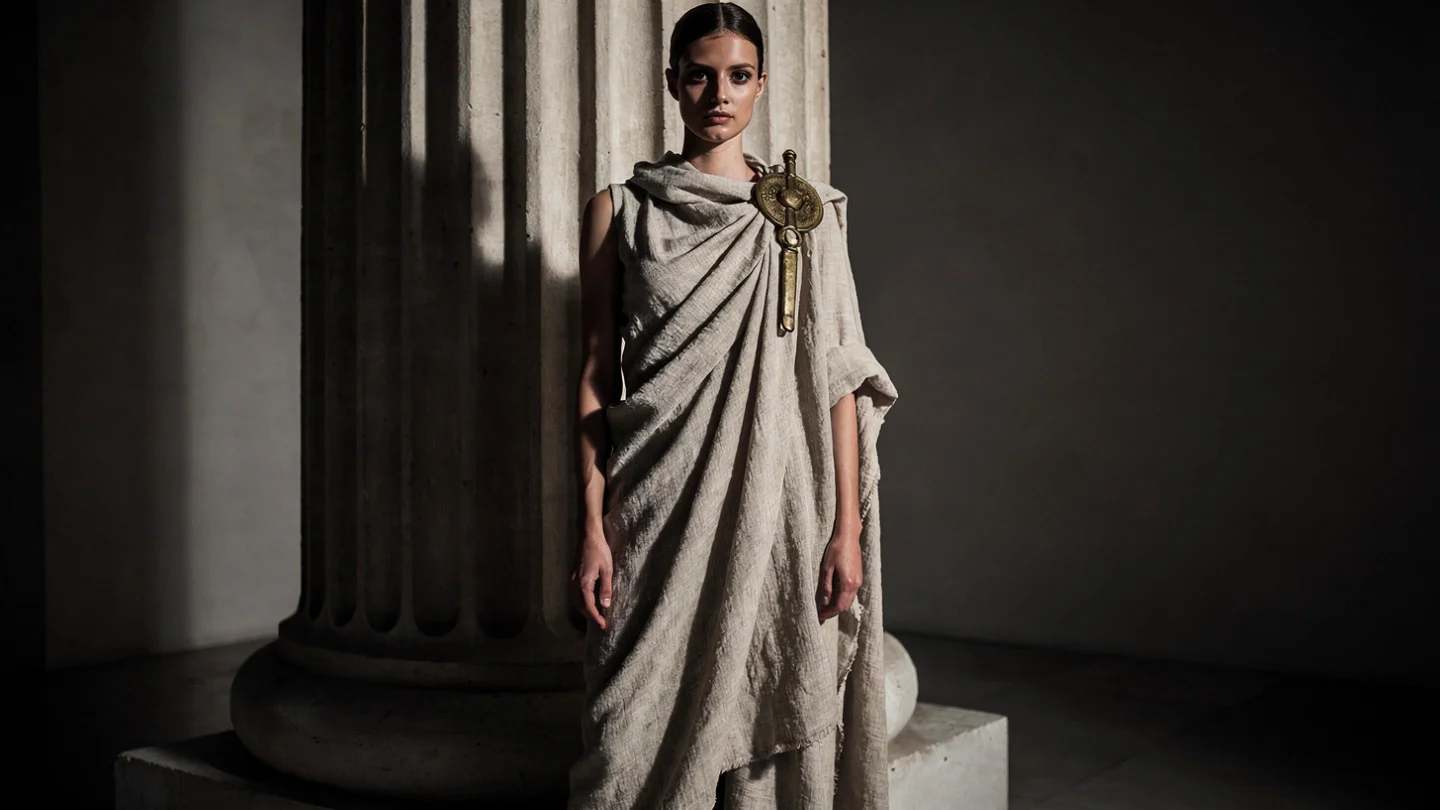
This single fact is the one modern engagement with Greek clothing most consistently underestimates. The chiton, the himation, and the peplos were never garments in the modern sense, fabric cut to a predetermined shape and sewn into a fixed three-dimensional form whose silhouette existed before anyone put it on. They were rectangles of woven cloth, and their entire form came from the act of draping, pinning, and belting the wearer performed fresh each time the cloth went on the body.
The same cloth looked different on different wearers. The same cloth looked different on the same wearer from one occasion to the next. Whatever form it took in any given moment came from the interaction of three things: the weight and weave of the fabric itself, the proportions of the particular body wearing it, and the choices that wearer made in the act of draping, how much cloth to leave loose at the top, where exactly to pin the shoulder, how tightly to cinch the waist, how the folds were arranged as they fell from belt to hem.
This is what makes Greek dress a genuinely philosophical subject rather than merely a historical one. The garment was never a fixed object a person simply put on. It was a performance, executed fresh each time with cloth as the instrument, and the resulting form was the visible record of a body moving through the specific act the occasion called for.
Sculptors understood this completely. The wet drapery technique, in which fabric appears to cling to the body beneath it while still falling under gravity and moving in the wind, is the achievement of sculptors who grasped that the garment was never a covering laid over the body but an extension of it, the body’s own three-dimensional form continuing outward into the surrounding space. The Apollo Buddha article in this collection develops how this exact technique traveled from Greek sculpture through the Gandharan school into Buddhist sculpture across Central and East Asia: the sanghati, the Buddhist monk’s robe, rendered in Gandharan workshops using the same wet drapery vocabulary Greek sculptors had built as the formal language for a divine body’s presence in the world.
The Chiton and the Grammar of the Draped Body
The chiton was the foundational garment: a rectangle of linen or wool whose draping produced the primary layer both men and women wore against the skin.
The Doric chiton was the simpler, older form: a heavy wool rectangle, usually left undyed in the fleece’s own natural color, folded vertically in half and pinned at the shoulders with fibulae. The fold produced front and back panels in a single motion. The shoulder pins held that fold in place. A belt at the waist or just below the breasts gathered the excess cloth into the deep, weighted folds the Doric chiton’s own heaviness made possible, folds whose weight and depth carried the same restrained, unornamented character Doric architecture expressed in stone.
The Ionic chiton was lighter and more elaborate: finer linen, sewn along the sides but left open at the shoulders, where a series of small fasteners, buttons or ties, ran the length of the upper arm to produce a gathered sleeve. The visual effect matched the Ionic aesthetic generally: more movement, more complexity, more of the fabric actively shaping the draped form rather than hanging in the severe vertical folds of the Doric chiton’s single unbroken panel.
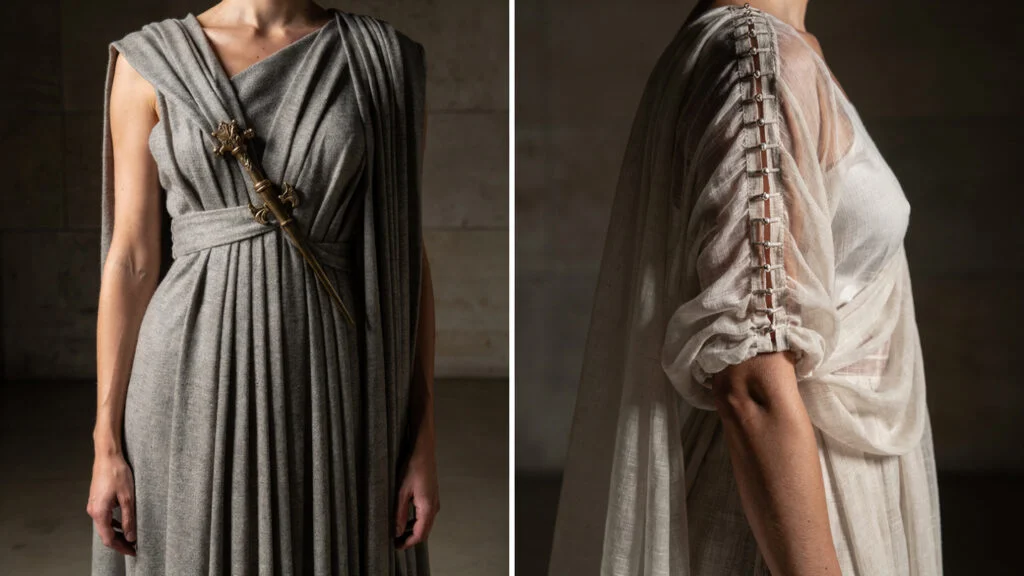
The distinction between Doric and Ionic chiton was never simply regional preference or fashion. It expressed, in cloth, the same aesthetic difference architecture expressed in stone, between the plain Doric capital and the voluted Ionic one, between the unornamented Doric frieze and the continuously decorated Ionic frieze. The same underlying vision that produced the Parthenon and the Erechtheion in two different architectural registers produced the Doric and Ionic chiton in two different registers of the same draping.
The Peplos and the Body of the Goddess
The peplos was the garment most closely tied, in ancient practice, to the divine feminine, its form and ritual weight connecting it directly to goddess cult.
Heavier than the chiton, the peplos was a large rectangle of thick wool whose draping produced an apoptygma, an upper section folded down over the belt to form an overfold whose visual weight gave the peplos its characteristic monumental solidity. It never moved in the wind the way an Ionic chiton did. It hung with the gravity of heavy wool, in deep, slow folds that resisted the air’s own movement.
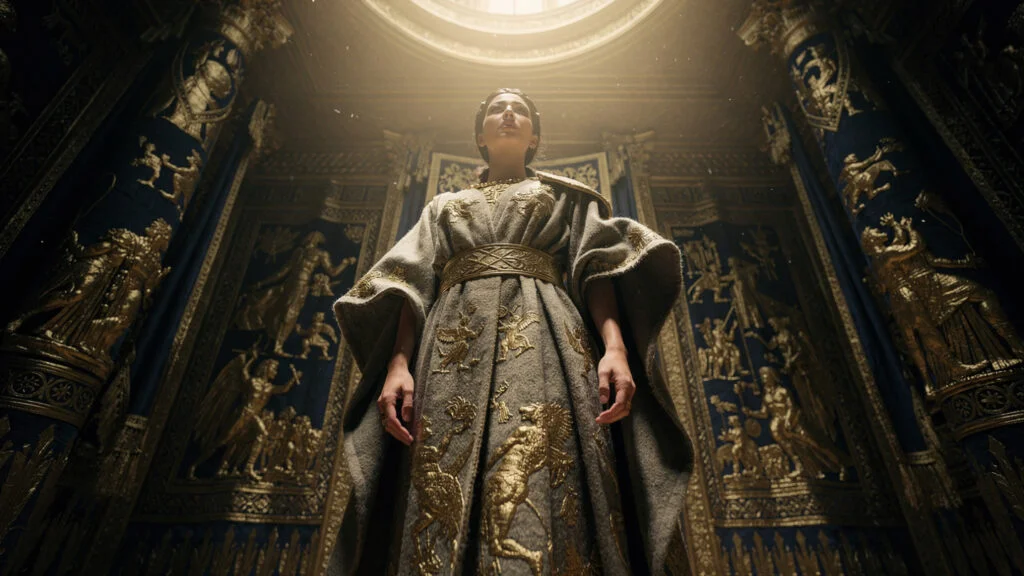
The most famous peplos in the Greek world was the one offered to Athena at the Panathenaic festival: a woven garment whose production occupied Athens’s designated weavers for the entire span between one Panathenaia and the next, its design depicting the Gigantomachy, the mythological record of Athena’s own part in defending the ordered divine world against primordial chaos.
Offering the peplos to Athena was an act of literal clothing: the goddess dressed each year in a garment her worshippers had made for her, a gift that performed the whole relationship between goddess and community rather than simply marking it. The goddess who gave Athens the olive tree received, in turn, a garment displaying the city’s own acknowledgment of that gift, woven by Athenian women whose role in the Panathenaic festival placed them, quite literally, as weavers working for the goddess of craft herself.
The Parthenon frieze, whose survival across the centuries and whose place in the ongoing Elgin Marbles controversy the Greek architecture article in this collection touches on, depicted the Panathenaic procession itself, the civic event that culminated in exactly this offering, carved onto the exterior of the very building that housed the goddess’s statue inside. The Panathenaic peplos and the Parthenon frieze relate to each other the way any offering relates to the building that receives it: the garment giving physical form to the same devotion the frieze records, and the drapery of Pheidias’s own Athena giving that devotion its most complete sculptural expression.
The Himation and the Philosophy of the Outer Garment
The himation was the outer layer, a rectangle of heavier wool draped over the chiton or peplos, and its social meanings were the most complex and carefully developed of any Greek garment.
It was never a coat in the sense of an enclosed form built to trap warmth. It was a rectangle of cloth draped according to what the wearer’s status and the occasion demanded, and the specific way it was draped became a direct, visible statement of the social identity being performed in whatever public space that draping happened in.
The philosopher’s himation took the most austere possible form of this public garment: worn without a chiton underneath, draped directly over the bare body. This was a genuine philosophical statement made through cloth rather than words, a position on the relationship between body and mind, between material comfort and intellectual discipline, expressed in exactly how the garment was worn.
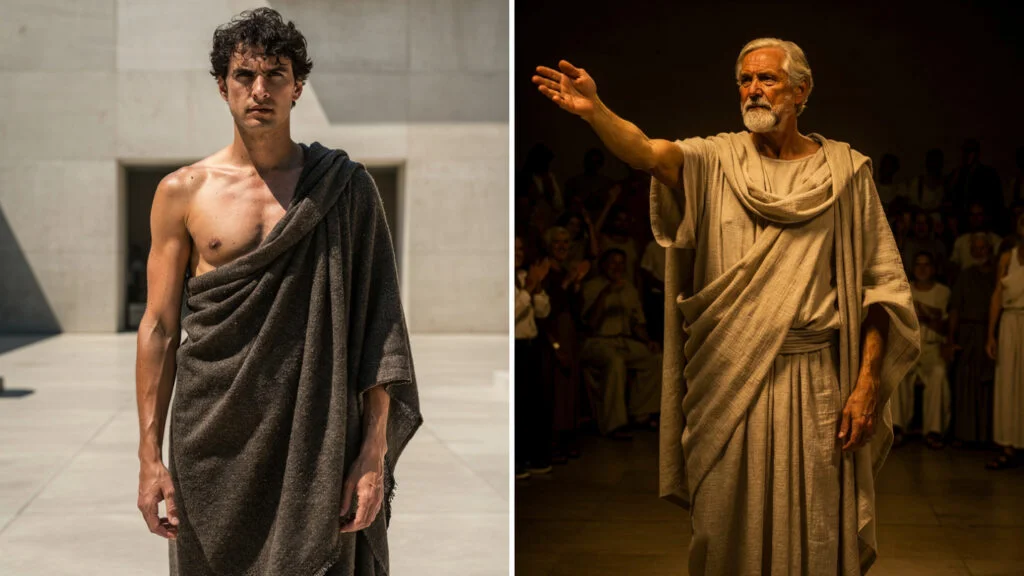
Diogenes wore his himation exactly this way. The Diogenes article in this collection develops the Cynic position in full: human needs reduced to their genuine minimum, social conventions rejected outright, including whatever conventional dress those conventions demanded. A philosopher’s himation was the Cynic’s own most visible daily performance of his central claim, that the organized social world and its dress code were constraints, and that rejecting them was the actual condition of philosophical freedom.
The orator’s himation was draped for an entirely different purpose: an arrangement that let a public speaker’s gestures, an arm extended for emphasis, a hand brought to the chest for sincerity, move freely without the cloth losing its shape or the speaker losing the visible authority a properly arranged garment lent to public speech.
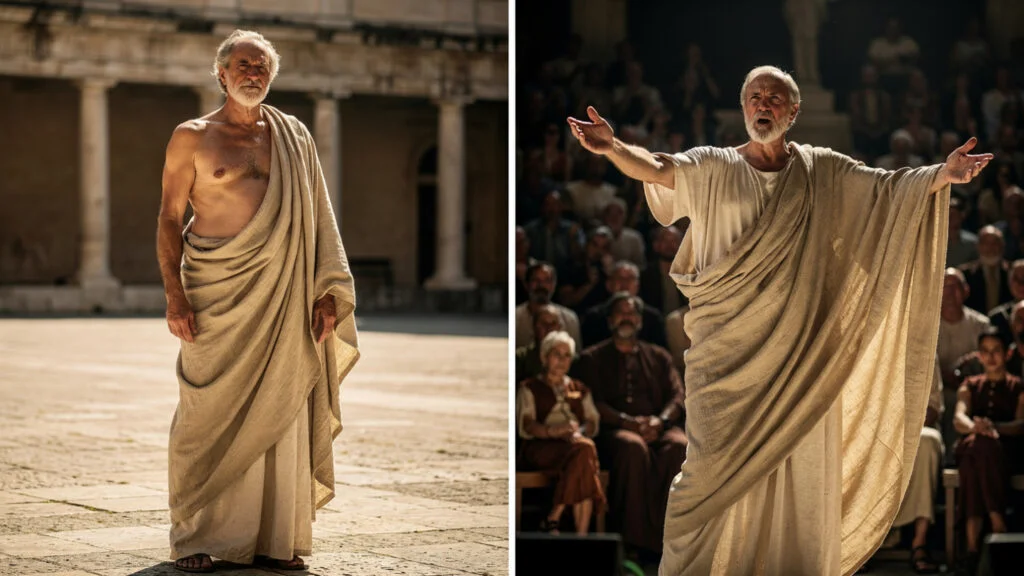
The himation, worn differently by different people in different settings, gave the Greek public world an entire visible vocabulary of social identity. The same rectangle of cloth, draped differently, was the Cynic philosopher’s rejection of social convention, the orator’s display of civic authority, and a woman’s modest covering of her own body in public space, where completeness of covering was expected in a way the domestic sphere never demanded.
Weaving, Arachne, and Penelope
The Arachne article in this collection develops the theological argument behind the mortal weaver whose work told a truth divine authority could not permit: the tapestry Athena could find no flaw in, and destroyed anyway, and the spider whose weaving preserves the ability while stripping away everything it once represented.
Arachne’s myth and Greek dress connect through the same underlying technology: weaving, and what its products actually did in Greek society.
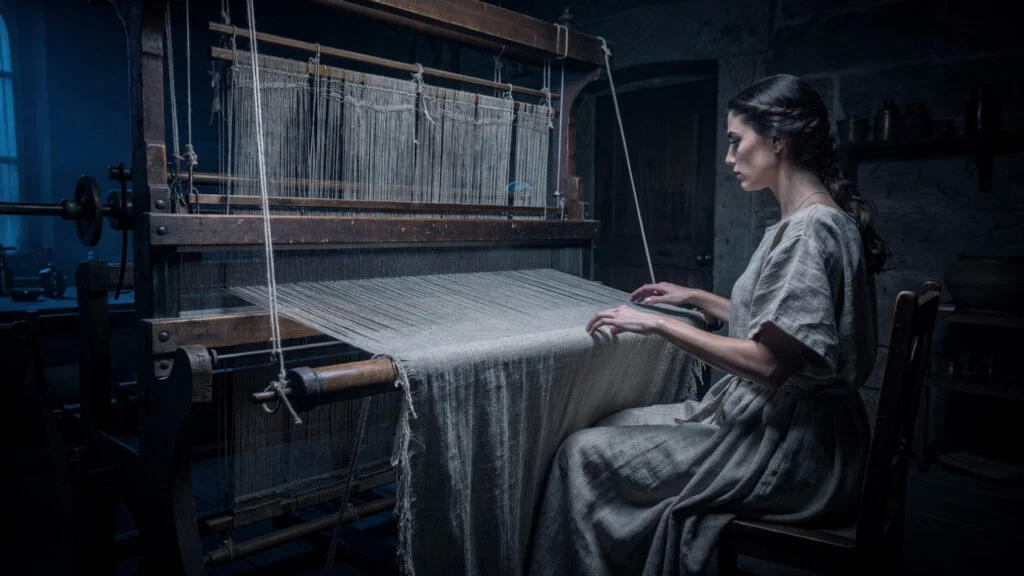
Weaving in ancient Greece was never a specialized craft confined to designated workshops producing designated commercial goods. It was domestic labor every household depended on: everyone wore cloth, and producing it was work performed by the women of the household as a direct expression of that household’s capacity to sustain itself.
Penelope, in the Odyssey, weaves and unweaves Laertes’s funeral shroud, using the loom as an instrument of resistance in a way that inverts Arachne’s own story: where Arachne wove a truth that challenged divine authority, Penelope wove a deferral that resisted the very human pressure of the suitors’ demands. Both women used the same technology for opposite purposes. The resistance took different forms. The loom itself was identical.
The Linear B tablets from the Mycenaean palaces, which the olive tree article in this collection develops as evidence of the palatial economy, record exact quantities of textile material the palace workshops kept in stock: wool, flax, and finished cloth tracked with the same administrative precision as any other resource the palace’s economy depended on.
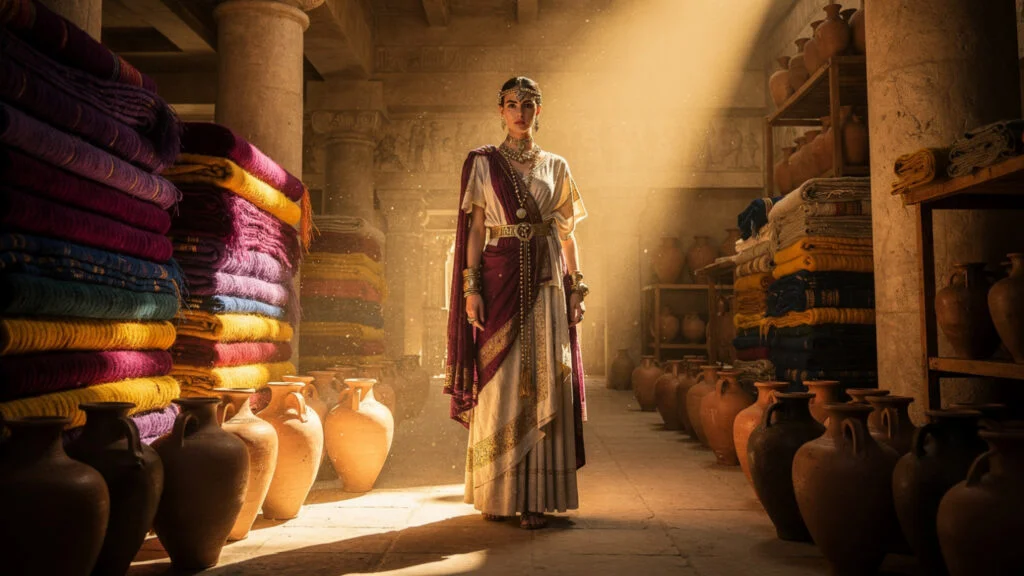
Textile production was never simply a domestic activity carried out household by household. It became, at the palatial level, a genuinely industrial output traded across the Bronze Age Mediterranean: stirrup jars of perfumed olive oil and bolts of dyed wool traveled the same trade routes, both counted among the luxury goods the palace workshops’ recorded production capacity made possible.
The Fibula and the Color of Status
Every draped garment needed a fibula, the pin whose form was the actual technology holding a garment’s folds in the arrangement the draping required.
The fibula was never simply practical. It was personal ornament, a concentrated, visible signal of the wearer’s status. A bronze fibula from an ordinary household and a gold fibula from an aristocratic one both fastened cloth in exactly the same way. In every other sense, the two objects could hardly have signaled more different things.
The fibula’s own form evolved across the centuries, from the simple safety-pin shapes of the earliest Iron Age examples to the elaborate zoomorphic and geometric forms of the developed archaic period, a fibula shaped as a horse, as a ship, as a griffin, each one fastening cloth while simultaneously broadcasting the wearer’s own cultural and economic identity in public.
Cloth color carried its own social signal, legible only to someone who already understood which dyes cost what to produce and what those costs implied about the wearer.
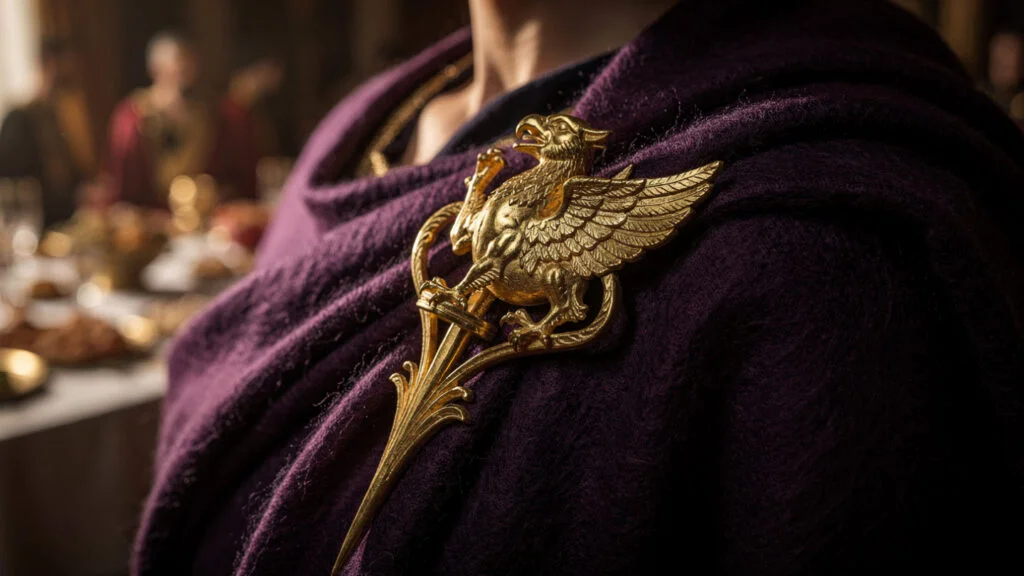
Phoenician murex purple required extracting dye from mollusk shells in quantities rare enough to make the finished cloth a genuine luxury object across the entire ancient Mediterranean, and that rarity made purple the color of rule itself: the purple border of the Roman toga, the purple robes of Byzantine emperors, the purple appearing in the decorative program of the Vergina gold artifacts, whose connection to Macedonian royalty this collection’s coverage of Alexander’s archaeology develops.
Saffron yellow carried a different, equally specific meaning: worn by brides, its association with the passage from maiden to wife made it the visible marker of that exact transition, the bride in her saffron veil embodying, in cloth, the transformation the wedding itself was performing.
What the Draped Form Said About the Body
The falling folds, the negative space, fabric moving in the wind revealing the body’s form while creating its own secondary form as it moved through the air, all of it expressed an understanding of the relationship between the clothed body and human dignity that modern dress has largely lost the vocabulary to even describe.
A draped garment never imposed a fixed shape on the body. It responded to it: cloth falling from the points where it was fastened produced an arrangement of folds whose character came directly from the proportions of the body beneath. Two people wearing the same cloth in the same basic arrangement produced two visibly different results, because their bodies differed and the cloth responded to each one differently.
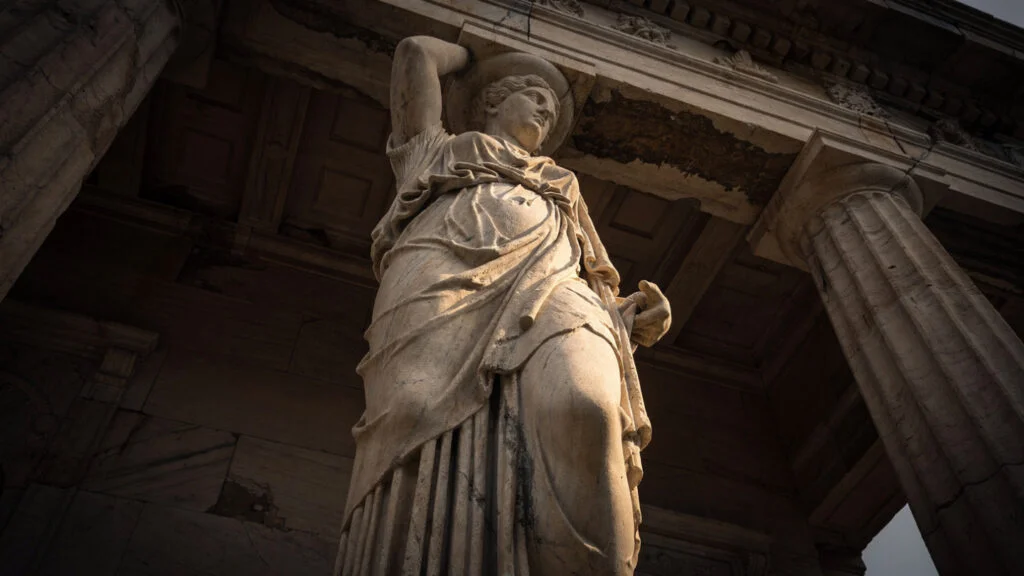
Greek sculptors spent centuries learning to render exactly this quality in marble: visible evidence that cloth was responding to a real body beneath it, that its folds came from the interaction between a three-dimensional form and gravity acting on real fabric weight. Wet drapery was the sculptural answer to a genuinely difficult technical problem, making stone appear to have properties it does not actually have, the properties of cloth responding to a living body, through nothing but years of accumulated technical skill.
The philosophical content behind this aesthetic came from a specific understanding of the body itself: not a shape to hide, not a form to put on display, but the organizing principle the cloth arranged itself around, a three-dimensional presence whose proportions the fabric’s own form responded to. A clothed body carried its dignity from exactly this acknowledgment, neither displayed by tight-fitting cloth that simply reproduces the body’s contours, nor hidden by loose cloth that erases the body’s form and substitutes its own. The Greek draped garment revealed a body’s gravity, proportion, and movement precisely by falling around it.
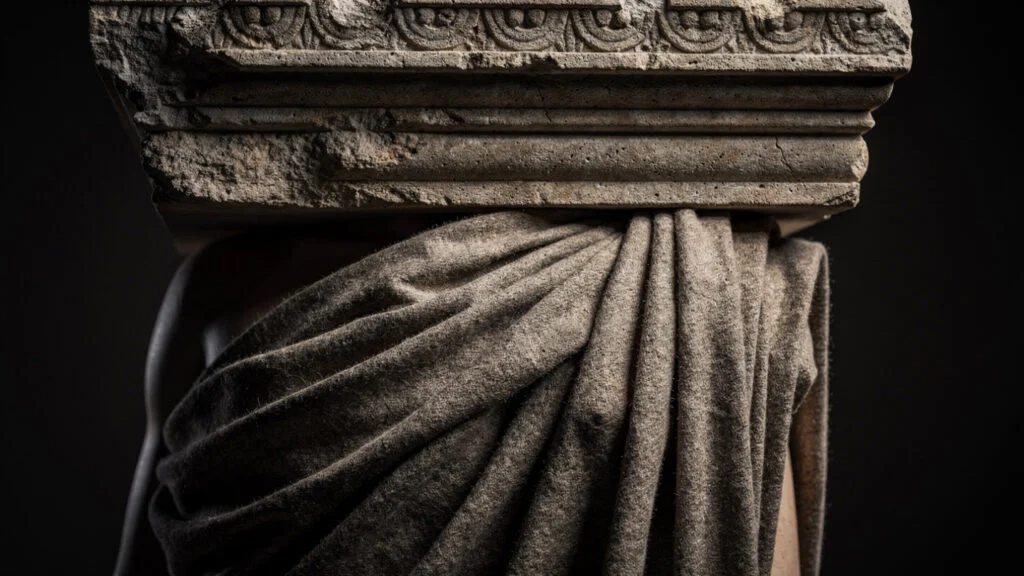
The Caryatids on the Erechtheion porch, which the Greek architecture article in this collection names as the sculptor’s own solution to drapery as a structural element, wear chitons that fall with a heaviness stone alone should not be able to convey, folds whose depth and direction carry the actual structural load of the entablature above their heads while still expressing the movement of cloth caught in a single moment of the body’s own posture. The draped body holds up the building. The cloth falls and supports in the same gesture. It is Greek sculpture’s most complete demonstration that the draped form could be beautiful and structurally necessary at once, with no contradiction between the two.
At Olympus Estate, Cultural Chronicles traces the practices and institutions that defined Greek civilization from the inside. The Greeks did not cut their clothes. The chiton, the himation, and the peplos were rectangles of woven cloth whose form came entirely from the draping, pinning, and belting a wearer performed fresh each time. Sculptors spent three centuries learning to express this in marble. Wet drapery solved the problem of making stone appear to respond to a body the way cloth actually does. The Panathenaic peplos was woven by Athens’s own designated weavers, depicted the Gigantomachy, and was offered to the Athena whose statue stood inside the very building whose frieze recorded that offering. Diogenes wore his himation without a chiton beneath it because the draping itself was a visible philosophical claim. A clothed body’s dignity came from the presence the cloth acknowledged simply by responding to it.