

On the morning of January sixth the priest walked to the water.
In the coastal towns the water was the sea. In the river villages it was the river. In the mountain settlements where neither sea nor navigable river was within reach, it was the village fountain, the cistern, or whatever body of water the community maintained as its point of contact with the liquid element the day’s blessing required. The body of water mattered less than the act itself: the Great Sanctification, the blessing of the waters that ritually completed the twelve days whose cosmological weight the Kallikantzaroi article in this collection develops as one of the most ancient and persistent encodings anywhere in Greek folk religion of the fear that the organized world might not hold.
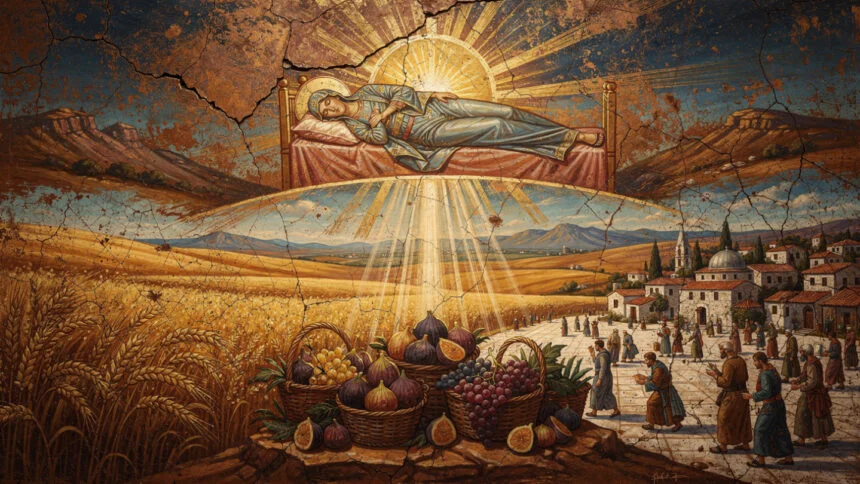
The twelve days between Christmas and Epiphany were the Dodekaimero: the period when Christ had been born but not yet baptized, when the cosmic order had been saved in principle but not yet restored in practice, when the Kallikantzaroi, driven from their underground work by the Christmas miracle, roamed the surface because the ritual that would send them back had not yet occurred. The twelve days table article in this collection develops the foods whose protective symbolism was built to navigate exactly this cosmological turbulence: the hearth fire that must never go out, the colander left on the doorstep, the sacred breads, the fermented grains, the wish-bread cut in silence at the year’s turning.
The Blessing of the Waters was the ritual that ended it. When the first drop of holy water touched the ground, the Kallikantzaroi were driven back below. The World Tree they had spent a year sawing had already fully regenerated. The cosmic boundary the twelve days had left permeable was sealed shut. The organized world was restored.
The priest walking to the water that morning was completing the cosmological restoration Christmas had begun. Christ’s birth had healed the World Tree. His baptism, commemorated on January sixth, was the event whose ritual re-enactment in the Great Sanctification produced the sacred substance, holy water, whose first contact with the ground signaled to the Kallikantzaroi that their window of freedom had closed.
What the Baptism of Christ Had to Do with the Cosmic Boundary
Orthodox Christian theology explains the Epiphany celebration as the commemoration of Christ’s baptism in the Jordan River by John the Baptist, the event the Gospels record as the moment the Holy Trinity was revealed to humanity: the dove descending, the voice speaking from the sky, the theological identity of the baptized figure made visible to everyone witnessing it at the river.
The theological weight the Church places on that baptism gives the Epiphany blessing its particular character: the immersion of Christ in the Jordan was understood, in patristic thought, as the event that sanctified all water everywhere at once, transmitting through the contact between the divine body and the element of water a sacred quality that then became a permanent property of water’s own subsequent use throughout the Church’s sacramental life.
Water had, of course, been blessed before Epiphany elsewhere in Christian liturgical practice. But the Great Sanctification was understood as a blessing of a different order entirely, one that renews, in each year’s performance, the original sanctification of the Jordan’s own waters, restoring to whatever body of water the priest blesses on January sixth the sacred quality that baptism had first established as a permanent property of water itself.
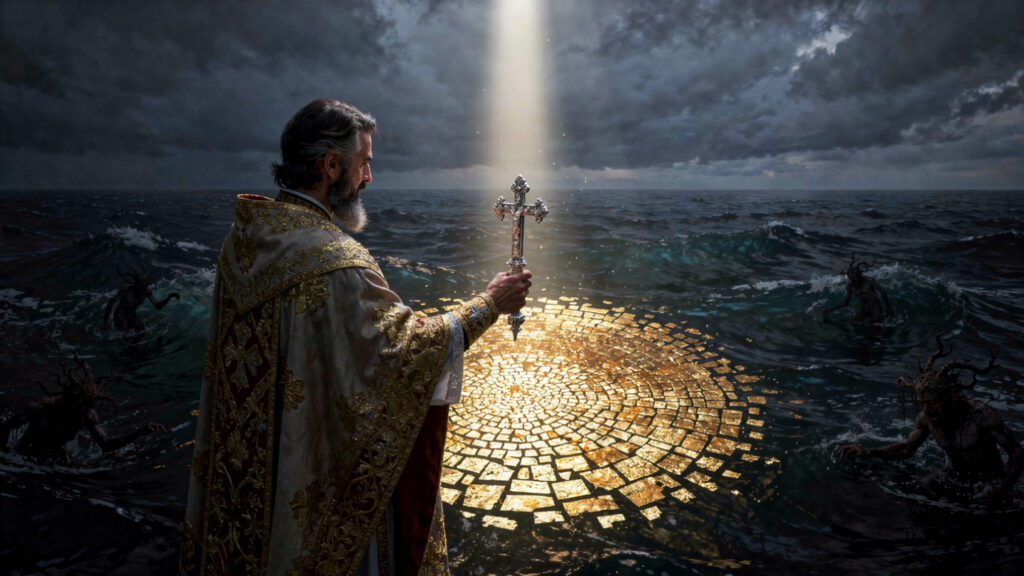
This idea, restoring an original sanctification through annual ritual performance, connects directly to a much older pattern: the pre-Christian practice of seasonal ritual renewal at the cosmic boundary, and that connection is exactly what gives the Epiphany Blessing of the Waters its depth as the ritual Greek folk belief understood as the actual mechanism driving the Kallikantzaroi back below.
The holy water was never simply water over which a prayer had been said. It carried the quality of the original sanctification, restored fresh in that year’s performance, the most completely sanctified substance available anywhere in the Orthodox sacramental world. When it touched the ground, it carried a sacred concentration the forces the twelve days had released onto the surface could not remain near. The Kallikantzaroi fled the holy water because it was the concentrated form of exactly the sacred order their own existence stood permanently opposed to.
The Procession
The Great Sanctification did not begin at the water. It began in the church.
The Divine Liturgy of Epiphany morning prepared the blessing directly: the prayers, the readings, the ritual gestures that moved the community through the day’s theological content before it moved, physically, from the church into the streets and down toward the water.
Then the procession formed.
In the major port cities, the procession became the civic community’s full public expression: clergy in their vestments carrying the icons that marked its sacred character, civic officials in formal dress marking its civic character, military and naval representatives marking its connection to the maritime and military life the blessing of the waters served most directly in communities whose survival depended on the sea.
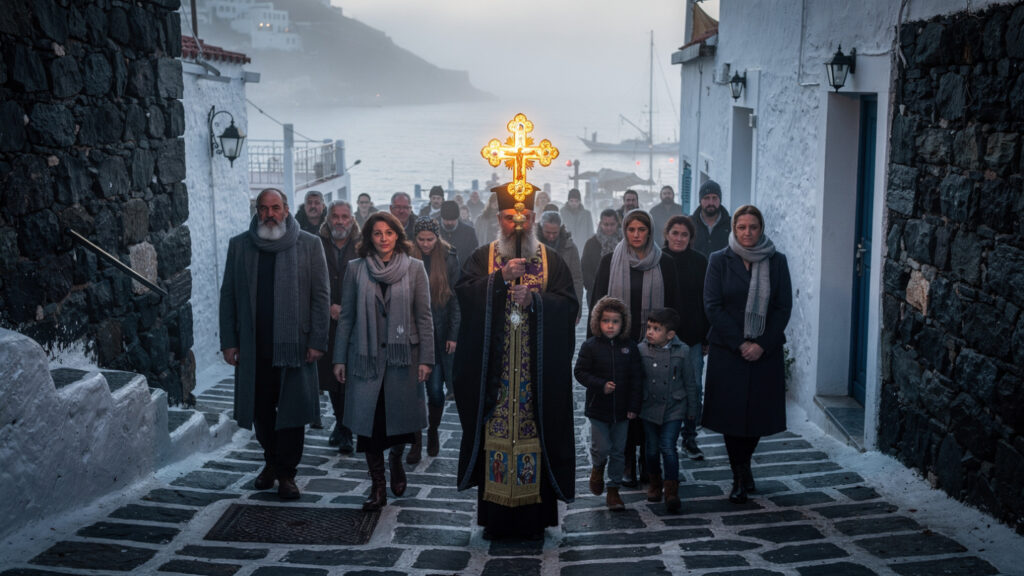
In the smaller coastal villages and island communities, the procession was simply the entire available population moving together from church to harbor: fishermen who had decorated their boats for the festive season walking beside the very waters their boats would soon move through, families whose sons and husbands had spent autumn and winter at sea walking toward the blessing of exactly those waters.
The procession’s movement from church to water was itself a spatial enactment of the day’s theology: the sacred moving out of the church’s enclosed sanctuary, into the public street, and finally into the open space of harbor or riverbank or shoreline, extending the liturgical space outward to wherever the blessing would actually be performed, and where its consequences would be most directly felt.
The Cross and the Cold Water
At the water’s edge the priest read the prayers of the Great Sanctification, an elaborate text moving through the creation narrative, the Jordan baptism, and the properties of water as the element of purification and new life, preparing the substance whose first contact with the water would complete the sanctification.
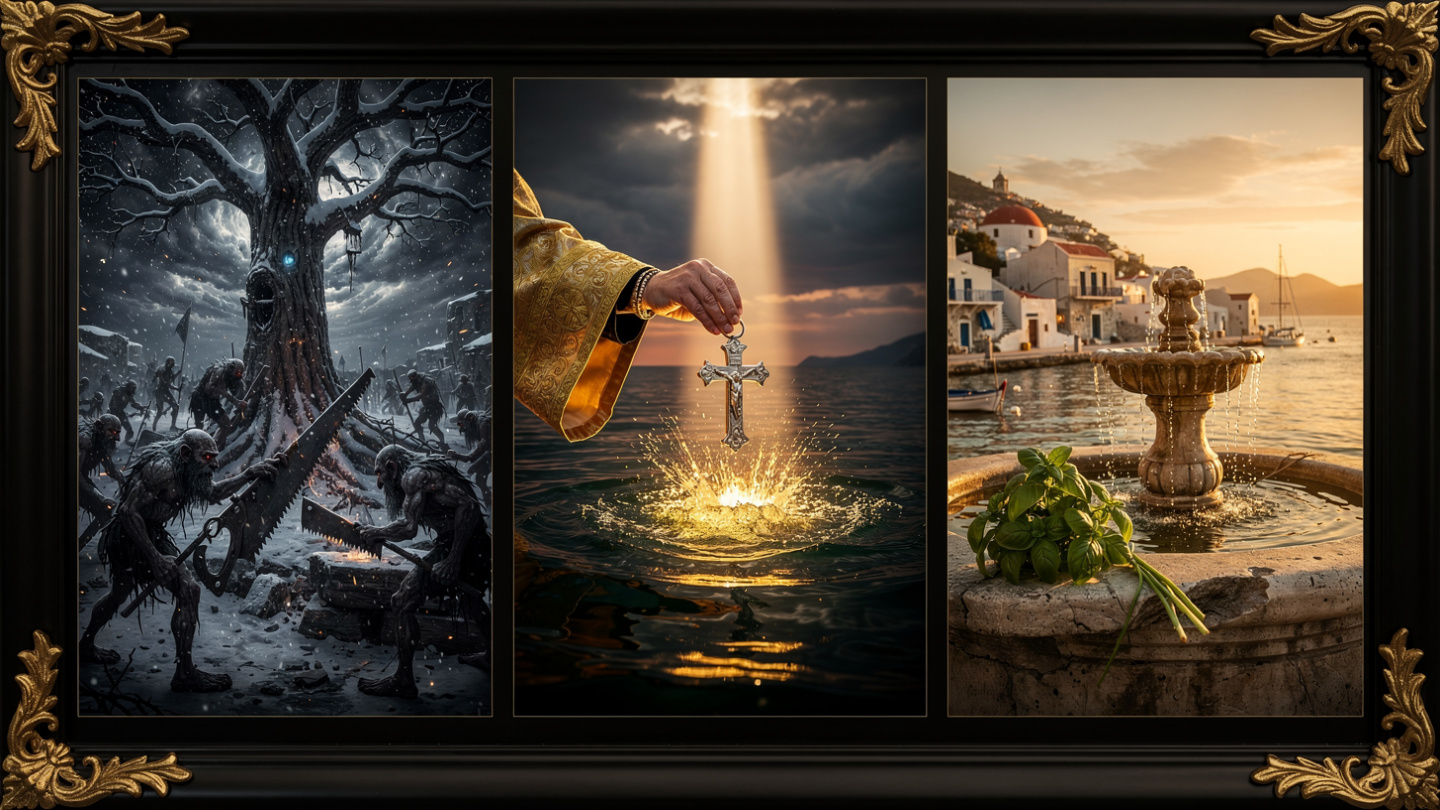
Then the cross entered the water.
In small village celebrations, the priest lowered the cross into the water at the bank’s edge. In the major harbor celebrations, he threw it from a pier, a bridge, or in some coastal cities the deck of a naval vessel, out into the harbor basin. The cross entered the water and the water received it.
Belief held the consequences of that single moment to be simultaneous and immediate: the water blessed, the Kallikantzaroi driven below, the cosmic boundary sealed, the organized world restored for another year.
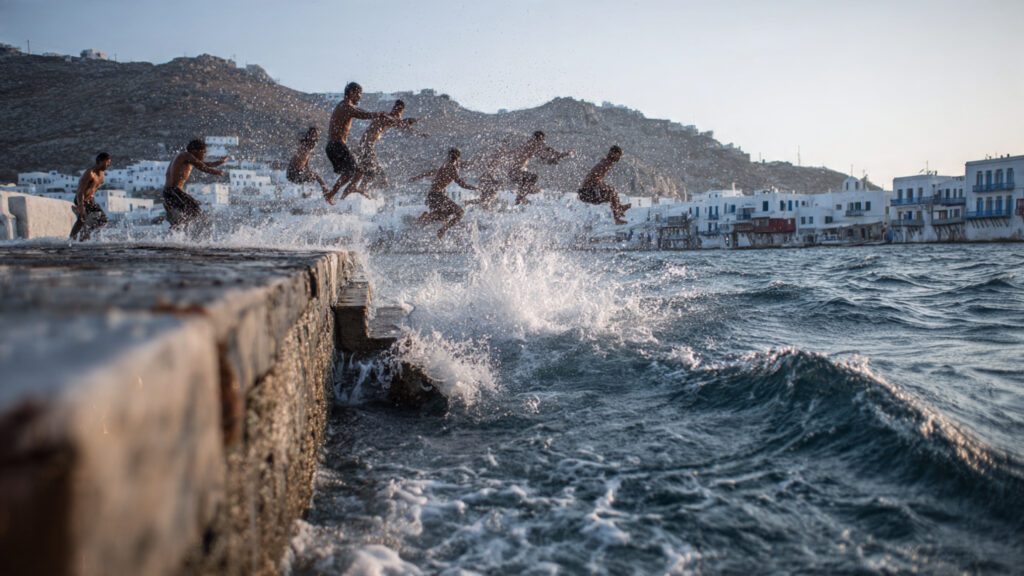
In harbor communities where the cross was thrown rather than lowered, young men dove from the pier, the bridge, or the quay to retrieve it. The diving was never simply the athletic display contemporary audiences tend to see in it, though the athletic dimension was real, and the community celebrated real physical courage shown in cold January water. It was the embodiment of the moment’s own theology: the willingness to enter the water at its point of most complete sanctification was the willingness to be physically present at the instant of cosmic restoration, to immerse the body in the sacred substance exactly when it was most fully what it was.
The swimmer who surfaced with the cross had been in the water at the precise moment the blessing completed. He carried it back to the surface, back to the priest, back to the waiting community. The consistent belief that good fortune followed the cross’s retriever recognized exactly this: whoever had been in the water at the moment of the Great Sanctification had touched the sacred substance at its point of maximum intensity.
The Maritime Blessing and the Fleet
The Epiphany Blessing of the Waters and the wider Greek maritime world are connected at real depth, reflecting exactly the relationship to the sea this collection’s articles on the Aegean’s own name, on Poseidon’s shores, and on the karavaki tradition each develop from a different angle.
Maritime communities never treated the blessing of the waters as a general seasonal ritual whose maritime application happened to be incidental. They understood it as the ritual that blessed the very waters their boats moved through, extending sacred protection over the navigational environment whose dangers the community’s survival most directly depended on managing.
The boats gathered in the harbor on Epiphany morning were the working boats the community’s fishing, trading, and island-connecting life actually required. Fishermen who had kept the karavaki lit through the twelve days, the decorated boats whose lights illuminated the Dodekaimero’s cosmological turbulence from inside the household, brought their real working boats down to the harbor for the same blessing.
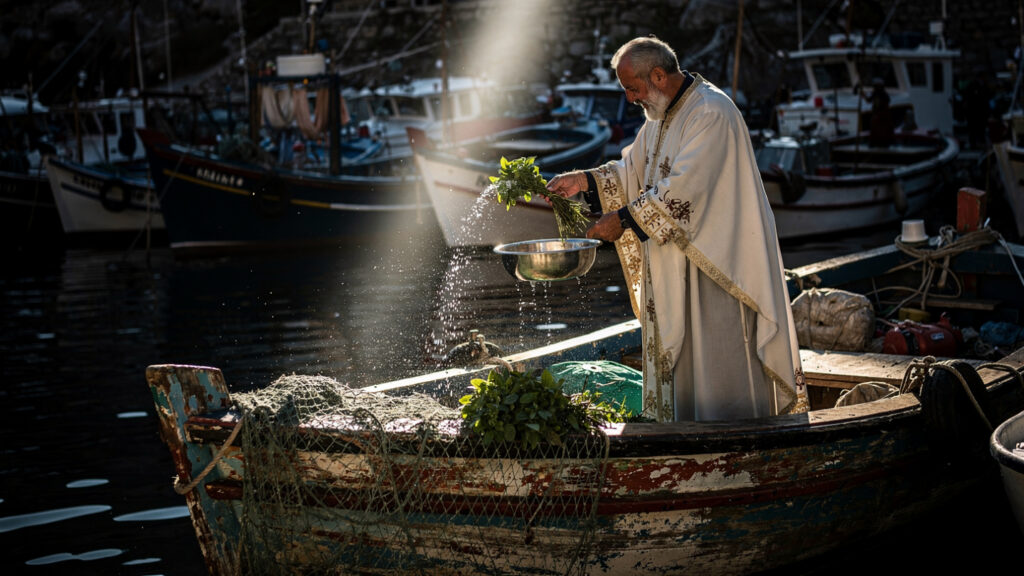
The holy water the priest sprinkled across the boats, the harbor, and the sea itself was the sacred protection the maritime community understood as the proper way to begin a new year of navigation. A fisherman who had spent the twelve days tending the karavaki’s lights, the hearth fire, and the colander on the doorstep now sent his boat out into blessed water under the Epiphany’s completed protection.
The Ionian islands, whose character this collection’s articles on Kefalonia and Corfu and Lefkada both develop, preserve this maritime dimension of the blessing in its most complete contemporary form: harbor celebrations where the whole community gathers at the water’s edge, boats decorated and present for the blessing, the cross thrown into the harbor and divers entering that same water the moment the blessing completes, together enacting the belief that Epiphany’s restoration of the organized world included restoring the maritime order the island community’s own continued existence depended on.
The Kallikantzaroi Returning Below
When the holy water’s first drops touched the ground, the Kallikantzaroi descended.
Their return below on Epiphany completes the arc the Kallikantzaroi article in this collection traces in full: their annual near-success in severing the World Tree’s roots, the Christmas miracle that heals the tree and drives them to the surface, twelve days of frustrated surface rampage, and finally the Epiphany blessing that sends them back down.
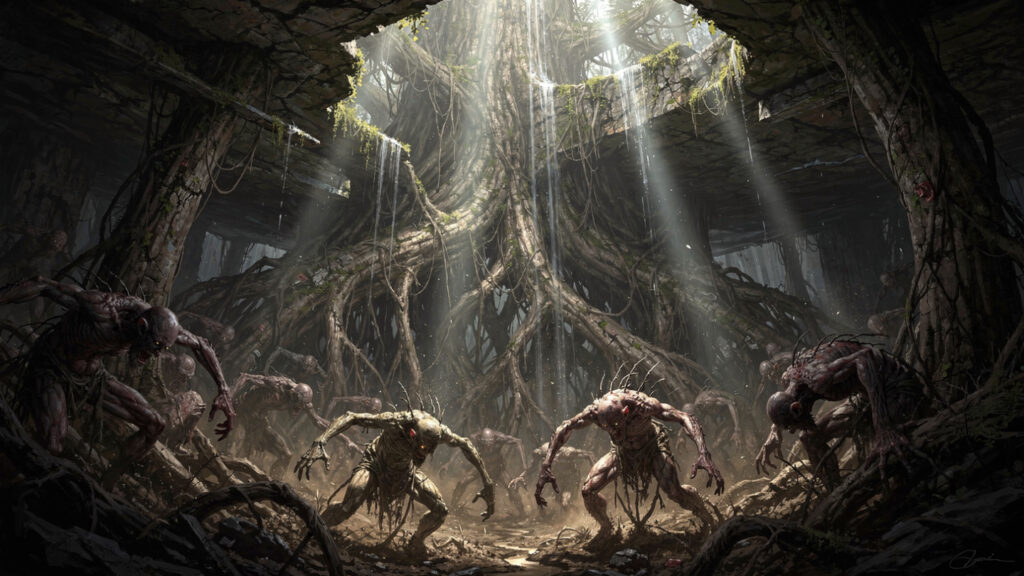
They returned below to find the World Tree completely regenerated. The tree whose roots they had spent eleven months sawing, the very axis whose destruction would have ended the organized world, had healed completely while they were away on the surface. The healing happened at Christmas. They were not there to see it, since they were already above ground by then. They came back to find eleven months of work undone.
They picked up their saws. The cycle began again.
The Kallikantzaroi article names the logic behind this whole cycle as the oldest Greek fear expressed in its most persistent folk form: not the fear of a monster that can be fought and defeated, but the fear of the foundation giving way beneath a world built on top of it. The answer to that fear was never heroic confrontation. It was ritual maintenance, keeping the foundation intact through faithful observance: the fire kept through the twelve nights, the colander on the doorstep, the foods of the Dodekaimero, and at the end of it all, the priest walking to the water, the cross entering the sea, the holy water touching the ground.
The Kallikantzaroi returned below every year. Every year the World Tree was intact. Every year the organized world continued.
Because every year the priest walked to the water.
The House-to-House Blessing and the Scent of Basil
The Great Sanctification at the harbor was Epiphany’s public expression. The house-to-house blessing was its domestic one.
In the days following January sixth, the priest moved through the community visiting each household with the blessed water and a sprig of basil, dipping it and sprinkling the drops through every room: extending Epiphany’s sanctification from the public water into private domestic space, sealing the household against exactly the forces the twelve days had released, using the same sacred substance whose first drops had already sent them back below.
The scent of basil and holy water lingering through a house in the first week of January was the sensory marker of Epiphany’s completion, the smell a home took on once the new year’s ritual protection had spread from the harbor to the household, from the civic to the domestic, from the public water’s blessing to the private sanctification of its own rooms.
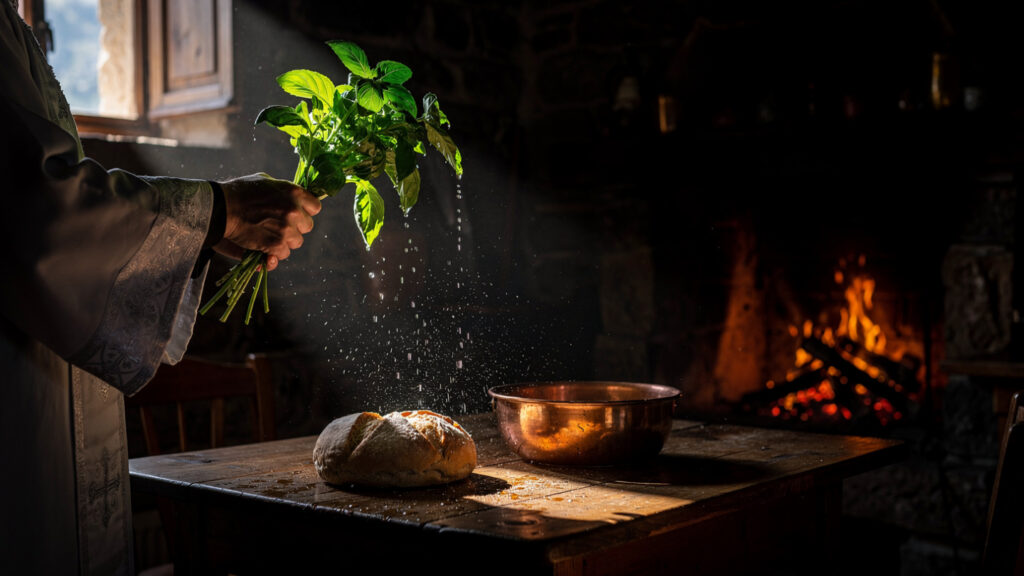
The priest performing the house blessing was extending the sacred order out of the church’s sacred space and the liturgy’s sacred moment into the everyday life that same order existed to sustain. The Epiphany house blessing performed this function precisely when it mattered most: the first week of January, the first week of the new year, the first week after the Great Sanctification had resolved the twelve days’ cosmological turbulence, still needing to be sealed at the household level before ordinary life could fully resume.
What January Seventh Felt Like
The morning of January seventh was the morning after the cosmic boundary had been sealed.
The Kallikantzaroi were below. The World Tree was intact. The hearth fire that had burned through the twelve nights now burned with the quality of a protective function successfully completed, rather than one still urgently needed. The colander could return from the doorstep to the kitchen. The pig’s lower jaw hung above the door had done its work.
The new year had begun.
Not on January first, which the civil calendar marks as the year’s start but which the older cosmological calendar of Greek folk belief understood as simply a moment inside the Dodekaimero’s ongoing turbulence, not the year’s real beginning at all. The year began on January seventh, once the Great Sanctification had sealed the cosmic boundary, the house-to-house blessing had extended that sanctification into every home in the community, and the Kallikantzaroi had gone back below and picked up their saws again.
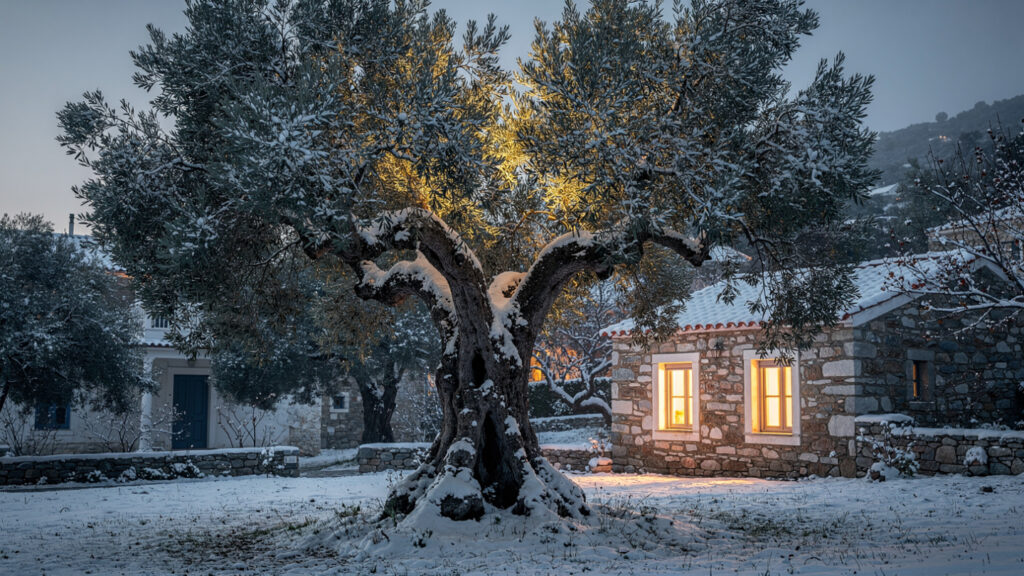
January seventh in the Greek village world was a day felt rather than simply noted, a lightening of the whole atmosphere once the twelve days’ ritual requirements had finally been met, after the darkness and cold and cosmological anxiety of the Dodekaimero.
The fire still burned in the hearth. It would burn through the rest of winter. But it burned differently now, with the warmth of an organized world restored rather than the urgency of one still under threat. Hestia’s fire continued. The Kallikantzaroi were below. The World Tree stood.
The year could begin.
At Olympus Estate, Cultural Chronicles traces the practices and institutions that defined Greek civilization from the inside. The twelve days between Christmas and Epiphany were the period when the cosmic order had been saved in principle but not yet restored in practice. The Kallikantzaroi were loose on the surface because the ritual that would drive them back had not yet been performed. When the priest walked to the water on January sixth and the cross entered the sea and the first drops of holy water touched the ground, the Kallikantzaroi descended. They returned below to find the World Tree completely regenerated. The work of eleven months was undone. They picked up their saws. The cycle began again. The house-to-house blessing sealed the sanctification into every domestic space. The scent of basil and holy water in the rooms of the house in the first week of January was the sensory marker of the organized world restored. The year could begin.