

Lefkada is the only Greek island that was deliberately built as an island.
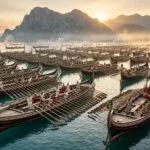
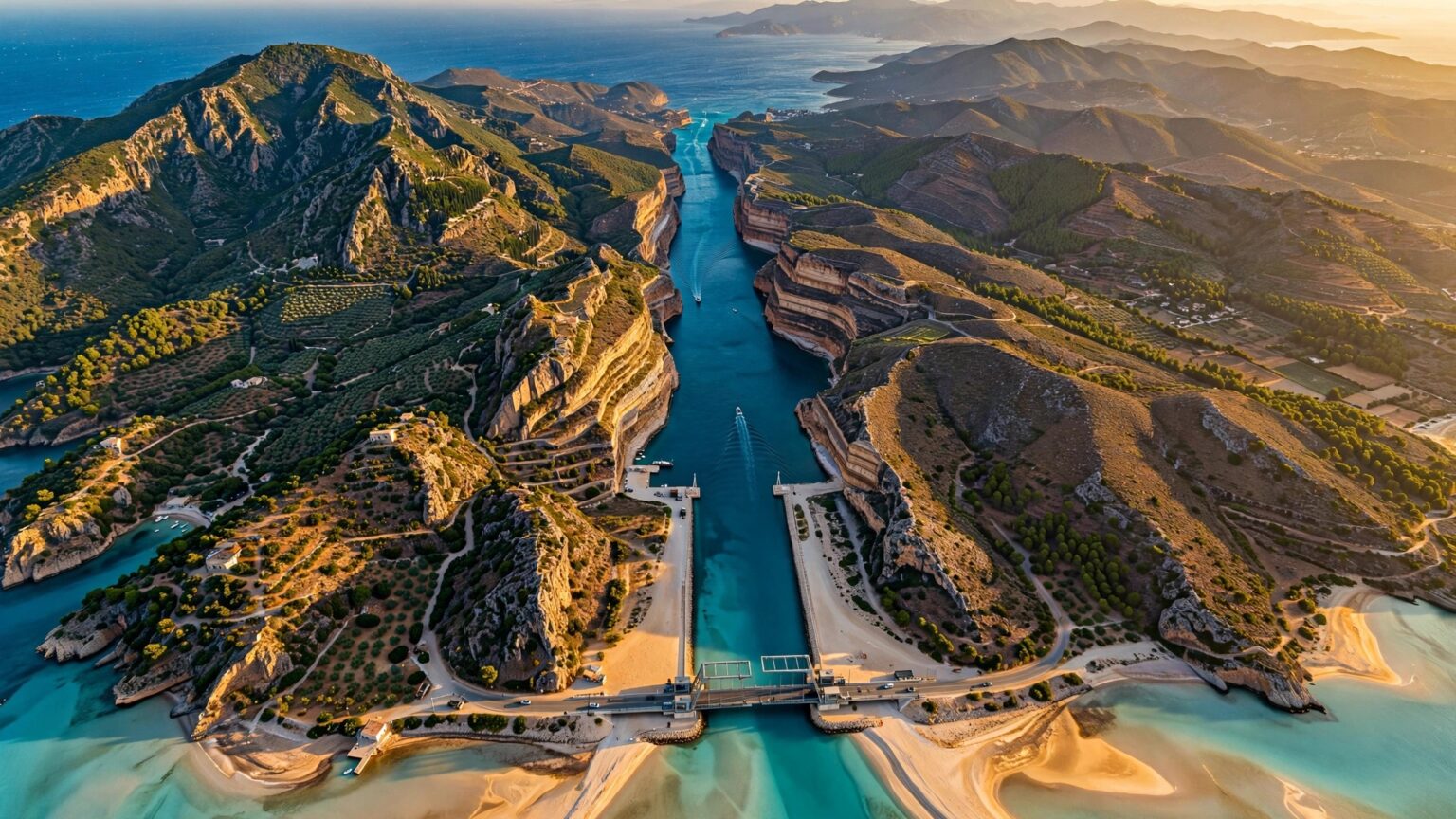
Every other island in the Aegean and Ionian world is an island because geology made it so: the sea rose, or the land sank, or a volcano collapsed, or the continental shelf simply ended at a particular point and the land stopped. Lefkada was a peninsula. It had a land connection to the Akarnanian mainland on its northeastern side, a shallow, rocky sill that people could cross on foot or in shallow-draft boats, and that connection made it strategically and commercially accessible in ways that a true island was not. In the seventh century BCE, the Corinthians, who had colonized the area and founded a city on the island’s southern shore, decided this was inefficient. They dug a canal through the isthmus, turned the peninsula into an island, and altered a piece of geography that the Mediterranean had arranged over millions of years of tectonic activity.
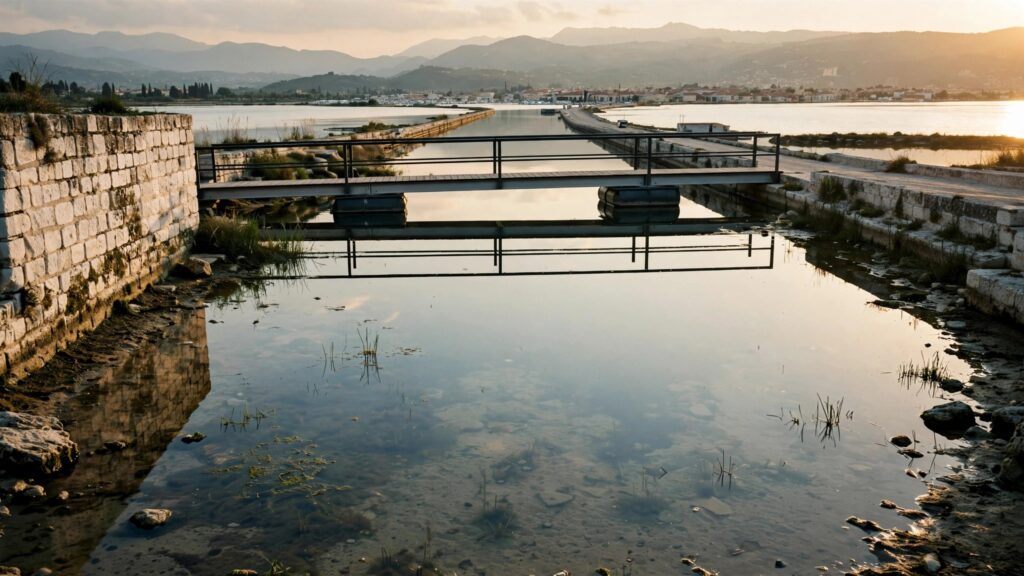
The canal has been redug and maintained continuously ever since, because the Ionian tides keep filling it with sediment and the connection to the mainland keeps trying to reassert itself. A modern causeway and a floating bridge now cross the strip of water the Corinthians first opened, and Lefkada is still, technically, not entirely separated from the mainland: the lagoon it created on the northeastern side is only marginally deeper than the original isthmus, and the island’s connection to Akarnania is a matter of centimeters of water rather than open sea. This is the first thing worth knowing about Lefkada, because it explains the character of everything that follows: this is an island that was made deliberately, that has been maintained deliberately against the geography’s tendency to undo it, and that carries, as a consequence, a particular quality of human intention in its own existence that purely natural islands do not have.
The White Rock and the Rite That Preceded the Legend
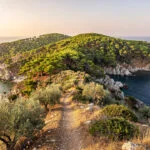
At the southernmost tip of Lefkada, accessible by road and then a short walk on a path that ends at a fenced viewpoint above a thirty-meter vertical drop, Cape Lefkada provides the island’s defining natural feature and its most ancient mythological association.
The white cliffs that gave the island its name, lefkos meaning white in Greek, drop directly into the Ionian Sea at the point where the island’s long western ridge finally ends above open water. The Temple of Apollo that once stood here, whose ruins are still partially visible near the lighthouse that now occupies the same promontory, made the site a genuine sanctuary long before any romantic legend attached itself to it.
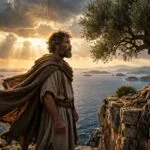
The leap from Cape Lefkada, which the Sappho tradition made famous across the ancient world and which the tourist infrastructure still markets under her name, was not originally a suicide. It was a ritual. The ancient sources are specific about this, above all the geographer Strabo, who describes the practice directly: criminals condemned to death, and people suffering from excessive or transgressive desire, the Greek word used is akolastos, undisciplined longing, were thrown from the white rock as a form of purification. Feathers and live birds were tied to their bodies to slow the fall. Fishing boats waited below to rescue them if they survived. The ceremony was expiatory, designed to purify the person thrown or to purify the community of the crime or the transgression the person represented, and it functioned under the patronage of Apollo, whose sanctuary at the cape treated the leap as a sacred rather than merely punitive act.
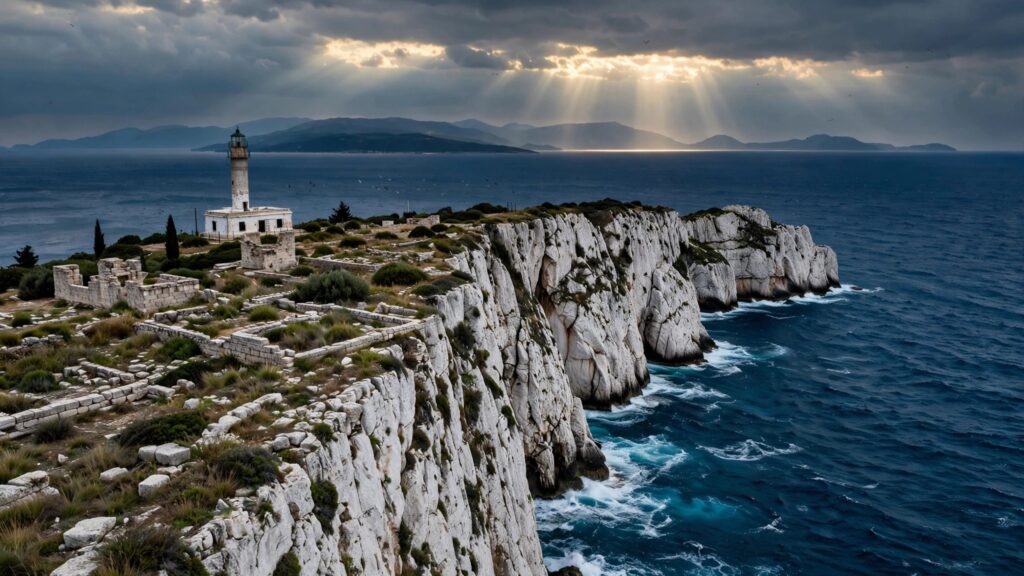
This is the ceremony that the legend of Sappho attached itself to. The story that the poet of Lesbos threw herself from this cliff out of unrequited love for the ferryman Phaon is, as almost all modern scholars accept, almost certainly a later fictional invention, possibly satirical in its original form, that borrowed the cliff’s existing association with transgressive desire and its ritual purification and gave it a romantic biographical narrative. Sappho almost certainly died in old age on Lesbos. But the legend’s persistence across two and a half thousand years tells you something true about the cape regardless of its literal accuracy: this is a place where the Greek imagination located the specific intersection of beauty, desire, and the gulf that separates a person from what they want, and the thirty-meter drop into the sea below the white rock is the geographical form that intersection takes.
The Apollo temple’s ruins, the lighthouse, and the fenced viewpoint together occupy a headland that on a clear day provides a view across open water to the dark profile of Kefalonia to the south and Ithaca beyond it, the same sea that the Odyssey’s hero navigated in the poems that some scholars have argued were set on this island rather than the one bearing the hero’s name.
The Island That Might Be Ithaca
The German archaeologist Wilhelm Dörpfeld, who spent decades working at Troy alongside Heinrich Schliemann before developing his own archaeological career, became convinced in the early twentieth century that Lefkada, not the island currently named Ithaca, was the Homeric Ithaca of the Odyssey, the home Odysseus was trying to reach across ten years of wandering.
His argument combined textual analysis of the Odyssey’s geographical descriptions with the archaeological evidence he found at Nidri on Lefkada’s eastern coast, where excavations revealed Bronze Age burial mounds he identified as Mycenaean, connecting the island to the period in which the Trojan War and the Odyssey’s events were traditionally placed. Mycenaean-era artifacts found at Nidri gave the argument some archaeological weight, and certain passages in the Odyssey, particularly those describing Ithaca’s position relative to neighboring islands, do fit Lefkada’s geography more precisely than the modern Ithaki’s.
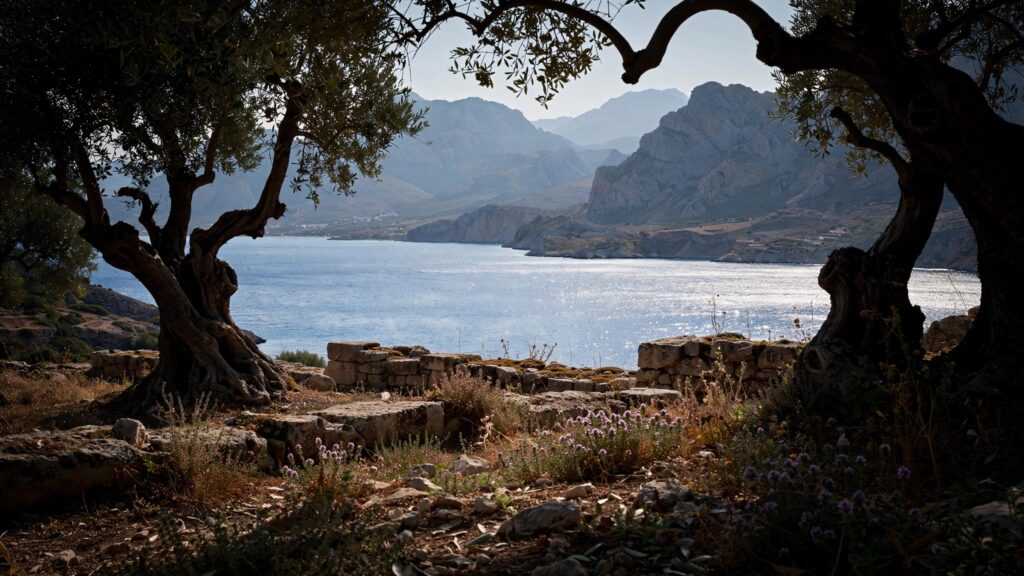
The scholarly consensus has never fully accepted the identification, and the modern island of Ithaki continues to claim the Homeric connection with the full force of two and a half thousand years of tradition behind it. But the ancient story that the island was given to Odysseus and Penelope as a wedding gift by Laertes, Odysseus’s father, and the Cape Lefkada tradition of the white rock as the passage from life to death of the Odyssey’s suitors, keep the connection alive in the island’s own mythology regardless of what academic consensus concludes about the geography.
What this means for the visitor is something genuinely interesting: Lefkada is an island whose relationship to one of the foundational texts of Western literature remains unresolved, not as a marketing claim but as an actual scholarly question that knowledgeable people have disagreed about for over a century, and the uncertainty itself is part of the island’s intellectual character rather than simply a gap in the evidence.
The Castle That Named an Island
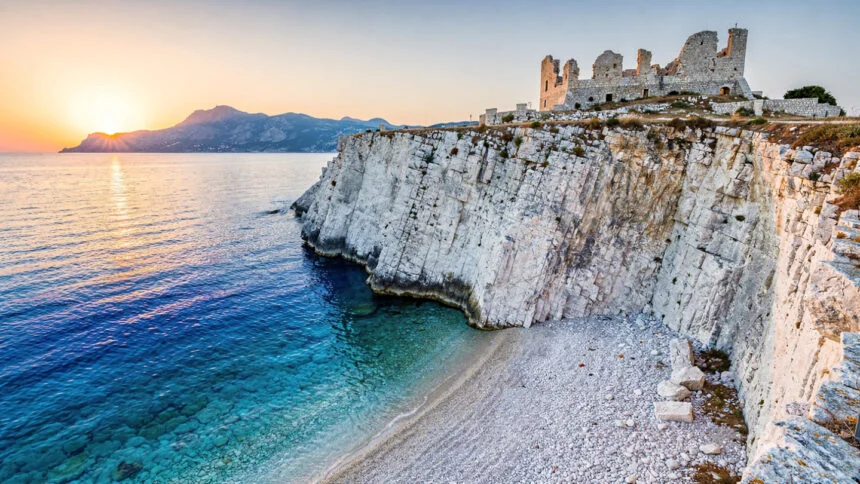
The Castle of Santa Maura, on the northeastern edge of Lefkada near the point where the causeway crosses from the mainland, was built beginning in 1300 by Giovanni I Orsini, the Lombard nobleman who had received Lefkada as a gift in 1294 and ruled it after it passed out of Byzantine administration in the wreckage the Fourth Crusade left across the Ionian world, and it gave the island the alternative name by which it was known through much of its later medieval and early modern history.
The fortress sits on a small islet separated from the main island by the same lagoon that the Corinthian canal created, its walls reflected in the flat water of the shallow bay, accessible across the causeway that later rulers repeatedly rebuilt after earthquake damage and military sieges. The castle changed hands with a regularity that reflects the island’s strategic position on the route between the Adriatic and the Ionian Sea: from the Orsini family, whose control was interrupted for a few decades in the fourteenth century by the Count of Brienne acting on behalf of the Angevin kings of Naples, to the Ottomans in 1479, to the Venetians briefly in 1500, back to the Ottomans by 1503, and finally to Venice again in 1684, after a sixteen-day siege, before French, Russian, and Septinsular Republic control during the chaos of the Napoleonic Wars gave way to British capture of the fortress in 1810 and, at last, union with Greece in 1864 under the Treaty of London, along with the rest of the Ionian islands.
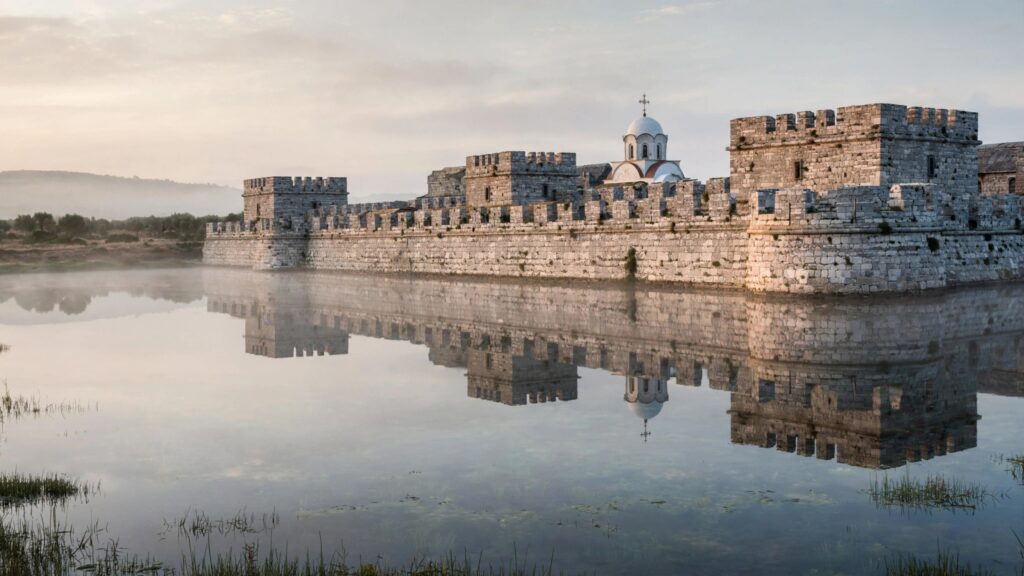
Inside the walls, the city of Santa Maura that gave the whole island its name for three centuries is now reduced to atmospheric ruins. The chapel that provided the name, dedicated to Saint Maura, stands in modified but functioning form within the fortification, its whitewashed walls visible from the causeway across the water. The fortification itself, with its irregular, many-sided outline and multiple bastioned ramparts, is one of the better-preserved examples of late medieval and early modern military architecture in the Ionian, and its position on the water makes it photogenic in a way that neither the standard Greek island fortress on a high cliff nor the standard inland stronghold quite achieves.
The Venetian olive grove planted after 1684 with the deliberate intention of shifting the island’s economy from seafaring to agriculture survives on the slopes above Lefkada town, its ancient trees now protected as a living environmental monument, the specific agricultural intention of a colonial administration still legible in the landscape it produced.
The Mountain Villages and the Interior
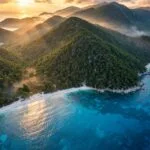
Lefkada’s mountainous interior, rising to Stavrotas at 1,158 meters and covered in dense pine and fir forest interspersed with the phrygana, the low aromatic scrub of the Mediterranean limestone, carries a different register of the island’s character from the beaches and the coastal towns that most visitors concentrate on.
The village of Karya, roughly in the center of the island, is the hub of a traditional embroidery tradition that local women have maintained across centuries, producing the specific needlework patterns that appear in the island’s folk costume and that are now sold in the village’s small workshops in a tradition of genuine craft production rather than tourist-market approximation. The embroidery museum in Karya documents the pattern vocabulary of the island’s folk textile tradition with the same kind of serious cultural attention that the Chios mastiha museum gives to the resin: a regional craft tradition treated as genuinely worth understanding rather than simply purchasing.
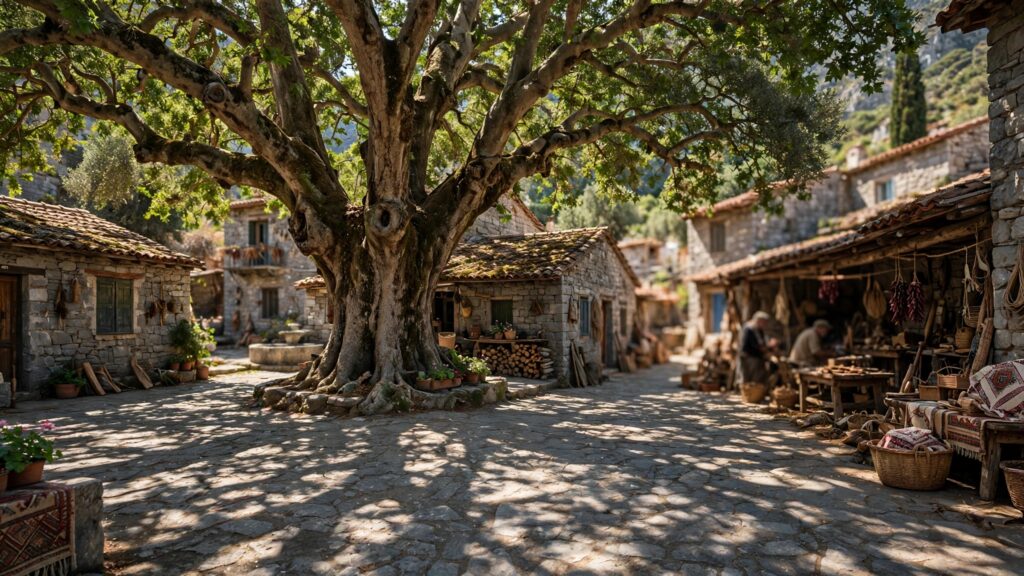
Englouvi, the highest village in the Lefkada mountains at roughly 800 meters, produces a specific variety of lentil whose quality is connected to the altitude and the soil of the plateau it grows on in the same way that the Thasos Throumba olive or the Naxian graviera are connected to their own geography: a product that requires this specific location to be what it is. The Englouvi lentil festival in August combines the harvest celebration with music and food in the manner of the Ionian island festival tradition, the village’s single agricultural identity treated as an event worth a dedicated celebration.
Exanthia and Nikiana on the eastern coast, Vafkeri and Alexandros in the interior, carry the architectural character of the traditional Ionian island village, tile-roofed stone houses arranged around shaded squares with plane trees and central fountains, a domestic spatial vocabulary that the western coast’s beach-resort infrastructure does not entirely replicate. The road network connecting these villages through the mountain interior rewards a day of unhurried driving that most visitors who came for Porto Katsiki never take.
The Beaches | What Is True and What Is Worth Saying
Porto Katsiki is as beautiful as you have heard. This needs to be stated directly rather than approached with the skepticism that heavily photographed places often deserve, because Porto Katsiki is one of those rare cases where the photographs, however saturated and filtered, actually undersell the physical experience rather than overselling it.
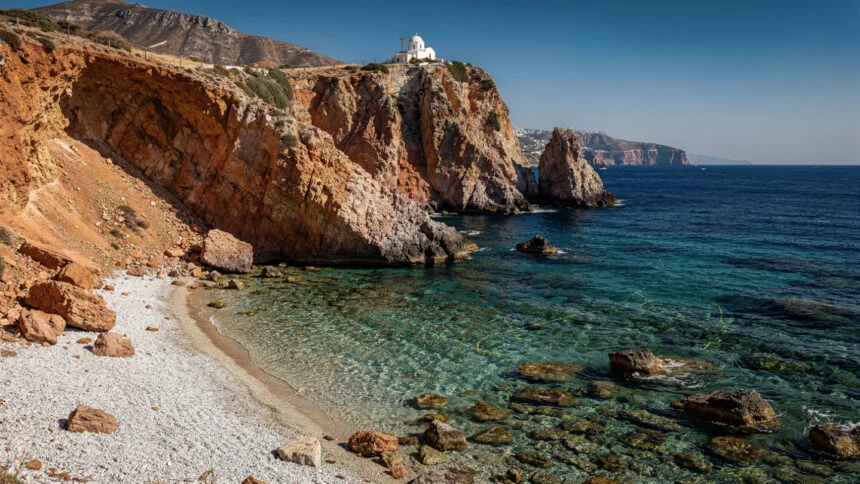
The beach sits at the base of a vertical white limestone cliff on the island’s western coast, accessible by a long staircase from the parking area above or by boat from Nidri and Vasiliki. The water is the specific blue-green that white limestone produces when the sea is clear, and the beach itself is composed of white pebbles and coarse sand that the cliff has been producing for centuries of slow erosion. The cliff face above is high enough that the beach is in shade until mid-morning, then in full sun until the late afternoon, and the combination of the cliff’s thermal mass and the sea breeze produces a microclimate that is noticeably cooler than the exposed beaches to the north.
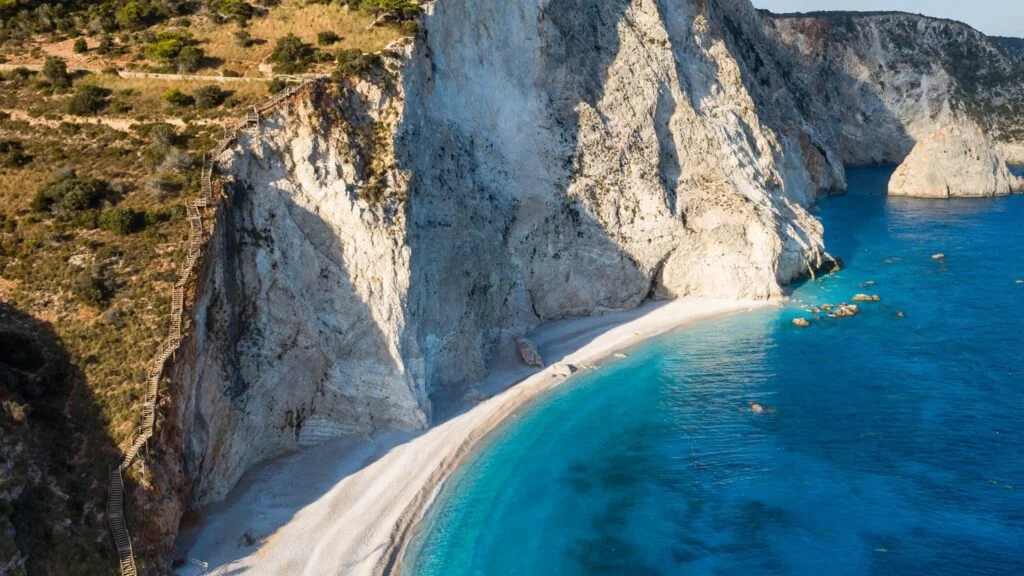
It is crowded in peak season, particularly in the middle hours of the day when the boat trips from Nidri are at maximum capacity. The early morning and the late afternoon are when the beach returns to something like its natural proportions: fewer people, better light, the particular quality of silence that a beach enclosed by two hundred meters of white limestone produces when the human noise level drops.
Egremni, accessible by an even longer staircase to the south, and Kathisma to the north, offer versions of the same western coast character with smaller crowds but also less dramatic cliff architecture. The eastern coast beaches, calmer in the afternoon when the western coast catches the Ionian wind, serve a different purpose: swimming rather than spectacle, the kind of accessible, warm, sheltered water that families with small children require and that the island’s geography provides in abundance around Nidri and Lygia and Nikiana.
Vasiliki, at the island’s southern end on the eastern shore, is a windsurfing centre of international reputation, its funnel-shaped bay producing the thermal wind conditions that concentrate late-afternoon Ionian breezes into a consistent, reliable sailing environment that has made it a competition venue and a teaching destination for several decades. The town around the bay has the character of a place where a sport has organized the community around its own requirements: equipment rental, instruction schools, early mornings and late afternoons on the water as the social rhythm, an international mixture of serious enthusiasts in conversation with the local fishing and tourism economy that has been accommodating them since the 1980s.
Practical Notes
Lefkada is unusual among the Ionian islands in being accessible by road without a ferry crossing: the causeway from the mainland at Aktio connects the island to the road network of western Greece, and the drive from Athens takes approximately four to four and a half hours via the E65 motorway and the Rio-Antirio bridge. The nearest airports are at Preveza on the mainland, forty-five minutes by road, and at Kefalonia, two hours by ferry from Vasiliki, with domestic connections from Athens and some direct European seasonal flights to Preveza.
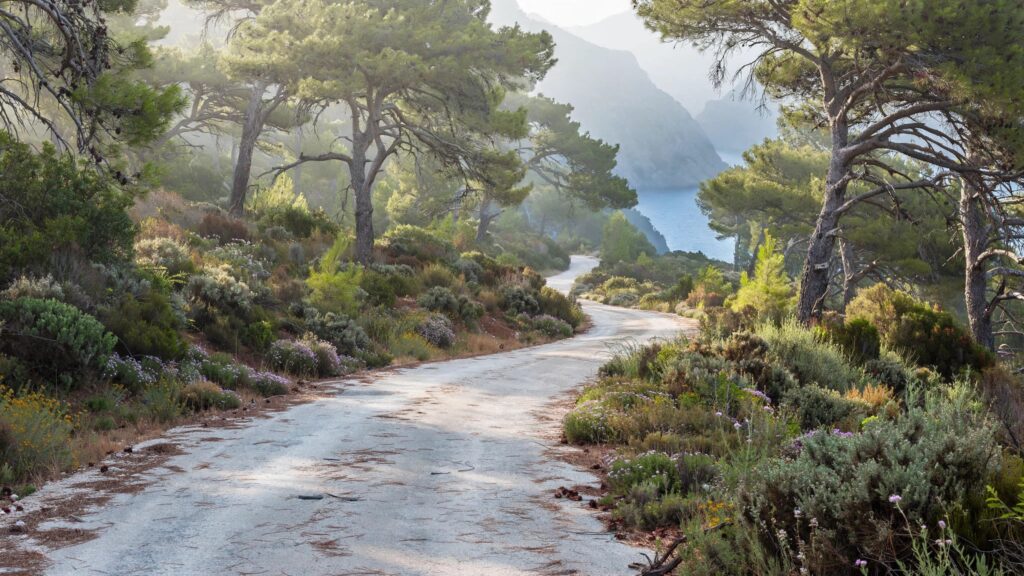
A car is necessary for any serious engagement with the island beyond the main town, the coastal road north toward Nikiana, and the bus connections to Vasiliki. The mountain villages, the interior, Porto Katsiki, and Cape Lefkada are all reachable by car on roads that require confident driving rather than particular technical skill, and the island’s relatively compact size, thirty-five kilometers from the northern canal to the southern cape, makes full circumnavigation in a single day manageable if not exactly relaxing.
April through June and September through October provide the conditions for engaging with the island’s full range, the beaches less crowded, the mountain roads and hiking trails comfortable, the fishing villages operating in their own rhythm rather than the compressed service-economy intensity of July and August. The Meltemi, which drives the afternoon sea state on the western coast, is most consistent and most intense in July and August, which is both the best time for windsurfing at Vasiliki and the most challenging for swimming at Porto Katsiki and Egremni in the afternoon.
The Island That Keeps Choosing to Be One
The Corinthians who dug the first canal through Lefkada’s isthmus in the seventh century BCE made a decision that required continuous reaffirmation. The sediment kept accumulating. The channel kept narrowing. Every subsequent power that held the island, Orsini, Angevin, Ottoman, Venetian, French, British, Greek, redug the canal, maintained the crossing, and recommitted to the decision that Lefkada was to remain an island rather than allow itself to slowly reattach to the mainland that geography kept attempting to reclaim it toward.
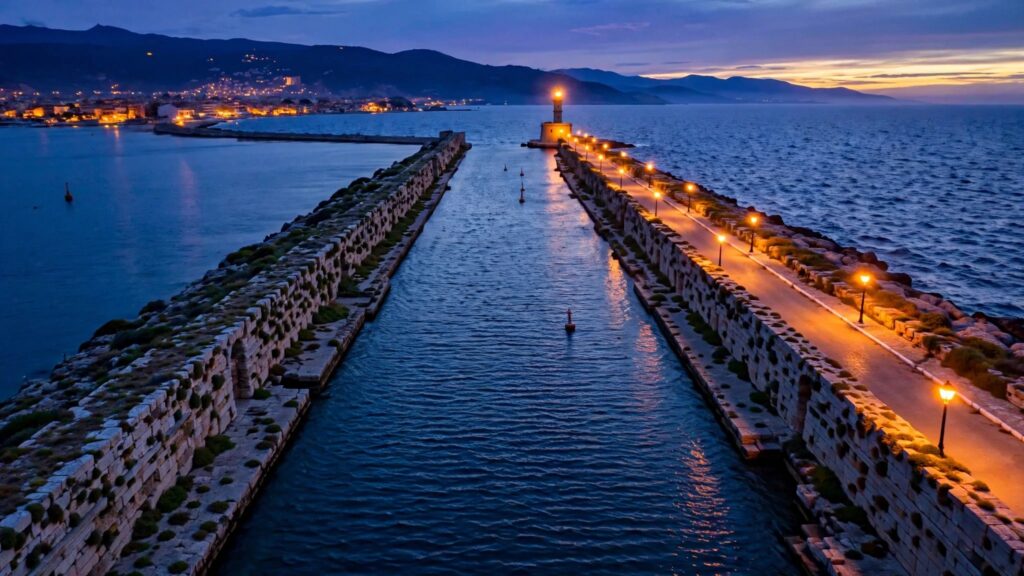
This is, in a way that extends beyond the purely hydraulic, the defining characteristic of the island’s entire historical identity. It chose, through the canal, to be something it was not naturally, and it has maintained that choice through twenty-seven centuries of continuous maintenance against the natural tendency of sedimentation to undo it. The island that was made rather than found, the cape where purification preceded romance, the claim on Homer’s geography that no one has fully proved or fully disproved, the embroidery patterns that survived every change of administration, the olive grove that a colonial government planted to change an island’s economy and that is still growing: these are all expressions of the same quality, a place that has consistently made deliberate choices about what it was going to be, and has maintained those choices through the same patient, repeated effort that the canal requires.
Porto Katsiki is as beautiful as you have heard. The canal is as improbable as it should be. The white cliff at the southern tip is still the place where the boundary between one condition and another has been tested since before Sappho was born.
At Olympus Estate, Wanderlust Greece looks for the places where Greece is most completely and most honestly itself. Lefkada is the only Greek island that was deliberately made rather than found: Corinthian colonists cut a canal through its isthmus in the seventh century BCE, and every power that has held the island since, Orsini, Ottoman, Venetian, French, British, Greek, has maintained that choice against the sea’s constant attempt to silt the channel closed again. Cape Lefkada’s white cliffs hosted an actual purification ritual, documented by Strabo, centuries before the legend of Sappho’s suicide attached itself to the same rock. The archaeologist Wilhelm Dörpfeld spent decades arguing this island, not modern Ithaki, was Homer’s true Ithaca. The Castle of Santa Maura, begun in 1300 by Giovanni Orsini, passed through Ottoman, Venetian, French, and British hands before the island joined Greece in 1864. Porto Katsiki is exactly as beautiful as the photographs suggest. Lefkada has spent twenty-seven centuries choosing, again and again, to be an island at all.