



She had a name before she had a cave.
The ancient sources give her the form first: woman above the waist, serpent below, the division running somewhere through the torso at a line the poets never specify precisely. But the form is not the beginning. The beginning is the parentage, and the parentage places Echidna at a depth in the genealogy of the Greek cosmos that most of the Olympian gods cannot match. She was not made by Zeus. She predates him in the order of things, descended from Phorcys and Ceto, the ancient sea deities who specialized in what the structured divine world preferred not to look at directly, or descended, in other accounts, from Gaia and Tartarus themselves, from the earth and the abyss that preceded every god who ever sat on a throne.
That depth matters. Echidna did not emerge into a world that the Olympians had finished building. She was part of the foundation on which the Olympians built, and the monsters she produced were not aberrations in the world’s order. They were the order that existed before Zeus established his version of it, still present, still operative, still requiring heroes to address them because no administrative decree from Olympus had managed to dissolve them.
The Limestone That Remembers
The Greek landscape holds its oldest things in its caves.
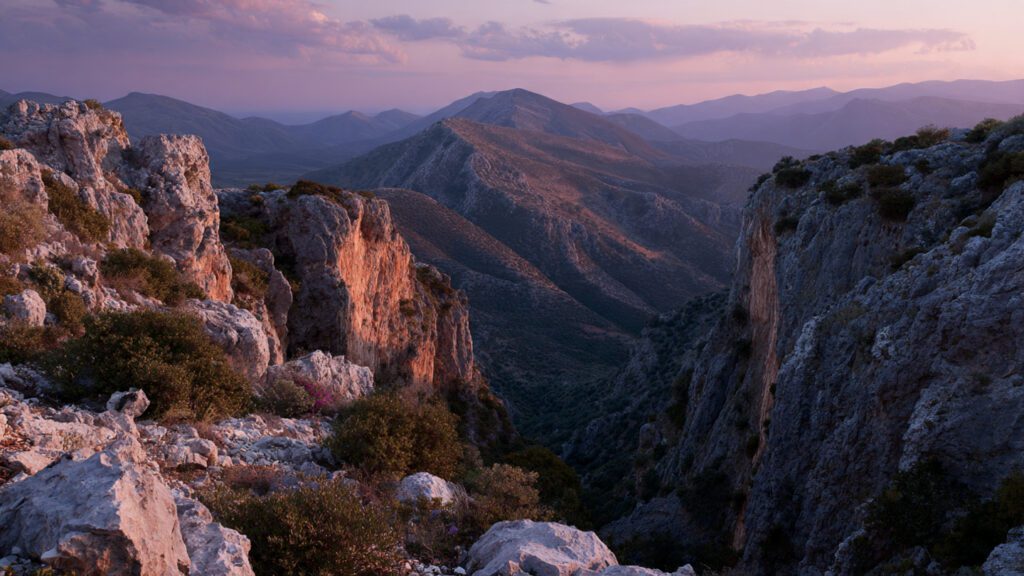
Walk far enough from the archaeological sites with their numbered ruins and their information boards, into the limestone uplands of the Peloponnese where the path becomes a goat track and the goat track becomes a suggestion, and the air changes. The warmth of the open hillside gives way to something cooler and more complex: the breath of the earth coming up through the cracks in the rock, carrying the smell of deep water and wet stone and the cold that accumulates in spaces where sunlight does not reach. The ancients called such openings the mouths of the underworld. They were the places where the boundary between the living surface and whatever lay beneath it became permeable.
Echidna lived in one of these places. The sources locate her variously in the Peloponnese and in the Cilician mountains of Asia Minor, which suggests that the tradition understood her as belonging to a type of location rather than a one: the deep hollow in limestone, the cave that goes further down than it seems it should, the opening in the rock that produces cold air on warm days and warm air on cold ones. She was not hiding from the world in her cave. She was inhabiting the part of the world that the world preferred to regard as its underside, and she was doing it permanently, without apology, for as long as the sources trace her.

Heraclitus wrote that nature loves to hide. What he meant was that the world’s most consequential operations are not visible on the surface: that the processes shaping what we see are conducted in the dark, below the threshold of ordinary attention. Echidna’s cave is the spatial expression of this principle. She was the hidden mechanism that the heroic tradition depended upon, producing the resistance without which no hero could demonstrate what he was.
Woman and Serpent
The ancient poets describe her upper half with a consistency that crosses sources and centuries: a face of startling beauty, the clear eyes and graceful bearing of a nymph, the kind of presence that the Greek tradition associated with dangerous attractiveness rather than safe domesticity. Below the waist, the human form gave way to the coiled length of a great serpent, scaled and massive, capable of the kind of constriction that leaves no room for anything the constricted creature might have been planning to do.
The combination was not monstrous in the sense of being incoherent. It was monstrous in the sense of being a precise and deliberate joining of two things the Greek world kept carefully separate. The woman who was beautiful and the creature that was lethal existed in the same body, and the line between them was not a wall but a gradient. You could not interact with the beautiful woman without also being in the presence of the lethal creature. You could not address the lethal creature without acknowledging the beautiful woman. The myth gave this combination a physical form so that the culture could look at it directly and understand what it was saying: that these two qualities coexist in the world and that pretending otherwise is not wisdom but evasion.
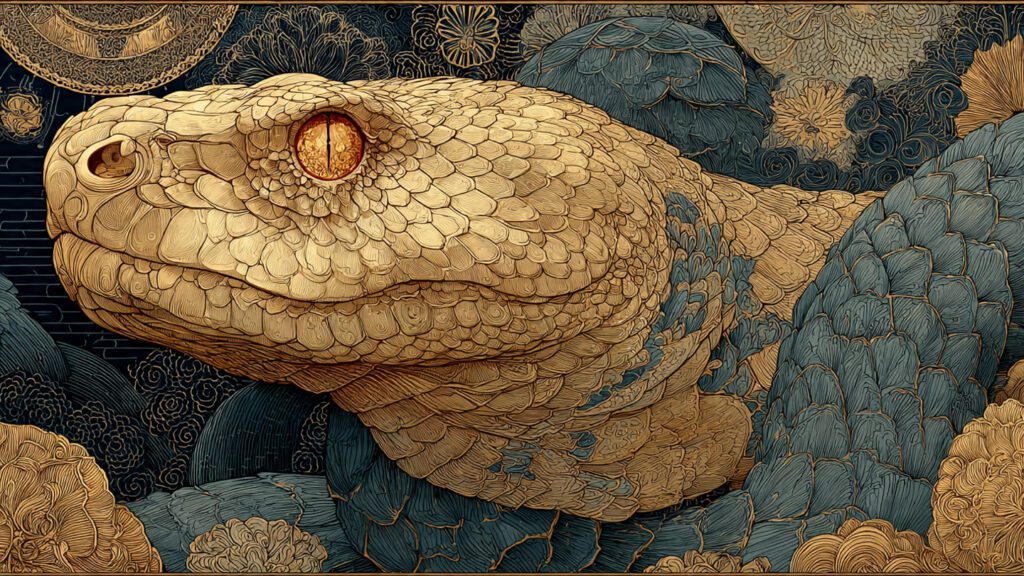
In some strands of the tradition, Echidna had not always been this. There are traces in the older accounts of a figure who was something else before the cave, who moved through the early world in a form closer to the nymph she half resembled, whose change into the creature the myth presents was the result of divine intervention of the kind the Olympian tradition applied selectively to those it wished to neutralize. Whether this earlier form is an artifact of a separate tradition or a genuine alternative account of her origins, it adds a dimension to the myth that the simpler version lacks: the possibility that what Echidna became was not what she was born to be, that the serpent half was added to her rather than original to her, and that the cave was a consequence rather than a natural habitat.
Argus and the Contradiction the Tradition Never Resolved
The hundred-eyed giant Argus Panoptes appears in the myth of Echidna at a point most retellings move through quickly, and the ancient sources disagree about him in a way worth stating plainly rather than smoothing over.
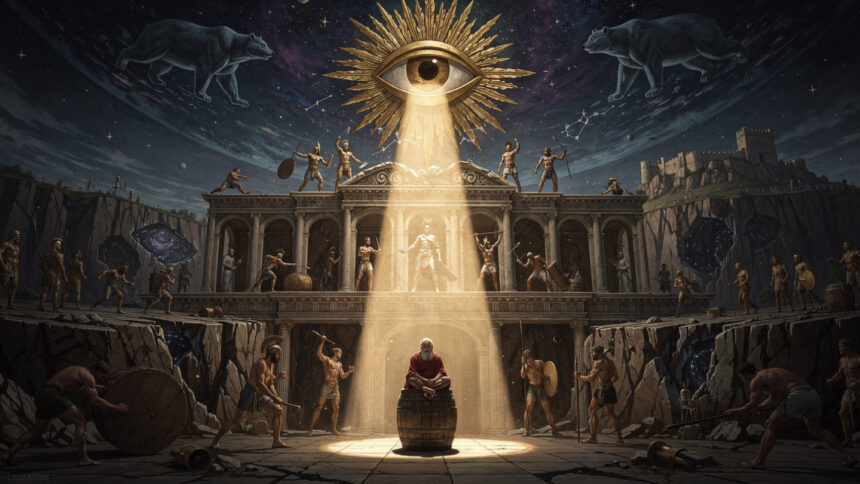
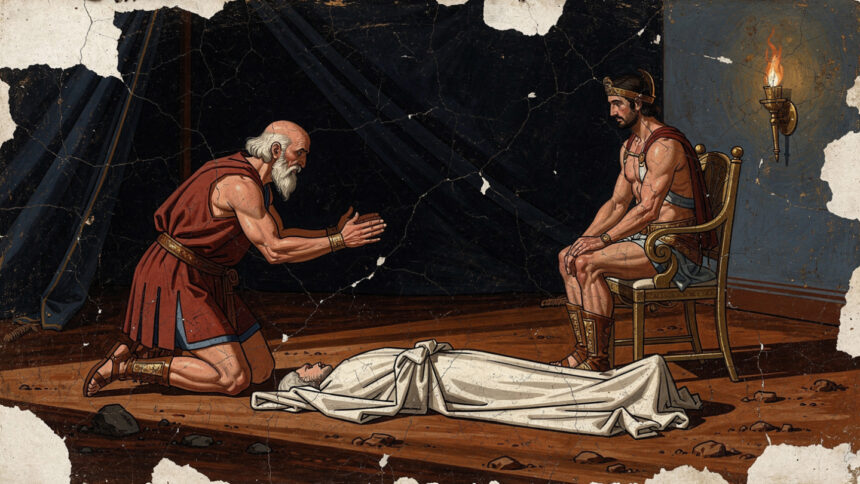
Argus was a being defined entirely by the capacity to see. A hundred eyes distributed across his body meant he could not be surprised, could not be approached from a blind side, could not be deceived by darkness or distance. Hera deployed him as a guardian and a watchman, an instrument of surveillance in the service of the queen’s purposes. Pseudo-Apollodorus records, in a single brief line, that among Argus’s feats before his more famous assignment guarding Io, he tracked Echidna to her cave and killed her while she slept, ending the raids she had been conducting on travelers passing through the region.
This is where the tradition splits, and the split is real rather than resolvable. Hesiod, the oldest surviving source and the one the rest of Echidna’s mythology consistently follows, calls her explicitly ageless and undying, a creature who “dies not nor grows old all her days.” Apollodorus, writing centuries later, has Argus end her permanently, and does so in a single sentence with no elaboration: no account of how a being defined by total visibility managed to approach a being who lived by total concealment, no description of the killing itself, nothing beyond the bare fact that she was sleeping and then she was not among the living.
The two accounts cannot both be literally true, and the wider mythology, Echidna producing monster after monster across the entire span of the heroic age, Zeus deliberately choosing to let her live on after Typhon’s defeat, clearly follows the older Hesiodic strand rather than the Apollodoran one. What the contradiction actually preserves is a genuine irony worth sitting with regardless of which version an ancient audience believed: the only figure in the mythological record credited with ending Echidna at all was defined by exactly the quality her cave was built to defeat. She lived by not being seen. The one being who could not fail to see everything was the one story that ever claimed to have finished her.
Typhon
Every account of Echidna eventually arrives at Typhon, and the arrival is not incidental.
Typhon was the last and largest of Gaia’s attempts to overthrow the Olympian order, produced by the earth goddess after the Titans had already been defeated, a creature of such scale and violence that the gods fled Egypt in animal form when he appeared. He had serpents for legs, a hundred dragon heads, voices that produced every animal sound the world contained, and a reach that the ancient sources describe in terms that require the imagination to extend considerably beyond ordinary scale. He was the storm at the end of the world, the thing that the Olympian order had to defeat in order to establish itself as permanent.
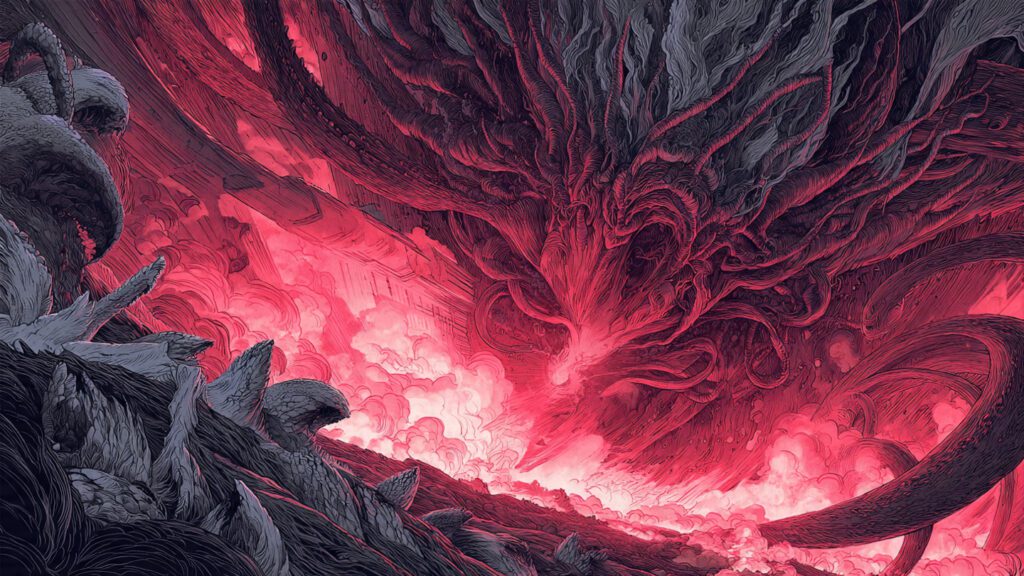
Echidna and Typhon found each other in the depths, two creatures of the old order in a world being reorganized around the new one. The match was neither romantic in the Olympian sense nor political in the way the dynastic marriages of the gods were political. It was a recognition: the serpent woman of the cave and the storm giant of the abyss identified in each other the same quality of belonging to something that predated the current arrangement and would not be absorbed into it. They were both remainders, both the elements that Zeus’s new order had not managed to eliminate, and their union was the natural consequence of the fact that the world’s margins tend to collect what the center has expelled.
The Children
Cerberus. The Lernaean Hydra. The Nemean Lion. The Chimera. Orthrus. The Sphinx. The Colchian Dragon. The Caucasian Eagle that ate the liver of Prometheus daily and returned each morning to do it again.
Each of these required a hero. Cerberus required Heracles, and then Orpheus, and then Heracles again. The Hydra required Heracles and Iolaus and the intelligence of cauterization, the understanding that the creature’s regenerative logic could be interrupted if the wound was sealed rather than merely opened again. The Nemean Lion required Heracles and the discovery that a creature whose skin deflected every blade had to be strangled because strangulation bypassed the skin entirely. The Sphinx required Oedipus and the answer to a riddle that the Sphinx itself knew the answer to, which means the Sphinx was not testing for knowledge but for the kind of reasoning that arrives at knowledge independently.
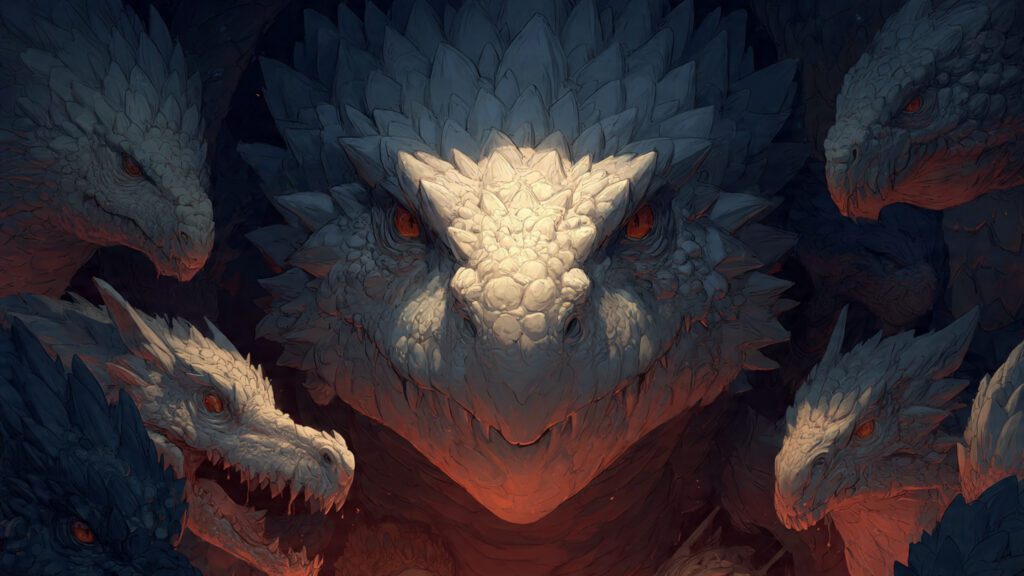
Each child of Echidna was a problem that force alone could not solve. The Hydra multiplied under violence. The Lion was impervious to weapons. The Sphinx killed those who answered incorrectly and killed herself when answered correctly, which means the correct answer was always going to end her. The pattern across all of them is the same: Echidna’s children required heroes to think as well as fight, to understand the nature of the obstacle before committing to a method of overcoming it. She produced, in her cave, the entire curriculum of the heroic education.
Heracles spent the majority of his labors working through her children. The myth presents this as his achievement. The shadow version of the same story is the account of a mother in a cave, hearing the news arrive from the surface one by one.
What the Heroes Needed Her For
The heroic tradition of ancient Greece required monsters in a way that the tradition rarely states directly but that the pattern of the myths makes clear.
A hero is not defined by strength or courage or divine parentage. He is defined by what he overcomes, and what he overcomes must be genuinely formidable, genuinely dangerous, genuinely resistant to the methods that ordinary strength and courage can bring to bear on it. Without Echidna’s children, Heracles is a man of exceptional physical capacity with nowhere to apply it. Perseus is a young man with a reflective shield and no particular occasion to use it. Bellerophon is a rider looking for something to ride toward.

Echidna gave the heroic age its structure. She produced the resistance that made the heroes possible, and she produced it in the cave, in the dark, in the margins of the world that the Olympians administered from above. The monsters were not failures of divine governance. They were the preconditions of heroic existence, and Echidna was the source.
Zeus knew this. The detail that appears across multiple ancient sources and that most retellings omit entirely is that Zeus chose to leave Echidna alive after the defeat of Typhon. He had the power to destroy her. He had the precedent, having imprisoned the Titans in Tartarus and the monsters who could be imprisoned. He left her in her cave, still producing, still permanent, still the mother of whatever the next generation of heroes would need to face. The decision reads as administrative in the sources, a choice to preserve the function she served. It reads, at a second glance, as something else: an acknowledgment that the order he had established required the disorder she represented in order to have anything to be ordered against.
The Cave Is Still There
The limestone of the Peloponnese has not changed in the time since the myths were formed around it.
The caves are still in the hillsides above Sparta and Argos and the mountain passes of Arcadia, still producing their cold breath on warm days, still going down further than a hand lamp can illuminate. The serpentine motifs on the pottery in the regional museums, the crossing gesture the old women in the villages make when they pass a deep hole in the ground, the quality of attention that the Greek landscape produces in anyone who has spent enough time in it to understand that the surface is not the whole story: these are the traces Echidna left on the culture that produced her.
She was not tamed. She was not redeemed. She was not given a story that ended with her reintegration into the Olympian order. She remained in her cave, immortal, unchanged, the permanent resident of the world’s underside, producing whatever the next age required from the union of the serpent and the storm.
The heroes died. Their names became myth. The mother in the cave continued.
At Olympus Estate, Mythic Essays moves through the deeper currents of the Greek tradition, from the cave where Echidna shaped the heroic age to the forge where Hephaestus made the weapons that ended it. The monsters were always the point. The heroes were the evidence.