





The corn was ground at the village mill and carried home by donkey.
That detail, unremarkable to anyone who knew it, contains the entire world of bobota: the seasonal calendar of the Greek countryside, the relationship between a family and its single viable crop, the weight of a sack of coarse flour on the back of an animal walking a dirt path in autumn. Bobota did not begin in a kitchen. It began in a field in April when the seed went into the ground, and it ended months later wrapped in walnut leaves and buried in hot ash, baking into something dense and smoky that a family would eat with olives if they had them and without if they did not.
It was not a delicacy. It was not meant to be remembered. It was meant to keep people alive, and in the years between 1941 and 1944, when the Axis occupation of Greece reduced urban food supply to near nothing and the famine that followed killed more than a hundred thousand people, bobota is part of the reason the rural population survived at odds that the cities could not match.
What Corn Meant in a Wheat World
Greek cuisine was built on wheat. The bread of the ancient world, the bread of Byzantine monasteries, the bread that accompanied oil and wine and fish through every century of Hellenic life: wheat. Corn was a later arrival to the Mediterranean, brought from the Americas after the sixteenth century, adopted slowly into the agricultural rotations of the Greek countryside as a secondary crop, reliable in a way that wheat sometimes was not, yielding coarser flour that produced coarser bread.
In ordinary times, that coarseness was a social marker. Wheat bread was aspiration. Corn bread was what you ate when wheat was beyond reach. The hierarchy was understood by everyone who sat at a Greek table, and bobota sat at the bottom of it.
The occupation inverted the hierarchy. When wheat disappeared into German requisitioning and black market prices that ordinary families could not approach, the crop that had always signaled poverty became the margin between life and starvation. Families in Athens and Thessaloniki had no fields, no mills, no donkeys. Families in the villages of Epirus, Macedonia, the Peloponnese, the agricultural interior of the mainland had corn, and the knowledge of what to do with it, and the community structures that made sharing what they had possible.
The cities buried their dead in numbers that the records struggled to keep pace with. The countryside endured.
The Making of It
The process required nothing that was not already present in a village kitchen, which is the point.
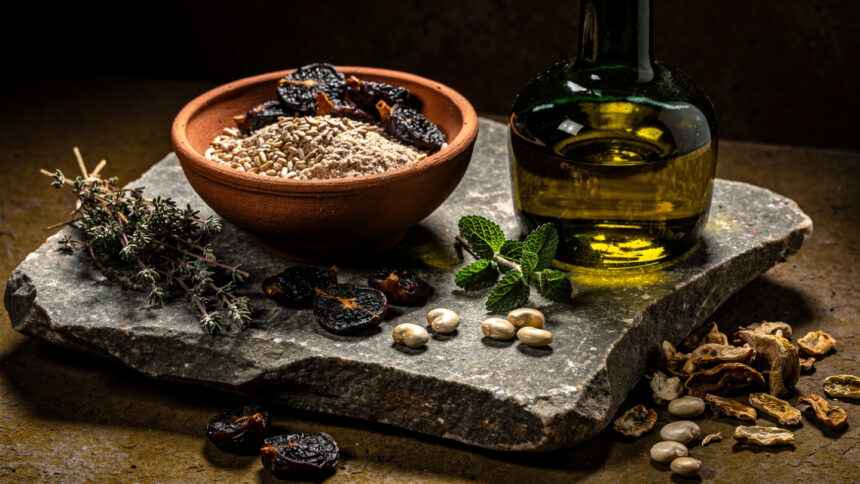
Cornmeal passed through a fine sieve to remove the largest fragments of husk. Hot salted water added in stages and worked into the meal until it cohered into a firm dough. Whatever was available folded in: wild greens gathered from the hillside, a chopped onion, dried herbs, an egg if the chickens were still laying, a measure of olive oil if the family had pressed enough from their trees to spare any for the bread. The additions were not recipe. They were inventory: you used what existed and the bobota absorbed it.
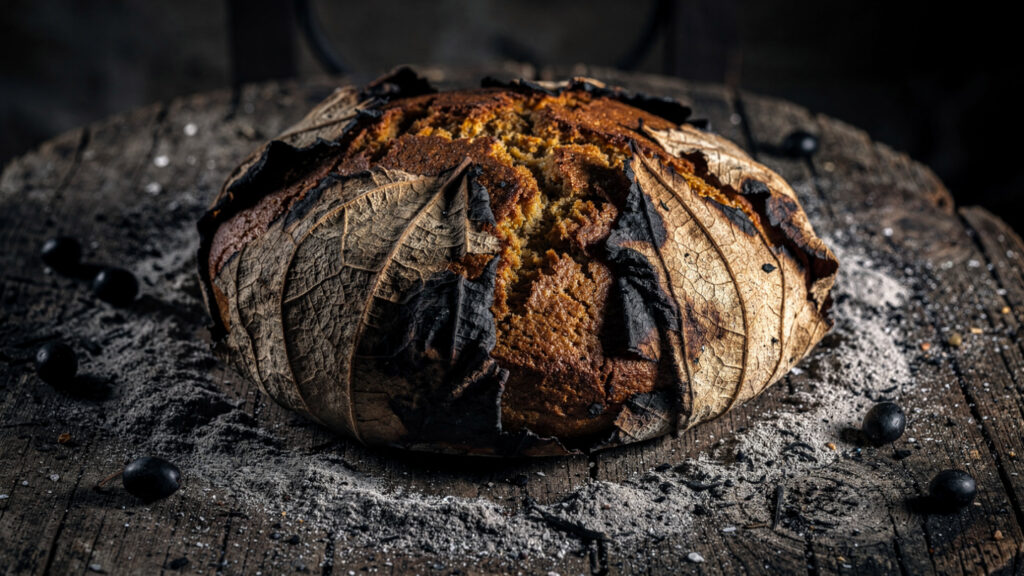
The dough shaped by hand into a round or a slab, laid into whatever pan the household owned, or shaped around a hearthstone, or wrapped in walnut leaves or fig leaves and buried directly in the hot ash of the fire. The leaf method did something the pan could not: it sealed the moisture inside the bread while the ash conducted an even heat around it, and the tannins in the walnut leaves moved into the dough during baking, adding a flavor that was not exactly smokiness and not exactly bitterness but something between the two that identified bobota to anyone who had eaten it before by smell alone.
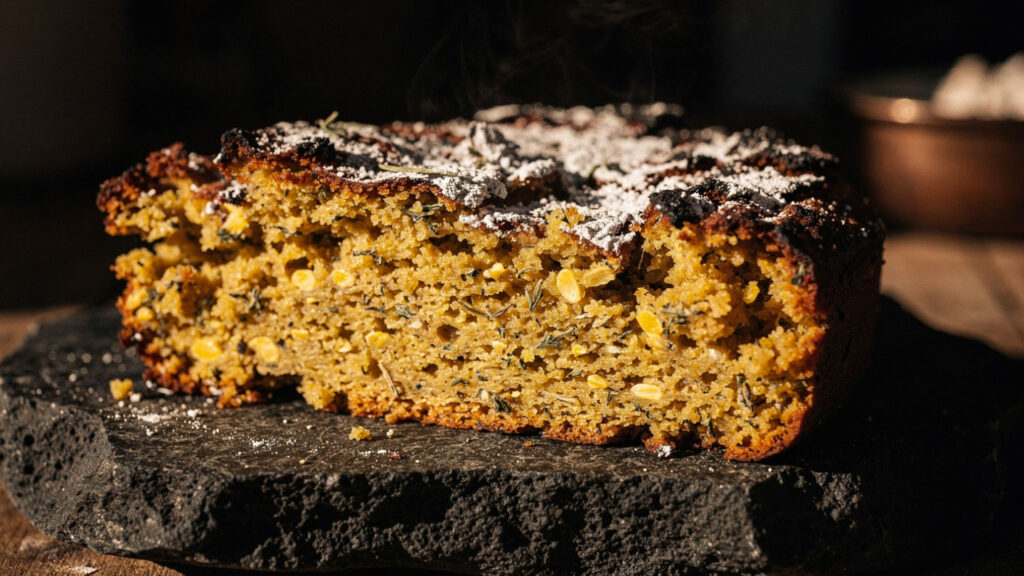
Dense when cut. Grainy in the mouth in a way that refined flour never is, the individual corn particles still present in the texture, resisting slightly before yielding. Paired with olives it was a meal. Drizzled with honey it became something closer to comfort. Eaten plain with nothing beside it, which was often the condition under which it was eaten, it was sufficient. That was the word that mattered: sufficient. Not good, not satisfying, not pleasurable. Sufficient. The standard that survival sets is precise and unromantic, and bobota met it.
The Women Who Made It
The making of bobota was women’s work in the sense that most of the labor of keeping a Greek household fed through the occupation years was women’s work. The men who had not been conscripted or killed or imprisoned were often absent from the domestic daily labor of procurement and preparation, and the women who remained managed the gap between what the family needed and what the available resources could provide.
The kneading of bobota dough is physical in a way that wheat bread dough is not. Cornmeal does not develop gluten. It does not become elastic. It must be worked into coherence by force, the water incorporated slowly, the mass persuaded rather than stretched into a consistency that will hold its shape through baking. Women who made bobota regularly developed a knowledge of when the dough was right: a particular resistance under the heel of the hand, a surface quality that indicated the moisture balance was correct, a weight and temperature that experience calibrated without instruments.
That knowledge was not written down. It passed from mother to daughter in the kitchen, transmitted through demonstration and correction and the accumulated failures that teach more reliably than instruction. When bobota disappeared from Greek kitchens after the war, the knowledge disappeared with it, held in the hands of women who were glad to have nothing left to apply it to and did not pass it on.
The Disappearance
The postwar generation wanted wheat bread. They wanted it urgently and without ambiguity. The association of bobota with hunger, with occupation, with the quality of deprivation that the war years had imposed, was strong enough that the food itself carried the memory. To eat bobota was to remember what eating bobota had meant, and the generation that had survived on it was not interested in maintaining that memory at the table.
By the 1980s, bobota had retreated almost entirely from Greek domestic cooking. It survived in the recollections of elderly women in rural areas, in the oral histories of the occupation years, in ethnographic records made by researchers who understood that the food cultures of wartime Greece were disappearing along with the people who had lived them. In restaurants it did not exist. In urban Greek kitchens it did not exist. It had become an artifact of a period that the culture had collectively decided to move past.
The moving past was necessary and understandable. It was also a loss of a kind: the loss of a food that encoded, in its ingredients and its method and its taste, a particular form of resilience that the culture had demonstrated under conditions it hoped never to face again.
The Return
The revival of bobota is recent and modest and comes from directions the postwar generation would not have anticipated.
The global appetite for heritage foods, for recipes that carry documented history, for preparations that use whole grains and minimal processing and ingredients whose provenance is legible, has created a context in which bobota’s qualities read differently than they did in 1945. What was coarse is now artisanal. What was corn rather than wheat is now gluten-free. What was made with whatever was available is now made with sourced local cornmeal and cold-pressed olive oil and herbs from a hillside. The poverty of the original is being translated into the intentionality of the revival, and the translation is not dishonest so much as it is a reminder that the meaning of a food is never fixed.
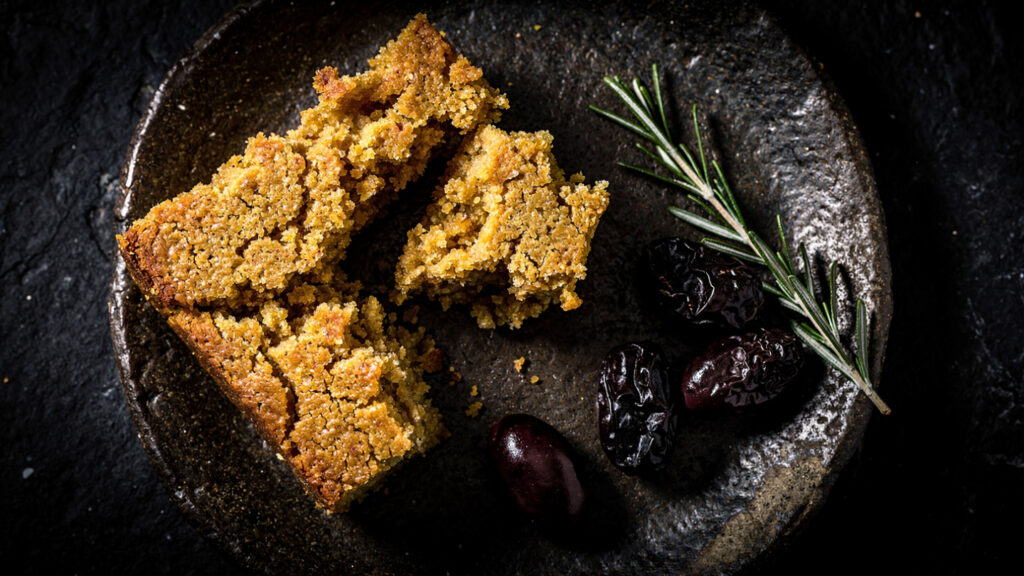
Some versions add feta pressed into the dough before baking. Some sweeten the base with honey or fold in raisins and cinnamon. Some bake it in small individual portions rather than the communal slab that a wartime kitchen would have produced. These are interpretations, and they are legitimate as interpretations, provided they are held alongside the original.
The original was not artisanal. It was necessary. That distinction is the thing worth preserving as bobota returns to Greek tables, because a food that has been through what bobota has been through carries an argument in its texture that no amount of feta or cinnamon can fully domesticate. The coarseness is the record. The density is the record. The leaf-and-ash method that no modern kitchen uses anymore is the record.
Bobota kept people alive during the worst years Greece faced in the twentieth century. That is not a heritage claim. It is a fact that the food itself, made correctly, will communicate to anyone who eats it with that knowledge in hand.
The Pie That Needs No Glamour
It will not appear on the cover of a food magazine. It does not photograph the way that moussaka photographs, or the way that a table of mezedes with wine and sea light behind it photographs. It is the color of dried corn and it sits on the plate without any gesture toward presentation.
That is its integrity. Bobota never needed to be beautiful because beauty was never what it was for. It was for the morning after a night when the ash had kept it warm. It was for the child who needed something in her stomach before the walk to school. It was for the family that had eaten worse and would be grateful for this.
The Greek culinary tradition is deep and diverse enough to contain both the elaborate and the austere, the celebratory and the sustaining. Bobota belongs to the sustaining end of that tradition with a specificity that no other bread in the culture matches. It is the food that the hardest years produced, and it tastes like what it is.
At Olympus Estate, Food & Seasonal Life traces Greek cuisine as a living calendar, from the harvest rhythms that filled the pithoi of Pavlopetri to the ash-baked loaves that carried families through occupation winters. The table has always held more than food.