




The Greeks invented the idea that how you dress is a statement about who you are.
This is not a metaphor for cultural refinement or an interest in appearances. Greek philosophical and political thought made the claim explicitly: clothing was a form of communication carrying the same weight as spoken language, and the choice of garment expressed the wearer’s relationship to civic life, to philosophical commitment, to divine expectation, and to the social codes the polis enforced through both law and pressure. The Greek world discussed clothing with the same seriousness it brought to ethics and politics, because it understood clothing as an extension of both.
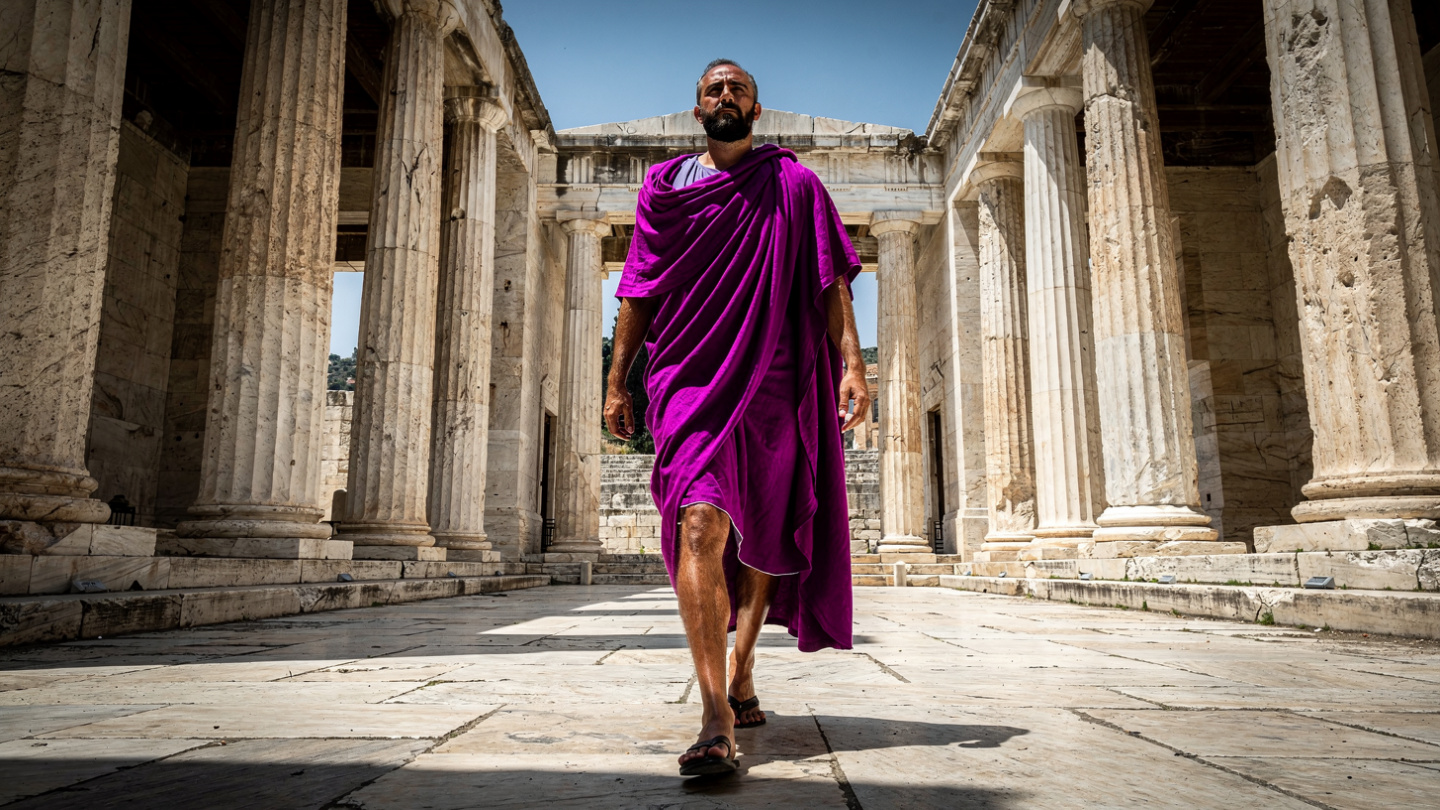
The anecdote about Alcibiades that Plutarch preserves in his Life demonstrates this most directly: Alcibiades walked through the streets of Athens wearing a purple cloak with gilded laces, the comic poets mocked him for it, and his political opponents cited it as evidence of the character that would eventually lead to his ostracism. The purple cloak was never simply an expensive garment. It was a political statement, since purple was the color of Persian luxury, and wearing it in Athenian streets in the decade after the Persian Wars amounted to a sartorial claim that the wearer stood above the democratic polis’s egalitarian norms. The mockery it drew was the democratic polis’s own answer to that claim.
The philosopher Empedocles, according to ancient biographers, wore bronze shoes, a purple cloak, a golden belt, and a laurel wreath. This was either madness or the most calculated self-presentation in the ancient world: Empedocles was performing the role of the divine sage, and every garment supported that performance. The bronze shoes were never comfortable. They were a statement about what Empedocles believed himself to be.
Ancient Greek clothing was a system of communication before it was ever a matter of comfort or aesthetics. Understanding the system means understanding what the civilization was saying to itself through the daily act of getting dressed.
The Materials and the Meaning They Carried
The two primary materials of ancient Greek clothing were wool and linen, and the Greeks themselves recognized and maintained a real social meaning in the distinction between them.
Wool was the domestic material, produced from the sheep of the Greek countryside and processed and woven inside the household, tied directly to the domestic virtue of the woman who produced it. The loom in an Athenian household was never simply equipment for making clothes. It was the site of one of the most symbolically charged activities in Greek domestic life: producing the textile that clothed the household was the female counterpart to the male civic activities of the agora and the assembly, and a woman’s skill at weaving was one of the primary markers of her social value and her marriageability.

Homer’s Penelope is the canonical literary embodiment of this association: the weaving she undid each night to delay the suitors was never simply a clever way to buy time. It was the assertion of her virtue through the most virtue-coded domestic activity available to her, and unraveling the work was exactly what made the deception morally acceptable, since she was undoing her own virtue-demonstration rather than counterfeiting it. The Athenian girls who worked in the Arrhephoria ceremony, weaving a new peplos for the statue of Athena on the Acropolis, performed a sacred version of the same domestic virtue in the city’s single most important religious context.
Linen was the luxury material, imported primarily from Egypt, more expensive than domestic wool, associated with the eastern Mediterranean’s more sophisticated textile world and with the warmer months, when its lightness and breathability set it apart from wool’s heavier texture. The shift from the woolen peplos to the linen chiton as Athens’s standard female garment, which occurred across the archaic period and which Herodotus explains through the story of Athenian women and their dress pins after the Aegina disaster, was simultaneously a material shift and a social one: the Ionic chiton needed different pins, produced a different drape, and allowed different movement than the Doric peplos, presenting an entirely different body to the viewer than the peplos ever had.
The colors available to ancient Greek textiles came directly from Mediterranean plant and animal dye sources: the yellow of safflower and saffron, the red of madder and murex, the blue of woad, and the purple of the Tyrian murex shellfish, which required enormous quantities of shellfish for small amounts of dye and was, as a result, the most expensive color available anywhere. The political and social coding of these colors stayed remarkably consistent across the ancient world: purple meant wealth, and in post-Persian War Athens specifically, the kind of wealth that could afford to be indifferent to democratic norms.
The Chiton, the Himation, and the Social Grammar of Draping
The garments of ancient Greek dress were never simply clothing types in the modern sense, categorical items chosen for weather and occasion. They were components of a social grammar whose combinations communicated a wearer’s civic status, gender position, and relationship to the values the polis maintained.
The chiton was the foundational garment for both men and women, a length of wool or linen, chosen by season and status, pinned at the shoulders and belted at the waist. Its draped silhouette is the form Greek sculpture renders in hundreds of variations, from the kouros and kore of the archaic period through the masterworks of the fifth century. Fabric shaped not by cutting and sewing but by weight, pinning, and movement is what makes the sculptural rendering of clothing one of the most demanding achievements in the whole history of marble carving. To depict draped cloth convincingly, a sculptor had to understand exactly how fabric behaves under gravity and motion, and this achievement reflects a culture that thought with real care about how cloth actually falls on a human body.
The himation, the large rectangular outer garment men wore over the chiton in the polis’s public spaces, carried the most elaborate civic coding of all. An Athenian citizen who wore his himation correctly, draped to leave the right arm free for the gestures of speech and expose the left shoulder in the way convention required, communicated his belonging to civic life without saying a word. The garment and the manner of wearing it were themselves the credentials. A Spartan who appeared in Athens without a himation, or wore it differently, signaled his foreignness as clearly as if he had announced it aloud.
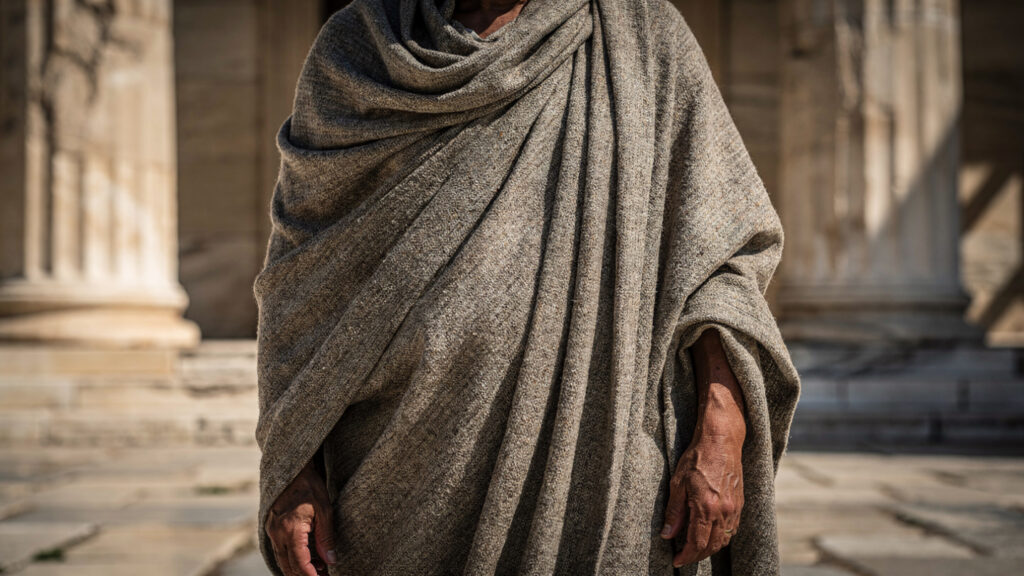
The exomis, the one-shouldered tunic baring the right arm and shoulder, was the workman’s and the slave’s garment, its draping suited to physical labor the way the himation’s draping suited speech and deliberation. The two garments together encoded the polis’s basic social distinction between those who worked with their bodies and those who deliberated with their words.
The chlamys was the military and traveler’s cloak, shorter than the himation and pinned at one shoulder, tied to the mobility military life and travel required rather than the stability civic life in the agora and the assembly embodied. A young man in Athens who wore the chlamys around the city rather than the himation was making a statement about his relationship to civic norms: the chlamys belonged to someone passing through, not someone settled into the city’s life.
Athletic Nudity
The most radical sartorial claim the ancient Greek world made, the one that most clearly distinguished Greek culture from every neighboring civilization and drew more comment from non-Greek observers than any other single feature of Greek life, was athletic nudity: training and competing wearing nothing at all.
The gymnasium, whose name comes from gymnos, the Greek word for naked, was the institution most closely tied to this practice. The daily training of the young male citizen took place in the nude. The athletic contests of the Panhellenic games were performed in the nude. And the whole visual world of the gymnasium and the palaestra, the unclothed male body in motion and at rest, is exactly what Greek sculpture devoted so much of its technical and imaginative energy to representing.

Several explanations for athletic nudity survive from antiquity. One claims it began when a runner lost his loincloth mid-race and won anyway, setting the precedent. Another connects it to the philosophical conviction that a well-trained body expresses a well-ordered soul, and that clothing conceals exactly this expression. A third holds that nudity marked the Greek citizen apart from the barbarian, since non-Greek athletes competed clothed.
What the practice actually accomplished in the gymnasium and the palaestra was making the male body a public object of evaluation, connected directly to kalokagathia, the union of physical beauty and moral excellence aristocratic culture treated as its highest ideal. The beautiful body in the gymnasium was never merely an aesthetic sight. It was visible proof of discipline and virtue, and judging the body meant judging a person’s success in exactly the moral project of self-cultivation aristocratic life demanded.
Greek philosophy understood the practice’s central paradox clearly. The gymnasium was the institution most closely tied to cultivating physical excellence, and simultaneously the institution most closely tied to the erotic culture surrounding the public display of the male body. Plato’s dialogues are set in the gymnasium and the palaestra as often as anywhere else, and an erotic charge runs through nearly every one that uses that setting. Socrates in the gymnasium, examining beautiful young men and asking them about the relationship between physical beauty and philosophical truth, is working inside the one institution where athletic excellence, civic virtue, and erotic education were most tightly bound together.
Female Dress and Its Regulations
The conventions and regulations governing female dress in ancient Greece were far more elaborate and far more formally enforced than those governing male dress, reflecting how central the female body was to civic and familial concern: it was the body whose reproductive capacity was the actual mechanism of legitimate civic succession, and regulating its presentation and exposure meant regulating the polis’s most fundamental mechanism for perpetuating itself.
The gynaikonomoi were the officials whose function included overseeing female behavior in public spaces. An Athenian woman on the city’s public streets was subject to scrutiny from officials whose authority extended to her dress, her comportment, and whatever occasion justified her presence outside the domestic sphere. The law Herodotus connects to the Aegina disaster, prescribing exactly what type of garment Athenian women should wear, is the most dramatic ancient example of the underlying principle that female dress was a matter of public concern, never simply private choice.
The pins that fastened the peplos are the detail Herodotus’s story focuses on as the actual mechanism of the violence the Aegina widows committed: the Aegina widows who killed the returning survivor with their dress pins were using the very fastening devices of the garment that subsequent legislation required be replaced with a pin-free alternative. The story channels anxiety about female violence through the domestic object the female body’s daily management itself produced, the instrument of modesty and containment becoming the instrument of killing.
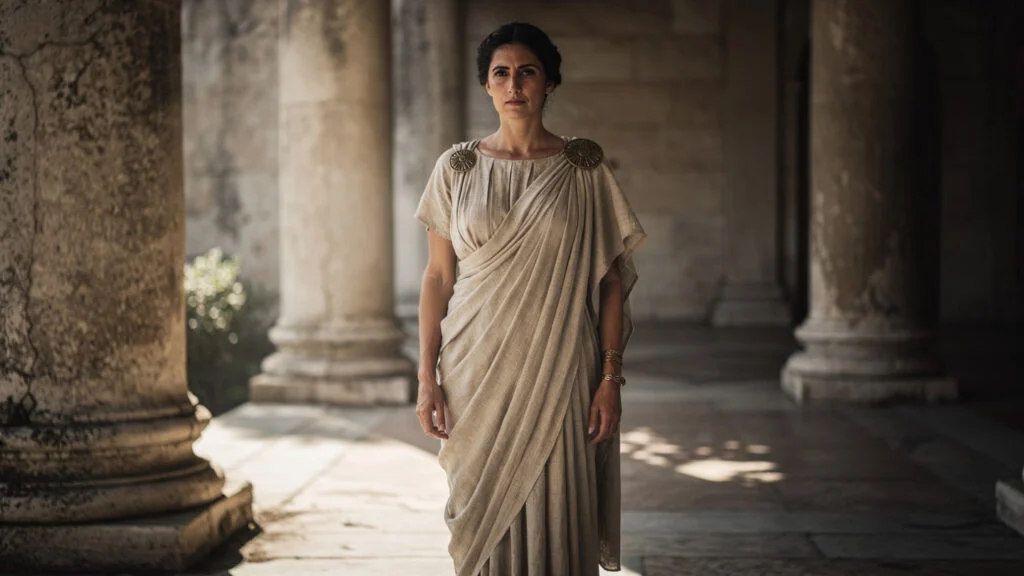
The colors linked to female dress differed from those linked to male dress in ways the sources describe directly. Yellow and saffron garments, worn by women at specific ritual settings such as the arkteia at Brauron and by the priestesses of Artemis, marked female participants in ceremonies that recognized the transitions of female life. The color of the garment was simply the ritual’s own way of identifying a wearer’s place inside the structure of the ceremony.
Cosmetics, Perfume, and the Philosophy of Adornment
Greek philosophy’s engagement with cosmetics and adornment came from a culture deeply invested in the distinction between the authentic and the artificial. The cosmetically enhanced female face was exactly where that distinction carried its greatest weight, the surface where questions of truth, deception, virtue, and display all became visible at once, and the site where philosophy pressed most directly on the tension between appearance and reality.
Xenophon’s Oeconomicus preserves the most extended ancient discussion of cosmetics in a domestic setting. Ischomachus tells Socrates he instructed his young wife not to use the white lead and red dye women applied to whiten and redden the complexion, on the grounds that a cosmetic face deceives the observer, while the unadorned face is the honest one. The products Ischomachus describes, white lead (psimythion) for whitening and red dye for the cheeks, were the standard cosmetic palette of an Athenian woman, and his wife’s abandonment of them in favor of her natural complexion was exactly the domestic virtue the Oeconomicus was recommending.
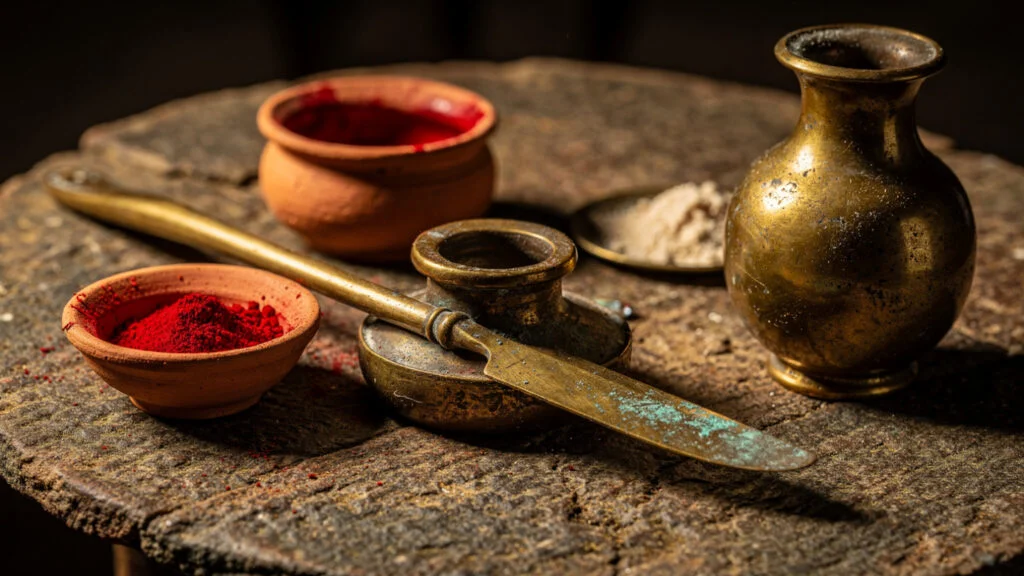
Ischomachus’s argument against cosmetics belongs to a philosophical current that consistently preferred reality to representation: a cosmetically enhanced face represented something other than what the face actually was, and anyone drawn to it was drawn to a fiction. A marriage built on attraction to that fiction was a marriage built on deception, and deception of any kind was unstable in the same way, since reality eventually surfaces from beneath whatever representation was covering it.

Perfume escaped this philosophical censure far more completely than cosmetics did, perhaps because there was no comparable concept of an authentic smell against which an artificial one could be measured. Both men and women applied scented oils and botanical perfumes, understood as enhancements of the body’s natural warmth rather than concealments of its natural appearance. The perfume industry of the ancient Greek world was genuinely extensive: Athens devoted a whole quarter of the agora to perfume sellers, and the season’s own scents, spring flowers, autumn resins, imported aromatics carried in from the eastern trade routes, were simply the smells of the city at different times of year.
Jewelry and Protective Adornment
The jewelry of the ancient Greek world was not primarily decorative. It was primarily protective, and its forms reflect exactly what protective functions the Greeks believed jewelry actually performed.
The evil eye belief running through Greek culture from Homer to the present, the understanding that an admiring or envious gaze could transmit real damage to whatever it fell on, was the foundation for a whole category of amulet jewelry meant to deflect or absorb that dangerous influence before it reached the wearer. Its forms, the animal-shaped pendant, the grotesque face with a threatening expression, the geometric pattern believed to carry protective properties, developed specifically to look back at whatever was looking at the wearer with dangerous intent.
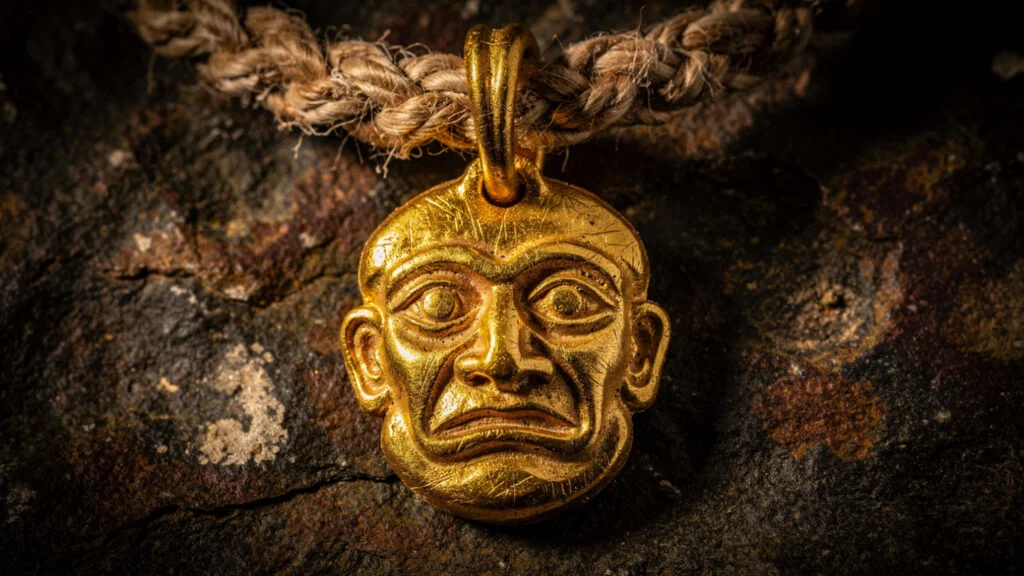
The gold jewelry the archaeological record has preserved in its most elaborate forms, the gold earrings, necklaces, and diadems from the Macedonian royal tombs at Vergina and from Hellenistic-period burials in the Black Sea Greek colonies, was luxury display and protective function at once: the gold’s material value announced the wearer’s status, while the jewelry’s own forms carried protective intent. The two functions were never in tension. In the ancient Greek view, the status the gold announced was itself a form of protection, since a high-status person occupied a place in the divine economy that conferred its own kind of divine attention and protection.
What Getting Dressed Meant
The ancient Greek morning’s act of dressing was the morning’s declaration of one’s position inside the polis’s own social grammar: the citizen who draped his himation exactly as civic convention required confirmed his membership in the civic body, the worker who tied his exomis for the day’s labor confirmed his position in the productive economy, and the woman who arranged her chiton and jewelry within the conventions governing female presentation was negotiating the tension between attractiveness and modesty the polis maintained as one of its most fundamental social concerns.
Philosophy’s own engagement with clothing simply extended this social grammar of appearance into the realm of self-understanding. Socrates in his single worn himation was making a philosophical statement about his relationship to the values expressed by the elaborate dress of the wealthy, and the statement was legible to anyone who saw him, because the conventions were shared and his deviation from them was visible. A philosopher who wore too little or too much was making an argument about what actually mattered, an argument carried in the fabric and the draping before a single word was ever spoken.
Treating clothing as a system of communication is what shaped the later Western understanding of fashion as a cultural force rather than a practical need. The insight that dress reveals character, that choosing a garment is a moral and political act as well as a functional one, that a community has a legitimate interest in what its members wear and how they wear it, finds its fullest ancient expression in exactly this system: present in the draped chiton, the carefully worn himation, the bronze shoes of Empedocles, and the purple cloak of Alcibiades.
The purple cloak was always the statement. The philosopher’s worn himation was always the counter-statement. What made both legible as statements, rather than simply as choices, was the system the ancient Greek world had built into the daily act of getting dressed.
At Olympus Estate, Cultural Chronicles traces the practices and institutions that defined Greek civilization from the inside. The ancient Greeks dressed knowing their dress was being read by everyone who encountered them: by the civic officials who monitored female presentation in the streets, by the comic poets who noted the purple cloaks of the vain, by a philosophical culture that measured the worn himation against the elaborate dress of the wealthy and found the worn himation more honest. Getting dressed in ancient Athens was never a private act. It was a civic one. It still is.