




The iconic blue and white of the Greek islands is approximately ninety years old.
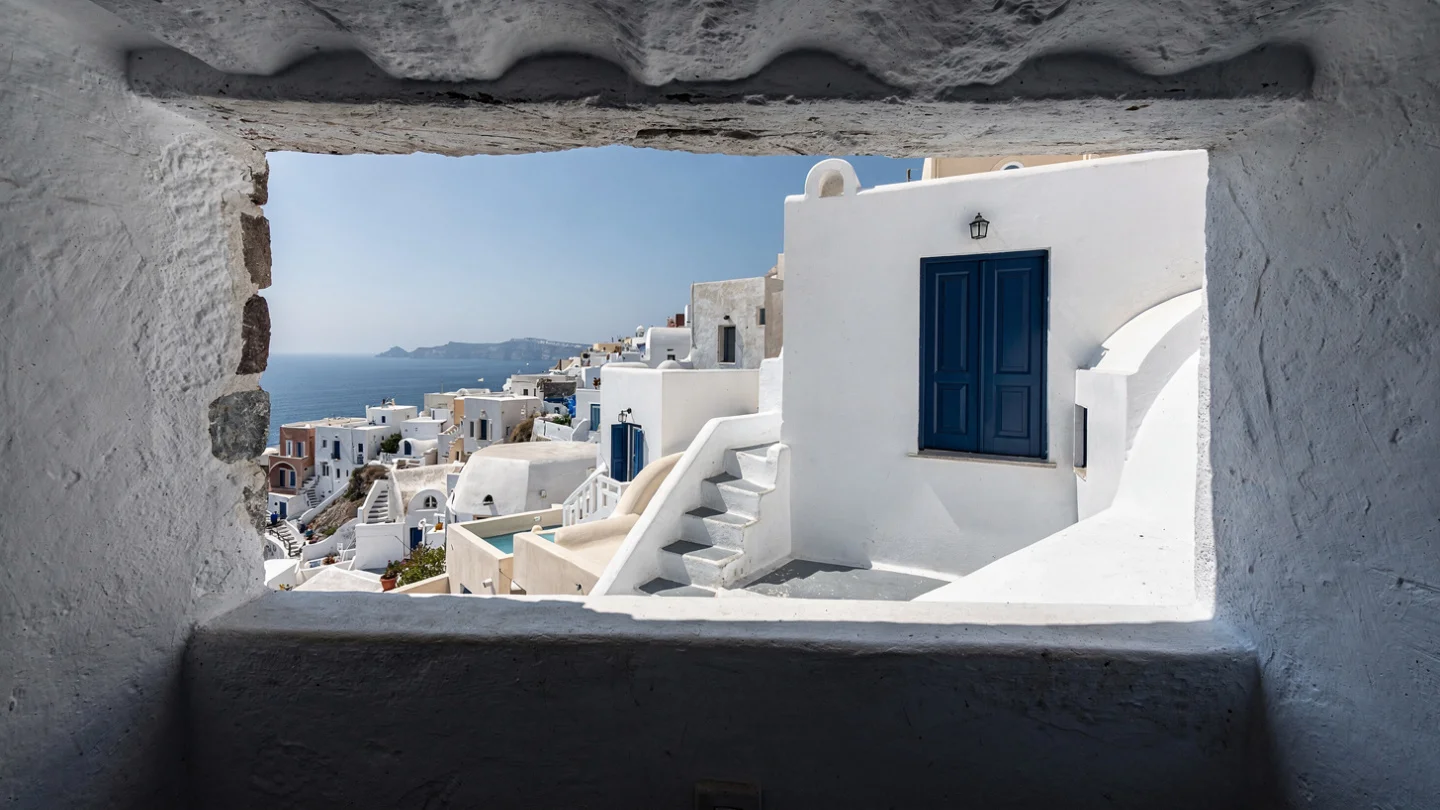
This is not the statement that the photograph on the travel brochure suggests. The whitewashed walls of the Cycladic village, the blue domed church, the cobalt-painted shutters and doors: these are the visual identity of a place that the twentieth century assembled from older practical traditions through a sequence of public health measures, political mandates, and the logic of the tourist gaze that consolidated the combination into the global icon it subsequently became.
The white is ancient. The blue and white combination is not.
Understanding how the most recognizable visual identity in Mediterranean travel was produced, and what it was before it became that identity, is understanding something true about the Cycladic landscape rather than something comfortable.
The White and Its Reasons
The whitewash of the Cycladic wall is lime: calcium hydroxide produced by burning the abundant local limestone, mixed with water and applied to the exterior surfaces of the buildings in successive thin coats that build up the quality of the Cycladic whitewash, the slightly uneven surface that catches the Aegean light differently from a flat painted wall and that weathers into the warm white of the well-maintained village house rather than the sharp white of a freshly painted wall.
The practical logic of the lime whitewash was the logic of the conditions of the Aegean island environment. The Cycladic islands are built from dark volcanic and metamorphic stone: the local stone that the building tradition used for walls absorbed the intense Aegean summer heat and radiated it into the interior of the house, turning the stone-built interior into an oven through the hottest months. The lime whitewash was the reflective coating that the island building tradition developed to address this: calcium hydroxide has a higher albedo than dark stone, reflecting rather than absorbing the incident sunlight and reducing the thermal mass effect that the dark stone walls otherwise produced.
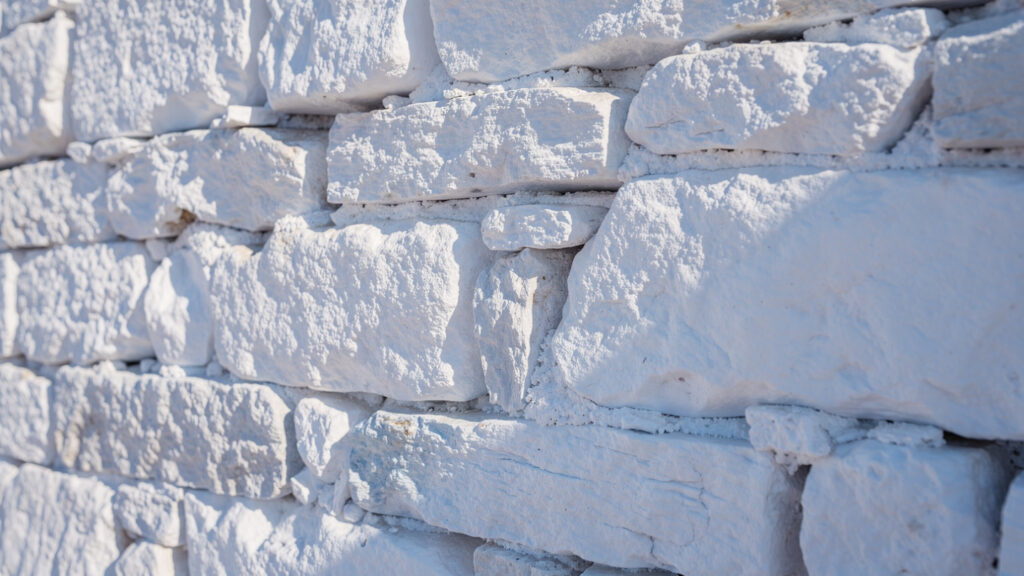
This was not a decorative choice. It was a functional one that produced the visual character of the Cycladic village as a secondary consequence of the thermal management that the island climate required. The brilliance of the whitewashed Cycladic village in the direct Aegean sun is the brilliance of a building technology solving an environmental problem, not the brilliance of a decorative tradition designed for its visual effect.
The lime whitewash had a second functional property that the island communities understood and used. Calcium hydroxide is strongly alkaline, and the strongly alkaline surface of the freshly whitewashed wall was inhospitable to the bacteria and fungi that would otherwise colonize the exterior surfaces of the buildings in the warm, humid conditions of the Aegean summer. The annual whitewashing of the house, traditionally undertaken in the spring before the heat of summer arrived, was the annual renewal of the building’s antibacterial surface as much as the renewal of its appearance.
The 1938 Mandate and the Cholera Logic
The universal application of lime whitewash across the Cyclades, which turned what had been a widespread but variable practice into the visual uniformity that the contemporary traveler encounters, was the consequence of a public health crisis and a government response to it.
In 1938, the government of Ioannis Metaxas, the right-wing authoritarian who had taken power in a coup in 1936, issued a mandate requiring the whitewashing of all buildings in the island communities as a measure against the cholera epidemic that was threatening the Greek population. The public health logic of the mandate was the logic that the lime’s alkalinity provided: calcium hydroxide applied to walls, floors, and surfaces was a genuine disinfectant whose alkaline properties killed the Vibrio cholerae bacteria. The mandate was a public health measure with a genuine scientific basis.
The consequence of the mandate for the visual character of the Cycladic village was the consequence of universalization: the buildings that had been whitewashed some years and not others, that had been whitewashed in some neighborhoods and not others, that had been whitewashed to varying degrees of thoroughness depending on the resources and the attention of the individual household, were now uniformly whitewashed by official requirement. The visual uniformity of the contemporary Cycladic village, the quality of whiteness that appears total and unbroken from a distance, was produced by the application of a public health mandate rather than by the organic development of a decorative tradition.
The Blue and Where It Came From
The blue of the Cycladic door and shutter and window frame and, in the most celebrated cases, the dome of the small island church, came from a different source than the white of the walls, and its origin explains both its color and its application pattern.
The blue paint that the Cycladic building world used for the woodwork of the houses was historically made from copper oxide or from indigo‑based pigments combined with limestone powder and a fixing agent. The blue that the visual inheritance most consistently associates with the Cyclades, the deep cobalt of the Santorini dome and the Mykonos shutter, was the blue that was available from the same materials that the Aegean fishing community used to paint the wooden hulls of their boats.
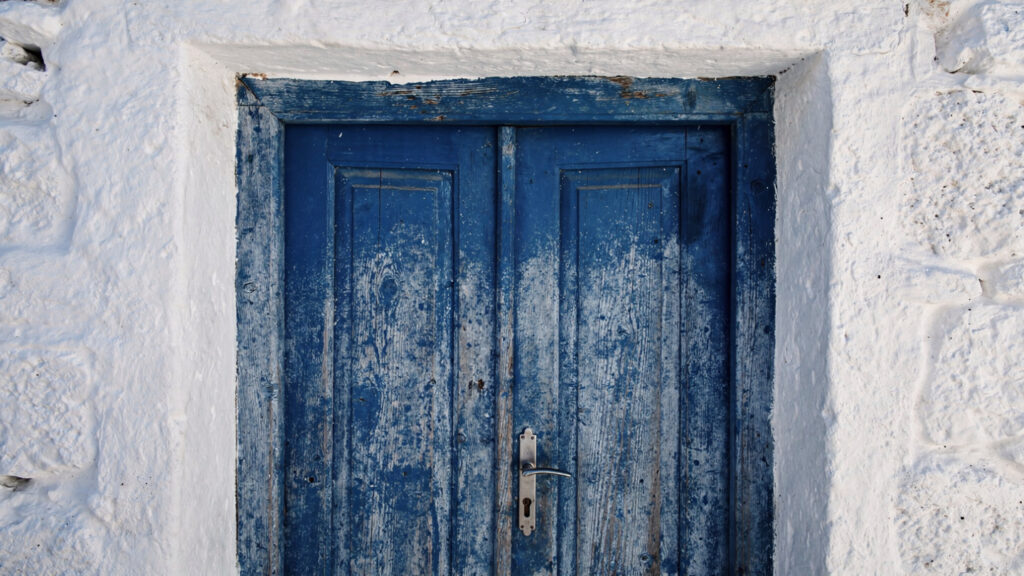
The copper oxide compound that protected wooden boat hulls from marine fouling, the growth of algae and barnacles that the unprotected hull accumulated in the sea, was a genuine antifouling agent whose blue-green color was the color of the copper salt rather than a color chosen for its visual effect. The fishermen who maintained their boats with this compound had the compound available in their households, and the application of surplus boat paint to the wooden elements of the house, the doors, the shutters, the window frames, the external staircases, was the practical application of available materials to a maintenance requirement rather than the expression of a color preference.
The application of the blue to the wooden elements and the white to the masonry elements was therefore a consequence of the materials available for each maintenance task: the lime wash for the masonry, the copper-based or indigo compound for the wood. The visual combination of the two was the combination that the materials of the island economy produced rather than the combination that a designer had chosen for its aesthetic effect.
The Junta and the Mandate
The final step in the production of the blue and white combination as a uniform national visual identity was taken by the military dictatorship that governed Greece from 1967 to 1974.
The junta that came to power in the colonels’ coup of April 1967 was a regime that understood the political utility of national symbols with the literalness of authoritarian governments that believe in the power of visible uniformity to produce a sense of shared national identity. The Greek flag is blue and white: the nine horizontal stripes of alternating blue and white with the white cross on blue in the canton represent the Greek national identity that the independence movement of the 1820s had defined. The junta’s application of this flag symbolism to the built environment of the Cyclades was the application of the flag’s colors to the most visible and most internationally photographed built environment in Greece, producing a visual national identity statement in the medium of the architecture that tourists photographed.
The 1974 regulation, passed in the final year of the junta before its collapse following the Cyprus crisis, mandated that the houses of the Cycladic islands be painted in the blue and white combination that the regime had identified with Greek national identity. The regulation was the formalization of what the combination of the whitewash practice and the boat‑paint application had already produced in many Cycladic communities, but its application as a legal requirement rather than a traditional practice was the junta’s transformation of a vernacular building world into a national identity statement.
The regulation has been substantially relaxed since the restoration of democracy in 1974 and the subsequent accession to the European Community, but its aesthetic legacy remains: the blue and white combination is now sufficiently established as the expected visual identity of the Cycladic village that the communities maintain it by convention and by the demands of the tourist economy that the visual identity supports, regardless of the original legal mandate that established it.
The Architecture Beneath the Color
The visual identity of the blue and white is so powerful that it can occlude the architectural world that produces the surfaces on which it appears, and the Cycladic vernacular architecture that the whitewash covers is worth understanding on its own terms as an architectural tradition of considerable sophistication.
The Cycladic village was not designed. It was grown: the agglomerate of interconnected buildings, shared walls, common terraces, and the narrow labyrinthine lanes that connect the building clusters emerged through the accumulated decisions of many generations of builders working within the constraints of the island environment rather than through the formal design of any single planner or architect. The character of the labyrinthine village lane, the narrow passage that turns unexpectedly and that a stranger navigates with difficulty, was not designed for the convenience of the visitor: it was designed for the inconvenience of the pirate, the defensive logic that the Cycladic communities developed during the centuries of Aegean piracy when the primary threat to the island community came from the sea.
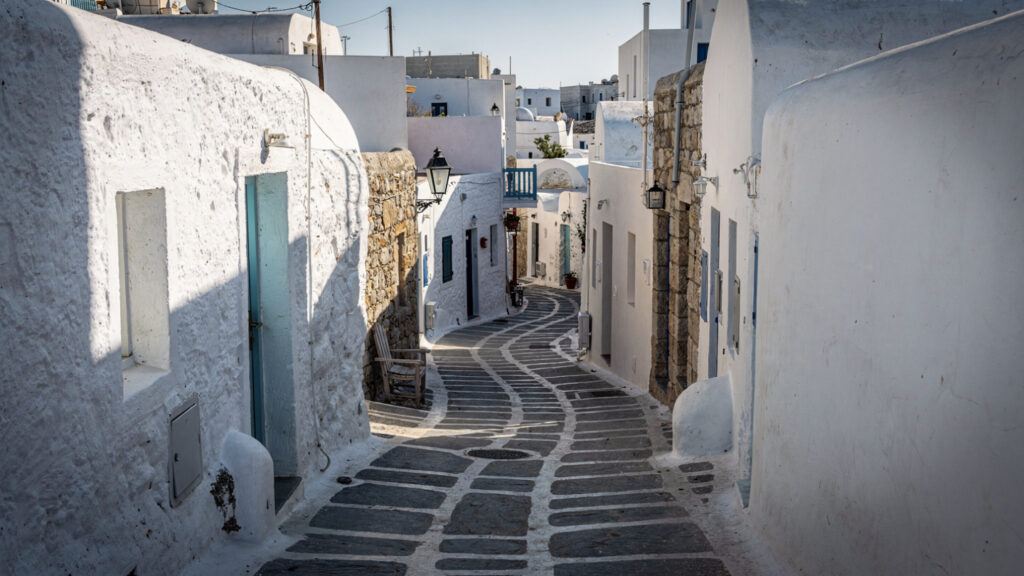
The building technology of the Cycladic house is the technology of the materials available on the islands: the dark volcanic and metamorphic stone of the island geology, the locally produced lime mortar that bonded the stone walls, and the thin stone slabs of the flat roof whose structural logic, the horizontal slab rather than the pitched roof of the northern architectural tradition, was the logic of an island environment where snow loads were not a structural concern and where the flat roof surface could be used as an additional living and working space accessible from the upper story of the house.
The spatial organization of the Cycladic house interior, the single main room that combined the cooking and eating and sleeping functions of the household with the furniture hierarchy that organized the space, was the spatial organization that the limited interior volume of the island house required: on islands where building material had to be quarried from the island’s own geology and carried by hand to the building site, the economy of space was the economy of labor, and the small room that served multiple functions was the small room that could be built and maintained by the resources of the island household.
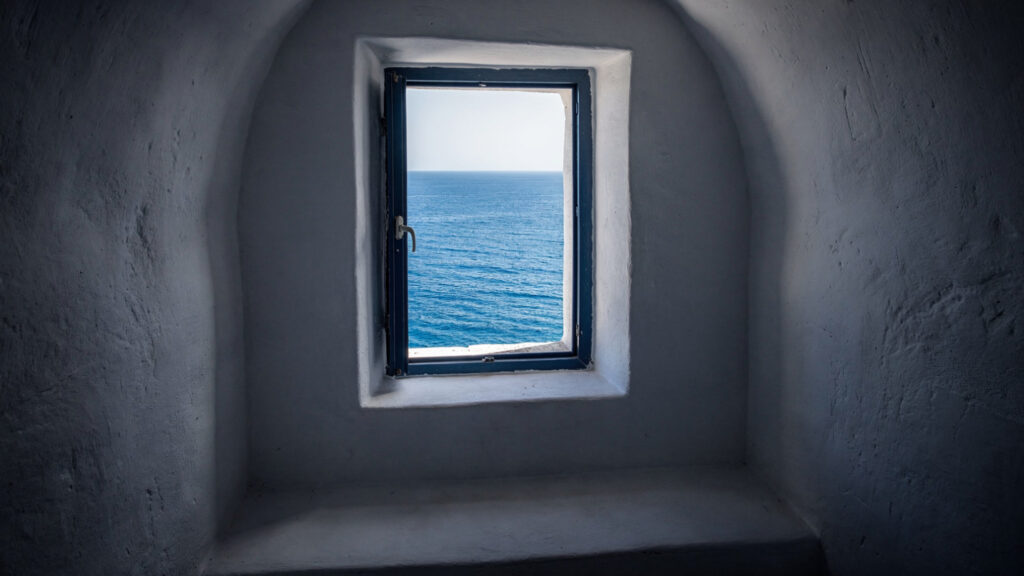
The quality of the light in the Cycladic village interior, the cool white-reflected light that enters through the small windows whose size was calibrated to admit light without admitting the summer heat, is the quality that the combination of the white exterior surfaces, the small apertures, and the thick walls produces: the experience of entering a Cycladic house interior from the full intensity of the Aegean summer sun is the experience of the building technology performing its thermal function, a temperature differential that the lime whitewash and the small windows and the thick walls achieve together.
What the Tourist Photograph Does Not Show
The visual identity of the blue and white Cyclades is the identity that the tourist photograph consistently shows, and there are things about the Cycladic built environment that the tourist photograph consistently does not show.
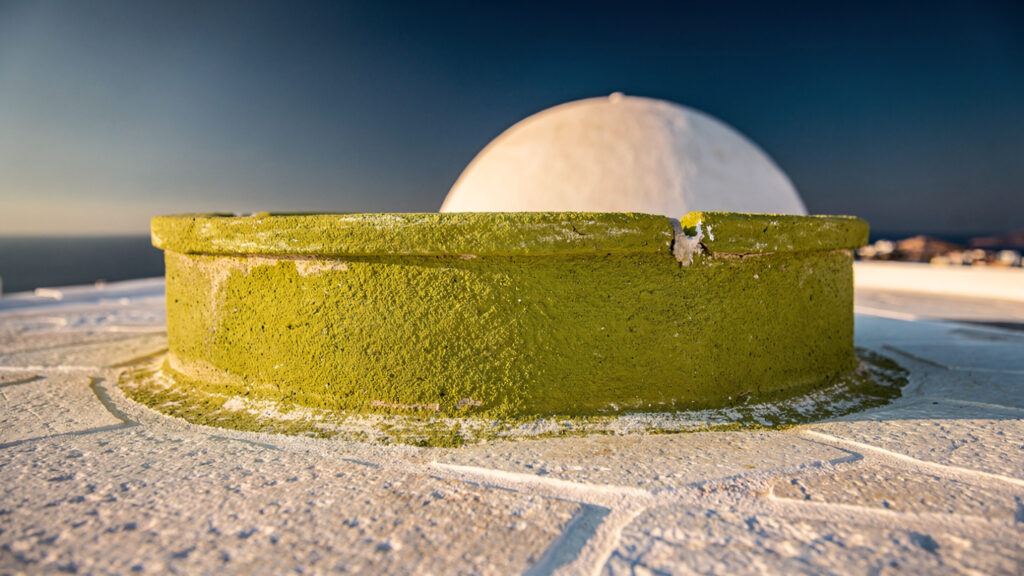
The tourist photograph does not show the rooftop water cisterns, the infrastructure that the rainwater harvesting system requires on islands where freshwater scarcity was the defining constraint on human settlement: the flat roof that the aerial photograph shows as the white surface of the village was the flat roof that the island community used to collect the winter rainfall that the cistern beneath the house stored for the summer months. The cistern architecture, the sealed underground chamber whose lime-rendered interior surface preserved the water quality through the long dry summer, is the infrastructure that the whitewashed village was built to support as much as it is the infrastructure that the whitewashed village was built around.
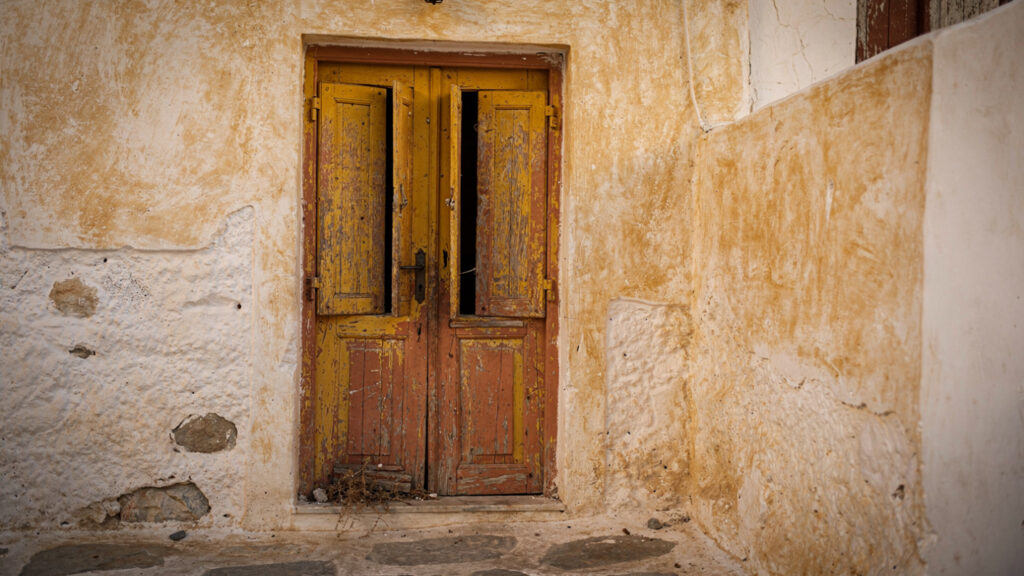
The tourist photograph does not show the original polychrome variety of the Cycladic building tradition before the junta’s mandate imposed the blue and white uniformity: the ochre and terracotta and the dark blue-grey of the local stone that appeared in the doors and shutters and the occasional painted wall surface of the pre-mandate village were the colors that the materials and the aesthetic preferences of the individual household produced before the regulation imposed the uniform palette.
The tourist photograph does not show the relationship between the blue and white of the village exterior and the interior of the house that the exterior was protecting: the cool, dark, slightly austere interior that the small windows and the thick walls and the whitewashed ceiling produce is the interior that the exterior was built to create, and the experience of sitting in the interior of a well-built Cycladic house in the middle of the August afternoon is the experience of the building tradition performing its central function.
The Legacy
The blue and white of the Greek islands is one of the most powerful visual identities in contemporary global culture: recognized from the photograph before the destination is named, associated with the qualities of Mediterranean summer, light, and leisure that the Cycladic visual environment embodies in its most concentrated form.
The process by which this visual identity was produced, the lime whitewash of the practical building world, the 1938 public‑health mandate that universalized it, the boat‑paint surplus that produced the blue woodwork, and the 1974 junta regulation that mandated the combination as the national visual identity, is a process whose history is more interesting than the mythology of the eternal blue and white tradition that the tourism literature consistently presents.
The Cycladic village was not always blue and white. The blue and white was assembled through the history of the twentieth century from older practical worlds that served different purposes. The assembled visual identity became, through the mechanism of the tourist gaze and the global circulation of the Aegean island photograph, one of the most widely recognized visual symbols of place in the contemporary world.
The island is more interesting than the photograph. The architecture is more interesting than the color. The history of how the color was imposed is more interesting than the mythology of how the color was always there.
Go to the Cyclades. Stand in the shadow of the whitewashed wall at midday when the shadow temperature is ten degrees lower than the sun. Enter the cool dark interior. Sit at the window and watch the light on the sea. The building is doing what it was built to do. The color is the consequence of that function. The function is still working.
At Olympus Estate, Cultural Chronicles traces the practices and institutions that defined Greek civilization from the inside. The white of the Cycladic wall is lime whitewash, the practical response to dark volcanic stone absorbing Aegean summer heat. The 1938 mandate universalized it as a cholera disinfectant. The blue came from surplus boat paint. The 1974 junta mandated the combination as national identity. The photograph that defines the Greek island in the global imagination was assembled across the twentieth century from materials that were solving practical problems. The buildings knew what they were doing before the photograph did.