





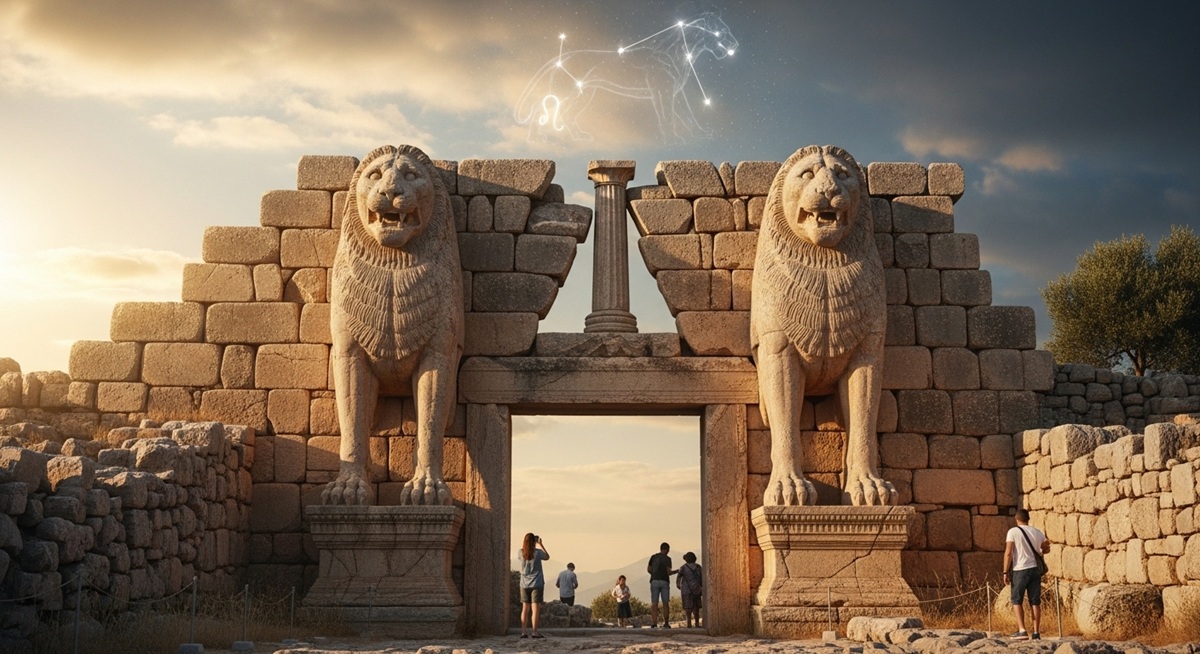
Imagine standing at the threshold of a forgotten world, where colossal stones whisper tales of gods, heroes, and the unyielding gaze of the heavens. High on a windswept hill in Greece’s sun-baked Peloponnese, the ancient citadel of Mycenae looms like a sentinel from a bygone era. This is the beating heart of Bronze Age glory, the fabled seat of King Agamemnon, the warlord who unleashed a thousand ships against Troy in Homer’s immortal epic. But amid the echoes of clashing bronze and the glint of golden grave goods, one feature demands your undivided awe: the Lion’s Gate.
Carved with ferocious precision around 1250 BCE, this monumental portal is flanked by two snarling lionesses, their paws planted firmly on either side of a sacred column, frozen in eternal vigilance. Tourists snap photos, historians pore over blueprints, but few pause to wonder: What if these beasts weren’t just symbols of brute force? What if they encoded a profound celestial riddle, linking the earthly might of Mycenae to the fiery sign of Leo in the Zodiac?
The Ferocious Majesty: Lions as Emblems of Power in Mycenaean Society
In the shadow of Mycenae‘s jagged peaks, the lion was the ultimate archetype of dominion. For the Mycenaeans, a warrior elite who dominated the Aegean from roughly 1600 to 1100 BCE, this creature embodied the raw, untamed essence of rulership. Think of it: a society forged in the fires of conquest, where palaces brimmed with Linear B tablets tallying olive oil and chariot wheels, yet every fresco and seal screamed of predatory supremacy.
From Savanna to Stone: The Lion’s Arrival in the Aegean World
Lions didn’t roam wild in ancient Greece, yet their image prowled every corner of Mycenaean art. Imported from the exotic realms of the Near East—via trade routes snaking through Crete and Anatolia—these beasts arrived as living trophies for elite hunters, their manes a cascade of solar fire. Seals unearthed from Mycenae‘s royal tombs depict kings wrestling felines, a motif borrowed from Mesopotamian overlords but infused with local ferocity. Why lions? Because in a world without written constitutions, symbols spoke louder than swords. The lion declared: I am the apex predator; my realm is unbreakable.
Archaeologists like Christos Tsountas, who excavated the site in the late 19th century, noted how these carvings transcended decoration. They were psychological warfare etched in limestone—reminders to invaders that crossing this threshold meant facing the claws of royalty itself.
The Lion’s Gate: Engineering a Myth in Massive Masonry
Step closer to the Lion’s Gate, and its genius unfolds. Towering 9.5 feet high, the entrance is a symphony of cyclopean masonry, those gargantuan boulders—some weighing up to 20 tons—stacked without mortar, defying earthquakes and time. Legend credits the Cyclopes, those one-eyed titans of Greek lore, but human ingenuity prevails: ramps, levers, and sheer communal will hauled these monoliths into place.
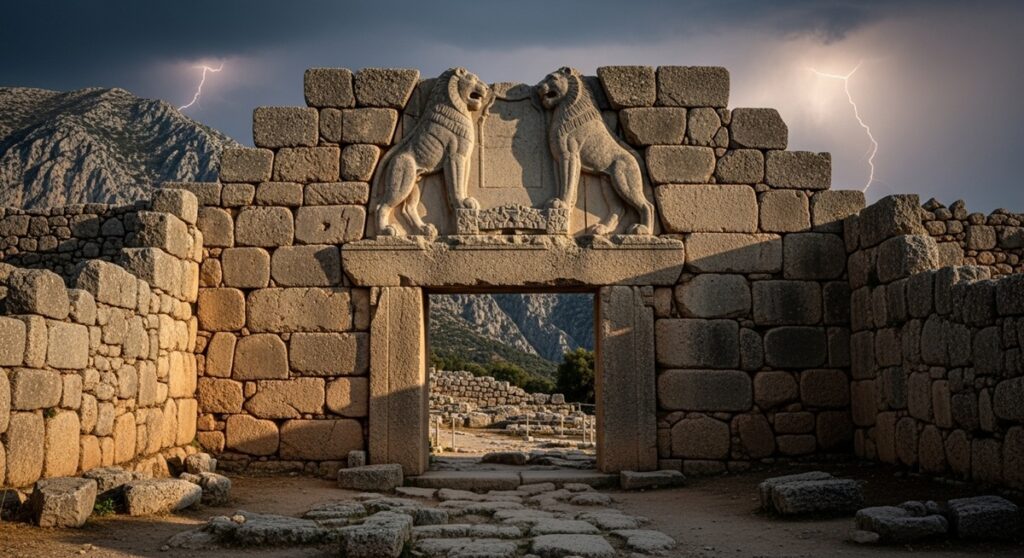
At the apex sits the relieving triangle, a clever void above the lintel that bears the wall’s crushing load, allowing the space for our iconic guardians. The two lionesses—not lions, mind you, a deliberate choice evoking Minoan influences from Crete—flank a missing central stele, perhaps once topped with a cult figure like a goddess or deity. Restored in the 20th century after erosion claimed much of the relief, they now roar anew, their bodies arched in heraldic symmetry.
The gate’s orientation—facing northeast—might align with processional routes from the plain below, funneling pilgrims and plunder alike under the beasts’ judgmental stare. In a citadel ringed by double walls and secret passages (like the famous tholos tombs), the Lion’s Gate was the front door to fear, a billboard of intimidation for any foe eyeing the Argolid’s riches.


Heroes in the Heat: The Lion’s Role in Epic Greek Mythology
Beyond bricks and bravado, the lion prowled the Mycenaeans’ storytelling soul. Their world was one of oral epics, where bards spun yarns of demigods toppling tyrants—tales that would crystallize in Homer’s Iliad centuries later. At Mycenae‘s core lay the cursed House of Atreus, a dynasty dripping with betrayal and bloodlust, yet crowned by Agamemnon‘s golden scepter.
Slaying the Beast: Heracles and the Nemean Lion’s Enduring Echo
No myth captures the lion‘s mythic charge like the labors of Heracles. His first trial? Dispatching the Nemean Lion, a monstrous terror whose golden fur laughed at arrows and whose jaws snapped spears like twigs. Born of the union between monstrous parents Typhon and Echidna (or so Hesiod claims), this beast haunted the wilds near Nemea, a valley just 15 miles from Mycenae. Heracles, armed only with cunning and club, strangled it in its lair, skinned it with its own claws, and draped the pelt as armor—a badge of impossible victory.

Why does this matter for Mycenae? Because the Nemean saga roots the lion in Peloponnesian soil, transforming it from imported exotic to local legend. Mycenaean kings, styling themselves as Heracles-like champions, likely invoked this tale in rituals. Gold signet rings from the site show similar hunts, blurring art, myth, and memory. The Nemean Lion wasn’t slain in isolation; it was a proxy for chaos tamed, a heroic blueprint for rulers who saw themselves as cosmic enforcers.
Threads of Fate: Lions in the Broader Tapestry of Greek Lore
Zoom out, and lions lace through other yarns. In the Oresteia by Aeschylus, Agamemnon‘s return from Troy unravels in lionish savagery—his wife Clytemnestra likens their doomed embrace to a lion cub raised in the house, only to devour its masters. Even the Sphinx of Thebes, that riddle-spouting horror from Oedipus’s tale, bore leonine flanks. These stories, though penned post-Bronze Age, draw from Mycenaean wellsprings, where the lion symbolized not just strength, but the perilous edge of hubris. To wear the lion’s skin was to court glory—and downfall.
Stellar Thrones: Bridging the Lion’s Gate to Leo in the Zodiac
Now, pivot skyward. The Zodiac, that glittering wheel of 12 signs charting the ecliptic, predates the Greeks by millennia. Babylonian astronomers sketched it around 1000 BCE, but echoes ripple back to Sumerian star-maps. By Mycenaean times, seafaring traders carried these ideas westward, seeding the fertile ground for Hellenistic astrology. Enter Leo, the fifth sign, a sprawling constellation mimicking a prowling cat, its brightest star Regulus (Latin for “little king”) blazing like a crown jewel.
The Solar Sovereign: Leo’s Astrological Dominion
Leo, spanning late July to August, basks under the Sun’s rulership—the ultimate celestial monarch. Astrologers ancient and modern attribute to it traits that scream Mycenaean: unyielding leadership, theatrical flair, and a heart as fierce as a forge. The Sun in Leo ignites creativity and command, but beware the shadow—ego unchecked becomes the rampaging lion. In Vedic traditions (linked via Indo-European roots), it’s Simha, the lion who devours ignorance. For Mycenae‘s sun-worshipping elite, this resonance must have sung like a lyre.
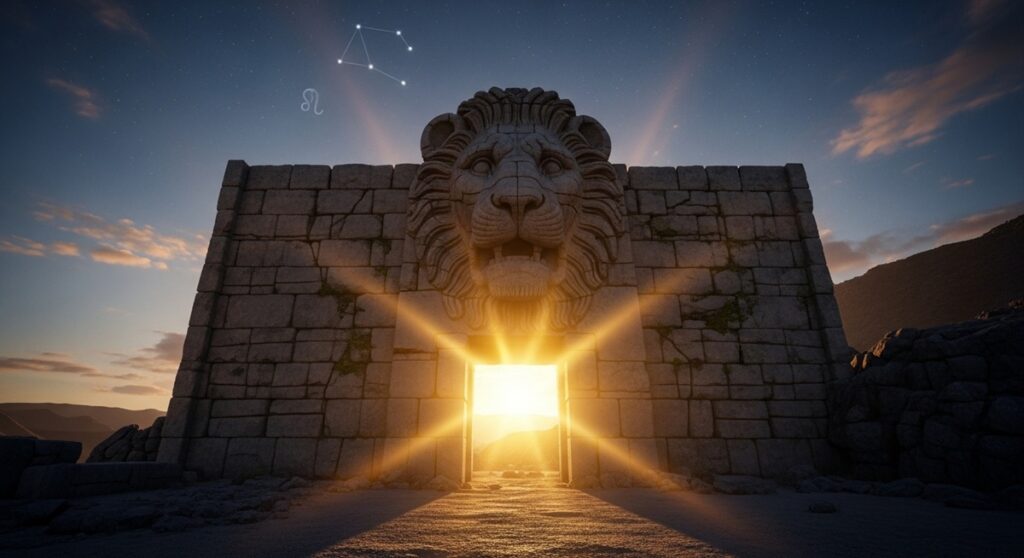
But was it coincidence? Or did the House of Atreus deliberately hoist their emblem under Leo’s watchful eye?
Aligning Earth and Sky: Archaeoastronomy’s Bold Hypotheses
Archaeoastronomy—the study of ancient sky-lore in monuments—illuminates tantalizing paths. Though Mycenae yields no star-charts (Linear B focused on ledgers, not longitudes), parallels abound. Egypt’s pyramids track Sirius; Stonehenge cradles solstices. Could the Lion’s Gate do the same?
Consider the gate’s northeast bearing: In the 13th century BCE, the summer sunrise—when the Sun “entered” Leo—would have crested near that azimuth, bathing the lions in dawn’s first gold. Scholars like Anthony Aveni argue such alignments consecrated spaces, merging mundane gateways with divine portals. Imagine Mycenaean priests timing dedications to this heliacal rising, invoking Leo’s solar vigor to bless Agamemnon‘s campaigns. The central column? Perhaps a gnomon, casting shadows that danced with constellations.
Skeptics counter: Precession (Earth’s wobble shifting stars over millennia) muddies exact math, and no texts confirm intent. Yet frescoes from Akrotiri on Thera (erupted circa 1600 BCE) show celestial motifs, hinting at broader knowledge. If true, the Lion’s Gate becomes a zodiacal time capsule—a stone zodiac entry proclaiming Mycenaean kings as solar scions, their fate intertwined with Leo’s roar.
Echoes Across Eras: The Lion’s Gate in Modern Imagination
Fast-forward through cataclysms: the Bronze Age Collapse toppled Mycenae around 1100 BCE, burying it under olive groves until Heinrich Schliemann’s spade in 1876 unearthed Agamemnon‘s “mask” (spoiler: not his). Today, the site draws 100,000 visitors yearly, each dwarfed by those eternal sentinels. Pop culture nods too—from the gate’s cameo in 300 to astrologers pondering Leo’s traits in leadership podcasts.
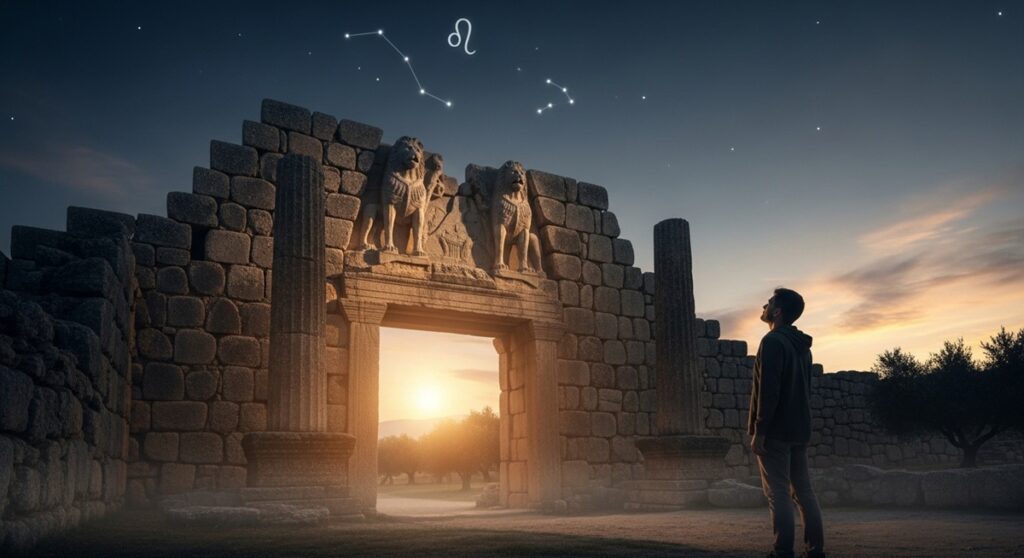
Yet the real magic? Personal resonance. Stand there at dawn in August, phone silenced, and feel the pull: Are you the hero facing the Nemean Lion, or the king under Leo’s gaze? This convergence of stone and stars invites us to question our own alignments—how do we encode our destinies in the monuments we build?
Eternal Guardians: Why the Lion’s Gate Still Captivates
In the end, whether by deliberate design or poetic serendipity, the Lion’s Gate fuses Mycenae‘s martial pulse with Leo’s stellar fire. It’s a Bronze Age billboard: Here rules the sun-king, guarded by heaven’s fiercest sign. The Mycenaeans, those architects of empire, didn’t just build walls—they sculpted a legacy where myth met astronomy, heroism met the horizon.
As you trace the weathered flanks of those lionesses, remember: Beneath this threshold, epics ignited, stars aligned, and the Zodiac‘s secrets slumbered in stone. Mycenae endures not as relic, but revelation—a call to look up, claim your roar, and step boldly through your own gates.