



Athenaeus knew the names of seventy-two different kinds of ancient Greek bread.
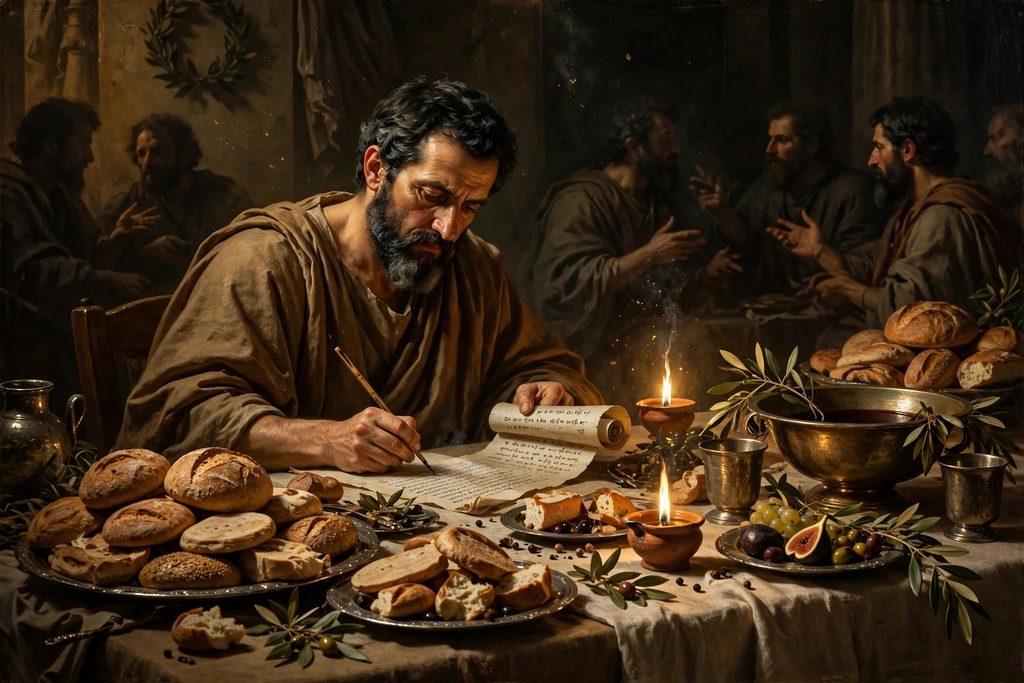
Writing in the second or third century CE, the grammarian and gastronome from Naucratis compiled the Deipnosophistae, a sprawling work of dinner-table conversation whose participants discuss, across fifteen books and thousands of quotations from earlier sources, everything the ancient world ate and drank and thought about eating and drinking. In Book Three, he turned to bread, and the catalogue he produced is one of the most startling documents in the history of food. Modern tallies of the names he records, drawn from bakers, comic poets, and food writers going back centuries before his own time, land at seventy-two, each with its own region of origin, its own social standing, and in some cases its own recipe.
Seventy-two breads. More varieties than most contemporary artisanal bakeries in any city on earth can currently name, produced by a civilisation remembered primarily for its philosophy and its architecture and its wars rather than for its extraordinarily varied relationship with what people ate every day.
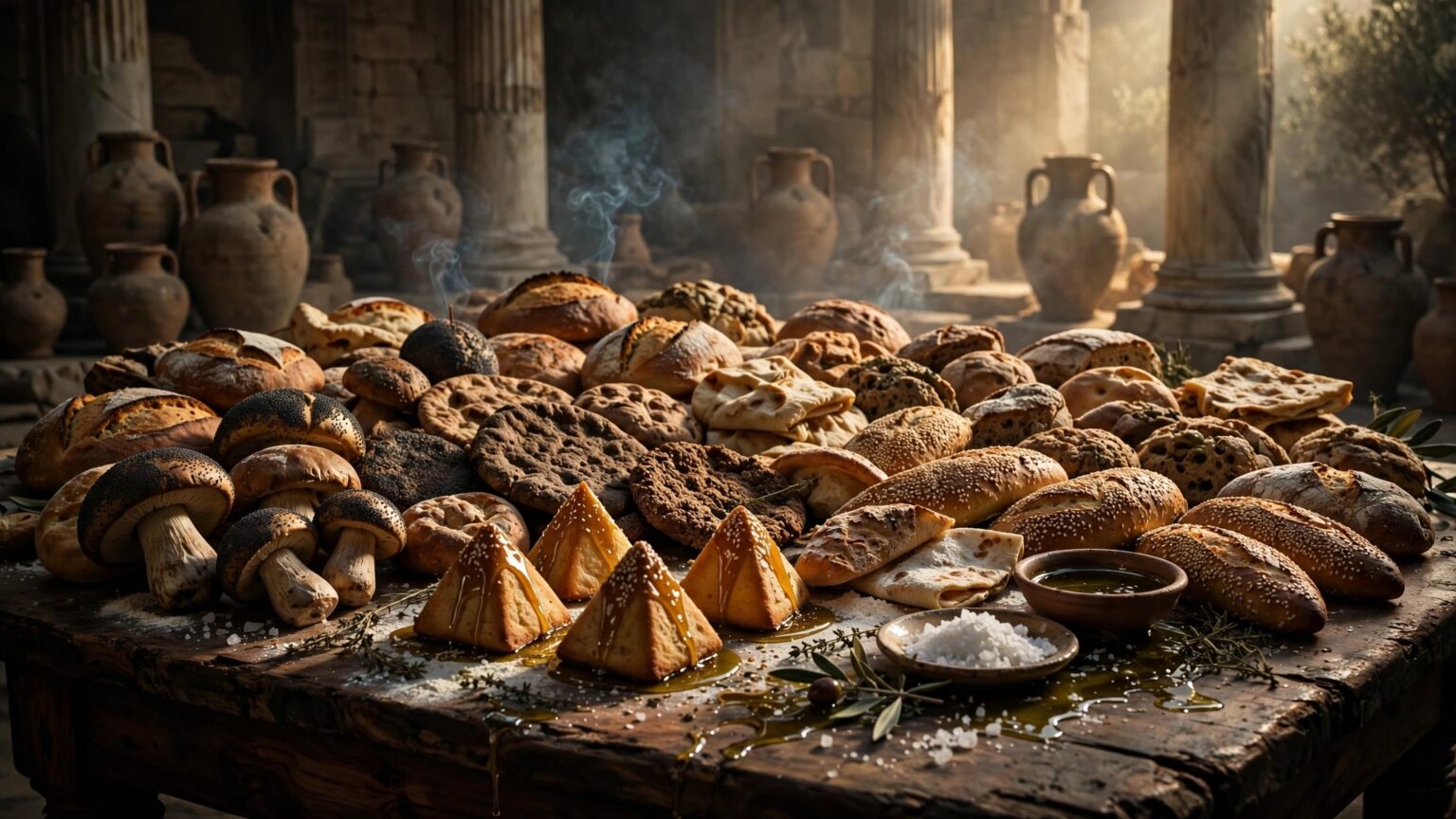
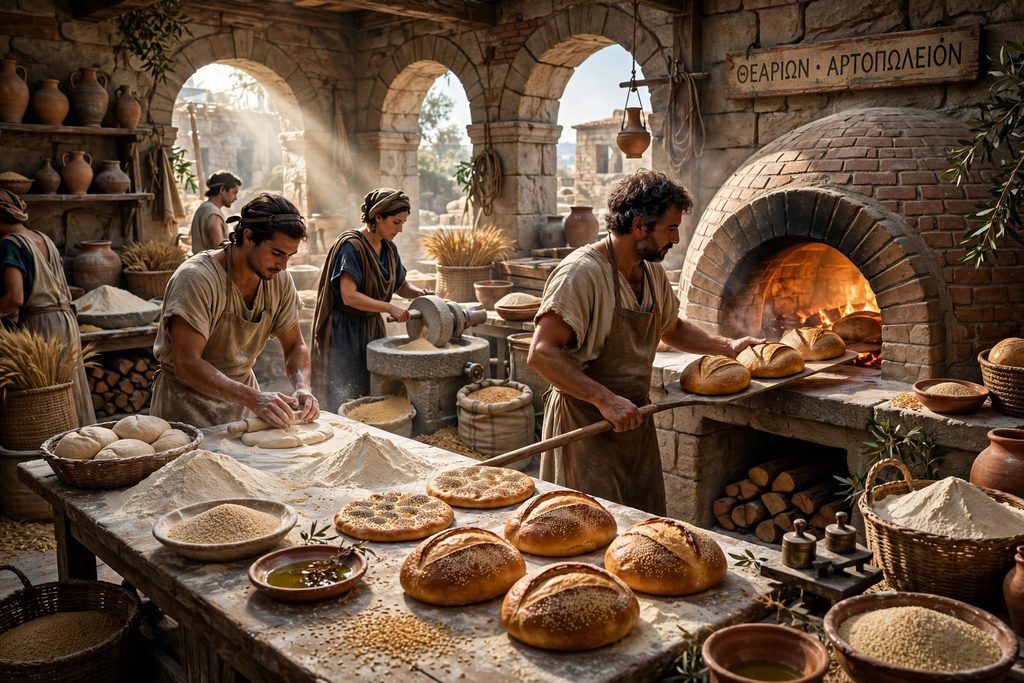
The varieties Athenaeus documented included griddle cakes, honey-and-oil bread, mushroom-shaped loaves scattered with poppy seed, and the military ration of rolls baked on a spit. They included bread made with wild lettuce worked into the dough, bread boiled rather than baked, bread buried directly in hot ash without a vessel, bread shaped for offering to the gods, bread enriched with cheese and honey for festival tables, and the bread that senators of Athens were legally required to eat by a law of Solon. They included the loaf sold from the commercial bakeries that operated in Athens by the fifth century BCE, part of an urban food economy sophisticated enough to produce famous names. One baker, Thearion, was well known enough that Plato could use him as a stock reference in the Gorgias, listing him alongside a cookbook author and a wine merchant as the kind of specialist who flatters the body rather than actually caring for it. Socrates meant it as an insult to a certain style of politics, not a compliment to baking, but an insult only works if the audience already knows the name. Athens in the fifth century BCE knew its bakers by name.
Bread arrived early in Greece and never really left. The first farmers appear in the archaeological record of the Greek peninsula in the early seventh millennium BCE, settling in Macedonia, Thessaly, and the Peloponnese with the cereal grains, chiefly barley, einkorn, and emmer wheat, that would become the foundation of the diet for every century that followed. Seven thousand years of grain does not mean seven thousand years of one unbroken recipe. Most of Athenaeus’s seventy-two breads did not survive as breads. Their names drop out of the record, their techniques go unrecorded, their occasions disappear along with the festivals and the social structures that gave them meaning. What survived, and survived specifically enough to trace, is narrower and in some ways more interesting: a handful of words, a handful of techniques, and a handful of ritual habits that keep resurfacing in the Greek kitchen across two and a half thousand years, under new names, serving new gods, baked in new ovens, but recognisably the same instinct at work.
Here is where it starts, what actually survived of it, and how to make the most important parts yourself.
Maza | The Bread Plato Used to Describe the Simplest City
There were two basic kinds of bread in the classical Greek world. Maza was barley bread. Artos was wheat bread. The distinction mattered in ways both nutritional and social, and it ran all the way to the top of Athenian public life: a law attributed to Solon required the Prytaneis, the rotating committee of the Boule that governed Athens day to day, to eat maza during their term of public service, the same loaf that fed the city’s poorer citizens and its slaves.
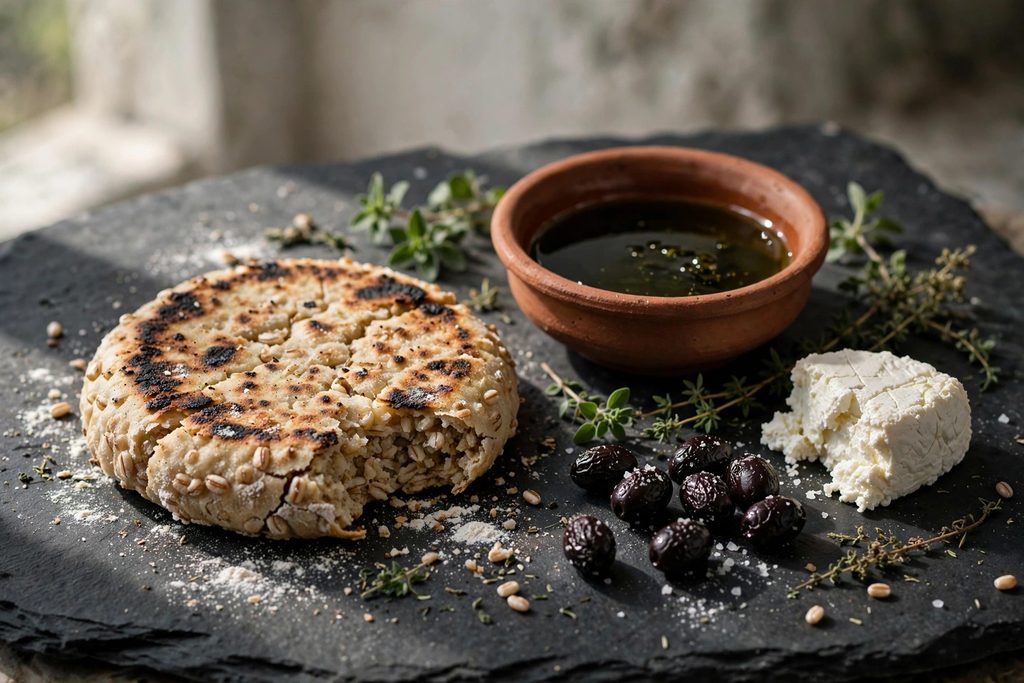
The reason barley bread was everyone’s bread, not only the poor’s, had to do with what the land around Athens could actually grow. Wheat was expensive, since the wheat suited to bread baking did not grow reliably in Attica’s climate and had to be brought in from outside, chiefly the grain routes running down from the Black Sea. Barley grew in Attica. Barley was what the land reliably produced, and maza was what the land reliably fed its people, from the Prytaneis at their public table to the field hand with a flatbread wrapped for the day’s work.
Plato used barley bread to make a point about human nature, though not the point usually attributed to him. In the Republic, when Socrates sketches the first and simplest city his argument needs, the citizens eat exactly what Attica’s poor ate: barley cakes and wheat loaves, with salt, olives, and cheese for relish, boiled onions and greens, and, to finish, figs and pulses and beans, with myrtle berries and acorns roasted at the fire. Glaucon objects almost immediately. A city with nothing beyond this, and no couches to recline on while eating it, he says, is a city fit only for pigs, the line that has given the whole passage its nickname in the scholarship on the dialogue ever since. Socrates does not deny that it is plain. He agrees to build a more elaborate city only because Glaucon demands one, and the entire argument of the Republic about what a just city actually requires grows out of that single objection. The maza that the Prytaneis were obligated to eat and the maza that Plato’s simplest, most honest city lived on were, as far as the grain itself went, the same loaf, carrying the same implicit argument that plainness and justice might have more to do with each other than luxury ever does. The wider ancient Greek diet that grew up around that grain is its own story elsewhere on this site.
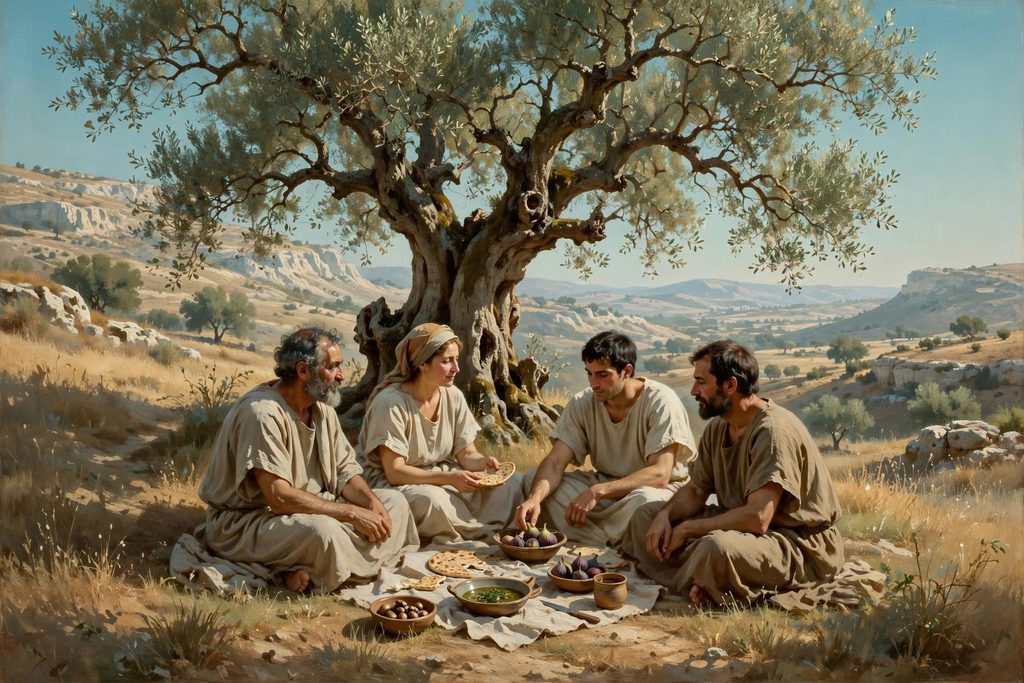
Maza was not always baked. According to Hesiod, it was made in the kitchen of each home out of barley flour worked with water, oil, or milk. It could be eaten as a soft, kneaded paste that required no oven, no leavening, and no extended preparation: the fast food of the ancient world, the field worker’s lunch, the soldier’s ration, barley flour and water and olive oil and salt formed into a flat round and eaten on the spot or carried for the day.
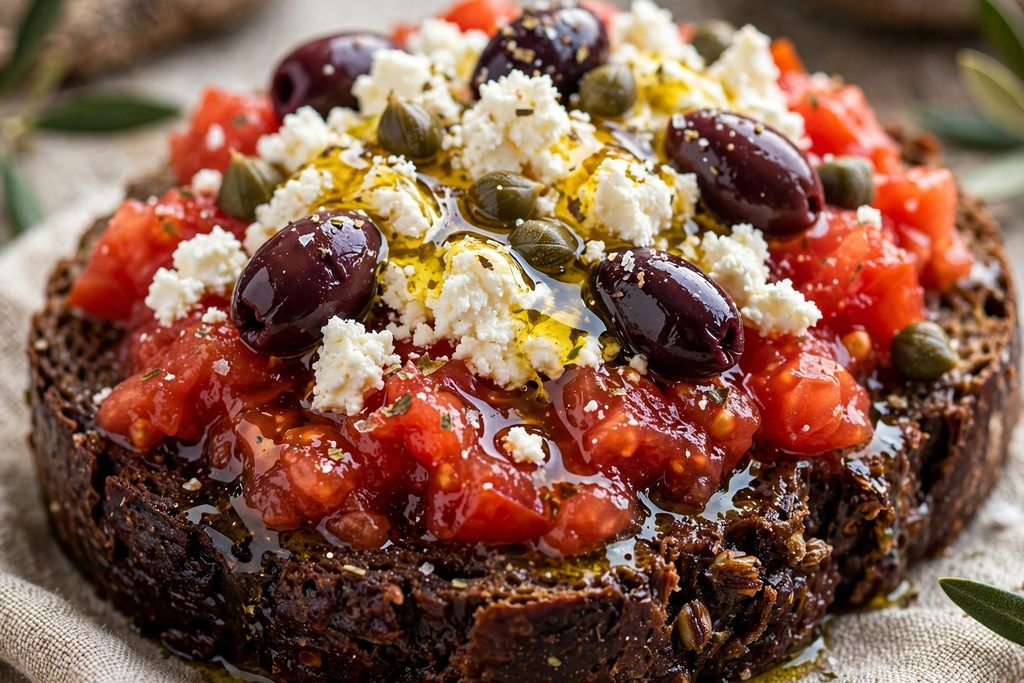
No single document hands maza down to the Cretan dakos, the hard barley rusk soaked in water and dressed with tomato, olive oil, and feta. What connects them is not a recipe but a logic that barley, Crete’s most reliable grain, keeps proving out: a dense, twice-cooked bread that stores through a lean season and comes back to life with water and whatever the pantry holds. The dakos is what that logic looks like after two thousand years of local refinement, not maza preserved, but maza’s reasoning, still working.
Olympus Estate · Food & Seasonal Life
Maza · Ancient Barley Flatbread
No ancient source gives exact quantities. This is a modern reconstruction built from Hesiod’s description and the plain logic of barley, oil, salt, and water.
Ingredients
- Barley flour, stone-ground if available200 g
- Sea salt½ tsp
- Extra virgin olive oil2 tbsp
- Water, warmapprox. 100 ml
Method
-
1
Mix the dough
Mix the flour and salt in a bowl. Add the olive oil and work it into the flour with your fingertips until the mixture resembles coarse breadcrumbs.
-
2
Add the water
Add the water gradually, working the dough until it just comes together into a firm, slightly rough mass. Do not overwork it.
-
3
Shape
Divide into four equal pieces and flatten each with your palm into a disc about half a centimetre thick.
-
4
Cook (6–8 min)
Heat a dry cast-iron pan or heavy skillet over medium heat until it is genuinely hot. Cook each flatbread three to four minutes per side, pressing gently with a spatula, until the surface is dry and lightly browned in spots.
The Seventy-Two and What Actually Carried Forward
Among the seventy-two varieties Athenaeus catalogued, most are names and nothing more now, a flour, an occasion, a shape, preserved in a list and nowhere else. A handful deserve individual attention because something about them, a word, a technique, a ritual function, kept circulating after the bread itself stopped being made the ancient way.
The laganon. A flat bread of fine flour, water, and olive oil, unleavened, cooked on a flat surface. The word is the clearest case in the whole catalogue: it is the direct linguistic ancestor of today’s lagana, the flat, sesame-scattered bread that contemporary Greeks eat on Kathari Deftera, Clean Monday, the first day of Great Lent, a fasting table this site has already set out in full elsewhere. Even here the honest claim is linguistic and ritual continuity rather than one fixed recipe. Athenaeus’s own sources do not agree on a single laganon across every period, and the thin unleavened bread the word describes shifted shape over the centuries it was in use. What survived intact is the word, the occasion, and the basic idea of a thin, unleavened bread for a fasting day, not a sealed recipe handed down untouched.
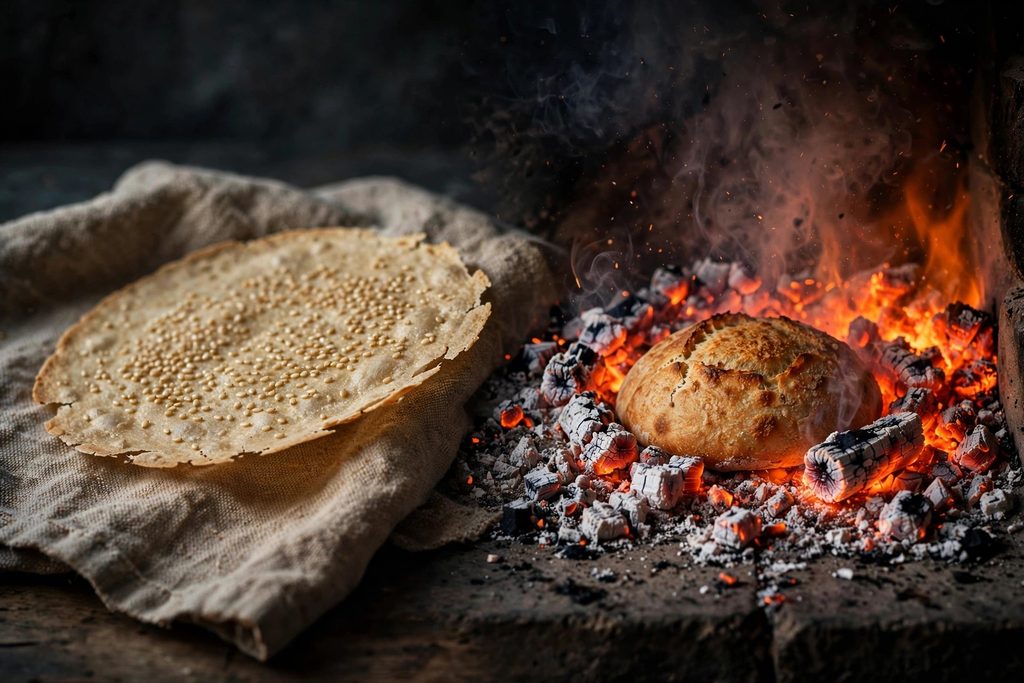
The egkryfias. Bread buried directly in the hot ash of the fire and left to bake without any vessel at all, the most elemental method available to anyone with grain flour and a fire. Hippocrates is among the ancient writers who mention it by name. This is a case of technique surviving rather than recipe: the method, not any particular loaf, was still being practiced in Cretan village kitchens well into the twentieth century, passed from parent to child because it never stopped being the simplest way to bake without an oven, not because any single ember-baked loaf was handed down generation to generation.
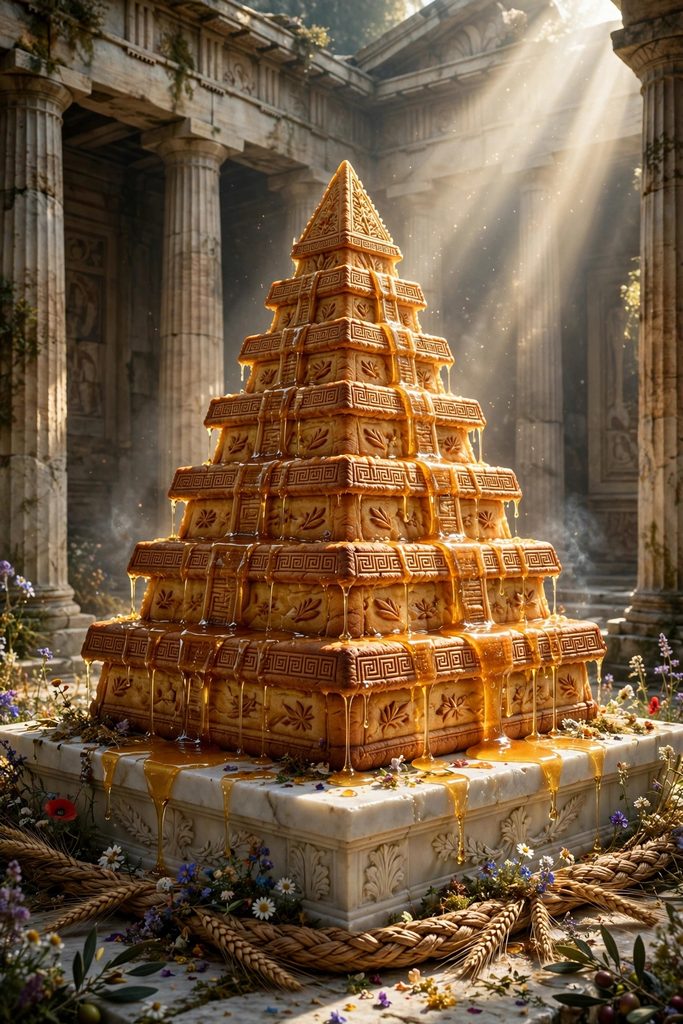
The pyramous. A pyramid-shaped cake, its name taken directly from its shape, sweetened with honey for offering at religious festivals. The gods were not given inferior bread. They were given flour worked into a demanding, deliberately wasteful shape, sweetened with the substance whose divine associations ran through nearly every register of Greek religious life. No modern descendant claims this one. It belongs to the majority of the seventy-two: a documented ancient fact that simply did not carry forward.
The apalos artos. A soft bread made from flour, leaven, water, milk, and oil. The leaven the ancient sources called zyme is the ancient Greek documentation of fermented dough kept back from one batch to raise the next, and Xenophon used the specific term zymitis artos, leavened bread, in exactly this sense. This is technological rather than genealogical continuity: no starter culture has been running since antiquity, but the principle that a piece of old dough can raise new dough was understood, named, and practiced in Greece as early as it was understood anywhere, a fermentation habit this site has already traced from the Dionysian kitchen to the modern Cretan pantry.
Demeter’s Bread and the Theology of Grain
The ancient Greeks offered bread to the gods and called the offerings divine loaves, and the deepest of those associations ran to Demeter, goddess of grain. The connection is more precise than it first appears. Demeter is not simply the deity who caused grain to exist. Her own mythology, the grief that followed Persephone’s abduction and the withdrawal from her divine duties that this site has told in full elsewhere, is the explanation the Greeks gave for why grain has to be worked for at all rather than simply gathered. The world Demeter tended before her grief would, on this account, have produced grain in abundance without labour. The world after her grief required the specific human effort of ploughing, sowing, harvesting, threshing, grinding, kneading, and baking that turns a wild grass into bread.
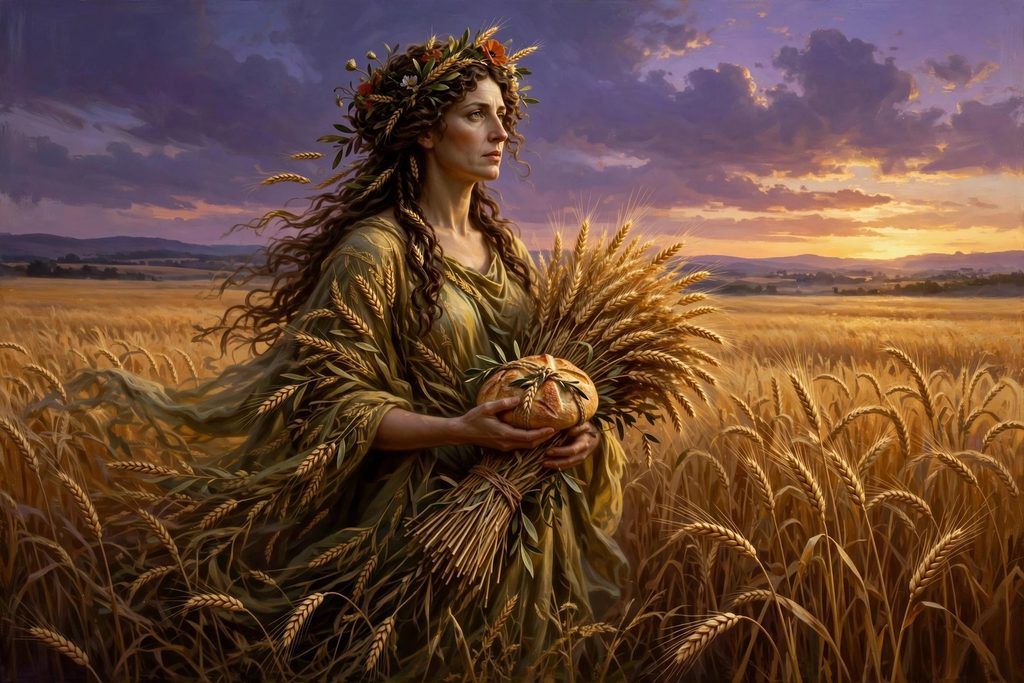
The bread offered at Demeter’s festivals was therefore not simply a food gift. It was a theological statement, the community returning to the goddess the finished product of the labour her grief had made necessary, proof that the human world had learned and kept practicing everything her withdrawal had required of it.
The Thesmophoria, the October women’s festival this site has already documented in full elsewhere, involved the ritual mixing of decomposed grain offerings with seed corn set aside for the following year’s planting. The feast that closed the festival’s third day was the consummation of that agricultural cycle: grain that had gone into the earth the previous year, grown through winter, been threshed and ground and leavened and baked, arriving at last at the table of the women whose ritual had made the harvest possible.
The specific breads tied to Demeter’s festivals included ouloi, small barley rolls scattered over sacrificial animals before a rite began, kylindros, cylinder-shaped loaves baked for the Thesmophoria itself, and the various popana, flat sacred cakes the tradition associated with several chthonic deities but above all with the goddess who governed the ground they grew from. None of these three breads exists today by these names. What persisted is the underlying pattern they served: bread as the thing a community owes a god in exchange for the grain that made the bread possible in the first place.
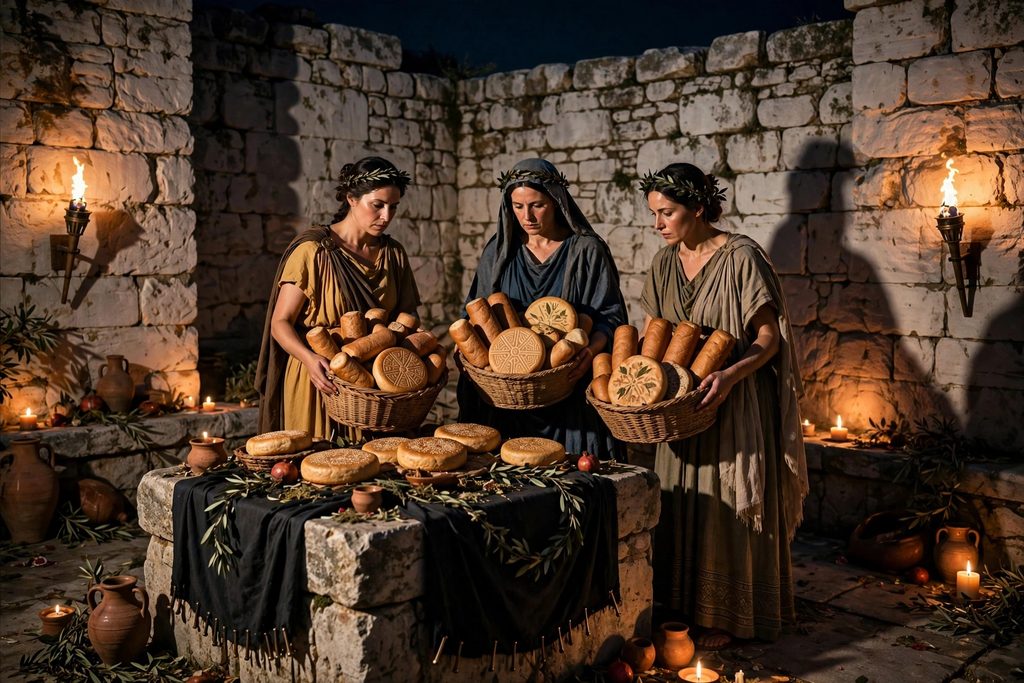
Dionysus’s relationship to bread runs through a different door, his connection to the whole cycle of fermentation: the grape that becomes wine, the grain that becomes beer, and, in at least one strand of the tradition, the leavened loaf rising through the same fermentative transformation wine undergoes. A wine-enriched loaf appears in several ancient recipe sources, and the Dionysian tradition would likely have recognised its own logic in a bread raised by the same process as the god’s own drink, the culinary expression of a deity whose entire domain was transformation through fermentation.
Artos | The Ritual Loaf That Crosses from Ancient to Orthodox
An artos is a loaf of leavened bread blessed during the services of the Eastern Orthodox and Byzantine Rite Catholic churches. A large artos, sealed with an image of the Resurrection, is baked for use at Pascha, Easter. Smaller loaves are blessed at Great Vespers in a ritual called the artoklasia, and at other occasions including feast days, weddings, and memorial services.
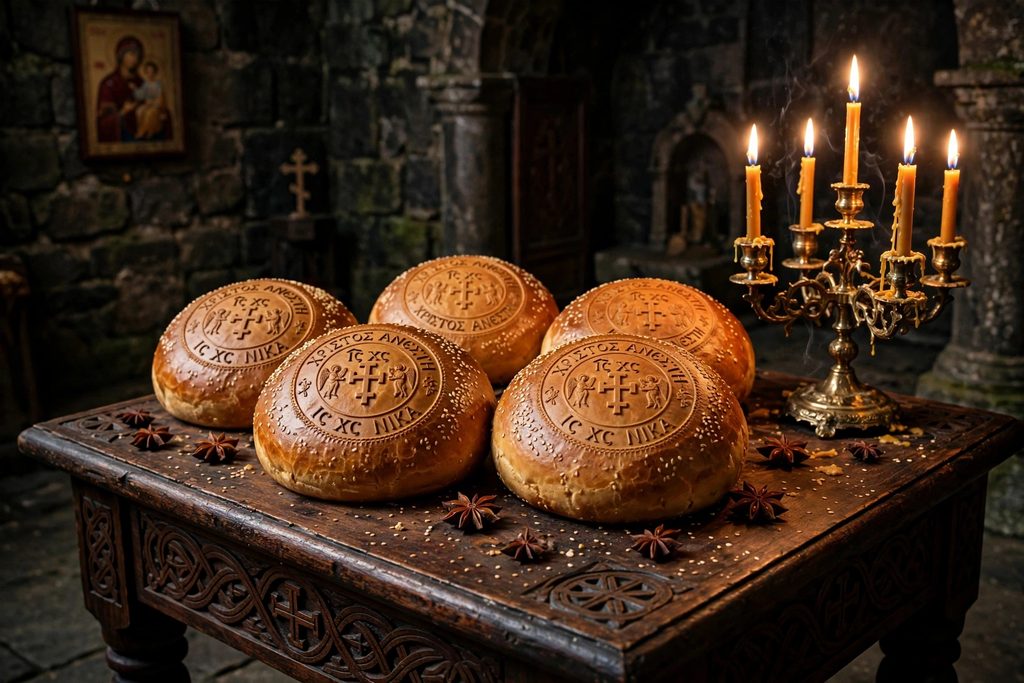
The word artos itself appears as early as Homer’s Odyssey, part of the Homeric food world this site has already mapped in full elsewhere, where Telemachus, son of Odysseus, is described taking a whole loaf of bread from the table. The same word that named the wheat bread on Telemachus’s table in the eighth or seventh century BCE is the word the Orthodox Church still uses for the blessed loaves distributed at the end of the Paschal service, two and a half thousand years later. This is the single clearest case of straight-line continuity in the entire tradition, but it is a continuity of the word and the ritual gesture, not of the bread itself. The modern artos is not an ancient pagan offering wearing Christian clothing. Its meaning belongs entirely to Christianity. What survived from antiquity is narrower and still remarkable: the Greek language never let the word go, and when a new religion needed a name for its own sacred bread, it reached for the one already sitting in the vocabulary.
The artoklasia, the blessing and breaking of five loaves at Great Vespers, explicitly recalls the New Testament miracle of the loaves and fishes, but it performs that recollection with a liturgical bread whose form and function descend directly from the older Greek tradition of sacred communal bread, blessed in the name of divine abundance and distributed to the assembled community as both nourishment and social bond. The five loaves of the artoklasia echo the ancient Greek practice of offering multiple bread forms at a single festival, each carrying its own theological association, each handed to a participant as physical evidence of a generosity received and returned.
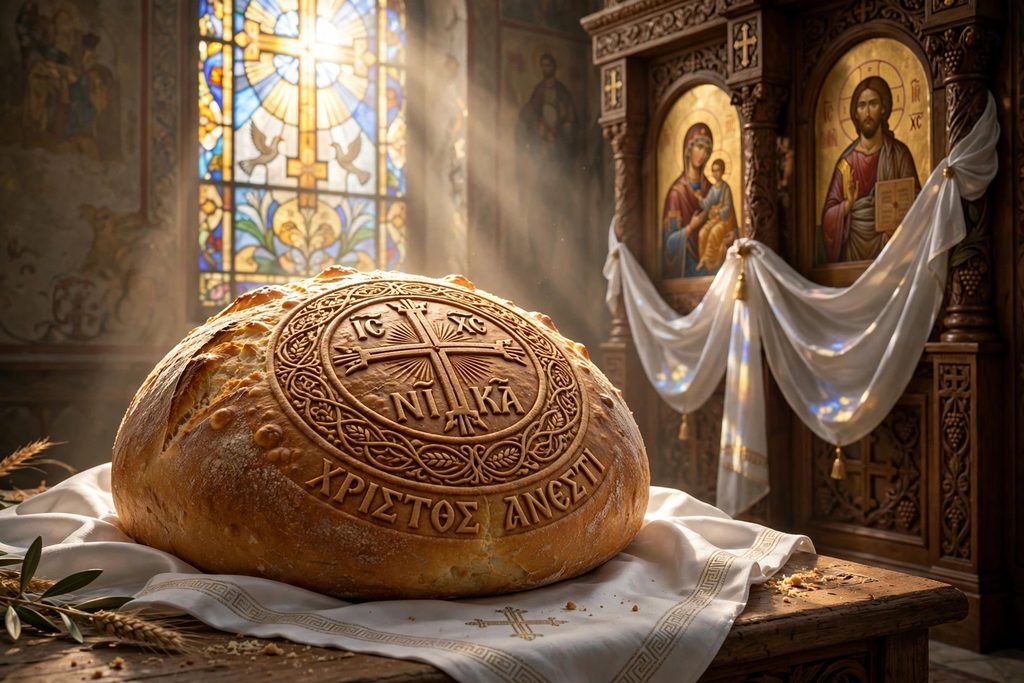
The Paschal artos itself, kept in the church through the whole of Bright Week before being distributed and eaten the following Saturday, is the most elaborately ritualised bread in the contemporary Orthodox tradition, and the one whose form most directly expresses the ancient Greek understanding of sacred bread: a loaf whose making, blessing, and distribution matter as much as its eating, food and theological statement and community bond all at once.
Olympus Estate · Food & Seasonal Life
Artos · Household Blessing Bread with Olive Oil and Anise
Not the full ecclesiastical artos with its wooden seal, which needs a priest’s blessing to be complete. A household loaf in the same tradition, for a name day or a Sunday table.
Ingredients
- Strong white bread flour500 g
- Instant yeast7 g
- Sea salt1 tsp
- Sugar or honey1 tbsp
- Extra virgin olive oil3 tbsp
- Anise seeds, lightly crushed1 tsp
- Water, warm300 ml
- Sesame seeds, for the topto finish
Method
-
1
Mix the dough
Combine the flour, yeast, salt, sugar, and anise seeds in a large bowl. Add the olive oil and warm water and mix until a shaggy dough forms.
-
2
Knead (10 min)
Turn out onto a lightly floured surface and knead for ten minutes until smooth and elastic.
-
3
First rise (1–1.5 hrs)
Place in an oiled bowl, cover, and leave in a warm place for one to one and a half hours until doubled.
-
4
Shape and prove (45 min)
Knock back gently and shape into a round loaf. Place on a lined baking sheet, cover, and prove for forty-five minutes.
-
5
Bake (30–35 min)
Brush with water and scatter generously with sesame seeds. Bake at 200 degrees Celsius for thirty to thirty-five minutes until deep golden and hollow-sounding when tapped on the base.
Cretan Sourdough and the Oldest Living Tradition
The Cretan barley rusk, the dakos, is the most visible contemporary survivor of the ancient barley bread culture, but beneath it sits a sourdough tradition whose character gives Cretan baking, like the rest of the island this site has already explored elsewhere, its distinctive identity among Greek regional bread cultures.
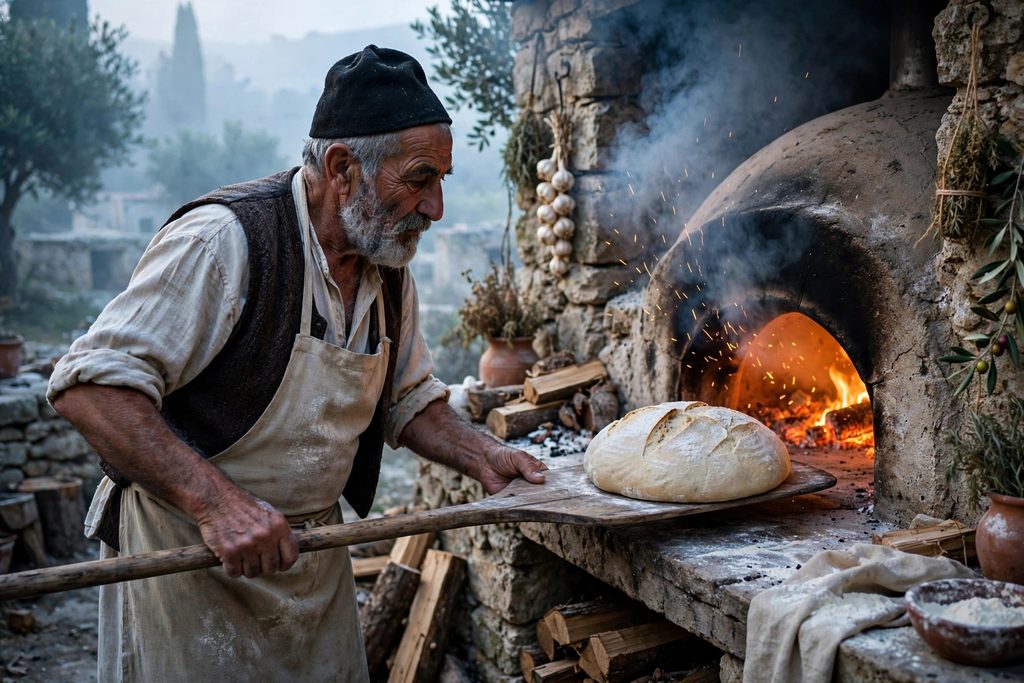
The Cretan sourdough starter, maintained in village households across the island’s mountainous interior much as wine cultures maintain their own yeasts, passes between generations with the same mixture of casual continuity and absolute seriousness that the best agricultural traditions tend to display. No particular starter is claimed to be ancient. What is old is the principle it runs on, fed not always on a schedule and not always with scientific precision, but reliably enough to survive and reliably enough that the bread it produces carries the deep, slightly acidic flavour that identifies Cretan sourdough to anyone who has eaten it, not the sharp sourness of some northern European starters but something earthier and warmer, closer to the barley and emmer wheat that the island’s own soil has always grown.
Among the seventy-two breads, Athenaeus recorded a Cretan speciality unlike anything else on the list: a bread that was boiled rather than baked, floating in the water as it cooked. Boiling dough before finishing it has turned up independently in bread cultures all across the Mediterranean and the Near East in the centuries since, from the pretzel-like breads of the medieval Rhineland to the sesame-crusted simit of Istanbul, and no serious food history traces a direct line from any one of these to any other, including to the bagel, which the documentary record places squarely in the Jewish communities of Kraków in the early seventeenth century. What the Cretan boiled bread actually establishes is narrower and still remarkable on its own terms: the technique of boiling grain dough before it sets is not a modern trick at all, and Crete was already practicing some version of it when Athenaeus sat down to write.
Olympus Estate · Food & Seasonal Life
Dakos · Twice-Baked Barley Rusk with Tomato and Olive Oil
The contemporary expression of the ancient barley-bread logic: a dense, twice-baked rusk built to survive, revived with water and dressed at the table.
Ingredients
For the rusks
- Barley flour300 g
- Plain bread flour, plus more for kneading200 g
- Instant yeast7 g
- Sea salt1 tsp
- Dried thyme or oregano1 tsp
- Olive oil3 tbsp
- Water, warm250 ml
To dress each rusk
- Very ripe tomato, grated1
- Extra virgin olive oilto taste
- Aged feta, crumbledto taste
- Dried oregano, olives, capersoptional
Method
-
1
Make the dough (8 min)
Combine the flours, yeast, salt, and herbs. Add the olive oil and water and work into a firm dough. Barley dough is denser than wheat dough and will not develop the same elasticity, which is correct. Knead for eight minutes.
-
2
Shape and prove (1 hr)
Shape into eight oval rolls approximately 12cm long. Place on lined baking sheets, cover, and prove for one hour.
-
3
First bake (25 min)
Bake at 180 degrees Celsius for 25 minutes until golden and firm.
-
4
Dry the rusks (1 hr)
Remove from the oven and allow to cool completely, then return to the oven at 150 degrees for a further hour, turning once, until completely dry and hard throughout.
-
5
Dress and serve
Soak each rusk in cold water for sixty seconds, pressing gently to let the water penetrate. Grate a very ripe tomato directly over the surface until only the skin remains in your hand. Drizzle generously with the best olive oil you have. Crumble aged feta over the top. Add dried oregano, a few olives, perhaps a few capers. Eat immediately.
This is barley bread, two and a half thousand years of reasoning behind it, dressed for the twenty-first-century table.
The Thread From Then to Now
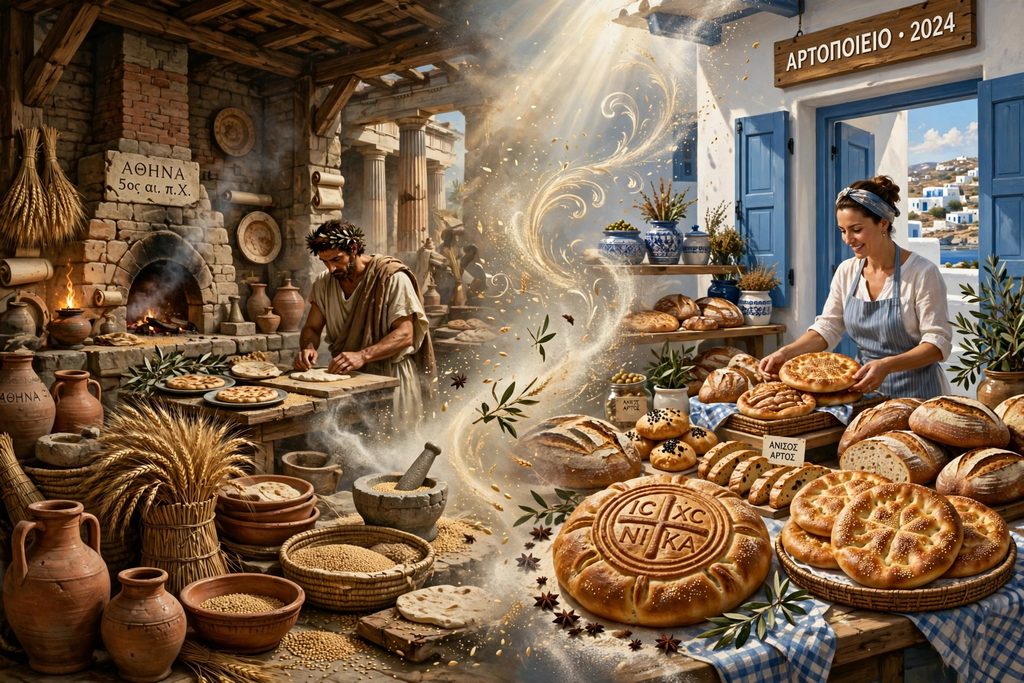
The thread from Athenaeus’s seventy-two breads to the bakery you pass on the way to the ferry port in any Greek town is real, but it is not the thread the number seventy-two might suggest. Most of those breads are gone. Their names survive only on the page where Athenaeus wrote them down, and no honest history can claim otherwise. What actually crosses the full distance is narrower and, on inspection, more interesting than a simple unbroken recipe would be: specific words that never left the language, specific techniques that kept solving the same practical problems, and a specific set of occasions, a fast, a feast, a blessing, that bread has been asked to mark for as long as there has been a Greek calendar to mark them on.
The lagana is the laganon’s word and the laganon’s occasion, reinvented more than once along the way. The dakos is the maza’s logic, not the maza’s recipe. The Orthodox artos carries the ancient word and the ancient gesture of communal bread forward, inside a theology the ancient word never knew. The sourdough starter kept alive in a Cretan village kitchen runs on the same principle as the zymitis artos Xenophon named, without being descended from any single ancient culture. Even the sesame scattered over a contemporary village loaf is doing the same decorative and flavouring work that Athenaeus recorded on the mushroom-shaped loaves of the classical period, whether or not it is literally the same habit passed down unbroken.
Seventy-two breads, and the tradition that produced them did not survive by staying the same. It changed its vocabulary when the religion changed. It narrowed when Ottoman rule disrupted the commercial baking infrastructure the classical world had built. It broadened again once the modern Greek state created the conditions for regional bread traditions to be documented and celebrated rather than simply practiced without comment. Each of those changes could have been the place the tradition actually stopped. None of them were.
The maza that fed Plato’s simplest city is the flatbread you can make in twenty minutes from barley flour, olive oil, and a hot pan, reconstructed rather than recovered, but built from the same grain and the same reasoning. The artos that Homer mentioned in the Odyssey is the loaf your neighbour’s grandmother still bakes, enriched with oil and anise, for the Sunday table, carrying the word forward through a religion that did not exist when Homer used it. The bread baked in hot ash that the fifth-century writers documented is the technique the old man in the Cretan village still uses on the days he lights the outdoor oven, not because anyone taught him to copy antiquity, but because it still works.
The tradition is in your kitchen. It did not get there by refusing to change for seven thousand years. It got there by changing constantly and never once deciding that bread was finished.
At Olympus Estate, Food & Seasonal Life traces the dishes, rituals, and ingredients that have fed Greece without interruption. Athenaeus counted seventy-two breads in the classical world, and most of them are names now and nothing more. What survived was narrower and more durable. The word artos was carried whole from Homer’s Telemachus into the Orthodox Church’s Paschal loaf. The technique of ash-baking outlasted every oven built to replace it. The logic of barley, dense and storable, turns maza into dakos without needing a single recipe to travel intact. And the standing debt a community owes Demeter for every loaf grain becomes never really went away. Plato used the plainest version of that bread to ask what a city actually needs, and the honest answer, two and a half thousand years later, is still being baked every morning in a wood oven somewhere in Crete.