

A few hundred meters west of the Acropolis, on a low, unglamorous outcrop of bare rock that most visitors to Athens never reach, there is a flat stone platform cut directly into the hillside, worn smooth by feet, facing an open semicircular space that could once hold several thousand standing citizens.
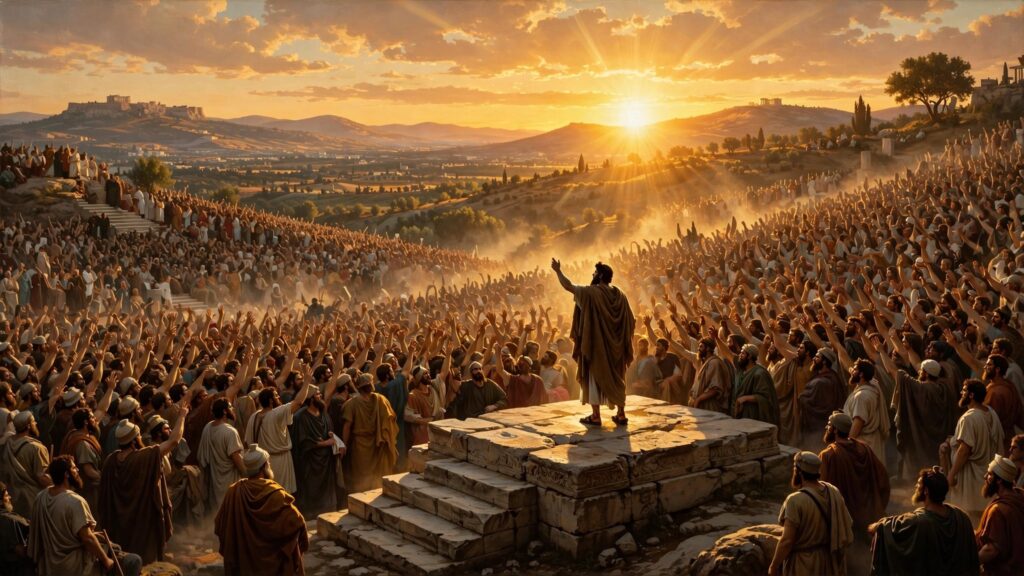
This is the Pnyx, and if any single piece of ground on earth deserves the title birthplace of democracy without qualification, it is this one rather than the more famous rock looming above it. For three days each October, that same hill belonged to someone else entirely. The Acropolis is where Athens built its temples, its statements of religious and artistic ambition, the architecture meant to be seen from every direction across the whole Attic plain. The Pnyx is where Athens actually practiced democracy: where, from the early fifth century BCE, the full Assembly of male citizens gathered, in person, in the open air, to debate and vote by show of hands on war, peace, ostracism, the fate of conquered cities, and the whole running business of governing the city, standing on this exact slope, facing this exact platform, where the city’s most consequential orators, Pericles, Demosthenes, Aeschines, once stood to be heard or shouted down by several thousand of their fellow citizens at once.
Almost nobody visits it. The Acropolis receives several million visitors a year. The Pnyx, a ten-minute walk away, receives a fraction of that number, mostly hikers and a handful of history-minded travelers who happened to read the right guidebook. This is, in miniature, the central fact about Athens that this article is built around: the city’s most important stories are very rarely standing where the crowds are standing. They are usually a short walk away, hiding in plain sight, beneath, beside, or simply downhill from whatever everyone has already come to photograph.
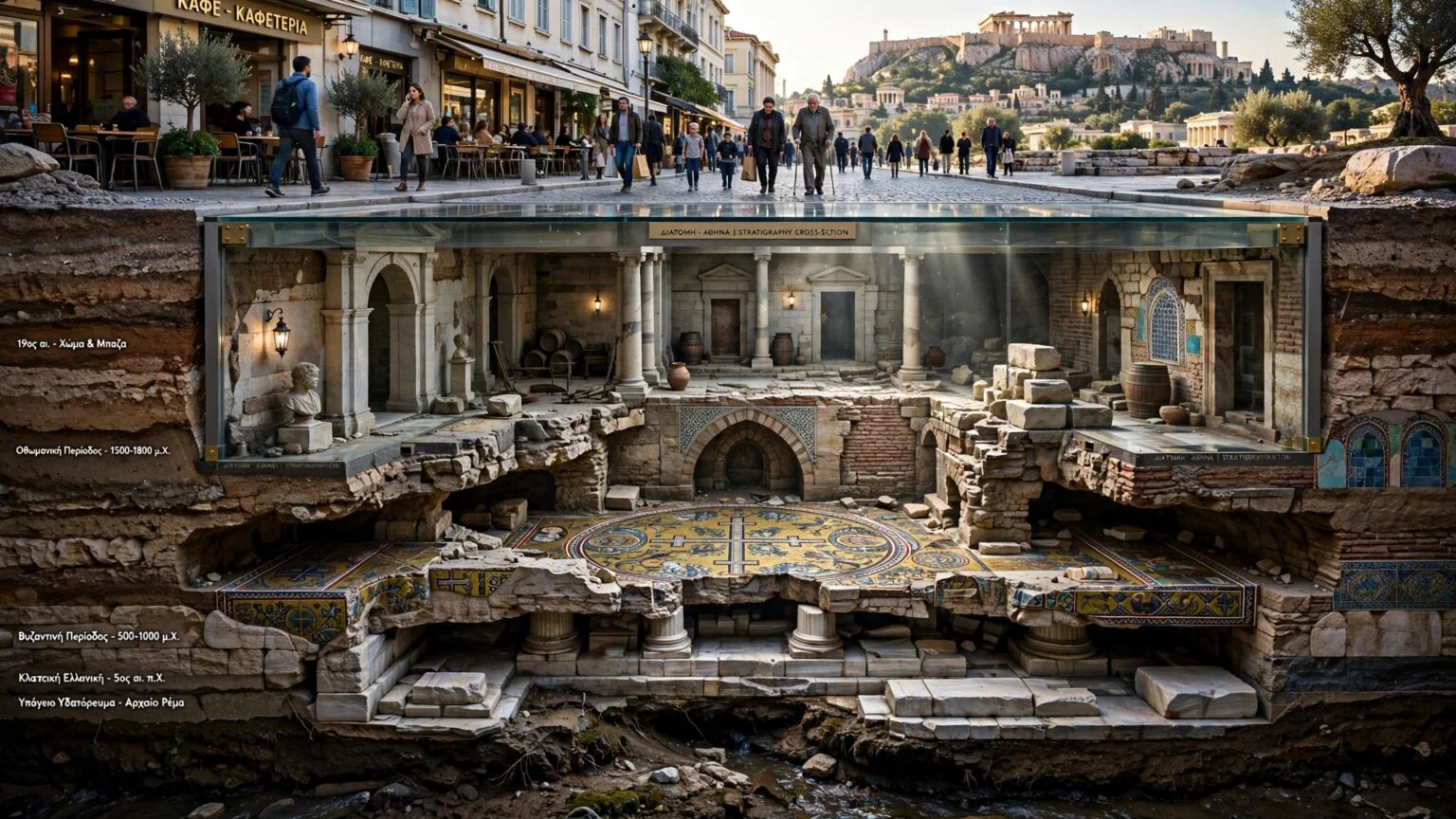
Athens has been inhabited continuously for at least seven thousand years, which makes it one of the oldest named, continuously occupied cities on earth, and the consequence of that length of habitation is not a single legible historical narrative but something closer to a cross-section: ancient Greek foundations beneath Roman additions beneath Byzantine churches beneath Ottoman mosques beneath nineteenth-century neoclassical mansions beneath the apartment blocks and metro stations of a thoroughly contemporary European capital, the whole sequence visible, in places, in a single glance downward through a glass floor in a metro station or a gap between two modern buildings. This article tries to read that cross-section properly, rather than simply ticking off its most famous single layer.
The Rock Everyone Comes For, and What It Is Actually Doing
The Acropolis deserves its reputation, and no honest account of Athens pretends otherwise. The Parthenon, built between 447 and 438 BCE under the direction of the sculptor Pheidias and the statesman Pericles, dedicated to Athena Parthenos, protector of the city that bears her name, remains, even in its ruined and long-disputed state, one of the most completely realized architectural statements human civilization has ever produced, its proportions calculated with the same subtle, deliberate distortions, the swelling columns, the gently curving foundation, that this site has already documented at length in the context of Crete’s Venetian buildings and Olympus’s mountain light: a building engineered specifically for how it would be seen, by human eyes, under this particular quality of Attic sun.
The Erechtheion, beside it, carries the Porch of the Caryatids, six carved female figures functioning as load-bearing columns, the originals now preserved in the Acropolis Museum while weathered casts stand in their place on the building itself, and the Propylaea, the monumental gateway through which every ancient visitor to the sanctuary first passed, frames the approach with the same deliberate architectural choreography a modern museum still relies on when it decides what a visitor sees first.
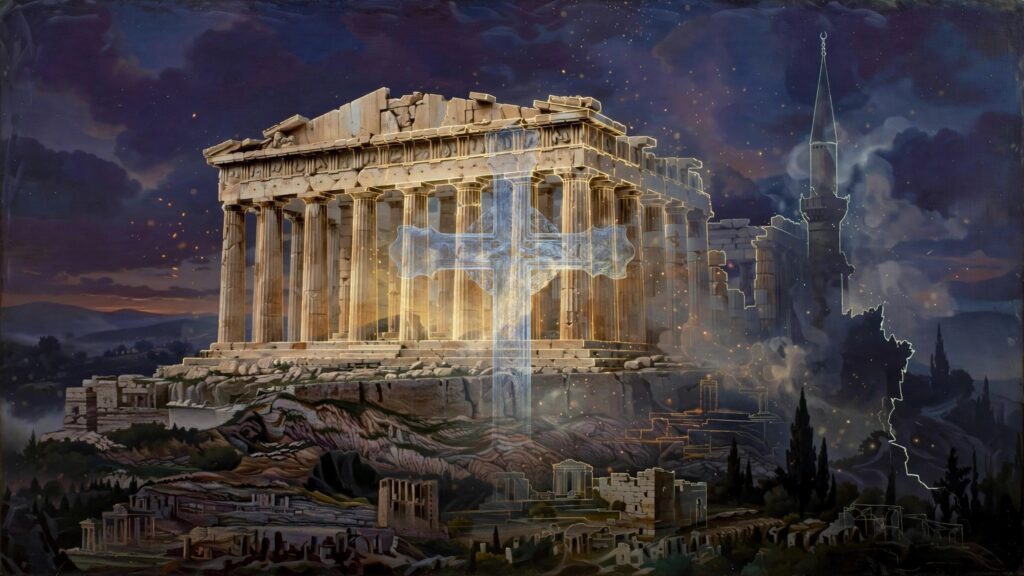
What deserves equal attention, and rarely gets it, is what came before and after the fifth-century building program that gets all the postcards. Mycenaean Athens had already fortified this same rock with a cyclopean wall some four and a half to six meters thick by the late Bronze Age, centuries before the Parthenon existed, the remains of a Mycenaean megaron palace still identifiable beneath later construction near the Erechtheion. The Parthenon itself became, in the sixth century CE, a Christian church dedicated to the Virgin Mary, then, after the Ottoman conquest of 1458, a mosque, with a minaret added to one corner that nineteenth-century restorers later removed. The Acropolis was, in other words, a continuously repurposed sacred site for roughly three thousand years before anyone began treating it primarily as a monument to be looked at rather than a building to be actively used, and the modern archaeological convention of presenting it almost exclusively in its fifth-century BCE state, scrubbing out the Byzantine and Ottoman centuries almost entirely from the visible site, is itself a choice worth being aware of rather than simply absorbing as the only available truth about the rock.
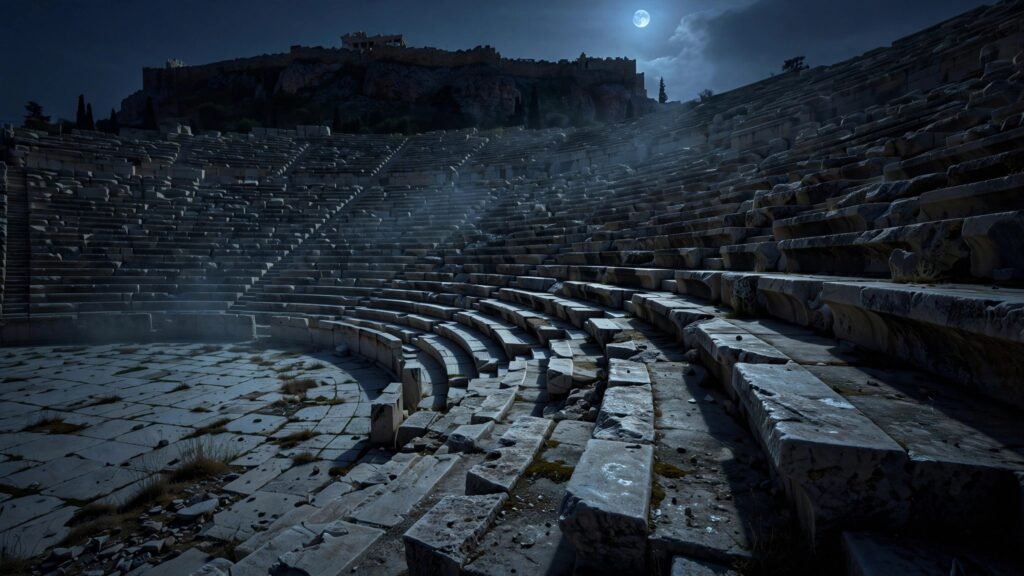
Below the Acropolis’s southern slope, the Theatre of Dionysus is where Athenian tragedy was born and where Aeschylus, Sophocles, and Euripides first staged the plays this site has already drawn on repeatedly elsewhere, the worn stone seating still arranged in its ancient curve facing a stage that hosted, for the first time anywhere, the dramatic form the entire Western theatrical tradition descends from.
The Hill Where Democracy Actually Happened
Continue west from the Acropolis and the crowds thin out almost immediately, dropping away across the pedestrianized Dionysiou Areopagitou and Apostolou Pavlou streets that the Unification of the Archaeological Sites project, completed in stages from the late 1990s through the early 2000s, knitted together into one of the more genuinely successful pieces of urban planning in any European capital: a continuous, largely car-free walkway connecting the Acropolis, the Ancient Agora, the Pnyx, the Hill of the Muses, and Kerameikos into a single, walkable archaeological landscape rather than a series of disconnected fenced sites separated by traffic.
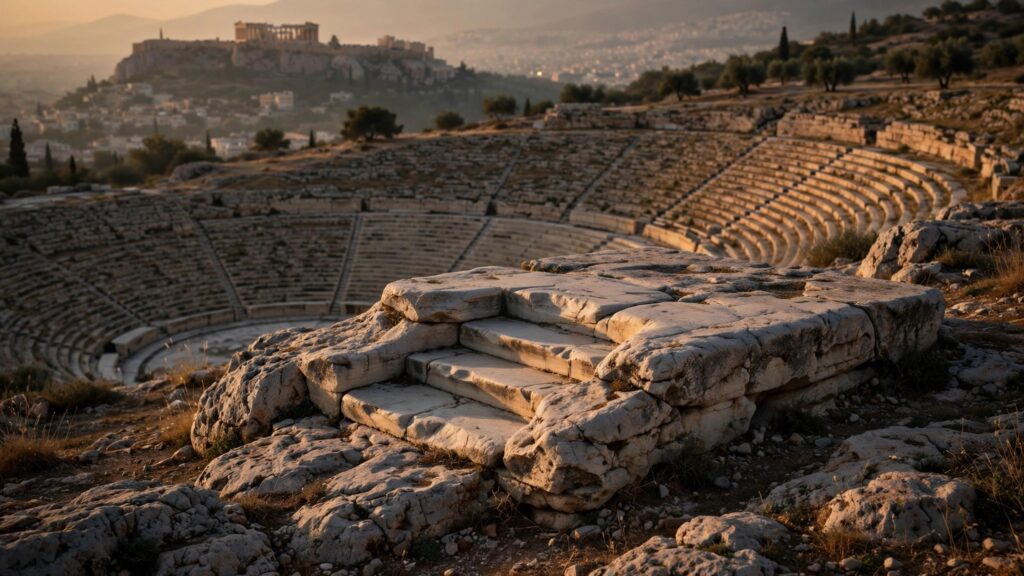
The Pnyx itself sits between the Hill of the Muses, Philopappou, and the Hill of the Nymphs, where Athens’s National Observatory now stands. In the earliest period of Athenian democracy, following Cleisthenes’s reforms of 508 BCE, the Assembly had met in the Agora itself. Sometime in the early fifth century the meeting place moved here, to this specific hillside, where the natural slope provided a rough amphitheater for several thousand standing citizens and the bedrock could be cut into the speaker’s platform, the bema, that still stands today, a simple stone block from which any citizen, not only the wealthy or the well-born, had the legal right to address the entire body of Athenian citizenship directly.
This is worth sitting with for a moment in a way most visitors, rushing between the Acropolis and the Agora, never get the chance to. The Pnyx has none of the architectural ambition of the rock above it. There is no temple here, no carved frieze, nothing built to be beautiful. It is simply a worked hillside and a stone platform, and the entire elaborate apparatus of fifth-century Athenian self-government, the wars voted on, the generals appointed and recalled, happened on this specific, undecorated patch of ground. Socrates himself was a familiar figure in the public life this hillside represents, his own trial in 399 BCE proceeding not before the Assembly on the Pnyx but before a large citizen jury in one of the city’s courts, a different institution but one that grew from the same broader culture of open, participatory public judgment the Pnyx made structurally possible in the first place.
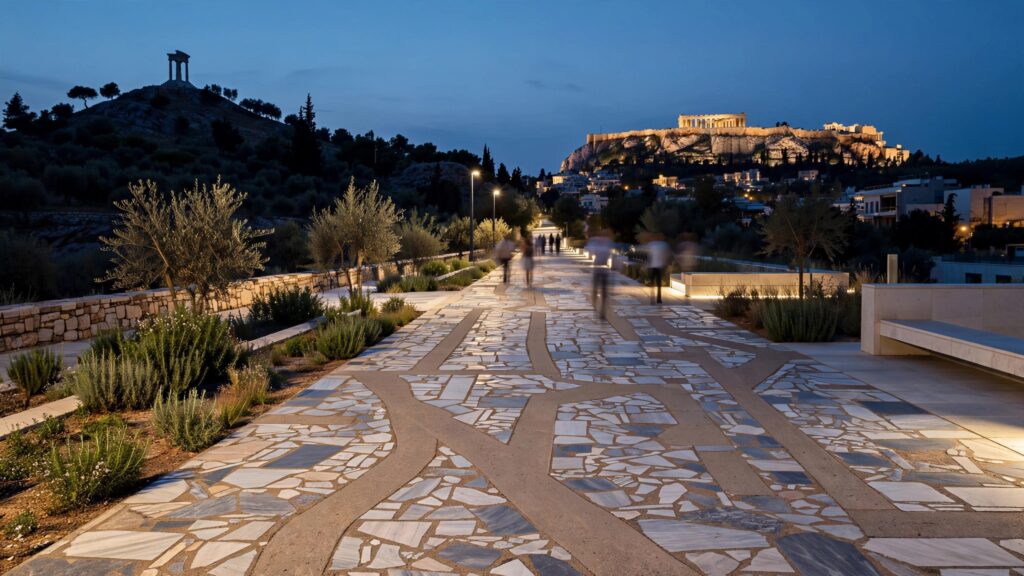
The walk up Philopappou Hill above it, designed in the 1950s by the architect Dimitris Pikionis using salvaged fragments of demolished buildings, ancient pottery shards, and reclaimed marble worked directly into new stone paving, a deliberate, physical compression of the city’s entire history into the path itself, leads to the best surviving panoramic view of the Acropolis available anywhere in Athens, and on most afternoons you will share it with a few dozen people rather than a few thousand.
The Agora, the Areopagus, and the Court That Tried Saint Paul
Below the Acropolis’s northern slope, in what is now the Monastiraki district, the Ancient Agora was the actual commercial, religious, and civic center of daily Athenian life for roughly a thousand years, predating the democratic reforms that made the Pnyx necessary and continuing in active use long after Rome had absorbed the city into its own empire.
The site’s archaeological layers run extraordinarily deep. Neolithic tools confirm habitation here before written history, dozens of Mycenaean tholos tombs have been excavated within the Agora’s boundaries, and the open civic square that eventually developed here became, in the words ancient and modern historians alike apply to it, the place where political discussion and argument gave rise to the very concept of democracy as a practice rather than simply an institution voted on elsewhere. The Temple of Hephaestus, on the Agora’s western edge, is the best-preserved ancient Greek temple anywhere in the world, having survived intact in part because it was converted into a Christian church around the seventh century CE and therefore kept in active use rather than abandoned to slow collapse. The reconstructed Stoa of Attalos, rebuilt by American archaeologists in the 1950s using ancient methods and materials, now houses the site’s museum, including, among its collection, an allotment machine, a kleroterion, the actual mechanical device fifth-century Athenians used to randomly select citizens for jury duty and public office, democracy’s lottery system rendered in carved stone slots and bronze tokens.
Above the Agora’s southwestern corner rises the Areopagus, the Hill of Ares, bare rock with steps cut into its side and no protective railing at the summit, which served, in the earliest period of Athenian governance, as the meeting place of the aristocratic council that predated democratic reform, and which retained, even after Cleisthenes and the rise of the popular Assembly, its function as the city’s court for homicide and certain religious offenses, among the oldest documented judicial bodies anywhere in Europe. It was here, according to the Acts of the Apostles, that the apostle Paul addressed the philosophers of Athens around 51 CE, including, by the account’s own description, Stoics and Epicureans who gathered to hear what this new teaching might be, making the bare hilltop simultaneously the seat of the continent’s first law court and a site of genuine significance in the early history of Christianity’s spread into the Greek-speaking world.
The Cemetery That Held Athens’s Grief in Public
Northwest of the Agora, past the modern neighborhood that has inherited its name, lies Kerameikos, and its own name gives away the district’s original purpose more directly than almost any other place in Athens: it is named for the kerameis, the potters, whose workshops lined this low, once-marshy ground beside the Eridanos stream, and it is from this same Greek root that English derives the word ceramic. Before it was anything else, this was a working neighborhood, its kilns firing the vessels that carried Athenian oil and wine across the ancient Mediterranean.
It became something else entirely once the Themistoclean city wall was built here in 478 BCE in the aftermath of the Persian invasion. Two gates were set into the fortification at Kerameikos, the largest gateway complex in the ancient world. The Dipylon, the double gate, covered nearly two thousand square meters and controlled the main road north toward Plato’s Academy, four towers rising at its corners with a rectangular courtyard designed, quite deliberately, to trap any attacking force that breached the outer doors before it could reach the inner ones. Immediately beside it stood the Sacred Gate, from which the Sacred Way departed on its twenty-two-kilometer route to Eleusis, the road this collection has already followed in its own right, along which tens of thousands of initiates walked each September during the Eleusinian Mysteries, the most widely observed religious rite in the ancient Greek world.
Between the two gates, and along the road leading out from the Dipylon toward the Academy, lay the Demosion Sema, the public cemetery where Athens buried its most distinguished citizens and its war dead at the city’s own expense. Pericles is buried here. So are Cleisthenes, the architect of the democratic reforms that had made the Pnyx necessary in the first place, and Harmodius and Aristogeiton, the tyrannicides whose killing of Hipparchus in 514 BCE the Athenians would later celebrate as the founding act of their own political freedom, whether or not the history was quite that clean. It was here, at this same public burial ground, in the winter of 431 BCE, that Pericles stood to deliver the funeral oration over the first Athenians killed in the Peloponnesian War, a speech Thucydides recorded and that has functioned, ever since, as one of the founding texts of democratic political theory, its description of Athens as a city that looks to the exceptional as the norm rather than the exception, a society governed in the interest of the many rather than the few, delivered on this exact ground rather than in any temple or council chamber. Pericles himself died of the plague two years later and was buried among the men he had eulogized.
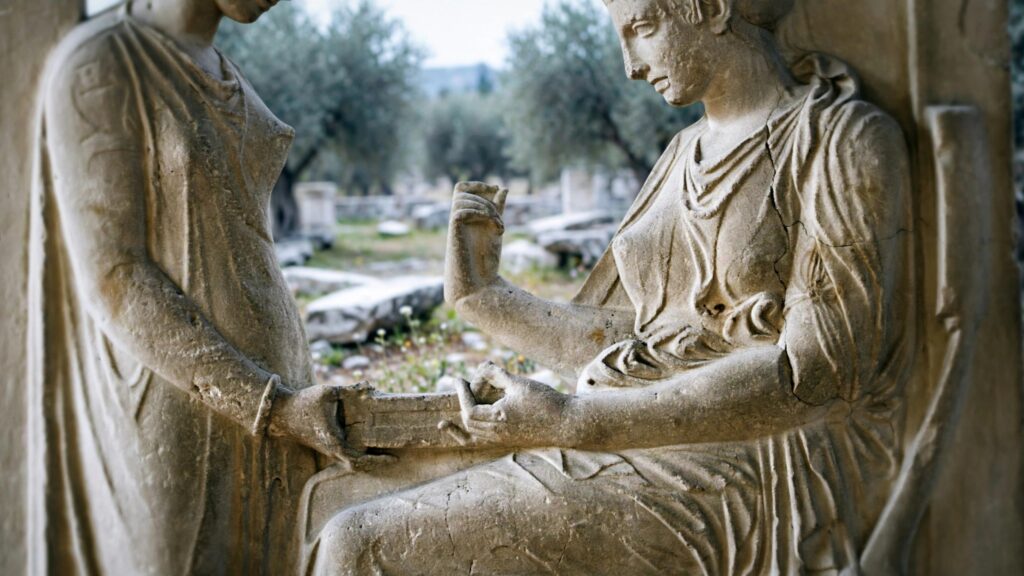
Beyond the Demosion Sema, along the Street of the Tombs, the private grave monuments of wealthy Athenian families still stand largely where they were found, carved reliefs of extraordinary tenderness and restraint: the stele of Hegeso, showing a seated woman examining a piece of jewelry handed to her by a servant, the funerary monument to the young cavalryman Dexileos, killed in battle at the age of twenty and commemorated by his family with a relief showing him still on horseback, cut down by an enemy soldier beneath him. None of these monuments shout. Classical Athenian funerary sculpture, almost without exception, depicts a quiet handclasp, a moment of departure held at exactly the pitch of ordinary domestic feeling rather than heroic grandeur, and walking the Street of the Tombs remains one of the few places in Athens where that particular, restrained emotional register survives entirely intact, largely because almost no one comes to see it.
The Temple That Took Six Hundred and Thirty-Eight Years
Southeast of the Acropolis, in an open precinct that most Athens itineraries allot perhaps thirty rushed minutes, stands the single most protracted building project the ancient world ever completed: the Temple of Olympian Zeus, the Olympieion, begun around 520 BCE under the tyrant Peisistratos and not finished until 132 CE, when the Roman emperor Hadrian dedicated it, six hundred and thirty-eight years after the first foundations were laid.
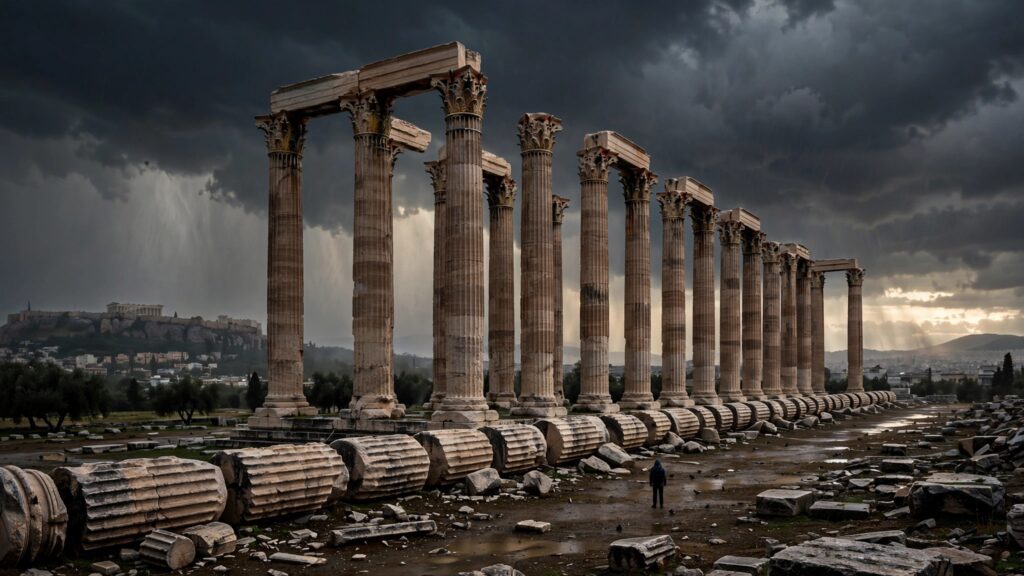
Peisistratos’s original plan called for an enormous Doric temple in limestone, but when his son Hippias was driven from power in 510 BCE and the tyranny fell, the project stopped where it stood, the incomplete foundation left as a monument to precisely the kind of grandiose ambition the new democracy wanted no part of. It sat unfinished for more than three centuries, until 174 BCE, when the Seleucid king Antiochus IV Epiphanes, who liked to present himself as the living embodiment of Zeus, revived the project entirely on his own terms. He brought in the Roman architect Decimus Cossutius, switched the design from Doric to the more ornate Corinthian order, the first time that order had ever been used on the exterior of a major Greek temple, and rebuilt the plan around a hundred and four columns, each more than seventeen meters tall, cut from gleaming Pentelic marble rather than the original limestone. Antiochus died in 164 BCE with the temple still only half finished, and the project stalled again. Sulla’s sack of Athens in 86 BCE damaged what had been built. Centuries of Roman-era Athenians grew up walking past a half-standing forest of the tallest columns in the Greek world, unroofed, unfinished, a landmark of interrupted ambition rather than completed grandeur.
It took Hadrian, one of the most philhellenic emperors Rome ever produced, to finish it. Between roughly 124 and 132 CE, Hadrian completed the temple, enclosed it within a monumental precinct wall, and placed inside its cella a colossal statue of Zeus in gold and ivory, deliberately built to rival the lost masterpiece Pheidias had made for Olympia. He also placed a statue of himself beside it, and the Athenians, in gratitude, gave him the title Olympios, the Olympian, treating their new Roman patron as something close to Zeus’s own earthly counterpart. Beside the temple he raised the monumental Arch of Hadrian, still standing today, its two facing inscriptions announcing, on the side facing the Acropolis, this is Athens, the ancient city of Theseus, and on the side facing the temple, this is the city of Hadrian, and not of Theseus, a boundary marker between the old Greek city and the new Roman quarter Hadrian had built to its east, the two inscriptions arguing, quite literally, across the same stone gateway.
Of the temple’s original hundred and four columns, only fifteen still stand today, thirteen at the southeastern corner and two at the southwest, the columns’ great height and slenderness making them one of the most photographed ruins in the city. A sixteenth column lies exactly where it fell during a violent storm on the night of October 26, 1852, its individual drums still stacked in the precise line of their collapse, a single fallen column that communicates the temple’s original scale more immediately than the fifteen still upright ever could. In 1759, the Ottoman governor of Athens, Mustapha Agha Tzistarakis, had already had one of the columns pulled down and burned for lime, material he needed to build the mosque in Monastiraki that still bears his name, an inscription cut into a neighboring column afterward recording the exact date of the demolition as if the marble itself wanted the vandalism remembered. Between the tyrant who started it, the foreign king who revived it, the Roman general who damaged it, the Roman emperor who finally finished it, and the Ottoman governor who quarried a piece of it for his own mosque four centuries later, the Temple of Olympian Zeus may be the single clearest physical record in Athens of just how many different hands, across just how many incompatible political systems, this city’s stones have consistently passed through.
The Village Built Overnight on the Acropolis’s Own Slope
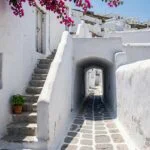
Climb the northeastern slope of the Acropolis rock itself, above the lanes of Plaka, and the architecture changes so completely that for a disorienting moment it stops looking like Athens at all: whitewashed, cubic houses with thick walls and brightly painted shutters, narrow unnamed cobbled lanes that double back on themselves with no logical route through, small chapels tucked between buildings, bougainvillea spilling over low garden walls. This is Anafiotika, and it looks exactly like a Cycladic island village because it was built, quite deliberately, by people who had just left one.
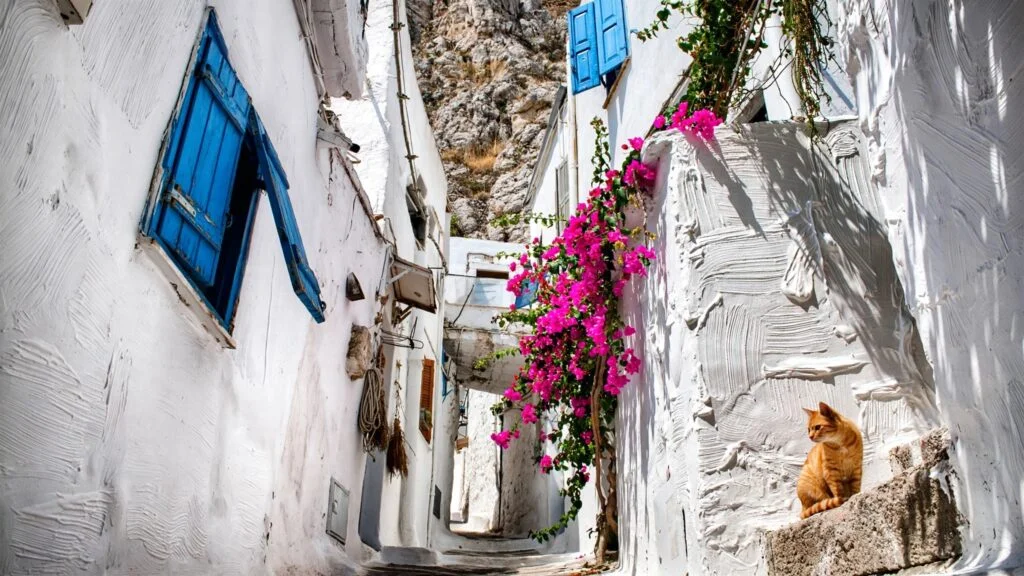
In the 1840s, King Otto I, establishing Athens as the capital of the newly independent Greek state out of what had been reduced, after centuries of Ottoman rule and the destruction of the War of Independence, to a town of barely four thousand people, needed skilled labor for the ambitious building program the new capital required: the royal palace, the early excavations around the Acropolis, the first wave of the neoclassical architecture that still defines much of central Athens today. Stonemasons and craftsmen traveled from across Greece to do this work, and a particularly skilled contingent arrived from the small Cycladic island of Anafi, whose building tradition was already renowned. Needing somewhere to live, on a rocky northeastern slope of the Acropolis that had been designated a protected archaeological zone since 1834 and where, in principle, no new construction should have been permitted at all, they exploited an old legal provision that granted ownership of any structure completed between sunset and sunrise. Working through the night, they built their houses, in the only architectural style they knew, the same whitewashed, thick-walled, cubic Cycladic vernacular that this site has documented at length on Naxos and Folegandros, transplanted, stone by stone, onto the single most archaeologically sensitive hillside in the entire country.
Anafiotika was, from its very first completed roof, illegal. It has remained, in a sense, illegal ever since. Many of the original houses were eventually demolished as the formal archaeological excavation of the Acropolis intensified through the later nineteenth and twentieth centuries, and fewer than fifty structures survive today, almost all still owned and inhabited by direct descendants of the original Anafiot families, under a standing arrangement that permits the houses to be passed down within those families or sold only to the Greek state, never onto the open market. The unnamed lanes are still identified only by sequential numbers, Anafiotika One, Anafiotika Two, and so on, a neighborhood that has spent nearly two centuries existing in the gap between formal legality and simple, stubborn continuity.
This is, properly understood, the same Athens story the Pnyx tells, in a different register entirely: the most consequential, most distinctively Athenian things in this city are very often not the things built with imperial or civic ambition in mind. They are the things built quickly, out of necessity, by people without much power, who simply got on with making somewhere to stand before anyone could tell them not to.
What the Romans, the Byzantines, and the Ottomans Each Left Behind
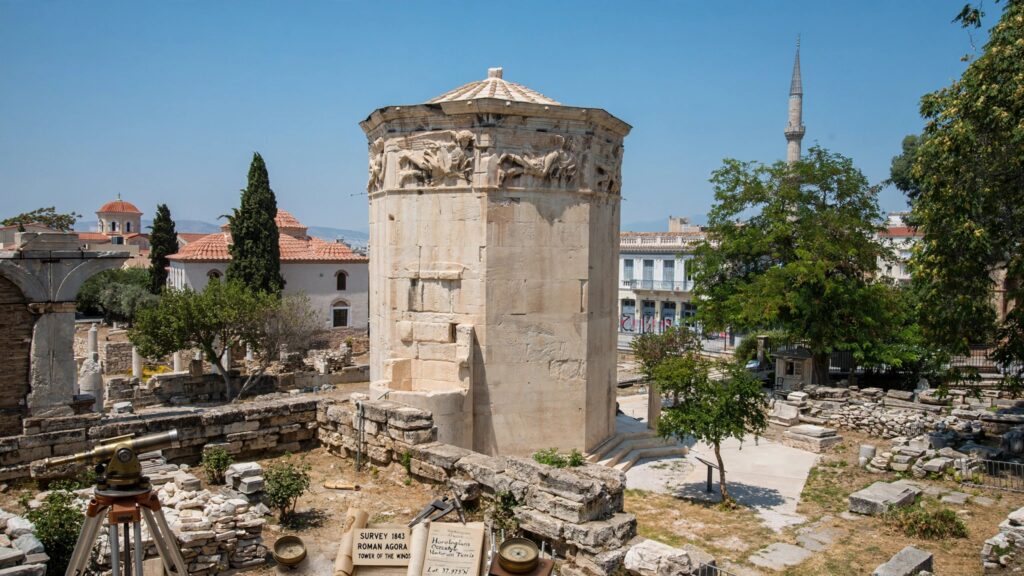
East of the Ancient Agora, the Roman Agora, built between 19 and 11 BCE under Julius Caesar and Augustus, became the city’s primary commercial center once Roman administrative practice supplemented rather than replaced the older Greek civic structures. Its most striking surviving feature, the octagonal Tower of the Winds, built in the first century BCE by the astronomer Andronicus of Cyrrhus, functioned simultaneously as a sundial, a water clock, and a weather vane, each of its eight faces carved with a relief figure representing one of the eight winds, a single small building doing the combined work of three separate scientific instruments centuries before either Greek or Roman engineering would attempt anything comparable at this scale again. Under Ottoman administration, the building found a third life entirely: it was used as a tekke, a gathering place for whirling dervishes, the same octagonal chamber that had once tracked Mediterranean wind patterns for Roman merchants now hosting a distinct tradition of Sufi devotional practice, before the Ottomans built the Fethiye Mosque directly on the site of an earlier Byzantine basilica nearby, completing, within a few hundred meters of ground, a sequence of Roman astronomy, Byzantine Christianity, and Ottoman Islam each occupying the same small corner of the city in turn.
The neighborhood of Plaka, threading between the Acropolis and Monastiraki, has been continuously inhabited for roughly three thousand years and carries the visible evidence of nearly every one of them at once: neoclassical nineteenth-century facades standing directly beside Byzantine churches, which stand in turn on or beside genuine Roman ruins, the whole compressed into a district of narrow lanes that feels, walking through it, less like a single historical period preserved than like several centuries arguing quietly with each other in the same square meter of stone. Tripodon Street, one of Plaka’s oldest, follows the route of what is sometimes described as the oldest road in Europe still in continuous use, once lined with choregic monuments, dedications erected by the wealthy private citizens who funded and sponsored the dramatic festivals performed at the nearby Theatre of Dionysus, a direct physical link between the financing of ancient Greek tragedy and the pavement still underfoot today.
The eleventh-century church of Agios Nikolaos Ragavas, just below Anafiotika, has had its outer walls gradually exposed by centuries of rain and wind to reveal ancient marble columns built directly into its own structure, the building quite literally wearing its older material on the outside.
What the City Eats, and Where to Find the Layers Underfoot
Athens’s food culture draws on every region of Greece this site has already documented at length, but the city has its own contributions worth knowing before arrival. Souvlaki and gyro stalls in Monastiraki and around the Central Market on Athinas Street serve the fastest, most honest version of the Athenian street meal, grilled meat, tomato, onion, and tzatziki wrapped in warm pita, eaten standing or walking, an Athenian register of hospitality that does not require a table to be genuine.
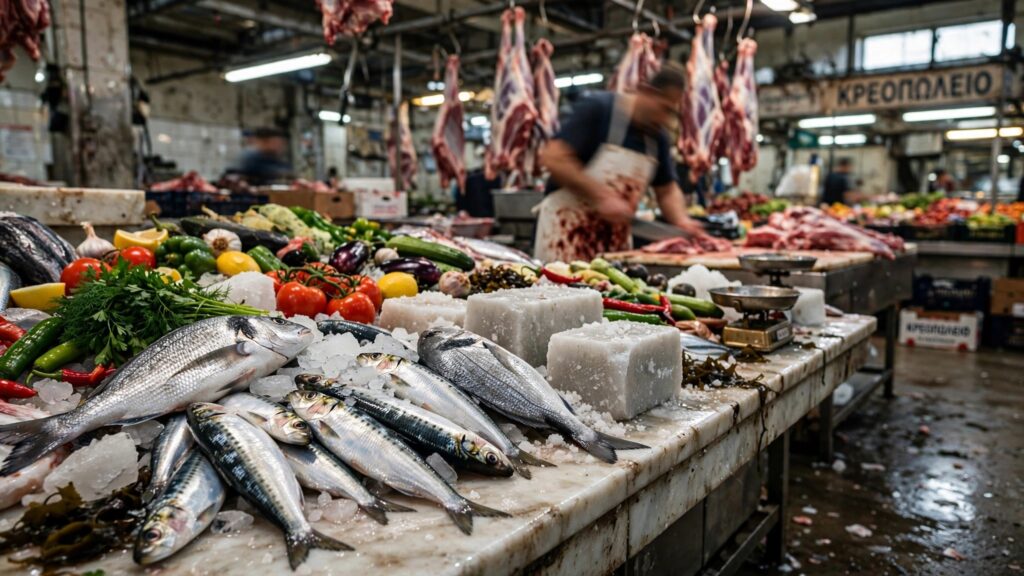
The Varvakeios Central Market, open since the 1880s, remains a working wholesale and retail fish and meat market in the heart of the modern city, loud, unglamorous, and entirely unconcerned with whether visitors find it picturesque, the precise opposite of a curated food hall and considerably more honest for it. Restaurants in the Psyrri and Koukaki neighborhoods have, over the past decade, built a genuinely serious contemporary Greek dining scene drawing on regional ingredients this site has traced individually across Crete, the Mani, and the northern Aegean, served now within walking distance of the Acropolis itself rather than requiring a journey to their place of origin.
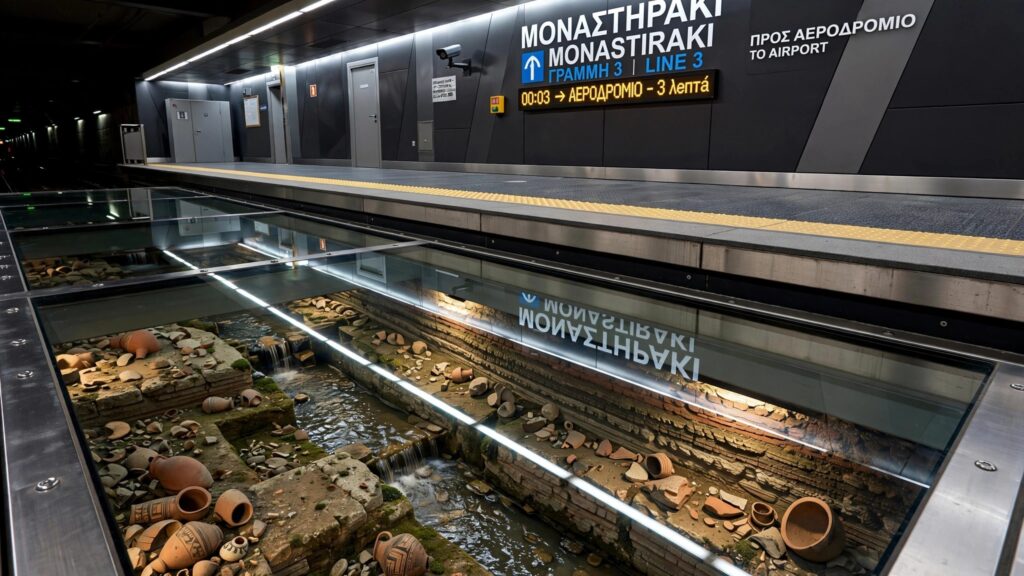
For the layers literally underfoot, Monastiraki metro station is worth descending into even if you have no train to catch: a glass walkway over an excavated archaeological section, visible mid-platform, exposes settlement remains ranging from the eighth century BCE through to the nineteenth century stacked directly on top of each other, with the trickling remnant of the Eridanos River, the same stream that once ran past the Sacred Gate and the potters’ workshops of Kerameikos, still audibly running beneath the modern platform. The National Archaeological Museum, somewhat further from the main tourist circuit on Patission Street, holds the depth and quality of collection, Mycenaean gold, Cycladic figurines, classical sculpture, that the more famous Acropolis Museum, excellent as it is, was never designed to also provide, and deserves a minimum half-day on any itinerary serious about understanding what came before the fifth-century BCE building program that otherwise dominates every Athens guidebook.
Practical Notes
Athens is most often arrived at by air, through Athens International Airport, connected to the city center by a dedicated metro line that takes roughly forty minutes, or by ferry into Piraeus, the city’s port and the gateway to the wider island world this site has documented at length elsewhere.
The Acropolis and the Ancient Agora are each worth a minimum of two to three hours, ideally at opening time in the early morning or in the final two hours before closing, when both the heat and the crowds of midday have eased. The combined archaeological ticket, covering the Acropolis, the Ancient Agora, the Roman Agora, the Kerameikos cemetery, the Temple of Olympian Zeus, and several smaller sites, is genuinely worth purchasing in full rather than piecemeal, given how naturally the unified walkway connects all of them on foot.
Allow a separate, unhurried half-day for the Pnyx, Philopappou Hill, Kerameikos, and Anafiotika together, since all four sit largely outside the main crowds and reward slow, undirected wandering rather than a fixed itinerary. Spring and autumn offer the most comfortable walking conditions across the hills. The Acropolis rock itself, treeless and exposed, becomes genuinely punishing in the full heat of an Athenian August afternoon, and the fifteen standing columns of the Olympieion are, for what it’s worth, floodlit after dark and worth returning to see a second time once the day’s heat and crowds are gone entirely.
The City That Never Stopped Building on Top of Itself
Most cities that have been continuously inhabited for seven thousand years eventually choose, consciously or not, a single era to present as their defining identity. Athens has resisted that choice more thoroughly than almost any comparable capital, not out of any deliberate civic policy but simply because every century that passed through here left something behind that the next century found too useful, too sacred, or too structurally sound to fully clear away. The Parthenon became a mosque rather than a ruin. The Tower of the Winds became a dervish hall rather than an abandoned curiosity. A half-finished temple sat as a monument to interrupted ambition for three hundred years before a Roman emperor decided to finish what an Athenian tyrant had started. A Mediterranean island’s entire vernacular architecture got transplanted, in a single illegal night’s work, onto the slope of the most protected hillside in the country, and survived there for nearly two centuries afterward.
The Acropolis deserves every visitor who climbs it. It is also, properly understood, the single most famous chapter in a book whose other chapters are sitting a few hundred meters away in almost total quiet: on a bare hillside where citizens once voted by raising their hands, in a cemetery where a city buried its grief in public and Pericles described, in words a democracy still measures itself against, what it thought it was for, among fifteen columns that took six centuries and four incompatible political systems to finish, in a whitewashed village built overnight by people fleeing the Aegean wind, in a glass floor beneath a metro platform where a buried river is still, very faintly, audible.
Go to the rock first. Everyone does, and it earns it. Then walk the few minutes further that almost nobody bothers with, and let the city show you what it was actually doing while the postcards were being taken somewhere else.
At Olympus Estate, Wanderlust Greece looks for the places where Greece is most completely and most honestly itself, including in the city its own modern name comes from. Athens has spent seven thousand years building on top of itself rather than starting again. The Acropolis holds the postcards. The Pnyx holds the actual practice of democracy, an undecorated hillside where several thousand citizens once voted by raised hand. Kerameikos holds the city’s public grief, the ground where Pericles delivered the funeral oration Thucydides preserved. The Temple of Olympian Zeus took six hundred and thirty-eight years and four incompatible political systems to complete. Anafiotika is an entire Cycladic village built illegally in a single night by island stonemasons in the 1840s and still standing on the Acropolis’s own slope. Almost everything that matters is still down there, a short walk from wherever you happen to be standing.