

There is a quality to Greek winter light that does not exist in July. It is a lean, unforgiving light that does not blur the edges of the mountains or soften the texture of the sea. It sharpens everything instead, exposing the bone structure of the landscape underneath the tourist season’s surface. For the traveler willing to arrive when the maps are folded away, the reward is a warmth that has almost nothing to do with the reading on a thermometer. It is closer to a sensation of continuity: the feeling of a place that has not stopped being itself simply because the visitors have gone.
This is Hidden Greece, the country that becomes visible only once the summer crowd and its expectations have gone.
The common mistake is to think of Greece as a seasonal stage struck and dismantled after the last October ferry. The country does the opposite. It returns to itself once the noise of the summer migration fades, and the rhythm of the days becomes legible again. You see it in the way a fisherman mends a net without an audience, or in the way smoke from a wood fire hangs motionless over a Peloponnesian village. This is Greece as it exists for the people who live there rather than for the people who visit it: a season of repair and social closeness, where the landscape and its inhabitants draw inward to wait for the return of the high sun. And while they wait, they inhabit a country that is, against every outside assumption, surprisingly temperate, protected by a geography and a way of life refined over several thousand years.
The Stone Ship of Monemvasía and the Memory of the Sun
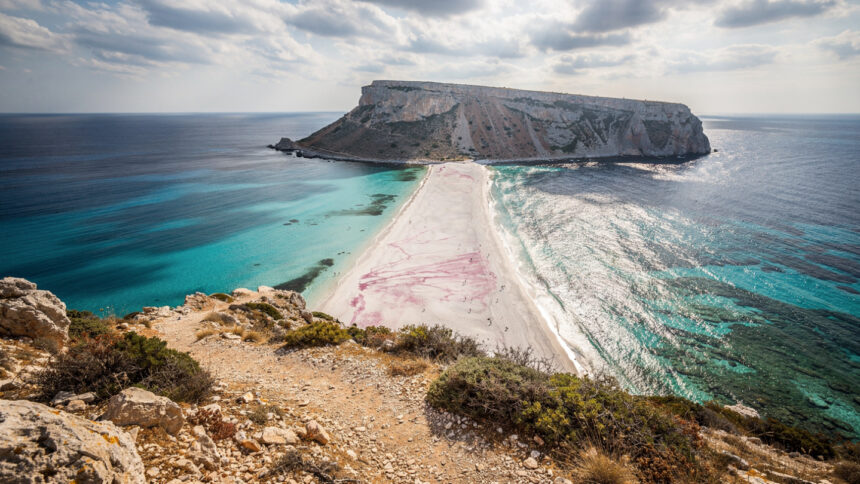
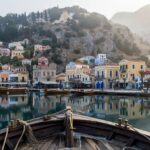
Monemvasía performs a quiet daily miracle in its architecture. The massive limestone rock, tethered to the Laconian coast by a single causeway, was built to withstand siege. What the Byzantines and Venetians built without intending it was a thermal battery. The medieval houses are packed so tightly within the walls that they form a single continuous mass of stone, and through the short winter days that mass absorbs the pale sunlight. By the time the sky turns to bruised purple in the late afternoon, the walls begin releasing that stored heat back into the narrow, winding alleys. Walking through Monemvasía’s winter streets is like moving through a house kept warm by someone who is no longer visibly there.
There are no cars here. There is only the sound of your own boots on cobblestones and the distant murmur of the sea against the base of the cliffs. The wind that cuts across the open plains of the mainland is blocked entirely by the height of the rock, and inside the lower town the air stays still and noticeably milder than the surrounding country. It is a physical comfort precise enough to let you sit at a small table in a hidden square, in nothing heavier than a light coat, and watch the light change over the Myrtoan Sea. The cafés here do not close because the visitors have gone. They stay open because the people who actually live here still need somewhere to gather and argue about the world.
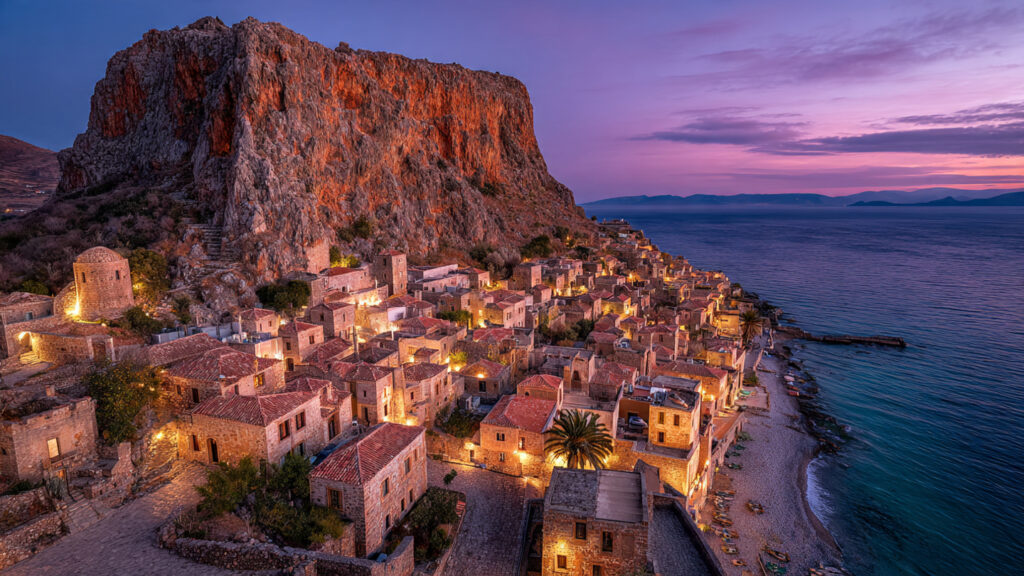
The depth of the history adds its own weight to the air. This is a town where Crusaders once rested and where the last Despots of Morea made their final stands. In winter, that history stops being a set of facts on a plaque and becomes a lived environment: the absence of crowds means the echoes of the past carry more clearly. The stone does not simply hold heat. It holds memory.
Nafplio and the Softening of the Argolic Gulf
Further north, Nafplio sits at the edge of a bay that seems to hold onto autumn well into the new year. As the first capital of the modern Greek state, the town carries a sense of proportion that manages to feel both grand and modest at once. The Venetian fortifications of Palamidi loom above it, but at sea level, among the neoclassical mansions and bougainvillea-lined streets, a microclimate of its own takes over. The water of the Argolic Gulf is deep and sheltered, acting as a heat sink substantial enough to keep the temperature from ever dropping into the bitter registers of the north.

In the off-season, Nafplio shows a different version of itself. The Pervola and the grand expanse of Syntagma Square stop being transit points for tour groups and become, once again, the town’s actual living rooms. The local elders sit on the marble benches with their faces turned toward the sun, absorbing what light the winter sky offers. The warmth here is cultural as much as climatic: the taverns move their tables inside, but the doors stay open, and the smell of slow-cooked beef with quince and cinnamon drifts into the street, a sensory anchor that announces both the place and the season without needing to say either aloud.
This is a town built for curiosity in winter: you can spend an entire morning in a shop that makes nothing but traditional worry beads, komboloi, listening to a man explain the different weights of amber and bone, with no urgency to sell you anything. The conversation is the transaction. In the off-season, the people of Nafplio have the time to be themselves again. They are no longer hosts performing a role. They are residents of a town that has watched empires arrive and leave, and they treat winter as a season of well-earned reflection.
The Elemental Truth of the Mani Peninsula
To move south into the Mani is to enter a landscape stripped of ornament. This is a country of stone towers and prickly pears, where the sun feels more honest because it has less to hide behind. Travelers often overlook the Mani in winter, deterred by its reputation for harshness, but the peninsula’s dryness and its southern exposure make January here remarkably comfortable. Rain arrives as a sudden, dramatic event that clears the air and leaves the stone gleaming, only for the sun to return within the hour with renewed intensity.

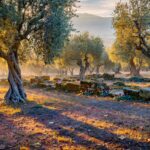
The architecture of the Mani answers directly to this landscape. Its tower houses were built for defense, with thick walls and small windows that keep interior temperatures stable no matter what is happening outside, and in winter these towers feel less like fortifications than sanctuaries. The warmth comes from the hearth and the heavy rugs, but also from the way sunlight strikes the gray rock of the Taygetos range: a precision of light that is almost surgical, picking out every crack in the stone and every silvered leaf on the olive trees.
Walking through villages like Areopoli or Kardamyli in the off-season shows you a version of the peninsula that summer crowds never see. You can hike the coastal paths without July’s crushing heat, feeling the salt spray on your skin and the warmth of the earth through the soles of your shoes. The Mani’s clarity of mind comes from being surrounded by nothing but the elemental: rock, sea, and sun, without clutter or distraction. It is a place that insists you be present in your own body.
Chania and the Persistence of the Cretan Orange
Crete is less an island than a continent moored in the middle of the Mediterranean, and its southern position lets it hold onto heat with a stubbornness that feels entirely Cretan. In Chania, winter feels like one long golden afternoon that never quite concludes. While the White Mountains in the distance carry their snow caps, the old harbor remains a place to sit in the sun and feel the sea’s humidity on your skin. The Venetian walls encircling the old town act as a windbreak, creating a pocket of calm where the citrus trees keep bearing fruit straight through the darkest months.

Chania’s winter markets are a riot of color and scent. This is the season of orange and lemon, the fruit hanging so heavy on the branches of the surrounding groves that the trees seem to bow toward the earth. In the laiki agora, the street market, you will find mountain greens, fresh sheep’s cheese, and the sharp clean smell of freshly pressed olive oil. The winter food is heavier and more nourishing than the summer table: this is the season of pithia, the slow-simmered chickpea soup, and antikristo, lamb cooked open beside the fire.
Chania stays alive in winter because its center of gravity was never the harbor but the people living in its backstreets. University students, artisans, and farmers from the Apokoronas region keep the cafés full year-round. There is a continuity here that makes a winter visit feel like an arrival rather than a compromise: you are seeing the island as it exists for itself, not as it stages itself for others. It is the right anchor for an Olympus Estate itinerary built around the soul of a place rather than its summer surface.
The Walled Shield of Rhodes and the Monastic Light of Patmos
In the southeastern Aegean, Rhodes offers a winter that is almost architectural in its warmth. The medieval city, a UNESCO World Heritage Site, was built by the Knights of Saint John with an obsession for durability, and the walls are so massive and the streets so narrow that together they generate their own weather. The wind is channeled and broken by the fortifications, and the sun, which shines here more often than in almost anywhere else in Europe, is caught and held by the pale limestone.

In winter, the Street of the Knights becomes a silent stone canyon. Walk it at midnight and you can feel the heat still radiating from the walls. The town remains inhabited, families living in houses that have stood for six hundred years, and the shops along Sokratous Street serve locals rather than tourists, the coffee strong and hot. This is Rhodes at its most legible: without the crowds, the Gothic and Ottoman layers of the city are free to breathe, and you can spend hours in the moats and gates feeling like the only person in a city built to house thousands.
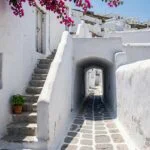
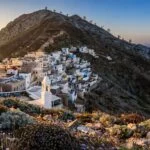
Patmos, the holy island of the Apocalypse, offers a different register of warmth entirely: the warmth of silence and light. The Monastery of Saint John the Theologian sits like a crown on the hill of Chora, its dark, fortified walls reflecting the winter sun. The air is remarkably clear, and the view across the scattered islands of the Dodecanese seems to have no limit. In winter, Patmos becomes a place of genuine contemplation. The sea runs a deep, cold blue, but the sheltered courtyards of Chora’s white houses trap the day’s heat and hold it. It is an island that asks you to listen, and in the silence of the winter months, the landscape has a great deal to say.
The Seasonal Hearth and the Internal Heat of the Greek Table
Warmth in Greece is never purely a matter of weather. It is a relational event that happens around a table. In winter, the Greek kitchen turns toward the hearth: the summer salads give way to legumes and the wild greens that appear after the first rains, and there is something close to ritual in the winter meal, beginning with thick, crusty bread from a wood-fired oven and the pouring of a local wine whose weight and spice match the cooler air.
Food is the country’s internal heating system. A bowl of fasolada, the traditional bean soup, is not simply a meal but a cultural memory of endurance and simplicity. In the Peloponnese, you might find hilopites, handmade pasta, served with a rich rooster stew. On the islands, winter brings sea urchins and the citrus-based desserts that brighten the shortening days. This is how the Greeks maintain their warmth: they eat the season, they drink the landscape, they share the fire.

Philoxenia, hospitality toward the stranger, is at its most potent in winter. When someone arrives in a village tavern in January, they are not simply another customer. They are a guest in the full sense the word once carried. The conversation drifts naturally toward the state of the olives, the height of the snow on the mountains, and the stories of the people who stayed behind. This is Greece off-season, and it is a warmth no guidebook can fully capture: the kind you carry with you long after you have left the table.
The Enduring Light and the Invitation of the Off Season
The Greek winter is not an ending. It is a season of preparation, the period when the land stores its energy for spring’s return. For the traveler, it is a season of discovery. To choose the country’s warm places in winter is to make a quiet statement about what you value: you are looking for the truth of a place, for the bone structure beneath the skin, for a connection to a timeline that runs back to the first fires lit in the caves of the Mani and the first stones laid into the walls of Monemvasía.
Standing on the battlements of a Venetian castle, or walking through an orange grove in Crete, the cold winds of the north start to feel like a distant rumor. The Mediterranean is a generous sea, and the land it touches is a resilient one. The warmth is there, waiting for anyone willing to look for it in the texture of a stone wall, the scent of a wood fire, or the eyes of someone who has seen seventy winters and is still ready to welcome one more.
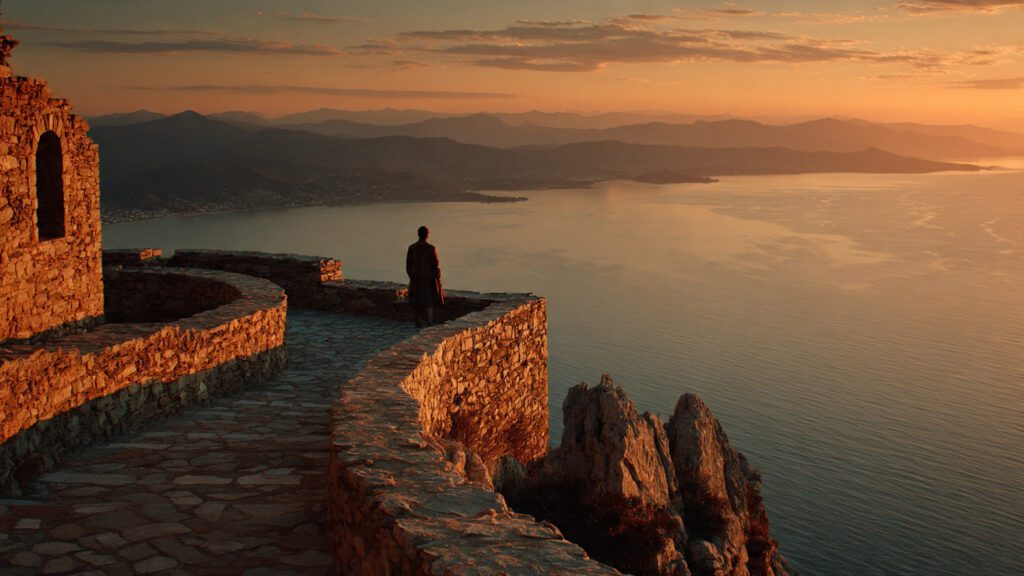
The road through a Greek winter leads inward. It leads toward a deeper understanding of what it means to live in balance with the seasons and with each other: an invitation to slow down, to breathe the sharp, clean air of the Aegean, and to recognize that the sun never really leaves this land. It simply changes its angle.
At Olympus Estate, Wanderlust Greece guides you across the sacred and storied terrain of the Hellenic world. The medieval houses of Monemvasía are pressed so tightly together that they form a single continuous mass of stone. Through the short winter days the stone absorbs the pale sunlight. By late afternoon the walls begin to release that heat back into the narrow alleys. The stone does not just hold heat. It holds memory. In Nafplio the conversation is the transaction. In the Mani the winter light is surgical: it picks out every crack in the stone and every silver leaf on the olive trees. In Chania the orange trees bow under the weight of fruit through the darkest months and the laiki agora smells of freshly pressed olive oil. On Rhodes you can walk the Street of the Knights at midnight and feel the heat radiating from the walls. The warmth is there, waiting for those willing to look for it in the texture of a stone wall, the scent of a wood fire, or the eyes of a person who has seen seventy winters and is still ready to welcome one more. The sun never really leaves this land. It just changes its perspective.