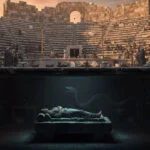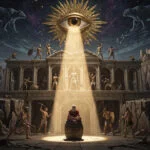

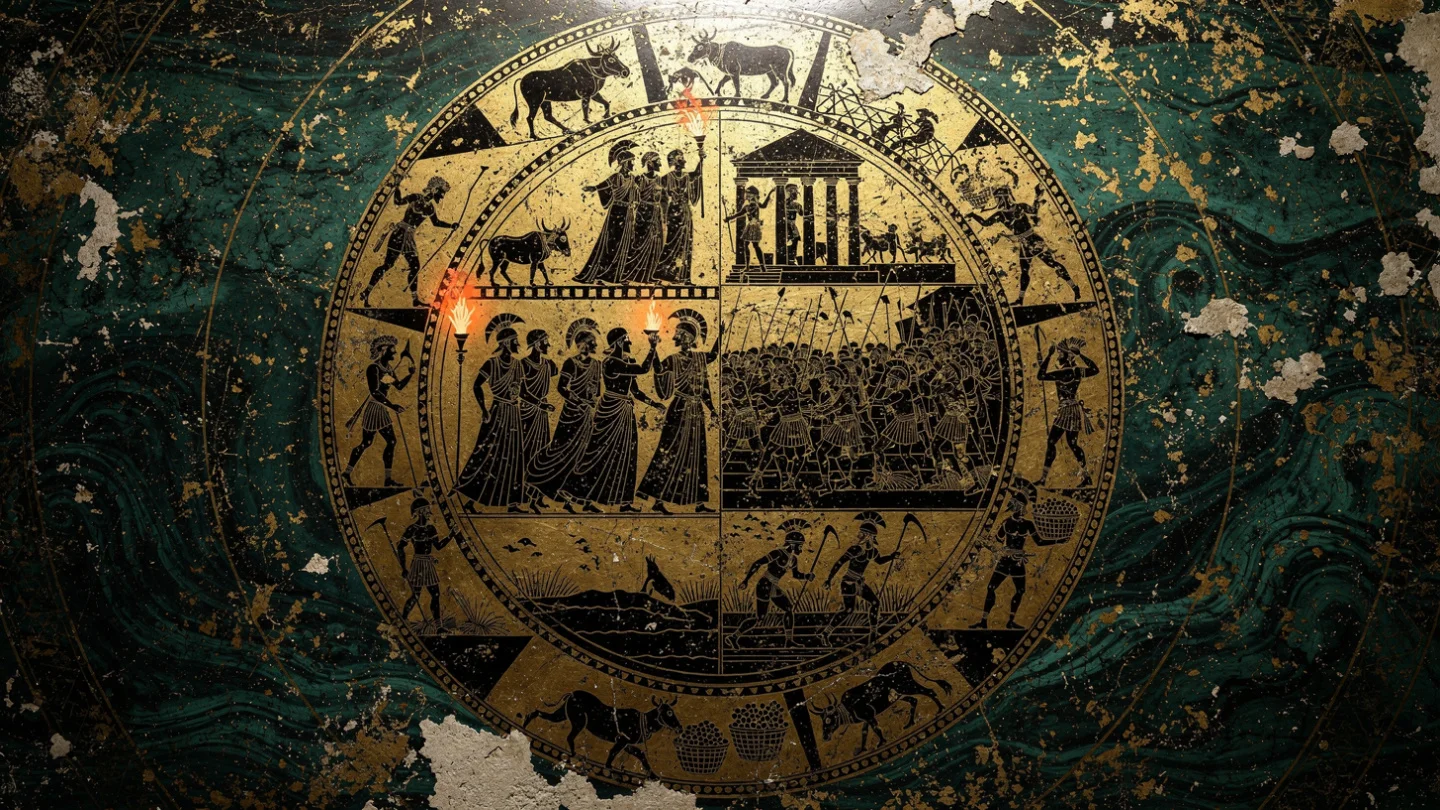
Hephaestus made the shield between a death and a killing.
Patroclus was already dead when Thetis climbed to the divine forge. Achilles had already decided to return to battle and to kill Hector and to accept that his own death would follow. The events between Patroclus’s death and Achilles’s first step back onto the Trojan plain were already determined in the way that the Iliad’s world understood determination: the choices had been made, the divine machinery had engaged, the outcome was the outcome. The only question was the form of the passage between the catastrophe that had just occurred and the killing that would follow it.
Into that passage Hephaestus placed the world.
Not the world of the Trojan War, whose violence the preceding seventeen books had documented in exhausting and magnificent detail. Not the world of divine politics on Olympus, whose management of the war’s outcome the poem had tracked with equal attention. The world that Hephaestus placed on the shield was the world outside the war: the world of the wedding and the harvest and the legal dispute and the vintage and the dance and the herd moving through the summer pasture. The world that the war was taking Achilles away from forever and that Achilles, in choosing the short glorious life over the long ordinary one, had already chosen to forfeit.
The shield is what Homer put in the space between the death and the killing. It is the poem’s answer to its own violence: here is what the violence is destroying, here is what the world is when the violence has not yet arrived, here is what Achilles will never have.
The Position in the Poem
The shield passage arrives in Book 18, which is the pivot of the Iliad’s entire structure. The first book established the terms of the conflict: Achilles’s quarrel with Agamemnon, his withdrawal from battle, his prayer to Thetis to ask Zeus to punish the Greeks through Trojan victories, the chain of events whose consequence was the accumulation of Greek losses that eventually required Patroclus’s intervention. The long middle books documented those losses and the Trojan advances that the losses produced. Book 16 gave Patroclus the armor and sent him to battle. Book 17 killed him.
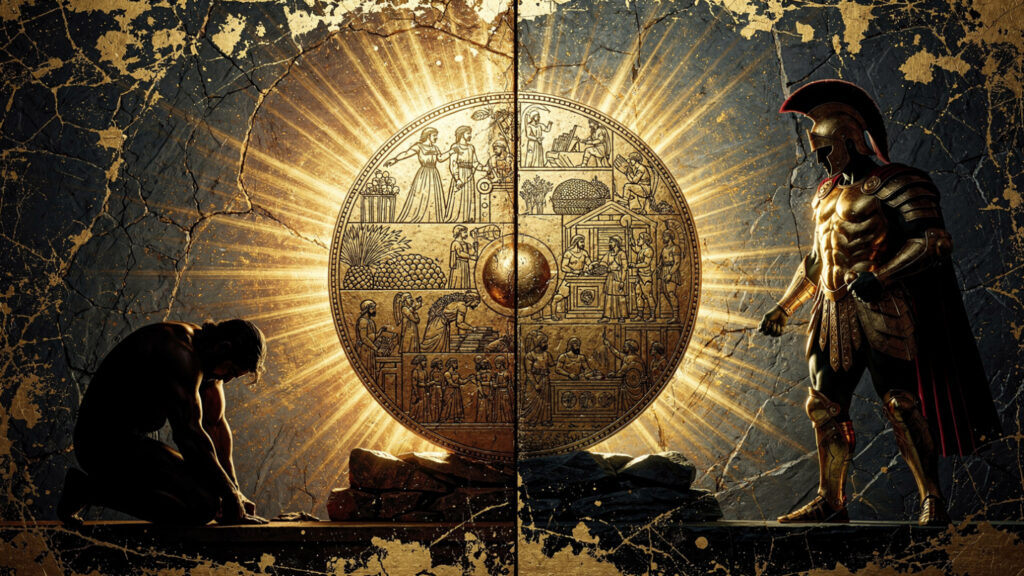
Book 18 is the book of the aftermath: Achilles’s grief, his decision to return, Thetis’s climb to the forge, the making of the armor, and the shield’s description that occupies the book’s center. Book 19 returns to the plain. Books 20 through 22 deliver the killing of Hector. Books 23 and 24 complete the poem with the funeral games for Patroclus and the ransom of Hector’s body.
The shield passage is in the exact center of the poem’s emotional structure: the space between the death that removes every reason for restraint and the killing that removes the last obstacle between Achilles and his own death. Homer does not fill this space with preparation for battle. He fills it with the description of the shield, which is the description of the world, which is the meditation on what exists outside the war that the war cannot accommodate.
This is the structural argument that the ekphrasis makes before it makes any other argument: the poem stops its narrative movement, arrests the action at its most emotionally extreme point, and inserts a description of the entire human world that has nothing directly to do with the Trojan War and everything to do with what the Trojan War is costing. The formal device of the ekphrasis, the description of a work of art within the narrative, is used here not as decoration but as the poem’s most concentrated philosophical statement: this is what exists, this is what is at stake, this is what the violence that the poem has been documenting is the negation of.
The Cosmos That Frames the Human World
Hephaestus begins with the universe.
The earth and the sky and the sea and the tireless sun and the full moon and the constellations: Pleiades, Hyades, Orion, and the Bear, which Homer calls the Wagon and which alone of the constellations never bathes in the Ocean stream but always wheels in place watching Orion. The cosmos is placed on the shield before any human scene appears, establishing the cosmological context within which the human scenes will be placed: the world of the wedding and the harvest and the legal dispute exists within the cosmological framework of the eternal celestial bodies whose movement organizes the agricultural year and whose presence in the sky gives the human world its orientation.
The Bear that never sets, the constellation that the Iliad identifies as the unique marker of the north and the fixed point around which the other constellations wheel, is the astronomical detail whose inclusion in the shield’s cosmic frame reflects the Greek sailor’s and farmer’s practical relationship to the night sky: the constellation whose permanent visibility above the horizon gives the observer their orientation in the darkness is the constellation that Hephaestus places on the shield as the cosmological anchor. The world turns. The Bear does not. The human scenes on the shield exist within the turning world that the fixed Bear watches.

The Ocean stream that encircles the entire shield’s outer rim is the cosmological boundary whose ancient Greek character the Hades article in this collection develops through the underworld geography: the stream of Ocean was the ancient Greek world’s outer boundary, the geographical limit beyond which the organized known world gave way to the undifferentiated outside. Hephaestus places this boundary around all the human scenes, enclosing the weddings and the harvests and the legal disputes and the dances within the cosmological frame of the organized world. Everything on the shield is inside the Ocean. Everything outside the Ocean is outside the world that the shield represents.
The Two Cities
The two cities at the shield’s center are the shield’s most important and most carefully constructed feature, and they are the feature whose content most directly addresses the Iliad’s governing question.
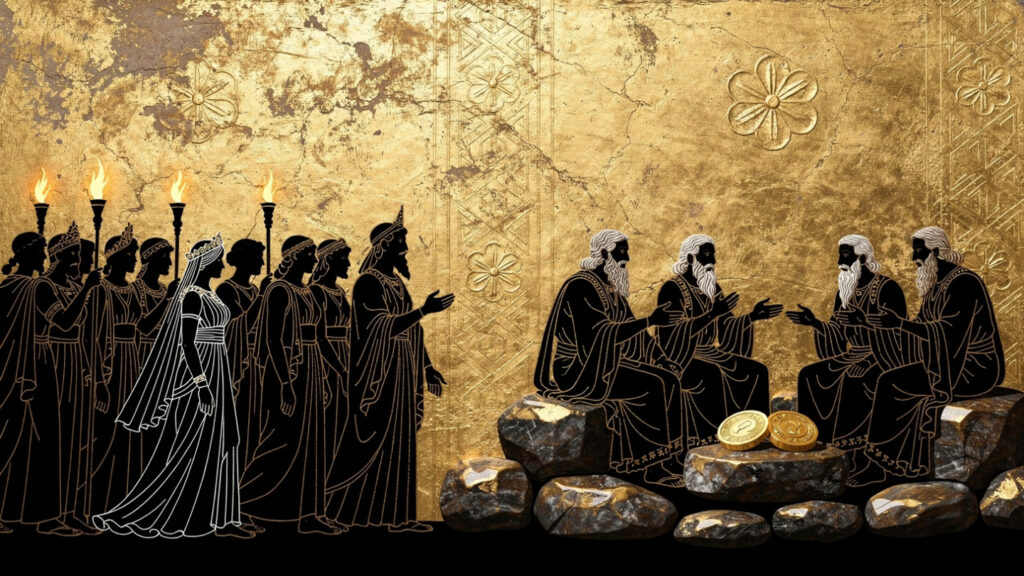
The first city is at peace. It is not simply peaceful in the sense of being without war: it is a city whose activities are the activities of the organized human community at its most fully realized. There are weddings: the brides being led by torchlight, the young men dancing, the flutes and the harps, the women watching from the doorways. The combination of the musical celebration and the communal watching is the combination of the community organized around its own continuation, the wedding as the institution through which the community reproduces itself in the organized form of the family whose children will be the community’s next generation.
And there is a legal dispute. Two men are arguing over the blood-price for a killed man, one claiming to have paid it and one denying the payment, and they have brought their dispute to the elders who are sitting on polished stones in the sacred circle, each elder receiving the herald’s staff before speaking, and the crowd cheering for whichever elder argues their side most convincingly, and the heralds maintaining the order of the proceedings, and in the center two gold talents as the prize for the elder who argues most justly.
The legal dispute in the peaceful city is the detail that most directly addresses the Iliad’s governing question because it is the scene that most directly shows what the community does with conflict when it has the institutional machinery for managing conflict without violence: it brings the dispute to the elders, it organizes the hearing through the procedures of the herald’s staff and the speaking order and the crowd’s response, and it resolves the dispute through the medium of the argument whose quality the community judges rather than the force whose application one party imposes on the other.
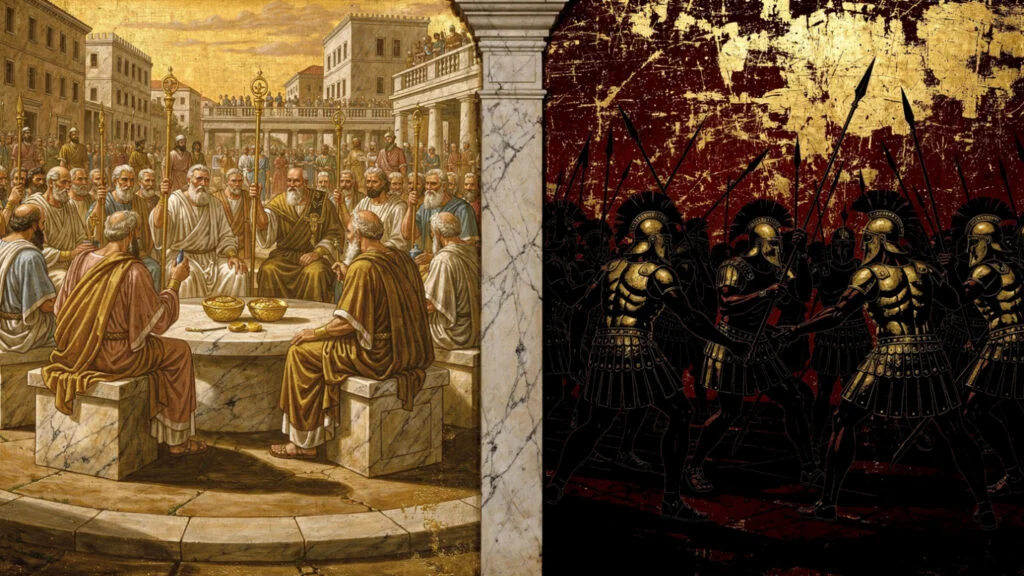
The city at peace is the city with courts. It is the city that has developed the institutional machinery for managing the conflicts that the human community inevitably generates without resolving those conflicts through the mechanism of the killing that the war uses as its only available method. The blood-price dispute in the peaceful city is the alternative to the blood-price dispute in the warring city: in the warring city, the question of who owes what to whom is resolved by the means of the sword and the spear. In the peaceful city, it is resolved by the means of the argument and the judgment.
The second city is besieged. Two armies are debating whether to sack it completely or to split its wealth with the besieging force, while the city’s men set an ambush by the river and the city’s women and old men and children watch from the walls. The gods Ares and Athena are among the fighters, golden and enormous, the divine scale that gives the human figures their diminished quality by comparison. The river runs red. The captured women are dragged away.
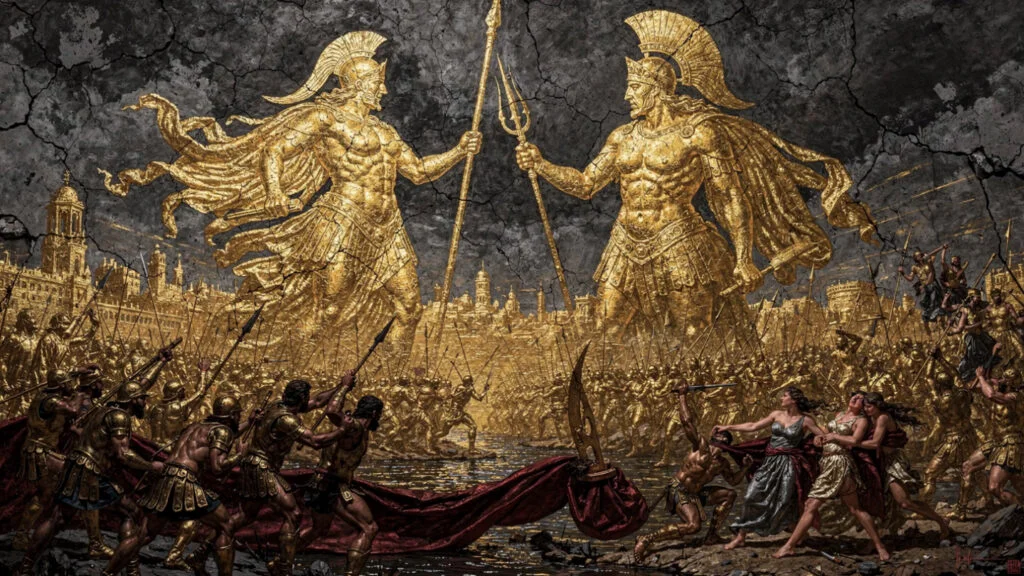
The juxtaposition of the two cities is the juxtaposition that the Iliad’s entire structure has been building toward from the first book: the world that has the institutional machinery for managing conflict without violence placed beside the world where that machinery has failed or been refused and where the conflict is being managed by the mechanism of the killing. The shield shows both cities simultaneously, which is the artistic claim that the two conditions coexist in the human world, that the peaceful city and the besieged city are not two different kinds of world but two conditions of the same world, and that the difference between them is the difference between the community that has developed and maintained the institutional machinery for managing conflict and the community that is being destroyed by the failure or refusal of that machinery.
Achilles is looking at this shield on the eve of his return to the form of conflict management that the second city is showing: the killing whose logic the Iliad has been developing since the first book, whose cost the death of Patroclus has just demonstrated at the maximum available personal scale, and whose consequence Achilles already knows will be his own death after Hector’s. He is looking at the city with courts before he returns to the city being sacked.
The Agricultural World
The middle rings of the shield develop the agricultural world whose character is the character of the organized human community in its most daily and most necessary form: the plowing and the harvesting and the vintage and the pastoral work of the shepherd and the cowherd.
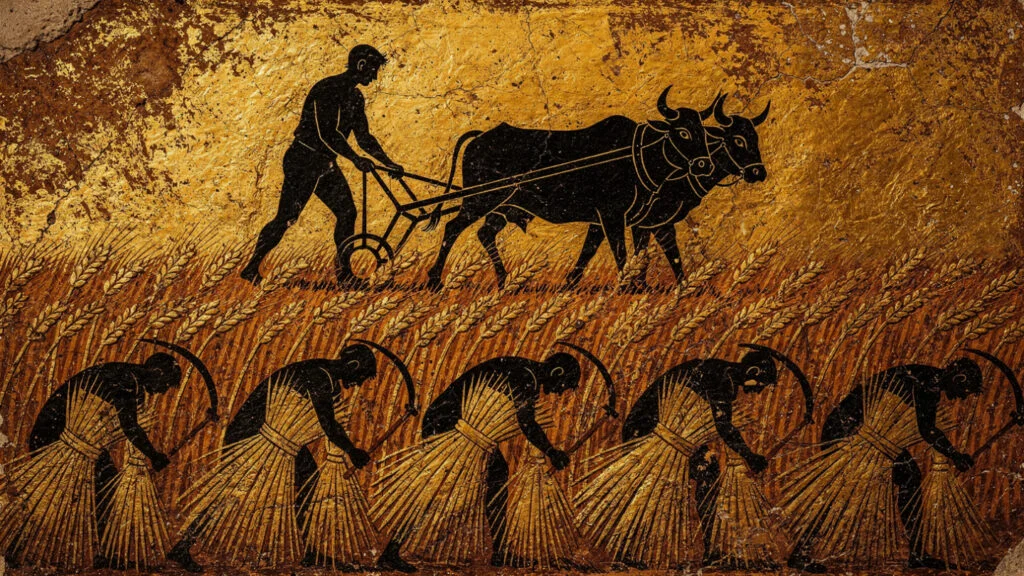
The king’s estate is being plowed for the third time, the soil turning dark as the plows move back and forth, and at the field’s end the king’s men are waiting with cups of wine for the plowmen who reach them, and then the plowmen turn and drive the furrows back across the field in the rhythm of the agricultural work that the survival of the community requires. The harvest: the reapers moving through the standing grain with their sickles, and the children gathering the cut grain into bundles behind them, and the king standing at the row’s end watching with pleasure, and the heralds preparing the feast under the oak, and the women scattering barley for the harvesters’ meal.
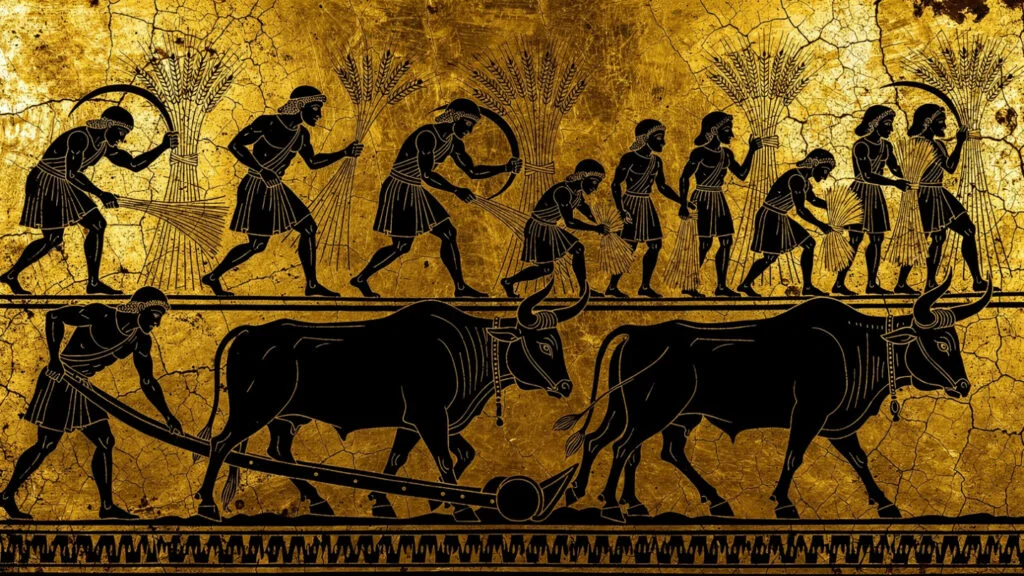
These are the scenes of the world that the war has interrupted. The Trojan War that the Iliad has been documenting is the interruption of the agricultural cycle whose continuation is the condition of the community’s survival: no harvest at Troy while the siege continues, no plowing on the Greek side while the army is at Troy. The shield’s agricultural scenes are the scenes of what the warriors’ home communities are doing in their absence, the agricultural cycle that continues without the warriors who have gone to fight and that will receive them back, or not, when the war is over.
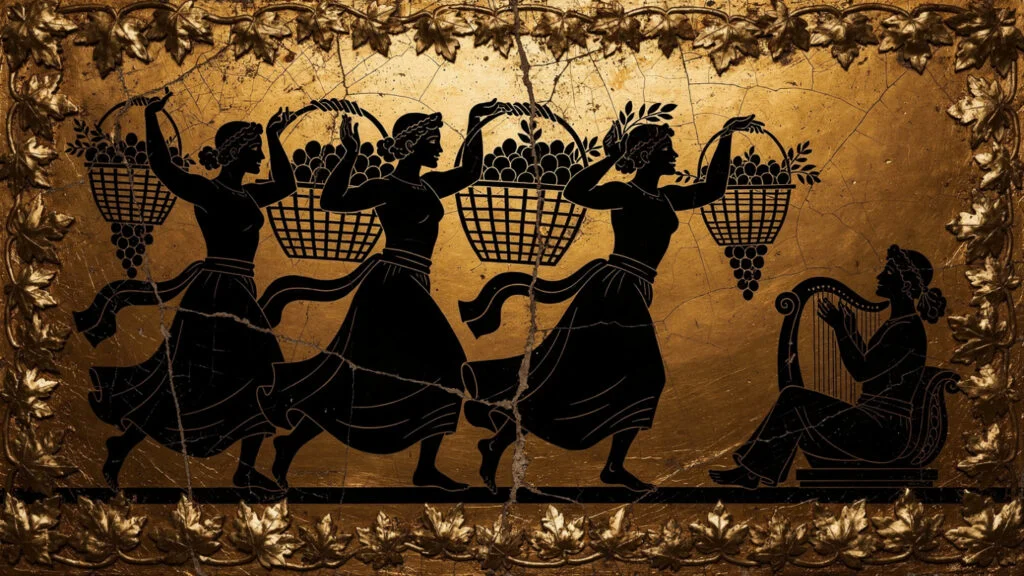
The vintage whose scene Hephaestus places on the shield is the scene that most directly connects the agricultural world to the Dionysian tradition of Vergina–Dion the collection develops through multiple articles: the grapes heavy on the golden vines, the youths and maidens carrying the vintage in wicker baskets and singing the song of Linos, the lyre leading the song and the dancers following the music and the stamping feet. The vintage as the communal celebration of the harvest that Dionysus’s domain organized is placed on the shield of the warrior who will never return to participate in it.
The cattle attacked by lions are the disruption of the pastoral world whose organized productivity the herds represent: two lions have seized the lead bull and are dragging it off while the herdsmen’s dogs stand back baying and the herdsmen themselves run to help and cannot. The pastoral world, like the human world in general, contains the violence that the organized community manages but cannot entirely prevent: the lions that attack the cattle are the expression of the natural violence whose management is the community’s permanent task, just as the legal dispute in the peaceful city is the expression of the human conflict whose management is the organized community’s permanent achievement.
The Dance
The last scene before the Ocean stream is the dance.
A dancing floor like the one that Daedalus made for Ariadne in the broad ways of Knossos: youths and maidens hand in hand, the maidens in fine linen wearing garlands of flowers, the youths in well-woven tunics gleaming with oil, the pairs turning in the choreography of the dance whose form the skilled craftsmen are beating on the lyre, and two acrobats moving through the center of the dancers, and the crowd watching from around the floor.
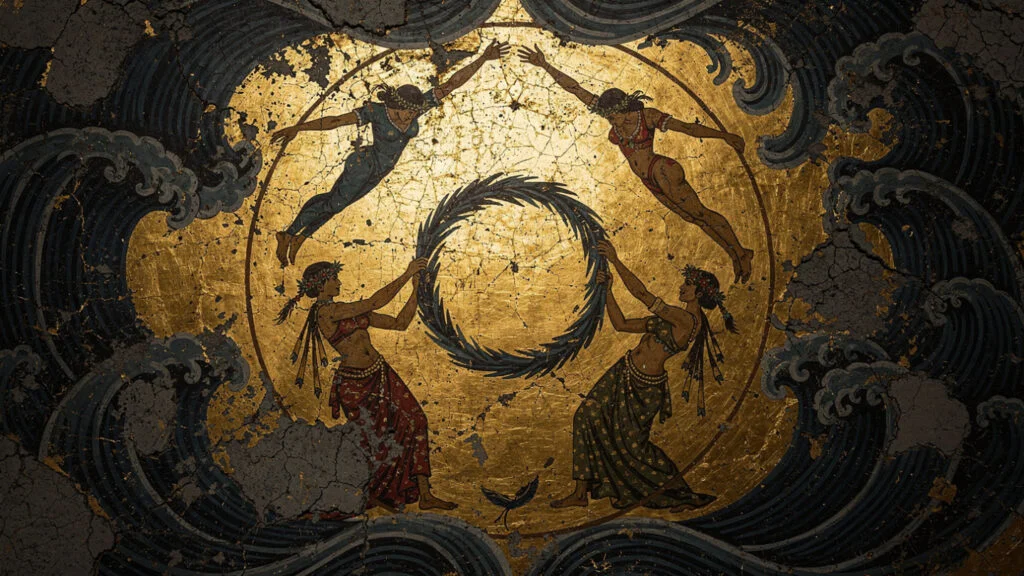
The Daedalus reference is the cross-reference to the Cretan tradition whose character the Knossos article in this collection develops: Daedalus, the divine craftsman who built the labyrinth for the Minotaur and who made the wings that Icarus flew too close to the sun with, made a dancing floor for Ariadne in the Minoan tradition. Hephaestus, the divine craftsman who is making the shield, places on the shield a dancing floor like the one that Daedalus made. The two divine craftsmen are placed in explicit comparison, the shield’s maker acknowledging the dancing floor’s maker across the medium of the divine craft tradition.
The dance is the last human scene before the Ocean closes around the world. It is the scene of the human community at its most purely celebratory: no work being done, no conflict being managed, no practical necessity being served. The dance exists for itself, in the same way that the song that Achilles is singing when the embassy from Agamemnon arrives in Book 9 exists for itself: the human activity that the community performs when it is most fully itself, most fully free from the necessities whose management occupies most of its time and energy.
Hephaestus places the dance at the edge of the world, just inside the Ocean stream that encircles everything. It is the last thing that the world contains before the cosmic boundary, the human activity that is most fully itself when it is most fully free from the necessity that war is the most extreme expression of. The warrior who will carry this shield back to the battle that will kill him is carrying the dance at the world’s edge on his left arm.
What the Shield Did Not Show
The shield showed the world outside the war. It did not show Troy or the Greek camp or the plain where the fighting was occurring or the dead that the preceding seventeen books had accumulated. It showed the world that existed alongside the war and that would continue to exist after the war ended, and it showed it to the man who would not be there when it continued.
W.H. Auden’s 1952 poem The Shield of Achilles reimagines the shield as showing the opposite: the wasteland, the barbed wire, the column of soldiers, the arbitrary violence, the girl being raped by three men while others look away. Auden’s Thetis watches Hephaestus make this shield and weeps, because what she had hoped to see, the vines and the olive groves and the marble well-governed cities, is not what the forge produced. The poem’s critique is the critique of the twentieth century’s experience of industrialized war: the shield that the modern forge makes does not show the world that the war is supposed to be protecting.
Homer’s shield shows the world the war is supposed to be protecting. Auden’s shield shows the world the war actually produces. Both shields are made by the divine craftsman for the warrior who will carry them into the killing that the poem has been building toward. The difference between the two shields is the difference between the world that Homer wanted Achilles to look at before he killed Hector and the world that Auden wanted his readers to look at after two world wars.
What remains constant across the three thousand years between the two poems is the function of the shield as the object that makes the warrior look at something other than the enemy before the killing: the object that interposes the world between the warrior and the violence, that asks the warrior to see what exists before the violence arrives and what will need to exist after the violence has passed.
Homer’s shield showed Achilles the dancing floor that Daedalus made for Ariadne and the wedding with torchlight and the elders judging justly and the harvest and the vintage and the Bear that never sets. He saw all of it, carried it on his left arm, and killed Hector.
The world did not stop him. It was never meant to stop him. It was meant to be seen.
At Olympus Estate, Mythic Essays moves through the deeper currents of the Greek tradition. Hephaestus made the shield between a death and a killing. The two cities on the shield show the city with courts beside the city being sacked, which is the Iliad’s governing question given its most concentrated visual form. The dance at the world’s edge is the last human scene before the Ocean stream closes around everything. The warrior who will carry this shield back to the battle that will kill him is carrying the dance at the world’s edge on his left arm. Homer’s shield showed Achilles everything that the war was destroying and the world did not stop him. It was never meant to stop him. It was meant to be seen.