



The Greeks had a word for drinking together: symposion.
Not eating together. Drinking together. The act that the institution was named for was not the consumption of the meal but the communal drinking that followed the meal, because the meal was the necessary preparation for the intellectual and social activity that the drinking organized rather than the point of the gathering in itself. The deipnon, the evening meal, was the first part of the evening. The symposion was the second part, and the second part was the part that the ancient tradition found worth writing about.
Plato’s Symposium is set at a symposium. Xenophon’s Symposium is set at a symposium. Plutarch’s Table Talk, the Quaestiones Convivales, is the record of philosophical discussions that took place at symposia across Plutarch’s adult life. The intellectual tradition that the Western world identifies with ancient Athens, the Socratic method, the philosophical dialogue, the practice of submitting every received idea to sustained critical examination in the company of people who disagree with you, was not produced in the lecture hall or the private study. It was produced at symposia, over wine mixed with water in the ratios that the symposiarch determined for the evening, in the rooms of private houses, among the men of the Athenian educated class who gathered for the combination of drinking and conversation that the symposium provided.
The institution was the method’s home, and understanding the institution is understanding where the method came from and what conditions it required.
The Deipnon | The Meal That Preceded Everything
The deipnon, the main meal of the ancient Greek day, was consumed in the evening after the day’s work was finished, and its character as the most important of the three daily meals reflected the understanding that the shared evening meal was the institution through which the household maintained its internal coherence and through which the individual maintained their connection to the social body.
The three meals of the ancient Greek day were the akratismos, the breakfast of barley bread dipped in undiluted wine with olives or figs, the ariston, the midday meal which was lighter than the evening meal and often consumed wherever the day’s work had taken the individual rather than at home, and the deipnon, the evening meal that was the meal the day was organized around. The hierarchy of the three meals was not simply a matter of the quantity of food consumed: it was the hierarchy of social significance, with the deipnon occupying the position of the most important meal because it was the meal that brought the complete household or the invited company together in the most deliberate and most organized form.
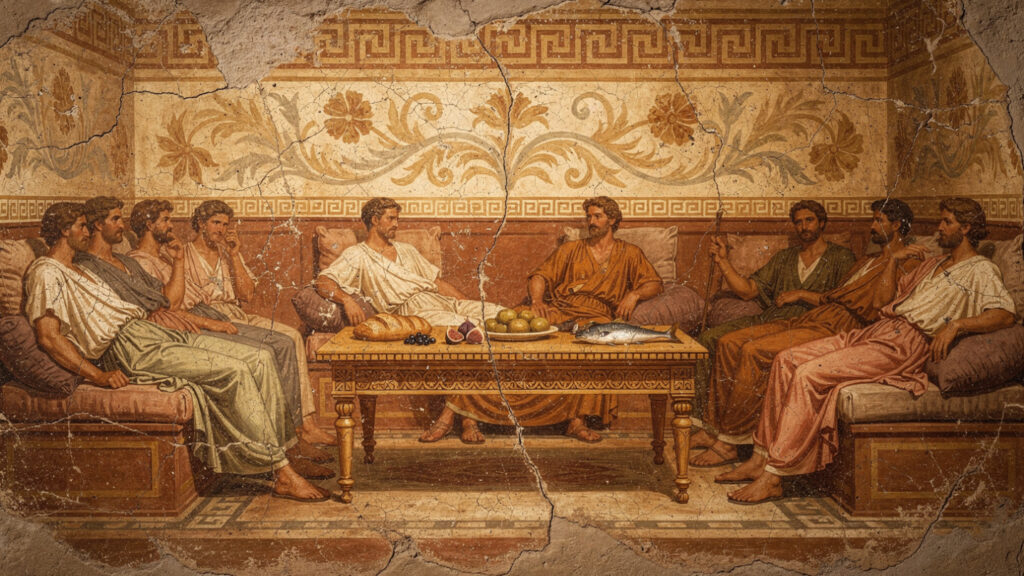
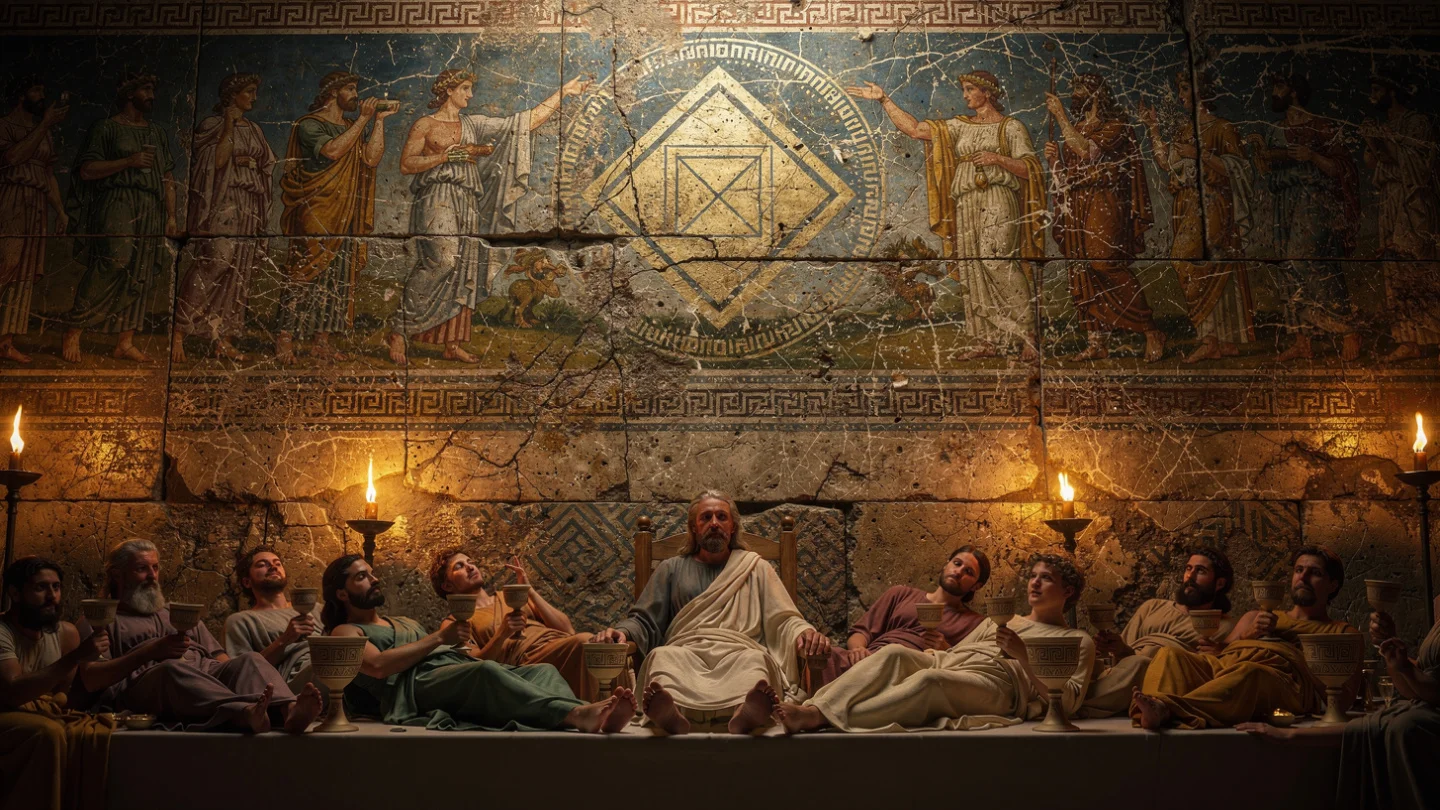
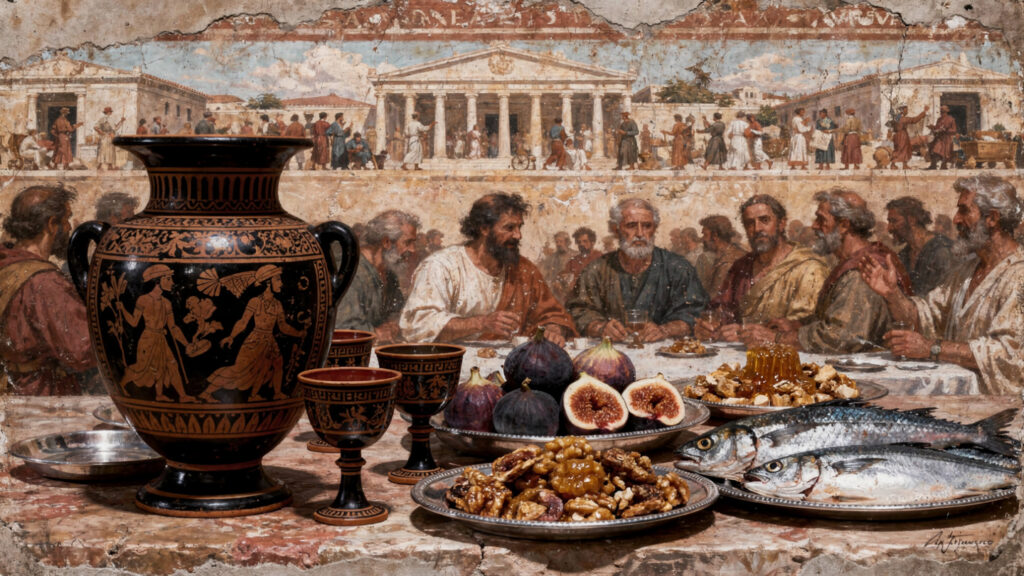
The deipnon was organized in two courses: the first course of bread and vegetables and fish and meat, eaten from the common dishes arranged on the low table called the trapeza that was brought into the andron, the men’s dining room, for the meal, and the second course of dried fruits and nuts and sweets called the tragemata. The spatial organization of the andron was the spatial organization of the symposium that would follow: the room was lined with klinai, the dining couches on which the guests reclined, arranged around the walls so that each couch faced the center of the room where the trapeza stood during the deipnon and where the mixing bowl, the krater, would stand during the symposium.
The reclining position on the klinai was itself a social marker: the Greeks understood reclining at table as a practice of the free adult male citizen rather than of the slave or the woman or the child, who sat on chairs or the floor. The posture of the symposium participant, reclining on the left elbow with the right hand free for the wine cup, was the posture of the citizen in his civic leisure, the posture that the vase paintings of the symposium tradition consistently represent and that carried the social meaning of belonging to the class of people who had the time and the status to recline rather than sit or stand while consuming food and wine.
The Symposiarch and the Wine
Between the deipnon and the symposium, the tables were removed, the hands were washed, and the libations were poured. The libation to the gods, specifically the three libations to the Agathos Daimon, to Zeus Soter, and to Hermes, was the ritual transition that marked the passage from the meal to the symposium and that placed the drinking occasion under divine supervision. The symposium did not begin until the libations were poured and the ritual gesture of the divine acknowledgment was complete.
The symposiarch, the master of the drinking, was elected by the company at the beginning of the symposium, typically by the throw of the knucklebones that the Greek tradition used for many forms of allocation that the contemporary world uses dice for. The symposiarch’s authority was the authority to determine the ratio of wine to water in the communal mixing bowl, the krater, and the pace at which the cups were filled and emptied throughout the evening. This authority was not trivial: the wine-to-water ratio determined the degree of intoxication that the evening would produce, and the symposiarch who set the ratio too high risked losing the quality of the intellectual engagement that the symposium was organized to produce, while the symposiarch who set it too low risked the sobriety that prevented the loosening of inhibition that the symposium’s social function required.
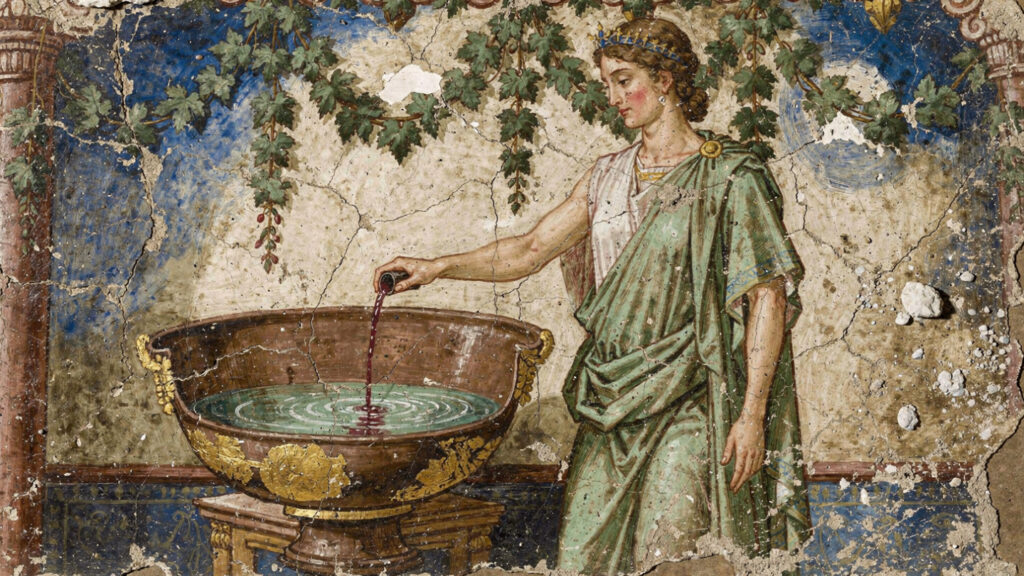
The standard dilution ratios described in the ancient sources range from one part wine to three parts water, the most dilute and most sober, to equal parts wine and water, the strongest mixture that convention permitted. Drinking undiluted wine was the behavior of the barbarian or the drunkard. The symposium world consistently maintained that proper wine consumption required dilution, and the ratio chosen by the symposiarch was the calibration of the evening’s intellectual and social temperature.
The wine itself was the wine of the Greek archipelago, produced from the vineyards of Chios, Lesbos, Thasos, and the mainland regions whose terroir the ancient Greek wine world identified and valued in the same way contemporary wine culture identifies and values regional character. Chian wine was among the most celebrated of the ancient Greek wines, associated with the quality of the island’s volcanic soil and its maritime microclimate. The gift of Chian wine to a symposium host was the gift of the most esteemed wine in the ancient Greek world.
The Symposium’s Program
The symposium was not an unstructured social gathering. It was an organized program of activities, conducted in sequence, under the direction of the symposiarch, and the activities it included were the exercises that the ancient world regarded as the appropriate intellectual and social practices for the citizen in his leisure.
The symposium also included music: the aulos player who accompanied the singing, whose presence at the symposium was the presence of the instrument most associated with the Dionysian ecstasy that the symposium was designed to invoke in a controlled form, and whose role in the program was to provide the musical foundation for the singing that was the evening’s primary collective activity. The relationship between the aulos and the symposium, with the aulos providing the continuous drone over which the symposium’s singing moved, is the relationship that the Symposium of Plato’s Agathon explicitly addresses when the guests agree to send away the aulos player so that they can talk without the competition of the music.
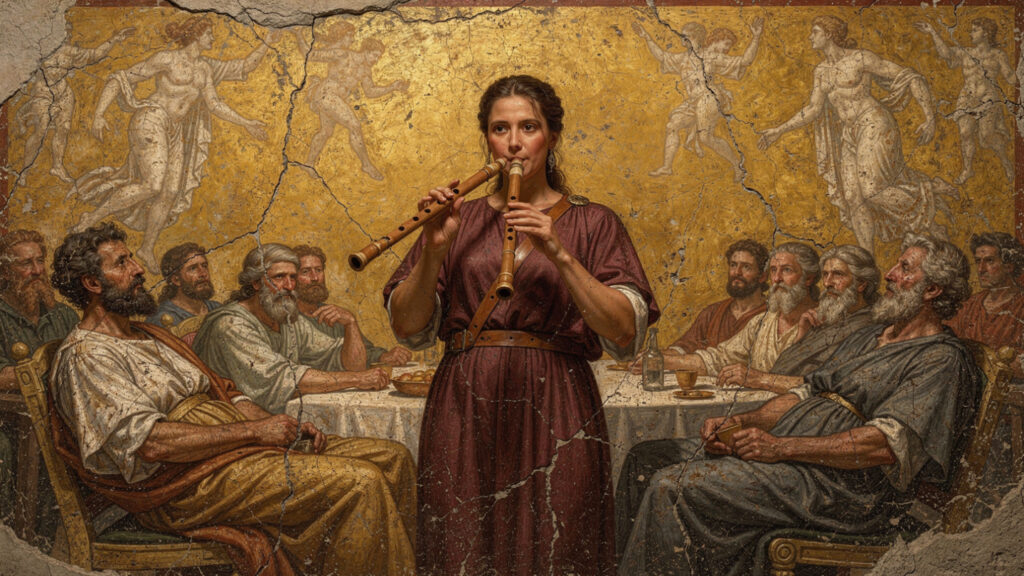
The philosophical discussion that followed the singing was not the symposium’s departure from its entertainment function but its continuation of it by other means: the ancient Greek tradition did not distinguish between the intellectual pleasure of the philosophical argument and the sensory pleasure of the music and the wine in the way that the modern distinction between intellectual and physical pleasure would suggest. The symposium’s program moved from the physical to the intellectual and back again, and the wine that continued to circulate through the discussion was the same wine that had accompanied the singing, calibrated to the level of loosening that the intellectual engagement required rather than the level of intoxication that would prevent it.
Kottabos | The Erotic Competition
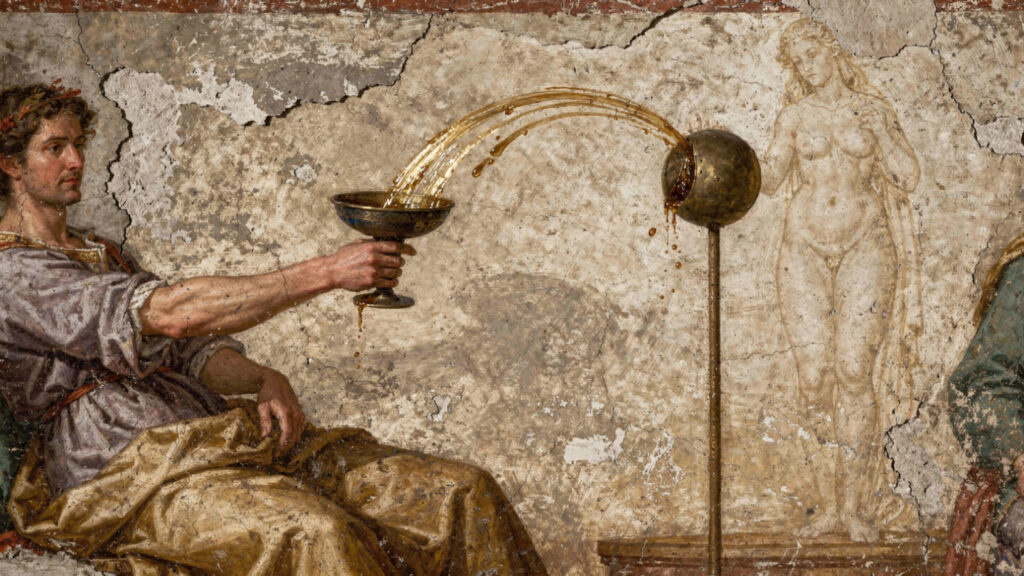
The kottabos was the game that the symposium included as the expression of its erotic dimension, and its mechanics are worth understanding because they express something precise about the relationship between the erotic and the intellectual that the symposium tradition maintained.
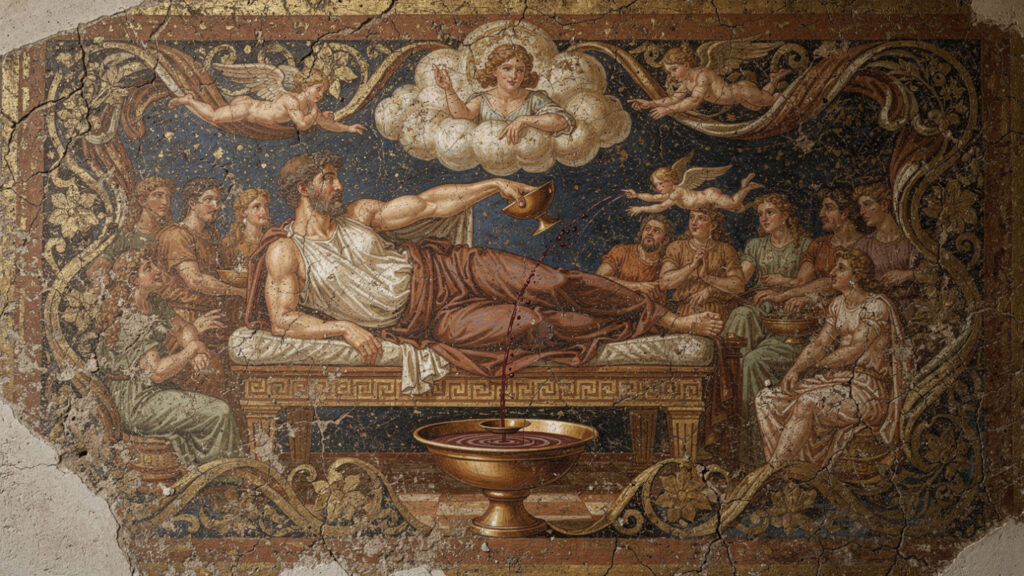
The kottabos player drained their wine cup, leaving a small quantity of wine at the bottom, and then flicked the cup’s contents across the room at a target: either a small disc balanced on a vertical rod set up in the center of the room, or a series of small bronze saucers floating in a larger basin of water. The skill of the kottabos throw was the skill of controlling the wine’s trajectory with a single flick of the wrist, and the quality of the throw was evaluated both for accuracy and for the elegance of the gesture.
Before throwing, the kottabos player dedicated their throw to the person they desired: they named the beloved, threw the wine, and the accuracy of the throw was understood as a divinatory indicator of the beloved’s reciprocation. The kottabos was therefore simultaneously a demonstration of physical skill, a social act of public erotic declaration, and a divinatory practice whose outcome was read by the assembled company as the omen of the thrower’s erotic prospects.
The erotic dimension of the kottabos was not separate from the symposium’s philosophical and musical dimensions but integrated into the same occasion: the symposium was the institution in which the ancient Greek tradition understood the erotic, the intellectual, and the musical as three aspects of the same human capacity for connection rather than as three separate domains of experience. The Platonic Symposium’s argument, that the erotic desire for physical beauty is the first step of a philosophical ascent that culminates in the desire for beauty itself, the Form of Beauty, is the philosophical articulation of what the symposium’s program was enacting simultaneously in the physical and the intellectual registers.
Plato’s Symposium and What It Documents
The Symposium of Plato, composed in approximately 385 BCE and set at the symposium held in the house of the tragic poet Agathon the day after his first victory at the Lenaia festival of 416 BCE, is the most complete surviving literary representation of the ancient Greek symposium as an institution and the most philosophically ambitious ancient Greek engagement with the question of what the erotic desire is and what it is for.
The dramatic setting, the symposium the day after Agathon’s theatrical victory, is the setting that gives the evening its character: the guests are recovering from the previous evening’s celebration, Socrates has already been offered the garlands of the victory celebration, and the mood of the gathering is the mood of the morning after the public triumph in the private setting of the follow-up gathering where the real conversation can happen without the performance requirements of the public occasion.
The agreement to send away the aulos player so that the guests can talk, which Phaedrus proposes and the company accepts, is the moment in which the Platonic Symposium declares its own nature as a philosophical work rather than an entertainment: the aulos is sent away because the music would compete with the argument, and the argument is what Plato wants to document. But the framing makes clear that the argument that follows, the sequence of speeches in praise of Eros delivered by each guest in turn, is the symposium’s program conducted through the philosophical medium rather than the musical one: the skolia have been replaced by the speeches, but the structure of each guest contributing their account to the communal intellectual project is the structure of the symposium’s singing tradition conducted in philosophical prose.
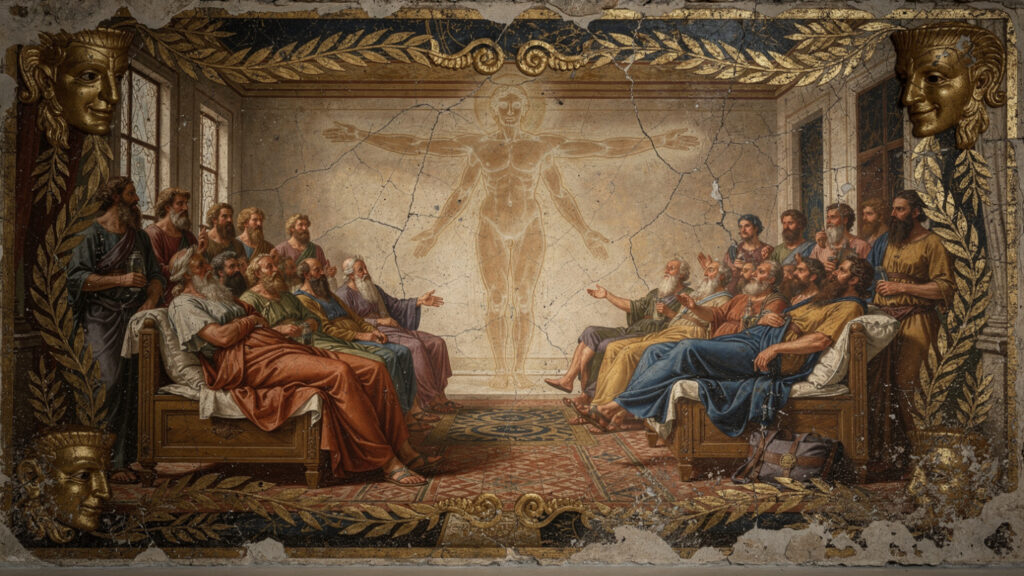
The speech of Aristophanes, in which the comic poet provides the most imaginatively compelling of the evening’s accounts of the erotic, the myth of the originally spherical double humans who were split by Zeus and who spend their lives seeking their original other half, is the speech that most clearly reveals what the symposium’s mixing of the comedic and the philosophical was designed to produce: the argument that the erotic desire is the desire for the restoration of an original wholeness is the argument that the comic poet makes through the mythological form that his art was trained to produce, and the symposium is the institution in which the comic poet’s form of argument is heard alongside the tragic poet’s form and the philosopher’s form as three contributions to the same communal investigation.
The Food Itself
The foods of the ancient Greek meal are documented extensively in the comic world, particularly in the fragments of Athenian Middle and New Comedy whose interest in food and dining reflects a theatrical imagination that understood the comic possibilities of the gap between the idealized symposium of the philosophical texts and the actual eating and drinking of daily Athenian life.
Fish was the most prestigious food on the Athenian table. The fish of the Aegean — sea bass, tuna, grey mullet, red mullet, and the many species of the Greek coastal fishery — were the foods whose prices the comic poets consistently noted as indicators of the social ambition of the buyer. The fish market in the Athenian agora was the market whose prices the comic poets used as the index of social pretension. The man who spent too much on fish was the man trying to purchase the prestige of the symposium through the quality of what he served rather than through the quality of what he said.
The vegetables and legumes of the ancient Greek meal, the lentils, chickpeas, broad beans, and the wild greens gathered from the countryside, were the foods of the poor and the foods of the moderate. The Pythagorean prohibition on beans, preserved in the ancient sources without a fully agreed explanation, is the most famous dietary restriction in Greek philosophical life.
Bread was the foundation of every meal. In the classical period it was barley bread rather than the wheat bread that later ages associated with luxury, because the Attic soil grew barley more readily than wheat. Barley bread was the bread of the citizen’s daily self‑sufficiency, not the imported indulgence of wheat. The maza, the barley cake that accompanied the meal, served as an edible utensil, the equivalent of the modern flatbread used for scooping rather than for independent eating. Its role at the table was to make the other foods accessible, not to stand as the centerpiece of the meal.
The Legacy
The intellectual world that the symposium produced is the world that the West has been working with in various forms since the Platonic dialogues were first circulated across the Hellenistic world in the generation after Plato’s death. The method of the Socratic dialogue, the sustained examination of a single question through the exchange of views between participants who disagree, is the method shaped by the symposium’s combination of wine, company, time, and the social expectation of thoughtful engagement.
The contemporary belief that important ideas are produced in the focused isolation of the scholar at a desk is a belief that the Greek world would have found both recognizable and incomplete. The isolated scholar was the scholar in training, reading and thinking and preparing to engage. The actual intellectual work happened at the table, in the company of people who had also been reading and thinking, over the wine that loosened the inhibitions that prevented the honest statement of disagreement, in the institution designed specifically to produce the kind of thinking that isolation cannot produce.

Plutarch’s observation in the Table Talk that the questions worth asking are the questions that the wine reveals rather than the questions that sobriety permits is the observation that the symposium tradition was built on: that the quality of the intellectual engagement that the symposium produced was the quality of an engagement that the ordinary social inhibitions prevented and that the controlled intoxication of the symposium’s wine ratio made possible.
The meal that preceded the symposium was the preparation for the conversation that followed it. The conversation was the point. The wine was the tool. The institution was the method.
At Olympus Estate, Cultural Chronicles traces the practices and institutions that defined Greek civilization from the inside. The symposiarch determined the wine-to-water ratio for the evening. The kottabos player dedicated their throw to the person they desired and read the accuracy of the throw as the omen of reciprocation. The aulos player was sent away so that Socrates could ask his questions. The Platonic Symposium was set in the house of a tragic poet the day after his theatrical victory, which is the occasion that gave the philosophical argument its festive setting and the festive setting its philosophical consequence. The conversation was the point. Go find the table where it is still happening.