





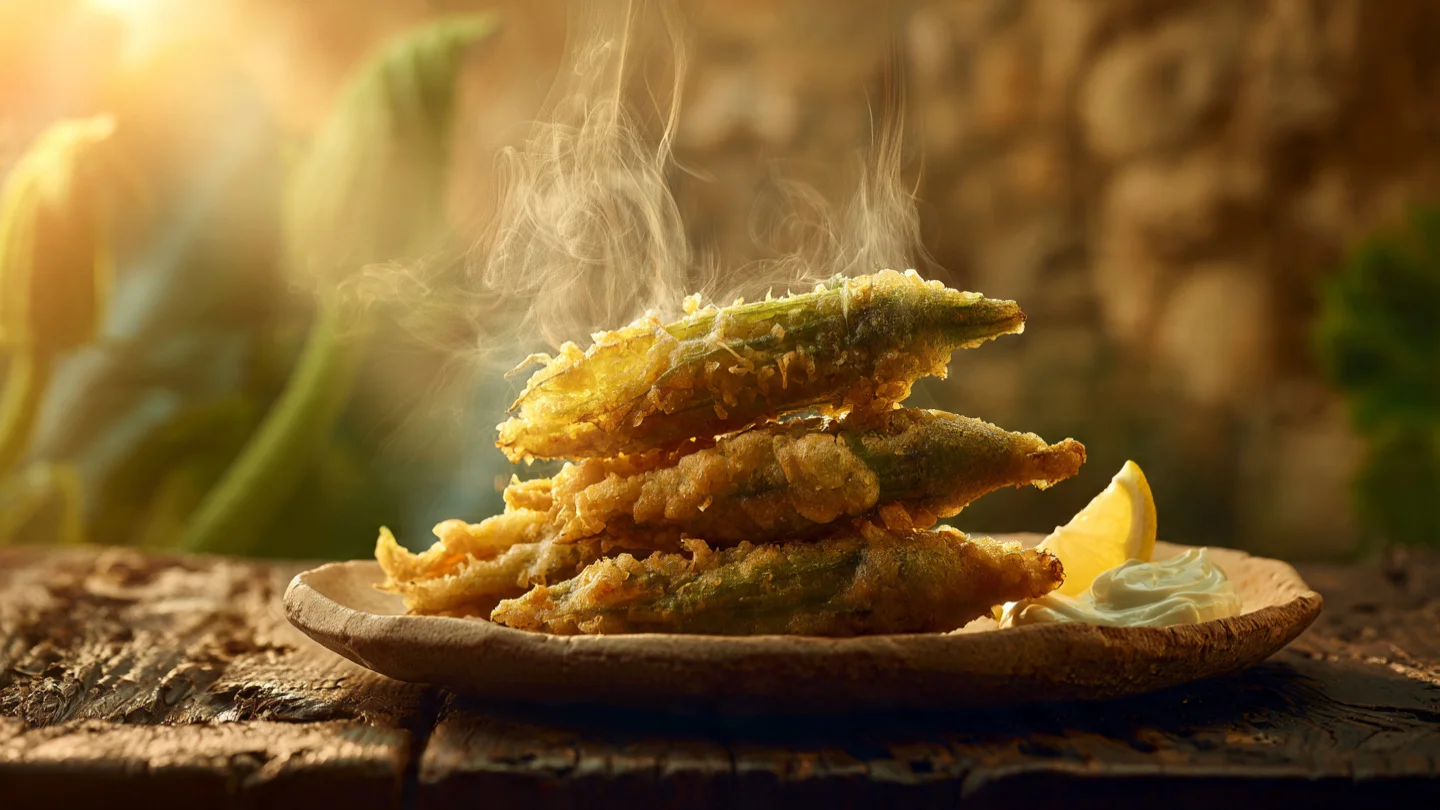
The zucchini flower has a window of approximately six hours.
This is the logistical reality that separates the stuffed fried zucchini flower from almost every other preparation in the Greek summer kitchen, and it is the reason that the dish belongs to the garden and the market rather than to the supermarket and the delivery order. The blossom opens in the early morning and begins to close and soften by midday. The flowers that are picked and cooked within a few hours of opening are the flowers with the structural integrity that the stuffing and the frying require: the petals that hold the shape of a parcel around the filling without tearing, that maintain their texture in the hot oil rather than collapsing before the batter crisps. The flowers that have waited a day in the refrigerator will fry, and will taste of the filling, but they will not have the quality of a blossom that opened this morning and was in oil by noon.
The Greek kitchen’s relationship with the zucchini flower is the relationship of a kitchen organized around what the garden is producing rather than around what the shops are stocking: the kolokythanthoi, the zucchini flowers, arrive in the kitchen on the same mornings that the gardener has gone to check the plants, and they are cooked that day because they cannot wait for a more convenient occasion. This perishability is the condition that keeps the preparation seasonal and the ingredient valuable, and it is the condition that the tourist restaurant menu and the food media recipe article cannot fully replicate for the reader who is not standing in front of a garden.
The stuffed fried flower is the Greek summer table’s most concentrated expression of the logic that produces the best seasonal cooking everywhere: the perfect thing to do with an ingredient in a season is the thing that the people who grew up with that ingredient in that season have been doing with it for generations, and it does not require improvement.
The Flower and Its Character
The zucchini flower is the male blossom of Cucurbita pepo, the same plant that produces the zucchini that the Greek kitchen uses in its summer stews and its fried vegetable plates and its kolokythokeftedes, the zucchini fritters that appear on every meze table from June through September. The male flowers, which appear on long thin stems rather than on the short stems that carry the developing fruit, are the flowers most suitable for stuffing because they do not carry a developing zucchini at their base that would interfere with the preparation.

The flavor of the flower is the flavor of the zucchini in its most delicate possible register: the same green vegetable sweetness, lighter and more floral than the fruit, with the quality of a very young plant part that has not yet developed the watery mildness that the mature zucchini tends toward. The flower is not a neutral wrapper for the filling. It contributes its own flavor to the finished dish, and the filling should complement rather than overwhelm it.
The pistil and stamens in the center of the flower are removed before stuffing not because they are inedible but because their texture and their slight bitterness in the finished dish is unnecessary when the filling already provides the dominant flavor. The removal is gentle work: the finger inserted into the center of the open flower and used to sweep out the central structure without tearing the petals is the technique that practice makes easy and that the first attempt can make awkward.
The cleaning of the flowers requires the gentleness that the fragile structure demands: a brief rinse under very slow running water or a wipe with a barely damp cloth is sufficient. Strong water pressure tears the petals. The flowers need to be as dry as possible before they go into the batter, because surface moisture prevents the batter from adhering and produces the steaming rather than the frying that makes the batter separate from the flower in the oil.
The Filling and Its Logic
The filling of feta and fresh mint is not an arbitrary combination assembled for the recipe. It is the combination that the properties of both ingredients make correct for this preparation.
Feta is the Greek dairy product that most completely expresses what happens when milk is treated with the bacterial cultures and the aging conditions of Greek tradition: the sharp, salty, slightly crumbly cheese that the Protected Designation of Origin now reserves exclusively for the Greek product made from sheep’s milk or sheep’s and goat’s milk in the regions of mainland Greece and Lesbos. The feta that goes into the stuffed zucchini flower should be the proper feta of Greek tradition rather than the white salted cheese sold under the same name in other countries, because the sharpness and salinity of the real feta is the quality that the filling requires to assert itself against the delicate sweetness of the flower and through the batter.
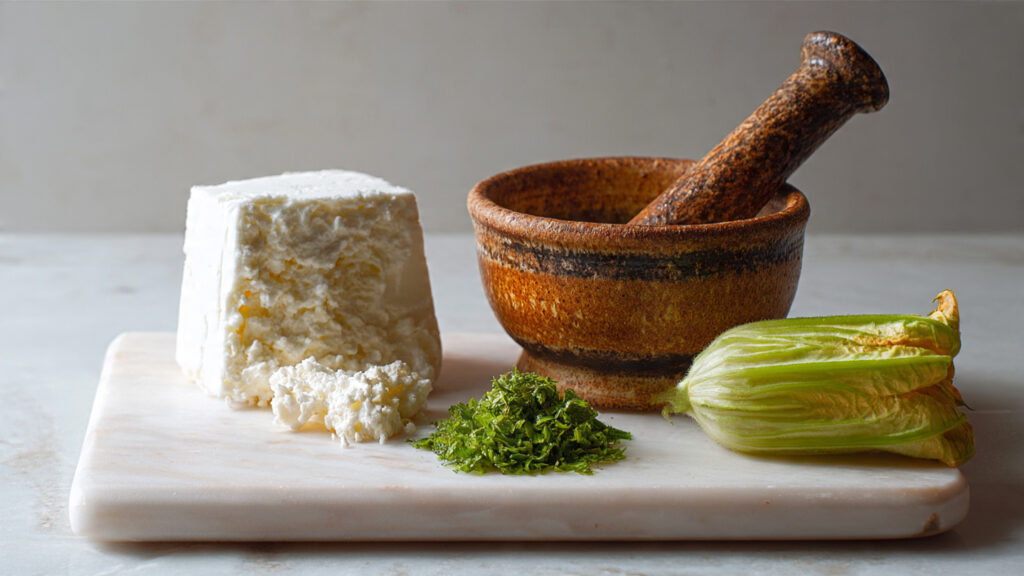
Fresh mint in the Greek kitchen means diosmos, the spearmint whose aromatic character distinguishes it from peppermint in a way that every cook who has used both knows immediately: the diosmos is bright and clean and slightly sweet in its aromatics, not the sharp medicinal character of the peppermint. It is the herb that appears in the keftedes, in the tzatziki of certain regional styles, and in the stuffed vegetables of the summer kitchen, and its combination with feta in the stuffed flower is the combination that the Greek kitchen has been using for the same reason that all good traditional combinations persist: it works, and it works in the way that the season and the ingredient require.
The proportion of mint to feta is the proportion that the cook determines by taste rather than by measurement: enough mint to be present in every bite without dominating the feta, which in practice means approximately one tablespoon of finely chopped diosmos for every 100 grams of feta. The feta is mashed with a fork rather than crumbled, which produces a smoother filling that holds together in the flower without leaking out into the batter before the heat seals it.
A small addition of fresh ricotta or anthotyro, the fresh Greek whey cheese, in a proportion of one part to three of feta, softens the filling and makes it more yielding in the mouth without reducing the feta’s flavor contribution. This is not standard in every Greek kitchen but is the adjustment that makes the filling marginally more refined in texture while remaining entirely within the Greek dairy tradition.
The Batter
The beer batter is the batter that the Greek taverna tradition uses for fried foods across the summer menu, and its properties make it the correct batter for the zucchini flower rather than a recipe-writer’s clever substitution.
The carbonation in the beer, the dissolved carbon dioxide that forms bubbles when the pressure is released, is what distinguishes the beer batter from the plain flour-and-water batter in the finished fry: the bubbles that form during the mixing and that continue to expand in the hot oil produce the open, light crumb structure that makes the beer-battered coating crispy rather than doughy, and that produces the shattering texture when the fried flower is bitten rather than the chewy resistance of a heavier batter.
The beer that produces the best batter is the lightest available beer rather than the most flavorful: a pale lager whose carbonation is high and whose flavor contribution to the batter is minimal. The beer batter is not a vehicle for beer flavor in the finished dish. It is a vehicle for carbonation, and the beer whose carbonation is highest and whose other flavor compounds are most neutral produces the lightest and most neutral batter.
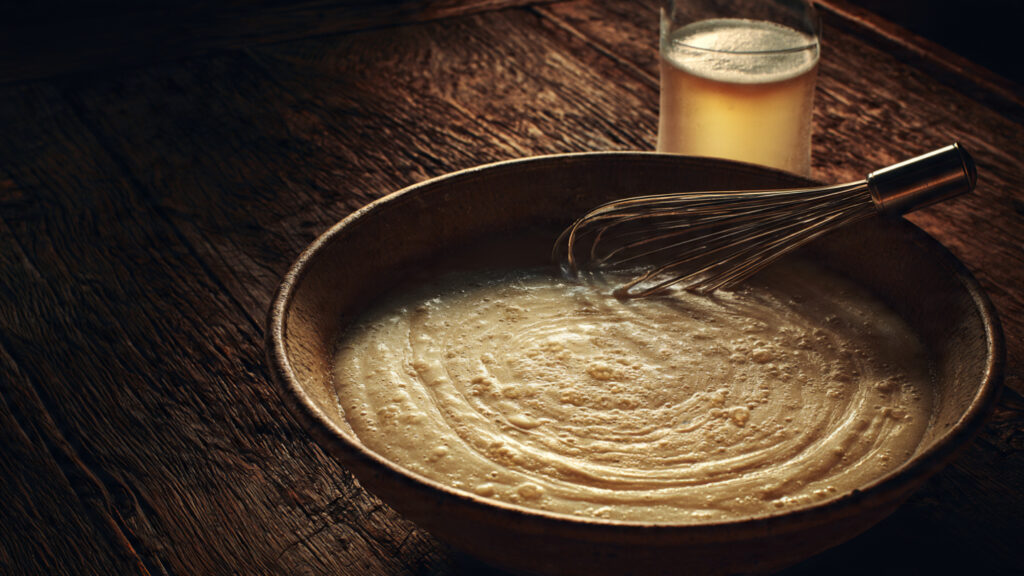
The proportion of flour to beer in the batter is the proportion that produces the consistency of thin cream. If it is too thick, the batter coats the flower so heavily that the steam from the stuffing cannot escape during frying and the batter blisters and separates from the flower. If it is too thin, the coating is insufficient to protect the delicate petals from the direct heat of the oil and to produce the crispiness that the dish requires. The batter is mixed quickly and used immediately. Resting the batter allows the gluten to develop and makes it tougher in the finished fry
The oil for frying should be olive oil rather than a neutral oil for the same reason that the olive oil is used for most frying in the Greek kitchen: the flavor that the olive oil contributes to the fried food is part of what makes the fried food taste as it does in Greece rather than as a technically similar preparation might taste elsewhere. The olive oil need not be the most expensive cold-pressed extra virgin production: a good quality olive oil used at the correct temperature is the correct choice, and the temperature is the temperature at which a small drop of batter sizzles immediately and rises to the surface without the oil smoking.
The Service and the Moment
The stuffed fried zucchini flower must be eaten immediately. This is not a suggestion or a preference: it is the physical condition of the dish that makes the eating most meaningful and most pleasurable.

The crispiness of the batter is the result of the water in the batter having been driven off by the heat of the oil: the steam has expanded the bubbles in the batter and the surface has dried and crisped as the moisture left. When the flower is removed from the oil and begins to cool, the steam that was driving the moisture out reverses direction and the crispy batter surface reabsorbs moisture from the interior of the filling and from the surrounding air. The window between the flower leaving the oil and the batter beginning to soften is approximately five minutes in optimal conditions and shorter in humid weather.
The Greek summer table understands this condition naturally because the Greek summer table serves fried food as it comes from the oil rather than in a single coordinated serving at the end of a sequence: the fried flowers that the cook brings from the kitchen in batches of three or four as they finish frying are at their best at the table rather than all served at once when the last batch has been waiting for the first. The cook fries and the table eats, and the conversation continues between the batches, and this is not an inconvenience of the preparation but the rhythm that makes the fried flower the social dish that it is in the Greek summer kitchen.
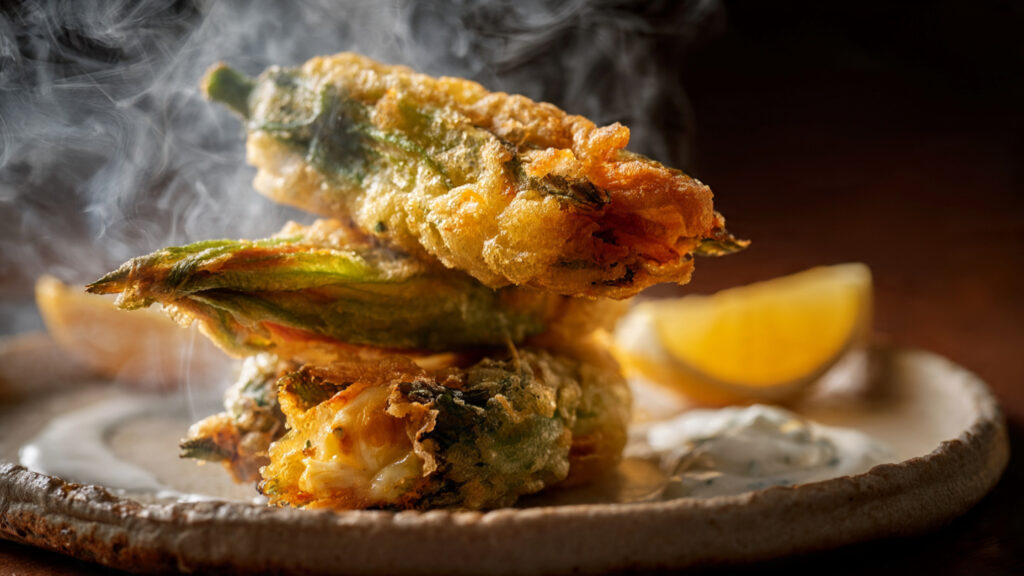
Serve with wedges of lemon for those who want the acid, with cold tzatziki alongside as a dipping sauce, and with nothing else that would compete with the combination of the crispy batter, the salty sharp feta, and the cool mint that the flower itself contains. The flower does not need improvement at the table. It needs only the moment of being eaten while it is exactly what it is, which is available for approximately five minutes.
Olympus Estate · Food & Seasonal Life
Kolokythanthoi · Fried Zucchini Flowers Stuffed with Feta and Fresh Mint
Pick them in the morning. The flower has a six-hour window and the batter has five minutes. Feta, diosmos, beer batter, olive oil. Eat immediately.
Ingredients
The flowers
- Zucchini flowers, male (on long thin stems), freshly picked12
The filling
- Greek feta, mashed with a fork200 g
- Fresh spearmint (diosmos), finely chopped2 tbsp
- Freshly ground black pepperto taste
The batter
- Plain flour120 g
- Pale lager beer, cold180 ml
- Sea saltpinch
For frying and serving
- Extra virgin olive oilfor frying
- Lemon wedgesto serve
- Tzatziki (optional)alongside
Method
-
1
Clean the flowers
Gently open each flower and use a finger to sweep out the pistil and stamens from the center. Wipe the outside with a barely damp cloth or rinse under the slowest possible stream of water and pat completely dry. Surface moisture prevents the batter adhering. Handle with care throughout: the petals tear easily.
-
2
Make the filling
Mash the feta with a fork until smooth enough to spoon. Mix in the chopped diosmos and black pepper. Taste: the feta is salty enough that additional salt is rarely needed. The filling should be cohesive enough to hold its shape when spooned.
-
3
Stuff the flowers
Use a small spoon to place a teaspoon of filling inside each flower, reaching toward the base without overfilling. The flower should be plump but the petals should still close over the filling without straining. Twist the petal tips gently together to seal.
-
4
Make the batter
Whisk the flour and salt together in a bowl. Pour in the cold beer gradually while whisking, stopping when the batter reaches the consistency of thin cream. Mix quickly and do not overmix: gluten development toughens the batter. Use immediately.
-
5
Fry in batches (2 to 3 min per batch)
Heat olive oil in a deep pan to approximately 180°C: a drop of batter should sizzle immediately and rise to the surface. Dip each stuffed flower into the batter, letting the excess fall back into the bowl, and lower gently into the oil. Fry 3 to 4 flowers at a time without crowding. Turn once after 2 minutes when the underside is golden. Remove when golden all over and drain on kitchen paper for 30 seconds.
-
6
Serve immediately
Bring to the table as each batch finishes. The window between the oil and the softening of the batter is five minutes, shorter in humid weather. Serve with lemon wedges and tzatziki alongside if desired. The flowers eaten immediately from the oil are the flowers at their only correct moment.
At Olympus Estate, Food and Seasonal Life traces Greek cuisine as a living calendar. The zucchini flower has a window of six hours. The batter has a window of five minutes. The Greek summer kitchen is organized around exactly this kind of urgency, which is not urgency at all but the attention that the garden and the season require. Pick them in the morning. Fry them by noon. Eat them immediately. This is the dish.