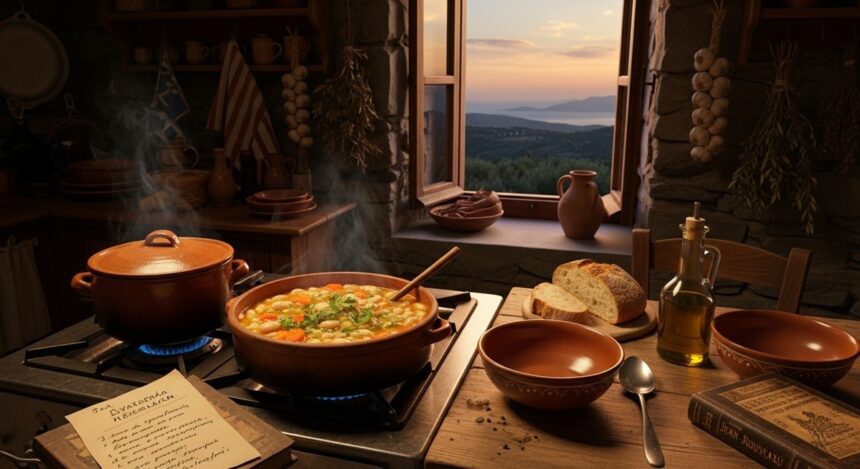






Hidden high among the rocky slopes of Greece’s snow-dusted peaks, where the wind whispers secrets of ancient gods and the frost clings like a stubborn lover, the holiday season unfolds with a blend of reverence and revelry. It’s Christmas season in the Greek mountains, a time when families huddle closer, fires crackle brighter, and the air thickens with tales of mischief from below. Enter the Kallikantzaroi—those impish, coal-black goblins straight out of folklore, slinking up from the earth’s shadowy depths to tangle yarn, sour milk, and generally upend the fragile peace of the twelve days from Christmas to Epiphany. But fear not, weary wanderer of winter lore; in these highlands, protection comes not from incantations alone, but from the golden glow of the oven and the earthy aroma of a dish born of the land itself: the Chestnut and Leek Pita.

This isn’t your seaside spanakopita, all flaky and fleeting. No, the Chestnut and Leek Pita is a mountain-born behemoth, a savory fortress of dough and filling that anchors the soul against the encroaching dark. Rooted in the timeless traditions of Epirus and Macedonia, it harnesses the autumn harvest‘s bounty—those glossy, nutty chestnuts roasted over open flames—to craft a warming dish that nourishes body and spirit. Imagine the Mountain Mana, that wise, weathered grandmother of the hills, her hands flour-dusted and callused from years of kneading resilience into every layer of phyllo. In her kitchen, history simmers alongside superfoods, folklore dances with flavor, and this pita emerges as more than mere sustenance: it’s a talisman, a defiant feast against the goblins’ glee.
The Winter Harvest: Why Chestnuts Reign Supreme in Greek Mountain Lore

In the grand tapestry of Greek mountains cuisine, few ingredients evoke the raw poetry of survival quite like the chestnut. Long before global trade flooded tables with exotic staples, these humble nuts were the unsung heroes of highland life, their spiky husks hiding a treasure trove of energy and endurance. Picture the autumn harvest in full swing: villagers in Arcadia or the fog-shrouded slopes of Thessaly scaling ancient trees, baskets brimming with the season’s gold. This wasn’t idle foraging; it was a ritual of readiness, a harvest that bridged the lush chaos of fall to the barren hush of winter.
A Timeless Legacy: The Chestnut’s Journey Through Greek History

The chestnut (or kastano, as it’s tenderly called in the local tongue) isn’t a newcomer to the Greek pantheon of foods. Archaeological whispers from Mycenaean ruins suggest its cultivation dates back over 3,000 years, a staple for shepherds and warriors alike who roamed these unforgiving terrains. In the Ottoman era, when isolation bred ingenuity, mountain folk ground chestnuts into coarse flour for unleavened breads or simmered them into thick porridges that could sustain a family through blizzards. Historians in Epirus recount tales of entire villages bartering chestnut yields at seasonal fairs, their value rivaling that of wool or wine.
But it’s the nutritional prowess that cements the chestnut‘s throne. Clocking in at around 200 calories per cup, these nuts deliver a powerhouse punch: complex carbs for steady energy, fiber to fortify the gut, and a smattering of vitamins C and B6 to bolster immunity against winter’s siege. Unlike fleeting fruits, chestnuts store well in cool cellars, emerging months later as resilient as the people who prized them. In mountain cuisine, they’re not just eaten—they’re exalted, roasted on spits during festivals or pureed into velvety spreads that anoint the simplest of loaves.
Fuel for the Frost: Chestnuts as Nature’s Winter Battery

What sets the chestnut apart in a warming dish like the pita? It’s that rare alchemy of sweetness and savoriness, a natural caramel note that blooms under heat without overwhelming the palate. For the labor-intensive life of a mountain dweller—chopping wood, herding goats through snowdrifts—this nut was pure propulsion. Folklore even weaves it into tales of endurance: legends speak of hunters lost in Thessaly‘s gorges, revived by fistfuls of boiled chestnuts that staved off hypothermia’s grasp.
Today, as we chase superfood trends from quinoa to kale, it’s worth pausing to honor this OG: the chestnut. Low in fat yet rich in antioxidants, it combats oxidative stress from cold exposure, making it a sly ally in modern wellness. In the Chestnut and Leek Pita, those roasted kernels aren’t mere fillers; they’re the heartbeat, chopped coarse to lend textural drama and a subtle, toasty depth that lingers like a fireside yarn.
Leeks: The Unsung Heroes Adding Bite to the Highland Feast

If the chestnut is the steadfast base of this mountain pie, then the leek (praso) is its spirited counterpart—a verdant whisper of earthiness that cuts through the richness like a shepherd’s knife through fog. These elongated alliums aren’t the dainty scallions of summer gardens; they’re the tough, towering survivors of late winter season, thrusting up through frozen soil when lesser greens have long surrendered.



From Field to Fire: The Leek’s Role in Rustic Greek Kitchens
Grown in the loamy pockets of Macedonia‘s valleys, leeks thrive on neglect, their layers trapping moisture like secrets in a stone wall. Ancient texts from Hippocrates praise them for their diuretic and anti-inflammatory properties, prescribing leek broths to purge winter ailments. In Greek traditions, they’re woven into everything from lentil stews to Easter magiritsa, but in the Chestnut and Leek Pita, they shine as the aromatic bridge—sautéed low and slow until their sharpness mellows into a silky, oniony perfume that binds the filling’s bold elements.

Nutritionally, leeks are a quiet powerhouse: packed with vitamin K for bone health (crucial in calcium-scarce highlands) and prebiotic fibers that feed the gut microbiome, warding off the digestive doldrums of heavy holiday fare. Their sulfur compounds, those same ones that make your breath linger, offer antimicrobial perks—fitting for a dish meant to fortify against unseen foes.
Balancing Act: How Leeks Elevate the Pita’s Profile
In the hands of a Mountain Mana, leeks aren’t chopped haphazardly; they’re coaxed, their whites and pale greens sliced thin to release layers of flavor without bitterness. Paired with chestnuts, they create a yin-yang harmony: the nut’s plush sweetness tempered by the leek’s verdant zing. Add a glug of Greek extra virgin olive oil, and you’ve got moisture that steams the phyllo to perfection, ensuring every bite is succulent, not sodden.
For the home cook eyeing authenticity, seek out heirloom varieties from Epirus markets—thicker, more robust than supermarket fare. Or experiment: a dash of wild mountain thyme, foraged from rocky outcrops, can amplify the leeks’ wild spirit, transporting your kitchen straight to a shepherd’s hut.
Folklore and Flavor: The Kallikantzaroi and the Power of the Hearth Pie

Food in Greek folklore isn’t just fuel; it’s folklore incarnate, a spell cast in steam and spice. And nowhere does this ring truer than during the Christmas season‘s goblin gambol, when the Kallikantzaroi claw their way topside. These pint-sized terrors, with legs like twisted roots and eyes like embers, embody the chaos of the liminal, the threshold between old year and new, light and shadow.
The Goblins’ Yuletide Uprising: Myths from the Underworld
Born of pre-Christian rites blended with Orthodox fervor, the Kallikantzaroi myth paints a vivid underworld tableau. All year, these saw-backed sprites gnaw at the world-tree’s roots, threatening cosmic collapse. But come Christmas Eve, the church bells toll, Christ’s light pierces the gloom, and they tumble earthward—disheveled, vengeful, and oh-so-mischievous. In Macedonia‘s villages, elders spin yarns of goblins souring wine vats or knotting loom threads, their antics a metaphor for winter’s unruly wildness.
Yet, hope flickers in the folklore’s folds. The Kallikantzaroi vanish at Epiphany’s blessing, banished back below until next year. It’s this twelve-day window that sharpens traditions into weapons: bonfires blazed higher, salt scattered at thresholds, and yes, feasts fortified with intent.
Hearth Magic: How the Pita Becomes a Goblin-Repellent

Enter the Chestnut and Leek Pita as culinary countermeasures. In Greek mountains homes, the hearth wasn’t mere heat; it was a sacred barrier, its flames fed ’round the clock to dazzle and deter. Baking this pita—its phyllo crackling like distant thunder—filled the air with scents of roasted chestnuts and caramelized leeks, a sensory smokescreen against spectral snoops. Some say the pie’s heft, its dense filling a bulwark of bounty, symbolized abundance’s triumph over scarcity, shaming the goblins into retreat.
In deeper lore from Epirus, families portioned out wedges as “offerings,” left on sills to distract the wee wreckers—perhaps a crumbly corner to gnaw while humans feasted undisturbed. Modern revivals in Thessaly festivals keep the custom alive, with communal bakings that double as storytelling sessions, passing the pie (and the protection) to the next generation. It’s a reminder: in the face of folklore’s frights, nothing wards like warmth shared.
Crafting the Legend: Your Guide to the Authentic Chestnut and Leek Pita
Ready to channel your inner Mountain Mana? This pita demands no finesse, only fervor—a rustic rumble of ingredients that yields a pie big enough for a horde (or a holiday table). Serves 8-10, with leftovers that reheat like whispered promises. Prep time: 45 minutes. Bake time: 50-60 minutes. Total: Under two hours of hearth-tending bliss.

Gathering the Guardians: Ingredients for the Filling and Crust
Start with the soul of the dish—the filling, a tapestry of textures and tastes that evokes the forest floor after rain.
- Chestnut Core: 2 ½ cups roasted and peeled chestnuts (fresh from the pod or vacuum-packed for ease), coarsely chopped for that satisfying crunch.
- Aromatic Allies: 4 medium leeks, cleaned meticulously (slit and rinse to banish grit), sliced into half-moons; 1 large yellow onion, diced fine; 2 cloves garlic, minced for extra whisper.
- The Luxe Bind: 1 ¼ cups crumbled Feta cheese (sheep’s milk for tang, or mix in myzithra for a softer nod to Epirus authenticity); 3 eggs, whisked with a fork to embrace without overwhelming.
- Herbal Heart: A generous handful each of fresh dill and flat-leaf parsley, chopped; optional wild oregano for a highland kick.
- Seasoning Sentinel: Sea salt to taste (start light—Feta brings brine); cracked black pepper; a whisper of cinnamon or nutmeg to echo chestnut‘s warmth.
- Crust Citadel: 1 pound phyllo dough, thawed gently; ¾ cup melted Greek extra virgin olive oil or clarified butter for brushing—oil for vegan valor.
Pro tip: Source organic chestnuts from Mediterranean grocers; their flavor trumps canned every time.
Step-by-Step Sorcery: From Pan to Perfection

1. Ignite the Aromas: The Slow Sauté
In a wide, heavy skillet (cast iron sings here), warm ⅓ cup olive oil over medium-low. Tumble in the onions, leeks, and garlic. Let them woo the heat—no rush, no scorch. Stir occasionally, dreaming of mountain dawns, until they’re limp, golden, and fragrant—20-25 minutes. This caramelization? It’s the flavor’s foundation, turning humble veg into velvet.
2. Forge the Filling: A Bowl of Boldness
Off the flame, cool the mix for five minutes. In a vast bowl, unite it with chopped chestnuts, Feta, eggs, herbs, and spices. Fold gently, like confiding a secret— the result should mound, moist but not soupy. Taste and tweak: a squeeze of lemon if it needs lift, honoring the land’s acidity.
3. Build the Bastion: Layering the Phyllo
Preheat to 375°F (190°C)—hot enough for crisp, not char. Oil a 9×13-inch pan (or round taverna-style). Unfurl phyllo; cover unused sheets with a damp cloth to prevent parchment protests. Layer 10 sheets in the base, brushing each with oil—let edges ruffle for rustic charm. Spoon filling evenly, pressing to edges. Top with 10 more sheets, oiled and tucked. Score a diamond pattern atop, venting steam like goblin sighs.
4. Bake the Barrier: Golden Glory Awaits
Slide into the oven’s heart for 45-55 minutes, rotating midway for even blush. It’s done when phyllo shatters at a touch and filling bubbles subtly. Rest 15 minutes—patience, friend; it slices cleaner. Serve warm, perhaps with a yogurt-cucumber tzatziki to cool the fire.
Variations for the Venturesome: Swap half the Feta for smoked metsovone cheese from Epirus for a peaty depth. Vegan? Skip eggs, bind with mashed potato. Gluten-free? Rice paper wrappers mimic phyllo admirably.
Beyond the Bite: Nutritional Notes and Pairings
This pita is sustenance supreme. Per slice: ~350 calories, 15g protein from Feta and eggs, plus fiber from chestnuts and leeks to steady blood sugar through feast marathons. Pair with a robust Xinomavro red from Macedonia to toast the traditions, or a crisp Assyrtiko white if goblins prefer chill.
The Eternal Ember: Why This Pita Endures in Heart and Hearth
As the last Kallikantzaroi slinks back to the depths on Epiphany’s dawn, the Chestnut and Leek Pita lingers as living legacy. In an era of instant meals and fleeting fads, this warming dish from mountain cuisine reminds us of local ingredients‘ quiet might: chestnuts foraged from ancestral groves, leeks pulled from frost-kissed plots, all swaddled in phyllo spun from wheat that kissed the same soil.

It’s the Mountain Mana‘s masterstroke—resourcefulness rendered rapturous, folklore flavored for the fireside. When sleet lashes the windows and shadows stretch long, slice into this pie: feel the crunch yield to creamy heart, taste the triumph of plenty over peril. Here, in every herb-flecked forkful, Greece’s wild spirit endures—a ward against winter’s whims, a welcome to the year’s renewing light. Bake it, share it, savor it. The goblins may return, but with this pita on your plate, you’ll greet them grinning.