





From the golden peaks of Olympus to the obsidian depths of the Underworld, few landscapes in Greek mythology evoke such awe as the subterranean realm of Hades, the invisible kingdom of shadow and transformation. Known to the Romans as Pluto, he is not merely a god of death, but the keeper of all that lies hidden—minerals, mysteries, and the profound rebirth that follows every ending.
This mythic domain is echoed in the heavens through astrology, where Pluto rules the sign of Scorpio, the zodiac’s dark alchemist, governing cycles of destruction and renewal. Just as Pluto’s caves mark portals into the unknown, Scorpio’s energy marks the soul’s descent into itself.
The Enigmatic Ruler Beneath: Pluto, Hades, and the Riches of the Subterranean Realm
Long before telescopes pierced the night sky, the ancients sensed a cosmic force lurking in the planet we now call Pluto, a distant, icy wanderer that embodies the inexorable pull of the unseen. In Greek mythology, this energy manifests as Hades, the brooding elder brother of thunderous Zeus and sea-sweeping Poseidon. While his siblings claimed the heavens and oceans, Hades drew the short straw: the vast, echoing Underworld, a kingdom of perpetual twilight where souls drifted like autumn leaves on a still pond.
But don’t mistake this realm for mere punishment. Hades, often softened in Roman lore as Pluto (from the Greek Plouton, “the giver of wealth”), presided over profound abundance. Think of the earth’s hidden veins—gold, gems, fertile soil—all gifts from his domain. Yet Pluto’s wealth extends beyond the material; it’s the alchemical gold forged in crisis, the wisdom unearthed from grief’s rubble. The myths paint him not as a villain but as a stern steward, his three-headed hound Cerberus warding off intruders while ensuring the dead find their place.
Pluto’s Astrological Shadow: The Architect of Radical Change
Fast-forward to the 20th century, when astrologers like Evangeline Adams and Dane Rudhyar elevated Pluto from dwarf planet to zodiacal powerhouse, crowning it the modern ruler of Scorpio. This pairing isn’t arbitrary; it’s a cosmic echo of Hades’ subterranean throne. Pluto in astrology demands we dismantle illusions, stripping away the superficial to reveal the bone-white truth underneath.
Picture Pluto’s transit through your chart: it’s the cosmic demolition crew, razing outdated structures to make way for phoenix-like renewal. Key themes pulse through its influence:
- Death and Rebirth Cycles: No gentle fade-outs here—Pluto insists on total immersion in the void, much like Orpheus descending for Eurydice, only to emerge (or not) forever altered.
- The Veiled Realms: From Freudian subconscious drives to geopolitical undercurrents, Pluto exposes what festers in secrecy, urging ethical reckonings with power’s dark side.
- Magnetic Intensity: Its energy is a slow-burning obsession, drawing us into vortexes of passion and peril, where superficial connections burn away like mist.
These qualities find their earthly mirror in the chthonic caves of Greece—dank, labyrinthine wombs of stone that swallow light and spit out revelations. To step into one is to invoke Pluto’s rite of passage, a visceral reminder that true power blooms in the compost of what we’ve lost.
Scorpio’s Sting: The Zodiac’s Guardian of Forbidden Thresholds
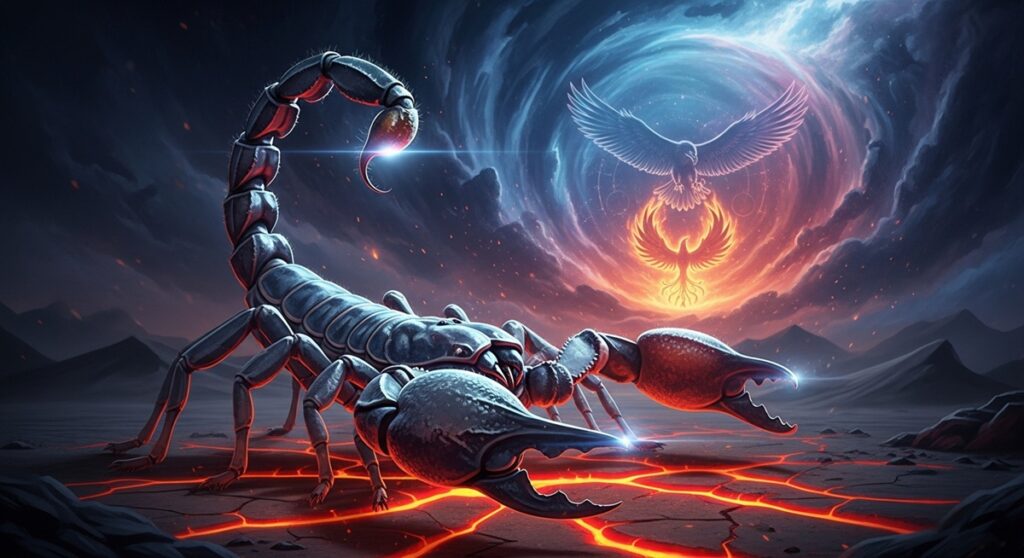
Born between the crisp veil of October 23 and November 21, Scorpio slithers into the zodiac as a fixed water sign, its glyph a sinuous M tipped with a barbed tail. Symbolized by the scorpion—that nocturnal hunter of the desert floor—Scorpio embodies the thrill and terror of plumbing emotional abysses. Where other signs skim the surface, Scorpio dives headlong, armored in mystery yet vulnerable to its own venom.


This sign’s allure lies in its duality: the predator who strikes without warning, and the healer who transmutes poison into medicine. Scorpio’s traits—fierce loyalty, unerring intuition, and a penchant for the taboo—make it the zodiac’s natural custodian of Pluto’s domain. It’s no coincidence that Scorpios are drawn to professions involving investigation, therapy, or the occult; they thrive where others fear to tread.
Peering into the Scorpio Psyche: Layers of Shadow and Light
At its core, Scorpio is the alchemist of the soul, mastering the art of catharsis through unflinching self-examination. Ancient philosophers like Heraclitus might have nodded in recognition: “The way up and the way down are one and the same.” For Scorpio, ascent demands descent, a theme etched into the Eleusinian Mysteries and echoed in modern Jungian shadow work.
Delve deeper, and you’ll encounter Scorpio’s secrets:
- Penetrating Gaze: Like a spelunker’s beam cutting through obsidian, Scorpio energy dismantles facades, unearthing buried traumas or societal hypocrisies with surgical precision. It’s the force behind forensic breakthroughs or whistleblower exposés.
- Reservoirs of Latent Power: As a fixed sign, Scorpio hoards emotional aquifers, channeling them into bursts of creative or destructive force. Harnessed wisely, this mirrors Hades’ quiet sovereignty; unchecked, it rivals the Titanic hubris of overreaching mortals.
- The Evolutionary Arc: From Scorpion to Eagle to Phoenix: Scorpio’s journey evolves—from stinging survivalist, to soaring visionary, to the phoenix of legend, rising incandescent from its own ashes. This triad reflects the Underworld’s narrative: trial by fire, baptism in the Styx, triumphant return.
The ancient Greeks, ever attuned to such cycles, sanctified their chthonic caves as arenas for this inner drama. These weren’t casual hikes; they were initiations, where the Scorpio initiate shed their skin to claim their wings.
Sacred Fissures: Tracing Greece’s Mythic Entrances to the Underworld

Greece’s topography is a living mythos, its karstic landscapes riddled with caverns that the ancients revered as entrances to Hades. From the jagged Peloponnese to the misty wilds of Epirus, these sites pulsed with chthonic energy—earth’s breath rising as vapor, carrying oracles from below. Pilgrims flocked here not for leisure, but for the soul-shaking privilege of brushing against eternity.
Archaeology confirms what Homer hinted at in the Odyssey: the Underworld wasn’t a distant abstraction but a tangible neighbor, accessible via these geologic rifts. Excavations reveal altars stained with blood offerings, inscriptions invoking Pluto, and labyrinths engineered to mimic the soul’s winding path. Today, these spots draw neo-pagans, historians, and Scorpio-leaning adventurers, proving their timeless pull.
The Necromanteion: Epirus’ Oracle of the Damned
Nestled in the fog-shrouded valleys of Epirus, where the Acheron River—that mythic “river of woe”—meanders like a serpent toward the Ionian Sea, lies the Necromanteion of Acheron. This was a fortified complex crowning a vast subterranean vault, engineered as Hades’ front door. Dating back to the 4th century BCE, its ruins still evoke a chill, as if the ghosts linger.
Pilgrims, from Spartan warriors to lovesick poets, endured a gauntlet to commune here. The rituals? A Scorpio-worthy ordeal: three days of fasting to purge the body, isolation in lightless cells for sensory unraveling, and potions brewed from hallucinogenic herbs like henbane. Descending rope ladders into the echoing chamber, they’d invoke the shades—perhaps Tiresias the blind seer or a lost kin—amid the lap of underground streams (stand-ins for the Styx and Cocytus).
What emerged from these sessions? Prophecies that toppled kings or mended hearts, but always at the cost of transformation. One entered a seeker; one exited reborn, scarred by Pluto’s unsparing mirror. Modern psychologists see parallels to ayahuasca ceremonies or EMDR therapy—tools for hacking the subconscious, much like Scorpio’s relentless probe.
Eleusis’ Ploutonion: The Abduction Echo and Rites of Eternal Spring
Shift eastward to the sun-baked plains near Athens, and you’ll find Eleusis, cradle of the Eleusinian Mysteries—a clandestine cult that gripped the Greco-Roman world for two millennia. At its core: the myth of Persephone, abducted by Hades into the Underworld, her return heralding spring’s bloom. The site’s crown jewel? The Ploutonion, a modest yet mighty cave where legend says the earth split to swallow the goddess.
This fissure, framed by marble telesterion (initiation halls), hosted the Mysteries’ climax: a night of torchlit processions, sacred drinks (kykeon, laced with ergot for visions), and theatrical reenactments of descent and ascent. Initiates swore oaths of secrecy—Scorpio’s vow of silence—under penalty of tongue-severing curses. The payoff? A golden ticket to Elysium, the Underworld’s paradise, plus an unshakable conviction in life’s cyclical grace.
Archaeologists like George Mylonas unearthed altars here in the 1930s, alongside barley grains hinting at Demeter’s grief-fueled famine. For Scorpio types, it’s a masterclass in surrender: embrace the abduction, and the pomegranate seeds of wisdom become your rebirth.
Lesser-Known Labyrinths: From Mani’s Chasms to Mycenae’s Eternal Tombs
Greece brims with subtler gateways, each a footnote in Hades’ ledger. In the stark, tower-dotted Mani Peninsula of the Peloponnese, sea-eroded caves like those at Diros plunge 100 meters into turquoise oblivion. Locals spun tales of Cerberus prowling these depths, and Byzantine hermits sought Pluto’s solitude within. Boat tours today reveal stalactites like frozen tears, a poetic nod to the Cocytus’ wails.
Further north, the Mycenaean tholos tombs—bronze-age behemoths like the Treasury of Atreus (circa 1250 BCE)—aren’t caves per se, but corbelled vaults mimicking them. Carved into hillsides, these “beehives” funneled kings like Agamemnon toward Hades’ embrace, their dromoi (approaches) lined with reliefs of lions and griffins—Scorpio’s fierce sentinels. Gold masks and amber grave goods unearthed by Heinrich Schliemann scream Pluto’s wealth, but the real treasure? The cultural obsession with death as a transformative forge, prefiguring Scorpio’s evolutionary fire.
Embracing the Abyss: Pluto’s Lessons in Darkness, Desire, and Divine Renewal

To wander these chthonic caves is to court Scorpio’s ecstasy and agony, a dance with the void that leaves no participant unchanged. The ancients knew this; their rituals weren’t escapism but engagement, a deliberate flirtation with annihilation for enlightenment’s sake. In our hyperlit era of distractions, these sites beckon as antidotes: unplug, descend, dissolve.
Yet the confrontation isn’t solitary. Pluto’s mythology reminds us that Hades rarely acted alone—Persephone’s duality, Orpheus’ lyre—soothing the savage Cerberus—underscore partnership in peril. For Scorpio natives or anyone under Pluto’s transit, the message is clear: wield your sting wisely, for in the Underworld’s forge, vulnerability forges unbreakable strength.
As we surface from this mythic plunge, consider your own shadows. What chthonic cave calls to you, a therapy couch, a midnight journal, or a literal trek to Epirus? The Greek Underworld teaches that rebirth isn’t a gift bestowed but a prize wrested from the dark. Heed Scorpio’s whisper: the greatest treasures lie buried, waiting for the bold to dig.