


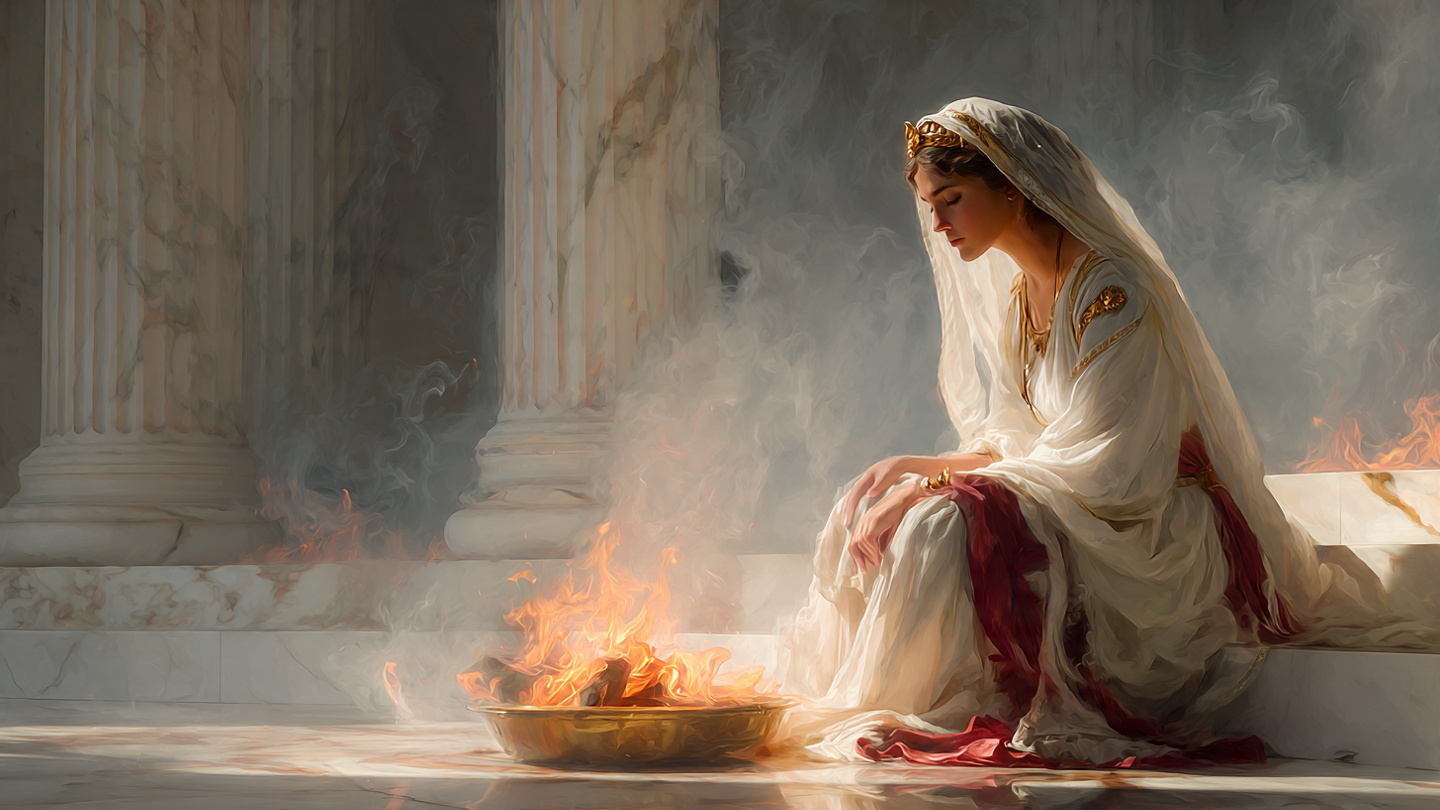
No thunderbolts. No epic battles. No seductive transformations, jealous rages, or heroic catastrophes. The stories of the Greek pantheon are usually defined by noise and chaos, yet among all the glittering and unpredictable Olympians, there is one who stands apart. It is Hestia, the goddess of the hearth, who quietly holds the oldest, highest, and most sacred position. Her myth is not loud. It is luminous. Her presence is not dramatic. It is foundational. Still today, in Greek homes and winter villages, in ancient Greek rituals and travel traditions, her ancient flame continues to burn.

This is the story of Hestia’s birth, her unwavering role on Mount Olympus, and the surprising ways her mythic traditions still shape everyday Greek life. From the lighting of winter hearths to the creation of new cities in antiquity, she remains the silent force behind it all.
The Firstborn of the Titans and the Violence of Creation
Before the graceful Olympians established their golden age, there were the Titans. Few myths capture the raw cosmic chaos of that era more vividly than the story of Cronus swallowing his own children. When Hestia was born to Cronus and Rhea, she became the first child of the Olympian generation. She was the dawn of a new order. However, almost immediately after her birth, she was swallowed whole by her father, who feared a prophecy stating that one of his children would eventually dethrone him.

Hestia lived inside the dark belly of Cronus for years, joined eventually by her siblings Demeter, Hera, Hades, and Poseidon. It was only when Zeus, the last to be born, forced their father to regurgitate his children that she saw the light again. Here lies a mythic symmetry that ancient Greek storytellers adored and philosophers pondered deeply. Hestia is the first born. She is also the last to emerge. This dual nature makes her the oldest and the youngest, the beginning and the end. In Greek thinking, the first thing born is the foundation. She is the constant. She is the flame that always remains while others flicker and fade.
The Goddess Who Refused Two Gods
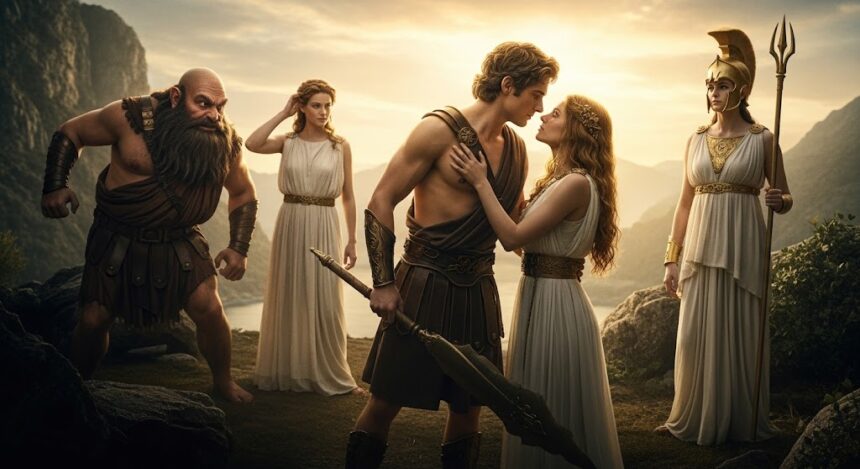
Once the Titanomachy ended and order was restored, the young Olympians took their thrones. It was a time of political alliances and marriages, and naturally, the male gods turned their eyes toward the eldest sister. Both Apollo and Poseidon sought to marry Hestia. Either match would have made her a powerful queen, aligning her with the sun or the sea. But Hestia made a decision that altered the divine world forever. She refused them both.
A Vow of Eternal Independence
The Greek mythology hearth goddess placed her hand on the head of Zeus and swore a mighty oath. She vowed to remain forever a maiden, the keeper of the sacred fire, and to dwell always at the center. This vow was not merely a rejection of marriage. It was an acceptance of a higher purpose. By giving up dramatic storylines and romantic entanglements, she became the one deity who ensured order, balance, and safety in the home.

Her choice symbolized purity, devotion, and self governed peace. It represented the unbroken flame of life that must never be extinguished by the winds of passion or war. Zeus, recognizing the immense weight of her sacrifice to maintain peace in the family, granted Hestia the highest honor. She would receive the first and the last offering of every sacrifice. This was a privilege no other Olympian shared, not even the King of Gods himself.
The Unmoving Throne on Olympus
While other gods wandered the earth stirring seas, stealing cattle, inspiring heroes, or causing havoc in the lives of mortals, Hestia never left her place. Her throne sat in the very center of the Olympian palace, right next to the great hearth where the immortal flame burned without ceasing.


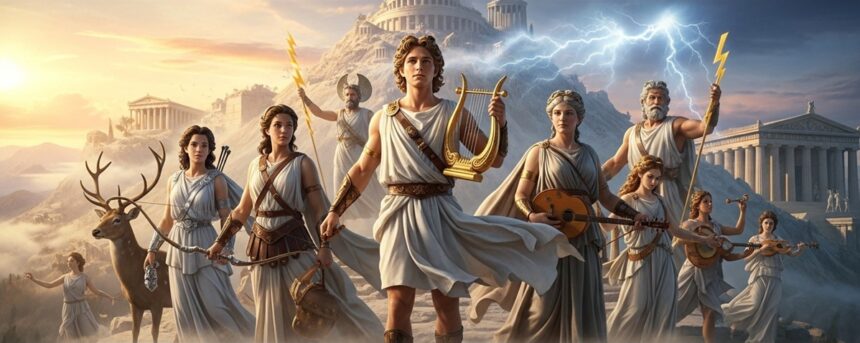
This central role symbolized the heart of a home and the soul of a city. It represented the stillness that holds the universe together. The ancient Greeks believed it was Hestia, not Zeus, who ensured the divine household remained stable. Where Zeus ruled the heavens, she ruled the space that held heaven together. Her presence was not loud, but it was absolutely necessary. Without the hearth, there is no home. Without the center, the structure collapses.
Where to Feel Hestia in Modern Greece
One of the most beautiful aspects of Greek mythology is how it attaches itself to real landscapes. Even though Hestia left behind few dramatic myths or statues, her presence can be felt intensely in places where flame and hospitality shape the local culture. This is a vital part of Greek travel mythology for anyone seeking the soul of the country.
Delphi and the Eternal Flame

Long before Apollo claimed Delphi and made it the center of the world, the sanctuary belonged to earlier powers, including Hestia. Even after Apollo became the god of prophecy, a perpetual sacred flame dedicated to Hestia burned at the heart of the temple. This was the Common Hearth of Greece. Travelers to Delphi today often feel an inexplicable stillness in the landscape. It is the kind of quiet that echoes the breathing of the earth, a remnant of the Delphi sacred flame that once united all city states.
Winter Hearth Rituals in Traditional Villages
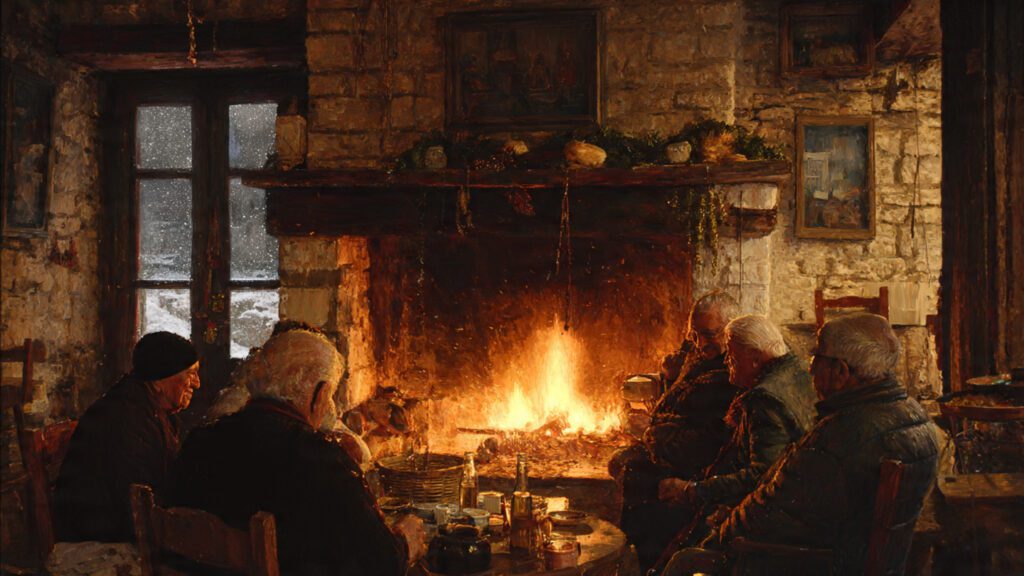
In the mountain regions of Zagori, Pelion, Arcadia, and the highland villages of Crete, the spirit of the goddess is alive and well. Here, you still find the old winter hearth traditions. The locals light the first winter fire with whispered blessings. They make offerings of bread, wine, and herbs before the meal. There is a prevailing custom of kali kardia or good heart, which involves opening your home to travelers and feeding strangers. Every grandparent warming chestnuts by the fire in a stone house in Epirus is repeating a ritual that began with the Mount Olympus myth of the first fire.
The Mythological Traditions That Survive Today
Hestia may not star in blockbuster movies, but she is present in Greek household traditions that have survived thousands of years. The ancient Greeks always offered a pinch of food or a drop of wine to her before serving Zeus or guests. This primacy of the hearth goddess meant that she was the first priority of the human soul.
The Amphidromia and Newborns
In antiquity, a newborn was not considered part of the family until the Amphidromia ritual. The baby was carried around the hearth on the fifth or seventh day, officially becoming part of the household under the protection of Hestia. Today, while the ritual has changed, the deep cultural emphasis on the home as the sanctuary for the child remains a pillar of Greek life.
The Fire of the Colonies

Perhaps the most profound legacy of Hestia is found in the history of migration. When a new Greek colony was founded in Italy, Turkey, or the Black Sea, settlers did not just bring tools and weapons. They took a sacred flame from the Prytaneion, the town hall of the mother city. This fire, protected by the sanctity of Hestia, was carried across the sea to light the first fire of the new settlement. This flame symbolized unity, lineage, and divine protection. It meant that no matter how far a Greek traveled, the fire of home was literally burning in the new land. Hestia was not just the goddess of the home. She was the goddess of the homeland.
Why Hestia Matters More Than Ever
We live in a world that celebrates noise, constant movement, and digital chaos. In this environment, Hestia reminds us of the sacredness of stillness. She represents the center that never changes. She is the antidote to burnout. She is the goddess of warmth, peace, and belonging.

Her myth endures not because it is dramatic, but because it is foundational. She is the goddess we return to when the battles are over. She is the quiet warmth waiting at the end of the odyssey. Whether you are reading an Olympus Estate mythology article or sitting by a fireplace in a snowy village, remember the First Flame. She is still there, waiting in the center.