


“Happiness depends upon ourselves.” — Aristotle
Beyond the Alphabet: 7 Untranslatable Greek Words That Master the Art of Living
Greece is a land that defies simple description. It is a place where history is not merely preserved in museums but is etched into the rugged mountains, whispered by the olive groves, and reflected in the crystalline waters of the Aegean. For the traveler, the initial allure lies in the stunning landscapes and the tangible remnants of antiquity. However, beneath the visual splendor lies a treasure far more enduring: the Greek language itself.
This ancient lexicon offers more than just a means of communication; it provides a profound framework for understanding existence. Beyond the standard pleasantries of “kalimera” or “efcharisto,” there are words in Greek that hold the weight of entire philosophies. These are terms that encapsulate complex emotions, ethical stances, and ways of being that English often struggles to define with a single word.
For those seeking to immerse themselves in Hellenic culture, understanding these concepts is the key to unlocking a richer, more vibrant way to perceive the world. This is the art of living, a wisdom honed over millennia yet eternally relevant to the modern soul.
Eudaimonia: The Pursuit of the Flourishing Life

In our modern world, we often conflate happiness with fleeting moments of pleasure—a delicious meal, a raise at work, or a sunny day. The ancient Greeks, however, held a much more rigorous and rewarding standard. Eudaimonia (εὐδαιμονία) is often translated simply as “happiness,” but this does a disservice to its depth. Coined and championed by Aristotle, the term is better understood as human flourishing.
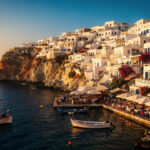
Eudaimonia is not a temporary state of mood; it is an active state of being. It is the result of living in accordance with one’s true self (daimon) and striving for excellence through virtue and reason. It implies a life well-lived, where one is constantly fulfilling their potential. To experience Eudaimonia in Greece is to look beyond the surface level of tourism. It is found in the deep, satisfying connection to history, the intellectual stimulation of a museum, or the profound peace of watching a sunset over the caldera, knowing you are exactly where you are meant to be. It is the ultimate goal of a meaningful existence.
Meraki: The Soulful Act of Creation

There is a distinct difference between doing a task because you must, and doing it because you love it. The Greeks have a word for the latter: Meraki (μεράκι). This is perhaps one of the most beautiful and untranslatable words in the global vocabulary. It describes the act of putting “something of yourself”—your soul, your creativity, and your absolute passion—into whatever you are doing.
Meraki is the antidote to the robotic, mundane nature of daily chores. It is what transforms a simple meal into a feast and a house into a home. When you sit in a tavern and taste a dish that seems to sing with flavor, you are tasting the chef’s Meraki. It applies to the artisan carving olive wood with absolute devotion, the musician losing themselves in a melody, or even a friend setting a table with exquisite care. It serves as a reminder that the value of our work is not just in the outcome, but in the love we pour into the process.
Philoxenia: The Sacred Law of Hospitality
If you have ever traveled to Greece, you have likely felt the warmth of Philoxenia (φιλοξενία). While standard dictionaries might define it as hospitality, the etymology reveals a much deeper, almost sacred obligation. Literally translating to “friend of the stranger,” Philoxenia is an ancient cultural code that predates modern tourism by thousands of years. In mythology, Zeus himself was known as Zeus Xenios, the protector of travelers, making the mistreatment of a guest a divine offense.



This is not merely about good customer service in a hotel. Philoxenia is the spontaneous, genuine generosity shown to those who are far from home. It is the shopkeeper offering you a sweet preserve, the local guiding you when you are lost, or the invitation to join a family table. It is a powerful reminder of our shared humanity. In a world that often feels divided, the Greek practice of Philoxenia teaches us that strangers are simply friends we have not yet met, deserving of honor, respect, and kindness.
Nostos: The Sweet Pain of the Return
The concept of returning home is universal, but the Greeks imbued it with epic significance through the word Nostos (νόστος). Made immortal by Homer’s Odyssey, which details the arduous ten-year journey of Odysseus, Nostos is the root of our English word “nostalgia” (nostos + algos, meaning pain). However, it signifies much more than missing the past.
Nostos is a deep, soulful longing for a return—not just to a physical location, but to a sense of belonging and identity. It is a homecoming that is often bittersweet, acknowledging that the traveler and the home may have both changed during the absence. For the Greek diaspora, Nostos is the magnetic pull back to ancestral lands and traditions. For the traveler leaving Greece, it is that inexplicable ache that settles in the chest as the plane ascends, a yearning to return to the timeless embrace of the Aegean before you have even fully departed. It speaks to the fundamental human need for roots.
Kleos: The Echo of Undying Glory
In the heroic age of Greece, death was inevitable, but oblivion was not. The warriors of the Iliad fought not just for land or wealth, but for Kleos (κλέος)—undying glory. This was the fame and renown one earned through great deeds, ensuring that one’s name would be sung and remembered long after the physical body had perished. It was the ancient method of conquering mortality through memory.
While we may no longer slay mythical beasts or besiege walled cities, the pursuit of Kleos remains relevant in the modern art of living. It manifests in our desire to leave a legacy, to have a positive impact on our community, and to be remembered for our integrity and achievements. It asks us a pivotal question: What will be said of us when we are gone? Seeking Kleos encourages us to live lives of substance, where our actions resonate with honor and significance, creating a reputation that outlasts the present moment.
Kairos: Seizing the Opportune Moment
The ancient Greeks had two words for time. Chronos referred to sequential, chronological time—the ticking of the clock. But Kairos (καιρός) referred to something far more qualitative: the right, critical, or opportune moment. Kairos is not about checking a schedule; it is about intuition and awareness. It is the moment when conditions are perfect for a decision or an action.
To live by Kairos is to live in the present, fully awake to the possibilities that surround you. It is about seizing the moment when it arises. In travel, this is essential. It is realizing that now is the time to jump into the sea, now is the moment to strike up a conversation with the elder in the village square, or now is the perfect light for a photograph. Unlike the rigid march of Chronos, Kairos is fluid and fleeting. Embracing it allows us to step out of the rush of daily life and into a space of profound significance and opportunity.
Phos: The Illuminating Essence of Truth

Greece is a land defined by its light. The sunlight there is legendary—piercing, revealing, and absolute. The Greek word Phos (φως) means light, but in the context of Greek philosophy and culture, it extends far beyond physical illumination. It represents knowledge, truth, clarity, and hope. It is the essence of enlightenment.
The connection between light and wisdom is deep-rooted in the Hellenic psyche. The Socratic method was designed to drag ideas out of the shadows of ignorance and into the Phos of truth. When we speak of “shedding light” on a subject, we are borrowing from this ancient metaphor. To seek Phos is to seek understanding and to dispel the darkness of confusion or despair. Whether it is the dazzling glow on ancient marble columns or a sudden moment of intellectual clarity, Phos reminds us that the pursuit of truth is the highest calling of the human spirit.
Unlocking a New Perspective
These seven words are merely an introduction to the profound wisdom embedded within the Greek heritage. As you explore the ruins of Delphi, navigate the streets of Athens, or simply sit by the sea, let these concepts guide you. They are invitations to a richer existence.

They invite you to live with Eudaimonia, to create with Meraki, to extend Philoxenia, to understand the depth of Nostos, to strive for Kleos, to seize the Kairos, and to always walk towards the Phos. By embracing this vocabulary, your journey transforms from a simple vacation into a deeply enriching masterclass in the art of living.