



The soul knew everything before it was born.
That is Plato’s claim, or very nearly. In the Meno, Socrates says that the soul has been born many times and that there is nothing it has not learned. In the Phaedrus, Plato tells the same idea as a myth. Before it took on a body, the soul rode in the company of the gods to the rim of heaven and looked out on what lies beyond it, the realities he called the Forms. Justice itself, Knowledge itself, Beauty itself, seen directly, without eyes and without words. Then the soul fell into a body, and in falling it forgot. Everything a person learns afterwards, if Plato is right, is not new. It is the slow recovery of what the soul already saw and lost.
The Greek word for that recovery is anamnesis, recollection. It is one of the strangest and most influential ideas in the history of thought, and it runs through three of Plato’s greatest dialogues, the Meno, the Phaedo and the Phaedrus. It also has a particular way of coming to life at this time of year.
Plato never wrote a word about autumn. Nothing in the dialogues says the soul remembers best in October, and it would be dishonest to pretend otherwise. But the materials he built the theory from point toward the season with surprising consistency. His account of the soul’s vision borrows the language of the Eleusinian Mysteries, which Athenians celebrated every autumn. His freed prisoner in the cave begins with the gentle light of the moon before he can face the sun. And his argument for recollection rests on the observation that beautiful things in this world fade and fall short, which is exactly what an autumn landscape shows. Beneath all of it lies one of the oldest questions in philosophy. Why can a finite, imperfect thing, a face, a tree, a slant of light, awaken a longing for something beyond itself? Autumn is not Plato’s answer to that question. It is a good place to ask it, and this essay reads him in October light while keeping clear where he speaks and where the season does.
Before Birth | The Procession Beyond the Heavens
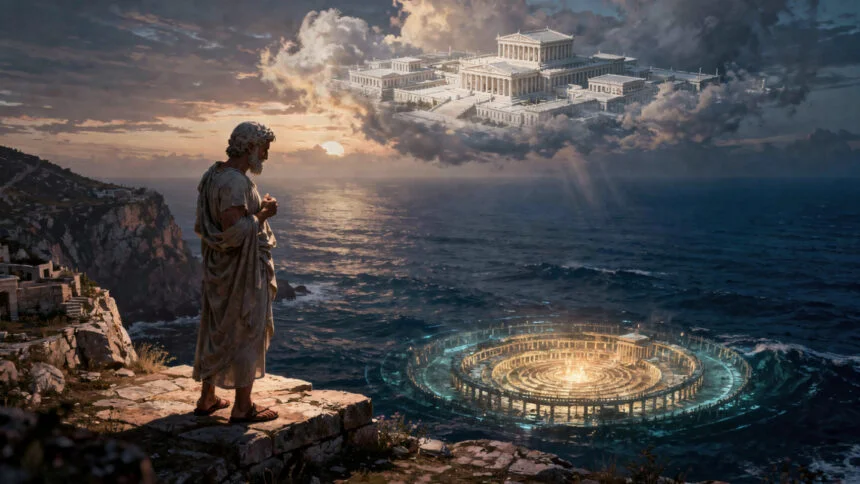
The Phaedrus gives the theory its great myth. Socrates compares the soul to a winged chariot, a charioteer driving two horses, one noble and obedient, the other unruly. The gods drive their chariots easily. Zeus leads the procession across the heavens, the other gods follow in order, and each soul follows the god it most resembles. At the high point of the circuit the gods pass out onto the back of the heavens and stand there, looking at the place beyond them, the region Socrates calls the place above heaven, where true being lives without colour, shape or touch.
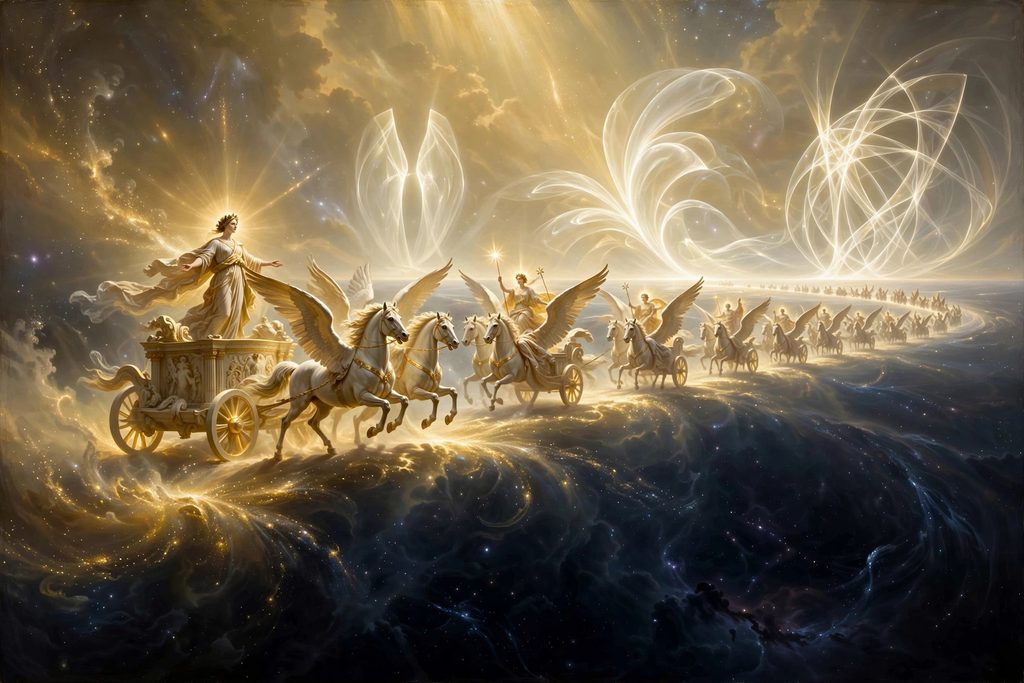
Human souls struggle to follow. Their unruly horses drag them down, and the best of them only lift their heads above the rim for moments, catching glimpses before they sink again. In the crush and confusion, wings break and souls fall. A fallen soul takes a body, and how much it saw before falling decides what kind of life it begins with. The soul that saw the most becomes a lover of wisdom and of beauty.
A different myth, at the end of the Republic, imagines the forgetting itself. The two stories do not fit together as a single map of the afterlife, and Plato never asks them to. Each is a way of picturing what the arguments of the dialogues try to prove.
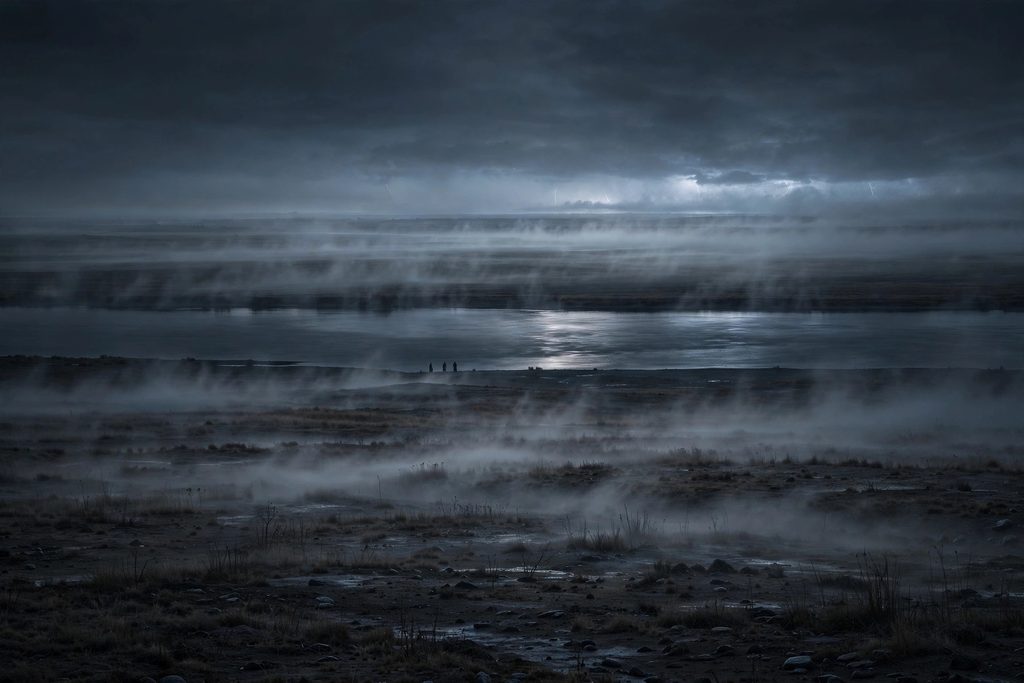
Er was a soldier killed in battle who woke on his funeral pyre and described what he had seen of the world between lives. Before rebirth, he said, the souls marched across a burning, treeless plain called Lethe and camped at evening by the River of Unmindfulness, whose water no vessel can hold. Every soul had to drink a measure of it. Those not protected by wisdom drank more than the measure, and as each one drank, it forgot everything. At midnight came thunder and an earthquake, and the souls were swept up and away to their births, darting like shooting stars. Er alone was not allowed to drink, so that he could remember and tell.
Plato did not invent the idea that the dead and the unborn are threatened by forgetting. Gold leaves buried with initiates in southern Italy and elsewhere, the oldest from around 400 BCE, instruct the soul to avoid a spring beside a white cypress in the house of Hades and to drink instead from the cold water flowing from the lake of Memory. The tradition that produced them is usually linked to the Orphic Mysteries, and it gave Memory a sacred role. Mnemosyne, Memory, was a Titan in Greek myth, and by Zeus the mother of the nine Muses. In the Greek imagination, to remember was close to being inspired, and to forget was close to dying.
Even the Greek word for truth has been drawn into this story. Aletheia shares its root with Lethe, and many later readers, most famously Martin Heidegger, have heard in it the sense of something no longer hidden or no longer forgotten. Plato himself, in the Cratylus, offered a playful etymology of his own and derived it from a divine wandering. The linguistic link is real. The reading of truth as un-forgetting is an interpretation rather than a settled meaning, but it fits the theory Plato built remarkably well.
What Anamnesis Means
Anamnesis comes from the verb anamimneskein, to remind or to call back to mind. The prefix ana carries the sense of going back up, recovering. Plato’s use of it answers a puzzle Meno throws at Socrates. How can you search for something you do not know? If you do not know it, you will not recognise it when you find it. If you already know it, there is nothing to search for.
Socrates’ reply is that the soul, being immortal and born many times, has already seen everything, so that, in Jowett’s old translation, “all enquiry and all learning is but recollection.” Searching is possible because what we seek is not wholly unknown. It is known and forgotten, and we recognise it when we meet it again, the way a half-remembered name falls into place the moment someone says it.
The Phaedo, set in prison on the day Socrates drank the hemlock, gives the argument its most careful form, and it is the one worth understanding. Socrates first notes how ordinary recollection works. A lover who sees the lyre or the cloak of the person he loves suddenly thinks of that person. One thing reminds us of another, sometimes because it resembles it, sometimes simply because the two were once together.
Then he turns to equality. We see two sticks or two stones and call them equal. Yet the same sticks can seem equal from one angle and unequal from another, and no pair of sticks is ever perfectly equal. Still we know what perfect equality is, well enough to judge that the sticks fall short of it. We could not have got that knowledge from the sticks, because they never showed it to us. We must have had it before we first saw anything at all, which means, Socrates concludes, before birth.
Not everyone has been persuaded. Plato’s own student Aristotle rejected the idea of knowledge carried in from a previous existence, and compared the mind before learning to a writing tablet on which nothing has yet been written. Later philosophers have argued over the question ever since, under names such as innate ideas and a priori knowledge. But the shape of Plato’s insight survives the argument about reincarnation. Some of what we know does not look like a collection of experiences. It looks like recognition.
The Boy and the Square | The Experiment in the Meno
To prove his point, Socrates stages the most famous lesson in philosophy. He calls over one of Meno’s household slaves, a boy who speaks Greek but has never studied geometry, and draws a square in the dust, two feet by two. Its area is four square feet. How long, Socrates asks, would the side of a square twice as large have to be?
The boy answers confidently that the side must be doubled. Socrates draws it, and the boy sees that a square with a four-foot side has an area of sixteen, four times the original. He tries again and suggests three feet. That gives nine. Now he is stuck, and he says so. Socrates points out to Meno that this is progress. Earlier Meno had compared Socrates to the torpedo fish, which numbs whatever it touches, and complained that conversation with him left people paralysed. The boy has been numbed in exactly that way, and he is better off for it. Before, he thought he knew. Now he knows that he does not, and he wants to find out.
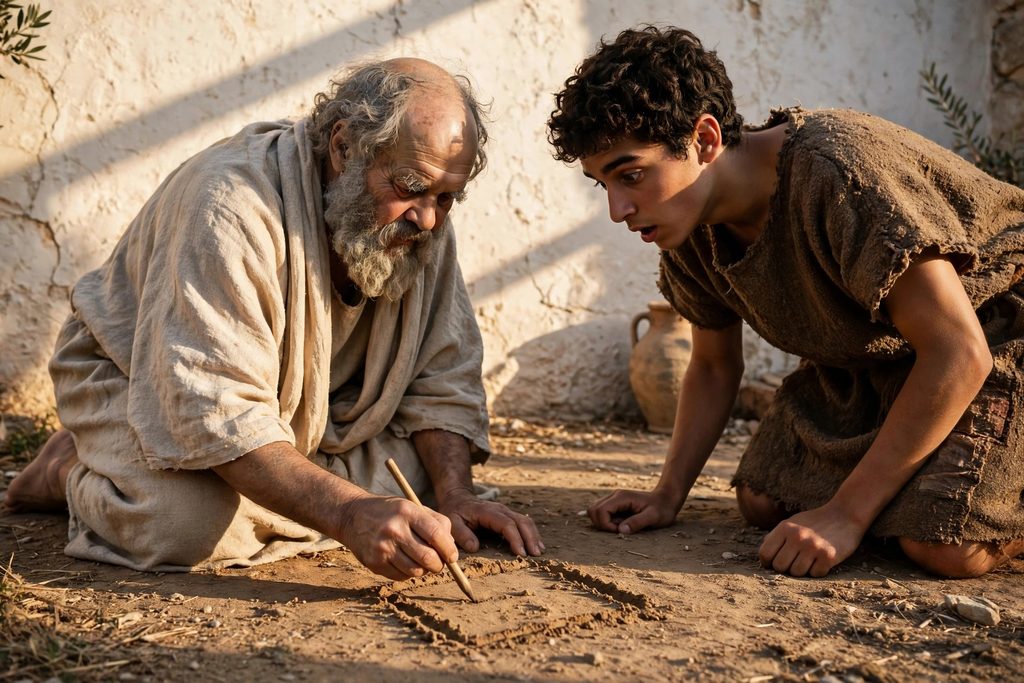
Socrates then draws the diagonal of the original square and asks a series of simple questions about it. Step by step, the boy sees that the square built on the diagonal is exactly twice the size of the first. He has found the answer. Socrates insists he taught him nothing, only asked. The true opinions, he tells Meno, were in the boy all along, stirred up now “as in a dream,” and with more questioning they would become knowledge.
Readers have objected for centuries that the questions are leading and that the diagrams do much of the work. That is fair. But the scene still captures something true about how understanding arrives. At first the boy was certain and wrong. Then he was uncertain and searching. At the end he understood. The difference Plato cares about is the difference between receiving an answer and understanding it. Understanding does not come as a pile of new facts. It comes after confusion, as a moment of seeing, and the person who sees it feels that the answer was somehow already there, waiting for the right question.
Beauty Alone | Why the Phaedrus Gives Beauty a Privilege
If all the Forms were seen before birth, why do we so rarely sense them? Plato’s answer in the Phaedrus is that their likenesses down here are faint. Justice and wisdom as we meet them in human affairs carry no light that the eye can catch, and only a few people, with difficulty, can trace them back to their originals. Sight is the sharpest of our senses, but wisdom cannot be seen. If it could, Socrates says, it would arouse a terrible love.
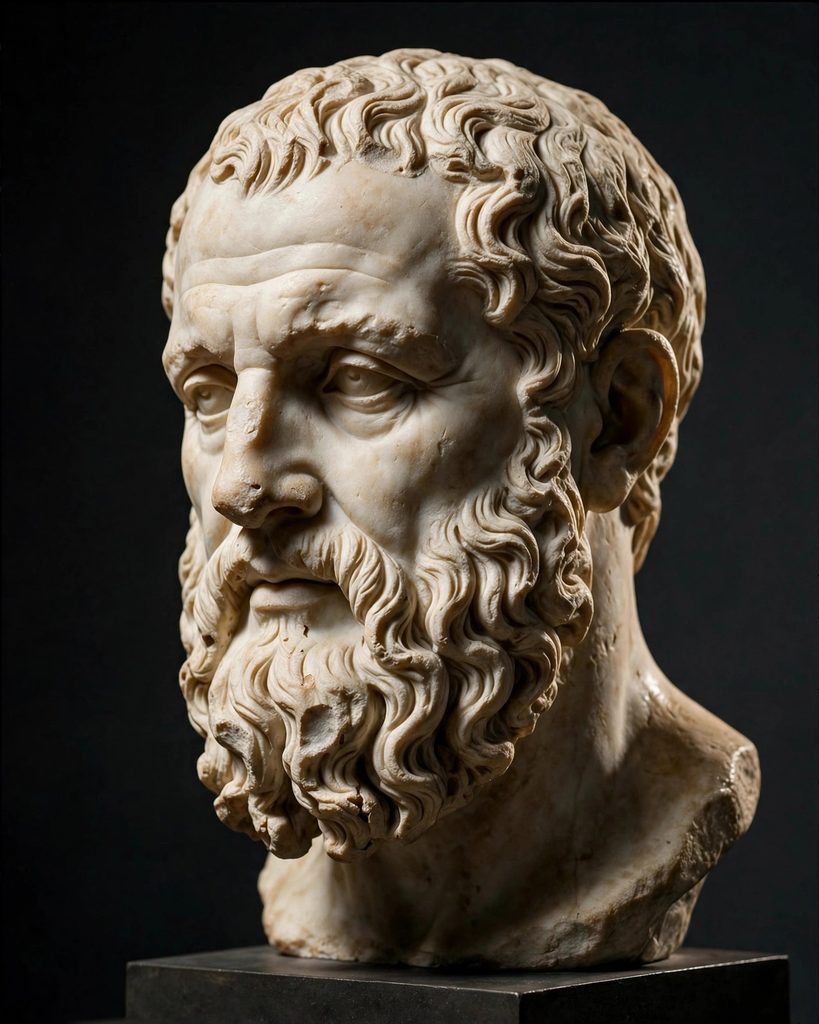
Beauty is the exception. In Fowler’s translation, “beauty alone has this privilege, and therefore it is most clearly seen and loveliest.” It is the one Form whose image in the world reaches the soul through the eyes with something of its original brilliance. That is why beauty can do what argument usually cannot. It can make a person remember without being taught.
Plato describes what happens next with a physical intensity that still surprises readers. A person who saw much in the procession and now sees a beautiful face or body first shudders, and a kind of awe comes over him. Then warmth floods through him, and the stumps of his lost wings begin to swell and grow, aching and itching the way the gums of a child ache when teeth are coming through. The soul throbs when the beautiful one is near and burns with pain when it is away. This is love, Socrates says, and it is also remembering. What moves us so far beyond ordinary pleasure in the presence of beauty is the soul recognising, through one beautiful thing, the Beauty it saw before it was born. The same story of desire as a way up rather than a fall is the subject of Eros before Cupid.
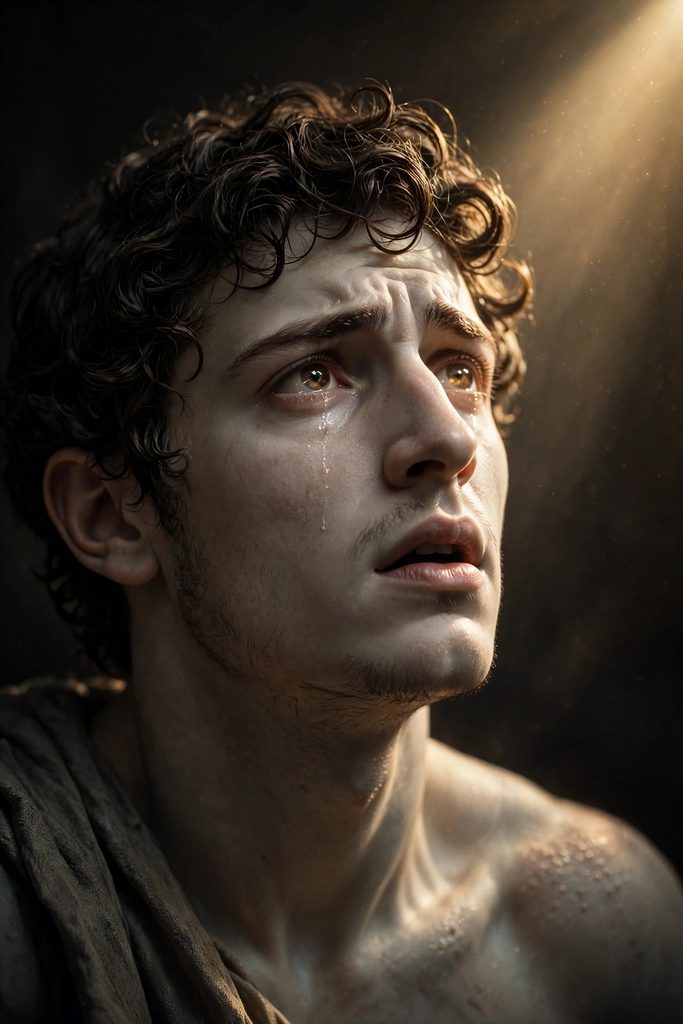
Plato knew that this shock can go wrong. In the same myth, the unruly horse of the soul lunges toward the beloved and demands pleasure. What saves the lover is memory. When the charioteer looks at the beloved’s face, he is carried back to the vision of Beauty standing beside Self-Control on a holy pedestal, and in awe he falls back and reins the horse in. Beauty begins the remembering, but only remembering rightly turns desire into something more than the wish to possess.
In the Symposium, Plato lets the priestess Diotima map the same journey as a ladder. The lover begins with one beautiful body, learns to see the beauty shared by all bodies, then the beauty of souls, of customs and laws, of knowledge, until at last he catches sight of Beauty itself, which Jowett renders as “everlasting, not growing and decaying, or waxing and waning.” The scene of that speech, with its wine and its arguments and its drunken final guest, is told in The Night of the Shared Cup.

One detail of that phrase matters for everything that follows. Beauty itself does not wax or wane. It belongs to no season. Summer cannot hold more of it and autumn cannot hold less. What the seasons can change is how clearly its images speak to us, and what they remind us of.
A Summer Dialogue | The Plane Tree by the Ilissos
It is worth being precise about the setting of the Phaedrus, because it is the opposite of autumn. Socrates, who almost never leaves the city, lets the young Phaedrus lead him barefoot along the Ilissos river at midday in high summer. They wade the shallow stream and settle in the shade of a tall plane tree beside a cool spring, with a flowering chaste tree scenting the air and the cicadas singing overhead. It is one of the few places in Plato where the countryside is described with real pleasure.
The cicadas even get a myth of their own. They were once human beings, Socrates says, who lived before the Muses were born. When the Muses came and song with them, some people were so carried away by singing that they forgot to eat and drink and died without noticing. From them the cicadas were born, creatures that need no food and sing from birth to death, and when they die they go to the Muses to report which humans honoured them. Even in the heat of the summer dialogue, the story Plato chooses is a story about forgetting the body in the presence of something higher.
Summer is the season of the Phaedrus, and its noon is the noon of Helios and the Aegean summer, intense, abundant and overwhelming. Plato chose it for a dialogue about the moment beauty strikes. But the work of recollection, the slow turning of the soul and the questioning that follows the first shock, belongs to other conditions. To see why, it helps to know what Athens did every autumn.
The Language Plato Borrowed | Eleusis in Boedromion
When Socrates describes the souls’ vision beyond the heavens, he changes vocabulary. The souls, he says, were initiated into the most blessed of all the mysteries. They celebrated it whole and untouched by the evils that came later, and were admitted as initiates to the sight of perfect, simple, calm and happy apparitions, seen in pure light. Every Athenian who heard those words knew where that language came from. It is the language of Eleusis.
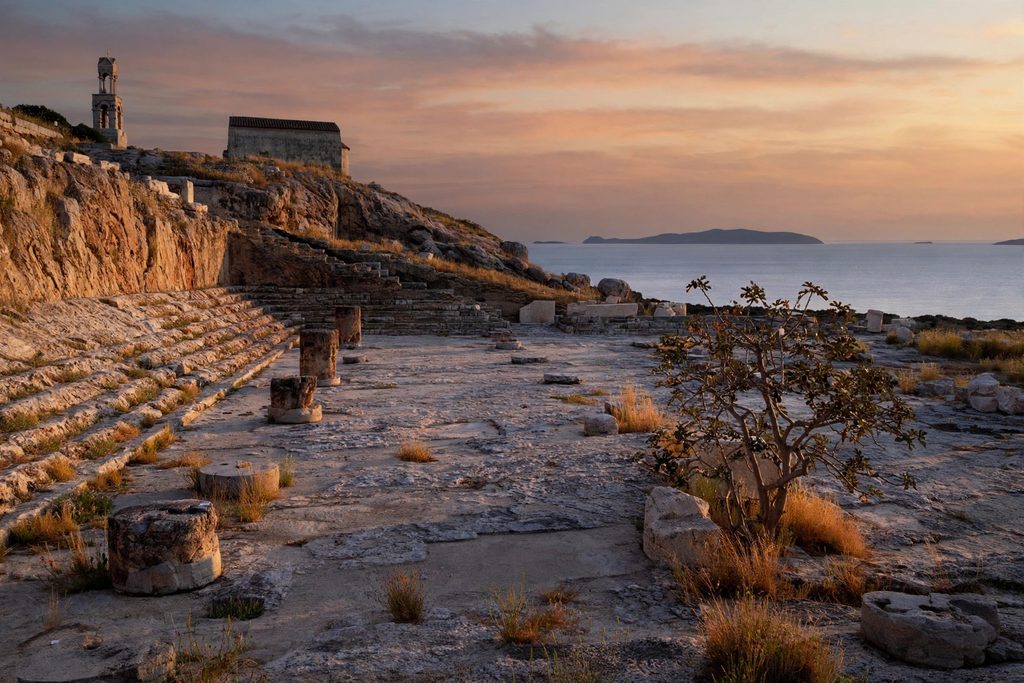
The Eleusinian Mysteries were the most famous initiation of the Greek world, held in honour of Demeter and her daughter Persephone. The Greater Mysteries took place every year in the Attic month of Boedromion, which fell in September and October. Initiates bathed in the sea at Phaleron, walked the Sacred Way from Athens to Eleusis in a great procession, and on the final nights entered the Telesterion, the hall of initiation, where after fasting and darkness they were shown sacred things, by most ancient accounts amid a sudden blaze of light. The highest grade of initiation was called epopteia, the act of beholding. Initiates swore never to reveal what they saw, and remarkably, almost none did, so that what happened inside the hall is still largely unknown.
Plato takes the vocabulary of that autumn rite, its words for initiation and for beholding, and gives it to the soul’s original vision. The souls in the Phaedrus are initiates. Plato does not reconstruct the secret ceremony, and nobody can, but he describes the sight of the Forms in the terms his readers used for the holiest thing they knew, and the philosopher who recollects is, in Socrates’ words, the one person always being initiated into perfect mysteries. In the Phaedo he quotes a saying of the Mysteries, that many carry the wand but few become true bacchants, and applies it to philosophers.
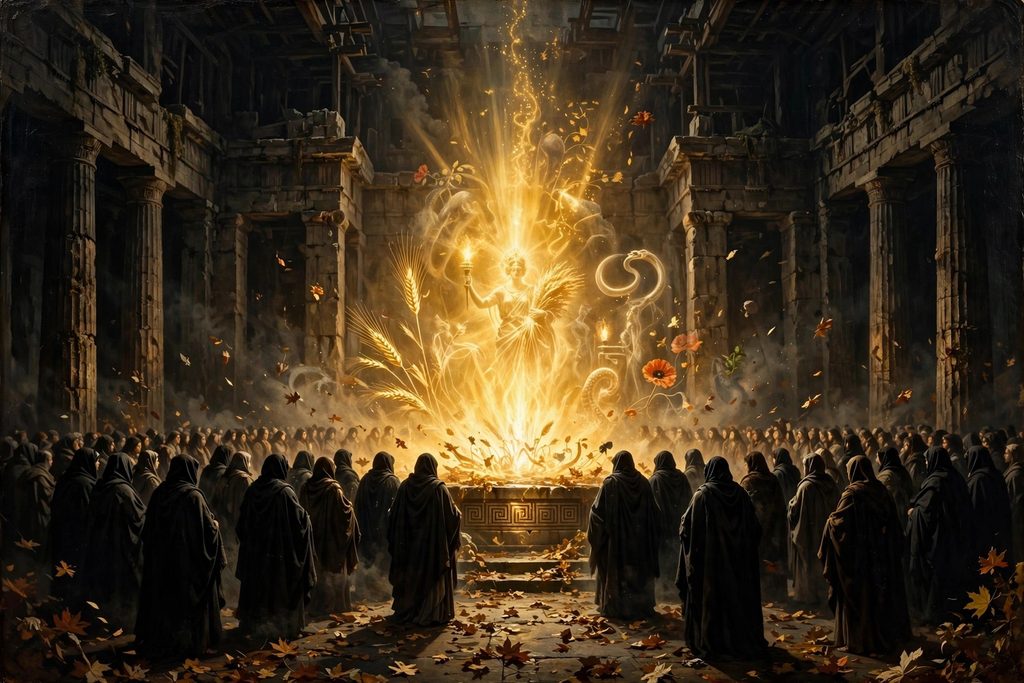
The myth behind Eleusis is itself an autumn myth. It tells how Demeter lost her daughter to the underworld and how the earth went barren in her grief, until Persephone was allowed to return for part of every year. The following month, Pyanepsion, brought the Thesmophoria, when the women of Athens kept Demeter’s festival at sowing time. In the Athenian calendar, the turn from summer to winter was the season of descent and return, of loss and recovery, of the dark hall and the sudden light. Plato’s readers lived inside that calendar, and his picture of the soul’s memory speaks its language.
Gentler Light First | The Cave and the Night Sky
The allegory of the cave, in the seventh book of the Republic, is the most famous image Plato ever made. Prisoners chained since childhood face the back wall of a cave and see only shadows cast by objects carried past a fire behind them. They take the shadows for the whole of reality. One prisoner is freed and dragged up the steep path into the open air, where the sun stands for the Form of the Good, the source of all truth and understanding.

What is often forgotten is the order in which the freed man learns to see. Blinded by the daylight, he cannot look at anything at first. He begins with shadows, then with reflections of people and things in water, then with the things themselves. Then, Socrates says, he would find it easier to study the heavens by night, looking at the light of the moon and the stars, than to look at the sun and its light by day. Only at the very end can he look at the sun itself.
The soul, in other words, needs gentler light first. Plato calls the whole of education a periagoge, a turning around of the soul, and insists that it cannot be forced. Knowledge is not poured into an empty soul like sight into blind eyes. The power to see is already there. Education turns it toward the right things, gradually, at a pace the eye can bear.
The Greek autumn offers a fair image of that gentler light. At the latitude of Athens, the noon sun stands about seventy-five degrees above the horizon in late June and only around forty-three in mid October. Summer light falls almost straight down, bleaching the stone, flattening the hills and shrinking every shadow to a dark pool at the foot of things. October light comes in at an angle. It throws long shadows, picks out the texture of bark and stone, and separates one ridge from the next. After the first rains wash the summer dust out of the air, the outlines of distant mountains come back. An olive tree that was a single blaze of silver at noon in August becomes, in the late afternoon of October, a structure of trunk and branch and leaf, each part distinct.

This is an analogy, not a doctrine, and Plato would warn against taking it too far. The light he cared about was the light of the intelligible, not of the sun over Attica. But he chose the imagery of light and seeing himself, and his freed prisoner learns by moonlight and starlight before he faces the noon. An autumn evening is as close as the physical world comes to that stage of the climb.
The Season of Falling Short
The strongest link between Plato and autumn is not the light. It is the argument of the Phaedo. Recollection, Socrates said there, is set off when we notice that the things in front of us fall short. The sticks strive to be equal and fail. Their failure reminds us of the equality they lack, and that reminder is the beginning of knowledge.
Beautiful things work the same way. Every beautiful thing in the world is beautiful only in part, only for a while, and only from some angle, and in the Symposium that is exactly what distinguishes it from Beauty itself, which does not grow, decay, wax or wane. In summer, the falling short is easy to miss. The world is at its height and seems complete. In autumn it becomes visible everywhere. The vine leaves turn and drop, the fig tree empties, the evenings shorten, the sea darkens. The world shows, openly and on a schedule, that its beauty does not last.
That is why an autumn day can be so affecting even when nothing dramatic happens. A plane tree turning gold beside a river, the smell of the first rain on dry earth, the last swim in a sea that has already begun to cool, all of these carry a feeling larger than the scene. Plato’s theory offers a name for that feeling. It is the soul being reminded, by a beauty that is visibly passing, of a beauty that does not pass. The fading is the prompt. Like the lyre that recalls the absent lover, the falling leaf recalls what does not fall.
A modern reader may explain the same feeling differently, as memory, association, or attention sharpened by the knowledge of loss. Plato’s metaphysics can be doubted. His question survives the doubt. Why should a passing thing point so insistently beyond itself, and why should we feel, in front of it, less that we are learning something than that we are being reminded?
This is also where a Platonic autumn differs from a merely melancholy one. The sadness of the season, in this reading, is not the whole of it. The ache Plato describes in the Phaedrus is the ache of wings beginning to grow back.
The Grove of Akademos | Philosophy Among the Olives
Plato founded his school in the 380s BCE in a place that was already old and sacred, the grove of the hero Akademos, about a kilometre and a half beyond the Dipylon Gate of Athens. Long before philosophy arrived, the site held a gymnasium, shrines and a grove of olive trees sacred to Athena, believed to descend from the first olive she gave the city. Plato owned a small property nearby, taught in and around the grove for some forty years, and was buried there after his death in 348 or 347 BCE. The school took its name from the place, and through it every academy in the world is named after a minor Attic hero.
The grove outlived its founder by more than two centuries. In 86 BCE, during his siege of Athens, the Roman general Sulla had the sacred trees of the Academy cut down to build siege engines. The site was later lost under fields and then under the modern city, until twentieth-century excavations uncovered parts of the gymnasium and other buildings. Today it is a free public park in the Athenian district still called Akadimia Platonos, with low ancient walls among apartment blocks, plane trees and a few olives, where residents walk their dogs across the ground where the Republic was first discussed. There is an irony in that. A school devoted to what does not change was itself felled, buried and rebuilt over by time, and survives now through copied manuscripts, translations and a name.
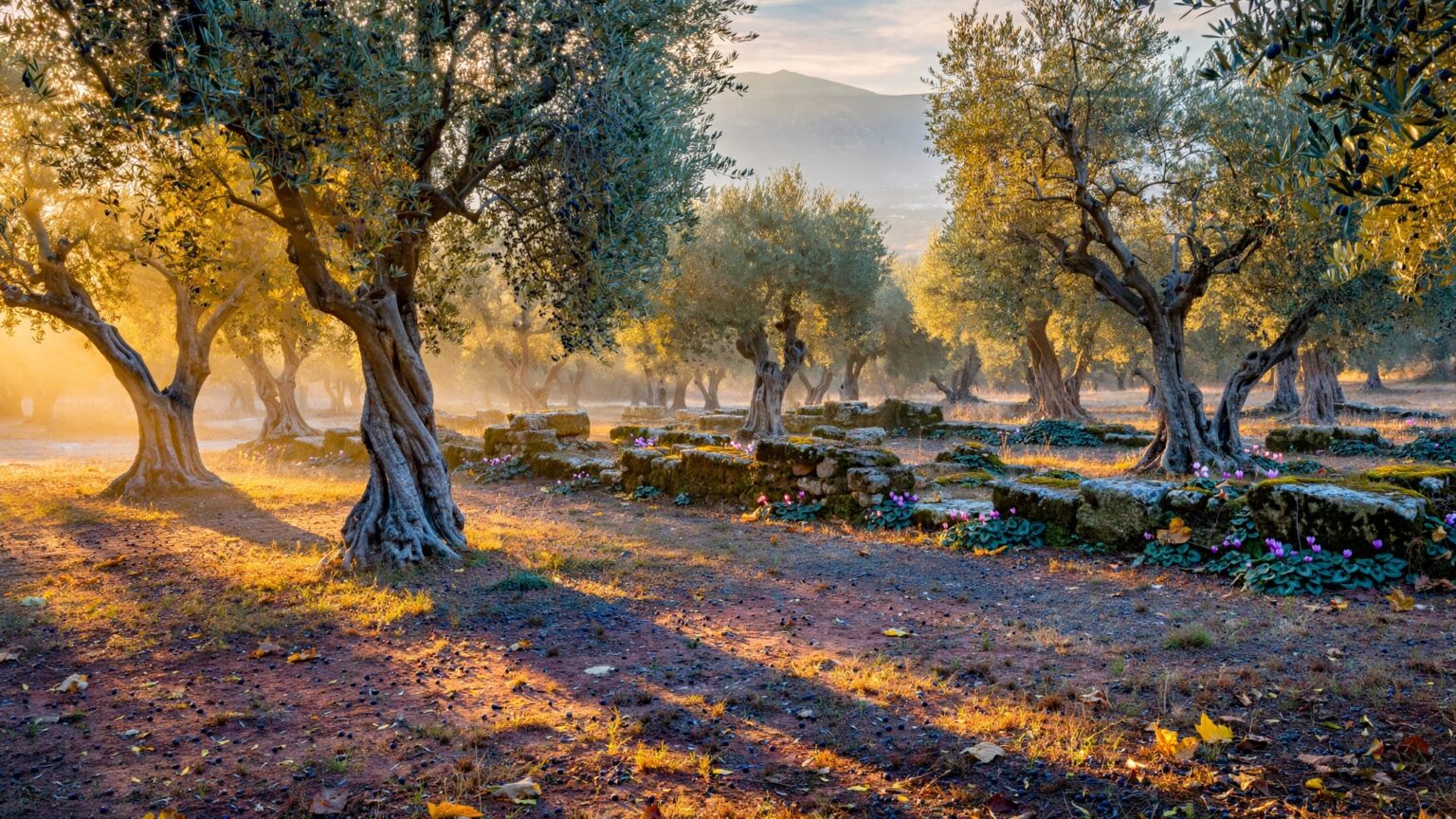
It is a good place to go in October. The heat has broken, the light is low, and in the groves of Attica the olives are darkening toward the harvest, which begins as the month ends and runs through the winter. The olive tree is a fitting companion for this philosophy, though not a perfect one, since no tree can stand for a Form. Its fruit ripens and falls and its trunk twists with the centuries. But it is evergreen. Its leaves do not fall with the season, and it can live for well over a thousand years, so that some of the oldest trees in Greece were already standing when Plato’s own words were being copied by medieval scribes. In a landscape full of things that pass, it is the nearest living image of what lasts.
What the Season Can and Cannot Do
It would be easy to turn all this into a mood, and Plato would object. Recollection, as he describes it, is not a feeling that washes over a person on a pleasant evening. In the Meno, the boy reaches the answer only because Socrates questions him, patiently, through two wrong answers and a moment of real confusion. Later in the same dialogue, Socrates compares true opinions to the statues of Daedalus, which run away unless they are tied down, and says they become knowledge only when they are fastened by reasoning, a fastening he calls recollection. In the Republic, the climb out of the cave takes years of mathematics and dialectic. Beauty can start the process. It cannot finish it.
The honest claim, then, is a modest one. Autumn does not make anyone wise. It offers occasions, the same kind of occasion as the lover’s lyre or the unequal sticks, small prompts that set the mind turning. The quiet after the summer crowds, the lower light, the visible fading of beautiful things, all of these make it easier to notice what Plato thought we always carry and usually ignore. What happens next depends on the questions we ask.
This archive has followed the year through Greek thought. Summer belonged to the noon sun of Helios, and winter to Zeno and the Stoic discipline of steadiness. Autumn, the season of descent and harvest and gentler light, belongs naturally to Plato, the philosopher who believed that the most important things we will ever learn are things we already knew.
The Olive Grove in October
Stand in the old grove of Akademos on an October afternoon. The traffic of the city is a low murmur beyond the trees. The sun is already at a slant, the shadows are long, and the light picks out each branch of the olives and the dark fruit among the leaves. The plane trees are beginning to turn. Something in the scene is more moving than it has any right to be, a few ruined walls and some trees in a city park.
Plato had a name for that feeling. He would have said that the soul, which once rode with the gods to the rim of heaven and drank from the river of forgetting on its way into the world, was being reminded of what it saw before it was born. He would have said that the beauty in front of you is fading so that you will notice the beauty that does not fade. And he would have said that the feeling is only the beginning, the first ache of the wings, and that the rest is the work of a lifetime.
He called it anamnesis. He did not reserve it for October, and he never promised that an olive grove could restore the soul’s wings. But the grove where he taught is still there, the light still slants across it every autumn, and the question he asked under its trees is still waiting for anyone willing to stop and look again.
At Olympus Estate, Mythic Essays reads the ideas of the Greek world closely and in their own setting, and Plato’s theory of anamnesis is one of the strangest and most lasting of them. In the Phaedrus the soul rides in the procession of the gods to the rim of heaven and glimpses the Forms, then falls into a body, and in the Myth of Er it drinks from the River of Unmindfulness on the plain of Lethe and forgets, while Orphic gold leaves told the dead to drink from the lake of Memory instead. In the Meno a slave boy finds the side of the doubled square through questioning alone, passing through two wrong answers and the numbness of the torpedo fish before the diagonal appears, and Socrates argues that all learning is recollection. In the Phaedo, unequal sticks remind us of an equality they never show, and in the Phaedrus beauty alone among the Forms is most clearly seen and loveliest, so that the sight of it makes the soul shudder and its lost wings begin to grow. Underneath runs the question of why a finite, imperfect thing can awaken longing for something beyond itself. Plato never tied any of this to autumn, and his Phaedrus is set by the Ilissos at the height of summer, yet he described the soul’s vision in the language of the Eleusinian Mysteries, celebrated every Boedromion, his freed prisoner learns by moonlight before he faces the sun, and his argument turns on beauty that visibly falls short, as an autumn landscape does. Taught for forty years in the olive grove of Akademos outside the Dipylon Gate, felled by Sulla in 86 BCE and now a public park in Akadimia Platonos, his philosophy holds that the season can only offer the prompt, and that the remembering, as the Meno and the Republic insist, is the work of questioning and of a lifetime.