





The most important word in Aristotle’s ethics has been mistranslated for two thousand years.
Eudaimonia is the word. It appears in the first sentence of the Nicomachean Ethics as the highest good toward which all human action aims, the end that everything else is pursued for the sake of, the target that gives the entire ethical system its direction and its point. It has been translated, consistently, across two millennia of Latin and then vernacular European philosophy, as happiness.
This translation is not simply imprecise. It is the kind of imprecision that changes the meaning of everything that follows it, because happiness in the contemporary English sense, and in the Latin felicitas that preceded the English, denotes a subjective state of mind: the feeling of being pleased, contented, satisfied, emotionally gratified by one’s circumstances. It is something that can be experienced momentarily, that can arrive and depart independently of how one’s life is actually going, that can in principle be produced by any combination of circumstances that the person experiencing it happens to find pleasant.
Eudaimonia does not consist of a state of mind or a feeling of pleasure. This is the Encyclopaedia Britannica’s own formulation, and it is the clearest available single-sentence correction of the mistranslation. Aristotle saw eudaimonia as the highest human good and an end in itself. It involves fulfilling one’s unique function through virtuous activity, particularly the exercise of reason, and this involves long-term habituation, reflection, social experience, and circumstance, making it an achievement of a complete life rather than a fleeting feeling.

An achievement of a complete life. Not a feeling. Not a state. An achievement, arrived at through sustained practice, over a complete lifetime, through the cultivation of particular capacities and the performance of particular activities, in a community of other people whose shared life makes the individual’s excellence possible and meaningful.
This is what Aristotle was actually describing, and the word that most accurately renders it in contemporary English is not happiness but flourishing: the condition of a living thing that is functioning excellently, in full expression of its capacities, in the conditions that make that excellent functioning possible. In Aristotle’s own words from the Nicomachean Ethics, eudaimonia means doing and living well. It is an active condition, not a passive one.
The entire subsequent history of Western ethics, including its contemporary expressions in positive psychology and wellbeing research, has been conducted partly in the shadow of a translation error that made Aristotle’s most demanding concept considerably easier to misuse than he intended.
The Man Before the Ethics
Aristotle was born in 384 BCE in Stagira, a Greek colony in the northern Aegean near the Chalcidice peninsula, the son of Nicomachus, the court physician to the Macedonian king Amyntas III. His father’s profession placed him, from birth, in a tradition of empirical observation: physicians observe, document, and reason from what they can directly examine, and this orientation toward the observable rather than the abstract would distinguish Aristotle’s philosophy from Plato’s in almost every domain it touched.

He came to Athens at seventeen to study at Plato’s Academy and remained there for twenty years, until Plato’s death in 347 BCE. What those twenty years produced was not a disciple who reproduced his teacher’s positions but a thinker who genuinely absorbed everything Plato had done and found it, across multiple crucial dimensions, incomplete. The Platonic theory of Forms, which located the most real and most knowable things in an abstract realm of eternal, unchanging essences that the material world imperfectly instantiated, was the target of Aristotle’s most sustained critical effort: he argued, across multiple works, that the Forms were not a solution to the philosophical problems Plato designed them to solve but an additional problem in their own right, generating more explanatory difficulties than they resolved.
After Plato’s death, Aristotle left Athens and spent several years traveling, including a crucially important period on the island of Lesbos, which this site has already documented at length in its own dedicated article. At the Kalloni Gulf, in the shallow, enclosed lagoon whose waters supported an extraordinary concentration of marine life, Aristotle conducted the systematic observation and dissection that produced the History of Animals and the other biological works that constitute the founding literature of the discipline. He documented more than five hundred species, including the first accurate description of the development of the chick embryo, dissecting specimens and reporting what he observed with a precision that subsequent zoology would not match for nearly two thousand years.

This is the biographical detail that most clearly distinguishes Aristotle from the popular image of a philosopher who sat in a room and thought: he was on his knees in the shallows of a Lesbian lagoon, cutting open sea creatures and describing what he found inside them, and the philosophy that emerged from this practice of rigorous empirical observation carried the character of someone who had learned, from direct encounter with the complexity of living things, that the world was considerably more varied and more specific in its operations than any general abstract principle could fully capture.
Philip of Macedon hired him to tutor his son Alexander, and Aristotle spent several years at the Macedonian court doing this before returning to Athens in 335 BCE to found the Lyceum, the school that became the center of his mature philosophical work and from which the surviving corpus of his writings emerged, almost certainly in the form of lecture notes compiled by him or his students rather than literary essays designed for a general audience.

The Lyceum and How It Worked
The Lyceum was not simply a school in the sense of a place where instruction happened. It was an institution whose intellectual program included research as well as teaching, systematic collection of specimens and evidence as well as discussion, and the collaborative, ongoing development of ideas rather than the transmission of a fixed body of doctrine.
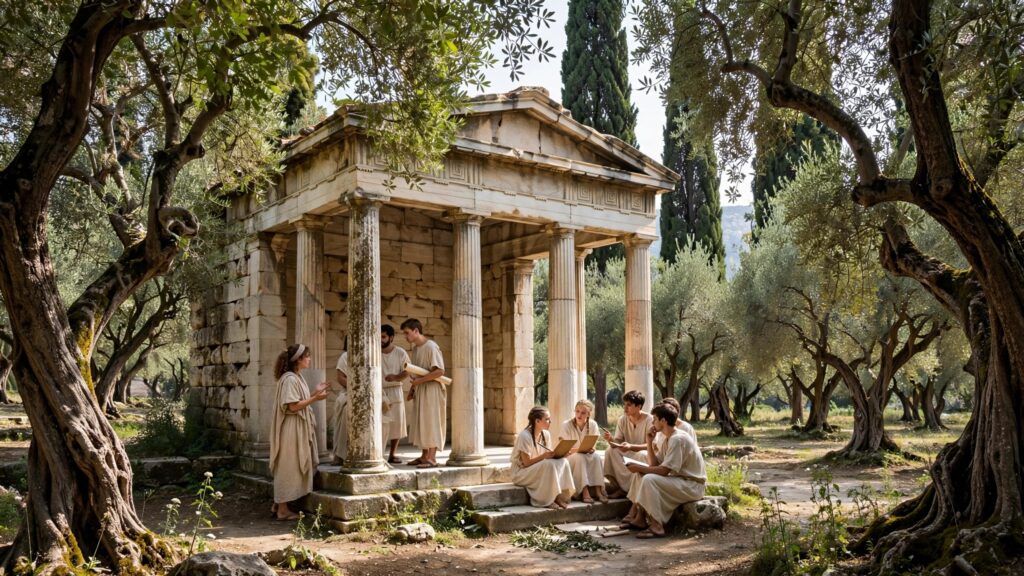
Aristotle’s followers were called Peripatetics, and the traditional story, repeated for centuries, holds that the name came directly from Aristotle’s own habit of lecturing while walking, peripatein, to walk around. The more careful modern account complicates this pleasant image without entirely discarding it: the school took its name most directly from the peripatos, the covered walkway or colonnade of the Lyceum grounds where Aristotle and his students actually gathered and talked, and the specific legend of Aristotle pacing back and forth as he lectured appears to trace to a later ancient biographer, Hermippus of Smyrna, rather than to any contemporary record. Whichever came first, the walkway or the walking, the name still carries something true about the character of the intellectual work done there: thinking conducted in motion, in dialogue, in the company of others moving through the same physical space together, rather than in fixed positions across a fixed text.

The range of subjects the Lyceum addressed was extraordinary by any measure: logic, metaphysics, natural science, biology, psychology, ethics, politics, rhetoric, poetics, economics. Aristotle’s surviving writings cover all of these, and the fragments of lost works suggest the original body of his output was considerably larger. The biological works alone constitute a research program of a scale that no individual scientist before the modern period attempted: systematic observation and classification of the animal world from insects to cetaceans, conducted with the explicit goal of understanding the principles that governed the extraordinary variety of living forms.

This breadth was not accidental and was not the consequence of a single unusually talented person’s curiosity ranging widely. It was the expression of a philosophical principle: that the investigation of specific, observable things was the correct method for arriving at genuine knowledge, and that the different domains of inquiry required their own methods rather than a single universal procedure imported from mathematics or from Platonic dialectic. The Lyceum was the institutional embodiment of the conviction that knowledge was plural in its methods and in its subject matter, that the principles governing political life were not the same kind of thing as the principles governing animal biology, and that both required direct investigation of the phenomena rather than deduction from first principles established in advance.
What the Nicomachean Ethics Actually Argues
The Nicomachean Ethics is not a systematic deductive argument from a single foundational principle to a set of derived conclusions. It is an investigation: an attempt to understand what living well actually consists in, conducted by a philosopher who is willing to revise and qualify and acknowledge the limits of what can be said with the same intellectual honesty he brought to the dissection of sea creatures in the shallows of the Kalloni Gulf.

The investigation begins from an observation rather than a postulate: every art, inquiry, action, and pursuit aims at some good. We plant fields to produce food, build houses to produce shelter, study medicine to produce health. And these goods are themselves aimed at other goods: health is good partly because it makes other activities possible. What is the good that everything else is aimed at for its own sake, the good that gives the whole structure of human striving its direction?
Aristotle’s answer is eudaimonia: activity of the soul in accordance with virtue, that is pleasant, continuous, self-sufficient, and pursued for its own sake. This definition is considerably more demanding than the translation as happiness suggests. Activity, not state: eudaimonia is something you do, not something you have or feel. Soul, in Aristotle’s sense: not a supernatural substance but the set of capacities that constitute a living organism of a particular kind. Accordance with virtue: the activity has to be excellent activity, activity that expresses and develops the capacities that are distinctly human. Continuous: not episodic or occasional but sustained across a complete life. Self-sufficient: not dependent on other things for its value but desirable entirely for its own sake.

Aristotle draws a foundational distinction between two categories of virtue: intellectual virtues and moral virtues. Intellectual virtues belong to the rational part of the soul. These include sophia, theoretical wisdom, episteme, scientific knowledge, nous, intuitive understanding, and most importantly phronesis, practical wisdom. Moral virtues, such as courage, temperance, generosity, and justice, concern character and are developed through repeated action and practice.
The relationship between these two categories is the Ethics’ central structural argument: moral virtues provide the stable dispositions of character that make excellent action reliably available, but they require intellectual virtue, specifically phronesis, to identify what excellent action actually looks like in the unrepeatable circumstances of each particular situation. Phronesis is an intellectual meta-virtue that deliberates upon and mediates conflicts between virtues, helping the agent navigate situations where different virtues might pull in different directions. Without it, even a person of good general character may act poorly in novel or difficult situations.

The Golden Mean, which popular accounts of Aristotle treat as a simple rule to avoid extremes, is considerably more sophisticated when read in full. Courage is not the midpoint between cowardice and recklessness on a fixed scale. The mean is not a fixed point the same for everyone. A seasoned soldier and a young recruit may both need courage, but the appropriate expression of that courage will differ based on their experience, roles, and circumstances.

Context always matters. The mean is relative to the person, the situation, and the moment, and identifying it correctly is precisely what phronesis is for. This means that the Golden Mean is not a formula but a task, requiring the kind of practical wisdom that only sustained engagement with real situations over a complete lifetime can develop.
The Three Things Eudaimonia Requires That Happiness Does Not
The most important structural feature of Aristotle’s eudaimonia, and the one most thoroughly obscured by the happiness translation, is that eudaimonia genuinely requires three things that a subjective feeling of happiness genuinely does not require.
The first is time. Eudaimonia is an achievement of a complete life, not a fleeting feeling. You cannot be eudaimon at twenty-five, however excellent your character and however excellent your current activities. Eudaimonia is a property of a complete human life, assessable only in retrospect, the way that the quality of a piece of music can only be fully heard when the last note has sounded. This is why Aristotle endorses the Solonic principle that you should call no man happy until he is dead: not as a grim observation about mortality but as a precise statement about the temporal structure of the concept. Happiness can be felt and lost and felt again many times in a single day. Eudaimonia is built across decades.

The second is other people. Aristotle is explicit that a human being cannot flourish in isolation, because human beings are by nature political animals, beings whose characteristic capacities, including the use of language and the exercise of the virtues in their specifically social forms, require a community of other people to be properly exercised. Our ability to practice virtue is vulnerable to misfortune: poverty, illness, untimely death, or adverse social conditions can all undermine a person’s capacity to flourish, even if their character is excellent. Aristotle is not simply acknowledging that it is nice to have friends. He is making the structural argument that the individual’s capacity for excellent activity depends essentially on the quality of the community that makes such activity possible and that recognizes and responds to it appropriately. You cannot be eudaimon in a community whose institutions systematically prevent your capacities from being exercised.
The third is luck. This is the most uncomfortable of the three requirements, and Aristotle acknowledges it with his characteristic refusal of philosophical consolation: some degree of external good fortune is a genuine prerequisite for eudaimonia, not simply a pleasant addition to it. Extreme poverty, severe illness, the loss of people one loves, the destruction of the community one’s flourishing depends on, these things genuinely undermine the possibility of a flourishing life, not simply the pleasantness of it. The person of excellent character living in terrible circumstances is admirable and in some sense worthy of honor, but they are not eudaimon.

Aristotle’s ethics is admirable for its realism. It does not pretend that virtue alone is sufficient for flourishing, because that pretension would require misrepresenting both what virtue is and what flourishing demands.
The Four Causes and Why Everything Has a Purpose
Alongside the ethics, Aristotle’s most consequential philosophical contribution is the framework he called the four causes, the fourfold account of why anything is what it is that structured Western scientific and philosophical thinking until the Scientific Revolution of the seventeenth century and that continues to illuminate dimensions of explanation that modern science’s focus on efficient causation tends to leave aside.
The material cause is what something is made of. The formal cause is the pattern or structure that makes it the specific kind of thing it is rather than something else. The efficient cause is the agent or process that brought it into being. And the final cause, the telos, is the purpose or function for which the thing exists, the end toward which it is directed as its characteristic activity and its completed state.
Modern science, since the seventeenth century, has been primarily focused on efficient and material causation: what is it made of and what processes produced it. Aristotle’s insistence that a complete explanation of any living thing must also address its formal and final causes, what kind of thing it is and what it is for, is not a pre-scientific mysticism that modernity has superseded. It is a different question, addressing different dimensions of the thing’s existence, and the contemporary sciences of biology, psychology, and ecology regularly find themselves returning to something like functional and formal explanation when efficient and material explanation alone produces accounts that are accurate but incomplete.
The teleological framework applies to ethics precisely: eudaimonia is the telos of a human life, the completed and excellent expression of what a human being characteristically is, the final cause that gives the activity of living its direction and its point. Ethics, in this framework, is not a set of rules or a catalogue of permitted and forbidden actions. It is the investigation of what a specifically human excellent life looks like and what kinds of character and practice and community make it achievable.
Aristotle and Plato | The Disagreement That Shaped Western Thought
The relationship between Aristotle and Plato has been simplified, in most popular accounts, into the image of two contrasting figures: Plato pointing upward toward the eternal Forms, Aristotle pointing downward toward the observable world, the two gestures captured in Raphael’s School of Athens as the defining image of their philosophical opposition.
The simplification is useful but incomplete. Aristotle genuinely admired Plato and spent twenty years working within the framework Plato had established, and the Ethics preserves Plato’s concern with the nature of the good, the importance of virtue, and the relationship between individual excellence and the political community. What Aristotle rejected was not Plato’s questions but his method of answering them: the appeal to Forms that transcend the observable world was, for Aristotle, a philosophical device that explained nothing because it placed the explanatory entity in a realm that the method of philosophy he had developed could not access.
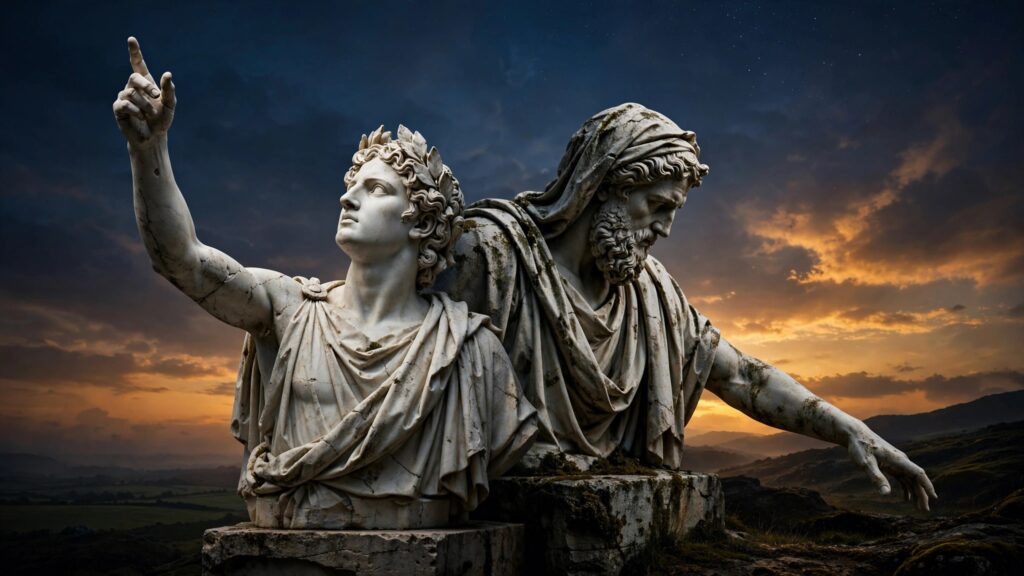
The Ethics’ opening argument is in some sense a corrective to Plato: Aristotle insists that the good for human beings cannot be a single, transcendent, abstract Form of the Good but must be the good of beings of this particular kind, in the particular conditions of human life, achievable through the particular capacities that humans specifically possess. The move from the Platonic universal to the Aristotelian specific, from the Form to the function, from what the Good is in itself to what living well looks like for beings like us, is the move that makes the Ethics a practical rather than a purely theoretical work, addressed to people who want to live well rather than simply to understand the Good in the abstract.
The Legacy That Shaped Two Civilizations
The story of Aristotle’s legacy in the history of ideas deserves its own account rather than a list, because the mechanism of transmission was as consequential as the content transmitted.
When the Western Roman Empire declined and the institutional infrastructure of Greek philosophical education contracted, a significant portion of the Aristotelian corpus was preserved and developed in the Islamic philosophical tradition, particularly by Al-Farabi, Avicenna, and Averroes, whose commentaries on Aristotle’s works became the primary vehicle through which Aristotelian philosophy re-entered the European intellectual tradition in the twelfth and thirteenth centuries.

Thomas Aquinas’s synthesis of Aristotelian philosophy with Christian theology, the scholastic tradition that dominated European university education from the thirteenth century through the Reformation, was built on an Arabic-mediated Aristotle: the Greek philosopher who shaped medieval Christian intellectual life arrived via the philosophical tradition of the Islamic world rather than directly from Greece.
This transmission history is not a footnote. It is the most complete available demonstration of the quality of the thing being transmitted: a body of philosophical work so fundamental in its questions and so rigorous in its methods that it remained productive, generative, and worth arguing with across three distinct civilizations, two distinct religious traditions, and more than fifteen centuries of intellectual development that changed almost everything else about how those civilizations thought about the world.

The Nicomachean Ethics carries a name whose exact origin the ancient sources themselves never quite settled. Aristotle had both a father and a son named Nicomachus, his father the court physician who trained his own earliest habits of observation, his son born late in Aristotle’s life to Herpyllis and said, in the scattered ancient testimony that survives, to have died young, possibly in battle, possibly before the text had reached the form in which it survives. Most modern scholars lean toward the son as the more likely dedicatee, with some proposing that Nicomachus the Younger may himself have edited his father’s lecture notes into their final surviving arrangement after Aristotle’s own death. But the ancient sources hedge, and a serious minority tradition favors the father instead, and honesty requires leaving the question exactly where the evidence leaves it: unresolved. What is not in question is that the text which carries this uncertain name, whichever Nicomachus it actually honors, has been read, commented on, argued with, and built upon by more philosophers than almost any other work in the Western tradition, and needed no single dedicatee’s fame to carry it forward, because it generated entire disciplines instead.
What the Word Actually Demands of You
Return to eudaimonia. Not happiness. Flourishing.
The word demands, if you take it seriously rather than using it as a more interesting synonym for feeling good, that you ask what kind of thing you specifically are and what the excellent exercise of that kind of thing looks like in the conditions of your own life. It demands sustained practice of the capacities you want to develop, not occasional performance of them. It demands a community whose shared life makes your individual excellence possible and meaningful, and reciprocal attention to the conditions that make other people’s flourishing possible. It demands phronesis, practical wisdom, the kind of intelligence that cannot be acquired from books or rules but only from sustained, reflective engagement with the actual complexity of real situations over time. And it demands the courage to acknowledge that external good fortune is a genuine condition of flourishing rather than a pleasant supplement to it, which means that the conditions of other people’s flourishing are genuinely your concern in a way that a purely subjective account of happiness does not require.

As one modern reference work puts it, the word is usually translated as happiness, but this is unfortunate, because happiness carries such a debased connotation for contemporary readers. For Aristotle, it was not a temporary feeling of elation, but a state of thriving or flourishing that characterized a whole life.
Aristotle spent years in the shallows of the Kalloni Gulf, documenting the forms that specific kinds of living things took in the specific conditions they inhabited. He brought the same quality of attention to the question of what a human life excellently lived looked like: observable, achieved through sustained practice in real conditions, assessable only across the whole of the life rather than at any single moment in it.
He thought happiness was the wrong word. He was right.
At Olympus Estate, Cultural Chronicles traces the institutions, thinkers, and practices that defined Greek civilization from the inside. Eudaimonia, the highest good in Aristotle’s Nicomachean Ethics, has been translated as happiness for two thousand years, but Aristotle’s own definition, activity of the soul in accordance with virtue, pursued for its own sake across a complete life, describes something closer to flourishing. It requires time, since it can only be assessed across an entire lifetime. It requires other people, since human capacities are inherently social. And it requires luck, since Aristotle refused to pretend that virtue alone could guarantee a flourishing life regardless of circumstance. Aristotle developed this thinking after twenty years at Plato’s Academy, years of biological fieldwork in the shallows of Lesbos, and the founding of his own school, the Lyceum, whose Peripatetic name may come from Aristotle’s habit of lecturing while walking, or, more probably, from the covered walkway where his students gathered. He thought happiness was the wrong word. He was right.