


Every Greek tragedy begins and ends with her.
Not because she appears in it. She does not appear in it. She has no part to play in the drama because drama requires conflict and she is the condition of stability that makes conflict possible. The tragedy begins in a household. The household exists because there is a hearth at its center. The hearth exists because Hestia is present. The tragedy unfolds because the organized space that Hestia’s presence created is the organized space whose disruption the tragedy’s events constitute.
She is not in the tragedy. She is what the tragedy is about.
This is the theological character that makes Hestia the most philosophically precise and the most consistently misunderstood figure in the Greek pantheon. The gods with mythologies, Zeus who pursues and punishes, Hera who jealously retaliates, Apollo who prophecies and destroys, Aphrodite who ignites desire across the organized world, Dionysus who dissolves the boundaries of the self, Athena who intervenes with strategic intelligence at the critical moment: all of these deities are figures within the mythological narrative, characters whose actions produce the events the tradition records.

Hestia is the figure without whom there would be no narrative at all.
She is the fire that must be burning before anything else can begin. She is the organized space whose existence is the condition of the human activity that takes place within it. She received the first portion of every sacrifice and the last because the ritual opened in her acknowledgment and closed in her acknowledgment, and without her acknowledgment at both ends the ritual was incomplete. Not because she demanded the acknowledgment. Because the acknowledgment was the recognition that the organized space within which the ritual took place was her creation and her maintenance.
First Born and Last to Emerge
The first child of Kronos and Rhea was Hestia.
Kronos swallowed her immediately. The prophecy that one of his children would dethrone him was the prophecy whose truth he was attempting to prevent through the method of preventing his children from existing as independent beings in the world. Hestia was swallowed first because she was born first. She spent the years of Kronos’s reign inside her father’s body alongside Demeter and Hera and Hades and Poseidon, in the darkness of the condition before the organized world had established the hierarchy that Zeus’s eventual victory would create.
When Zeus forced Kronos to disgorge his children, Hestia was the last to emerge. She was swallowed first and released last. In the Greek theological tradition, this dual character encoded a cosmological meaning: the thing that is oldest and the thing that is youngest simultaneously is the thing that is both the foundation and the completion, the beginning and the end, the condition that was present before everything else and the condition that remains after everything else has run its course.

The Homeric tradition preserves this dual character in the privilege that Zeus granted Hestia when she made her vow: she would receive the first portion of every sacrifice offered by mortals and the last portion as well. No other Olympian shared this privilege. Not Zeus himself, whose authority governed the entire divine world. The first and the last belonged to the oldest and the youngest simultaneously, to the being whose presence was the condition of the ritual rather than a participant within it.
The Vow and Its Meaning
Apollo sought to marry Hestia. Poseidon sought to marry Hestia. Both offers would have placed her in the relationships of the divine marriage tradition: the wife of the god of light and prophecy, or the wife of the god of the sea. Either marriage would have given her a position within the organized Olympian hierarchy whose structure was the structure of the relationships between the divine beings who governed the organized world.
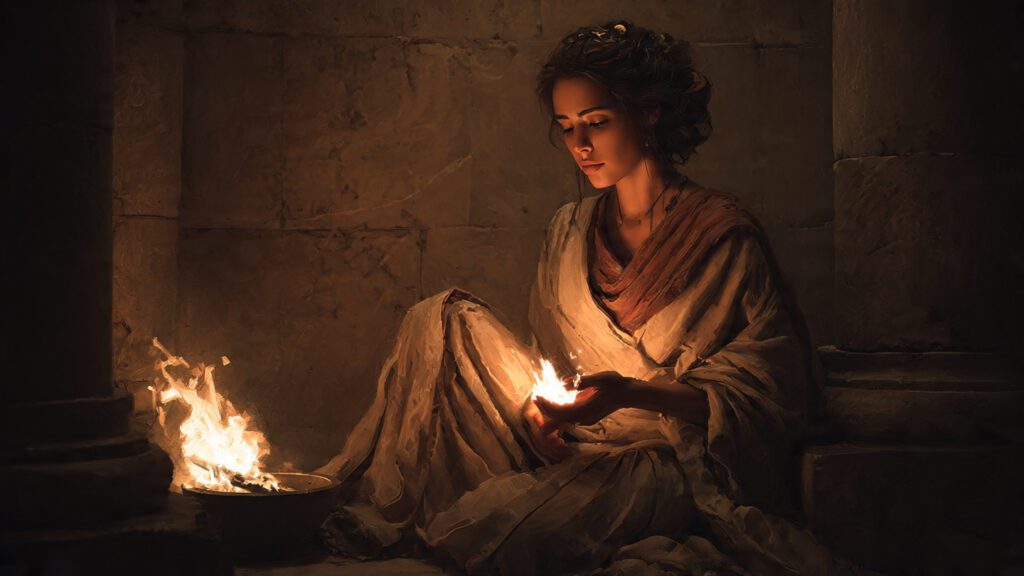
She refused both.
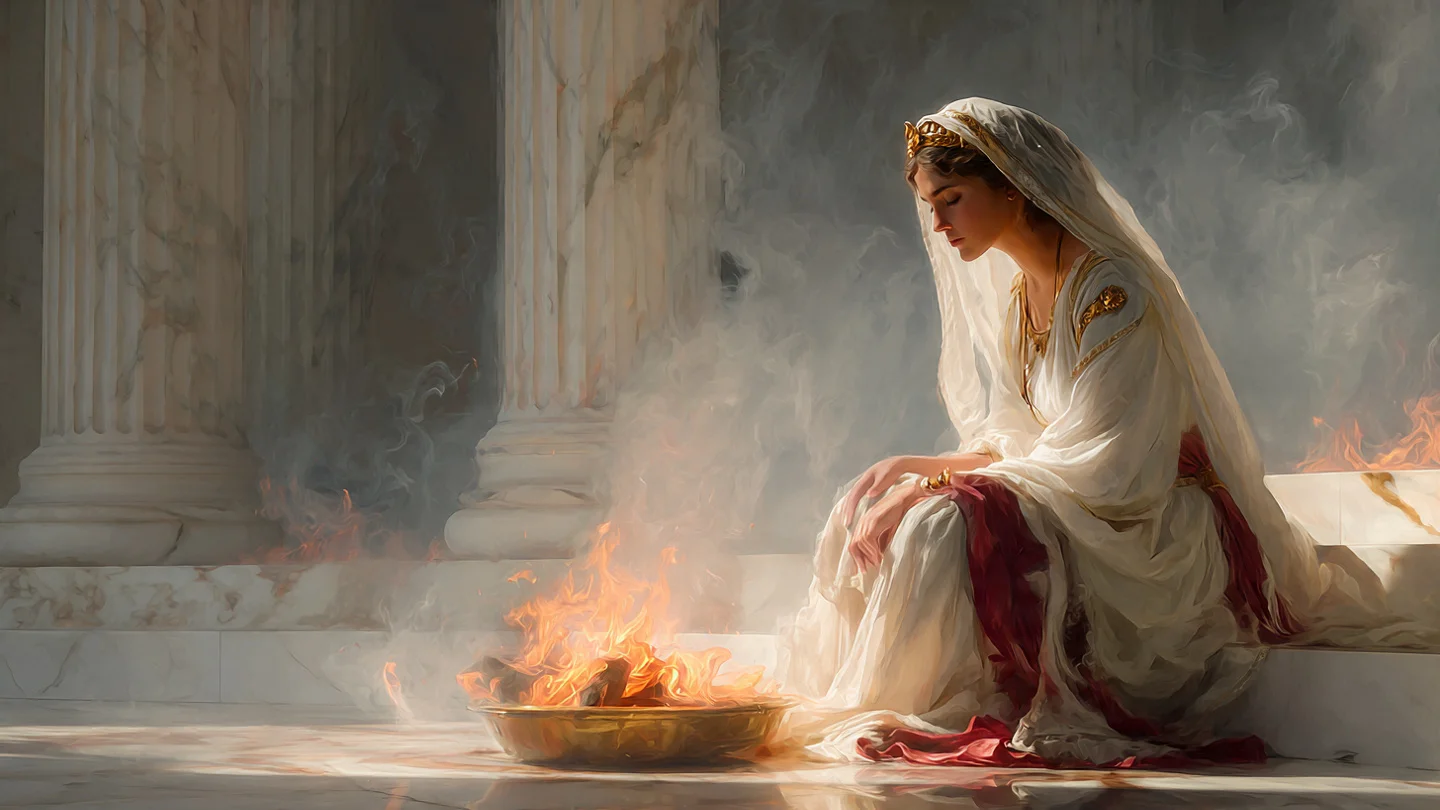
The vow she made was the vow of permanent virginity, the vow to remain the keeper of the sacred fire and to dwell always at the center. Zeus honored the vow and granted her the privilege of the first and last offering.
The standard reading of Hestia’s vow treats it as the choice of the domestic over the political, the quiet over the active, the personal purity over the entanglement of the divine social world. This reading is available but it misses the theological content of what the vow preserved.
The divine marriages in the Greek tradition are the relationships through which the divine beings produce the offspring whose natures reflect the combination of the parental divine natures. The children of Zeus and Hera are the divine beings whose characters reflect the tension between the authority of the sky and the institutional order of the bounded household. The children of Aphrodite and Ares are the divine beings whose characters reflect the combination of the most generative and the most destructive available forces. The divine marriages produce the divine family whose internal relationships are the relationships that the mythological tradition develops across its entire narrative arc.

Hestia’s vow preserved her from this structure. She had no divine children. She had no divine husband. She had no relationship within the Olympian family structure that produced the conflicts and the alliances and the jealousies and the interventions that the mythological narrative is built from.
She had no mythology because she was not within the structure that mythology traces. She was the condition of the structure’s existence.
The Hearth and the Household
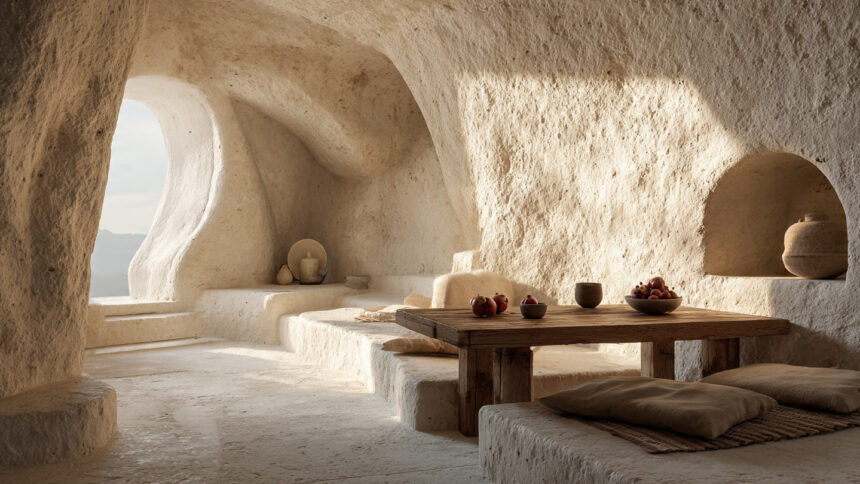
The Greek household, the oikos, was organized around the hearth. The Oikos article in this collection develops the architectural and social character of the Greek domestic tradition: the courtyard house whose organization reflected the understanding of how multiple generations sharing a space maintain both proximity and independence, with the kitchen and its central hearth as the point around which the household’s social gravity accumulated.
The hearth was Hestia’s domain, and the character of her domain was not the domain of a deity who governed one aspect of the household among others. It was the domain of the deity whose presence was the condition of the household’s existence as a household rather than as a collection of individuals sharing a physical space.
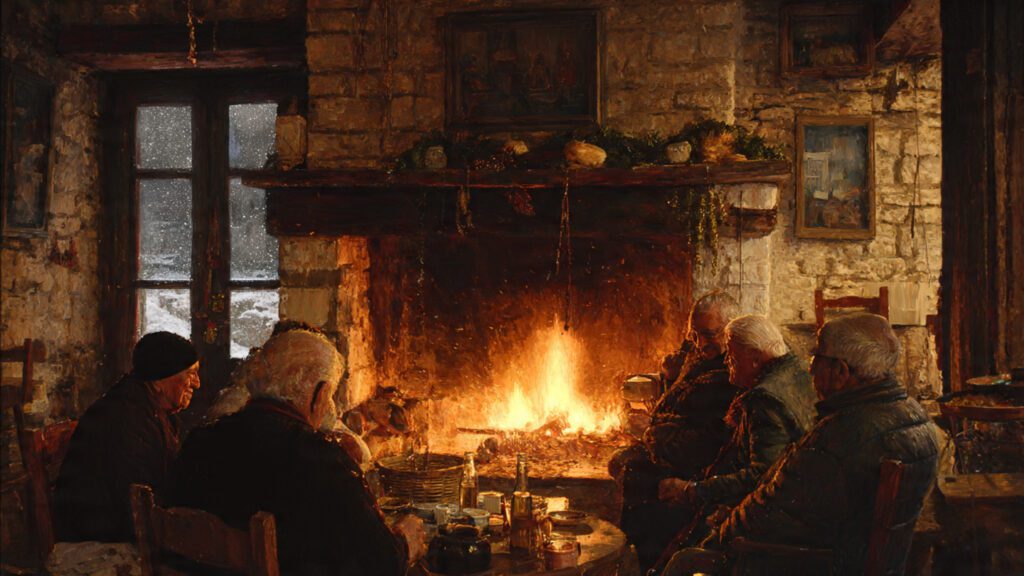
The fire at the center was the fire that organized the domestic space around itself. The meals were prepared at it. The rituals were conducted before it. The guests were welcomed in its light. The family gathered around it. The warmth that made the interior of the house different from the exterior was the warmth of the fire that Hestia embodied. Without the fire, the house was a structure. With the fire, the house was a home.
This is the theological content of Hestia’s domestic domain: not the management of household tasks but the presence that transforms the physical structure into the organized human space. The goddess who had no mythology was the goddess whose presence was the condition of the organized domestic world within which all human activity took place.
The Amphidromia and the Making of a Household Member
Five days after the birth of a child, the Athenian household performed the Amphidromia.
The ritual of the Amphidromia was the ritual of carrying the newborn around the hearth. The father or a designated family member took the child and walked in a circle around the fire at the center of the domestic space. The circuit completed, the child was set down within the organized space that the hearth defined.
Before the Amphidromia, the child existed but was not yet a member of the household. The child had been born into the physical space of the domestic interior but had not yet been formally incorporated into the organized social space that Hestia’s presence defined. The Amphidromia was the ritual whose performance constituted the incorporation: the carrying of the child around the fire was the act by which the child was placed within the orbit of the hearth’s authority and acknowledged as a being whose existence was now organized around the center that the household’s existence was organized around.

The child who had been carried around Hestia’s fire was the child who was now under Hestia’s protection. The protection was not the protection of the deity who intervenes in the crises of the individual life. It was the protection of the organized domestic space itself: the child was now inside the space that Hestia maintained, and the maintenance of that space was the form of the protection that Hestia provided.
This ritual is among the oldest surviving evidence of Hestia’s actual function in the Greek religious life: not the dramatic deity of the mythology but the presence acknowledged at the moments of household transition whose performance incorporated the new member into the organized domestic world.
The Colony Fire and the Civic Hestia
The domestic hearth was one expression of Hestia’s presence. The Prytaneion was the other.
Every Greek city maintained a Prytaneion, the civic hearth whose function was the function of the city’s central fire: the fire that was the city’s Hestia, the organized civic space’s center around which the city’s communal life was organized in the way that the domestic hearth organized the household’s communal life.
The Prytaneion was not simply a building. It was the location of the fire whose maintenance was the maintenance of the city’s organized civic existence. The officials who maintained the Prytaneion were the officials whose function was the function of tending the city’s Hestia. The rituals performed at the Prytaneion were the rituals whose performance acknowledged the city’s organized existence as an organized existence rather than as a collection of individuals sharing a territory.
When a Greek city sent out a colony, the colonists did not simply take their tools and their weapons and their agricultural knowledge and their social customs. They took fire from the Prytaneion of the mother city. The fire that had maintained the organized existence of the city whose colony they were becoming was the fire they carried across the sea to light the first fire of the new settlement.
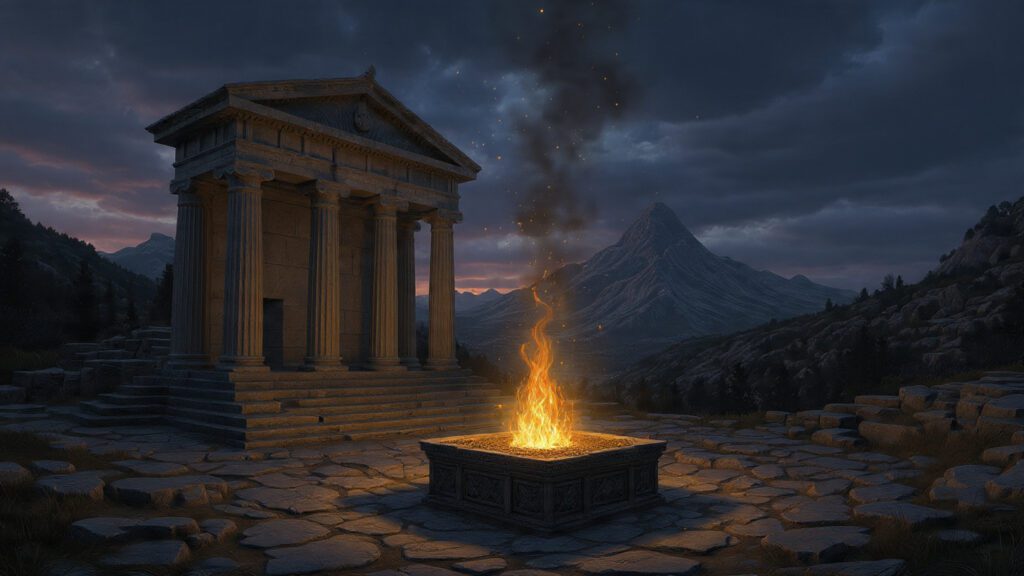
The colony fire was the material continuity between the mother city and the new foundation. It was the evidence that the organized civic existence of the mother city had been transmitted to the colony, not simply as a set of laws or customs or institutional forms but as the sacred fire whose presence was the condition of the organized civic existence that those laws and customs and institutional forms expressed.
Hestia was not simply the goddess of the home. She was the goddess of the organized human community at every scale at which organized human community existed: the household, the city, and the colony that carried the mother city’s fire across the sea to become a new organized human community in a new location.
What the Fire Actually Was
The Greek philosophical tradition, whose engagements with the question of what fire is give the concept of the sacred fire its deepest available philosophical content, understood fire as the most fundamental available expression of the organized world’s active principle.
Heraclitus, the philosopher of flux whose formulation of the relationship between permanence and change is the most concentrated surviving statement of the Ionian philosophical tradition’s engagement with the fundamental character of the world, identified fire as the material expression of the logos: the organizing principle whose presence in the world was the condition of the world’s being organized rather than chaotic.

The fire was not simply heat and light. The fire was the visible expression of the process by which the organized world maintained itself against the tendency toward disorder that the organized world was always working against. The fire consumed and transformed and produced light and heat and the organized activity of the flame whose movement was the movement of the ordered process rather than the random movement of the unorganized.
Hestia’s fire was the domestic and civic expression of this philosophical understanding. The fire at the center of the household was the fire whose presence was the condition of the household’s organized existence. The fire at the center of the city was the fire whose presence was the condition of the city’s organized existence. The fire that the colonists carried across the sea was the fire whose presence would be the condition of the new settlement’s organized existence.
The goddess who had no mythology was the goddess who was the material presence of the organizing principle that made all mythology possible.
The First and the Last
The privilege of the first and last offering is the most precise available summary of Hestia’s theological position in the organized Greek religious world.

Every sacrifice began with her acknowledgment. The fire was the instrument of the sacrifice: the organized space within which the sacrifice was performed was her domain, and the acknowledgment of her domain was the condition of the sacrifice’s ritual validity. The first portion of what was offered went to her as the acknowledgment of the condition of the offering’s possibility.
Every sacrifice ended with her acknowledgment. The ritual closed as it had opened, in the recognition that the organized space whose existence had made the ritual possible was still present, still maintained, still the condition of the organized religious activity that had just been performed.
The gods with mythologies received their portions in between. Zeus received the thigh bones wrapped in fat that the Homeric tradition specifies as the offering appropriate to the king of the gods. The other Olympians received their portions. Hestia received the first and the last.
The tradition never explained this privilege as a reward or as a concession or as a compensation for the things she had given up by taking the vow of virginity. It simply stated it as the appropriate acknowledgment of the character of her presence in the organized religious world: the condition of everything else received the acknowledgment that was appropriate to the condition of everything else.
She was present before the sacrifice began. She was present after the sacrifice ended. The sacrifice happened in the space between her first and last acknowledgment.

This is what it meant to be the goddess who had no mythology. It meant being the fire that was burning before the story started and that would still be burning after the story ended. It meant being the condition that every story required and that no story could contain.
The fire at the center. The first and the last. The organized space within which everything else was possible.
Hestia.
At Olympus Estate, Greek Living traces the domestic and daily traditions of the Hellenic world from the ancient household to the contemporary table. Hestia was swallowed first and released last, oldest and youngest simultaneously, the foundation and the completion. She refused Apollo and Poseidon and took the vow that preserved her from the structure that mythology traces. She was not within the structure. She was the condition of the structure’s existence. The Amphidromia carried the newborn around the hearth to make the child a member of the household. The colonists carried fire from the mother city’s Prytaneion across the sea to light the first fire of the new settlement. She received the first and last portion of every sacrifice because the ritual opened in her acknowledgment and closed in her acknowledgment. The gods with mythologies received their portions in between. She was the fire burning before the story started and still burning after the story ended. The condition that every story required and that no story could contain.