




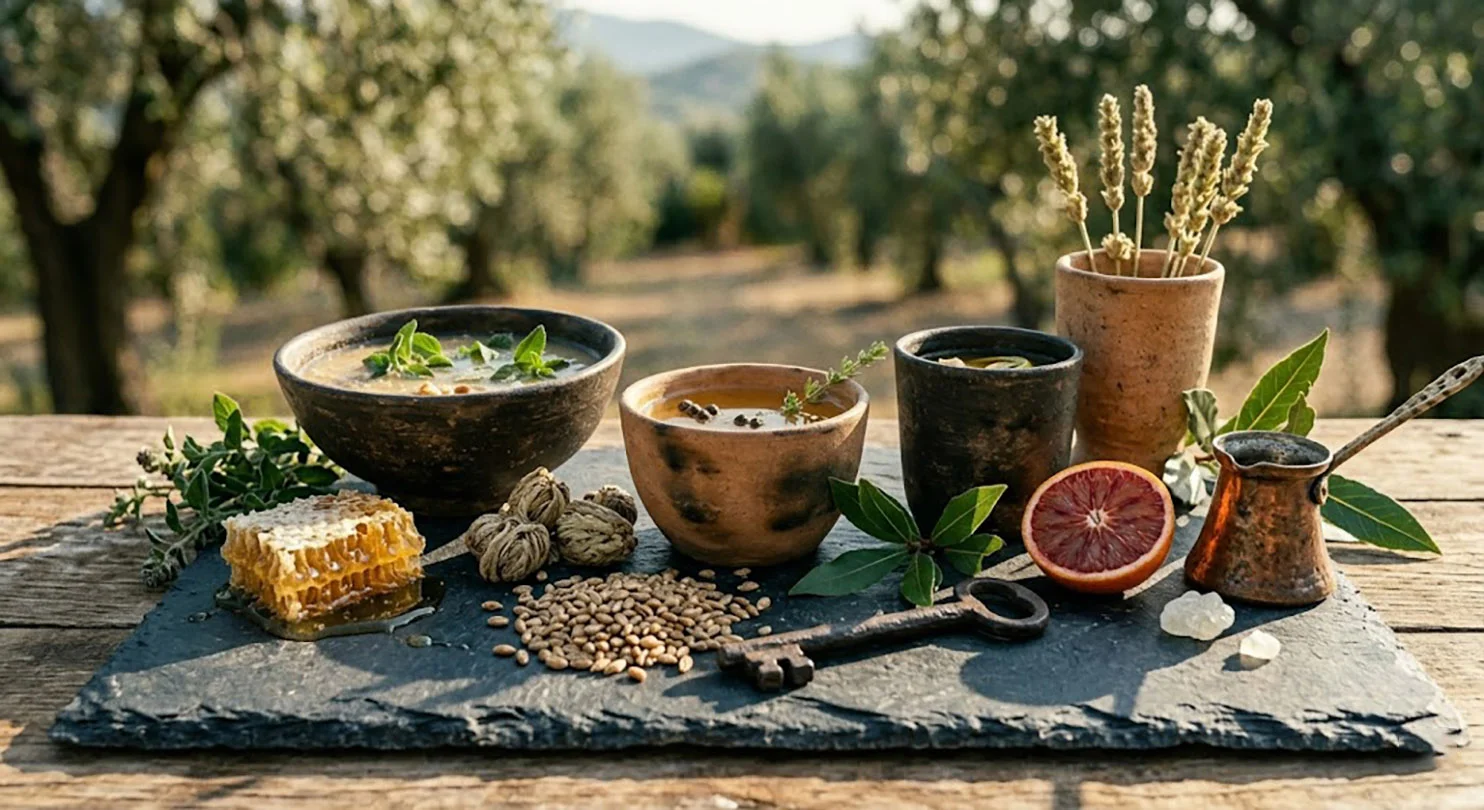
The Greek word for nectar, the drink of the immortals, means victory over death.
Ambrosia, what the gods ate, means immortality. The Olympians were served both by Hebe, the goddess of youth, whose name means the bloom of vitality, and later by the Trojan prince Ganymede after Hebe married Heracles. The divine table was presided over by figures whose names encoded what the food and drink they served were understood to do: sustain the condition of being imperishable.
These were not idle metaphors. The ancient Greek understanding of what you consume and what you become ran deeper than nutritional theory. Liquids moved between the practical and the theological with an ease that the modern separation between food and medicine and ritual cannot accommodate. A barley drink prepared with a herb, consumed at the right moment in a ceremony, was understood to produce in the drinker a transformation that the ceremony required. Wine diluted to a precise ratio and consumed in a structured social context was understood to produce the quality of thought and conversation that the institution of the symposium was built to generate. Mountain herbs steeped in water according to the season were understood to bring the drinker into alignment with the quality of that season’s energy.
To reconstruct these drinks today is not archaeology. It is the recovery of a philosophy of nourishment in which what you drink is part of how you think, how you feel, and what kind of person you are becoming.
Each of the ten preparations below is grounded in ancient sources, botanical reality, and the mythological context that gave it meaning. Where a recipe has survived with proportions, those proportions are given. Where the recipe must be reconstructed from partial evidence, that is stated honestly.
The Kykeon of Demeter | The Drink That Opened the Underworld
Of all the drinks in the ancient Greek tradition, the kykeon is the one that carried the greatest ritual weight and the most closely guarded preparation secret.
It was the sacramental drink of the Eleusinian Mysteries, the most significant religious institution in the ancient Greek world, whose initiates over nearly a thousand years included Socrates, Plato, Cicero, Marcus Aurelius, and Hadrian. The penalty for revealing what occurred inside the Telesterion, the initiation hall at Eleusis, was death. Almost no one revealed it. The kykeon’s precise contents remained partially secret for over two millennia.
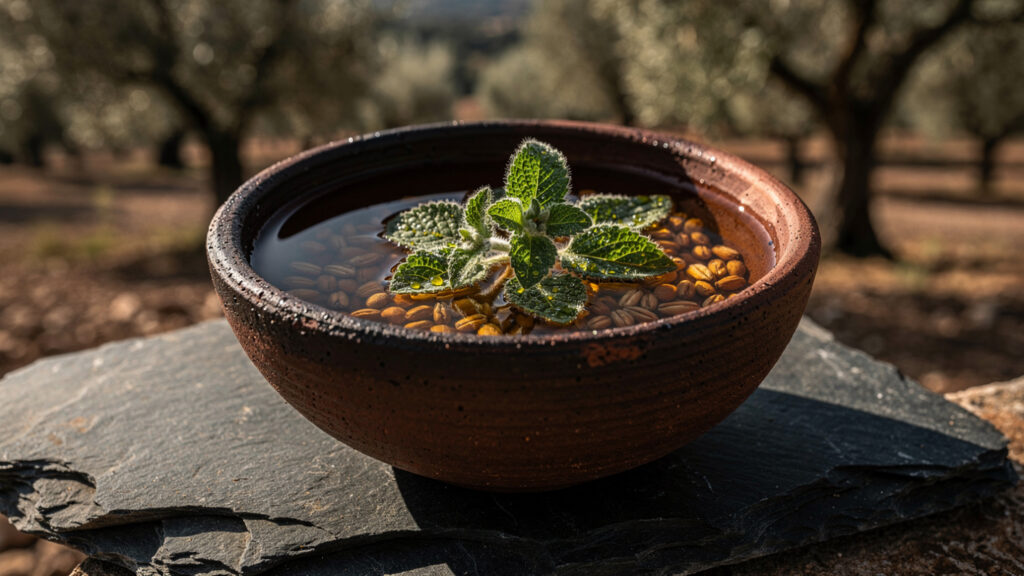
What survived in the ancient sources is the framework. The Homeric Hymn to Demeter, the foundational text of the Eleusinian myth, describes Demeter herself refusing wine when she breaks her grief-fast at Eleusis and asking instead for barley, water, and glechon: the ancient Greek name for pennyroyal, Mentha pulegium, a low-growing mint with a sharp, medicinal fragrance quite unlike sweet garden mint. The Homeric Hymn records her words precisely: she asked for barley and water to drink, mixed with tender leaves of glechon, and Metaneira made the potion and gave it to the goddess as she had asked, constituting the precedent for the Mystery.
This is the public recipe. The barley, the water, the pennyroyal. What the initiates suspected and what modern scholarship has investigated is the possibility of an additional ingredient that the public recipe did not mention.
In 2026, researchers published a study in Scientific Reports presenting experimental evidence that priestesses may have used ergot fungus to create psychedelic hallucinations, and the researchers investigated how ergot could be consumed without causing serious illness, since complications of ingesting the fungus include convulsions, gangrene, and respiratory failure. The ergot hypothesis, first proposed in 1978 by ethnobotanist R. Gordon Wasson, Albert Hofmann who synthesised LSD, and classicist Carl Ruck, proposed that the barley used in the kykeon was infected with Claviceps purpurea, an ergot fungus containing LSA, a precursor to LSD. The controlled preparation would have allowed the psychoactive properties while neutralising the toxic ones.
Whether the ergot hypothesis is correct remains genuinely unresolved. What is not disputed is that for nearly a thousand years, thousands of initiates described the Eleusinian experience as the most significant event of their lives, the encounter that removed the fear of death. Something in the kykeon, or in the full sensory context of the initiation, or in both simultaneously, produced this transformation reliably enough to sustain the institution for a millennium.
The contemporary preparation follows the Homeric Hymn’s public recipe, which produces a drink of genuine character regardless of what the full Eleusinian version contained.
Roast two tablespoons of pearl barley in a dry pan over medium heat until it colours golden and smells nutty. Simmer in 600ml of water for twenty minutes, then allow to cool to warm. Steep a generous handful of fresh pennyroyal in the warm liquid for ten minutes. Strain and drink slowly, ideally while fasting or at the transition between afternoon and evening. If pennyroyal is unavailable, spearmint is the documented substitute, though it produces a gentler result. The drink has an earthy, slightly bitter quality with a clean herbal brightness at the end. It is not wine. It asks to be received with attention rather than pleasure.
Hydromel | The Drink That Preceded Wine
Before Dionysus arrived with the vine, the sacred drink of the Greek world was fermented honey and water.
Hydromeli preceded wine in Greece for a long time, and the Orphists describe Zeus becoming drunk on honey of wild bees before castrating his father Kronos. The myth places hydromeli at the founding violence of the cosmos, the moment when the new divine order displaced the old one, which suggests the drink’s antiquity: it was the liquid associated with the primordial events before the Olympian dispensation established its own institutions.
In Greek mythology, bees were supposed to be the messengers of the gods and honey to be a source of wisdom and poetry. The nectar the gods consumed was honey, and ambrosia was honey wine. Hebe and Ganymede served the Olympians with ambrosia and nectar, and the first beekeeper in the mythological tradition was Aristaeus, son of Apollo and the nymph Kyrene, who received immortality as a child when the Muses and Nymphs fed him nectar and ambrosia.
The physician Dioscorides, writing in the first century CE, gave instructions for hydromel that can be followed today: three parts water to one part good honey, simmered briefly to remove the foam, then left to ferment for at least forty days. The Geoponika, a Byzantine agricultural compendium preserving much earlier material, specifies that oenomel, the version incorporating grape must, should be set in the sun at the rising of the dog-star for forty days, and adds: some call this nectar.
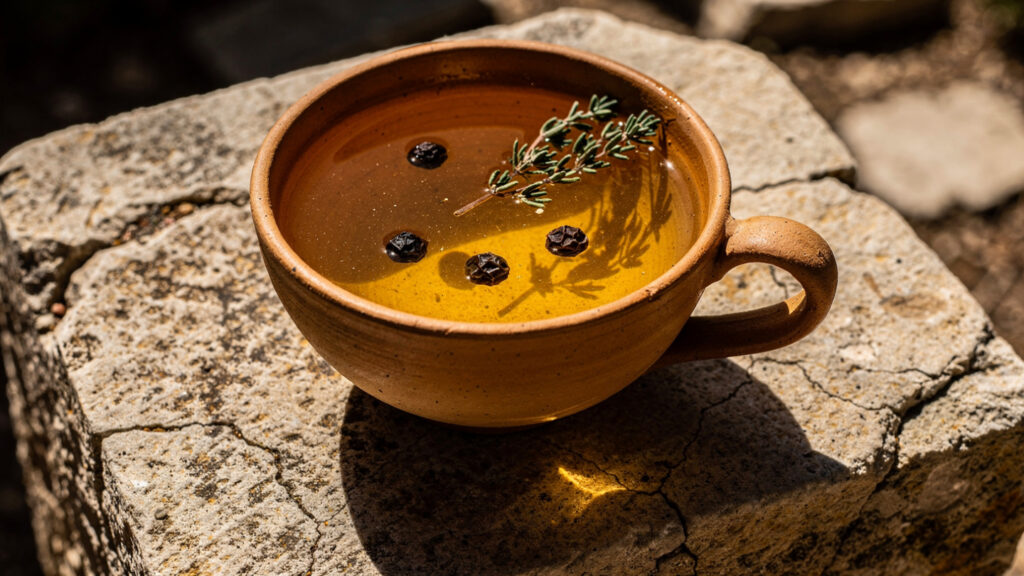
The simple contemporary preparation requires no fermentation. Dissolve two tablespoons of raw thyme honey, the best available, the kind from hives placed in the mountains of the Peloponnese or the hillsides above Kalamata, in 300ml of warm water at approximately 40 degrees Celsius. No hotter, because heat above this temperature destroys the enzymatic content that gives raw honey its character. Add four black peppercorns and a small sprig of fresh thyme. Let it steep for five minutes. Drink warm.
This is the version closest to what Demeter’s Hymn calls melikraton, the milk and honey mixture the Odyssey describes as a refined beverage. The peppercorn is historically attested in ancient Greek symposium preparations and provides the mild heat that lifts the sweetness into something more complex.
Oxymel | Hippocrates’s Prescription
Oxymel is the drink that Hippocrates prescribed most frequently, and its preparation survives in his texts with the specificity of a doctor rather than a poet.
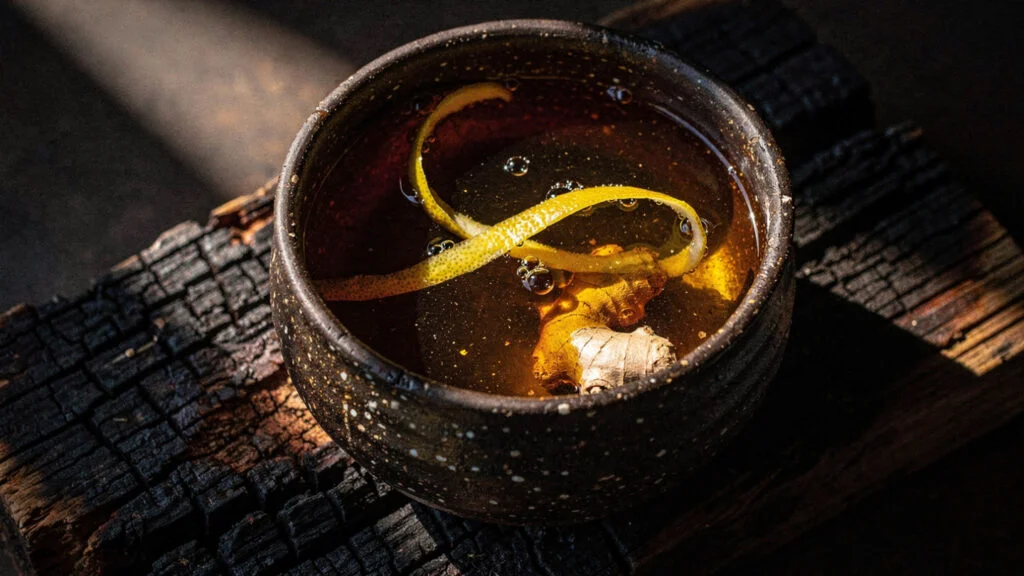
The name combines oxys, sharp or acid, and meli, honey. The preparation is honey dissolved in vinegar and water, the ratio varying according to the condition being treated. For acute fevers and respiratory conditions, Hippocrates specified a thinner version, more water, less honey, drunk warm. For convalescence and strength-building, a thicker version with higher honey content. For purging and cleansing the system before other treatments, a sharper version with a higher vinegar ratio.
This was not kitchen medicine. Hippocrates understood the properties of each component: the honey’s antibacterial and wound-healing properties, the vinegar’s role in digestion and its capacity to cut through mucus, the water’s diluting effect that made the combination tolerable and adjustable. The variations he prescribed were targeted interventions, and the Hippocratic corpus records their application to conditions with a clinical precision that modern ethnobotanical research has largely confirmed.
Oxymel passed from Hippocrates through Dioscorides into the Arabic medical tradition through Ibn Sina’s Canon of Medicine, from there into medieval European pharmacy, and from medieval pharmacy into the contemporary tradition of herbal medicine where it persists as a preparation method that herbalists still use and teach. It is one of the longest continuous pharmaceutical preparations in Western medicine.
The contemporary preparation: Warm 200ml of water with two tablespoons of raw apple cider vinegar, preserving the mother culture. Add one tablespoon of thyme or pine honey and stir until dissolved. Optionally add a small piece of fresh ginger and a strip of lemon peel. Drink warm in the morning before eating. The taste is sharp and sweet simultaneously, the kind of drink that the body recognises as medicine before the mind has finished analysing it.
Mountain Tea Infusion | Sideritis and the Altitude
The genus Sideritis, the mountain teas of Greece, includes approximately sixty species adapted to the geology and altitude of the Greek highland terrain. Each producing region’s plants carry the mineral and aromatic character of their environment so precisely that an experienced drinker can distinguish tea from Mount Olympus from tea from the Taygetos above Sparta from tea from the White Mountains of Crete.
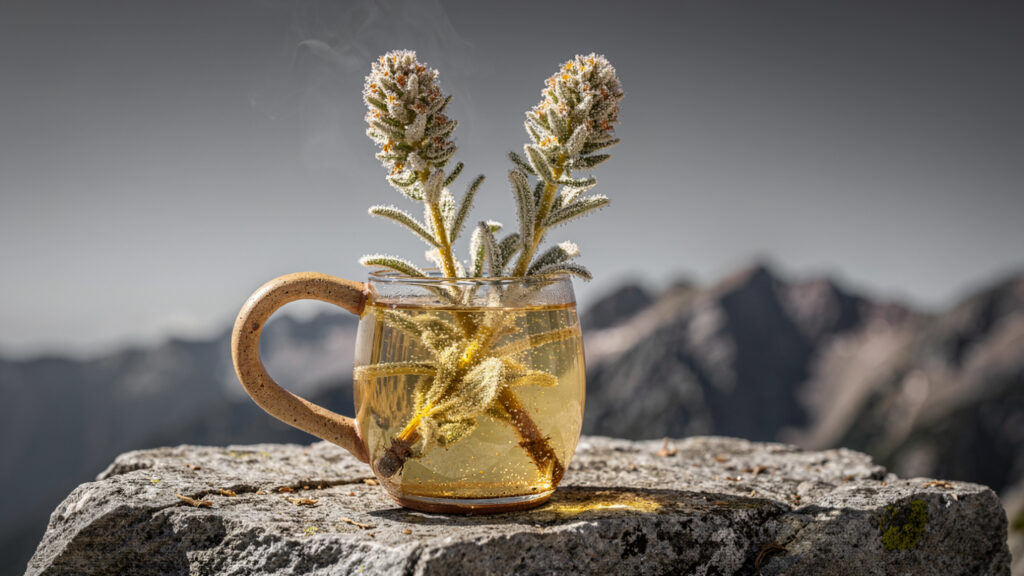
The name Sideritis derives from sideros, iron, either because the plant was believed to heal iron-weapon wounds, being found near ancient battlefields, or because the stems have a metallic, mineral quality that the dried plant’s fragrance carries. Dioscorides listed it in his Materia Medica as a wound-healing herb of the first order. It was gathered from the rocky elevations where the soil is thin and the plant is forced to concentrate its chemical resources to survive conditions that gentler terrain would not impose.
The mountain tea belongs to Hebe, the goddess whose name means the vigorous bloom of youth and who served the Olympians their immortality-sustaining drinks. This association is not arbitrary. Mountain tea harvested at peak flowering, steeped properly, produces a preparation of unusual vitality that is difficult to describe as merely relaxing: it is restorative in a more active sense, a drink that seems to return something rather than simply withdrawing tension.
The preparation: Use whole dried flowering tops, not broken or powdered, from a named mountain source. Bring 500ml of water to a boil and remove from heat immediately. Add two generous sprigs of dried sideritis, approximately four grams. Cover and steep for eight to ten minutes, no longer. The colour should be a pale gold. Strain and add a small spoon of raw thyme honey if desired. Drink in the morning or in the transitional hours of afternoon.
The single most important variable is the quality of the plant material. Mountain tea bought in tourist shops in sealed plastic bags has usually lost the volatile aromatic compounds that give the fresh-dried plant its character. Seek out a supplier whose source and harvest date you can identify.
The Rhodomel of Aphrodite | Rose and Honey
Roses were sacred to Aphrodite, and their presence in the mythology is not the sentimentality of a later tradition but the record of a botanical relationship between the goddess and a plant whose fragrance was understood in the ancient world to belong to the domain of Eros and desire.
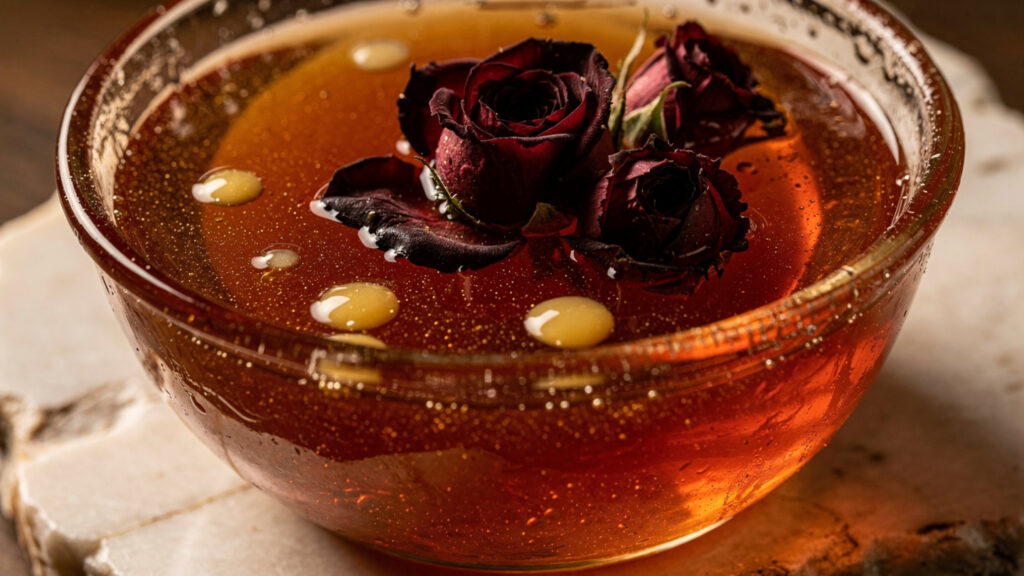
Rhodomel, rose honey, was prepared by macerating fresh rose petals in honey and then dissolving the infused honey in water or wine. The ancient Greek honey drink tradition included rhodomel, a mixture of roses and honey, alongside hydromel, oxymel, and oenomel. The resulting preparation carries the fragrance of rose in a form that is both more durable and more complex than rosewater: the honey preserves and concentrates the aromatic compounds in a way that water cannot.
Aphrodite’s domain was not simply physical attraction. The archaic tradition understood her as the force governing the generative principle in all things: the attraction between elements that produces combination and reproduction at every scale from the cellular to the cosmic. Rhodomel in this context is not a romantic gesture. It is a preparation whose fragrance engages the olfactory system at the level where the limbic brain processes memory and desire simultaneously, the level where Eros operated in the Platonic understanding.
The preparation: Pack a clean glass jar with fresh rose petals, preferably from unsprayed Damask or Rosa gallica varieties, the old roses whose fragrance is dense rather than bright. Cover completely with raw honey and seal. Leave for at minimum two weeks in a cool dark place, turning the jar daily. The honey will liquefy as it absorbs the rose’s moisture and fragrance. Dissolve two teaspoons of this rose honey in 250ml of warm water. Add a few drops of fresh lemon juice to sharpen the sweetness. The drink should smell of rose before it reaches the lips.
The Symposium Wine | Krater and Measure
The wine of the Greek symposium was not drunk undiluted, and the person who suggested drinking undiluted wine was considered both a barbarian and a danger to the evening’s intellectual purposes.
The standard ratio of dilution in the symposium was three parts water to two parts wine, though the Symposiarch, the master of ceremonies appointed at the beginning of each gathering, could vary this according to the occasion and the desired quality of the conversation. A ratio of five parts water to two parts wine was used for longer evenings with more philosophical intent. Two parts water to one part wine was the stronger preparation for occasions of celebration. Undiluted wine was associated with Scythian excess and the madness that the Greeks understood as the dark face of Dionysus rather than his gift.
The wine itself was frequently resinous. Pine resin had been used as a preservative in wine storage since Minoan times, when the clay storage jars were sealed with resinous compounds that inevitably flavoured the wine inside. Retsina, still produced today primarily in Attica from Savatiano grapes sealed with Aleppo pine resin, is the continuous descendant of this tradition.
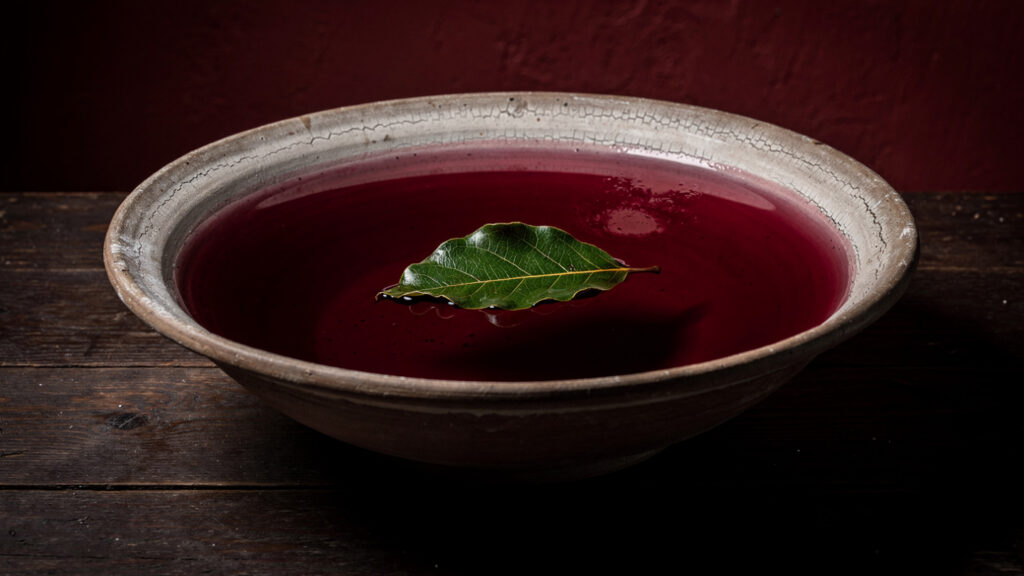
The contemporary symposium preparation: Use a full-bodied Greek red from a region whose winemaking history precedes modern viticulture: Nemea’s Agiorgitiko grape, or the Xinomavro of Naoussa, or the Mandilaria of the Aegean islands. Dilute three parts water to two parts wine in a ceramic or glass vessel. Add a single fresh bay leaf and allow it to rest for ten minutes before drinking. The bay was Apollo’s plant, worn as a crown by victors and prophets alike, and its aromatic oils release slowly into the diluted wine in a way that serves the drink’s intellectual purposes.
Drink slowly. The symposium was not a race.
The Circe Cup | Melikraton with Herbs
In the tenth book of the Odyssey, Circe prepares a drink for Odysseus’s men that contains honey, wine, barley, and cheese, along with a herb that she alone knew. She stirs it with her wand. They drink and are transformed into pigs.
The Circe cup is the Greek pharmacological tradition’s most explicit statement about what herbal preparation can do: it can transform the person who drinks it. The transformation in the myth is literal and grotesque, which is the myth’s way of expressing something that the pharmacological tradition knew empirically: that certain plant preparations alter consciousness and identity in ways that feel, from the inside, like becoming something other than oneself.
The same food Circe used was cheese, honey, and wine, the same with which the goddess Aphrodite fed the orphan daughters of Pindar, and the melikraton of the Odyssey was described as a refined beverage made of milk and honey.
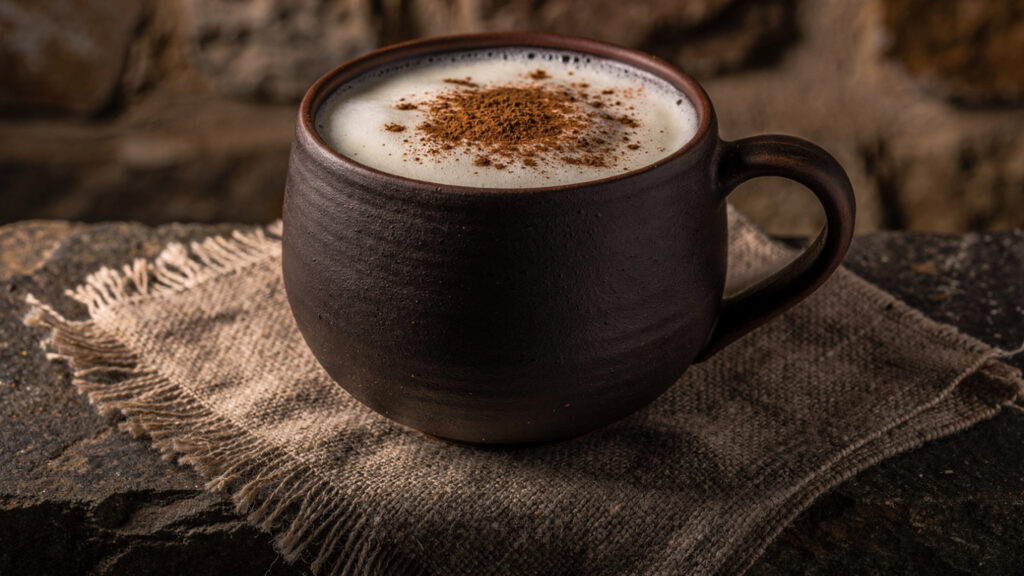
The contemporary melikraton, stripped of Circe’s herb, is a preparation of considerable warmth and comfort.
The preparation: Warm 250ml of full-fat sheep’s milk to just below simmering. Add one generous tablespoon of raw Cretan thyme honey and stir until dissolved. Add a pinch of ground cinnamon and a small amount of ground nutmeg. Optionally add a splash of sweet wine such as Muscat of Samos. Drink warm, in the early evening, before rather than after a meal. The drink is substantial without being heavy, nourishing without requiring digestion’s full attention.
The Apollo Preparation | Saffron and Blood Orange
Saffron, krokos in ancient Greek, was among the most expensive plant materials in the ancient Mediterranean and was understood to belong to the solar, Apollonian register of Greek botanical knowledge: it grows toward light, its colour is the colour of the sun at the moment of full intensity, and its chemical compounds produce, in small doses, a documented effect on mood that the ancient world understood as brightening.
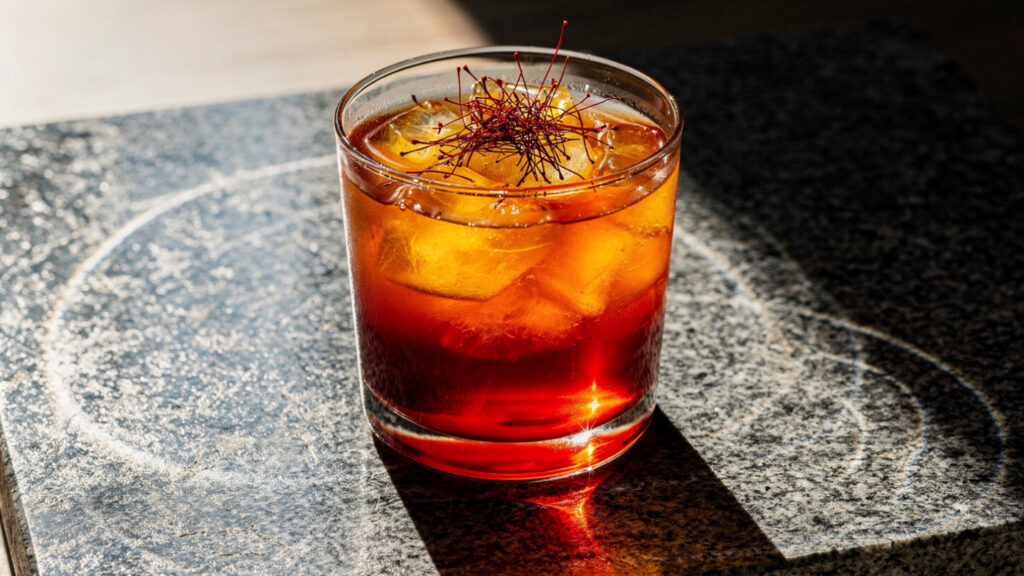
Blood orange arrived in Mediterranean cultivation later than saffron’s ancient use, but the combination of saffron’s warmth and the citrus’s sharp brightness produces a preparation that earns its Apollonian attribution: it is clarifying, slightly astringent, luminous in flavour.
The preparation: Steep twelve to fifteen saffron threads in a tablespoon of warm water for fifteen minutes. The water will turn a deep amber orange and the fragrance will open into the characteristic medicinal-floral quality that distinguishes genuine saffron from substitutes. Juice two blood oranges. Combine the saffron water, the blood orange juice, 200ml of cold still water, and a teaspoon of honey. Do not heat. This is a cold drink, a morning drink, the drink that belongs to the first clear light rather than the warmth of the afternoon.
The colour of the finished preparation is extraordinary: deep red from the blood orange shifting toward amber where the saffron dominates, a visual argument for the drink’s mythology.
The Hestia Preparation | Smoked Apple and Dark Honey
The hearth is the oldest sacred site in the Greek domestic tradition. Before the temples, before the altars, before the portable gods of the Olympian pantheon, there was the fire at the centre of the house around which the family gathered, from which all hospitality was extended, to which all returns were acknowledged.
Hestia had no mythology because she was the condition that made mythology possible: she was the stable centre around which the divine stories circulated. She had no consort, no adventures, no transformations. She was continuous, present, warm.
A drink for Hestia is a drink for the fire-hour, the hour when the light outside has changed and the domestic interior has become the primary world.
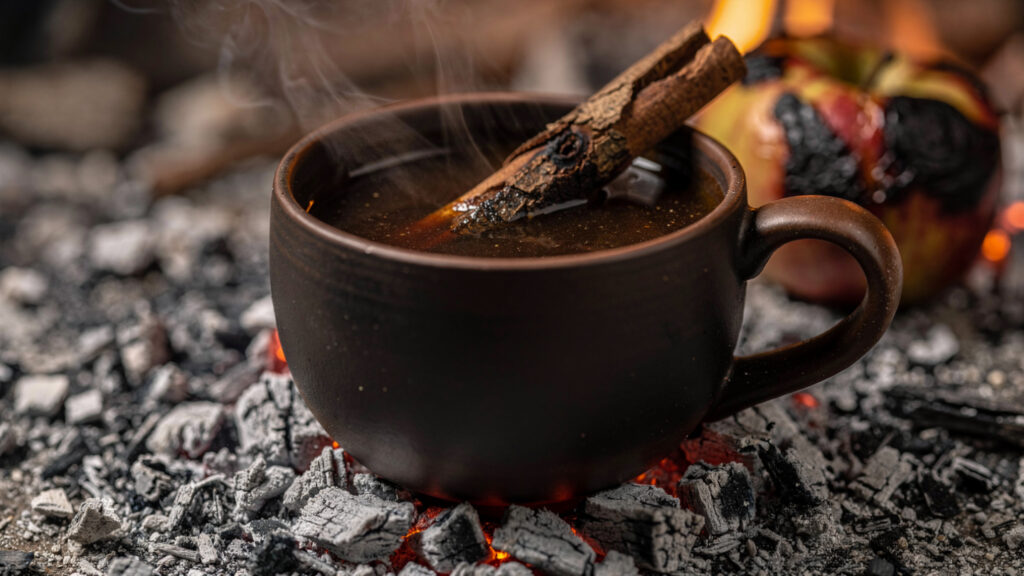
The preparation: Core two sweet apples and roast them directly over an open gas flame, or under a very hot grill, turning until the skin blackens and blisters and the flesh begins to soften. The smoke that enters the apple flesh during this process is the fresh element that distinguishes this preparation from any other apple drink. Press the roasted apple flesh through a fine sieve. Combine the resulting juice with 300ml of hot water, one tablespoon of dark forest honey or chestnut honey with its bitter depth, and a single cinnamon stick. Steep for five minutes. The drink should smell of wood smoke and autumn fruit and something older than either.
Drink beside a fire if available. If not available, the drink will suggest one.
The Hermes Preparation | Mastic Coffee
Hermes required speed, clarity, and the capacity to move between worlds without being detained in either.
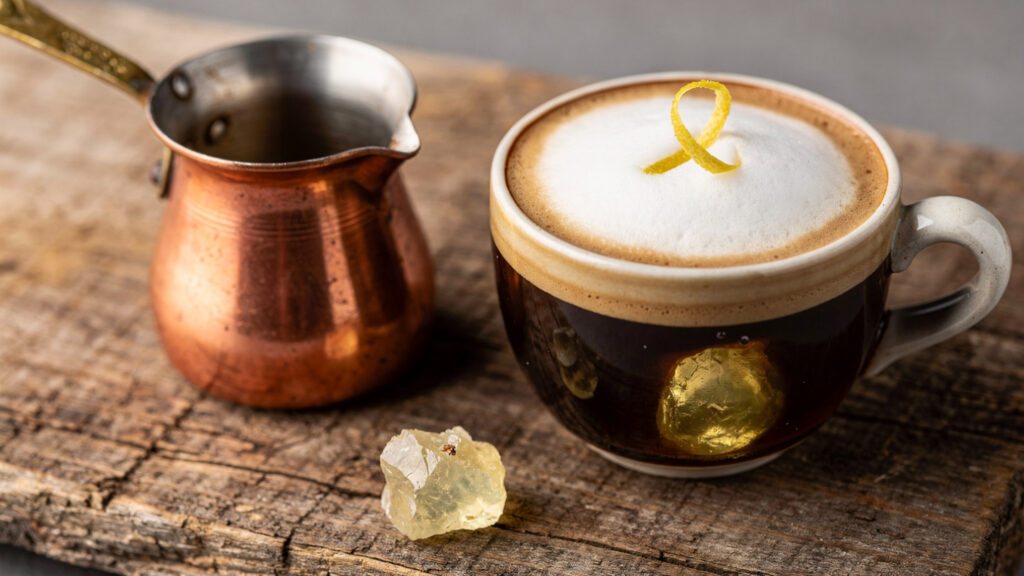
Greek coffee, prepared in a copper briki over direct heat until it rises and is poured grounds and all into the small cup it will be consumed from, is already a preparation of considerable philosophical complexity: it requires patience in the preparation, attention at the moment of pouring, and the willingness to wait for the grounds to settle before drinking begins. It is not a fast drink, which is the paradox appropriate to the messenger god: what looks like urgency contains, inside it, the requirement for stillness.
Mastic from Chios, whose biochemical profile we have examined at length elsewhere on this site, adds to the coffee a resinous brightness unlike any other addition to the Greek table. The combination of the coffee’s bitterness and the mastic’s clean botanical clarity produces a drink of unusual precision: it is simultaneously grounding and alerting, anchored in the earth where the mastic tree bleeds its resin and lifted by the coffee’s effect on the nervous system.
The preparation: Prepare a single Greek coffee in the traditional manner, one heaped teaspoon of finely ground coffee to a single measure of cold water in the briki, sugar to taste, brought slowly to the point of rising and poured immediately. Into the cup before pouring, place a single small crystal of Chios mastic, approximately the size of a small pea. The heat of the coffee will soften but not dissolve the mastic, which can be chewed briefly at the end of the cup. Add a thin strip of lemon zest twisted over the surface.
Drink standing if the occasion calls for it. Drink seated if the conversation does.
A Note on Botanical Sourcing
Every preparation above depends on the quality of its ingredients, and quality in this context means origin rather than general category.
Greek mountain tea purchased from a named mountain with a known harvest date is a different substance from Greek mountain tea purchased in a generic sealed packet. Raw thyme honey from a Peloponnesian hillside carries different aromatic compounds from commercial honey that has been heated to prevent crystallisation. Saffron whose provenance is certain behaves differently from saffron that has been adulterated, which a significant proportion of commercially available saffron has.
The ancient Greek relationship to botanical ingredients was precise for this reason. Theophrastus, whose botanical work at Lesbos alongside Aristotle founded the science of botany, understood that the same plant species grown in different soils and at different altitudes produced materially different substances. His Enquiry into Plants documents this not as a curiosity but as the foundational observation of his field: place is constitutive of the plant.
When you source the ingredient for these preparations, source it the way Theophrastus would have wanted you to: with attention to where it came from and when it was harvested. The drink that results will carry that information inside it, the way that the landscape carries the history of what happened on it, in a form that the body reads before the mind has thought to ask.
At Olympus Estate, Greek Living explores the soul of Hellenic culture through the ingredients, rituals, and living traditions that have endured from antiquity to the present. These drinks are not recreations. They are continuations.