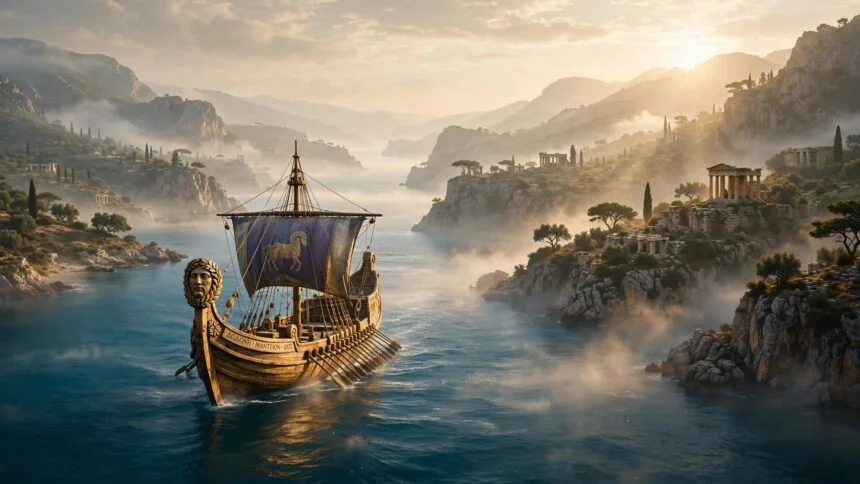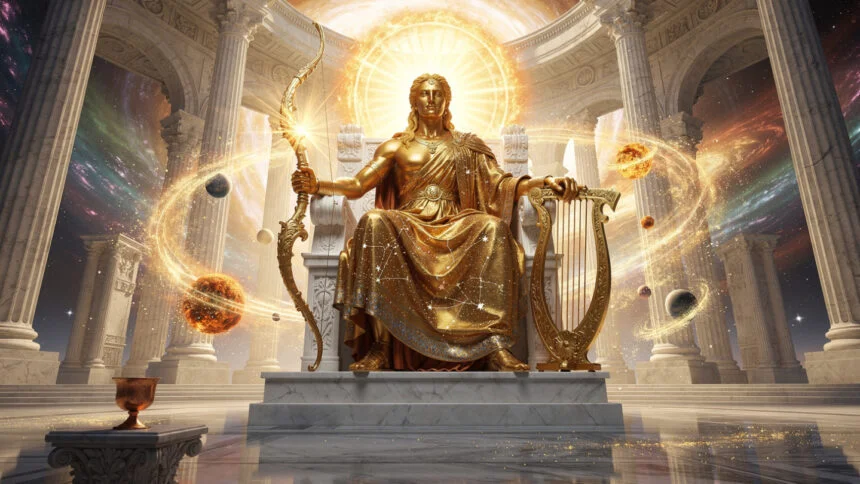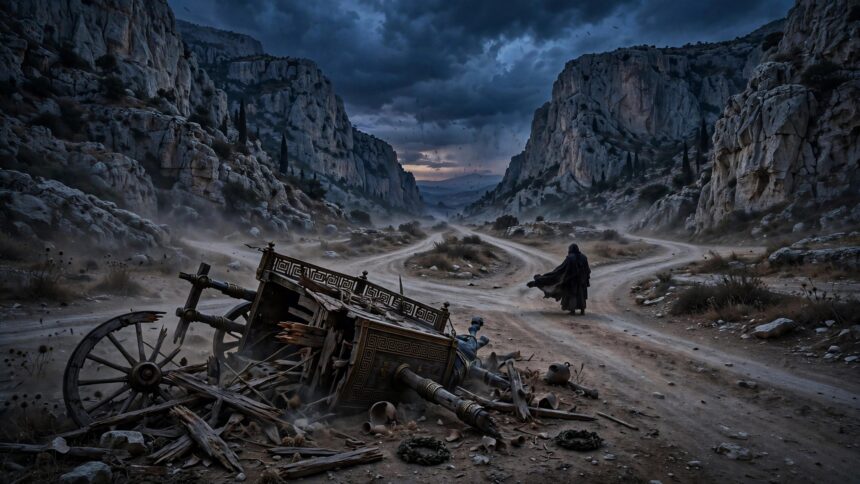




The most beautiful things in the Greek mythological world were made by the ugliest god.
This is not a coincidence the Greeks stumbled into. It is a deliberate observation about creativity, about what it costs, about where the impulse to make something extraordinary comes from and what it requires of the person who acts on it.
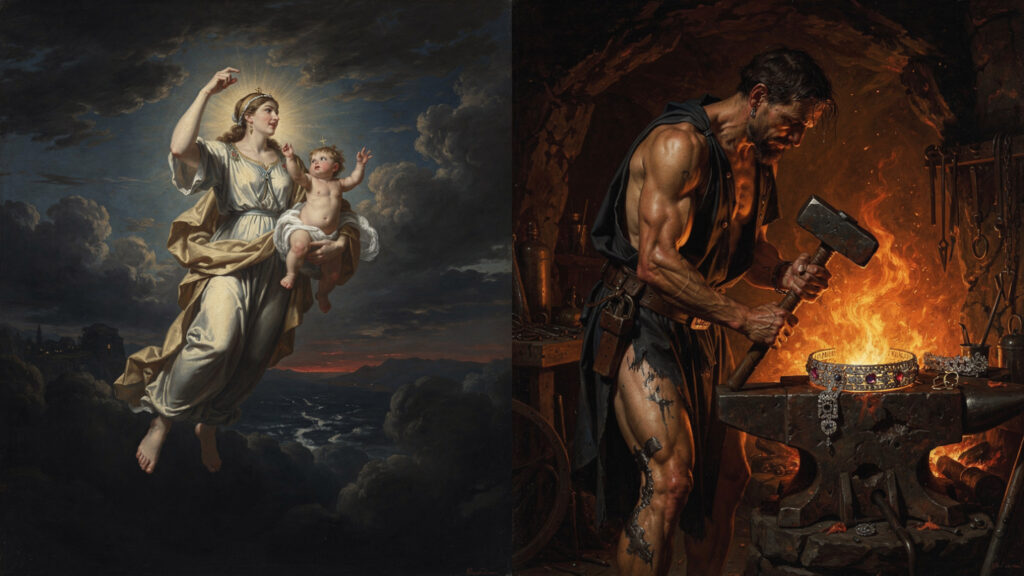
Hephaestus was thrown from Olympus. Depending on which version of the myth you trust, either Hera hurled the infant from the heights of heaven because he was born lame and she was ashamed of him, or Zeus threw him during a domestic argument when the young god tried to intervene on his mother’s behalf and was launched into the sky with the force of a father who has lost his patience. Some versions offer both: thrown once as an infant, thrown again as an adult, two separate acts of rejection from the two people who were supposed to protect him.
He fell for a full day, the sources say. He landed on the island of Lemnos, broken and alone, and was taken in by the people there.
Then he went to work.
The armour he made for Achilles was so detailed, so completely articulated as a vision of the entire human world, that Homer’s description of it in the Iliad occupies well over a hundred lines of one of the greatest poems ever written. The golden automata he built to assist in his forge, mechanical women with intelligence and speech, anticipated by three thousand years the intellectual frameworks that the twenty-first century uses to think about artificial intelligence. The net he wove to catch Aphrodite and Ares together was so fine it was invisible and so strong it held two Olympian gods immobile. The throne of Hephaestus on Olympus was considered the finest object in the divine court.
A god who was thrown away twice, who limped through the divine world carrying the visible evidence of his rejection in his body, made the most significant objects in the mythological universe.
The Greeks were not being ironic. They were being precise.
What Rejection Made
There is a version of the Hephaestus story that reads his productivity as compensation: he made beautiful things because he had nothing else, because the social world of Olympus was closed to him and the forge was what remained. This reading is not wrong, but it is incomplete, because it treats the forge as a consolation prize rather than as the thing he chose.
Consider what Hephaestus had.
He had technical knowledge that no other being in the Greek cosmos possessed. The gods needed him in a way they did not need each other: Zeus could generate lightning without assistance, Poseidon could move the sea without tools, Apollo could drive the sun without a craftsman’s intervention. But the divine court’s physical world, the thrones, the armour, the weapons, the palaces, the objects that made the Olympians recognisable as the Olympians, required Hephaestus’s hands. Without him, the gods were powerful but unadorned. He was the one who gave their power a material form.
This is an unusual kind of indispensability. It is not the indispensability of force or authority. It is the indispensability of the person who makes the things that force and authority need in order to be expressed. Hephaestus could not command armies. He could make the sword that the commander carried, and the armour that made the commander worth following, and the shield that told the story of the entire world the commander was fighting for.
He understood this. And he used it.
The golden throne he sent to Hera, the mother who had thrown him from Olympus in his infancy, was the most elegant act of revenge in Greek mythology. It was beautiful. It was exactly the kind of gift a loving son would make for a mother he wanted to honour. Hera sat in it with the pleasure of someone receiving something genuinely extraordinary.
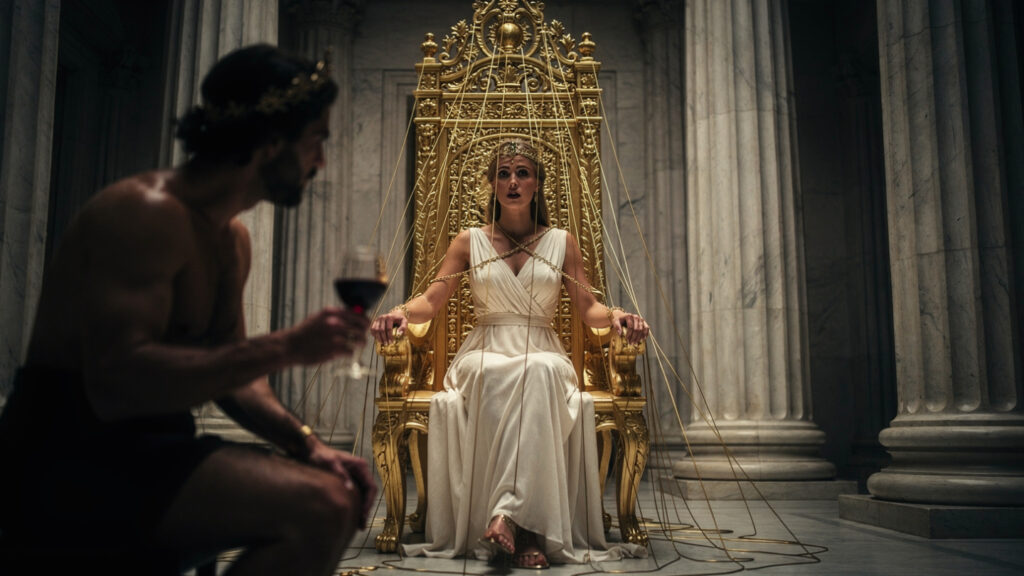
And then she could not stand up.
The throne held her fast by invisible mechanisms that only the maker understood. No god on Olympus could free her. No combination of divine strength or divine intelligence could undo what Hephaestus had done. The craftsman’s knowledge was, in this moment, more powerful than anything Zeus could do with lightning or Ares could do with a sword. Hera sat captive in her own gift until Dionysus got Hephaestus drunk enough to return to Olympus and release her, an episode the ancient vase painters found irresistible and returned to repeatedly.
The throne was not a threat. It was a demonstration. It said: you threw me away, and I am the one person in all of existence whose knowledge you cannot replace, and I know things about making objects that you cannot undo. The limp is real. So is the forge. And the forge is more powerful than the limp.
The Shield That Described the World
In Book Eighteen of the Iliad, Achilles’ armour has been lost. Patroclus borrowed it and died in it, and Hector stripped it from his body. Achilles cannot fight without armour. His mother Thetis, the sea nymph who bore him knowing she was giving birth to a mortal and grieving for him before he was old enough to grieve for himself, goes to Hephaestus and asks him to make new armour for her son.
What follows is one of the most sustained and extraordinary passages in the Western literary tradition.
Homer describes Hephaestus making the shield over more than a hundred lines, and what he describes is not a piece of military equipment. It is a map of the human world. The shield contains two cities. One is at peace, with weddings and legal disputes and the ordinary social fabric of a community going about its life. One is at war, besieged and desperate and defended by citizens who have not given up. It contains the agricultural year: ploughing, harvest, the vintage, sheep grazing on hillsides. It contains a dancing floor where young men and women move in figures that recall the labyrinth of Crete. It contains the ocean running around the rim of everything, because the ocean runs around the rim of everything.
The shield is a representation of the totality of human experience, made by the god who was marginalised by the most powerful society in the Greek cosmos, and given to the greatest warrior in the Greek literary tradition, who will carry it into the battle that ends his life.
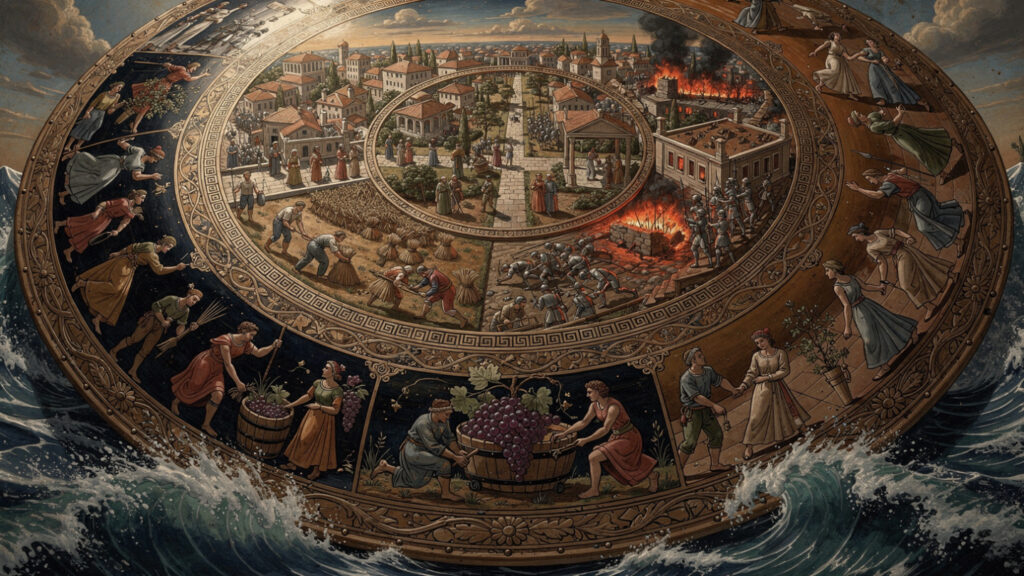
Think about what Hephaestus put on that shield.
He put peace alongside war, because a shield that showed only war would be a lie about what war costs. He put the harvest alongside the siege, because the person who fights needs to understand what they are fighting to protect and what their fighting destroys. He put the dancing floor at the centre of the human world because joy is not incidental to human life but structural: its presence is what makes the losses matter.
He did not make a weapon. He made an argument about what a human life contains.
Scholars have been writing about the Shield of Achilles for two and a half thousand years. W. H. Auden wrote a poem about it in 1952 that is one of the great poems of the twentieth century: a meditation on what Thetis expected to see when she looked over Hephaestus’s shoulder and what she actually found. The shield keeps generating meaning because it is not a description of the ancient world. It is a description of any world in which beauty and violence occupy the same space and the same moment, which is every world humans have ever inhabited.
The lame god, working through the night at his forge, made something that has outlasted every physical object from the ancient Greek world. The armour is gone. The poem describing it is still here, and the poem describing it is inexhaustible.
The Golden Women and What They Knew
Here is the detail in the Iliad that stops modern readers in their tracks and does not let them go.
When Hephaestus rises from his workshop to meet Thetis, Homer describes his forge assistants: golden maidens who look like living women, who have understanding and speech and strength, who have learned their craft from the immortal gods. They support him as he walks, compensating for his lameness, moving with the intelligence of beings who understand what they are doing rather than the mechanical obedience of tools.
These are automata. Artificial beings constructed with gold, with intelligence, with the capacity for speech and craft learning. They are three thousand years old and they anticipate, with more precision than most contemporary science fiction manages, the conceptual questions that artificial intelligence raises today: what does it mean for something made by human hands to have intelligence? What is the boundary between a tool and a person? What responsibilities does a creator have toward what they create?
Hephaestus also made Talos, the bronze giant who patrolled the coast of Crete three times daily, throwing rocks at ships that attempted to land without permission. He made the golden hound that guarded the infant Zeus on Crete. He made the bronze nets that caught Ares and Aphrodite. He made the chains that held Prometheus to the rock where the eagle came each day. He made Pandora, at Zeus’s instruction, the first woman, animating clay with the breath of life and the attributes that each god contributed.
The divine craftsman made beings with life. This is not smithing in any ordinary sense. This is creation at the level of the divine act: the bringing into existence of things that had not existed before, that had agency and purpose and consequence in the world.
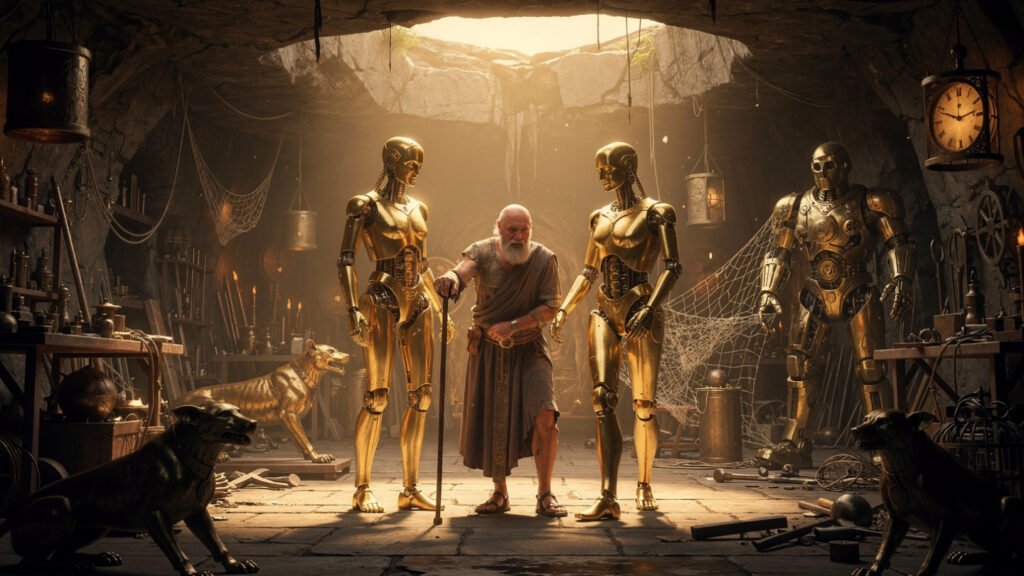
Every major creation narrative in the Greek mythological tradition passes through Hephaestus’s forge. The weapons that decided wars. The armour that made heroes possible. The chains that bound divine punishment. The automata that anticipated everything the twenty-first century finds most urgent about the relationship between makers and their creations.
The god who was thrown away made the world’s most significant things. The rejection is not incidental to this. It is the condition of it.
Aphrodite, Ares, and the Net
The marriage of Hephaestus to Aphrodite is one of the Greek tradition’s most deliberately constructed contrasts: the ugliest god and the most beautiful goddess, the limping craftsman and the radiant force of desire, the maker and the thing that makes making seem inadequate.
The ancient sources are not entirely consistent on whether the marriage was Hephaestus’s reward for releasing Hera from the golden throne or a separate arrangement, but they are consistent on its outcome: Aphrodite preferred Ares, the god of war, beautiful and violent and careless in the way that gods of war tend to be, and the affair was conducted with a transparency that insulted the craftsman who had been given the goddess as though she were a prize.
Hephaestus’s response was not a confrontation. It was a construction.
He made a net of bronze so fine it was invisible, so strong it was unbreakable, and he set it around the bed where Aphrodite and Ares met. When they lay down together, the net closed around them. He then invited all the gods of Olympus to come and look.
What the gods found when they arrived was not simply an adulterous couple caught in the act. What they found was the craftsman’s knowledge holding the god of war immobile. Ares, who had never in his divine existence been physically constrained by anything, lay trapped in a net he could not see and could not break, made by the god he had dismissed as irrelevant to the business of war and desire and the Olympian social world.
The gods laughed, Homer tells us. The laughter was the laughter of recognising something true: that the person whose skill is indispensable cannot be permanently marginalised, that what looks like weakness from outside the forge looks entirely different from inside it, that the capacity to make things no one else can make is a form of power that muscular beauty and martial violence cannot overcome.
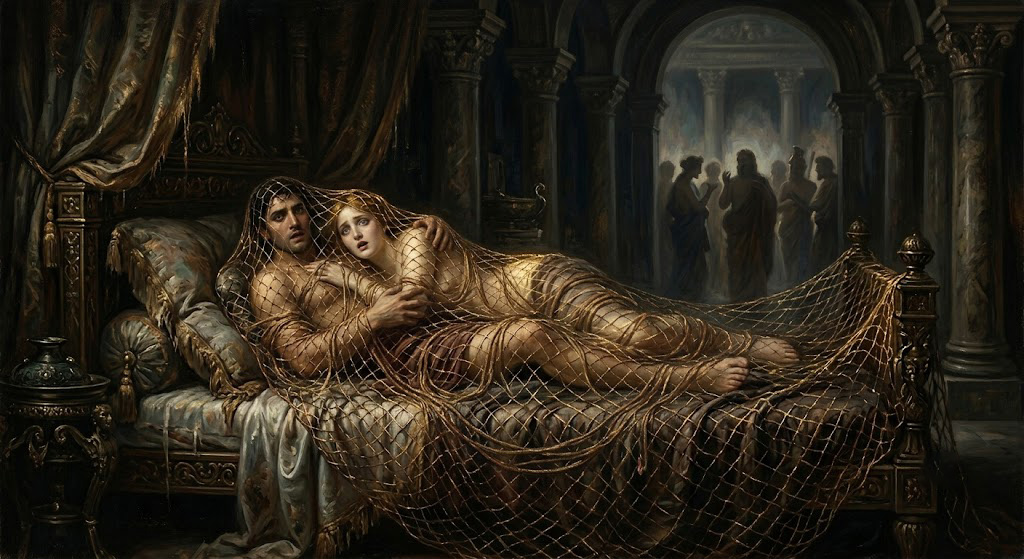
Ares and Aphrodite were eventually released, after considerable negotiation and some embarrassment. Hephaestus returned to his forge. The net had made its point with a completeness that no confrontation could have achieved.
This is the third shape of Hephaestus’s power: not the compensation argument of a man who has nothing else, not the cosmic argument of the Shield, but the precise tactical argument of a craftsman who understands that knowledge is the only power that cannot be taken away by physical force, and who builds accordingly.
Lemnos, the Volcano, and Where He Worked
The Greeks were too geographically minded to leave Hephaestus’s forge without an address.
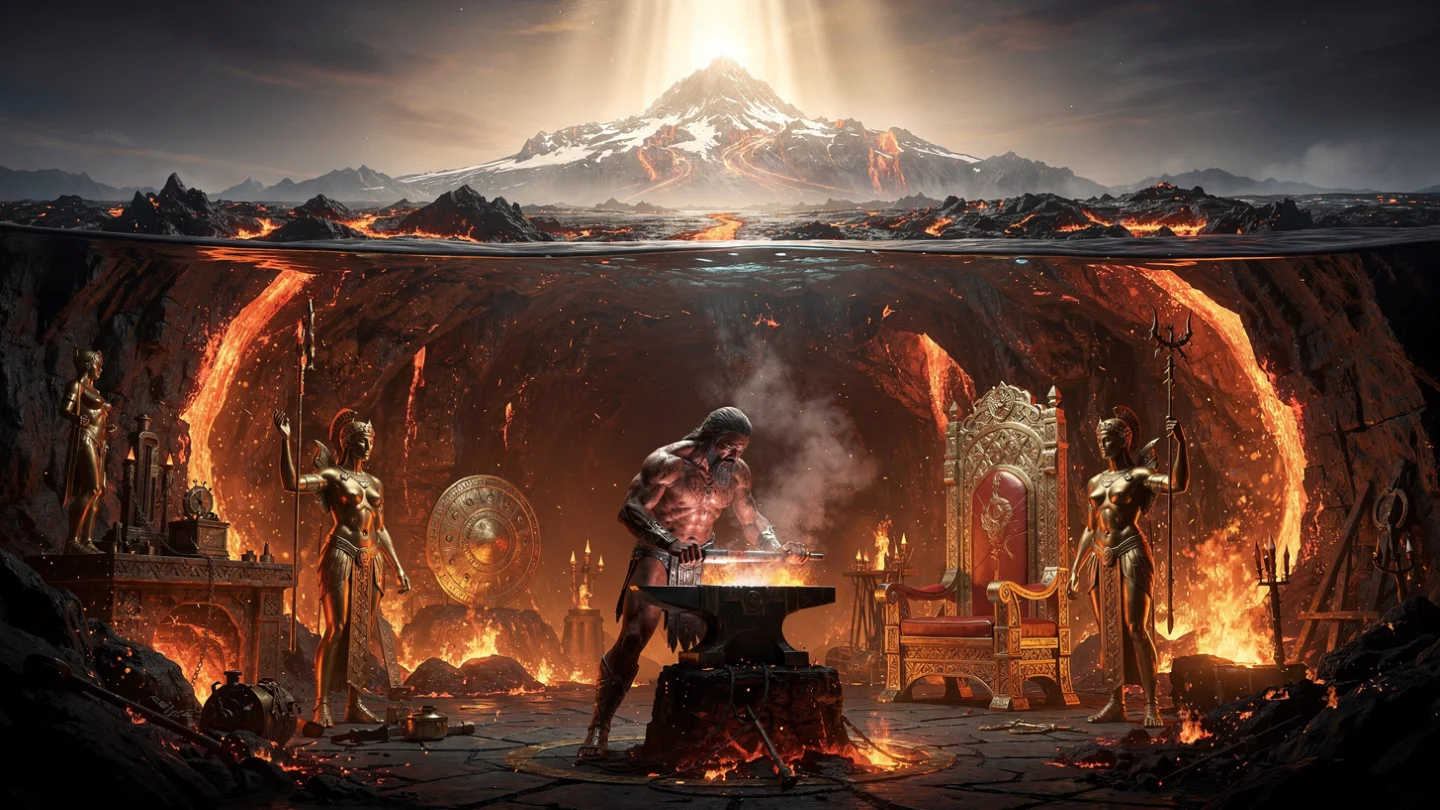
In the earliest traditions he worked on Lemnos, the island where he landed after his fall, whose volcanic activity gave the ancient world the impression of divine fires burning underground. The island’s volcanic springs, still active today in forms that modern visitors can see and smell, were understood as the evidence of the forge beneath: the heat and the sulphur rising from below the surface as by-products of divine metalwork.
Later traditions moved the forge to Etna in Sicily and to the volcanic islands of the Aeolian chain, the Lipari islands north of Sicily where the volcanic activity is visible from the sea on clear nights and where the ancients understood themselves to be living directly above the divine craftsman’s workplace. The Cyclops, in some traditions, were Hephaestus’s forge assistants rather than the independent monsters of the Odyssey: one-eyed giants who could look directly into the flame without being blinded.
The volcanic geography of the Greek world, which is extensive and active and productive of exactly the kind of dramatic underground heat that a forge mythology requires, gave Hephaestus a physical reality that the other gods largely lacked. Zeus’s lightning was a weather event. Poseidon’s earthquakes were geological. Hephaestus’s fires were visible, locatable, approachable: you could sail to Lemnos and see the volcanic springs. You could climb Etna and feel the heat rising from below. The god’s forge had a physical address, and the address was real.

This matters for what the mythology was doing. Hephaestus was not simply a metaphor for craft or creativity. He was the explanation for the geological reality of a world that the Greeks lived inside, a Mediterranean landscape of volcanic islands and underground fires and the particular smell of sulphur on a hot morning at the edge of certain coastlines. The ugly, limping, rejected craftsman was also the force that produced the geological drama of the Greek world’s most active landscapes.
Beauty, destruction, and creation emerging from the same underground source. The same fire that makes the island dangerous makes the metal workable. The same forge that produced the net that humiliated Ares produced the armour that protected Achilles. The same hands that threw the golden chair trap built the golden automata that assisted the crippled god who could not stand without help.
What the Greeks Were Saying About Art
Let’s be direct about what the Hephaestus myth is doing that most mythological treatments of craft and beauty do not do.
It is refusing the romantic version.
The romantic version of the artist, which Western culture has been refining since the Renaissance and which reached its fullest expression in the nineteenth century, goes something like this: the artist is a person of exceptional sensitivity and vision, possibly afflicted with some form of torment, who transforms suffering into beauty through the alchemy of genius. The suffering authenticates the art. The art redeems the suffering. The artist is a tragic figure whose gift is inseparable from their wound.
The Greek version of this story, as embodied in Hephaestus, is considerably less sentimental.
Hephaestus was not transformed by his suffering. He was not redeemed by his art. He was rejected, he worked, and his work was superior. The limp did not become beautiful. The rejection did not become poignant. What became beautiful was the objects he made, and what became powerful was the knowledge that produced them, and neither of these things required the suffering to be anything other than what it was: an injustice that did not prevent the work from happening.
This is the Greek argument about art and imperfection: that the relationship between damage and creation is not alchemical but practical. You do not make beautiful things because you suffered. You make beautiful things because you have the knowledge and the will to make them, and suffering, if it has any role at all, is simply the condition in which that knowledge was acquired and that will was formed.
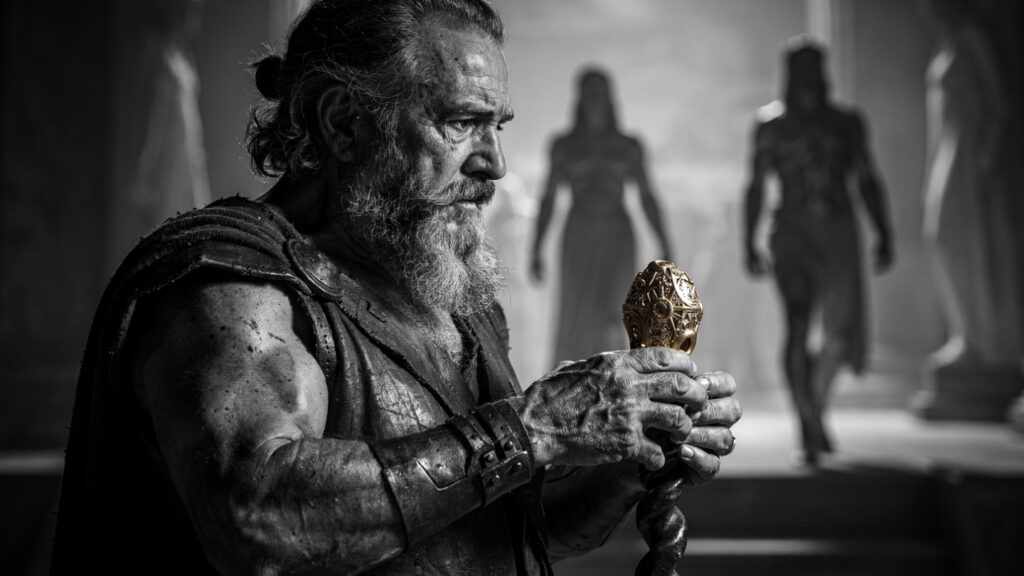
Hephaestus is not the artist as wounded hero. He is the craftsman as stubborn expert: the person who knows more than everyone in the room, who was excluded from the room, and who demonstrates the exclusion’s absurdity not by demanding admission but by making the room impossible to function without him.
The net for Aphrodite’s bed. The throne for Hera who threw him away. The armour for Achilles who will die in it. The automata who support his walking because his legs will not do it alone.
These are not gestures of bitterness or redemption. They are the work of a craftsman who has understood what he can do and who does it, regardless of what the radiant and powerful beings around him think of the fact that he limps.
What Remains
There is a question that the ancient world did not ask directly about Hephaestus but that sits beneath every account of his work: was it worth it?
The rejection, the fall, the lameness, the marriage that became a public humiliation, the existence on the margins of a divine court that needed what he made but did not make room for what he was: was the work that came from all of this worth the conditions that produced it?
The Shield of Achilles says yes. The golden automata say yes. The net that held a god of war immobile says yes. The throne that trapped the goddess who threw away her own child says yes, and also says something more complex than yes: it says that the making was not in spite of the conditions but partly because of them, and that the conditions were not forgiven or forgotten but transformed into something that outlasted them.
The limp is gone from the modern world. The shield description is still in the Iliad, still generating essays and poems and arguments and revelations for readers who come to it with no knowledge of the ancient context and leave it having understood something about what art is for.
The most beautiful things in the Greek mythological world were made by the ugliest god.
The Greeks were not being ironic. They were stating, with the precision that their best myths always achieve, the thing that every person who has ever made something genuinely beautiful from conditions that were genuinely difficult already knows.
The forge is its own answer. The work is its own answer.
Everything else is a throne you can sit in but cannot stand up from.
At Olympus Estate, Tales from Olympus explores the full architecture of Greek myth, including the figures whose stories illuminate not just the ancient world but the permanent conditions of making something worth making. Hephaestus was not the greatest god. He was the most necessary one.