




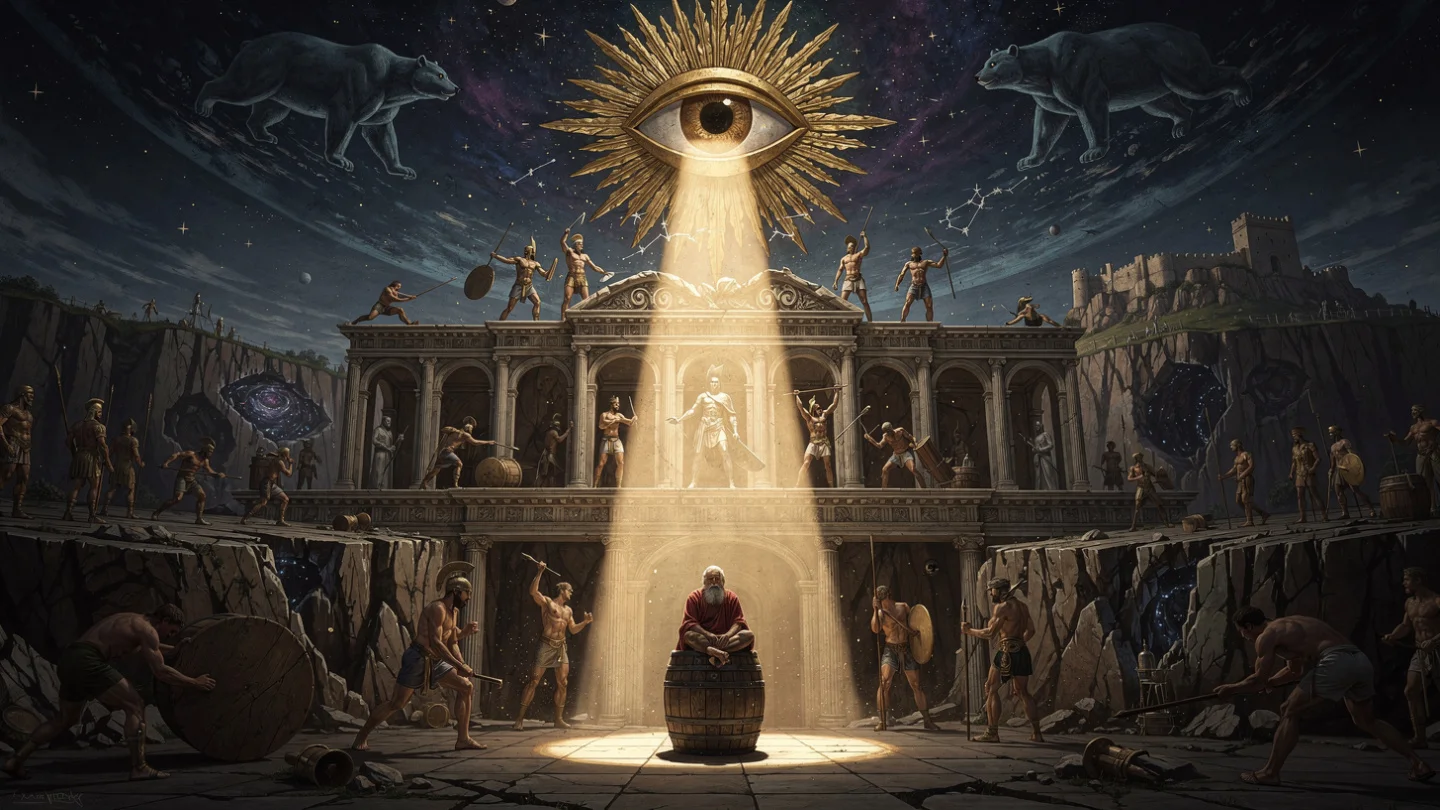
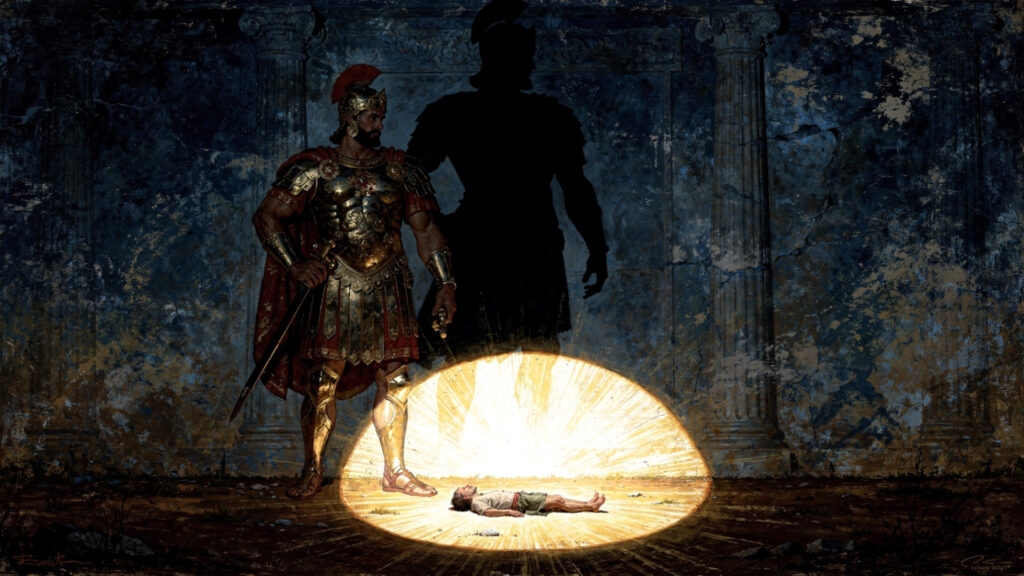
The most powerful man in the world stood over the philosopher lying in the sun and offered him anything he wanted.
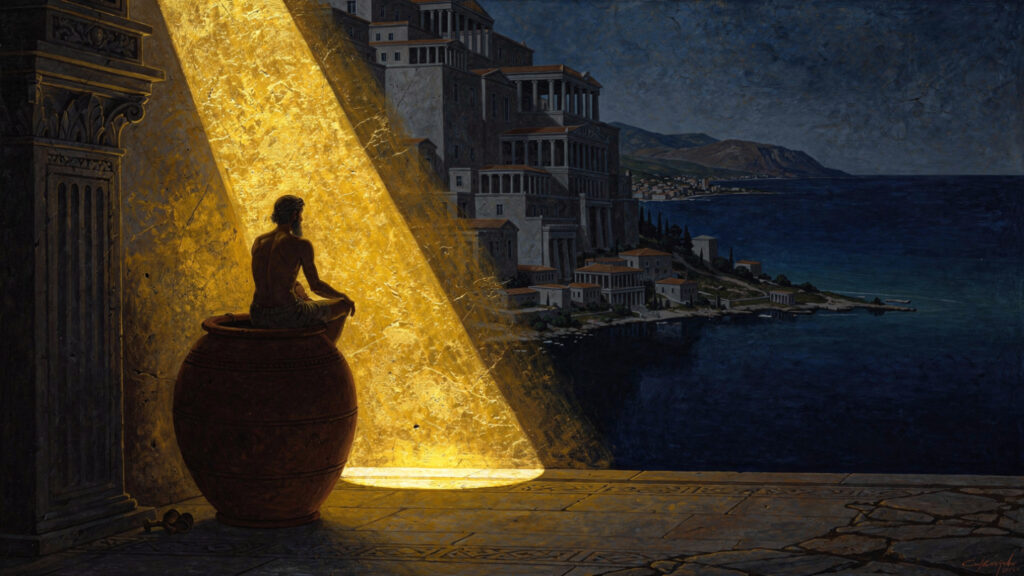
Alexander had just completed the sequence of victories that had given him control of Greece and Persia and Egypt and was moving toward India, and his reputation for generosity toward the persons whose intelligence or courage impressed him was the reputation that made the Corinth encounter with Diogenes the encounter that ancient writers preserved as the most concentrated available statement about the relationship between power and philosophy. He had heard of Diogenes. He went to find him. He found him lying in the sun outside the large clay jar that served as his dwelling and he stood over him and said that he was Alexander the Great and that Diogenes could ask him for anything. The Macedonian world that produced Alexander is explored in the Vergina–Dion article, where the dynasty’s sacred geography is preserved.
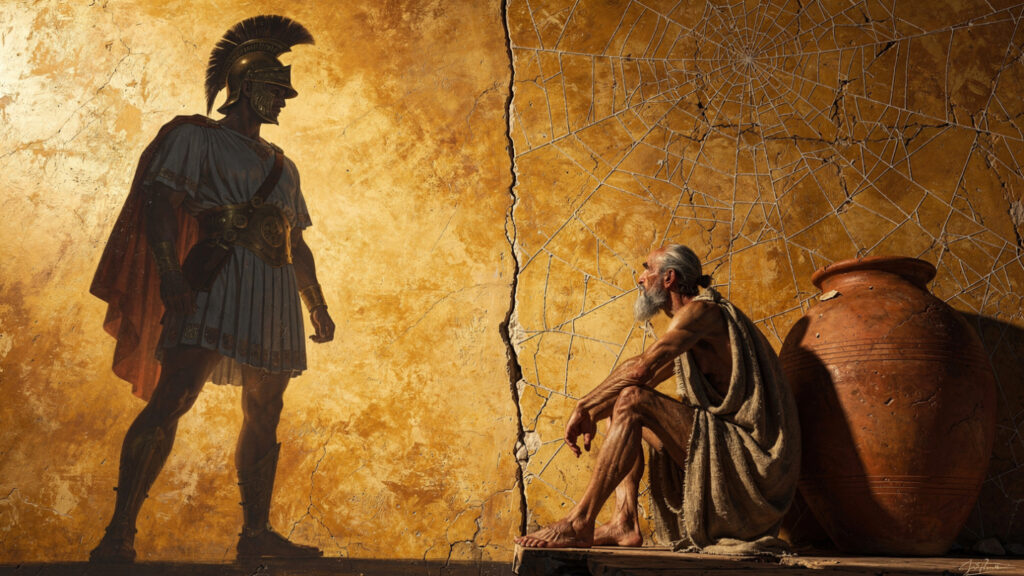
Diogenes said: stand out of my sunlight.
The quality of this response is the quality that the entire Cynic philosophical tradition was designed to make possible: the person who has organized their existence around the minimum requirements of the good life has nothing to ask of the person who controls everything else. Alexander had the wealth and the armies and the political authority that the entire social world organized itself around acquiring and maintaining. Diogenes had the sunlight, which was available to everyone without Alexander’s intervention, and which Alexander was currently blocking.
Alexander reportedly said: if I were not Alexander I would wish to be Diogenes. The recognition by the person who had achieved the maximum of the external goods that the person who had achieved the minimum of the external goods had achieved something that the maximum could not provide is the recognition that the Cynic philosophical tradition had been designed to produce in exactly this form: the encounter between the person who had everything and the person who needed nothing, and the quality of the encounter that demonstrated which of the two positions was the more philosophically defensible.
Who Diogenes Actually Was
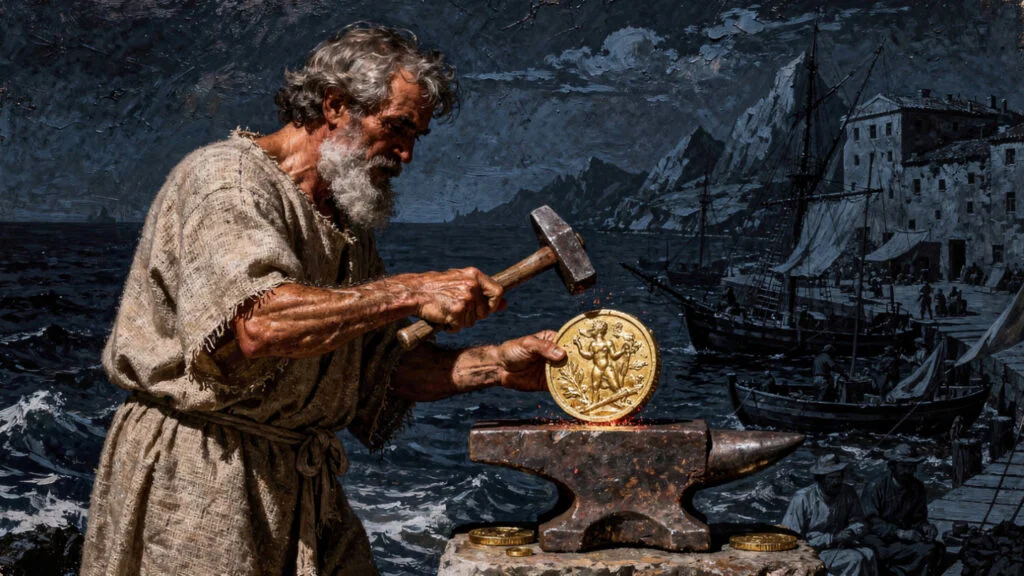
Diogenes of Sinope was born around 412 BCE in the Black Sea port of Sinope on the Pontic coast, the son of a banker. His entry into the philosophical tradition was not the entry of the person who chose philosophy as a vocation but the entry of the person who was expelled from his previous life: Diogenes and his father were accused of defacing or adulterating the city’s currency, an act whose symbolic content the philosophical tradition consistently connected to the philosophical program that Diogenes subsequently developed. He who defaced the currency of Sinope subsequently dedicated his life to defacing the currency of the social world: the values and conventions and status markers whose acceptance by the general population gave them their authority were the currency that Diogenes spent his philosophical career systematically devaluing.
Exiled from Sinope, Diogenes came to Athens, where he encountered Antisthenes, the philosopher who had been a student of Socrates and who had developed from the Socratic inheritance the philosophical tradition that valued the virtue of the self-sufficient life over the goods that the social world’s conventions identified as desirable. Diogenes became Antisthenes’s student and took the philosophical program of the examined self-sufficient life to the most extreme conclusion available: not the Socratic examination conducted through argument and question but the Cynic examination conducted through action and performance.
The difference between the Socratic and the Cynic methods is the difference that gives Diogenes his character in the philosophical tradition. Socrates examined life through the medium of the philosophical conversation, the elenchus, the questioning process whose application to the assumptions of his interlocutors revealed the contradictions and inadequacies of the beliefs they had accepted without examination. The Socratic method was the method of the private intellectual encounter whose public character was the character of the conversation in the Agora or the gymnasium or the symposion, the social spaces where the philosophical dialogue could occur.
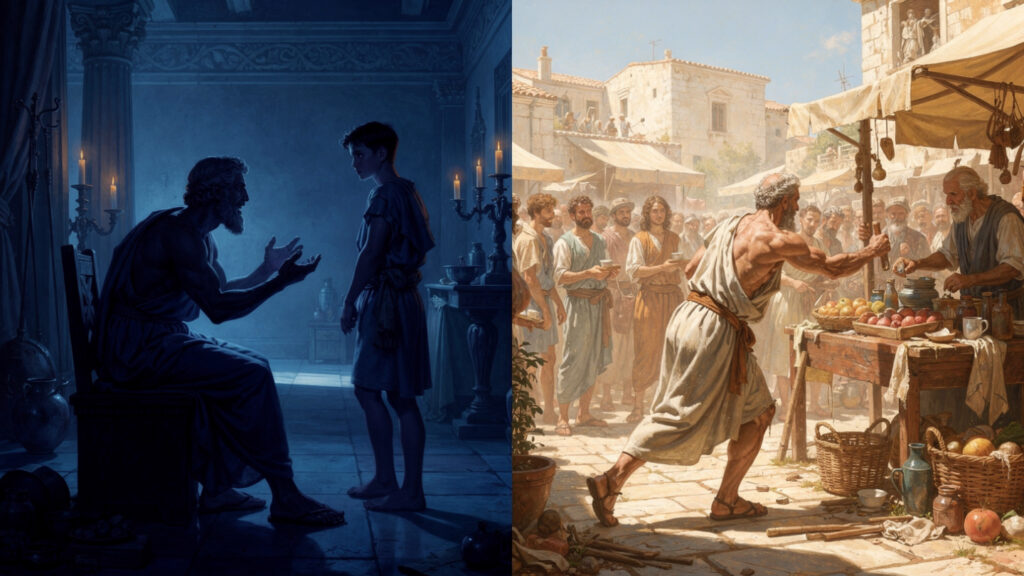
Diogenes examined life through the medium of the public action whose content was the philosophical argument made visible in the most concentrated available form. He did not argue against the social convention of the private satisfaction of bodily needs: he satisfied his bodily needs in public, which made the social convention’s prohibitions visible as prohibitions rather than as natural requirements. He did not argue against the convention of the private dwelling: he lived in the large clay pithos, the storage jar, in the public location where his living arrangement was visible to everyone who passed, which made the social convention of the private house visible as a convention rather than as a necessity. He did not argue against the social world’s pursuit of wealth and status: he begged, which made the desperation of the social world’s pursuit visible through the contrast between the philosopher who begged without shame and the wealthy person who accumulated without satisfaction.
The Lantern and What It Was Looking For
The action that ancient writers most consistently associated with Diogenes was the action of wandering through the streets of Athens or Corinth in broad daylight carrying a lit lantern, announcing that he was looking for an honest man.
This was not a sincere search. The lantern at noon in a Mediterranean city was the piece of equipment whose function, the provision of light in the darkness, was entirely superfluous in the conditions of its use, and the superfluity was the point: Diogenes was demonstrating through the absurdity of carrying a light source in the daylight that the social world had so thoroughly obscured the quality he was claiming to be looking for that the natural light of the sun was insufficient to find it.
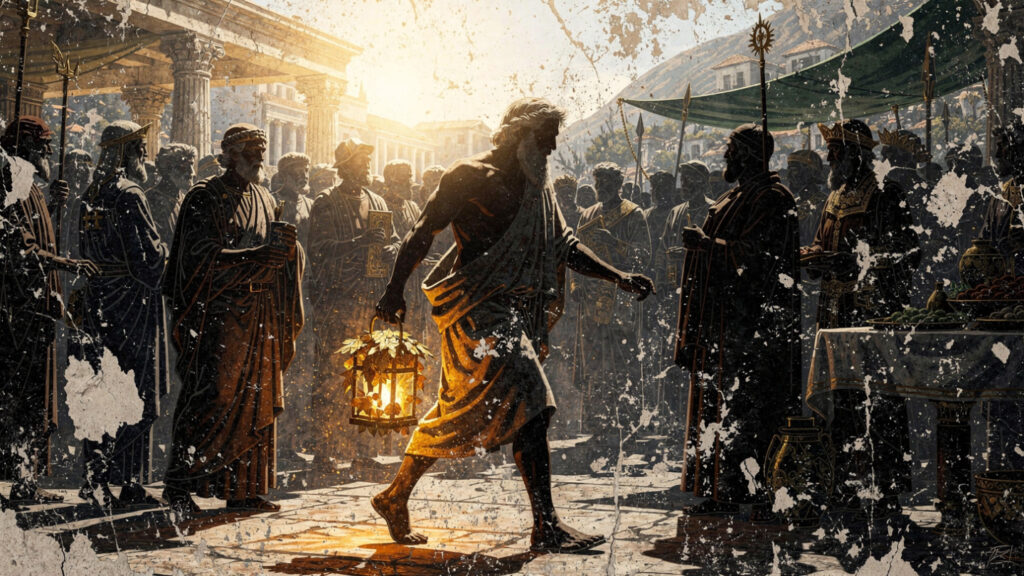
The honest man that Diogenes was not finding was not the man whose individual moral character was deficient in the way that the ordinary moral evaluation would identify. The honest man that Diogenes was not finding was the man whose relationship to himself and to the social world was the relationship of the person who had genuinely examined the social conventions and the social values and had accepted or rejected them on the basis of that examination rather than on the basis of the social pressure whose acceptance was the condition of participation in the social world.
The claim that Diogenes was making with the lantern was the claim that the social world of Athens and Corinth, the richest and most culturally sophisticated cities in the ancient Greek world, had produced a population among whom the quality of the examined and genuinely self-directed life was less common than the quality whose absence the lantern was designed to find in the darkness: that the social world’s machinery for producing the appearance of the examined life, the philosophical schools and the rhetorical training and the democratic participation and the theatrical culture and the social conversations in which the appearance of the examined life was the ticket of admission to the serious social world, had produced the appearance without the substance.
Diogenes was looking for a Socrates who had followed the Socratic argument to its conclusion. He did not find one.
Corinth and Its Character
The city where Diogenes spent the most significant portion of his philosophical career was Corinth, and the character of Corinth as the city that hosted the philosopher who rejected all the values that the social world organized itself around is the character of the most extreme available contrast.
Corinth was the most commercially significant city in the classical Greek world at the height of its power: the city whose geographical position on the Isthmus between the Saronic Gulf and the Gulf of Corinth gave it the control of the land route between the Peloponnese and the Greek mainland and the control of the sea routes between the eastern and the western Mediterranean whose combination made it the commercial crossroads whose wealth and cultural influence the seventh and sixth centuries BCE produced at a level that rivaled Athens before the Athenian democratic flowering of the fifth century.
The diolkos, the ship-transport way across the Isthmus whose engineering allowed the dragging of ships and their cargoes across the four kilometres of the Isthmus from one sea to the other, was the commercial infrastructure whose operation made Corinth the transit point for the Mediterranean trade that the sea voyage around Cape Malea, the dangerous southern tip of the Peloponnese, made it strategically and commercially essential to avoid. Ships were hauled overland. Corinth collected the tolls and the transit fees and grew wealthy from the commercial activity that the geography made inevitable.
The Corinth that Diogenes inhabited was the Corinth of this wealth: the city of the merchants and the sailors and the craftsmen whose pottery and bronze work the export trade had distributed across the Mediterranean, the city of the Temple of Aphrodite on the Acrocorinth whose institutional character the ancient sources described as the city’s most profitable religious establishment, the city of the Isthmian Games whose Panhellenic prestige gave Corinth the athletic and cultural standing that the city’s commercial character might otherwise have obscured.
Diogenes arrived in Corinth not by choice but by the mechanism of the pirate capture that his ancient biographers record: captured at sea and sold into slavery, he was purchased by a wealthy Corinthian named Xeniades who bought him to serve as the tutor to his sons. Diogenes tutored Xeniades’s sons with the Cynic pedagogical approach of the physical training and the memorization of the philosophical texts and the reduction of the ornamental curriculum’s content to the content that the genuinely educated person needed and that the socially performing educated person did not: he taught them to hunt and to cook and to exercise and to recite the philosophical poets and to satisfy their own needs with the minimum of external assistance.
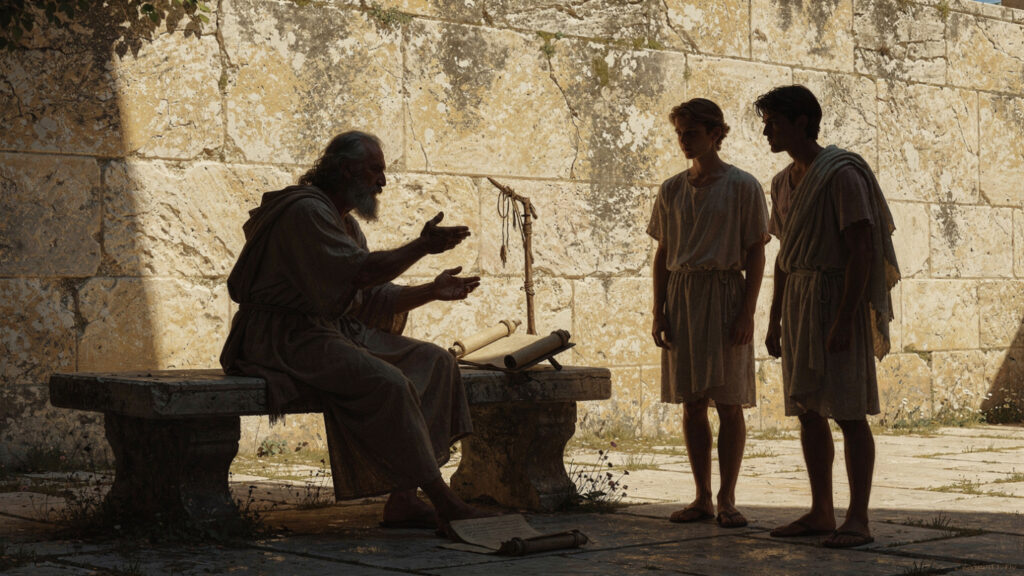
He remained in Corinth as a free man after the terms of his servitude were completed, because the character of Corinth as the most commercially excessive city in the Greek world made it the most appropriate available location for the philosopher who had dedicated his life to demonstrating the emptiness of the commercial values that the commercial world organized itself around.
Corinth’s Mythological Character
Corinth’s mythology gave the city a particular quality: it was the place where the consequences of excess, cleverness, and the violation of divine order were most directly visible in both landscape and story.
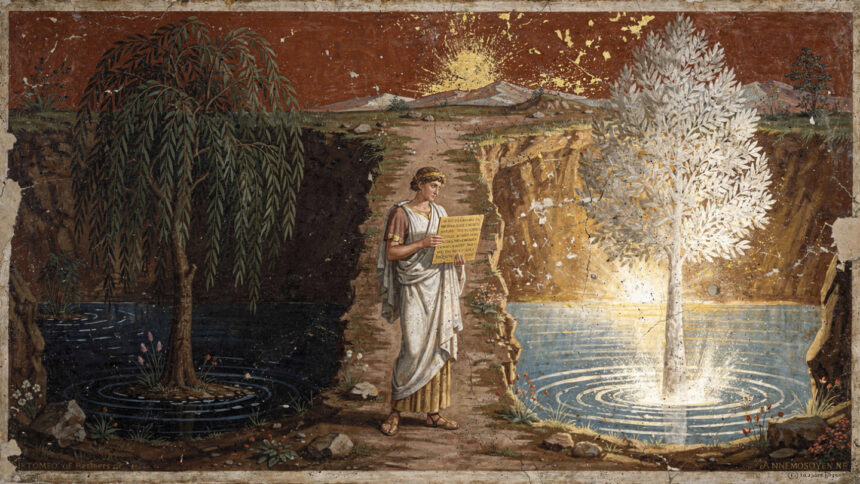
Sisyphus, the mythological founder and king of Corinth, was the mythological figure whose character was the character of the supreme human cleverness applied to the project of cheating death: Sisyphus tricked Thanatos into demonstrating the chains he had brought to bind Sisyphus, then used the demonstration as the occasion to bind Thanatos himself, which had the cosmological consequence of preventing death from occurring anywhere in the world for the duration of Thanatos’s imprisonment. Ares eventually freed Thanatos and Sisyphus died, but he had arranged to return to the upper world on a pretext and simply refused to go back, and had to be physically removed by Hermes.
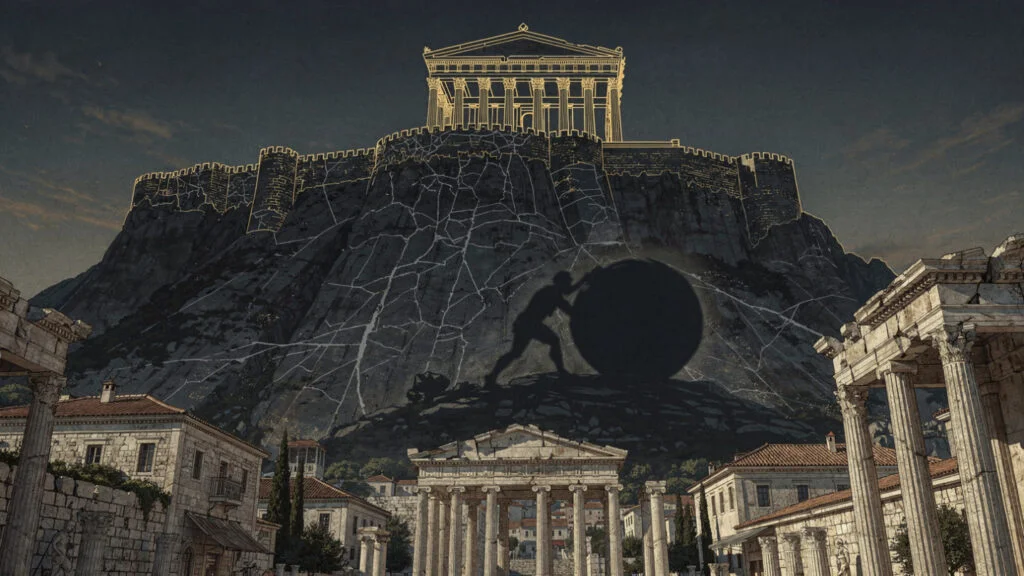
The punishment that Zeus assigned to Sisyphus was the punishment that the tradition has preserved as the archetype of the futile labor: the eternal rolling of the boulder up the hill whose slope prevented the boulder from remaining at the top, so that the boulder always rolled back down and Sisyphus always had to begin again. The quality of the Sisyphus punishment that Albert Camus developed in the twentieth century as the image of the human condition for absurdist philosophy was a quality the ancient world had already identified: the existence organized around the pursuit of a goal whose achievement is the condition of its own failure: the boulder at the top of the hill was the boulder that immediately became the boulder at the bottom of the hill, and the labor that produced the achievement was the labor that produced the necessity for the same labor again.
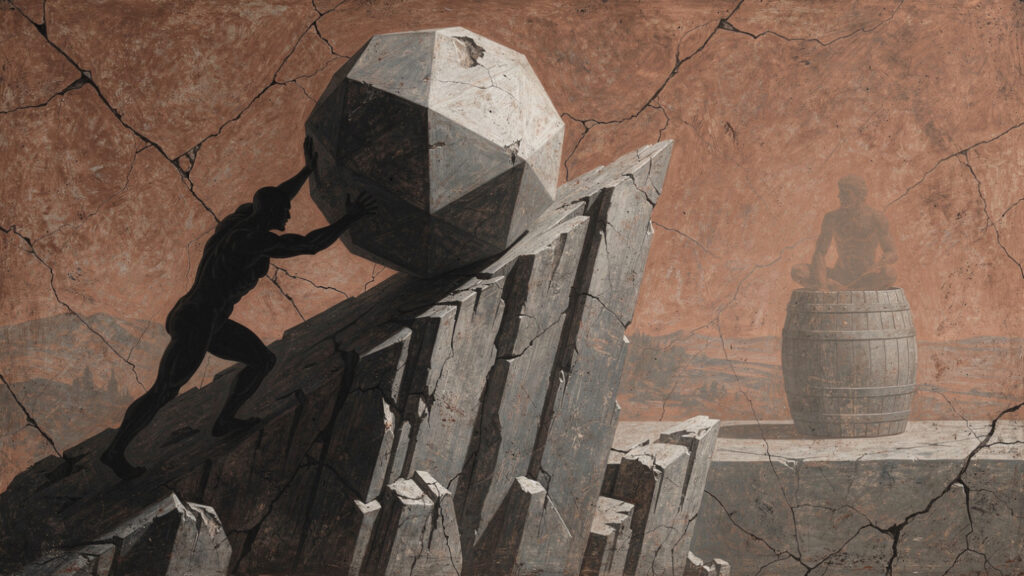
Diogenes, walking through the streets of Corinth with his lantern, was walking through the city of Sisyphus: the city founded by the figure whose mythological character was the character of the supreme cleverness applied to the project of cheating the consequences of the social world’s values, and whose eternal punishment was the form of the futile labor that the entire commercial and social world of Corinth was organized around performing without recognizing as futile.
Medea and Jason completed the Corinthian mythological repertoire of the consequences of the violation of the fundamental obligations: Jason’s abandonment of Medea in Corinth for the Corinthian princess Glauke was the act of ingratitude and betrayal whose consequences were the catastrophe that the Euripides tragedy preserved as the most disturbing of the fifth-century BCE dramatic explorations of the relationship between the divine obligation of the oath and the specifically human tendency to violate the oath when the violation served the interests that the social world had trained the person to pursue. Medea killed her own children to deprive Jason of the future that the betrayal had been designed to secure.
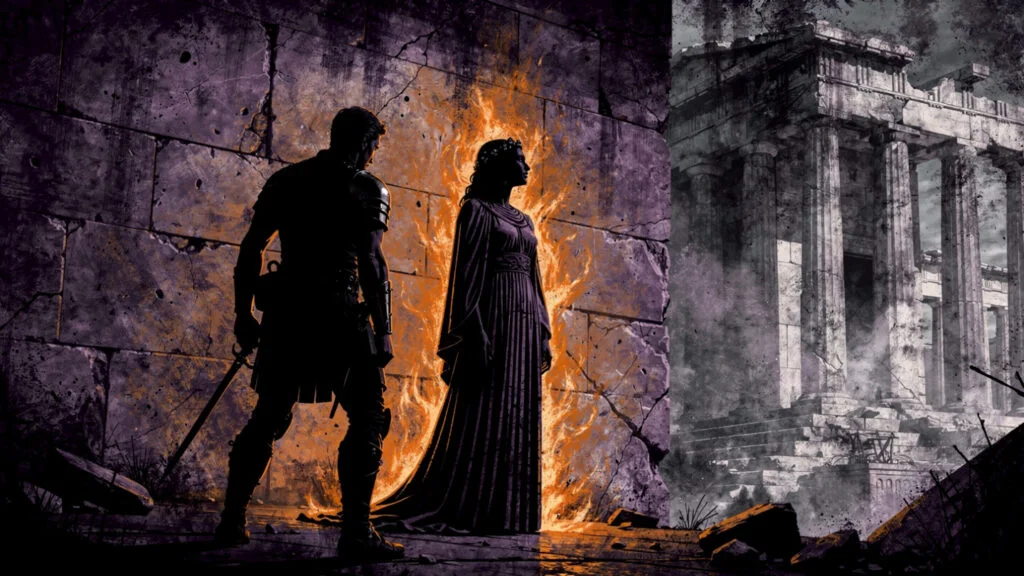
The Corinth that Diogenes inhabited was the city of Sisyphus’s futile cleverness and Jason’s violated oath and the commercial excess that both mythological traditions encoded in the character of the city’s founding mythology. The philosopher who had chosen to demonstrate the emptiness of the social world’s values had chosen the most appropriately concentrated available setting for the demonstration.
The Philosophical Method and Its Targets
The philosophical targets of the Cynic method were the forms of the social performance of the examined life that Diogenes identified as the most dangerous obstacles to the genuine examined life: dangerous precisely because their resemblance to the genuine thing was close enough to be mistaken for it by the person who had not examined the resemblance with the attention that the resemblance’s closeness required.
Plato was the philosophical target whose relationship to the Cynic method was the relationship of the most elaborately constructed alternative account of the examined life to the Cynic account: the Platonic philosophical tradition had developed the institutional form of the philosophical school, the Academy, with its curriculum and its forms of the philosophical dialogue and its social organization around the philosophical community whose shared practice of the examined life was the condition of the genuine philosophical progress.
Diogenes plucked a chicken and threw it into the Academy when Plato defined man as a featherless biped: the action whose theatrical quality was the quality of the philosophical refutation performed in the most concentrated and most immediately visible available form rather than in the form of the philosophical argument whose engagement required the preparation that the philosophical training provided and whose effect was available only to the audience that the philosophical preparation had equipped to receive it.
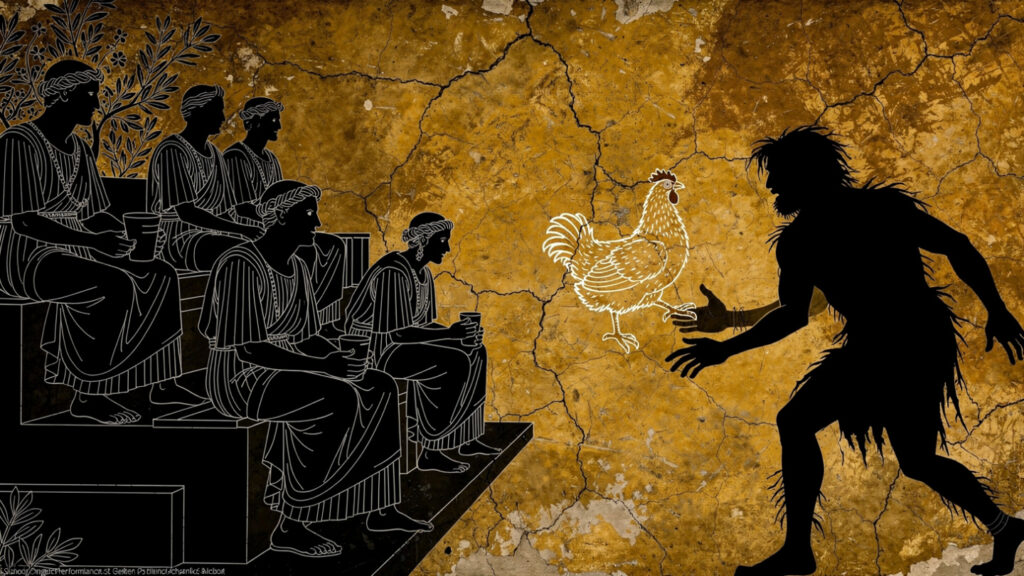
The chicken in the Academy was the philosophical argument made visible to everyone, including the audience that Plato’s philosophical method could not reach: the audience of the commercial and social world of Athens and Corinth for whom the philosophical school was the institution whose social status was the condition of whose engagement with it was possible, and whose social status was the form of the social performance that the genuine examined life was not.
Diogenes’s relationship to Alexander was the relationship of the Cynic method to political power: the most powerful man in the world was the most extreme available expression of the social world’s organization around the external goods whose pursuit the Cynic method identified as the obstacle to the genuine examined life, and the response of standing out of my sunlight was the response that made the emptiness of the external goods visible in the most concentrated available form. Alexander had everything. Diogenes had the sunlight that the everything was blocking.
The Isthmian Games and Diogenes’s Use of Them
The Isthmian Games, held at the sanctuary of Poseidon at Isthmia near Corinth in the Panhellenic athletic festival whose prestige the Poseidon article in this collection develops, were the occasion that Diogenes used for some of his most concentrated philosophical performances.
The Games assembled the largest available concentration of the social performances that the Cynic method identified as the objects of its philosophical attention: the athletes whose physical training was the form of the socially honored excellence that the Games existed to recognize and reward, the politicians who used the Games as the occasion for the public speeches whose political function was the function of the performance of the political persona, and the general audience whose attendance at the Games was the form of the participation in the social world’s most elaborate and most publicly visible celebration of its own values.
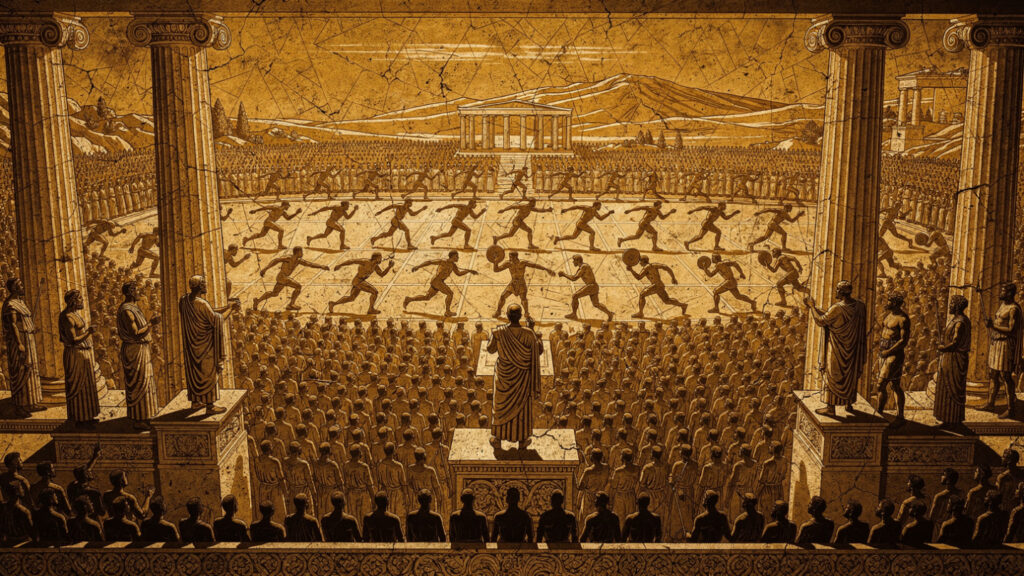
Diogenes appeared at the Games and announced that he was competing for the highest prize. The announcement was the announcement that produced the response of interested confusion from the assembled audience: what event was Diogenes competing in, and what prize could he be claiming to pursue? Diogenes described the contest he had won: the contest against poverty, against exile, against desire, against laziness. The response to this announcement, whether the laughter of the crowd or the philosophical recognition of the serious audience, was the audience whose engagement with the philosophical performance was the engagement that the performance was designed to produce.
What the Cynic Tradition Gave the World
Cynicism, which Diogenes built from the Antisthenes inheritance into the performative method of public action embodying philosophical argument, left behind a legacy that most directly challenged the assumptions the other philosophical schools shared.
The Stoic tradition, which the collection’s Eros and Aphrodite article cross-references through the Apollo article’s development of the Stoic philosophical connection to the Apollonian theological principle, drew its understanding of the self-sufficient life and the distinction between the things that are in our control and the things that are not in our control from the Cynic tradition whose philosophical content had identified the external goods as the source of the philosophical confusion that prevented the genuine examined life.
The Stoic claim that the virtuous life was the sufficient condition of the happy life, that the person who had developed the virtues of the organized rational existence had the good that no external condition could either provide or take away, was the claim that the Cynic tradition had developed in the most extreme available form: Diogenes’s possession of the sunlight was the statement of the Stoic claim made visible in the most concentrated available form, the good that the most powerful man in the world could not provide and could only block.
The cosmopolitan claim, that the human community consists of all human beings rather than merely the citizens of a single city-state, was the Cynic contribution to political philosophy. The Stoics developed it into a cosmopolitan political theory that shaped Roman political thought and, through Rome, the political thought of the modern West: among the most significant single contributions the ancient world made to how later ages understood politics.
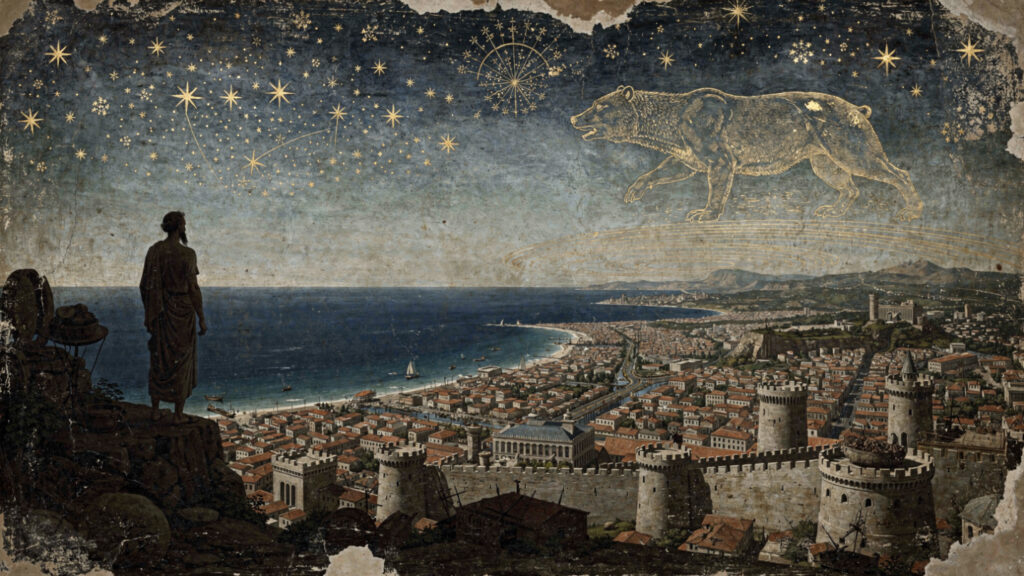
Diogenes, when asked where he was from, said he was a kosmopolites: a citizen of the cosmos. The claim was the claim that the identity constituted by the membership in the political community of the city-state was the conventional identity whose conventional character the examined life had revealed as conventional: the person who had genuinely examined the social world’s conventional identities and had found in that examination the conventional character of each of them was the person whose identity was the identity that the examination had left when the conventional identities had been stripped away, which was the identity of the human being as such, the member of the human community rather than the member of any particular political community.
Visiting Corinth
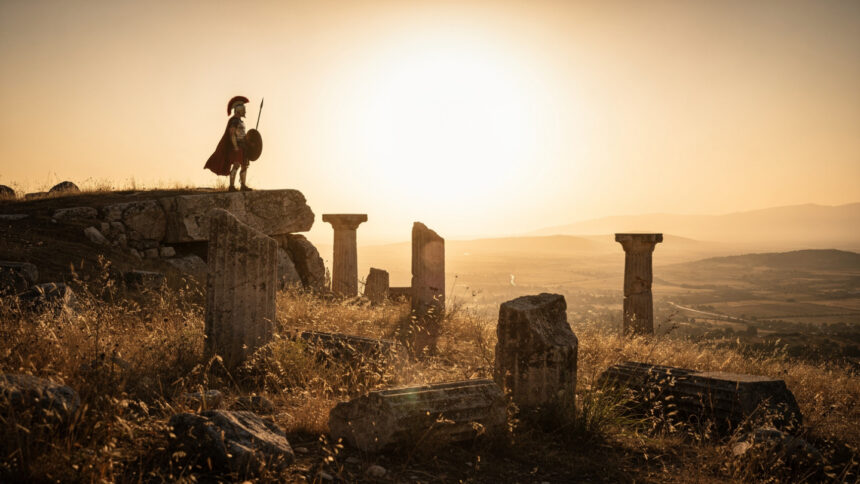
The archaeological site of ancient Corinth preserves the material record of the city in its most immediately accessible surviving form: the seven Doric columns of the Temple of Apollo, built in approximately 540 BCE and among the oldest surviving temple structures on the Greek mainland, are the architectural remains whose scale and whose position above the Agora give the site its most immediately recognizable visual character.
The Agora, the civic and commercial space whose function as the center of Corinthian public life gave Diogenes his most concentrated available audience for the philosophical performances that the public space of the city enabled, is the site whose extent the excavations of the American School of Classical Studies at Athens have been revealing since the 1890s: the shops and the stoas and the administrative buildings whose archaeological remains give the visitor the spatial understanding of the ancient city’s commercial and civic organization.
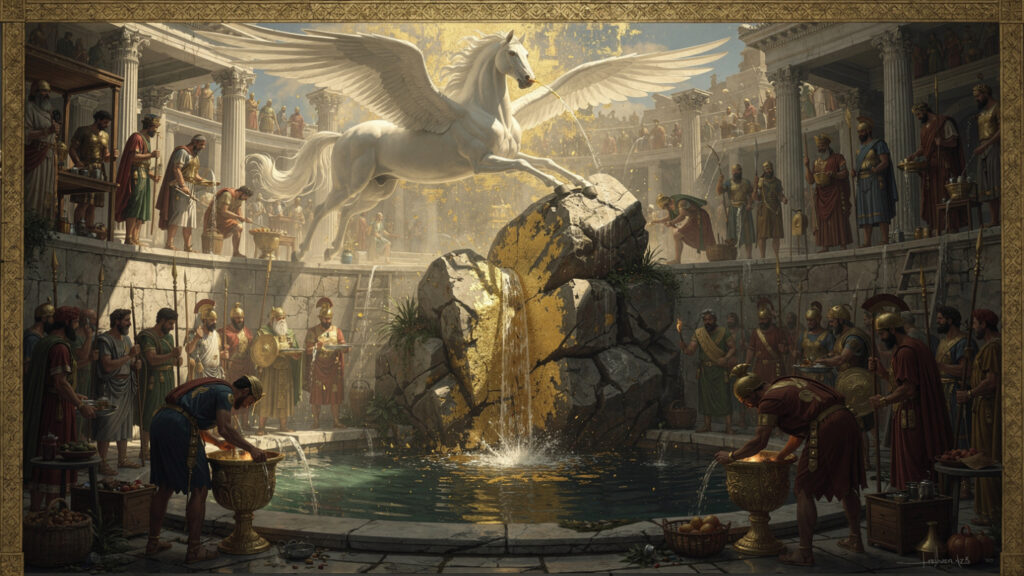
The Peirene Fountain, the architectural complex whose water supply mythology connected to the blow of Pegasus’s hoof that struck the earth and produced the spring, is the site whose architectural elaboration across the successive periods of Corinthian history, from the archaic period through the Roman rebuilding of the first century BCE, gives it the character of the city’s most continuous civic institution: the fountain that provided the city’s water supply across the entire span of the ancient city’s occupation is the institution whose continuous use gives it the quality of the site where the entire sequence of the city’s history was simultaneously present.
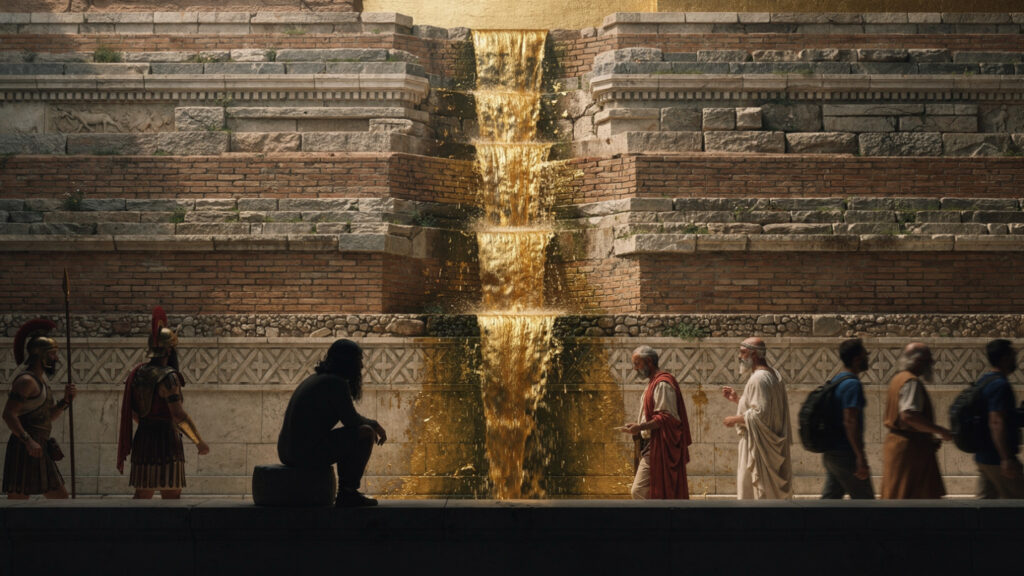
The Acrocorinth, the massive fortified rock that rises 575 metres above the city to the south, is the site whose combination of the ancient sanctuary of Aphrodite whose character the ancient sources described as the most commercially productive religious establishment in the classical Greek world, and the successive Byzantine and Frankish and Venetian and Ottoman fortifications whose layered architectural record gives the site its character as the most completely preserved multi-period fortified site in the Peloponnese, makes the ascent the experience of the entire sequence of Corinthian history concentrated in a single site.
The view from the Acrocorinth is the view that most completely expresses the geographical character that gave Corinth its commercial significance: the Saronic Gulf visible to the east and the Gulf of Corinth visible to the west and the Isthmus visible between them, the geographical accident that made Corinth the commercial crossroads whose control of both the land route and the sea transit gave it the wealth that the archaeological record documents and that mythology encoded in the stories of the city’s founding.
The Archaeological Museum of ancient Corinth holds the material record of the city’s history in its most concentrated surviving form: the Corinthian pottery whose distinctive orange-red figure style made it the most widely exported luxury ceramic of the archaic period, the architectural sculpture of the Temple of Apollo, and the collection of the Roman period’s decorative arts that the Caesar Augustus-era refounding of the city as a Roman colony produced.
What Diogenes Teaches the Visitor
The experience of visiting Corinth with the Diogenes tradition in mind is the experience of visiting the city whose character makes the Cynic philosophical method most directly legible in the landscape that the philosophical performances inhabited.
The Agora where Diogenes performed his philosophical antics, where he wandered with his lantern looking for the honest man among the merchants and the politicians and the philosophers who had not followed the Socratic argument to its conclusion, is the space whose commercial and civic character gives the lantern performance its target: the honest man was not to be found in the space organized around the commercial exchange and the political performance because the activities organized around the commercial exchange and the political performance were the activities whose organization required the performances of the social identity that the honest man, the person who had genuinely examined the social world’s conventions and had found their conventional character, had given up performing.
The action of wandering through the space with the superfluous equipment making the absurdist claim is the philosophical method whose character was the character of the public action embodying the philosophical argument rather than the private dialogue articulating it. Diogenes did not need to articulate the argument that the social world’s honest man was not to be found in the spaces that the social world had organized around the performance of the social identity: he carried a lantern into the daylight and the argument was immediately visible to everyone in the space who had the attention to see it.
The boulder of Sisyphus, invisible but permanent in the landscape of the city whose mythological founder had organized his entire existence around the project of cheating the consequences of the social world’s organization, is the mythological presence that gives the Diogenes tradition its Corinthian resonance: the philosopher who had given up the boulder of the social world’s goods was the philosopher who was watching the city of Sisyphus’s founder organize itself around the boulder whose eternal rolling back down the hill the mythological tradition had already identified as the condition of the existence organized around the external goods.
Stand out of my sunlight.
The response to the offer of everything that the most powerful man in the world could provide is the response that makes visible the philosophical position that the Cynic tradition had developed from the Socratic inheritance: the person who needs only the sunlight has nothing to ask of the person who controls everything else, because the sunlight is the good that is not among the things that the powerful person controls and not among the things that the examined life has identified as the goods whose possession is the condition of the happiness that the examined life was designed to produce.
Alexander stood out of the sunlight. Diogenes returned to his jar. The cosmological argument, in its Corinthian expression, was complete.
At Olympus Estate, Mythic Essays moves through the deeper currents of the Greek tradition. Diogenes carried a lit lantern through the streets of Corinth at noon, announcing that he was looking for an honest man, and did not find one. He lived in a large clay jar and begged for food and wandered the streets that Sisyphus had founded and the markets that Jason had traded in before he abandoned Medea. When Alexander the Great stood over him and offered anything he wanted, Diogenes said: stand out of my sunlight. Alexander said: if I were not Alexander I would wish to be Diogenes. The person who had everything recognized that the person who needed nothing had achieved something that the everything could not provide. The Acropolis of Corinth rises 575 metres above the Isthmus. The seven columns of the Temple of Apollo are still standing. The fountain of Peirene is still there. The boulder is still rolling.