





Kefi is not happiness.
The distinction matters because the English word happiness describes a stable positive state, a condition of being well that the person who has achieved it maintains across time. Kefi is not this. Kefi is a quality of a moment, the moment when the music and the company and the wine and the accumulated weight of whatever the gathering has been building toward since it began arrives at the threshold where something gives way and the person stops managing their participation and becomes the participation. The person who is in kefi is not someone who is happy in the background sense of having things going well. They are someone who has been taken over by the present moment in the way that the present moment, at its most concentrated, takes over the person who has stopped resisting it.
The word enters Greek from the Turkish keif, itself from the Arabic kaif, meaning a pleasant state or a pleasant sensation, and its path through the Ottoman cultural world into the Greek language is the path of a shared cultural transmission. Concepts about pleasure and its relationship to music, dance, and communal gathering moved between Greek, Turkish, and Arab communities during the centuries of Ottoman administration, and the vocabulary of each culture absorbed elements of the others.
The rebetiko world, the urban Greek musical form that developed in the port cities, the hashish dens, and the margins of respectable society in the early twentieth century, is the setting where kefi appears most extensively in the written record. The songs of rebetiko are songs about kefi and its absence, about the state produced by music and company and wine, and about the emptiness left behind when these elements are missing.
What Kefi Is Not
The international lifestyle media’s discovery of kefi in the past decade has produced a version of the concept that is simultaneously recognizable as something real and distorted by the demands of the wellness content genre into something the original would not recognize.
The wellness version of kefi is kefi as a state the individual can choose to enter by following practices: move your body unselfconsciously, cultivate presence, surround yourself with joy-conscious people, create small rituals of celebration. This is the translation of a Greek cultural phenomenon into the vocabulary of the self-improvement tradition, and the translation destroys the most important feature of the original: kefi cannot be chosen, scheduled, or cultivated. It arrives or it does not arrive, and the conditions under which it arrives are not fully within the control of the person who is trying to invite it.
This is why the Greek saying about kefi consistently frames it as something that comes: den erchete kefi, kefi does not come, is the statement about an evening that failed to achieve what it was reaching for, that stayed in the territory of the pleasant without crossing into the territory of the electric. The person who announces that they intend to have kefi tonight is the person who has misunderstood what kefi is. Kefi is not a goal that can be set and reached. It is a consequence that sometimes follows from the combination of the right music and the right company and the right moment and the quality of the attention that the gathering has accumulated through the hours of its development.
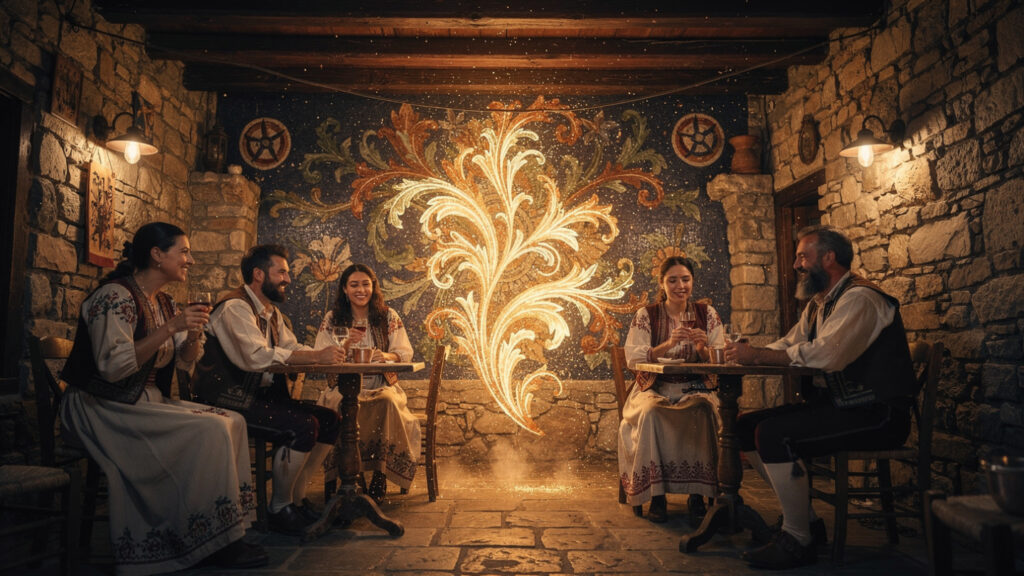
Kefi is also not hygge, the Danish concept of cozy comfort that the international lifestyle media has placed alongside it in the category of untranslatable national joy words. Hygge is domestic and enclosed and warm: the candle on the table, the thick socks, the rain against the window. Kefi is the opposite of this in almost every dimension: it is public and open and the temperature rises as it develops. The kefi that arrives in a Cretan kafeneion at midnight when the lyra player has been playing for four hours and someone who has been sitting quietly at the back of the room stands up and begins to dance is not cozy. It is fierce. The comparison to hygge that the lifestyle media finds useful is the comparison that most completely misrepresents what kefi is.
The Musical Foundation
Kefi in its most concentrated form is a musical phenomenon, and the relationship between kefi and music in the Greek tradition is the relationship between a state and its most reliable catalyst rather than the relationship between a mood and its soundtrack.
The Greek musical tradition understands music’s function in the gathering not as background or accompaniment but as the primary agent of the collective state that the gathering is attempting to reach. The musician at the Greek table is not providing entertainment in the sense of a performance that the audience observes. The musician is providing the energy that the gathering requires to move from the territory of the sociable into the territory of the transformed. The musician’s skill, in this understanding, is not only the technical skill of playing the instrument but the social skill of reading the gathering’s readiness and knowing when to push toward the moment and when to wait.

The zeibekiko is the dance that most completely embodies kefi in its individual form: the solo dance of the Smyrna tradition that the rebetiko culture brought to mainland Greece after 1922, in which the dancer enters the floor alone, without a partner, without a fixed choreography, and improvises the sequence of movements that the music and the moment and the dancer’s own particular emotional state are generating together. The person watching the zeibekiko is watching someone in the condition of kefi made visible in movement: the dancer is not performing for the audience but is in the music in the way that the music and the dancer have temporarily become the same thing.

The tsifteteli is the dance that moves between the individual and the collective: beginning as a solo improvisation and gathering others around the original dancer as the kefi spreads from the person who first entered it to the people around them. The spread of kefi through the tsifteteli’s gathering movement is the most direct visible representation of kefi’s social character: it is not one person’s private state but a state that can be transmitted from person to person through the medium of the shared music and the shared physical space.
The sirtaki, the dance that the international imagination most readily identifies as Greek, is in fact one of the newest Greek folk dances. It was choreographed for the film Zorba the Greek in 1964 from elements of the hasapiko by Mikis Theodorakis and danced by Anthony Quinn. Its global recognition as the dance of kefi is the recognition of a relatively recent theatrical creation rather than of the oldest and deepest expressions of Greek dance culture. The hasapiko, the kalamatianos, the tsamiko, and the Cretan pentozali are all older and more regionally rooted forms whose collective spirit of kefi the sirtaki was designed to represent on screen.
Kefi and Its Relationship to Eudaimonia
The ancient Greek philosophical world understood joy through the concept of eudaimonia, the condition of a person whose life as a whole was going well because the rational ordering of their activities and relationships was producing the quality of human flourishing that the ethical schools regarded as the highest good. Eudaimonia was not a feeling. It was an evaluation of a life or of a substantial portion of a life. Aristotle is explicit about this. The person who has had a good morning has not achieved eudaimonia, because eudaimonia is the assessment of the arc of a life rather than the assessment of a single moment.
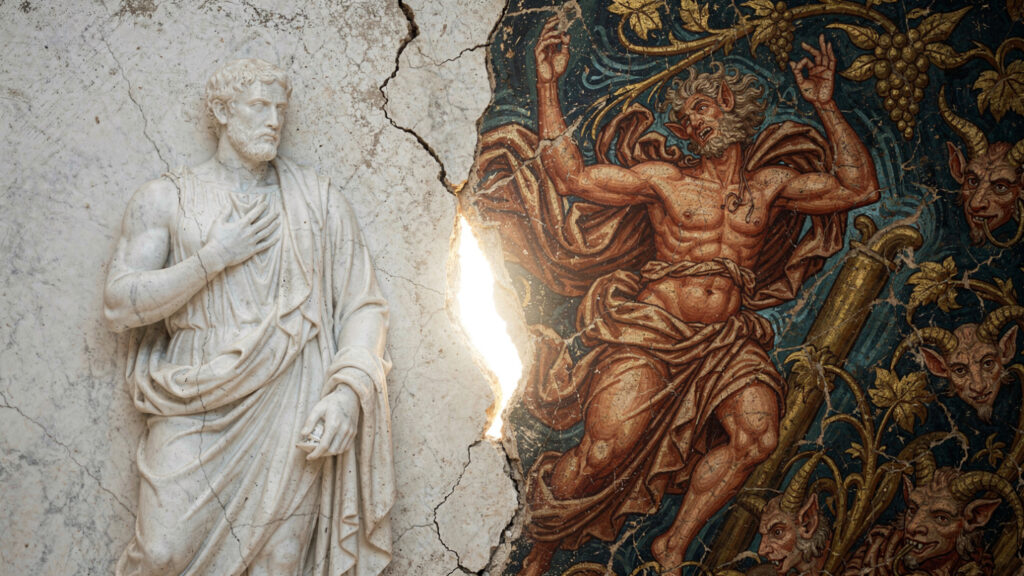
Kefi is the opposite of eudaimonia in almost every structural dimension. It is momentary where eudaimonia is longitudinal. It is felt rather than assessed. It is beyond rational control where eudaimonia is the achievement of the rational person who has organized their life correctly. The philosophical schools of antiquity did not develop an account of kefi because kefi is not the kind of phenomenon they were trying to understand. It belongs to the domain of Dionysian experience, the domain of the ecstatic and the temporary and the fundamentally un‑philosophical, that the Platonic lineage consistently placed in opposition to the philosophical.
The rebetiko world understood the relationship between kefi and what we might call eudaimonia with a clarity more honest than either the philosophical dismissal of the momentary or the wellness industry’s appropriation of it. The songs speak about the quality of the moment of kefi within the life that surrounds it, which is the life of the margins, the life of prison, poverty, the hashish den, loss, and the grief carried by the refugees who brought this music from Smyrna to Piraeus after 1922. The kefi that rebetiko celebrates is the kefi that arrives in conditions of deprivation, the joy made more intense because it has been earned against the resistance of the circumstances in which it appears.
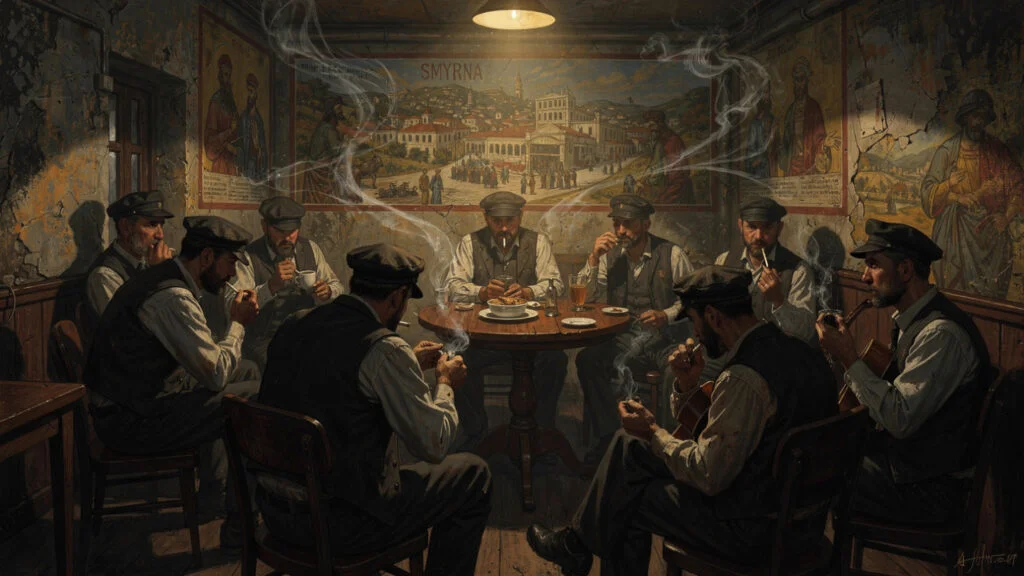
This is the dimension of kefi that the wellness appropriation most completely loses: kefi is not the joy of the comfortable person who has arranged their life to maximize positive experience. It is the joy that breaks through despite the conditions that would prevent it if it were merely a function of comfortable circumstances. The kefi of the rebetiko is the kefi that arrives in the kafeneion at midnight when the people in it have been carrying the weight of the migrant experience for decades, and the music and the company and the wine provide the moment of release that the weight has been building toward.
Meraki and Filotimo | The Conditions of Kefi
Kefi does not arrive in isolation from the other qualities of the Greek character that the social and philosophical tradition has developed: it arrives as the consequence of the conditions that meraki and filotimo establish.
Meraki is the word for the quality of total devotion that the Greek tradition expects from the person who is doing something worth doing: the cook who is making a dish with meraki is not following a recipe but is putting themselves into the preparation, and the dish reflects this in the quality that cannot be produced by the person who is executing a procedure rather than creating something. The musician who plays with meraki is not performing a song but inhabiting it, and the quality of the music that meraki produces is the quality that allows the gathering to move toward kefi. Without meraki in the music, kefi cannot arrive in the dance, because kefi requires the quality of a prior devotion that has created the conditions for the release.
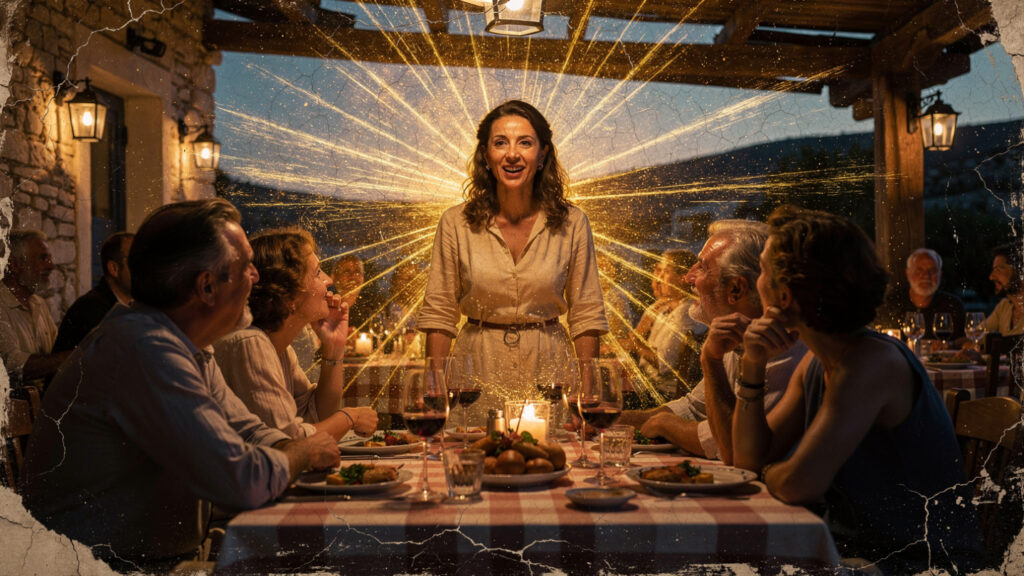
Filotimo, which Greek culture translates imperfectly as love of honor, names something broader and more social. It is the quality of the person who understands their obligations to the people around them and fulfills those obligations not from calculation but from the pride that Greek society associates with being the kind of person who does what they are supposed to do without being asked. The filotimo a host brings to the table, the lavishness of hospitality offered not with an eye to cost but from pride in the quality of what one provides, is the social condition that makes kefi possible. Kefi arrives most readily in gatherings where the host’s filotimo has established that the occasion is honored, that the people at the table are valued, and that the moment has been taken seriously enough to merit the joy that appears when the conditions for it have been properly prepared.
Where Kefi Lives
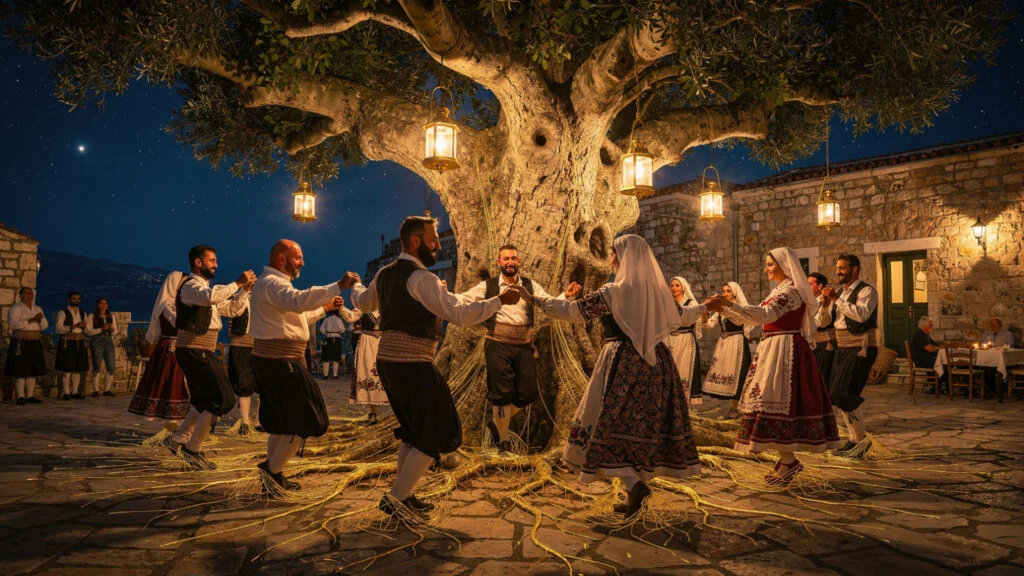
The panegyri, the village saint’s day festival that the Cultural Chronicles article in this collection develops in full, is the institution where the conditions for kefi are most deliberately assembled: the liturgical preparation, the communal cooking, the gathering of the dispersed community, the music that begins in the early evening and continues through the night, the quality of the outdoor summer gathering under the plane trees with the tables set up in the square and the whole village and its returning diaspora assembled together. The kefi that arrives at the panegyri is the kefi that has been earned by the weight of the preparation and the quality of the assembly: it arrives when the music has been playing long enough and the wine has been circulating long enough and the company has been warming long enough that the threshold is crossed and the gathering stops being a gathering and becomes something else.
The kafeneion of the Greek mainland village, which the gambling article in this collection develops as the institution where the tavli board has been open since morning, is the institution where kefi can arrive in a smaller and more quotidian form: the kefi of the afternoon conversation that has been running for two hours, in which something has been said or a combination of the company and the coffee and the shared reference has produced the moment of collective recognition that kefi names. This is the everyday form of kefi, less dramatic than the panegyri’s midnight dance but present in the same essential quality: the moment when the management of the experience stops and the experience takes over.
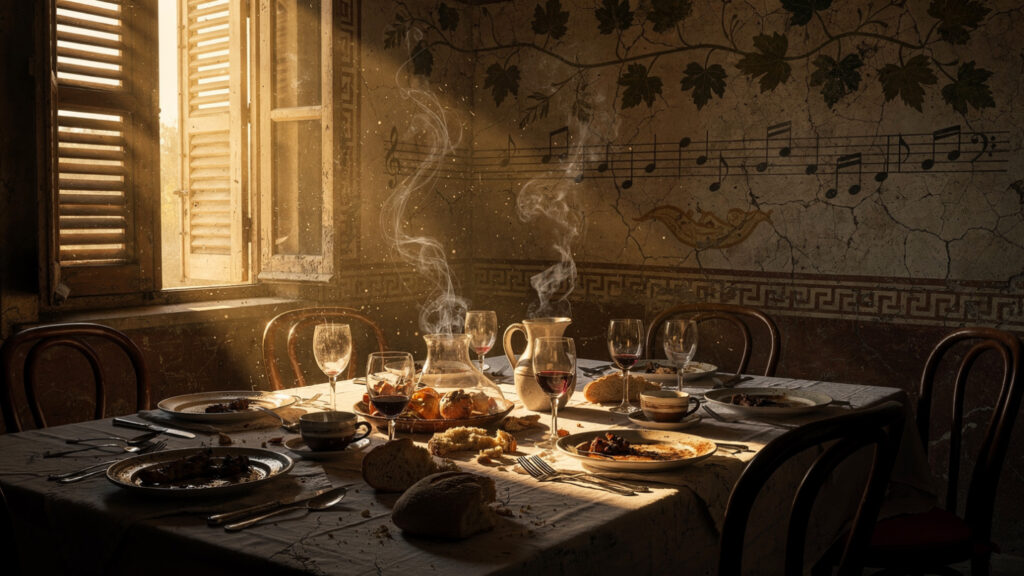
The Greek table at its most complete, the Sunday lunch that has been running since midday and that is still running in the late afternoon with the coffee and the sweets and the reluctance to end that the Greek table produces when the conditions for kefi have been met, is the domestic institution where kefi arrives most quietly and most durably: the family and the extended family assembled around the table in the quality of the long Greek lunch, where the food has been eaten and the dishes cleared and what remains is the company and the conversation and the warmth of the afternoon through the shuttered windows, is the condition where kefi sometimes arrives not as a dramatic outbreak but as the quality of the afternoon itself.
What Kefi Asks of You
The person who visits Greece seeking kefi is the person who will find the conditions for it more readily than the person who visits Greece seeking other things, and the quality of the seeking makes all the difference: kefi cannot be sought directly. It can only be sought indirectly, by seeking the conditions that make it possible.
Go to a panegyri in August and stay until midnight. Find a taverna where the owner is clearly in meraki about the food and accept what they recommend. Sit at a table with people who have been at the table long enough that the conversation has passed through the preliminary phases and arrived somewhere more honest. Listen to the music rather than using it as background. Accept the glass that is being offered. Stay longer than you planned. The person who does these things and has arrived at the conditions where kefi is possible has put themselves in the way of it as completely as it can be done.
Kefi will arrive or it will not. The person who insists on it will not find it. The person who is present enough to recognize it when it arrives, and willing enough to join it when it does, has understood the Greek understanding of joy: not something to be achieved but something to be recognized and accepted when it comes, with the gratitude of the person who knows that it could just as easily not have come and that its arrival is a kind of grace.
At Olympus Estate, Greek Living traces the customs and rhythms that connect the ancient Greek world to the one still visible in the kafeneion and the panegyri and the long Sunday lunch. Kefi is not happiness. It is the moment when the happiness stops being managed and starts being inhabited. The rebetiko singers knew this in the port cities and the hashish dens. The dancers at the village festival know it at midnight. You will know it when it arrives. Stay long enough for it to arrive.