





In 432 BCE, the Parthenon was finished.
The statement is deceptively simple for what it describes. The building that Pericles had commissioned from the architects Iktinos and Kallikrates, with Pheidias overseeing the sculptural program, had been under construction for fifteen years. It rose on the highest point of the Acropolis above a city that was, at that moment, the wealthiest, most intellectually productive, and most politically significant in the Greek world. It was built from Pentelic marble quarried from the mountain approximately sixteen kilometers northeast of the city, transported to the Acropolis, and worked by craftsmen whose names the inscriptions of the period preserve in the administrative accounts of the building project alongside the costs of their labor.
The Parthenon that was finished in 432 BCE was not the ruin that the Acropolis displays now. It had columns that were fully intact, a roof that enclosed the interior, a cult statue of Athena Parthenos that Pheidias had made from gold and ivory at enormous cost and that stood approximately twelve meters tall inside the cella, its gold drapery and ivory skin visible through the doorway, its presence dominating the interior of a building designed around it. The exterior carried 92 metopes carved in high relief, depicting the Gigantomachy, the Amazonomachy, the Centauromachy, and scenes from the Trojan War. The continuous frieze running around the inner building depicted the Panathenaic procession, 160 meters of carved marble showing Athenian citizens and gods in a single narrative sequence. The two pediments at either end contained free-standing sculptural groups depicting the birth of Athena from the head of Zeus and the contest between Athena and Poseidon for the patronage of the city.
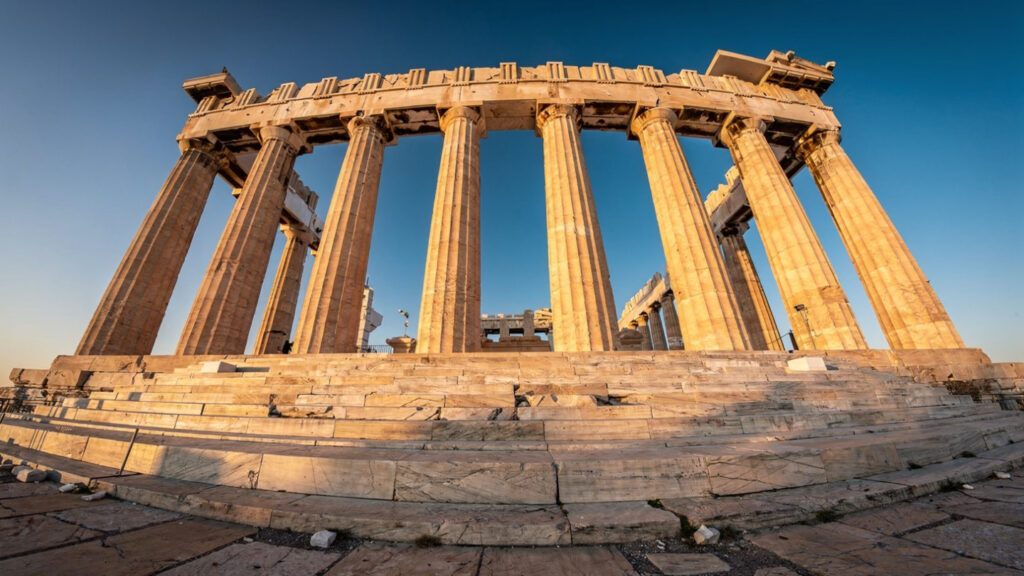
None of this is fully visible at the Acropolis today. The statue of Athena has been gone for over a thousand years, its exact appearance reconstructed from ancient descriptions and from later copies. The metopes are distributed across the British Museum, the Louvre, the Acropolis Museum, and the building itself in various states of completeness. The pediment sculptures that survived the centuries are in the Acropolis Museum and the British Museum. The frieze is similarly divided. The building itself is under restoration, its columns supported by steel dowels inserted in place of the original iron clamps that corroded and split the marble over two millennia, its roof absent since at least the Byzantine period.
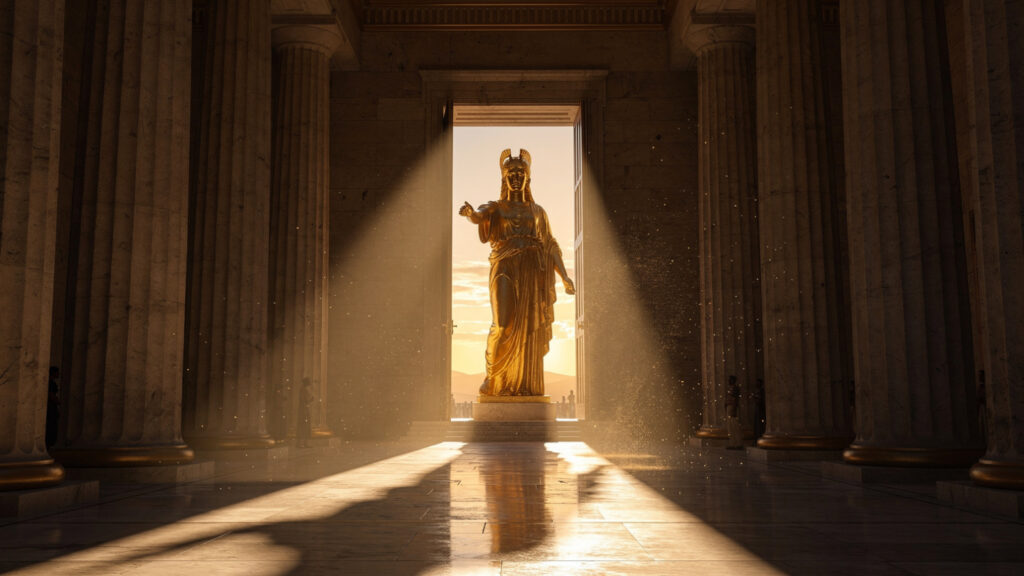
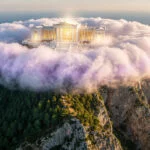
What Juan de Lara, Professor at the University of Oxford with expertise in classical antiquity and digital humanities, has produced is a reconstruction of the Parthenon as it stood in 432 BCE, using CGI technology built on the Unreal Engine framework that powers contemporary video game rendering: a photorealistic three-dimensional model of the building in its complete original state, with its full sculptural program, its original paint, and the quality of its Pentelic marble in the light of an Athenian day.
What the Reconstruction Required
The Parthenon is one of the most documented ancient buildings in the world, and the documentation has been accumulating since the seventeenth century when the first systematic architectural surveys were made. The building’s dimensions, column spacings, entasis curves, and proportional system have been measured, analyzed, and debated in a scholarly literature that fills entire library sections.
The refinements, the subtle deviations from perfectly straight lines and perfectly vertical columns that the Parthenon’s builders introduced throughout the structure, are among the most discussed features in the history of ancient architecture. The stylobate, the platform on which the columns stand, curves slightly upward toward the center rather than lying flat. The columns lean slightly inward rather than standing perfectly vertical. The corner columns are slightly larger in diameter than the others. These adjustments, which would be individually imperceptible to most observers, combine to give the building a visual presence that perfectly straight and vertical construction would not have achieved, correcting the optical illusions that large-scale architecture produces and making the building appear more precisely regular than a perfectly regular building would look.
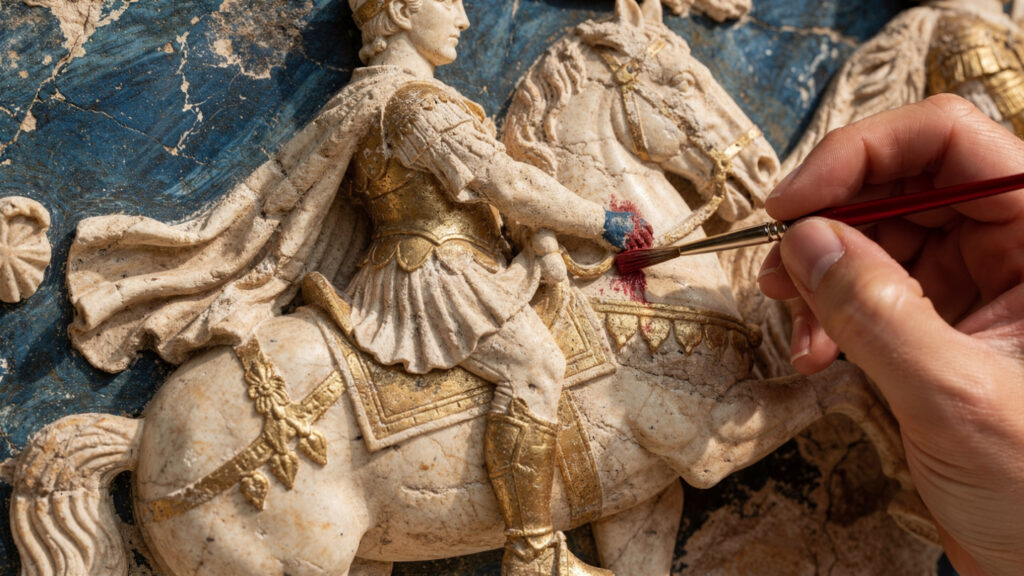
The sculptural program presents different challenges. The original paint that covered the marble sculptures, which were never intended to be seen in the white stone that centuries of weathering left them in, has been partially reconstructed through analysis of the pigment traces that the protected inner surfaces of the carvings still carry. The original colors were not the polychrome excess that some nineteenth-century reconstructions imagined: recent analysis suggests a more restrained palette in which the backgrounds were painted in strong colors, blue and red primarily, while the figures retained more of their marble surface, with paint used selectively for details of dress, armor, and attributes.
The statue of Athena Parthenos presents the greatest challenge of any element of the reconstruction. The ancient descriptions, particularly that of Pausanias, who saw the statue in the second century CE and described it in some detail, give the general character of the piece but not the precision that a three-dimensional model requires. The surviving copies, the best of which is the Varvakeion Athena in the National Archaeological Museum of Athens, are small-scale Roman copies that preserve the general composition but necessarily lose the quality of a twelve-meter original in gold and ivory. De Lara’s reconstruction of the statue synthesizes these sources into a version that carries what the sources confirm and models what they leave ambiguous with the scholarly consensus of those who have worked on the question most carefully.
What Astronomy Added
Professor de Lara’s reconstruction incorporates astronomical data to determine the quality of light in which the Parthenon and its surroundings are presented: the position of the sun at times of day and year, the angle at which the light entered the interior through the eastern doorway, and the relationship between the building’s orientation and the rising of the sun at points in the Athenian religious calendar.
The Parthenon’s orientation, facing east within the conventional Greek temple orientation, was not determined arbitrarily. The sunrise on the feast day of Athena’s birthday, the Panathenaia, would have entered the eastern doorway of the Parthenon and illuminated the face of the cult statue in the interior with a directness that no other day of the year would have produced. The building’s relationship with this moment in the astronomical calendar was part of its religious function, and the reconstruction renders this relationship in the quality of light that the astronomical data defines.
The incorporation of astronomical data into architectural reconstruction is not new: the same approach has been applied to Stonehenge, to the temples of Egypt’s Abu Simbel, and to other ancient structures whose orientation has been analyzed in terms of their relationship to solar and astronomical events. For the Parthenon, the convergence of the building’s orientation, the Athenian religious calendar, and the light qualities of the Attic atmosphere produces a reconstruction whose temporal specificity goes beyond the generic daylight of most ancient building visualizations.
The Building as Religious and Political Object
The Parthenon was a temple. It was also a treasury, a monument, and a political statement of a specific and calculated kind.
The building fund for the Parthenon was drawn in part from the tribute that the Delian League’s member states paid to Athens as the dominant power in the alliance formed after the Persian Wars. The use of allied tribute money to finance the construction of a building on the Athenian Acropolis was politically contentious in the ancient world: Pericles’ opponents in Athens criticized the appropriation of what was nominally a common defense fund for the glorification of the city that controlled it. The Parthenon was built with money that the allies of Athens had paid for collective security and that Athens had redirected to building the most expensive temple in the Greek world on its own acropolis.
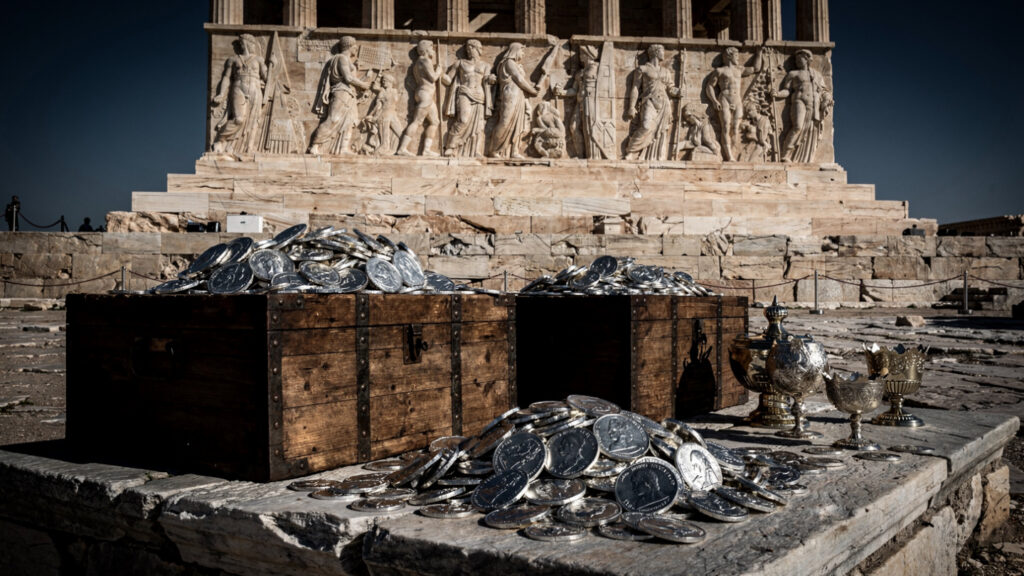
This political dimension is visible in the building’s sculptural program. The Amazonomachy depicted on the metopes of the west facade specifically referenced the mythological battle that Athenian tradition associated with Theseus’s defeat of the Amazons who had invaded Attica: a story of Athenian defense against external attack that the building’s position celebrating Athenian victory at Marathon and Salamis against the Persians made directly legible as political narrative. The Athenians who looked at the Parthenon’s exterior frieze were looking at a building that told them a story about who they were and what they had defeated.
The cult of Athena Parthenos that the temple housed was not the primary cult of Athena on the Acropolis: that belonged to the older Erechtheion and the ancient olive wood statue of Athena Polias that it contained, which was the image that the Panathenaic procession delivered a new robe to every four years. The Athena Parthenos statue was too large to be the object of this ritual. It was a demonstration of what Athenian wealth and craft could produce at the moment of the city’s maximum power, a permanent statement in gold and ivory of the goddess’s presence in a city that had made itself the center of the Greek world.
De Lara’s reconstruction holds this dimension of the building in the same focus as its architectural refinements: the Parthenon was a building that meant something to the people who built it and to the people who looked at it, and the visual reconstruction that renders it in accurate light and accurate color is also a reconstruction of the argument the building was making.
The Acropolis Museum and What Survives
The new Acropolis Museum, opened in 2009 at the base of the Acropolis hill below the Parthenon, was designed by the architect Bernard Tschumi to house the surviving sculptural elements of the Acropolis monuments in the relationship to the buildings above that their original positions defined.
The museum’s top floor, the Parthenon Gallery, is oriented to match the orientation of the Parthenon above: the surviving sections of the frieze are displayed in the position they occupied on the building, with plaster casts filling the sections that are in the British Museum or the Louvre, making the full circuit of the 160-meter frieze legible for the first time since the seventeenth century when much of it was removed. The effect of seeing the complete frieze in correct sequence, even with the cast sections marking the absences, is qualitatively different from seeing the fragments in separate museums where their relationship to each other and to the building is not spatially present.
The pediment sculptures that remain in Athens, displayed at the height they occupied on the building, carry the quality of original ancient marble that no cast reproduces: the surface texture, the relationship between the preserved paint traces and the stone color, and the character of the carving that Pheidias’s workshop produced. The reclining Dionysos figure from the eastern pediment’s left corner, among the most admired works of sculpture from any period of Western art history, is not among them. The original remains in the British Museum in London, part of the Parthenon Marbles removed by Lord Elgin’s agents in the early nineteenth century, and only a cast occupies its original position in the Acropolis Museum’s reconstruction of the pediment.
De Lara’s reconstruction, which can be experienced through the video at the link below, provides the complement to the museum visit that the museum itself cannot provide: the complete building in its original state, from the outside, in the light of an Athenian morning. The museum shows what the sculpture looks like. The reconstruction shows what the building that contained it looked like, which is a different and necessary form of understanding.
Watch the Reconstruction
The full CGI reconstruction by Professor Juan de Lara is available at:
![The Parthenon 3D - Ancient Greece in UNREAL ENGINE 5 + BLENDER [4K]](https://www.olympusestate.com/wp-content/cache/flying-press/5caf6aac735d41512a5b0bdce1177ab9.jpg)
The video is approximately eight minutes long and renders the Parthenon and the Acropolis in conditions that range from the morning arrival of light across the hill to the quality of midday illumination on Pentelic marble. It is the most archaeologically precise photorealistic reconstruction of the Parthenon currently available and the first to incorporate astronomical data at this level of specificity.
For the visitor planning a trip to Athens, watching this reconstruction before visiting the Acropolis and the Acropolis Museum provides the visual context that the existing ruins, beautiful as they are, cannot provide unaided: the knowledge of what was there before, in sufficient detail and sufficient accuracy to make the surviving fragments of the building legible as parts of something that was, for a period in a city, whole.
At Olympus Estate, Archaeology and Ancient Sites treats no ruin as merely a ruin. The Parthenon was finished in 432 BCE. Professor de Lara has given us the means to see it at that moment, which is not a small thing. The building that Athens built at the height of its power can now be understood again as its builders intended it to be seen: complete, painted, lit by the light of the Attic sky, and carrying everything the city had decided to say about itself.