



The wind that pulls off the peaks of Mount Olympus in early January carries a bite that doesn’t just chill the skin but seems to clear the mind of the previous year’s dust. There is a specific kind of silence in the Greek winter, especially in the high villages where the woodsmoke from stone chimneys hangs low in the damp air. It is a quiet that invites a different kind of thinking. In the modern world, we are taught to approach the new year with a frantic energy, a list of demands we make upon ourselves to be faster, thinner, and more profitable. We call these resolutions, yet they often feel like indictments. We treat our lives like a business that needs restructuring, a project that is perpetually behind schedule.
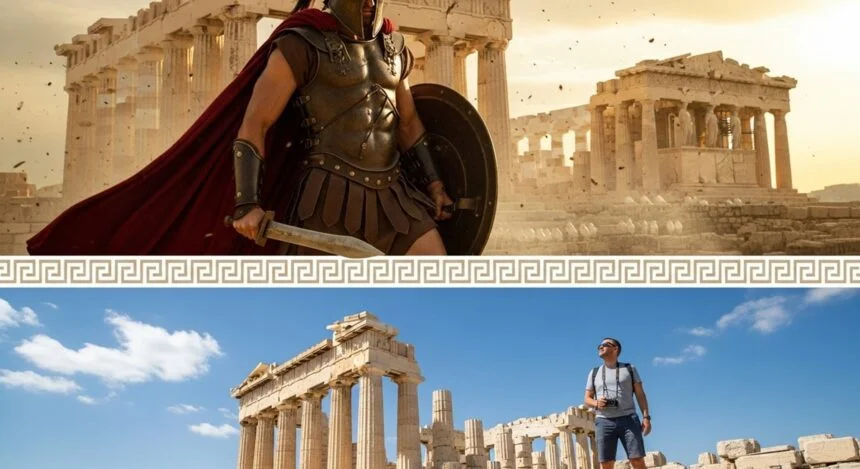
The people who walked the streets of Athens and the slopes of the Peloponnese thousands of years ago would find this approach puzzling and perhaps even a little tragic. For them, new beginnings were not about the accumulation of achievements. They were about the restoration of balance. They understood that the human spirit is not a machine to be optimized but a landscape to be tended. To start something new was to return to the roots of one’s own nature. This required a deep, often uncomfortable period of reflection that preceded any action. Before they could move forward, they had to understand where they were standing. This was the fundamental lesson of Ancient Greek philosophy as it applied to the lived experience of time and change.
The Two Faces of Time and the Rhythm of Kairos
The first thing a modern traveler must unlearn when stepping into the current of Greek culture is the idea that time is a flat, uniform line. The ancients had two distinct words for time, and the difference between them is where the possibility of renewal truly lives. There was Chronos, the sequential, relentless movement of the clock that devours everything it creates. This is the time of deadlines and graying hair. But there was also Kairos, the opportune moment, the time that cannot be measured by a ticking mechanism. Kairos is the window that opens when the right conditions meet the right intention.
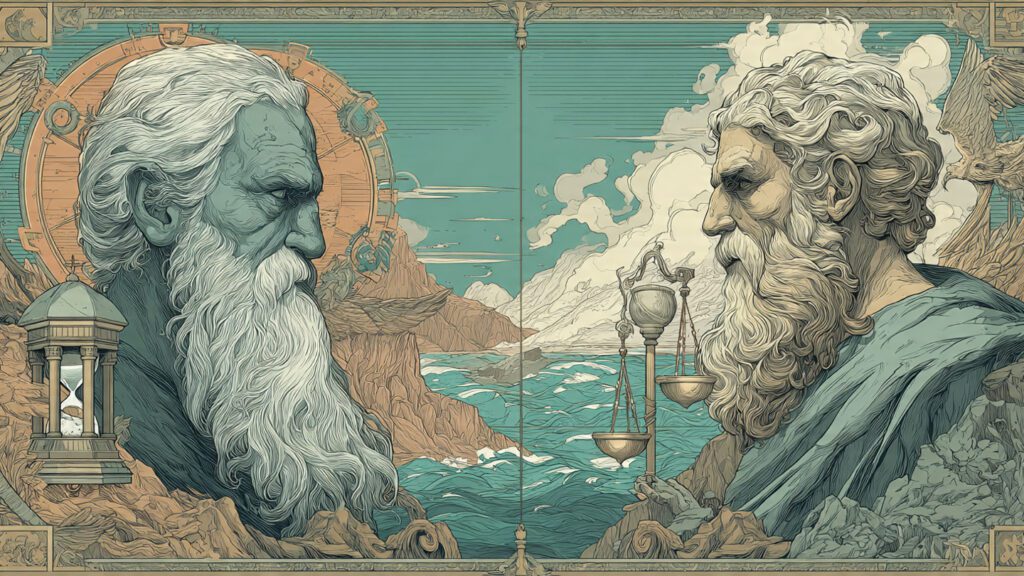
A new beginning in the ancient sense was an attempt to step out of Chronos and into Kairos. You did not resolve to change because it was January first. You waited until you sensed the opening. This required a level of patience that is almost entirely lost to us today. It meant watching the seasons, listening to the rhythms of the land, and waiting for the internal resonance that signaled it was time to move. When the Greeks spoke of wisdom, they often meant the ability to recognize these moments. To act outside of Kairos was to struggle against the wind. To act within it was to have the gods at your back. This shift in perspective transforms the pressure of a deadline into the grace of an invitation.
The Socratic Threshold and the Burden of the Unexamined Life
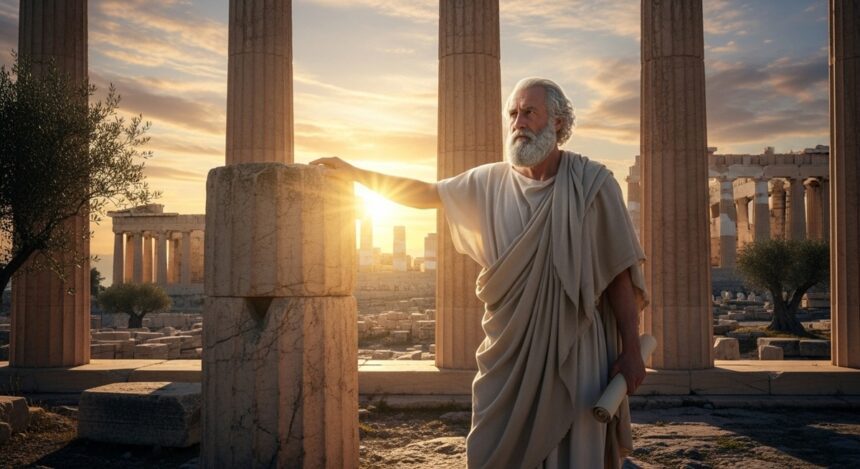
If you were to encounter Socrates in the bustling Agora of Athens, he would likely stop you before you could utter a single resolution. He would not ask you what you intended to do in the coming year. He would ask you if you knew who was doing the intending. For him, the only way to begin something new was to subject the old self to a relentless, honest examination. The famous command to know thyself was the ultimate prerequisite for any change. He believed that most of us live our lives according to habits and opinions we have inherited from others, moving through the world like sleepwalkers.
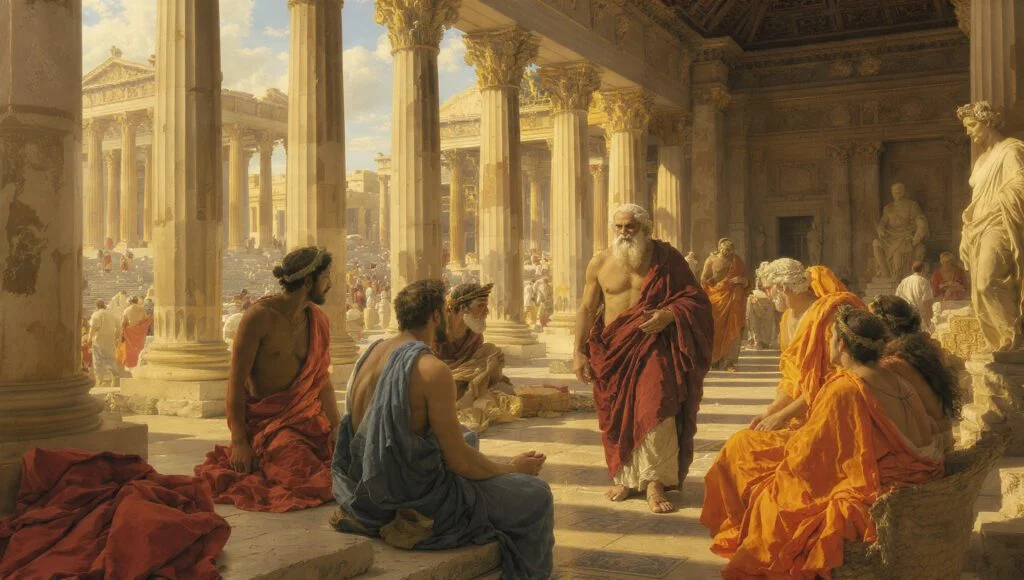
A Socratic new beginning is a waking up. It starts with the admission of ignorance. This is a far cry from the confident, often arrogant proclamations of modern goal setting. Instead of saying I will do this, the Socratic approach suggests I will question why I feel the need to do this. It is a peeling back of the layers of social expectation and ego until you reach the core of what is true. This process of reflection is not a passive act. It is a vigorous, sometimes painful dismantling of the false self. Yet, it is only after this clearing that a genuine beginning can occur. The ground must be plowed and the weeds removed before the seed of a new intention can take root.
Platonic Reordering and the Sight of the Good
For Plato, the journey toward a new beginning was always an ascent. He viewed the human condition as one of being trapped in a cave, watching shadows on a wall and mistaking them for reality. Turning around and walking toward the light of the sun was the most difficult beginning a person could undertake. It was not enough to change one’s behavior. One had to change one’s orientation. In his view, the soul is composed of different parts that are often in conflict, a charioteer trying to control two very different horses. One horse is noble and seeks the heights, while the other is unruly and pulls toward the earth.
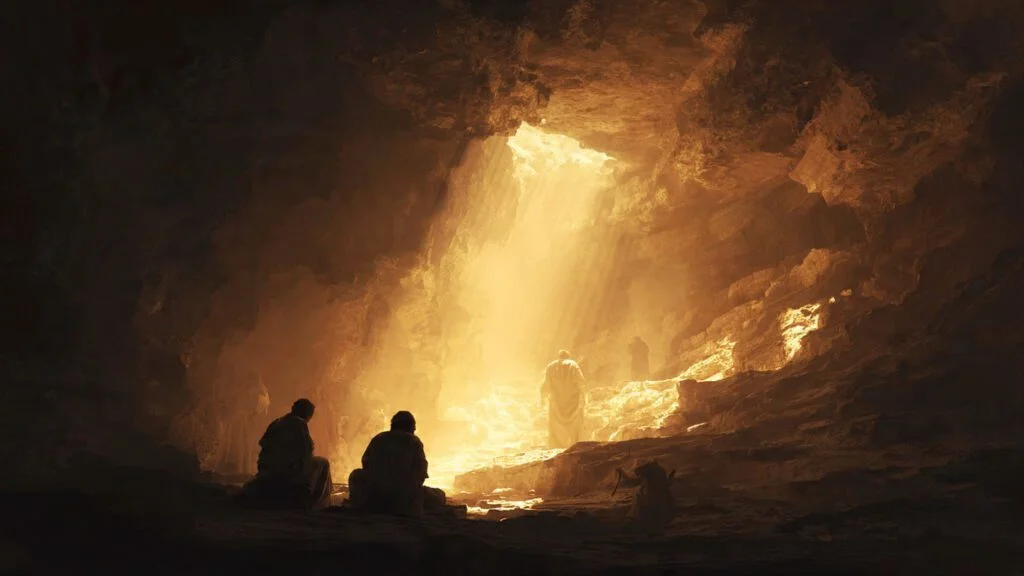
Renewal, in the Platonic sense, is the re-establishment of the charioteer’s control. It is a reordering of the soul so that the highest part, the reason, is in command. This is not about productivity, it is about virtue and harmony. When we look at our lives at the start of a year, Plato would have us ask whether our actions are aligned with the Good, the True, and the Beautiful. If we are merely chasing the shadows of fame or wealth, no amount of resolution will bring us peace. True renewal is the act of turning the entire soul toward the light. It is a slow, methodical climb out of the cave, one that requires us to leave behind the comforts of our illusions.



Aristotelian Habit and the Slow Carving of Character
While Socrates and Plato focused on the heights of the soul, Aristotle brought the conversation back down to the earth, specifically to the dust of our daily lives. He understood that we are what we repeatedly do. Excellence, he argued, is not an act but a habit. He would have been deeply skeptical of the sudden, radical transformations promised by modern resolutions. He knew that the human character is like stone, and you do not change the shape of stone with a single blow. You change it through the persistent, repetitive pressure of the chisel.
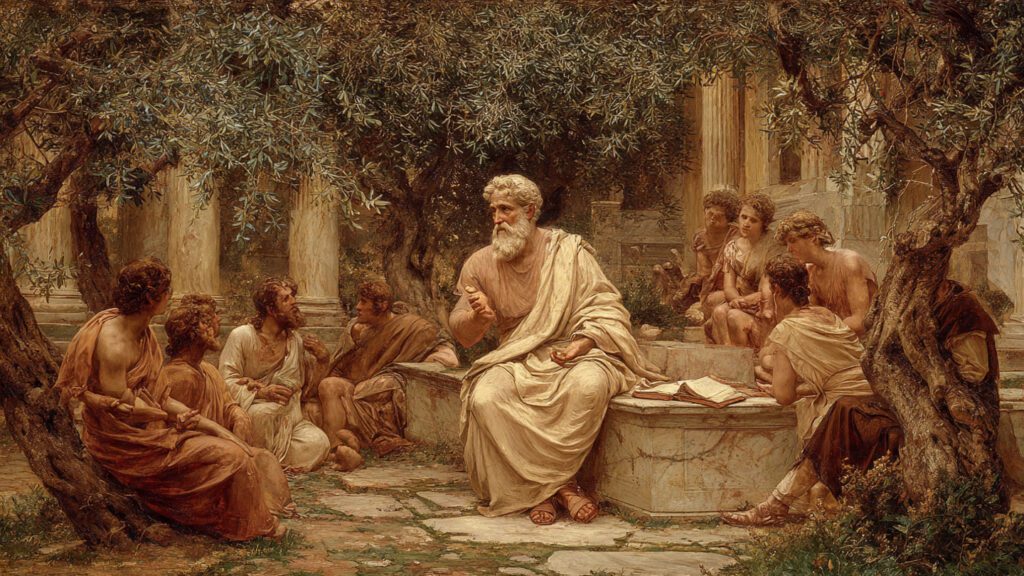
An Aristotelian approach to new beginnings is one of modest, consistent action. He believed that virtue is found in the mean, the perfect balance between two extremes. If you wish to be more courageous, you do not start by fighting a lion. You start by standing your ground in small, everyday ways. Each time you choose the middle path, the path of moderation, you are carving a new groove in your character. Over time, these grooves become deep, and the habit becomes second nature. This is the secret to lasting change. It is not found in the grand gesture but in the quiet, daily commitment to the better version of yourself. It is a process of renewal that is as slow and steady as the growth of an olive tree on the slopes of Mount Olympus.
The Epicurean Garden and the Wisdom of Subtraction
In a world that is constantly telling us we need more, the voice of Epicurus arrives like a cool breeze on a scorched afternoon. He believed that the greatest obstacle to happiness was not a lack of possessions but an abundance of unnecessary desires. He established a garden on the outskirts of Athens where he and his friends lived a life of profound simplicity. For them, a new beginning was often an act of subtraction. It was about stripping away the anxieties of the world, the thirst for power, and the fear of the future, until only the essential remained.
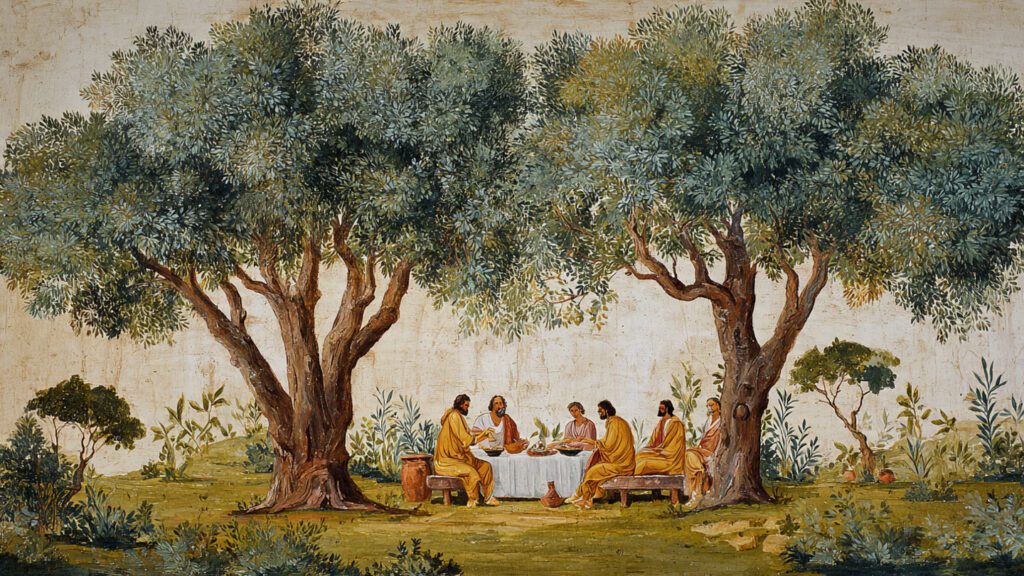
The Epicurean way of starting over is to ask what can be released. What are the burdens we are carrying that do not actually belong to us? We spend so much energy pursuing things that bring us more stress than joy. A new year is the perfect time to walk through the garden of your own life and prune away the dead wood of false ambition. This is a gentle, quiet form of reflection. It doesn’t require a gym membership or a new planner. It requires a piece of bread, a cup of wine, a good friend, and the courage to say that what you have is already enough. This is the wisdom of the garden, a reminder that the soul flourishes in peace, not in the frantic chase.
The Stoic Porch and the Architecture of Resilience
Finally, we find the Stoics standing on the painted porch of the Agora, facing the winter winds with an unshakable steadiness. Their approach to new beginnings was perhaps the most practical of all. They started by drawing a sharp, uncompromising line between what they could control and what they could not. Most of our resolutions fail because they are focused on outcomes that are not entirely up to us. We resolve to be promoted, to be loved, or to be healthy, yet all of these things can be taken away by fortune.

Stoicism teaches us to focus our energy entirely on our own character and our own responses. A Stoic beginning is a commitment to integrity, regardless of the circumstances. It is the realization that while you cannot control the wind, you can always control the sail. This creates a kind of renewal that is immune to the external world. You do not wait for the conditions to be perfect to start being a person of virtue. You start exactly where you are, in the midst of the cold and the chaos. This is the resilience of the Greek spirit, the ability to build an internal citadel that the world cannot touch.
Sacred Geography and the Physicality of Thought
It is impossible to separate Ancient Greek philosophy from the physical land that birthed it. The clarity of the light, the sharpness of the mountain silhouettes, and the vastness of the sea all demanded a certain kind of honesty in thought. When you stand in the ruins of the Agora in Athens, you can feel the ghost of Socrates lingering in the air. The stones are still there, worn smooth by the feet of people who were trying to figure out how to live a good life. These places are not just historical sites, they are anchors for a way of being.

In Delphi, where the oracle once spoke, the words Know Thyself were carved into the very stone of the temple. This was not a suggestion; it was a command to anyone who sought the guidance of Apollo. Even the gods insisted that reflection must come before action. The landscape itself forced you into a state of awareness. The high, thin air of the mountains and the relentless blue of the Aegean do not allow for the clutter of small thoughts. They demand that you look at the horizon. They demand that you consider your place in the vast, cyclical order of things. This is why Greek culture remains so vital. It is a philosophy that is rooted in the earth, as tangible as a handful of olives.
The Continuity of the Greek Spirit at Olympus Estate
This ancient way of approaching life is not a relic of the past. It is a living current that still flows through the contemporary Greek experience. At Olympus Estate, we see this continuity every day. We see it in the way the local farmers tend their land with a patience that spans generations. We see it in the way a meal is shared, with an emphasis on presence and connection rather than speed. We see it in the architecture that respects the light and the wind, built to endure the passage of Chronos while providing a sanctuary for the moments of Kairos.

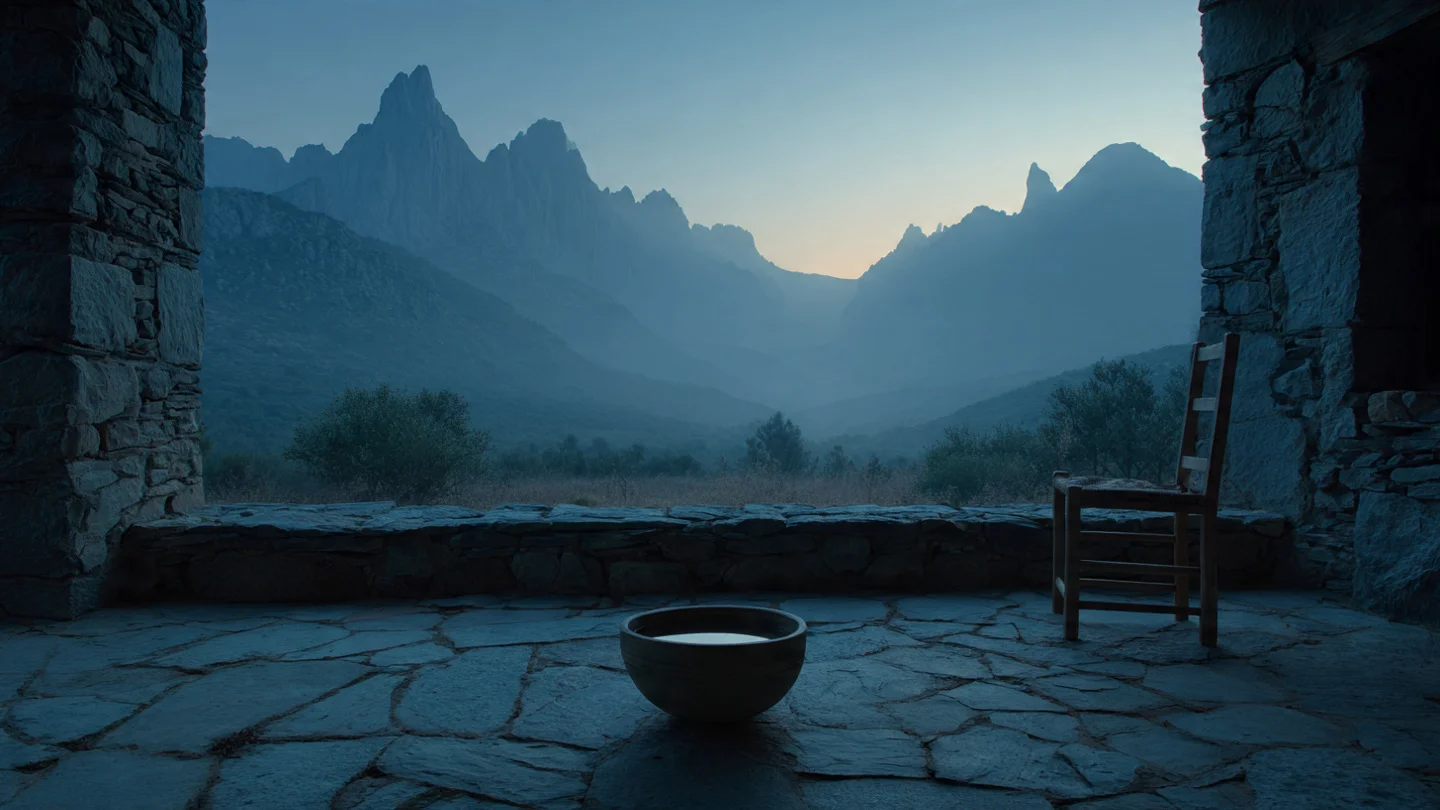
Choosing to live or spend time in this environment is, in itself, a kind of Socratic beginning. It is a decision to step out of the noise and into a place that demands reflection. The mountain doesn’t care about your resolutions, but it offers you the space to find your own alignment. Whether you are walking through a grove of ancient trees or sitting on a terrace watching the shadows grow long over the valley, you are participating in a tradition of wisdom that is thousands of years old. You are being invited to start again, not with a list of tasks, but with a deeper understanding of who you are and what truly matters.
A Reflective Gaze into the Starlit Future
As the year turns and the winter nights remain long, the temptation to rush into the future is strong. We want to be different, and we want it now. But the philosophers of Ancient Greece would urge us to pause. They would tell us to look at the stars, which move in their own slow, majestic cycles, indifferent to our human clocks. They would tell us that the only true renewal is the one that happens quietly, in the hidden parts of the soul.

The path forward is not found by running faster but by walking more intentionally. It is found in the moments when we stop to question our motives, in the small habits we build with care, and in the simplicity we choose to embrace. The beginning is indeed the most important part of the work, but only if it is a beginning grounded in truth. As we navigate the coming year, perhaps we can trade our frantic resolutions for a more ancient kind of wisdom. Perhaps we can learn to trust the rhythm of the seasons and the depth of our own roots. The light is returning, as it always does, but the growth that matters is the one that happens in the dark, beneath the surface, waiting for its own perfect moment to break through the soil.