


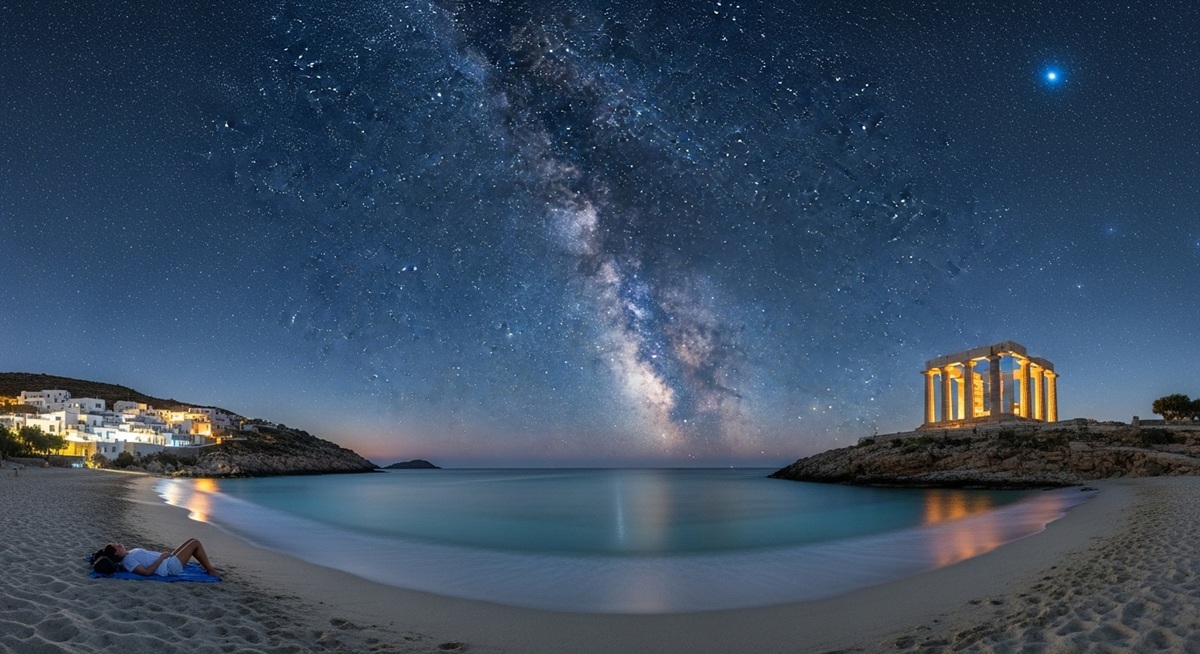
Greece beckons with its iconic whitewashed villages, crystalline turquoise waters, and crumbling ancient temples that whisper tales of bygone eras. But for those intrepid travelers who tilt their gaze upward from the sun-kissed shorelines to the velvet expanse of the night sky, an entirely different realm unfolds—a Greece where the cosmos dances in harmony with the sea. Here, the threads of ancient Greek mythology weave seamlessly into the fabric of the heavens, transforming ordinary beaches into portals to the divine. The stars aren’t mere pinpricks of light; they’re the immortalized heroes, gods, and beasts of legend, shining eternally above the Aegean.
Imagine reclining on warm sand as the Milky Way arches overhead, its milky glow reflected in the gentle waves. This is a profound immersion into Greece’s celestial coastlines, where myth, nature, and adventure converge under a canopy of constellations. From the hunter Orion pursuing his eternal quarry to the chained princess Andromeda awaiting rescue, these stories come alive against the backdrop of remote islands and secluded shores. In a world increasingly dimmed by urban glow, Greece’s low-light-pollution havens offer a rare chance to reconnect with the universe, much as the ancients did millennia ago.
Why Greece is a Star-Reader’s Paradise
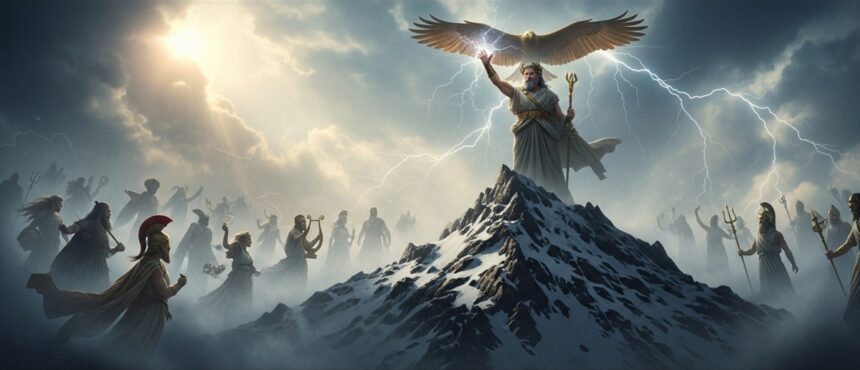
Few destinations on Earth entwine the terrestrial with the cosmic as elegantly as Greece. The ancient Greeks mythologized the stars, mapping the night sky with tales of gods, heroes, and epic quests that still captivate us today. Constellations like Orion the hunter, Andromeda the princess, and Perseus the rescuer weren’t abstract patterns; they were living narratives etched in the heavens by divine hands. Zeus, the king of gods, transformed himself into swans, bulls, and eagles, his exploits immortalized among the stars.
What makes Greece unparalleled for stargazing is its geographical serendipity. Scattered across the Aegean and Ionian Seas, its islands boast some of Europe’s clearest skies, thanks to minimal light pollution in remote areas. Unlike the hazy deserts or lofty mountaintops elsewhere, Greek beaches serve as natural observatories, where the sea’s mirror-like surface doubles the celestial spectacle. The Mediterranean climate ensures mild nights, and the lack of industrial haze allows for visibility that rivals the world’s top dark-sky sites.
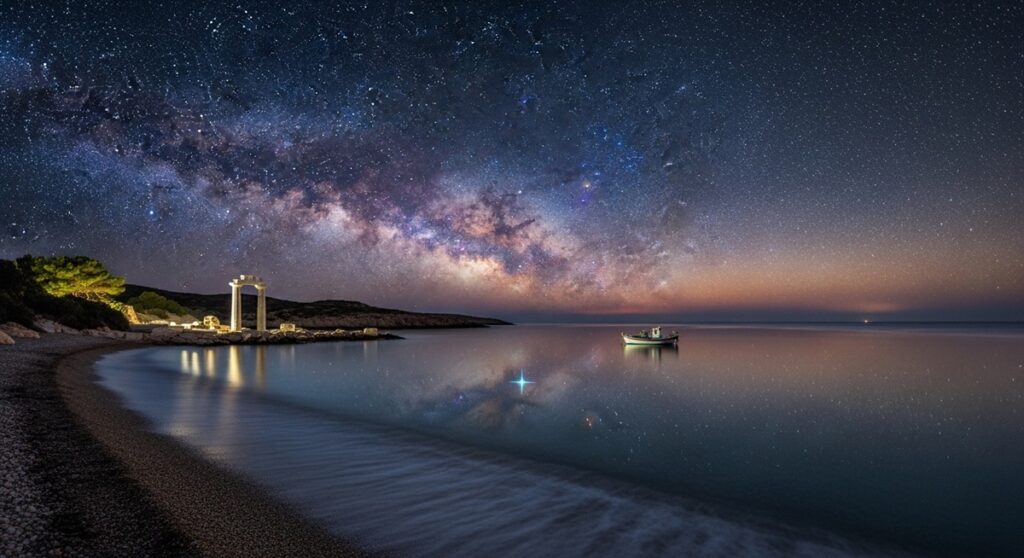
Beyond the science, there’s a poetic allure. On these shores, you’re not just viewing stars—you’re stepping into the myths. The ancient Greeks used these constellations for navigation, agriculture, and storytelling, believing the heavens influenced earthly fates. Today, travelers can recapture that wonder, blending relaxation with revelation. It’s a paradise where the roar of waves harmonizes with the silent symphony of the cosmos.
The History of Ancient Greek Astronomy and Mythology
Delving deeper, the roots of Greece’s celestial fascination trace back to the dawn of Western civilization. Ancient Greek astronomy emerged around the 6th century BCE, blending observation with philosophy and myth. Influenced by Babylonian and Egyptian knowledge, thinkers like Thales and Anaximander pondered the universe’s structure, viewing it as a harmonious cosmos governed by mathematical laws.
Homer’s epics, the Iliad and Odyssey, reference stars and constellations, portraying them as divine signals. By the time of Claudius Ptolemy in the 2nd century CE, the Greeks had cataloged 48 constellations, many of which we recognize today. These weren’t sterile diagrams; they pulsed with mythology. Ursa Major, the Great Bear, stemmed from Zeus transforming Callisto to protect her from Hera’s wrath. The Pleiades, seven sisters pursued by Orion, became a star cluster associated with rain and navigation.
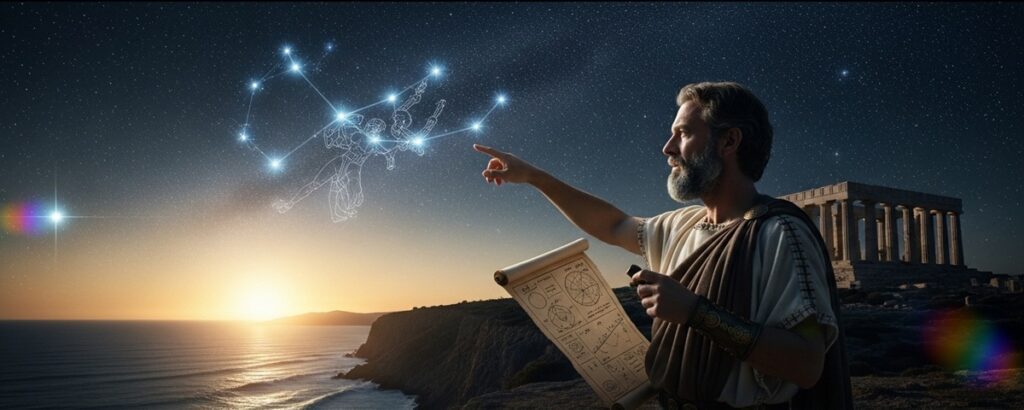
Astronomers like Aristarchus proposed heliocentric models centuries before Copernicus, while Hipparchus measured stellar positions with remarkable accuracy. This fusion of science and story elevated the night sky to a cultural canvas, where gods like Hephaestus forged volcanic wonders below and stellar marvels above. Visiting Greece’s beaches today feels like honoring this legacy, where every twinkling light echoes ancient wisdom.


Best Beaches for Stargazing in Greece
Greece’s archipelago is dotted with beaches that double as stellar gateways, each tied to ancient myths and offering unparalleled stargazing. From rugged Dodecanese outposts to volcanic Cycladic gems, these spots minimize light pollution for breathtaking views. Here’s an expanded guide to the finest, blending lore with practical appeal.
Orion’s Beach – Karpathos
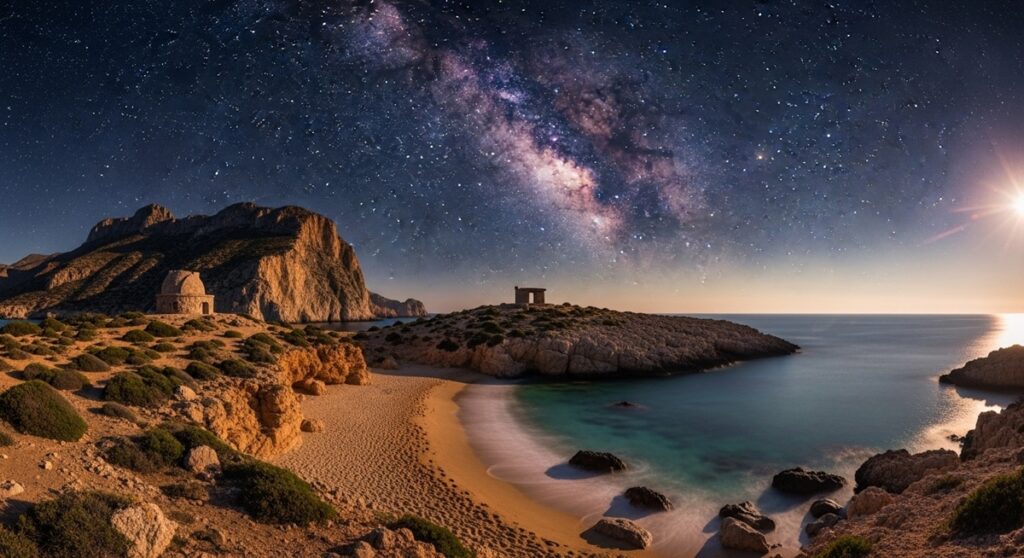
Tucked on the wild island of Karpathos in the Dodecanese, Orionas Beach lives up to its mythical namesake. As night falls, the constellation Orion rises majestically over the horizon, his belt—a trio of bright stars—guiding your gaze across the sea.
Mythic Connection: In Greek mythology, Orion was a mighty hunter slain tragically, elevated to the stars by Zeus. Sailors revered him as a navigational beacon, much like ancient mariners traversing the Aegean.
Travel Tip: This remote stretch is ideal for stargazing in the Dodecanese. Arrive at dusk, spread a blanket, and wait for moonrise—Orion’s reflection in the waves creates a hypnotic mirror effect. Pack insect repellent, as the rugged terrain attracts bugs.
Andromeda’s Shore – Naxos
Naxos, the Cyclades’ largest island, harbors shores near Apollonas village that evoke Andromeda’s dramatic tale. Under dark skies, the Andromeda constellation sprawls above, its stars seemingly cascading into the foam.
Mythic Connection: Chained to a rock as a sacrifice to a sea monster, Andromeda was rescued by Perseus—both immortalized in the heavens. The nearby Andromeda Galaxy (M31) adds a cosmic layer, visible naked-eye on clear nights.
Travel Tip: Late summer or autumn visits yield the best views, with Naxos’ quietude amplifying the experience. Hike to nearby ruins by day, then stargaze—book a guided tour for mythology insights.
Perseus Point – Tinos
Overlooked amid the Mykonos rush, Tinos’ rocky headlands at Kolymbithra Beach frame Perseus’ arc across the sky, especially during meteor showers.
Mythic Connection: Perseus, Medusa’s slayer and Andromeda’s savior, stars in the Perseid meteors, an annual spectacle tied to his legend.
Travel Tip: Mid-August aligns with the Perseids—expect shooting stars galore. Tinos’ pilgrim paths offer daytime exploration; at night, the beach becomes a meteor festival hub.
Milky Way Reflections – Ikaria
Ikaria, famed for longevity, delivers pristine skies at Seychelles Beach, where the Milky Way ribbons across the Aegean.
Mythic Connection: Named for Icarus, who plummeted after flying too near the sun, Ikaria symbolizes hubris and cosmic balance.
Travel Tip: Its remoteness ensures darkness—stay past midnight with a blanket. Combine with thermal springs for a rejuvenating trip.
The Volcanic Cosmos – Santorini
Santorini’s Perissa and Vlychada beaches, with black volcanic sands, turn ethereal after sunset, the cliffs seeming to prop up the sky.
Mythic Connection: Volcanoes signaled Hephaestus’ forge, linking earthly fire to stellar wonders.
Travel Tip: Moonless nights are prime; walk the sands for constellations feeling tactile. Daytime caldera views complement the nocturnal magic.
Cassiopeia’s Mirror – Skiathos
In the Sporades, Skiathos’ Mandraki and Agia Eleni beaches reflect Cassiopeia’s “W” in the sea.
Mythic Connection: Punished for vanity, Cassiopeia—Andromeda’s mother—thrones eternally in the stars.
Travel Tip: Late swims with bioluminescence mimic swimming in stars. Pine forests provide daytime shade.
The Celestial Silence of Gavdos
Europe’s southernmost island, Gavdos, off Crete, offers near-zero light pollution at Tripiti Beach.
Mythic Connection: Echoing Calypso’s isle from the Odyssey, it’s a mythic outpost where stars companion the solitary.
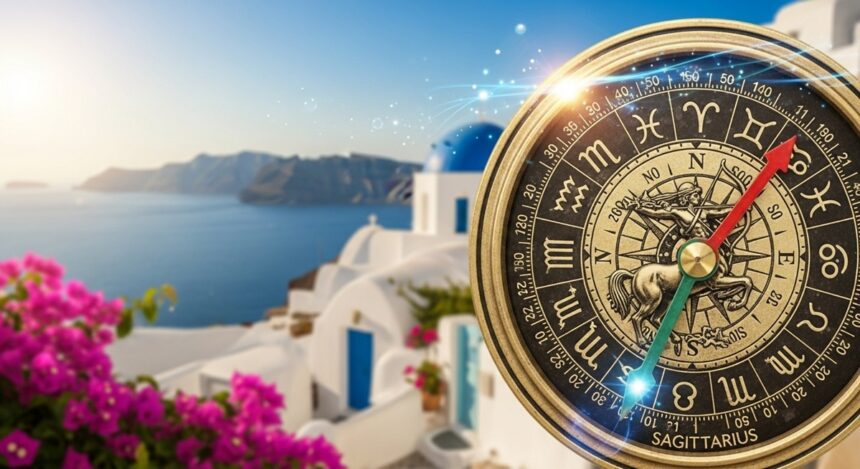
Travel Tip: Watch the zodiac wheel—unchanged since Homer. Ferry access limits crowds.
Lunar Landscapes of Sarakiniko – Milos
Milos’ Sarakiniko Beach, with moon-like white rocks, is a surreal stargazing spot in the Cyclades.
Mythic Connection: Tied to volcanic gods, it evokes Hephaestus’ creations.
Travel Tip: Cliff dives by day, stars by night—perfect for photographers.
Elafonissi’s Pink Sands – Crete
Crete’s Elafonissi Beach, with pink-tinged sands, offers dark skies in a Bortle-class low-pollution zone.
Mythic Connection: Crete, Zeus’ birthplace, links to eagle constellations.
Travel Tip: Southwestern tip ensures darkness; pair with lagoon swims.
Aenos National Park Shores – Kefalonia
Near Kefalonia’s Aenos Park, the first Greek Dark Sky Park, coastal spots like Valtos blend sea and stars.
Mythic Connection: Odysseus’ homeland ties to wandering stars.
Travel Tip: Park trails lead to beaches; summer visits peak visibility.
Best Time to Visit for Optimal Stargazing
Timing your trip maximizes the magic. Summer (June to August) offers warm nights and clear skies, ideal for stargazing amid low humidity. August’s Perseids are a highlight, with meteors peaking mid-month. Spring (April-May) and fall (September-October) avoid crowds, with mild weather and extended darkness. Winter brings crisp views but chillier conditions. Aim for new moon phases to minimize lunar glare. Always check forecasts—Greece’s islands can shift quickly.

Essential Gear and Apps for Your Stargazing Adventure
Pack smart for comfort and discovery. A red-light headlamp preserves night vision, while a reclining chair or blanket combats sand chill. Binoculars (7×50 or similar) reveal details without bulk; telescopes suit serious observers. Layer clothing for dropping temperatures, and bring snacks—nights stretch long.
Apps elevate the experience: SkySafari for detailed maps and telescope control, SkyView Lite for AR identification, and Stellarium for virtual planetariums. For Greece-specific, Windy forecasts weather, and Ferryhopper aids island-hopping. These tools turn passive gazing into interactive quests.
Travel Tips for Exploring Greece’s Celestial Coast
Navigate wisely: Fly into Athens, then ferry or fly to islands—book ahead for peak seasons. Rent cars for remote beaches; public transport lags. Join guided tours for mythology narration and equipment. Respect nature—leave no trace, avoid fires. Safety first: Inform someone of plans, watch tides. Eco-lodges near dark sites enhance immersion.
Combining Daytime Adventures with Nighttime Wonders
Balance nights with days: Hike ancient ruins, snorkel azure waters, savor feta and ouzo. On Naxos, explore temples; in Santorini, wine tours. This duality enriches—myths by day, stars by night—creating holistic memories.
Traveling the Celestial Coast
Embarking on Greece’s celestial coast is to straddle realms: the tangible beauty of beaches and waves, and the ethereal weave of myths in the sky. Each shore is a cosmic theater, where gods like Zeus and heroes like Perseus endure. Beyond ordinary travel, it’s a personal odyssey, reminding us that in Greece, the stars truly draw nearer, bridging ancient wonders with modern awe.