


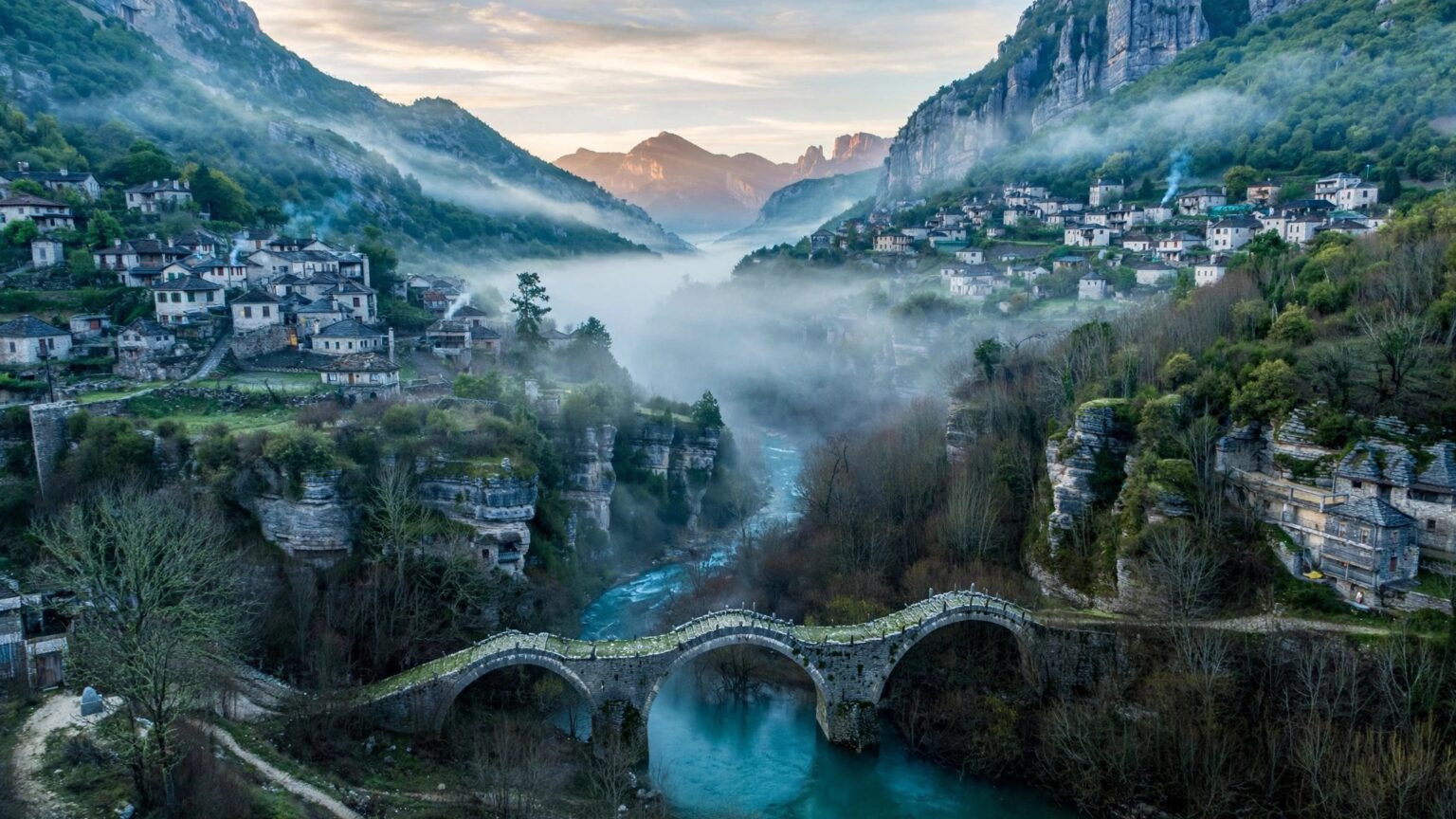
There is a specific silence in the Pindus Mountains that exists nowhere else in Greece.
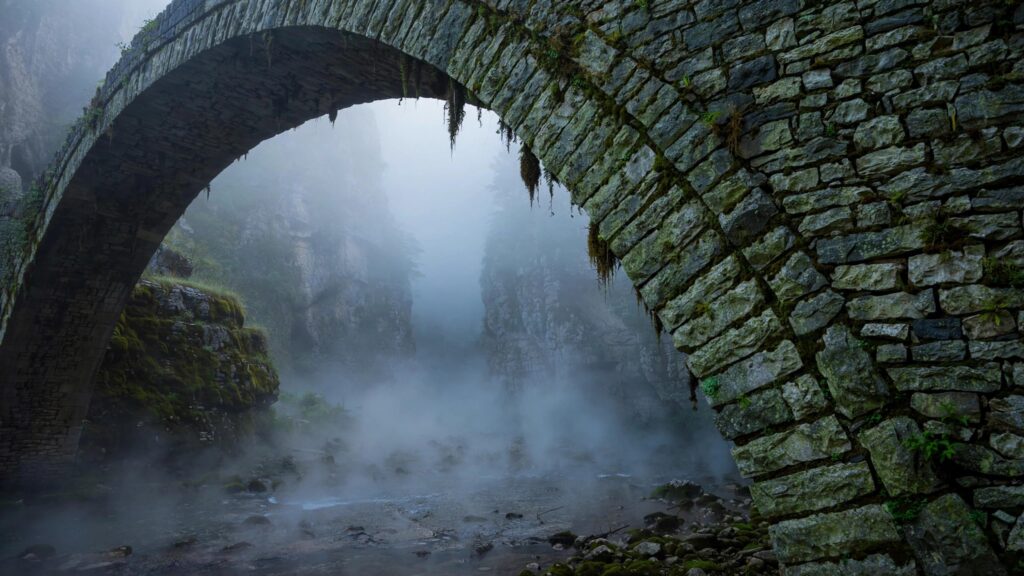
Not the silence of emptiness. The silence of stone that has been resting on stone for three centuries with no intention of moving. Walk across one of the high arched stone bridges of Zagori at dawn, when the mist is still in the river gorge below you and the sound of the Voidomatis rises cold from the water, and the stillness is so complete that you can hear the river’s weight against the bridge’s foundations: the muted vibration of two things that have been in conversation for two hundred years and have reached the kind of understanding that requires no further words.
This is the Zagorochoria: forty-six stone villages distributed along the western slopes of the northern Pindus mountain range in the Epirus region of northwestern Greece, linked to each other and to the valleys below by a network of hand-laid cobblestone paths and arched stone bridges that the master masons of the eighteenth and nineteenth centuries built with the intentionality of people who understood they were building something that would outlast themselves and everyone who came after them. The name itself is older than the stonework: Zagori is a Slavic word meaning roughly the place behind the mountain, a name that predates the villages by centuries and that the region kept through Byzantine rule, Ottoman rule, and Greek independence alike. They were not wrong about what they were building.
On September 19, 2023, at the forty-fifth session of the UNESCO World Heritage Committee meeting in Riyadh, the Cultural Landscape of Zagori was formally inscribed on the World Heritage List, becoming Greece’s first ever inscribed cultural landscape, recognized under Criterion V for representing an outstanding example of traditional human settlement shaped by centuries of agro-pastoral life in a demanding mountain environment. The inscription recognized something the landscape had always communicated to anyone willing to pay attention: that what exists in the Zagori is not a collection of preserved buildings but a living relationship between human construction and mountain geology that has been sustaining itself, with minimal assistance and no concession to the requirements of modernity, for three hundred years.
The Greek islands are about the transparency of light above a flat sea. Zagori is about something older and heavier: the depth of shadow in a mountain gorge, the weight of slate on a roof that has absorbed a hundred winters, the quality of a landscape that the human hand shaped and that the mountain then made its own. Among the villages of Greece, these are, without much competition, the most beautiful.
What the Masons Built and Why
To understand the Zagorochoria, you need to understand who built them and under what circumstances.
During the eighteenth and nineteenth centuries, the villages of the Zagori enjoyed an arrangement with the Ottoman administration that was unusual in the Greek-speaking world: a degree of autonomy, negotiated and maintained through a combination of political skill and strategic usefulness, that allowed the villages to govern themselves, maintain their own institutions, and keep the revenues of their local economy rather than surrendering them to Ottoman tax collectors. In exchange, the villages provided certain services and observed certain obligations. The arrangement was not freedom in any modern sense. But it was enough.
The men of the Zagori used this arrangement to do something that the men of most Ottoman-controlled Greek communities could not: they left. Seasonally and then permanently, they emigrated to the commercial capitals of the Enlightenment world. To Vienna, to Odessa, to Constantinople, to Bucharest, to Alexandria. They became merchants and physicians and scholars and moneylenders. They accumulated wealth in the cities of the Ottoman and Habsburg worlds, and then they did something that requires a specific quality of cultural attachment to understand: they sent the money home.
Not in small amounts. In the amounts that built schools and public fountains and churches with elaborate carved wooden iconostases and, above all, in the amounts that commissioned the boulouki: the traveling guilds of master masons from Epirus who understood the physics of the arch and the temperament of the mountain in a way that no other craftsmen in the eighteenth-century Greek world could match. Individual bridges and buildings across the region still carry the names of the specific benefactors who funded them, a tradition of attributed generosity that turned Zagori’s stonework into a kind of public ledger of who had made good abroad and chosen to remember home.
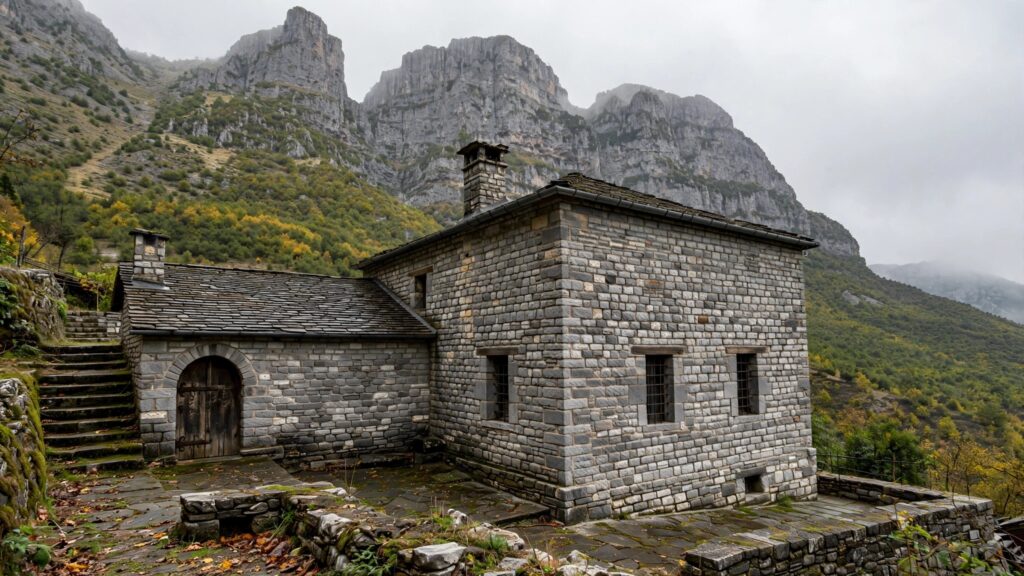
The boulouki moved across the region in organized teams, carrying the specific knowledge of dry-stone construction that the Pindus landscape demanded. They could read a mountainside and understand which stones it would yield and how those stones needed to be laid to bear the loads the climate would impose on them. They could build a three-arched bridge over a gorge whose seasonal floods could multiply the river’s force by factors that would destroy a less carefully calculated structure. They could build a mansion whose walls were nearly a meter thick, not as a display of wealth but as the correct answer to the question of how to keep a family alive through an Epirus winter.
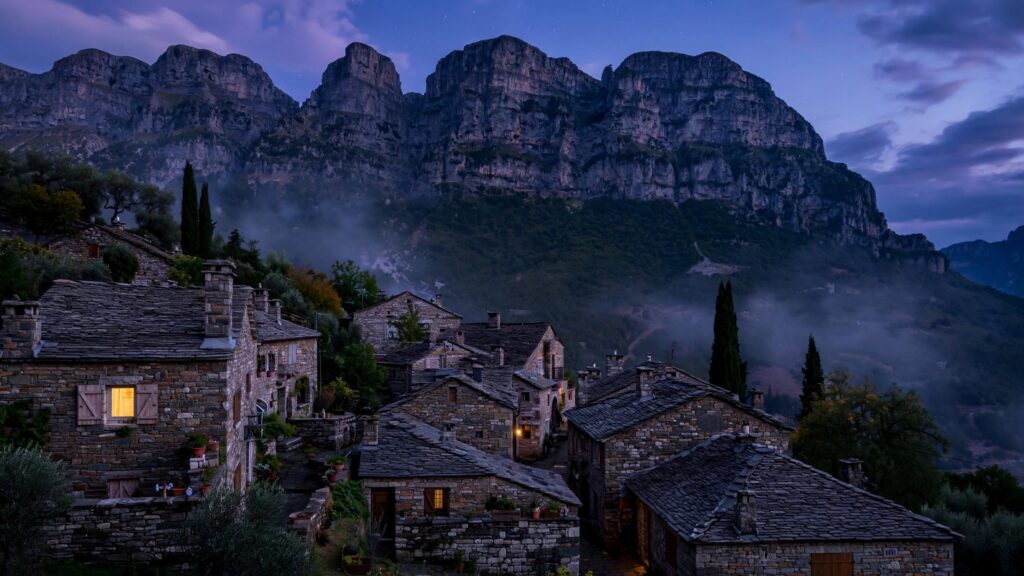
The aesthetic that resulted is one of monochromatic precision: slate roofs laid in overlapping courses so exact that centuries of snow load have not dislodged them, exterior walls of dry-set limestone whose surface weathers to the specific grey of the mountain they came from, interior spaces that distribute heat from the central hearth through the mass of the surrounding stone in a manner that modern passive house architects have spent decades trying to replicate with materials that do not do it as well.
The stone walls of the Zagori mansions function as thermal batteries. A meter-thick limestone wall absorbs the heat of the Epirus summer through the day and releases it slowly through the night, keeping interior temperatures stable without mechanical intervention. In winter, once the hearth has warmed the stone, the walls radiate that warmth back with the slow and steady generosity of a material that does not hurry. The architects of the eighteenth century solved a climate control problem that the twenty-first century is still working on, and they solved it with the material the mountain provided because that was the only material available and the mountain’s geology turned out to be precisely correct for the purpose.
The Bridges | What They Connect Beyond Rivers
Zagori has more than eighty documented historic stone bridges. Each one is a different answer to the same question: how do you cross a mountain river whose character changes completely between seasons, that runs clear and navigable in summer and becomes a force of geological consequence in the spring melt?
The answer the boulouki provided is the arch: the structural form that distributes the load of the bridge outward into its foundations rather than downward through its supports, that requires no mortar to hold its shape because the geometry of the arch makes each stone more stable under load than under no load, that becomes stronger the harder the river presses against it because the pressure drives the stones more firmly into their positions.
The bridge known both as Kalogeriko and as Plakida, spanning the river near Kipi and connecting the villages of Kipi, Dilofo, and Koukouli, is the most photographed in the Zagori and earns the attention. Built originally in wood and reconstructed in stone under the direction of the Abbot Serafeim, its three asymmetric arches of different heights, accommodating the different elevations of the riverbanks on either side, run fifty-four meters across the water. What photographs do not convey is the quality of the stone surface: smooth from two centuries of human feet but without the polished uniformity of dressed stone, each slab retaining the texture of its quarrying, the whole surface reading as something that was made rather than manufactured.
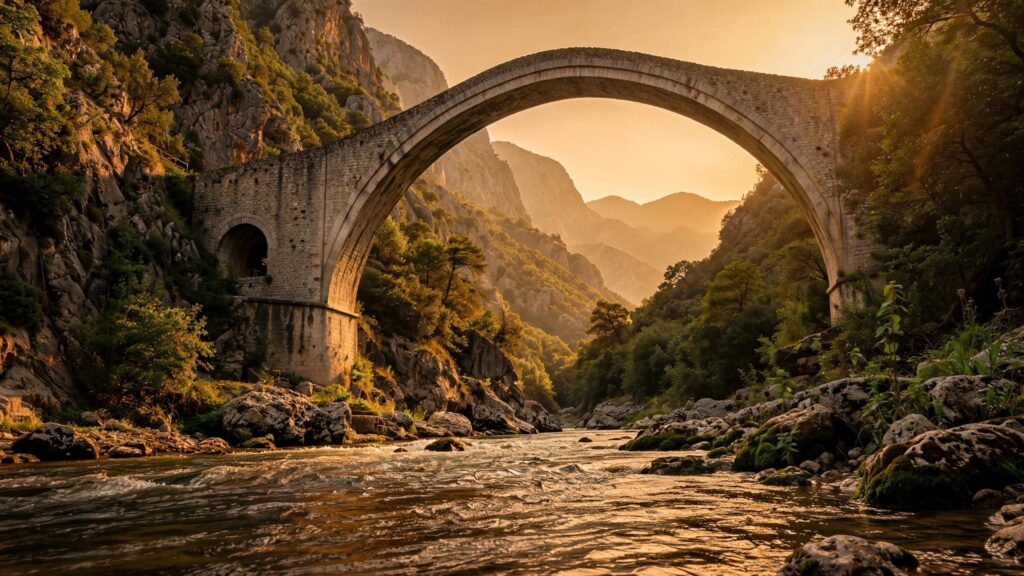
Not every bridge in the Zagori carries so gentle a story. The single-arched bridge that connects Kipi, Dilofo, and Vitsa was built in 1806 and originally named for the Xeropotamos, the dry river it crossed. It carries a different name today. On the sixth of August, 1906, Ottoman forces killed a Macedonian chieftain known as Captain Bear, Kapetan Arkoudas, near the bridge, and the crossing has carried his name ever since, a small stone monument to a specific, violent moment inside the longer, calmer history the rest of the region’s bridges usually tell. Standing on any of these bridges at dusk, when the light on the limestone walls has shifted toward amber and the sound of the river below carries in the evening air, you understand what the emigrants who paid for the gentler ones were paying for, and what the mountain remembers regardless of who commissioned the stone.
They were not simply solving a transport problem. They were building evidence: proof that the villages of the Zagori were civilized places worthy of the wealth that had been earned in Vienna and Constantinople, proof that the mountain landscape they came from was capable of the same architectural intelligence that the great cities of the Enlightenment world were producing.
The bridges connected the villages to each other physically. They connected the villages to Europe philosophically.
The Gorge | What the Mountain Kept for Itself
The villages of the Zagori are human architecture at a very high standard. The Vikos Gorge is nature’s reminder that the standard against which human architecture is measured is not human.
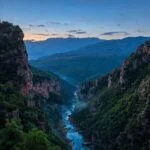
The gorge runs for roughly twelve kilometers through the heart of the Zagori, carved by the Voidomatis River through the Pindus limestone over millions of years into a canyon whose walls rise nearly a kilometer from the river at their deepest point. The Guinness Book of World Records has registered it as the deepest gorge in the world relative to its width, a measurement that corresponds to what you feel standing at the rim at the viewpoints of Beloi or Oxya, which is the specific quality of vertigo that comes not from height alone but from the recognition that the space below you was not designed for human presence and does not particularly require it.
The river at the bottom of the gorge is turquoise, fed by the karstic springs that emerge from the limestone walls, filtered by the rock to a clarity that makes the riverbed visible in two meters of water. In summer you can walk the gorge floor from the village of Vikos to the springs at Voidomatis, a journey of several hours through a canyon so enclosed that the sky is a narrow band of light above you and the sound of the river is the dominant sensory experience throughout. In spring the river runs fast and cold from the snowmelt and the gorge floor walk is not advisable: the same landscape that is accessible in August becomes a force of geological consequence in April.
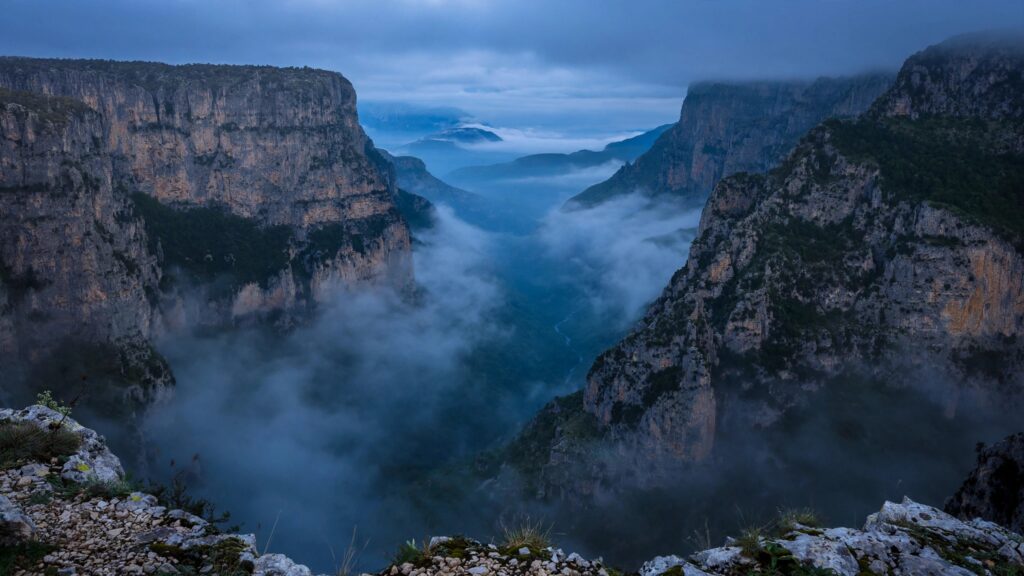
The gorge’s walls shelter species that the open landscape above them cannot support: the brown bear moves through the canyon’s forest cover, the golden eagle nests on the rock faces inaccessible to ground predators, the rare Balkan chamois navigates the cliff faces with a confidence that suggests the animal understands the limestone better than any human observer watching from the rim.
The Doctors of Vikos, the local herbalists who harvested medicinal plants from the gorge’s walls and valleys for centuries, were known across the Balkans for the particular knowledge their geography gave them: a canyon whose depth and orientation produced microclimates that supported plant species found nowhere else in the region, and whose inaccessibility protected those species from the overcollection that depleted them elsewhere. The herbalists’ knowledge was the gorge’s own knowledge, translated into human use.
Stand at the viewpoint at Oxya at dawn, before the day’s warmth has fully arrived, when the mist is still in the lower sections of the canyon and the walls are receiving the first light from the east. The scale becomes available at this hour in a way that the full daylight flattens. The gorge is not simply large. It is a different order of existence from the human world above it, and the villages on its rim, for all their architectural intelligence and all the wealth of Vienna that built them, are polite negotiations with a landscape that could, if it chose, render every one of them invisible.
The Table of the Hearth
In a landscape where olive trees do not grow, the culinary language is different from the rest of Greece.
The Epirus table is built around butter rather than olive oil, sheep’s milk rather than cow’s milk, the hearth rather than the grill. It is the gastronomy of a mountain culture that had to produce enough calories to sustain shepherds and masons and the families who waited for them through long winters, and it developed its character from the combination of what the landscape provided and what that landscape demanded of the people who lived in it.
The Epirus pie is the center of this table, and it is not the decorative pastry item that the phrase might suggest. It is an entire category of daily bread: dozens of varieties, each reflecting the resources and the season that produced it. Alevropita, the thin crispy flour pie, was the shepherd’s portable meal, baked in a pan over the fire and eaten on the hillside. Kasiopita, the cheese pie, is the expression of a dairy culture that produced more cheese than any other region of Greece. Blatsaria, made from wild greens and cornmeal, is the winter pie of the mountain interior when the snow made flour scarce and the hillside provided what the pantry could not.
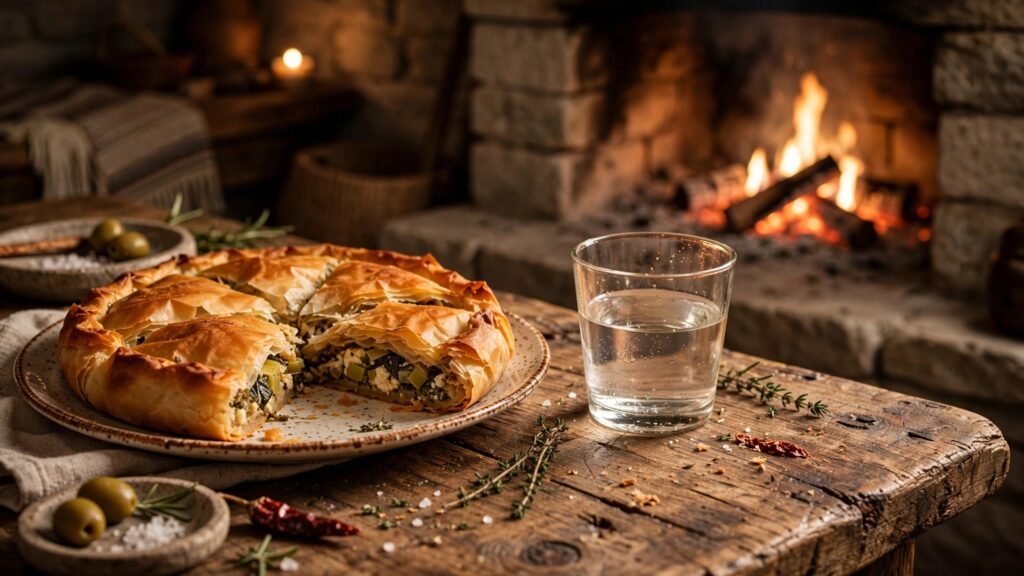
These pies were designed to be carried, to keep, to provide the calories of hard physical labor in cold air. That they are also delicious is a consequence of the seriousness with which the women who made them understood the difference between food that nourishes and food that merely feeds.
Sit by a fireplace in the village of Aristi or Vitsa in late spring, when the evening is still cold enough to justify the fire, with a glass of tsipouro from a local producer and a plate of smoked Metsovone cheese, and the table of the Zagori will communicate its philosophy without requiring further explanation. The food is, like the buildings, honest about what it is and completely uninterested in being anything else.
The tsipouro of Epirus is the correct spirit for this landscape: pomace-distilled, clear, without the anise note of ouzo, with a directness and a warmth that the mountain climate makes appropriate in a way that it is not in the coastal heat of a Cycladic summer. It is drunk slowly, in small glasses, between bites of food and moments of conversation, not as an aperitif or a digestif but as the continuous thread of a long evening that does not have a scheduled ending.
Restoration and What It Requires
For the heritage buyer and the serious restorer, Zagori represents the most demanding and most rewarding property proposition in Greece.
The legal protection is older than most visitors assume and considerably more precise. Following Presidential Decrees issued in 1978 and 1979, roughly thirty settlements in the Prefecture of Ioannina, most of them in the Zagori region, were formally designated as traditional settlements, with a further sixty placed under related protection zones. The decree, amended in 1995, divides protected villages into Zone A, covering the most historically authentic cores, and Zone B, covering areas of significant but less pristine character, and it places all building activity under the supervision of a dedicated architectural review committee. Buildings constructed before 1923 receive the strongest protection of all.
What can be done with a property here is both closely defined and closely monitored. New construction within the traditional village boundaries is effectively prohibited. Any intervention in an existing structure, from roof replacement to window installation to the repair of exterior stonework, must use traditional materials and techniques: local limestone, lime mortar, slate from the specific quarries that have supplied the region for centuries.
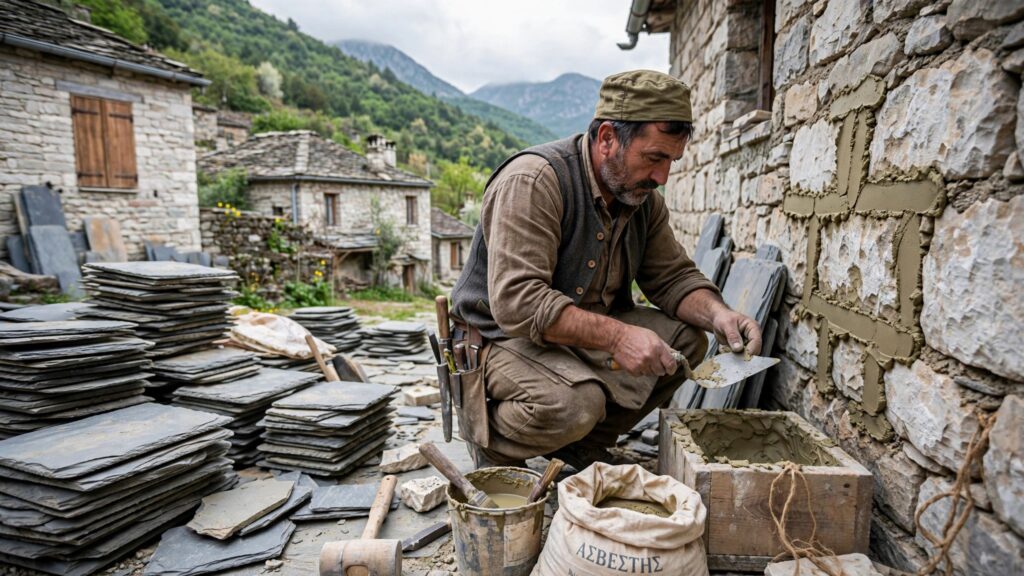
This is a constraint that functions as the protection making the investment worth having. The reason a restored mansion in Megalo Papingo commands prices that rival urban property in Athens is that the regulatory framework, now reinforced by UNESCO inscription on top of the original decree, guarantees the landscape around it cannot be compromised. Your neighbor cannot extend with a glass conservatory. The hillside behind the village cannot be cleared for a hotel development. The slate roof of the house across the lane will remain a slate roof because the decree requires it. You are not buying a building. You are buying a position in a protected landscape whose protective mechanisms have now been reinforced by international recognition as well as by domestic law.
The restoration process requires specific expertise: an architect with documented experience in the dry-stone tradition, an engineer familiar with the structural logic of the arch and the wall, craftspeople who have been trained in the lime mortar techniques that the boulouki used and that modern Portland cement cannot replace in this context. Portland cement is too rigid for the flexible, seasonal movement of a stone building in a mountain climate. Lime mortar moves with the building and can be repaired indefinitely without leaving the chemical traces that accelerate the deterioration of the surrounding stone. Using the wrong mortar in a Zagori restoration is not simply aesthetically incorrect. It is physically destructive.
The organizations working in this space, including groups dedicated to reviving traditional masonry techniques in the Pindus region, have produced a generation of craftspeople who understand the original materials and methods. These are the professionals to seek out. They know the quarries. They know the lime sources. They know the ways in which Zagori buildings fail and the ways in which those failures can be correctly addressed.
Allow five years for a project of meaningful complexity. Allow more if the property has structural issues or title complications of the kind that rural Greek property in mountain villages can carry. The timeline rewards patience, and the landscape the patience produces is unlike anything else available in the European property market.
Where to Go and What to Prioritize
The forty-six villages of the Zagori are not uniform in character, accessibility, or the quality of what they offer the first-time visitor. Understanding the distinctions helps.
Monodendri is the most visited village and the most accessible entry point to the Vikos Gorge: its position on the gorge rim provides the most dramatic viewpoints, and it has the infrastructure of guesthouses and tavernas that a first visit requires. It is also, in high season, the most crowded. If you are visiting in July or August, arrive early and leave the viewpoints before eleven in the morning.
The twin villages of Megalo Papingo and Mikro Papingo, at the foot of the limestone walls of Mount Astraka, are the most architecturally complete and visually dramatic in the Zagori. The stone here is darker, the buildings more compact against the cliff face, the proportions more monumental. These are the villages of the photographs that make people decide to visit the Zagori at all. Property in these villages comes to market rarely and sells quickly. If something appears, act without delay.
Kipi and the cluster of central Zagori villages offer the highest density of historic bridges within walking distance of each other: the Kalogeriko, the Kapetan Arkoudas, and the Kokkorou bridges are all accessible within a few hours of pleasant walking through a landscape that has the quality of somewhere that people have been walking between for three centuries because it rewards the walking.
Tsepelovo and Skamneli in the eastern Zagori are higher, quieter, and wilder: the road to them is longer and the infrastructure is sparser, but the properties available here are the most affordable in the region and the sense of genuine remoteness is the most complete.
Closing
The masons of the Zagori built something that the mountain has accepted.
This is rarer than it sounds. Most human construction in mountain landscapes reads as an imposition: a set of forms alien to the geology around them, requiring constant maintenance to sustain their argument against the environment they have been placed in. The stone villages of the Zagori do not read as impositions. They read as something that was always going to be here, that the mountain required to exist in order to be fully itself, that the limestone slopes were always going to produce if given enough time and enough human hands working in the right relationship with the material they were given.
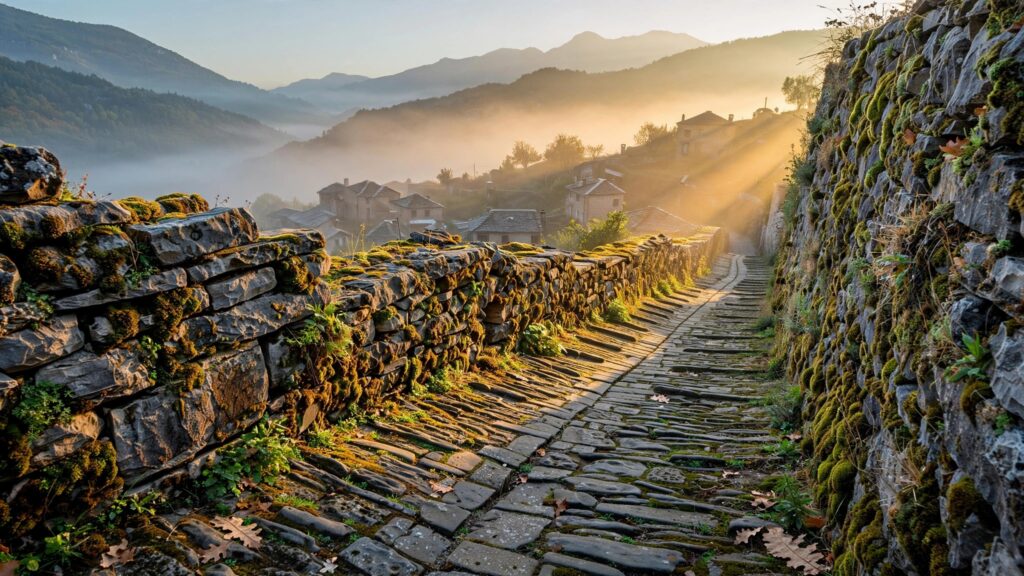
The bridges cross the rivers because rivers need crossing. The walls hold the snow because the snow comes every year. The slate roofs shed the rain because the rain is not seasonal. The paths connect the villages because villages need to be connected.
The masons understood these things and built accordingly, and the result has been standing without apology for three centuries and shows no signs of reconsidering its position.
Cross one of the bridges at dawn when the mist is still in the gorge. Walk the kalderimi between two villages at the hour when the light is horizontal and the stone walls are the same color as the mountain. Eat the pie by the fire in the evening when the Epirus spring is cold enough to require it.
The Zagori will tell you, without words, in the language of stone that has reached a permanent agreement with the earth it rests on, what the masons and the merchants and the mountain have been trying to say for three hundred years.
It is worth listening to.
At Olympus Estate, Wanderlust Greece looks for the places where Greece is most completely and most honestly itself. The Zagorochoria, forty-six stone villages along the western Pindus, became Greece’s first UNESCO Cultural Landscape on September 19, 2023. Their bridges and mansions were built between the eighteenth and nineteenth centuries by boulouki, traveling mason guilds, funded by emigrants who made their fortunes in Vienna, Odessa, and Constantinople and sent the money home. A Presidential Decree first protected the region’s traditional architecture in 1978 and 1979, decades before international recognition arrived to reinforce it. The Vikos Gorge at their center holds the Guinness World Record as the deepest gorge relative to its width anywhere on earth. These are, without much competition, the most beautiful villages in Greece.