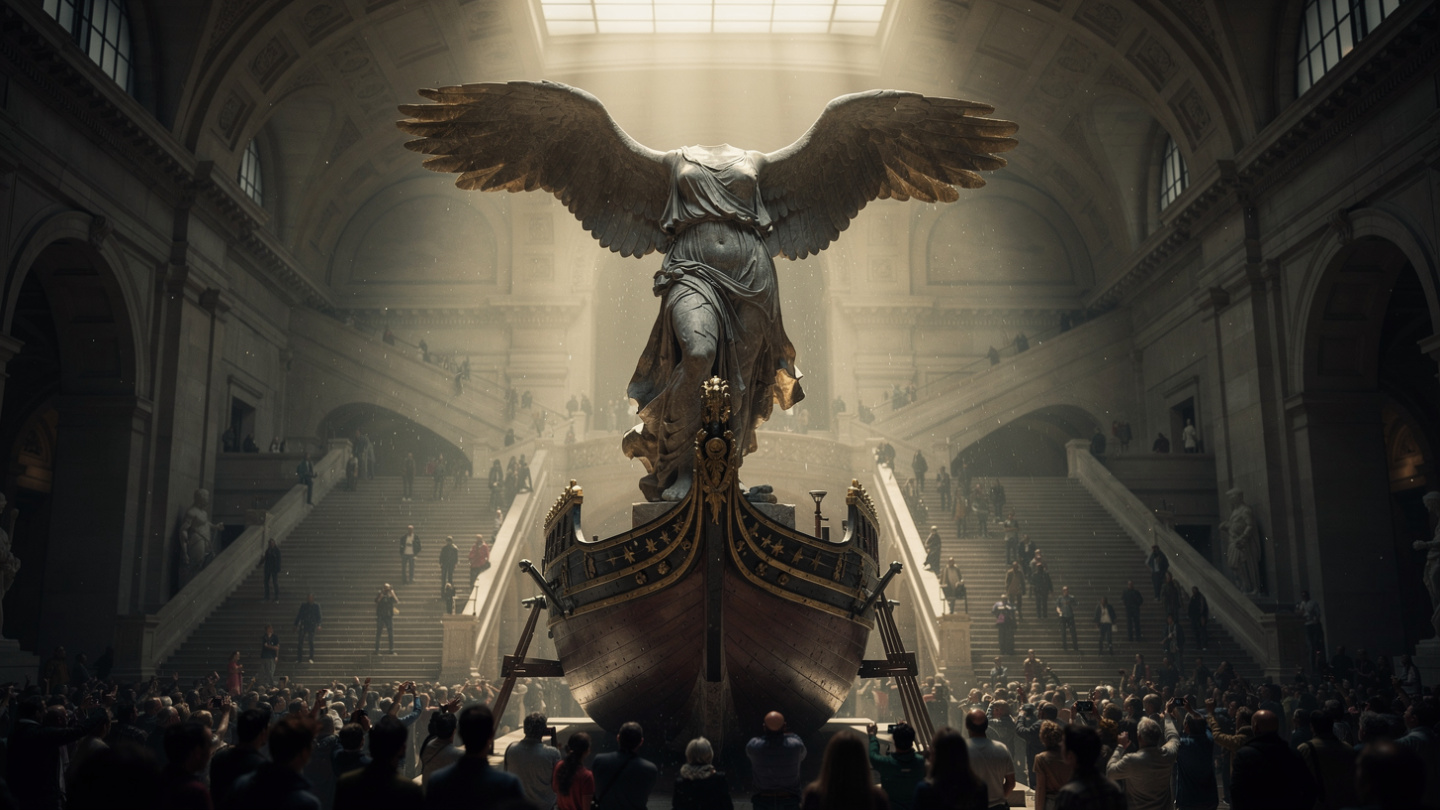
Ten million people a year walk past her at the top of the Daru staircase in the Louvre.
She stands on the prow of a warship, wings spread, drapery pressed against her body by a wind that stopped blowing two thousand years ago, her head missing, her arms missing, her identity and the naval battle she commemorates still unresolved after two centuries of scholarship. She is one of the most recognisable objects in the history of art, and the vast majority of the people who stop in front of her in Paris have no idea where she came from or what she was doing there.
She came from a small mountainous island in the northeastern Aegean, four hours by ferry from the nearest major port, with roads that require a confident relationship with vertiginous curves, a waterfall so dramatic that Greeks who know their own country make special pilgrimages to it, and a sanctuary that was, for nearly eight hundred years, one of the most sacred religious sites in the ancient world.
Not one of the most sacred sites in Greece. In the ancient world. Pilgrims came from across the Mediterranean to be initiated into its mysteries: from Macedonia and Thrace and Asia Minor and Egypt and Rome. Kings sent dedications. Generals sought protection before campaigns. Philosophers considered it worth the journey. The Macedonian royal family, the dynasty that produced Alexander the Great, had such a close relationship with the island that the union that made Alexander possible was formed here, during an initiation ceremony, when a young Macedonian king looked across the sacred precinct and fell in love with a princess from Epirus.

The island is Samothrace. The sanctuary is the Sanctuary of the Great Gods. The marriage was between Philip II of Macedon and Olympias, and Alexander the Great is said to have been conceived on this island during their time here.
Almost no one visits it today.
This is an invitation to change that.
An Island That Resists Description
Before the history, the geography, because Samothrace is one of those places whose physical character shapes everything that happened there and makes it comprehensible in a way that the historical facts alone do not.
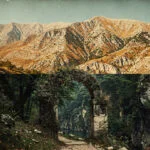
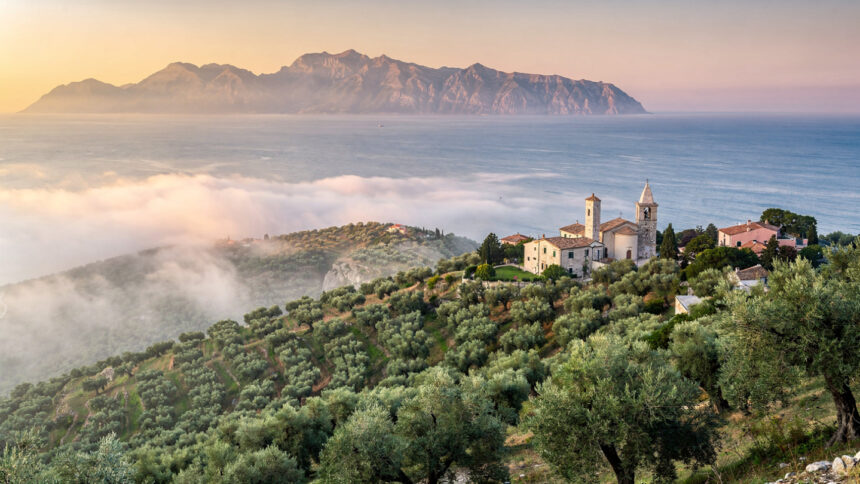
The island rises from the northeastern Aegean in a single dramatic gesture: Mount Fengari, the mountain of the moon, climbs to 1,611 metres from a coastline that provides almost no gradual approach. From the sea, Samothrace appears as a mountain with water around it rather than an island in the usual sense: a vertical mass that the ancient sailors used as a navigation landmark from extraordinary distances and that Homer describes, in the Iliad, as the vantage point from which Poseidon watched the Trojan War unfold.

This is not mythology as decoration. This is geography as mythology’s ground. An island whose summit is high enough to command a view of the Trojan coast on a clear day is an island that the Greek imagination, which was never less than precise about the relationship between landscape and divine significance, was always going to populate with something important.
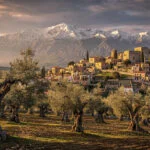
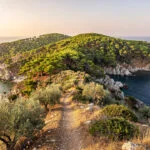
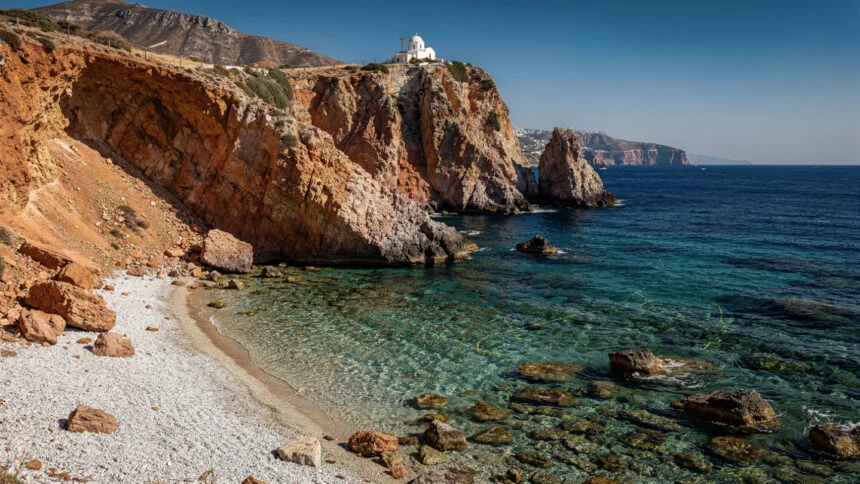
The interior of the island is wild in the sense of wild that the northeastern Aegean produces: dense forest, rivers that run clear and cold from the mountain even in August, waterfalls, gorges, a landscape that has been shaped by water in a region where water is not guaranteed. The coast is rocky and inaccessible in most places, without the sandy beaches that tourism expects and therefore without the tourism that sandy beaches attract. Getting to Samothrace requires the ferry from Alexandroupolis on the Thracian coast or from Kavala, and the ferry is subject to cancellation in bad weather because the approach to the island’s single port, Kamariotissa, is exposed to the open sea in a way that makes autumn and winter crossings genuinely unpredictable.

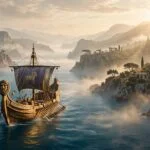
The island does not apologise for any of this. It has been this way for three thousand years and the people who needed to get here found ways to do it. The pilgrims who crossed the Aegean in triremes to be initiated into the Samothracian Mysteries were not deterred by difficult seas. The difficulty was, in a sense, part of the initiation before the initiation began.
Gods Nobody Could Name
Here is the most extraordinary thing about the sanctuary that drew the ancient world to this remote island: nobody knew exactly who the gods were.
The Great Gods of Samothrace were worshipped at this site before the arrival of Greek colonists in the seventh century BCE. Their cult predated the Greek presence on the island entirely, which means their names, their origins, and their theological relationships were not Greek in the first instance and were only imperfectly absorbed into Greek religious categories when the Greeks arrived.
The ancient sources, which include Homer, Aristophanes, Plato, and Plutarch, refer to the Samothracian mysteries repeatedly and with evident reverence. They are also, collectively, remarkably vague about what exactly was worshipped there. Strabo, writing in the first century BCE, captured the situation with unusual honesty: many authors have identified the gods worshipped in Samothrace with the Kabeiroi, though they cannot say who the Kabeiroi truly are.
What the ancient world agreed on was the following: there were four principal deities, including at least one great mother goddess whose image appears on the island’s coins, two male figures depicted in an archaic style, and an attendant figure. They were collectively called the Great Gods, a title that communicated their power without specifying their nature. They were pre-Greek in origin, possibly Thracian or Phrygian or Semitic at the root, though this remains genuinely unresolved.

What they offered, and this the sources are entirely consistent about, was protection at sea and, for those who underwent the second and deeper level of initiation, a blessed life after death. The mystery cult of Samothrace was open to anyone regardless of gender, nationality, or social status: slave or free, Greek or barbarian, man or woman. This inclusivity exceeded even the famous Eleusinian Mysteries, which required initiates to speak Greek. At Samothrace, the gods accepted everyone.
Diodorus Siculus, writing in the first century BCE, recorded that initiates into the Samothracian mysteries became more pious and more just and better in all ways than they had been before. This is not the language of superstition. It is the language of genuine transformation, of a religious experience that produced lasting change in the people who underwent it.
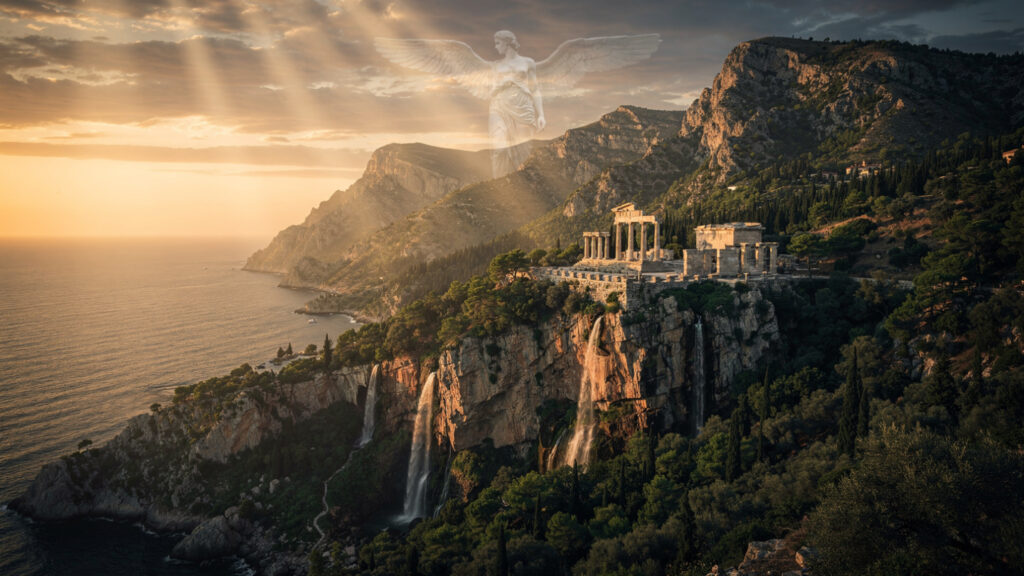
What happened during the initiation remains unknown. The initiates were sworn to secrecy and kept their oath with a consistency that two thousand years of scholarship has been unable to fully penetrate. What the archaeology has recovered are the crimson sashes tied around the waist that initiates received as protective talismans, and the iron rings magnetised by the island’s lodestone and given to those who had completed the rites. The physical objects of protection, carried home after the ceremony to a life somewhere else in the ancient world, connecting the wearer to the island and to whatever had occurred there.
Philip, Olympias, and the Conception of a World
In the mid-fourth century BCE, during one of the island’s sacred festivals, a young Macedonian king arrived to be initiated into the mysteries.
Philip II of Macedon was at this point a king of a northern Greek kingdom that the rest of the Greek world regarded with a mixture of condescension and wariness: Macedon was powerful but peripheral, its people considered only marginally Greek by the Athenians and Thebans who dominated Greek cultural and political life. Philip was in the process of changing this, methodically and with the strategic intelligence that would eventually make him the master of all Greece and prepare the instrument his son would use to conquer the known world.
At the sanctuary of the Great Gods, Philip encountered Olympias, a princess of the Molossian royal family of Epirus, who had come to Samothrace for the same initiation. Plutarch, in his Life of Alexander, records the moment: Philip fell in love with her immediately and betrothed himself to her at once, after obtaining the consent of her brother.

Their marriage, contracted in this place of pre-Greek mystery religion at the edge of the known Greek world, produced Alexander.
Alexander the Great was therefore the son of a union that began at a ceremony whose gods nobody could name, on an island that the Greek world understood as sacred for reasons that predated the Greek presence there, during an initiation into mysteries that promised divine protection and a better death.
He went on to spread Greek language and culture from Macedonia to the edge of India. The Hellenistic world that followed his conquests was built on the improbable foundation of a marriage that a religious ceremony on Samothrace made possible. The ancient sources are clear that Alexander was said to have been conceived on the island during his parents’ time here for the initiation. Whether this is historical fact or later mythologising does not diminish the symbolic weight that the ancient world gave it: the architect of Greek civilisation’s greatest expansion was connected, in the stories his culture told about him, to the place where the gods predated Greek civilisation itself.
The Sanctuary | What You Walk Into
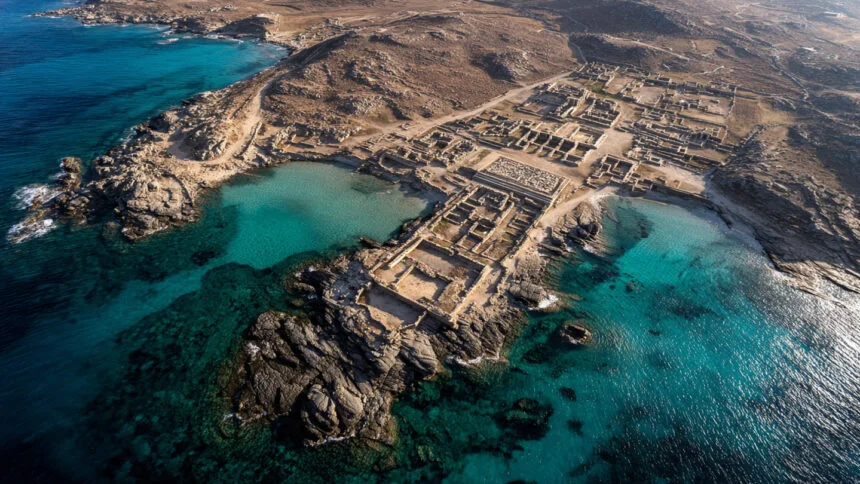
The Sanctuary of the Great Gods occupies a narrow river valley on the northern coast of the island, accessible from the coastal village of Palaiopoli and visible from the sea as a series of ruins climbing a hillside above a ravine through which a seasonal torrent still runs.
The site is well maintained, with paths and signage that allow independent navigation. What it lacks, and this is genuinely significant, is the original statue that was its greatest treasure. The Nike of Samothrace is in the Louvre. What stands in front of the on-site archaeological museum is a copy. The absence is real and worth acknowledging honestly before you go, so that you arrive oriented to what is actually there rather than disappointed by what is not.
What is actually there is extraordinary.
The Arsinoe Rotunda, built by Arsinoe II of the Ptolemaic dynasty in the early third century BCE, is the largest circular building in the Greek world. It was a gift to the sanctuary from a queen of Egypt whose life encompassed marriage to her own brother, exile, return, and eventual deification. She chose to memorialize her connection to these pre-Greek mystery gods on an island at the edge of the Greek world rather than in Alexandria or Athens. The rotunda she built is still standing, its walls reaching several metres in height, its dedicatory inscription partially intact.

The Hieron, the great hall of later initiation, is the largest roofed building at the sanctuary and the setting for the deeper level of the mysteries. Its apse still contains the carved marble details that the architects of the third century BCE installed, and the quality of the workmanship communicates, across two thousand years of weathering, the seriousness with which the building was conceived. This was not a provincial religious site. It was built to the standards of the finest sanctuaries in the Greek world, by craftsmen brought here specifically for the purpose, funded by the patronage of the Macedonian royal house and subsequently by the Ptolemaic dynasty that succeeded it.
The Hall of Choral Dancers, whose function scholars still debate, once had a marble frieze depicting nine hundred dancing women wrapped around its exterior. The frieze fragments, now in the on-site museum, show figures of extraordinary grace and animation: women moving in what appears to be a sacred dance, captured in marble with enough precision that the rhythm of the movement is still legible in the stone.
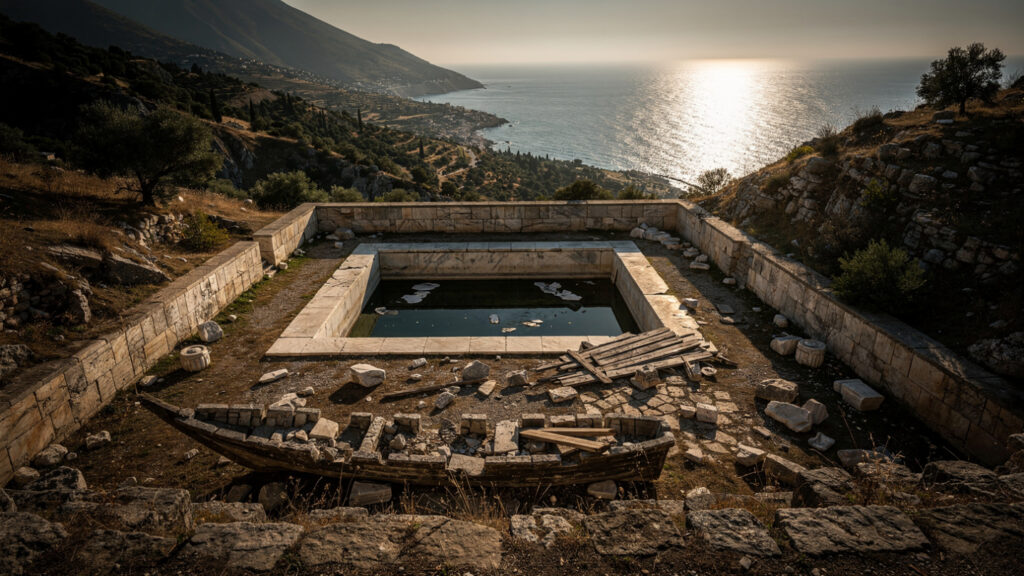
And at the southern end of the sanctuary’s upper terrace, in a rectangular enclosure cut into the hillside, is the empty space where the Winged Victory once stood: on her marble ship’s prow, in a pool of water that completed the illusion of a goddess alighting on a vessel breaking through waves, presiding over the entire sanctuary complex from her elevated position, visible from the valley below and from the sea beyond.
The pool is dry. The prow is mostly in Paris, with copies of its fragments integrated into the site. The Nike herself is on the Daru staircase. But standing in the enclosure, understanding the original arrangement, the water pool, the marble ship, the goddess landing at the precise angle calculated to be seen from three-quarters to the left, at this height, with the valley and the sea as the background, is one of those archaeological encounters that does what archaeology does at its best: it reassembles, in the imagination, something that was real and allows you to understand why it was worth making.
How the Nike Left and What the Leaving Means
On April 15, 1863, Charles Champoiseau, the French vice-consul to Adrianople and an amateur archaeologist with access to Ottoman-controlled territory that no Greek could then claim, arrived on Samothrace to excavate the sanctuary ruins.
On that day a Greek worker turned over a piece of marble and shouted to Champoiseau: “Sir, I’ve found a woman.”
What followed was one of the great acts of cultural extraction in the history of nineteenth-century archaeology. Champoiseau recognised immediately the quality of what had been found: a colossal female figure in white Parian marble, headless and armless but clearly of the first order of ancient sculpture. He obtained Ottoman permission for export, shipped the fragments to France on a French warship, and the Nike arrived at the Louvre in 1864.
He left the grey marble blocks behind, thinking they were part of a funerary monument.
It took until 1875 for Austrian archaeologists to understand that those blocks, correctly assembled, formed the prow of a warship, and that the prow had been the Nike’s base. The entire monument, goddess landing on ship’s prow set in a pool of water, was only understood after the goddess and her ship had been separated across a thousand miles and a decade of scholarship.
The reassembled monument at the Louvre, Nike on her ship’s prow at the top of the Daru staircase, is magnificent. It is also an object displaced from the context that explained it: the hillside sanctuary, the pool of water, the view toward the sea from which the pilgrims arrived, the relationship between the Nike’s position and the valley below that the original architects calculated with the precision of people who understood that a votive monument’s meaning is inseparable from the space it was made for.
Greece has been requesting the return of the Nike since at least 1999, when the inhabitants of Samothrace sent letters to Greek politicians asking for its return to the place where it was found. The request has produced no result. The Louvre’s ten million annual visitors, most of them unaware of the island the statue came from or the sanctuary it watched over, continue to file past her on the Daru staircase.
The empty enclosure on the hillside at Samothrace is one of the most eloquent arguments for repatriation in the world of contested cultural heritage, because it is not an abstract argument about ownership or national pride. It is a specific, physical, demonstrable case of a work of art whose meaning is diminished by its removal from the site it was made for and that was made for that site and no other.
Fonias | The Waterfall at the End of the Gorge
The sanctuary is the reason most people with an interest in ancient religion visit Samothrace. The Fonias waterfall is the reason everyone else should.
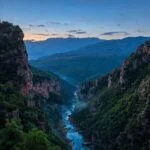
The Fonias river runs from the heights of Mount Fengari to the northern coast through a gorge of increasing drama, and the walk to the main waterfall follows the river through forest and over rocks for approximately forty-five minutes before the gorge narrows and the fall itself appears: a vertical drop of roughly thirty metres into a circular pool of water so clear and so cold that the temperature change when you enter it is immediate and absolute.
The pool is surrounded by the walls of the gorge on three sides, with the waterfall entering it from above and the river continuing below, and the quality of light in the gorge at midday, filtered through the forest canopy and reflected from the wet rock, is the quality of light that makes people who were planning to stay thirty minutes find themselves still there two hours later.

There are further falls accessible to those willing to continue up the gorge: the second and third falls require more scrambling and more time, and the path becomes progressively less defined, but the reward is the progressive solitude of a gorge that the crowds who make it to the first fall rarely continue beyond. On a summer morning the first pool has swimmers. By the second fall you are likely alone with the sound of the water.
The Fonias is not heavily promoted in Greek tourism. This is consistent with the way Samothrace presents itself to the world: as a place that provides extraordinary things for people who find their way there and makes no particular effort to lower the barriers to finding it.
Getting There and What to Expect
The ferry from Alexandroupolis takes approximately two hours. From Kavala the journey is longer. Both ports are accessible by bus or car from Thessaloniki, which is the natural base for exploring northeastern Greece.
The ferry does not run in bad weather, and the Aegean in autumn and winter produces bad weather with a frequency that the Aegean in July and August does not. If you are visiting outside the summer season, build flexibility into your schedule. The island will not accommodate a two-day window with a tight departure.
On the island itself, a car is essential. The roads between Kamariotissa, the port, and Palaiopoli, where the sanctuary is located, and the various starting points for the Fonias gorge walk, require transport that does not depend on the limited and infrequent bus service. The roads are navigable by any standard vehicle, though the mountain interior requires more attention than the coastal route.
The sanctuary is open during standard Greek archaeological site hours and charges a modest entrance fee. The on-site museum, which contains the frieze fragments and the finds from the sanctuary excavations, has experienced periods of closure for renovation: check its current status before visiting and allow time for it if it is open, because the marble fragments it contains are genuinely extraordinary and contextualise the sanctuary in ways that the site alone does not.
Accommodation on the island ranges from simple rooms to let in Kamariotissa to a handful of more comfortable options in Therma, the thermal spring village on the northern coast where the hot springs have been attracting visitors since antiquity. Therma is the most pleasant base: close to both the sanctuary and the Fonias gorge, with its own low-key thermal bathing facilities and the atmosphere of a small Greek village that has been receiving visitors for a very long time without being organised around receiving visitors.
Go Anyway
She stands at the top of the Daru staircase in Paris without her head and without her arms, on a ship’s prow made from stone quarried on Rhodes, and ten million people a year stop to look at her.
Very few of them know that she was made as an offering to gods whose names nobody could fully agree on, on an island at the edge of the ancient Greek world, for a sanctuary that pilgrims crossed the Aegean to reach because what was promised there, protection at sea, a better death, the transformation that only initiation can produce, was worth the journey.

Very few of them know that the marriage which produced Alexander the Great was contracted on the same island, during an initiation ceremony at this same sanctuary, when a young Macedonian king saw a princess from Epirus across the sacred precinct and made a decision that would reshape the known world.
Very few of them know that the island she came from is still there, its gorges still running cold from the mountain, the space where she stood still cut into the hillside above the dry pool, the sanctuary still visible from the sea that the pilgrims crossed to reach it, the mountain still high enough on a clear day that you can see, from its summit, the coast where Troy once stood.
The journey to Samothrace is four hours by ferry from a port that itself requires a journey. The roads are winding. The season for visiting is narrow. The most famous thing the island produced is in Paris.
Go anyway.
Stand in the enclosure where she stood and look out over the sanctuary valley toward the sea. Understand, in the way that physical presence in a place makes things comprehensible that no description fully communicates, why this island was chosen, why this site was sacred, why the people who built the greatest naval monument in Hellenistic art chose to build it here rather than in Athens or Alexandria or Rhodes.
Then walk to the Fonias and swim in the pool at the bottom of the first fall, and understand why people who come to Samothrace once tend to find reasons to come back.
The gods who were worshipped here had no names that anyone could agree on. They offered protection and a better death and made people, in Diodorus Siculus’s words, better in all ways than they had been before.
You do not need to know their names to stand where their sanctuary stood and feel that something about the place still earns the description.
At Olympus Estate, Sacred Geography explores the places across Greece where landscape, history, and myth read as a single text. Ten million people a year walk past her at the top of the Daru staircase in the Louvre. Almost no one knows she came from Samothrace, a small mountainous island in the northeastern Aegean with a sanctuary that was, for nearly eight hundred years, one of the most sacred religious sites in the ancient world. Not one of the most sacred sites in Greece. In the ancient world. Philip II of Macedon met Olympias here during an initiation ceremony. Alexander the Great is said to have been conceived on this island. Almost no one visits it today.