





The year 416 BC stands as the traditional dramatic date for an evening Plato later transformed into one of the most famous scenes in ancient philosophy. Agathon had just won his first dramatic victory, and the celebration at his house drew together some of the most recognizable figures in classical Athens, among them Socrates, Aristophanes, Pausanias, Phaedrus, Eryximachus, and, uninvited and far later in the evening, Alcibiades. They ate, they drank, and they agreed to attempt something that sounds simple until Plato makes the reader watch them try it. Each man would speak in praise of Eros, the god or power of love.
The conversation that followed became the Symposium, though Plato’s title never really meant only a drinking party. A Greek symposium was a social institution built around wine, conversation, performance, and companionship, and Plato turns that institution into a philosophical machine. The wine is diluted rather than drunk neat. The drinking is deliberately restrained. The flute girl is dismissed. The subject is chosen. One speaker follows another, each offering a different account of desire, until Socrates turns the entire evening toward a form of beauty that no human body can contain. Then Alcibiades arrives drunk and turns philosophy back into human experience.
What makes the dialogue extraordinary is that nobody simply gives Plato’s own answer. Phaedrus speaks as an admirer of heroic love. Pausanias turns desire into a question of moral discrimination. Eryximachus makes it medical and cosmic. Aristophanes makes it mythic. Agathon makes it beautiful. Socrates makes it philosophical. Alcibiades makes it painfully personal. The result is not one speech about love but an argument in which the meaning of love keeps changing as the person speaking changes.
The Evening Plato Remembered
The story does not begin with Plato telling the reader that he was there. It begins with Apollodorus, a passionate associate of Socrates, explaining that he has been asked to recount a famous banquet. He was not present at the original gathering. He heard the story from Aristodemus, who had been there, and later questioned Socrates himself about certain details. Even before the first guest speaks, Plato has already placed a layer of memory between the reader and the event, and that framing matters. The Symposium is not a stenographic transcript of an Athenian dinner. It is a philosophical dialogue presented as a story about a story about a story, in which Apollodorus remembers what Aristodemus remembered, Aristodemus tells what he saw, and Plato shapes the entire account for his own literary and philosophical purposes.
The dramatic date, traditionally placed in 416 BC, belongs to a very specific moment in Athenian history. Agathon had won his first dramatic victory, and the banquet Plato describes followed the celebration. The Athens of the dialogue was still powerful, wealthy, theatrical, argumentative, and confident enough to imagine itself at the center of the Greek world, yet it was also living through the Peloponnesian War, only a year before the disastrous Sicilian Expedition that would transform the city’s fortunes. Alcibiades, when he finally enters the room, embodies that contradiction. He is brilliant, beautiful, politically powerful, admired, and dangerous, and he is unable to convert what he recognizes as excellence in Socrates into a stable transformation of his own life. Plato does not need to explain the city around him. He puts Athens into one room.
The House of Agathon
Aristodemus arrives at Agathon’s house unexpectedly, after encountering Socrates on the road. Socrates is unusually well dressed and freshly bathed, a detail Aristodemus recognizes as a sign that something unusual is happening. The philosopher invites him to dinner, then falls behind on the way and becomes absorbed in thought. When Aristodemus reaches the house, the meal is already beginning. Agathon welcomes him and is surprised that Socrates has not arrived. A servant is sent to find him, but Aristodemus explains that Socrates has a habit of stopping somewhere and standing still when he becomes absorbed in thought, so they leave him alone. This small scene is one of Plato’s first reminders that Socrates does not quite belong to the ordinary rhythm of the room. Everyone else has arrived for the meal. Socrates has disappeared into thought before the drinking has even begun.
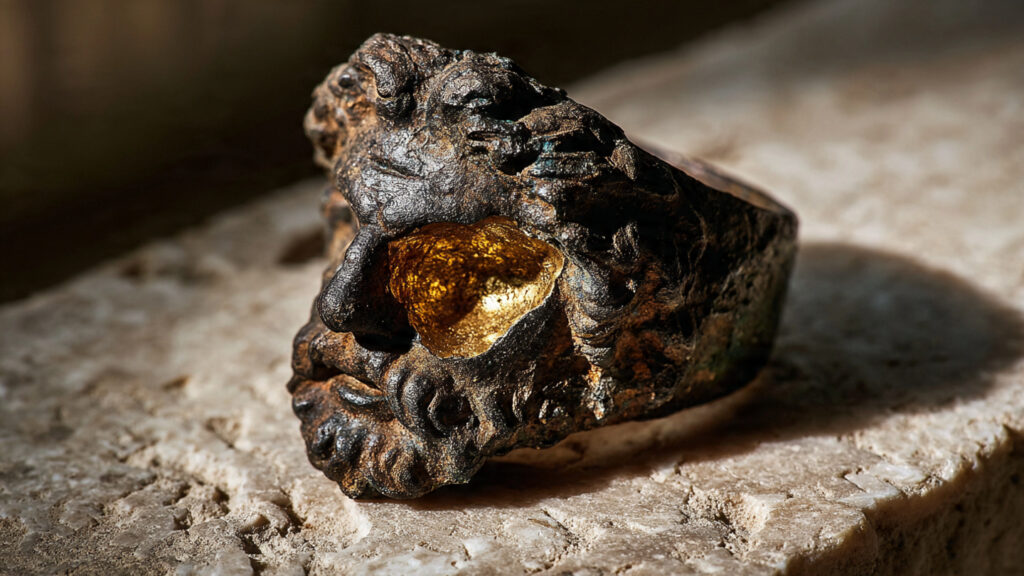
Eventually he arrives, sits beside Agathon, and jokes about wisdom flowing from the fuller person to the emptier one through physical contact, like water passing from one vessel to another. The joke is characteristic of Socrates because it is also a warning. Whatever wisdom emerges from this evening will not be transmitted simply by proximity, beauty, reputation, or status. It will have to be discovered.
After dinner comes the part of the evening that gives the dialogue its name. The guests make a libation, sing to the god, and begin to drink, but they have apparently been drinking heavily the previous day. Pausanias suggests they decide how much wine they actually want, and Eryximachus, speaking as a physician, argues against excessive drinking. The group agrees that nobody should be forced to drink more than he wishes. Then something particularly revealing happens. The flute girl who has arrived for the entertainment is dismissed, and the guests choose to entertain themselves with conversation instead. The transformation is complete. The symposium will become philosophy.
Five Men, Five Loves
Phaedrus proposes the subject. Eros, he observes, is one of the great forces of human life, yet poets and mythmakers have not given him the honor he deserves. He praises love as a source of courage, pointing to figures such as Alcestis, who died for her husband, and Achilles, who chose a short life with honor over a long life without it. For Phaedrus, love makes people brave because the lover wants to become worthy of the beloved and fears the shame of being seen as a coward.
Pausanias complicates the argument. There is no single Eros, he says, because there is no single Aphrodite. He distinguishes between Aphrodite Pandemos and Aphrodite Ourania, and from that distinction develops two forms of desire. One can be directed toward immediate physical gratification. The other can become an enduring relationship concerned with character, intelligence, and the formation of a better person. Pausanias therefore gives the evening its first great distinction. Desire itself is not automatically good. What matters is the kind of desire, the object toward which it is directed, and the relationship it creates.
Eryximachus then takes the discussion out of the human body entirely and expands it across the natural world. As a physician, he describes Eros as a principle of harmony between opposites. Health depends on balance. Music depends on the proper relation of high and low notes. The seasons depend on ordered relations between opposing forces. Eros, in his account, is not merely what happens between two people who desire one another. It is a principle of attraction and order operating throughout nature, and the argument has now moved from courage to ethics and from ethics to cosmology.
Then Aristophanes begins to speak, and Plato gives him a hiccup. The comic poet has been unable to take his turn because of an attack, so Eryximachus offers a remedy. Aristophanes eventually recovers and presents the myth that would become the most famous story in the entire dialogue. Human beings, he says, were once different from the creatures we are now. They were spherical, powerful beings with doubled bodies, possessing two faces, four arms, four legs, and two sets of reproductive organs, some male, some female, and some combining both. They became so powerful that Zeus and the other gods feared what they might do, so Zeus cut them in two. Ever since, each human being has searched for the other half from which he or she was separated. This is the origin, in Aristophanes’ comic mythology, of erotic longing. Love is homesickness for completeness. The image has survived for more than two thousand years because it expresses something psychologically immediate. We do not simply want pleasure from another person. We want recognition, and the feeling that someone else makes a broken part of ourselves whole. But Aristophanes’ speech is not the final word. Agathon follows.
When Beauty Takes the Stage
Agathon’s speech is the most elegant of the evening, and that is precisely the problem. The young tragedian praises Eros as the youngest and most beautiful of the gods. Eros is delicate, graceful, and associated with virtue. He does not simply cause people to desire beautiful things. He is himself beautiful, and through him human beings become gentle, courageous, just, and wise. It is an extraordinary performance, and it is also exactly the kind of speech Socrates knows how to dismantle.
Socrates begins asking questions. If Eros is desire, then Eros must desire something. If he desires it, he does not fully possess it. If he desires beauty, he cannot simply be beauty itself. If he desires goodness, he cannot already possess goodness in the complete sense Agathon has attributed to him. The point is not merely to embarrass Agathon. Socrates is changing the meaning of the entire evening. The previous speeches have tended to describe love by praising its effects or its beauty. Socrates asks what desire actually is, and forces the speakers to confront a strange possibility. Love may be defined not by possessing what is beautiful, but by reaching toward what one does not yet possess. Then Socrates says he is not going to offer an original speech of his own. Instead, he will report what Diotima of Mantinea once taught him, and the dialogue enters its philosophical center.
Diotima and the Ladder of Beauty
Diotima does not tell Socrates that love is simply the pursuit of another person. She gives him a much larger conception of desire. The lover begins with the beauty of one particular body. That is not condemned. It is the beginning. But if the lover learns to see properly, he recognizes that the beauty of one body belongs to a larger class of beauty, and he begins to understand that physical beauty is not confined to one person. From there, the ascent continues. The lover learns to value the beauty of souls above the beauty of bodies. He becomes interested in beautiful practices and laws, then in knowledge, then in the different forms of intellectual beauty a person can encounter. The movement is away from possession of one beautiful object and toward understanding beauty itself.
At the summit stands what Diotima calls Beauty itself, something eternal and unchanging, not born and not destroyed, not beautiful in one respect and ugly in another, not beautiful only at one time or from one perspective. It is not simply another beautiful object. It is the source and standard by which beautiful things are understood. This is why the famous ladder of love is more than a poetic image. It is an account of education. Desire begins somewhere particular and embodied, but it does not have to remain there. The beautiful body can become the first step toward beautiful character. Beautiful character can become the beginning of an interest in beautiful institutions, which can lead toward knowledge, and knowledge toward contemplation. Eros becomes the energy that makes the ascent possible. The philosopher, in this sense, is not someone who has escaped desire. He is someone who has learned what desire can become.
Love, Immortality, and the Desire to Create
Diotima’s teaching contains another idea that is easy to miss when the ladder is treated only as a sequence of beautiful things. Human beings desire immortality. We know we are mortal, yet we continually attempt to leave something behind ourselves. Children are one answer. Poetry is another. Laws, institutions, discoveries, works of art, acts of courage, and forms of wisdom can also become ways in which human beings participate in something that outlasts their individual lives. The connection to Eros is deliberate. Love is not merely the desire to possess another person. It is the desire to generate something beautiful and lasting through contact with beauty.
That makes the Symposium much more ambitious than a philosophical discussion about romance. The question is no longer simply who a person loves. It becomes what that love makes possible. A person can desire another body, another soul, wisdom, or beauty itself, and at every stage Plato asks whether the desire has remained fixed on possession or has become capable of creation. The answer is not given as a command. The ladder is offered as a possibility, and the ascent remains difficult because the first object of desire is usually the easiest to understand.
The Man Who Could Not Stay at the Bottom of the Ladder
Then the door opens. Alcibiades arrives drunk, crowned with ivy and violets, accompanied by others and demanding to know where Agathon is. He is not entering as a philosopher. He is entering as the embodiment of everything the previous speeches have been trying to understand. He refuses to praise Eros. He will praise Socrates instead, and what follows is one of the strangest and most psychologically powerful passages in Plato.

Alcibiades describes his attempts to seduce Socrates. He has used beauty, intimacy, invitation, and physical proximity. He has even spent the night beside him under the same cloak. Yet Socrates remained completely unmoved. The young Alcibiades has discovered that the ordinary economy of desire does not work on Socrates. Beauty does not guarantee possession. Power does not guarantee admiration. Sexual attraction does not guarantee reciprocity. Social status does not guarantee influence. Socrates possesses something Alcibiades wants but cannot acquire by the methods through which he has acquired everything else.
This is where Alcibiades becomes the living counterpoint to Diotima. He has recognized something beautiful. He has encountered a person whose inner life seems more valuable than the external things Athens teaches him to desire. But recognition is not the same as transformation. Alcibiades knows what he admires. He simply cannot become it.
Socrates as the Problem of Love
Alcibiades’ speech changes the meaning of everything that came before it. Phaedrus said love creates courage. Pausanias said love can educate character. Eryximachus said love creates harmony. Aristophanes said love searches for wholeness. Agathon said love is beautiful. Diotima said love can become an ascent toward Beauty itself. Alcibiades answers with a human being who understands all of this and still cannot live according to it. That is why he matters. If Plato had ended the dialogue with Diotima, the Symposium might have been read as a philosophical treatise on the ascent from physical attraction to transcendent beauty. Alcibiades prevents that simplification. He brings the theory back into the body, and reminds the reader that people do not become philosophers merely because they have heard a beautiful argument. Desire is powerful enough to recognize what is good while remaining attached to what is familiar. Alcibiades loves Socrates because Socrates represents something he cannot possess, and he also resents him for precisely the same reason. The philosopher has become the beloved who refuses to become an object.
The Beauty of the Inside
The language Alcibiades uses to describe Socrates is deliberately strange. Socrates looks ridiculous. He is physically unimpressive, unlike the beautiful young men admired in Athens, yet Alcibiades compares the things Socrates says to images of extraordinary beauty hidden inside crude exterior containers. The metaphor reverses the normal Greek hierarchy of appearance. Athens is a culture that knows how to recognize beauty. Statues, bodies, poetry, public performance, athletic achievement, political reputation, and wealth all make beauty visible, and the marble of the Parthenon stood a short walk from Agathon’s door as the city’s own monument to that principle. Socrates turns the hierarchy inside out. What matters is what lies within. Alcibiades has spent his life being rewarded for what can be seen from outside, and Socrates forces him to confront the possibility that the most valuable part of a person may be precisely what cannot be displayed in the same way.
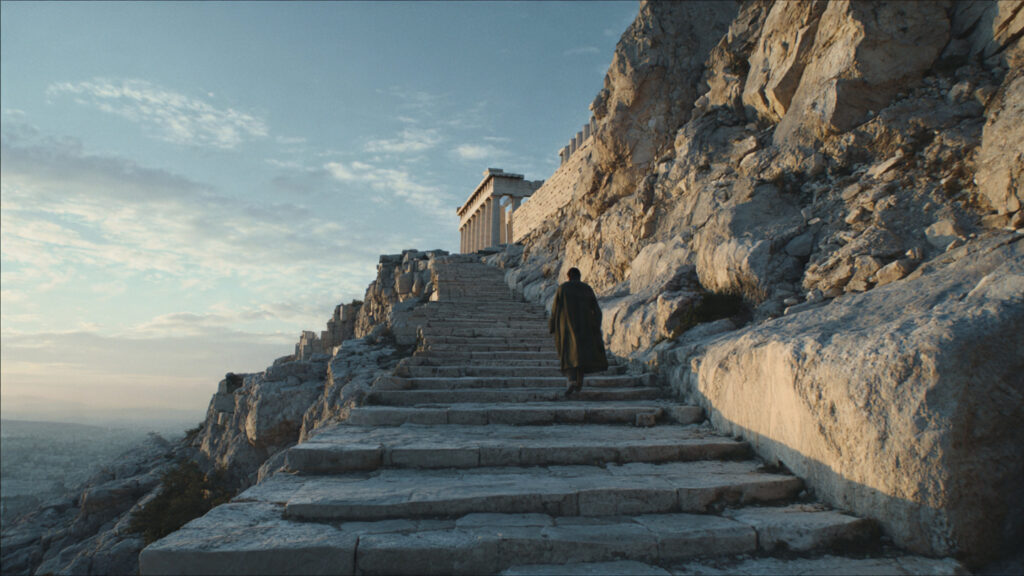
That is why Alcibiades’ speech is not an interruption to the philosophy. It is the test of it. Diotima described the ascent. Alcibiades shows what it feels like to stand at the bottom of the ladder while knowing that the summit exists.
The Shared Cup and the Discipline of Conversation
The drinking party itself now looks different in hindsight. A symposium was never simply a place where Greeks became drunk together. It was an institution with its own etiquette, vessels, rituals, entertainment, hierarchy, and rules concerning drink. Wine was ordinarily mixed with water in a krater, and the evening could involve libations, music, games, performance, and conversation. The Symposium uses that familiar social world but changes its center of gravity. The men are drinking, but they decide not to drink heavily. They have music available, but they dismiss the flute girl. They have every reason to turn the evening into entertainment, but instead they choose speeches. The result is an unusual kind of symposium in which conversation becomes the principal form of intoxication.
The shared cup remains present in the background. The wine connects the guests physically to the same vessel, but the speeches connect them intellectually to the same question. What is Eros? Each speaker answers differently because each speaker understands the world differently. That is one of Plato’s great literary achievements. He does not make philosophy happen outside ordinary life. He puts philosophy inside a room full of personalities, rivalries, vanity, attraction, exhaustion, jokes, wine, memory, and interruption. The argument becomes convincing because the people arguing are never merely arguments.
Dawn
The evening does not end with a neat philosophical conclusion. Alcibiades’ arrival changes the atmosphere, but the party continues, and eventually the others fall asleep. Socrates remains awake with Agathon and Aristophanes, attempting to persuade them that the same person should be capable of writing both comedy and tragedy. Eventually they too fall asleep. Socrates rises, leaves the house, walks to the Lyceum, bathes, and spends the rest of the day exactly as he always does, before going home in the evening to rest. That ending is almost brutally understated. After hundreds of pages of argument about beauty, desire, immortality, virtue, and the structure of the soul, Socrates simply goes on living. This is important because Plato does not allow philosophy to remain a spectacular performance. The conversation ends, but the philosophical life does not. Socrates returns to the ordinary rhythm of the city and continues doing what Socrates does. The symposium was temporary. The question was not.
What Plato’s Night Is Really About
It is tempting to read the Symposium as a book about romantic love. It is certainly about love, but Plato is asking a more difficult question. What happens when desire is taken seriously? Desire can begin with a beautiful body. It can become attachment to a beautiful soul. It can become admiration for laws, practices, knowledge, art, wisdom, or the intellectual order of reality. It can become the desire to create something that survives us. But desire can also remain possessive. It can turn another person into an object. It can confuse beauty with ownership. It can recognize excellence and still refuse to imitate it.
That is why the sequence of speeches matters so much. Plato does not simply give the reader competing definitions of love. He gives different levels at which human beings experience desire. Phaedrus sees courage. Pausanias sees moral discrimination. Eryximachus sees harmony. Aristophanes sees lost wholeness. Agathon sees beauty. Diotima sees an ascent beyond individual beautiful things. Alcibiades sees Socrates. And Socrates sees something beyond all of them. The progression is not a straight line toward an easy answer. It is a widening of the question.
Athens After the Wine
The physical evening is over, but Plato refuses to let it disappear, and that is perhaps the most extraordinary thing about the dialogue. The wine is gone. The lamps are gone. The guests are dead. The house has disappeared. Agathon’s victory has become a distant event in the history of Athenian tragedy. Alcibiades’ political career ended in catastrophe. Socrates himself was eventually executed. Aristophanes’ plays survived only in fragments and manuscripts. Yet the conversation remains. To read the Symposium is to enter a room whose original occupants have been absent for more than two thousand years, and to discover that the question they chose to discuss has not become obsolete.

What do we really want when we say that we love someone? Do we want possession, companionship, recognition, beauty, completion, virtue, immortality, or something that lies beyond all of these? Plato never lets the reader settle comfortably on one answer. That is why the shared cup still matters. A symposium was designed to bring people together around wine, and Plato transformed it into something harder to escape, a vessel for competing visions of human desire that he carried from the body to the soul, from the soul to knowledge, and from knowledge toward Beauty itself. And just when the argument threatens to become too perfect, Alcibiades breaks through the door drunk, reminding the reader that philosophy must eventually return to the human being who is trying, failing, desiring, resisting, and beginning again. The night ends. The ascent does not.
At Olympus Estate, Cultural Chronicles explores the philosophy, ritual, and intellectual life that shaped the Greek world. Plato’s Symposium remains one of antiquity’s most remarkable attempts to turn an ordinary social institution into a philosophical drama, its layered narration reminding the reader that even Plato’s Athens is remembered rather than simply recorded. Set at a celebration of Agathon’s dramatic victory, the dialogue moves through competing accounts of Eros from Phaedrus, Pausanias, Eryximachus, Aristophanes, Agathon, Socrates through Diotima, and finally Alcibiades, in a movement from desire for a particular beautiful thing toward the possibility of Beauty itself. Its deepest lesson is more human than abstract, since Alcibiades arrives to show what happens when a person can recognize excellence without yet possessing the strength to follow it, the same tension between recognition and transformation that runs through the sacred rituals of Ancient Greek dining this collection explores elsewhere. The wine is eventually finished, the guests fall asleep, and Socrates walks out into another Athenian day. The conversation remains.